Introduction
This multiple case study is focused on metacognition, a complex concept that refers to the ‘knowledge about knowledge’ that learners can develop during the process of acquiring new information. To be more precise, we can refer to Kuhn's definition of this concept: Metacognition concerns ‘cognition that reflects on, monitors or regulates first order cognition’ (Kuhn, Reference KUHN2000, p. 178). Metacognition can be divided into metacognitive knowledge (knowledge about declarative knowledge) and metacognitive control (or metastrategic knowledge, that is, knowledge about strategies and their effective uses) (Kuhn, Reference KUHN2000). All these metacognitive aspects play important roles in music learning and practice. Metacognition allows performers and music students to understand the task demands of a musical piece (metacognitive knowledge), identify potentially difficult passages (metacognitive control), select appropriate cognitive and physical strategies (metastrategic knowledge) that work best for them (metacognitive knowledge about themselves as musicians), and decide how to effectively structure learning/practice/performance in relation to such factors (metacognitive control). Students and performers also monitor and regulate the real effectiveness of their chosen strategies (metacognitive monitoring). These phases of the metacognitive process are well summarized in the model proposed by Fogarty (Reference FOGARTY1994). He suggests that metacognition can be divided into three phases. The first one concerns planning, and this is where an individual develops a plan before approaching a learning or a teaching task. For example, in this phase, a person may ask questions like: ‘What prior knowledge will help me (or the student) with this task? What should I (or the student) do first? In what direction do I want my thinking to take me (or the student)?’ This planning phase is followed by a monitoring phase, closely linked to metacognitive control, where individuals monitor their understanding and their progresses and use ‘fix-up’ strategies as needed. The final phase is an evaluation phase: During this phase individuals evaluate their thinking process and their performance. In case of the teachers, the evaluation can be both self-directed (to evaluate the effectiveness of their teaching) or directed to the students, to support their learning process.
Historically, starting with the work of Flavell in the 1970s (e.g., Flavell, Reference FLAVELL1971), metacognition was studied in relation to memory and was operationalized as metamemory. Even if metamemory itself was found to be highly influential in promoting different types of knowledge – such as strategic thinking, monitoring, self-efficacy, and knowledge about emotional states (Hertzog, Reference HERTZOG, Herrmann, Weingartner, Searleman and McEvoy1992) – nowadays metacognition is studied in many more contexts linked not only to memory itself but, more generally, to reasoning (Kuhn, Reference KUHN2000), problem solving (Antonietti, Ignazi & Perego, Reference ANTONIETTI, IGNAZI and PEREGO2000), and decision making (Colombo, Iannello & Antonietti, Reference COLOMBO, IANNELLO, ANTONIETTI, Efklides and Misailidi2010). Metacognition is also studied in relation to learning, including learning that is supported by technological tools (Antonietti, Colombo & Lozotsev, Reference ANTONIETTI, COLOMBO and LOZOTSEV2008). A good example of a topic that requires all these skills is learning music, on which this study is focused.
Metacognition appears to be a key factor for musicians, since the use of metacognitive strategies (e.g., planning, monitoring, and evaluation) during practice improves the performance of both novices and experts (Hallam, Reference HALLAM2001). Musicians spontaneously use strategies that enhance their performance (Antonietti, Cocomazzi & Iannello, Reference ANTONIETTI, COCOMAZZI and IANNELLO2009), so they appear to be able to self-regulate their own behaviour. How and when do musicians acquire these metacognitive skills? We know that metacognition can be fostered by teachers (Brown, Reference BROWN1997), so we can assume that musicians acquired these skills during their training. As Brown (Reference BROWN1997) claimed, reflective processes (at both levels: knowledge and control) can be internalized and become more effective with an appropriate metacognitive guide by teachers or experts. This point suggests that students with higher expertise should show a higher level of metacognition. This multiple case study aims at exploring this idea with specific reference to music training.
This topic is particularly relevant because, if music teachers report using metacognitive strategies related to students’ learning and prompting students to use the same strategies during their lessons, there is no explanation for why music students complain of the lack of these strategies in their training (Bathgate, Sims-Knight & Schunn, Reference BATHGATE, SIMS-KNIGHT and SCHUNN2012). It is not clear if this gap is due to a lack of awareness (in the sense that learners are trained according to a metacognitive approach, but they fail to realise it) or if metacognition is acquired by music students while they are working alone on their practice. We intend to explore these possibilities.
Literature provides some interesting starting points. Considering classical studies on metacognition, we see that the role of an adult/teacher/expert is highlighted as fundamental for fostering a more adequate use of metacognition. This has been recognized, for example, by Brown (Reference BROWN1997) in her model for improving metacognition within a learning community. Teachers and experts act as key figures providing learners with role models for thinking and adequate use of reflective strategies. More experienced teachers can improve their effectiveness as a role model by critically introducing new ideas and principles, explicitly modelling self-thinking, and suggesting ad hoc reflections.
Studies specifically focused on teaching metacognition to music students (e.g., Hallam, Reference HALLAM2001; Bathgate, Sims-Knight & Schunn, Reference BATHGATE, SIMS-KNIGHT and SCHUNN2012; Burwel & Shipton, Reference BURWEL and SHIPTON2013) supported Brown's position, showing the efficacy of the metacognitive teaching programs. Yet, most of them are lacking in ecological validity, since the learning situation is artificial. Teachers were usually asked to use metacognitive programs developed by the researchers. Such investigations provided evidence of the general efficacy of metacognition, but they cannot answer the question of how music students acquire metacognition in ‘real life’. Moreover, self-reported strategies are employed to assess metacognition: These measures rely on a high level of verbal understanding that may not always be present (Veenman, Reference VEENMAN, Artelt and Moschner2005), especially in music students, since music is a discipline where many strategies can be coded using mental images without the support of verbal code (as demonstrated by the efficacy of mental practice techniques in piano players: Bernardi et al., Reference BERNARDI, SCHORIES, JABUSH, COLOMBO and ALTENMUELLER2013). These methodological limits may reduce the generalizability of the findings and also account for the discrepancies between teachers’ beliefs (according to which they follow a metacognitive approach) and students’ opposite beliefs (namely, that they have to learn metacognitive practices alone starting from their individual experiences) as reported by Bathgate, Sims-Knight and Schunn (Reference BATHGATE, SIMS-KNIGHT and SCHUNN2012).
In order to avoid these problems and investigate metacognition in music teaching more accurately, an important point is to find a proper way to operationalize and analyse metacognition in such a context. In this study we decided to refer to Whitebread et al.’s (Reference WHITEBREAD, COLTMAN, PASTERNAK, SANGSTER, GRAU, BINGHAM and DEMETRIOU2009) model. In their study, the authors, building a model on existing literature, investigated three dimensions of metacognition: (i) metacognitive knowledge, (ii) metacognitive monitoring and control (declined into planning behaviours, monitoring the ongoing outcomes, and evaluating the partial and final outcomes of the applied behaviours), and (iii) monitoring and control of emotions and motivation during a learning task. We decided to focus mainly on the teacher's metacognition, since this allows us to study, in addition to metacognition itself, ‘other regulation’. ‘Other regulation’ refers to a situation where, within an interaction linked to a learning task, one person masters one or more key elements of the task, while another does not (Iiskala, Vauras & Lehtinen, Reference IISKALA, VAURAS and LEHTINEN2004): When the first actor uses his/her expertise to regulate the other person's learning behaviour (as should happen in teacher-student interaction), we can observe other regulation. This information should help answer our research questions related to the teacher's role in music training to promote metacognitive skills in novice and advanced students.
What could be considered a proper method to investigate these aspects? We already argued that self-reported measures are not adequate. Thinking aloud would be inappropriate as well: It causes overload of working memory and leads to interference in performance (Garner, Reference GARNER, Weinstein, Goetz and Alexander1988; Thorpe & Satterly, Reference THORPE and SATTERLY1990). We can assume that this would be especially true for piano practice, where working memory is already loaded by reading music, coordinating right and left hand actions, keeping the rhythm, and applying specific execution techniques. Observational methods appear to be a better choice because they do not rely on participants’ verbal abilities (Winne & Perry, Reference WINNE, PERRY, Pintrich, Boekaerts and Zeidner2000) and they allow researchers to record and then analyse what people (teachers and students) do, and not what they believe they do. Observation has been used extensively over the past decades to study teacher and pupil behavior in instrumental teaching, both in classroom and one-to-one contexts (for reviews see Rosenshine et al., Reference ROSENSHINE, FROEHLICH, FAKHOURI, Colwell and Richardson2002; Hallam, Reference HALLAM2006; Creech, Reference CREECH2012).
Starting from these assumptions, the present multiple case observational study, using an ecological setting, tries to understand if teachers do use metacognitive strategies to promote learning in their everyday teaching practice and if students respond to metacognitive prompts while learning. We are also interested in understanding what kind of metacognitive strategies an experienced teacher uses while teaching, and if he differentiates between novice and expert students.
Method
Design
An experienced piano teacher taught four lessons to four different adult students, balanced by gender, expertise, and length of time that they have been attending piano lessons.
Each lesson took place in the same room, at approximately the same time of day and had the same length and structure:
-
(1) introduction/greetings;
-
(2) presentation of the learning task: Beginners had the same learning task (learning the C major scale) and advanced students had the same learning task (learning improvisation jazz/blues techniques on the piano);
-
(3) focus on learning;
-
(4) end of the lesson/greetings.
A pilot lesson was scheduled and video recorded, both to test the procedure and to have material helpful to better define the coding scheme. Details about the pilot lessons and the use of these specific data are reported in the ‘Coding’ section.
Participants
The piano teacher who volunteered to join the experiment had more than 20 years of teaching experience.
The four students who volunteered were divided into:
-
• ‘Beginners’ (BS1 and BS2) were 2 students (1 man and 1 woman, balance by age, with one older and one younger student) who attended just one introductory piano lesson before the experimental one;
-
• ‘Advanced’ (AS1 and AS2) were 2 students (1 man and 1 woman, balance by age, with one older and one younger student) who had both been studying piano with a private teacher, once a week for 10 years.
We decided to balance the sample according to gender and age in order to be able to exclude their role as possible confounding variables.
Materials/Apparatus
Lessons took place in a room equipped with a table, two chairs, and an electronic keyboard with weighted keys. In front of the keyboard the teacher arranged a blackboard on which he wrote the C major scale for beginners’ lesson and different chords/progressions for advanced students.
The video camera used to record the lessons was placed in a hidden corner of the room in order to not disturb participants. Since the lessons had to have the same duration, a timer was located in a place where the teacher could easily see it and arrange the timing accordingly.
Procedure
Before starting the sessions the researcher met with the teacher and explained to him that the study was aimed at investigating teaching strategies in music lessons. She explained to him that his role would be to teach four lessons using the same approach he normally uses. She gave him a consent form to read and sign.
Two suitable topics for the lessons (one for beginner and one for advanced students) were chosen with the support of the teacher.
A pilot lesson was planned, performed, and recorded in order to enable researchers to test the efficacy of the lesson timing and of the coding (see below for details about how we used this recording to debug the coding). We selected a participant that was similar in expertise to one of our experimental students: He was an adult beginner piano student. He attended a lesson with the same teacher of the experimental lessons. The lesson's topic was the same as that presented to the beginner students in the experimental group and the timing and the apparatus of the lesson were scheduled in order to exactly mirror the experimental ones. After the first pilot recording, during which no problem emerged, the four experimental lessons were scheduled.
After reading and signing the informed consent form, students were asked to join the lesson. The researcher gave them written instructions explaining the general aim of the research and stressing that they would just have to attend the lesson as any other normal lesson. Each lesson lasted 30 minutes.
Lessons were video recorded. Participants knew that they were video recorded (information about this point was included in the informed consent).
After the lesson, the researcher asked each student if she/he had any questions and thanked her/him for her/his collaboration.
Coding
Recorded lessons were integrally transcribed (taking away any reference to students’ and teachers’ real names in order to protect their privacy) and coded by two independent judges. Inter-rater reliability was calculated to be 89%.
The complete transcripts with coding are reported in the Appendix.
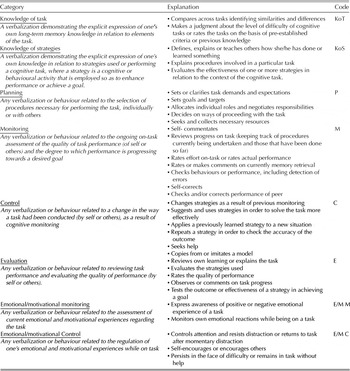
Coding categories were derived from Whitebread et al.’s (Reference WHITEBREAD, COLTMAN, PASTERNAK, SANGSTER, GRAU, BINGHAM and DEMETRIOU2009) observational procedure. We used the pilot lesson mentioned above to test the adequacy of categories for our specific data, to be sure that, even if Whitebread and colleagues already used and validated them in their study, they were still descriptive of metacognitive behaviours, mutually exclusive, and internally homogeneous when applied to our data.
After this pilot coding, we decided not to apply the ‘Knowledge of persons’ category (within the more general ‘Metacognitive Knowledge’ category), used in Whitebread et al.’s study, because it was never used by the teacher or the students.
We kept the other two sub-categories referring to Metacognitive Knowledge (Knowledge of Task – KoT, and Knowledge of Strategies – KoS), all the subcategories for Metacognitive Regulation (Planning – P, Monitoring – M, Control – C, Evaluation – E) and the two categories used to code Emotional and Motivational Regulation (Emotional/Motivational Monitoring – E/M M, and Emotional/Motivational Control – E/M C). A detailed description of each sub-category is reported in Table 1.
Coding scheme with explanation–derived from Whitebread et al. (Reference WHITEBREAD, COLTMAN, PASTERNAK, SANGSTER, GRAU, BINGHAM and DEMETRIOU2009).

Results
We will first present data from each single student individually. We will focus both on the teacher's use of metacognitive strategies while teaching and on the student's response to them during his/her learning experience.
Beginner student 1
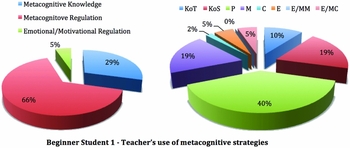
We started by considering the teacher's metacognitive behaviour while teaching to the first beginner student. Examining the transcript of the lesson with the first beginner student, we can notice the teacher focused mostly on metacognitive regulation and on metacognitive knowledge while teaching. The use of Emotional/Motivational regulation strategies was not frequent. More differences emerged considering the specific subcategories (Figure 1). While working with this beginner student, the teacher used metacognitive regulation mainly to focus on planning and monitoring the student's understanding of the task and less time was devoted to evaluation. The teacher also constantly checked with the student by the way of using metacognitive prompts focused on the knowledge of the task. Periodically he also encouraged the student by the way of using emotional/motivational control.
Beginner student 1-teacher's use of metacognitive strategies.

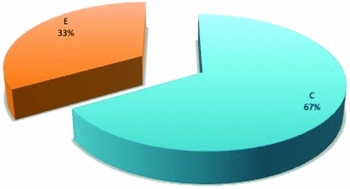
The way the first beginner student used metacognitive strategies while learning was mainly as control strategies (Figure 2). Most of the times he answered to the teacher's metacognitive prompt adopting a control strategy to check on his/her own learning.
Beginner student 1-student's use of metacognitive strategies.

Beginner student 2
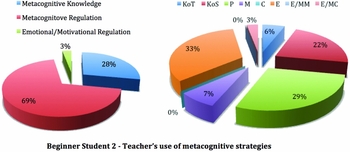
Moving to the second beginner student, we can notice how the overall uses of metacognitive categories stay the same (see Figure 3). Focusing on subcategories, we notice that the teacher appeared to behave differently when interacting with this student who, incidentally, was older. The teacher has been constantly using planning during the lesson, as he did with the first beginner student, but this time the use of evaluation was as high as it will be with the advanced students. Looking at the transcript, we can notice that, during the first part of the class, the use of metacognitive strategies follows trend similar to the other beginner class. In the second half, mainly in response to the student's metacognitive control prompts (see Figure 4), the teacher starts using evaluation strategies more often. Similarly to what he has been doing when teaching to the other beginner student, the teacher tends to use strategies that check the knowledge of the task more frequently. The use of emotional/motivational strategies is almost absent, possibly because, as it emerges clearly from the transcript, the student was extremely motivated.
Beginner student 1-teacher's use of metacognitive strategies.

Beginner student 1-student's use of metacognitive strategies.

As noted above, the student was prompt in answering to the teacher's metacognitive communication by the way of using quite frequently metacognitive control strategies (see Figure 8).
Advanced student 1
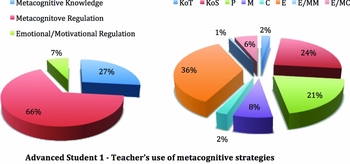
Frequencies of use of the different metacognitive activities are reported in Figure 5. As happened while teaching to beginner students, the teacher focused mostly on metacognitive regulation and on metacognitive knowledge while teaching. The use of Emotional/Motivational regulation strategies was not frequent.
Advanced student 1-teacher's use of metacognitive strategies.

Exploring more in details the subcategories (Figure 5), we can highlight some differences. Within the category of metacognitive regulation, the teacher spent most time using evaluation strategies. These are useful, while teaching, to promote a metacognitive attitude in the learner, since they are aimed at reviewing task performance and evaluating the quality of performance (Table 1). The teacher also used planning strategies quite often to support his teaching. This approach appears to be useful in supporting a metacognitive attitude during a class, since it makes explicit task demands and expectations, sets goals and targets clearly, and, especially working with advanced students, fosters a decision-making process on ways of proceeding with the task and supports seeking and collecting necessary resources. The teacher supported the use of these strategies by periodically monitoring the teaching process (6 per cent of the strategies). Metacognitive knowledge was fostered during the class and the teacher especially focused on knowledge of strategies. This can be helpful to support the student while performing a required task (e.g., improvising in a specific key), but also fosters the use of adequate strategies during independent home practice. As noted above, the teacher did not used emotional/motivational strategies very often, and used monitoring and control to the same extent.
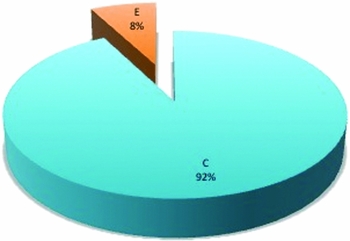
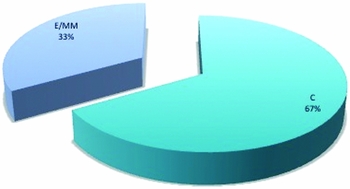
The student was mainly focused on following the teacher's directions and applied them playing the piano. Yet, it was possible to highlight the occurrence of metacognitive behaviours (Figure 6). Most of the student's strategies, as happened with beginners’ students, were control strategies: They were mostly used in response to the teacher's planning strategies, highlighting a good response to the teacher's metacognitive demands.
Advanced student 1-student's use of metacognitive strategies.

Advanced student 2
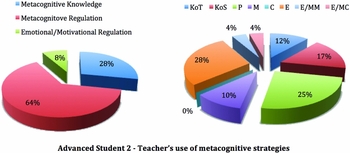
When analysing the metacognitive behaviours the teacher adopted while interacting with the second advanced student, a similar pattern to the one found in the previous transcripts could be highlighted (Figure 7). If the main categories of strategies (metacognitive regulation, metacognitive knowledge, and emotional/motivational regulation) were used to a very similar extent, the analysis of subcategories allowed highlighting some differences. The teacher spent more time using evaluation strategies and slightly less planning. Looking at the transcript (see Appendix), we can see that this advanced student was ready to act on the teacher's suggestion, hence the evaluation of her performance was useful, while planning would have been sometime redundant. Yet, the teacher kept using planning and monitor strategies, possibly to foster the use of the same metacognitive process later during independent learning. With this student the teacher also focused equally on the knowledge of the task and knowledge of strategies. Examining the transcript, we can see that strategies linked to the knowledge of the task were mainly directed at the student, checking her specific knowledge. Regarding emotional/motivational strategies, the teacher did not use them a lot either, but showed a clear preference for the emotional/motivational control over the monitoring. These emotional/motivation strategies were used especially during the second part of the lesson and were aimed at checking the student's motivation and interest.
Advanced student 2-teacher's use of metacognitive strategies.

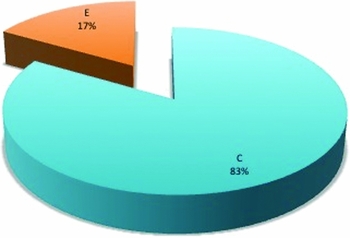
Once again the student was more focused on playing than on verbalizing metacognitive strategies. Yet, some metacognitive behaviour emerged (Figure 8). The student tended to use control strategies to be sure she was executing what the teacher suggested the right way. She also responded to the teacher's emotional/motivational control by using emotional/motivational monitoring herself.
Advanced student 2-student's use of metacognitive strategies.

Overall Evaluation of the Lessons
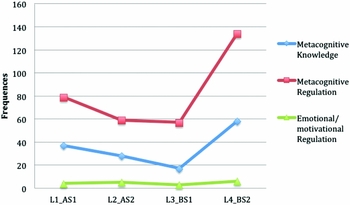
A first general question that this study tried to answer was whether the teacher did use any metacognitive strategies during his lessons and, if so, which ones. Analysis of the four lessons showed that the teacher has been constantly using metacognitive strategies while teaching. Analysing the four cases under exam, it was possible to clearly highlight that the teacher has been constantly using mainly regulation strategies. Emotional/motivational regulation strategies were the least used (Figure 9).
Teacher's use of metacognitive strategies (general categories) during the four lessons.

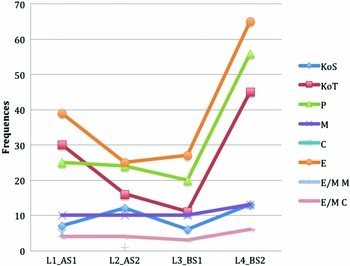
To have a more precise report of the strategies used and to see if, within the general categories, specific sub-categories had been used more than others, we considered, for each single case, the occurrences of the different sub-categories. A summary of the results discussed in the previous paragraphs is reported in Figure 10. We can see that, within regulation strategies, the teacher used evaluation and planning most often, while monitoring and control strategies were seldom used. Within the metacognitive knowledge category, the teacher referred especially to knowledge of the task. Emotional/motivational monitoring was used, even if not often, while Emotional/motivational control was almost never used.
Teacher's use of metacognitive strategies (subcategories) during the four lessons.

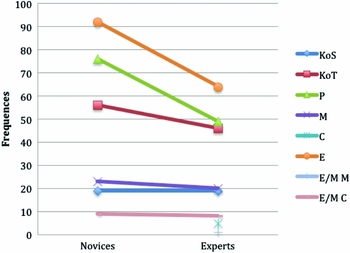
Yet, while examining the single cases, we were able to highlight some differences in the teacher's use of metacognitive strategies when teaching novices and experts. A summary of the results is reported in Figure 11. The teacher used more planning strategies when he was working with novices: He started used evaluation with the second novice as a direct response to the student's response to his use of the planning strategies. He also referred more often to the knowledge of the task while working with beginners. Evaluation was constantly present in every part of the class when teaching to advanced students.
Teacher's use of metacognitive strategies (subcategories) with novices vs. experts.

Literature suggests that music students do not recognize metacognitive practices in their music teachers. To understand if this perception may be related to students’ behaviours, we focused on students’ metacognitive behaviours. They were not so frequent (students mostly played the piano or listened to the teacher), but some differences emerged, as reported in Figure 12. Students mainly used Control strategies. The older students used control strategies four times more than the younger ones did. Moreover, the older students were the only ones who used evaluation strategies, even if they did so sparingly.
Older vs. younger students’ use of metacognitive strategies.

Discussion and Conclusions
This multiple case study focused on the role of metacognition in teaching music. Literature supports the relevant role of metacognition in reinforcing the teaching/learning process and also stresses the importance of metacognitive skills for musicians, both expert and novice (Hallam, Reference HALLAM2001). Yet it is not clear how metacognitive skills are acquired by musicians, since teachers state that they use them during their lessons, but students complain of a lack of them and report that they learn them during their own practice (Bathgate, Sims-Knight & Schunn, Reference BATHGATE, SIMS-KNIGHT and SCHUNN2012).
There are two main reasons for these contradictory results. The first is a simple lack of awareness on the part of either students or teachers, which leads to a misconception of the real use (or lack of use) of metacognitive strategies during music lessons. A second reason is methodological and is linked to the use of self-reported measures in previous studies. These measures, as discussed in the Introduction, rely on a high level of verbal understanding that may not always be present (Veenman, Reference VEENMAN, Artelt and Moschner2005), especially in music students. Moreover, in previous studies, metacognition was assessed in artificial settings, where teachers were asked to adopt a metacognitive program developed by researchers. Thus data could not provide any information about the real use of metacognition in everyday teaching practice. We tried to address these problems by exploring the spontaneous use of metacognitive strategies during four music lessons adopting observational methods. Differences between novices and experts had been taken into account.
As a first step, we investigated the use of metacognitive strategies during the spontaneous teaching practice. Data highlighted a strong and constant use of different metacognitive strategies, supporting teachers’ beliefs that they are using metacognitive strategies while teaching. Yet, whereas teachers report using metacognition explicitly to teach specific music-related techniques (Jorgensen, 2000, cited in Bathgate, Sims-Knight & Schunn, Reference BATHGATE, SIMS-KNIGHT and SCHUNN2012), in this study the teacher used mostly Regulation strategies (namely Evaluation and Planning) and then referred quite often to the Knowledge of the Task, but seldom used Knowledge of Strategies. This finding can partially explain the discordance between teachers’ and students’ beliefs. We can hypothesise that students may have read the teacher's statement linked to the performance or to the planning of a specific aspect of the lesson as referring only to the specific setting of the lesson. This would prevent them from generalising these indications to their daily practice. This could also be reinforced by the fact that monitoring strategies were rarely used by the teacher. Encouraging music teachers to use more open monitoring strategies while teaching could be a first operative suggestion: This metacognitive behaviour could enhance students’ regulation within the music lesson setting, helping the students to recognise and transfer metacognitive strategies used by the teacher to their own learning and everyday practice.
Bathgate, Sims-Knight and Schunn (Reference BATHGATE, SIMS-KNIGHT and SCHUNN2012), in commenting on their data, hypothesised that teachers are probably aware of students’ characteristics and modify their teaching behaviour accordingly, but students tend not to perceive these changes, and consequently do not apply any transfer from the specific setting of the lesson to any other setting when they have to self-monitor their learning. Therefore they do not apply these elements to their own practice. Our data also seem to support this idea, since we highlighted that the teacher did modify the use of metacognitive strategies according to students’ responses. He used more Planning strategies when teaching novice students, but applied Evaluation strategies in response to specific metacognitive prompt derived from beginner students. We would have expected higher monitoring levels when addressing novice students, but the use of these strategies did not differ among the four cases. This could explain why novice music students are often found to be unaware of their errors (Hallam, Reference HALLAM2001; Tobias & Everson, Reference TOBIAS and EVERSON2002). So, a second practical implication we can derive from this data and use to enhance metacognitive music teaching is related to students’ expertise. Monitoring appears to be a key element again: Using it more, especially with beginners, would probably help these students become more metacognitively aware of their mistakes and more likely to try to actively correct them both during lessons and practice.
Since differences between novices and experts were not so sharp, we also explored the possibility that differences were driven not by students’ music expertise, but by students’ age. As we saw in the Introduction, students tend to ascribe the development of their metacognitive skills to their personal cognitive development, rather than to the influence of their music teachers. If this is true, older students should be more metacognitively competent even as beginners, and this could prompt greater use of metacognitive skills from the teacher. Even if it is obviously hard to generalise any data collected from a multiple case study, our findings seem to support this hypothesis since differences existed in the teacher's use of metacognitive strategies with students in different age cohorts, and these differences seemed to be led by students’ metacognitive learning behaviours during class. This suggests a third practical indication for teachers. When working with older students they can rely on the students’ metacognitive skills, whereas they should spend more time fostering metacognition per se when working with younger students. One possibility, in order to have a more metacognitively centred teaching approach, could be introducing a ‘metacognitive corner’ at the end of the lessons. In this very last part of the lesson the teacher could explicitly reflect with the student on the lesson, prompting him/her to become more aware of the strategies used, of the possible mistakes, and suggesting openly how to apply this metacognitive knowledge to everyday practice.
Considering globally what emerged from this study, teachers use metacognitive strategies during their everyday teaching practice, but students are probably not aware of this because they tend not to use metacognitive strategies, do not respond/reciprocate metacognitive prompts used by the teacher, and focus only on monitoring their behaviours. In addition teachers are able to differentiate between expert and novice students.
As a direct implication for music education, this study suggests that, even if experienced teachers frequently use metacognitive strategies in their teaching, the efficacy of these strategies should be enhanced and the use of the same metacognitive skills in the students’ practice should be promoted. Such goals might be achieved through training programs addressing teachers’ awareness so as to prompt them to integrate their usual method with monitoring strategies and to focus explicitly on strategies (KoS), not solely on the task (KoT). Bathgate, Sims-Knight and Schunn (Reference BATHGATE, SIMS-KNIGHT and SCHUNN2012) reported that students’ self-efficacy did not increase following metacognitive teaching. Our data can help to explain this finding. Apart from the specific practical indications provided above, we also noticed that the teacher we observed almost never used emotional/motivational regulation strategies during the four lessons, whereas these could be the key element to modifying students’ self-efficacy.
The present multiple case study, even if it allowed us to highlight interesting aspects, has several limitations that can be read as possible hints for future researchers. First of all, we focused on only one teacher and thus we cannot generalise our findings to all music teachers, because some behaviours we observed may be due to his personal habits. Analysing teaching habits of more teachers is a necessary step to confirm the present data. The sample of students was not large, especially if the aim would be to compare novices and experts and younger and older students. Even if this sample is coherent with the specific type of study and the amount of data analysed is noticeable (we analysed the full transcripts of the four lessons), obviously the characteristics of individual students could have affected our data. Collecting data from a larger sample is needed. As a last point, by adopting a between-subjects design we analysed only one lesson for each student. Following a student for a few lessons could help investigators to highlight a more sophisticated model of the use of metacognitive strategies both by teachers and students.
Yet, even with this limitation, these findings allow us to derive direct implications for music teaching. From these implications we were able to provide specific practical hints, useful to improve music teaching and learning, enhancing both teachers’ metacognitive behaviour while teaching and students’ metacognitive awareness during their learning experience.
Supplementary material
To view supplementary material for this article, please visit http://dx.doi.org/10.1017/S0265051716000267