



1 Introduction
Suppose a groupoid
$\mathcal {H}$
 acts on the right of a topological space X, meaning that we have a continuous surjection
 (the anchor map of the action) and a continuous map

Let us further assume that X and
$\mathcal {H}$
 are locally compact Hausdorff, that the action is free and proper (i.e., X is a principal (right)
$\mathcal {H}$
 -space; [Reference Muhly, Renault and Williams21, p. 6]), and that the anchor map
$\sigma $
 is an open map. Out of X, we can build a left
$\mathcal {H}$
 -space
$X^{\mathrm {op}}$
 as follows: as a topological space, it is just X, but we write its elements with a superscript-op to avoid confusion. Its left action uses the anchor map
$\sigma ^{\mathrm {op}}\colon x^{\mathrm {op}} \mapsto \sigma (x)$
 , and the action is given by
 for any h with
$s_{\mathcal {H}}(h)=\sigma ^{\mathrm {op}}(x^{\mathrm {op}})$
 . Whenever
$\sigma ^{\mathrm {op}}$
 appears in a subscript, we will drop its superscript and simply write
$\sigma $
 . Now consider

With the subspace topology of the product topology,  is locally compact Hausdorff. For any given
 , consider the orbit

of
$(x,y^{\mathrm {op}})$
 under the “diagonal”
$\mathcal {H}$
 -action on
 . Since
$\mathcal {H}$
 is assumed to have open source map and to act properly on X, it follows that the quotient
$X\times _{\mathcal {H}} X^{\mathrm {op}}$
 by this equivalence relation is also a locally compact Hausdorff space [Reference Williams28, Proposition 2.18], and likewise is the quotient
$X/\mathcal {H}$
 .
We equip
$X\times _{\mathcal {H}} X^{\mathrm {op}}$
 with the structure of a groupoid with unit space
$X/\mathcal {H}$
 : its source and range maps are given by

and we can identify
$[y,y^{\mathrm {op}}]$
 with
 . Given
$\xi ,\eta \in X\times _{\mathcal {H}} X^{\mathrm {op}}$
 with
$s(\xi )=r(\eta )$
 , we can find representatives
$(x,y^{\mathrm {op}})$
 and
$(y, z^{\mathrm {op}})$
 of
$\xi $
 respectively
$\eta $
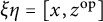
 with matching component “in the middle”, and then define their product by
$\xi \eta = [x,z^{\mathrm {op}}]$
 .
The groupoid
$X\times _{\mathcal {H}} X^{\mathrm {op}}$
 acts on the left of X: we define the anchor map

Note that
$\rho $
 is open [Reference Williams28, Proposition 2.12] and continuous. If
 , then
$s(\xi )=\rho (y)$
 implies that there exists
$x\in X$
 such that
$\xi =[x,y^{\mathrm {op}}]$
 ; this x is unique by freeness of the
$\mathcal {H}$
 -action on X. We can therefore define
 , i.e.,

Remark 1.1 Suppose X is a
$(\mathcal {G},\mathcal {H})$
 -groupoid equivalence (see [Reference Muhly, Renault and Williams21]) with anchor maps
 and
 ; these maps are open by definition. If
$\sigma (x)=\sigma (y)$
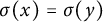 , then there exists a unique element
 in
$\mathcal {G}$
 such that
 . Indeed, since
$\sigma $
 is assumed to induce a homeomorphism
 , the equality
$\sigma (x)=\sigma (y)$
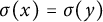 means exactly that
 , and so freeness of the
$\mathcal {G}$
 -action implies the existence of the unique
 which transforms y into x. Since the action is proper and
$\rho $
 is open, the surjective map
 is continuous and open, and it factors through the quotient
$X\times _{\mathcal {H}} X$
 of
 by the diagonal
$\mathcal {H}$
 -action, yielding a homeomorphism
$X\times _{\mathcal {H}} X^{\mathrm {op}}\cong \mathcal {G}$
 . In fact, equipping
$X\times _{\mathcal {H}} X^{\mathrm {op}}$
 with the groupoid structure described above, this map is an isomorphism of topological groupoids.
Likewise, if
$\rho (x)=\rho (y)$
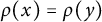 , we write
 for the unique element of
$\mathcal {H}$
 such that
 , and
 induces an isomorphism
$X^{\mathrm {op}}\times _{\mathcal {G}} X\cong \mathcal {H}$
 of topological groupoids. A quick computation shows that the following equalities hold (wherever one side of the equation makes sense):


Example 1.2 Any groupoid
$\mathcal {H}$
 acts freely and properly on
$X=\mathcal {H}$
 ; say, on the right. The anchor map is then given by
 , and the associated imprimitivity groupoid
$\mathcal {G}=\mathcal {H}\times _{\mathcal {H}} \mathcal {H}^{\mathrm {op}}$
 is isomorphic to
$\mathcal {H}$
 via
 . In particular, the map
 becomes the map
 . This isomorphism further turns the anchor map
 into the range map
 , and
 is therefore given by
 .
We arrive at a well-known result.
Lemma 1.3 (motivation; [Reference Williams28, Lemma 2.45, Proposition 2.47])
Suppose X is a principal
$\mathcal {H}$
 -space. Then
$X\times _{\mathcal {H}} X^{\mathrm {op}}$
 is a locally compact Hausdorff groupoid with open source map that acts freely and properly on the left of X with anchor map
$\rho \colon x\mapsto [x,x^{\mathrm {op}}]$
 . With this structure, X is a
$( X\times _{\mathcal {H}} X^{\mathrm {op}},\mathcal {H})$
 -equivalence of groupoids. Moreover, if X is also a
$(\mathcal {G},\mathcal {H})$
 -equivalence, then there exists an isomorphism
$X\times _{\mathcal {H}} X^{\mathrm {op}} \to \mathcal {G}$
 of topological groupoids that is uniquely determined by
 .
Note that the above in particular states that, in the setting where
$\mathcal {G}=X\times _{\mathcal {H}} X^{\mathrm {op}}$
 , the element
 of
$\mathcal {G}$
 for
$x,y\in Xu$
 is
$ [x,y^{\mathrm {op}}] $
 . A reason why one might be interested in groupoid equivalences is the following result due to works by Muhly, Renault, and Williams.
Lemma 1.4 ([Reference Williams30], [Reference Muhly, Renault and Williams21])
Suppose
$\mathcal {G},\mathcal {H}$
 are locally compact Hausdorff groupoids, that
 is a Haar system on
$\mathcal {H}$
 , and that there exists an equivalence X between
$\mathcal {G}$
 and
$\mathcal {H}$
 . Then
$\mathcal {G}$
 also allows a Haar system, and if say
 is any such Haar system, then the groupoid
$\mathrm {C}^{*}$
 -algebras
$\mathrm {C}^{*}_{r}(\mathcal {G},\mu )$
 and
$\mathrm {C}^{*}_{r}(\mathcal {H},\lambda )$
 are strongly Morita equivalent via an imprimitivity bimodule built as a completion of
$C_c(X)$
 .
An analogous theorem holds for the
$\mathrm {C}^{*}$
 -algebra of equivalent Fell bundles [Reference Muhly and Williams22]. Such results are powerful, for example because two strongly Morita equivalent
$\mathrm {C}^{*}$
 -algebras have the same representation theory,
$\operatorname {K}$
 -theory, and lattices of ideals (via the so-called “Rieffel Correspondence”). But not only do the above mentioned results state the existence of a strong Morita equivalence, they also construct it explicitly, which allows one to, for example, construct representatives of certain famous classes in
$\operatorname {KK}$
 -theory [Reference Duwenig and Emerson3].
There is a statement analogous to Lemma 1.3 for a right Hilbert
$\mathrm {C}^{*}$
 -module
$\mathbf {X}$
 over a
$\mathrm {C}^{*}$
 -algebra A. In the following, we use the symbol
 for
$\mathbf {x,y}\in \mathbf {X}$
 to denote the “A-rank-one” operator
$\mathbf {X}\to \mathbf {X}$
 that maps
$\mathbf {z}$
 to
 , and we let
$\mathbb {K}(\mathbf {X}_A)=\mathbb {K}_{A}(\mathbf {X})$
 denote the
$\mathrm {C}^{*}$
 -algebra generated by these operators; it is an ideal of the A-adjointable operators (see [Reference Raeburn and Williams24, Lemma 2.25]). We get that
$\mathbf {X}$
 has a left
$\mathbb {K}_{A}(\mathbf {X})$
 -inner product given byFootnote
1

With inner products such as these, we will drop the sub- and/or superscripts whenever there is no ambiguity. Furthermore, we let
$\mathbf {X}^{\mathrm {op}}$
 be the dual, left-Hilbert
$\mathrm {C}^{*}$
 -module as defined in [Reference Raeburn and Williams24, p. 49], meaning there exists an additive bijection
$F \colon \mathbf {X}\to \mathbf {X}^{\mathrm {op}} $
 such that
$F (\lambda \mathbf {x}) = \bar {\lambda }F (\mathbf {x})$
 for all
$\mathbf {x}\in \mathbf {X}$
 and
 . The analog of Lemma 1.4 can now be stated as:
Lemma 1.5 (motivation; [Reference Raeburn and Williams24, Propositions 2.21 and 3.8, Lemma 2.25])
Suppose
$\mathbf {X}$
 is a full right-Hilbert
$\mathrm {C}^{*}$
 -module over a
$\mathrm {C}^{*}$
 -algebra A. Then the set
$\mathbb {K}_{A}(\mathbf {X})$
 of A-compact operators on
$\mathbf {X}$
 is a
$\mathrm {C}^{*}$
 -algebra with respect to the operator norm, and
$\mathbf {X}$
 is a
$(\mathbb {K}_{A}(\mathbf {X}), A)$
 -imprimitivity bimodule. Moreover, if
$\mathbf {X}$
 is also a
$(B,A)$
 -imprimitivity bimodule, then there exists a *-isomorphism
$\mathbb {K}_{A}(\mathbf {X}) \to B$
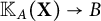 that is uniquely determined by
 .
Let us elaborate on the analogy to Lemma 1.3: If
$\mathbf {Y}$
 is another full right-Hilbert
$\mathrm {C}^{*}$
 -module over A, then the map
$\mathbf {X}\otimes _{A}\mathbf {Y}^{\mathrm {op}}\to \mathbb {K}_{A}(\mathbf {Y},\mathbf {X})$
 determined by
 is an isomorphism of bi-Hilbert
$\mathbb {K}_{A}(\mathbf {X})-\mathbb {K}_{A}(\mathbf {Y})$
 -bimodules (see Lemma A.2). In particular,
$\mathbf {X}\otimes _{A}\mathbf {X}^{\mathrm {op}} \cong \mathbb {K}_{A}(\mathbf {X})$
 is, in fact, the (up to isomorphism) unique
$\mathrm {C}^{*}$
 -algebra that is equivalent to A via
$\mathbf {X}$
 . (Note that we similarly have
$\mathbf {X}^{\mathrm {op}}\otimes _{\mathbb {K}}\mathbf {X}\cong A$
 as bi-Hilbert
$A-A$
 -modules via
 .)
The main result of this paper, Theorem 1.6, is an analog of Lemma 1.3 and Lemma 1.5 in the setting of Fell bundles over groupoids. To this end, we will first show that the correct analog of a principal
$\mathcal {H}$
 -space and a full right-Hilbert
$\mathrm {C}^{*}$
 -module over A is a
$\mathscr {B}$
 -demi-equivalence, which can be thought of as “half” of a Fell bundle equivalence in the sense of [Reference Muhly and Williams22, Definition 6.1]. We will then prove:
Theorem 1.6 Suppose
$\mathcal {H}$
 is a locally compact Hausdorff groupoid with open source map and X is a principal right
$\mathcal {H}$
 -space with open anchor map. If
$\mathscr {B}$
 is a saturated Fell bundle over
$\mathcal {H}$
 and
$\mathscr {M}$
 is a
$\mathscr {B}$
 -demi-equivalence over X, then there is a saturated Fell bundle
$\mathbb {K}(\mathscr {M}_{\mathscr {B}})$
 over the imprimitivity groupoid of X that is equivalent to
$\mathscr {B}$
 via
$\mathscr {M}$
 . Moreover, if
$\mathscr {M}$
 is also an
$(\mathscr {A},\mathscr {B})$
 -Fell bundle equivalence, then there exists a Fell bundle isomorphism
$\mathbb {K}(\mathscr {M}_{\mathscr {B}}) \to \mathscr {A}$
 that is uniquely determined by
 .
Many theorems about symmetric imprimitivity [Reference Duwenig and Li5, Reference Echterhoff, Kaliszewski, Quigg and Raeburn7, Reference Huef, Kaliszewski, Raeburn and Williams13, Reference Ionescu and Williams14, Reference Kaliszewski, Muhly, Quigg and Williams16] and generalized fixed point algebras [Reference Exel8, Reference Ferraro10, Reference Rieffel25] have appeared over the years and are extending (in various directions) a 1977-result of Green’s [Reference Green11]. In Section 6, we will see in what way our theorem captures some of those result.
The structure of the paper is as follows. After establishing notation and assumptions in Section 1.1, we give the definition of a
$\mathscr {B}$
 -demi-equivalence
$\mathscr {M}$
 over a principal
$\mathcal {H}$
 -space X (Definition 2.1) and prove some of its basic properties in Section 2. Section 3 is devoted to proving that
$\mathscr {M}$
 gives rise to a Fell bundle
$\mathbb {K}(\mathscr {M}_{\mathscr {B}})$
 over the imprimitivity groupoid of X, which we will also denote by
$\mathscr {M}\otimes _{\mathscr {B}}\mathscr {M}^{\mathrm {op}}$
 for reasons that will become apparent. We prove that this imprimitivity Fell bundle is equivalent to
$\mathscr {B}$
 via
$\mathscr {M}$
 in Section 4. In Section 5, we prove that
$\mathbb {K}(\mathscr {M}_{\mathscr {B}})$
 is unique (up to isomorphism), and we see some applications in Section 6. There are two short appendices to establish some background results about Hilbert
$\mathrm {C}^{*}$
 -modules and about upper semi-continuous Banach bundles.
1.1 Assumptions, conventions, and notation
We will denote groupoids using
$\mathcal {G},\mathcal {H},\mathcal {K}\ldots $
 , bundles using
$\mathscr {A},\mathscr {B},\mathscr {C},\ldots $
 , and stand-alone Hilbert
$\mathrm {C}^{*}$
 -modules and their elements using
$\mathbf {x\in X, y\in Y, z\in Z}\ldots $
 . Fibred products are denoted by
 , as defined in (1.1). The algebraic tensor product is
$\odot $
 and its completion is
$\otimes $
 ; we add a subscript for the internal (i.e., balanced) tensor product. Right and left actions on spaces are usually denoted by
 and
 , respectively, while actions on bundles are denoted by
 and
 . (The triangle is always pointing at the object that is being acted on.)
We try to use the letter p for the projection map of Fell bundles, while those of general Banach bundles are denoted by q. The fibre over a point h of the base space of a bundle
$\mathscr {B}=(B\to \mathcal {H})$
 with total space B is denoted
$B(h)$
 ; we adopt analogous notation for other bundles. We write
 for the source map of
$\mathcal {H}$
 composed with the projection map of
$\mathscr {B}$
 , and we adopt analogous notation for anchor maps
 .
We use the notion of upper semi-continuous Banach bundles, Fell bundles, actions of Fell bundles on upper semi-continuous Banach bundles, and equivalences of Fell bundles as in [Reference Duwenig and Li4], Definitions 2.3, 2.9, 2.10, and 2.11, respectively. As done in [Reference Muhly and Williams22], our Fell bundles are assumed saturated in the sense that their fibres are full (and hence imprimitivity) bimodules; we will rarely mention this assumption again. We frequently use the fact that our upper semi-continuous Banach bundles have enough continuous cross sections (see [Reference Lazar18, Corollary 2.10], [Reference Muhly and Williams22, Appendix A]).
$\blacktriangleright $
 For the remainder of the paper, we assume that
-
• $\mathcal {H}$
 is a locally compact Hausdorff groupoid with open source mapFootnote
2
,
-
• X is a locally compact Hausdorff space and
is a continuous open surjection, -
• X is a principal right $\mathcal {H}$
-space with anchor map
$\sigma $
, and -
• the groupoid $X\times _{\mathcal {H}} X^{\mathrm {op}}$
will be denoted by
$\mathcal {G}$
, and we will refer to it as the imprimitivity groupoid of X as in [Reference Williams28, Lemma 2.45].

 ,
 is a continuous open surjection,


In analogy to the notation 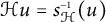 and
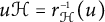 for
 , we will write
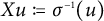 . We chose the letter
$\sigma $
 since it serves the purpose of a “source” map; for left-actions, we will therefore generally use
$\rho $
 (as in “range”) for the anchor map.
2 Demi-Equivalences
For the upcoming definition, we remind the reader that the anchor map  of the left action of
$\mathcal {G}= X\times _{\mathcal {H}} X^{\mathrm {op}}$
 on the principal
$\mathcal {H}$
 -space X is exactly the quotient map if we identify
 with
$X/\mathcal {H}$
 ; see (1.2).
Definition 2.1 (cf. [Reference Abadie and Ferraro1, Definition 2.1])
Suppose
$\mathscr {B}=(p_{\mathscr {B}}\colon B\to \mathcal {H})$
 is a Fell bundle over the groupoid
$\mathcal {H}$
 , and
$\mathscr {M}=(q_{\mathscr {M}}\colon M\to X)$
 is an upper semi-continuous Banach bundle over the principal
$\mathcal {H}$
 -space X. We call
$\mathscr {M}$
 a (right)
$\mathscr {B}$
 -demi-equivalence
Footnote
3
if there exist maps

and

such that the followingFootnote
4
hold for all appropriately chosen
$m_{i}\in M$
 and
$b\in B$
 .
-
(DE1)
covers the map in the sense that ; -
(DE2)
covers the map in the sense that ; -
(DE3)
is continuous, and fibrewise sesquilinear (meaning linear in the second and anti-linear in the first coordinate); -
(DE4)
; -
(DE5)
; -
(DE6)
in the
$\mathrm {C}^{*}$
-algebra
$B(\sigma _{\mathscr {M}}(m))$
, and only if
$m=0$
; -
(DE7) the norm
agrees with the norm that the upper semi-continuous Banach bundle
$\mathscr {M}$
carries; and -
(DE8) for each $x\in X$
, the linear span of is dense in
$B(\sigma (x))$
.
 covers the map
 in the sense that
 ;
 covers the map
 in the sense that
 ;
 is continuous, and fibrewise sesquilinear (meaning linear in the second and anti-linear in the first coordinate);
 ;
 ;
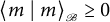 in the


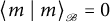 only if

 agrees with the norm that the upper semi-continuous Banach bundle


 is dense in

An analogous definition of a left
$\mathscr {B}$
 -demi-equivalence can be made; there, each instance of a range map becomes a source map (and vice versa) and sesquilinearity means that the first coordinate is linear. When there is no ambiguity, we will drop the subscript-
$\mathscr {B}$
 on the inner product; conversely, when there is ample room for ambiguity, we might add a superscript-
$\mathscr {M}$
 .
The reader might have noticed that there are a few natural properties, both algebraic and analytic, that a demi-equivalence should satisfy if it is to be “half” of an equivalence in the sense of Muhly and Williams. Let us show that all those properties actually follow automatically.
Lemma 2.1 (cf. [Reference Abadie and Ferraro1, Lemma 2.7])
Suppose
$\mathscr {B}=(p_{\mathscr {B}}\colon B\to \mathcal {H})$
 is a Fell bundle over the groupoid
$\mathcal {H}$
 and
$\mathscr {M}=(q_{\mathscr {M}}\colon M\to X)$
 is a right
$\mathscr {B}$
 -demi-equivalence over the principal right
$\mathcal {H}$
 -space X. Then we have the following, where
 .
-
(DE9) Each $M(x)$
is a full right-Hilbert
$\mathrm {C}^{*}$
-module over the
$\mathrm {C}^{*}$
-algebra
$B(\sigma (x))$
; -
(DE10)
for all appropriate
$b\in B$
; -
(DE11)
and ; -
(DE12)
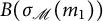
as elements of the
$\mathrm {C}^{*}$
-algebra
$B(\sigma _{\mathscr {M}}(m_{1}))$
(Cauchy–Schwarz).


 for all appropriate

 and
 ;
 as elements of the

Moreover,
$\mathscr {B}$
 acts on the right of
$\mathscr {M}$
 in the sense of [Reference Duwenig and Li4, Definition 2.11], i.e.,
-
(DE13)
is fibrewise bilinear; -
(DE14)
for all appropriate
$b,b'\in B$
; -
(DE15)
; and -
(DE16)
is continuous.
 is fibrewise bilinear;
 for all appropriate

 ; and
 is continuous.
Again, the analogous result for a left demi-equivalence must be rephrased in a way that every range becomes a source etc. With the properties listed in Lemma 2.1, we see that a
$\mathscr {B}$
 -demi-equivalence really satisfies all “one-sided” properties of a Fell bundle equivalence as defined in [Reference Muhly and Williams22, Definition 6.1]. In Proposition 2.3, we will see which properties are needed for a “two-sided” demi-equivalence to be an equivalence.
Proof of Lemma 2.1
Condition (DE9) is just a restatement of other properties. To be precise,
$M(x)$
 is a right inner product
$B(\sigma (x))$
 -module in the sense of [Reference Raeburn and Williams24, Definition 2.1] because of Conditions (DE3)–(DE6), and it is a Hilbert
$B(\sigma (x))$
 -module because we assumed that the norm with respect to which
$M(x)$
 is complete coincides with the norm induced by the inner product (Assumption (DE7)). Fullness is exactly Assumption (DE8).
Condition (DE10) follows from (DE5) and (DE4) combined, and (DE11) follows directly from (DE2).
(DE13) Fix
$x\in X$
 and
$m,m_{i}\in M(x)$
 . If
$b\in B(h)$
 for some
$h\in \sigma (x)\mathcal {H}$
 , then

Since multiplication in
$\mathscr {B}$
 is bilinear, we conclude that

for all
$m\in M(x)$
 . Choosing
 , it follows from (DE6) that
$m=0$
 , meaning that
 is linear in the first component. A similar computation, using (DE10), proves linearity in the second component and also (DE14), using associativity of the multiplication of
$\mathscr {B}$
 .
(DE15) We have

where
$(\dagger )$
 follows from (DE4) and (DE10).
(DE16) Suppose
$(m_{i },b_{i })$
 is a net in
 that converges to
$(m,b)$
 ; in particular,
 converges to
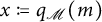 in X and
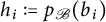 converges to
 in
$\mathcal {H}$
 . Now choose a continuous section
$\mu \in \Gamma _0 (X;\mathscr {M})$
 of
$\mathscr {M}$
 with
 . Since
$\mu $
 and the right
$\mathcal {H}$
 -action
 on X are continuous, we have
 . Using (DE4), (DE10), and sesquilinearity of the inner product, we have

By continuity of the involution and multiplication of
$\mathscr {B}$
 and by continuity of the inner product on
$\mathscr {M}$
 , the above converges to

which, again by (DE4) and (DE10), is
$0$
 . Since

by (DE7), it thus follows from [Reference Duwenig and Li4, Lemma A.5] that  converges in the total space of
$\mathscr {M}$
 to the zero-element of the Banach space
 . Since
 converges to
 and since limits are unique, this implies
 , as claimed.
The proof of (DE12) is verbatim that for [Reference Duwenig and Li4, Lemma 4.7] (after translating from the left to the right).
Remark 2.2 In [Reference Muhly and Williams22, Definition 6.1], neither continuity of the inner product on a Fell bundle equivalence nor Condition (DE7) were explicitly assumed but often invoked. I am unsure whether there is a way to deduce continuity from a combination of the algebraic properties of
$\mathscr {M}$
 and the topological properties of
$\mathscr {B}$
 , like it was the case for continuity of the action, (DE16). Consequently, I chose to include these conditions as assumptions in the definition.
Next, we show that a two-sided version of a demi-equivalence is an equivalence in the sense of [Reference Muhly and Williams22, Definition 6.1], provided there is some algebraic compatibility between the two structures.
Proposition 2.3 Suppose that X is a groupoid equivalence between
$\mathcal {G}$
 and
$\mathcal {H}$
 with anchor maps
$\rho $
 respectively
$\sigma $
 , that
$\mathscr {A}=(A\to \mathcal {G})$
 and
$\mathscr {B}=(B\to \mathcal {H})$
 are Fell bundles, and that
$\mathscr {M}=(M\to X)$
 is a left
$\mathscr {A}$
 - and a right
$\mathscr {B}$
 -demi-equivalence. Assume further that
-
(1) the actions of $\mathscr {A}$
and
$\mathscr {B}$
on
$\mathscr {M}$
commute, i.e., for all , we have ; -
(2) for each $x\in X$
,
$A(\rho (x))$
acts by
$B(\sigma (x))$
-adjointable operators on
$M(x)$
, meaning that for all $m_{i}\in M(x)$
and all
$a\in A(\rho (x))$
;
-
(3) for all
, the inner products on
$\mathscr {M}$
satisfy


 , we have
 ;


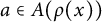
 , the inner products on


Then
$\mathscr {M}$
 is an equivalence between
$\mathscr {A}$
 and
$\mathscr {B}$
 .
Note that Assumption (2) is distinctly asymmetric; it could have been replaced by its counterpart:
-
(2)’ For each $x\in X$
,
$B(\sigma (x))$
acts by
$A(\rho (x))$
-adjointable operators on
$M(x)$
.


Proof First, we will do some sanity checks: Condition (1) makes sense because the actions on X commute, meaning that 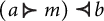 and
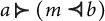 live over the same fibre of
$\mathscr {M}$
 by (DE1). Next, let us check that Condition (3) makes sense. Since
 is defined on
 and
 on
 , we can evaluate the shown inner products. By (DE11), we have
 , and since
 , we therefore have that
$m_{1}$
 can be acted on by
 on the right; a similar argument shows that
$m_{3}$
 can be acted on by
 on the left. Lastly, note that Conditions (DE1) and (DE2) combined with Equation (1.4) show that the elements in question are indeed living in the same fibre of
$\mathscr {M}$
 .
To see that
$\mathscr {M}$
 is an equivalence, we have to check Properties (FE1), (FE2), and (FE3) in [Reference Duwenig and Li4, Definition 2.11]. By assumption,
$\mathscr {M}$
 is an upper semi-continuous Banach bundle over a groupoid equivalence, and as explained in Lemma 2.1,
 and
 are actions in the sense of [Reference Duwenig and Li4, Definition 2.10]. Since they are assumed to commute, we therefore get Condition (FE1). For (FE2), note that the inner products are assumed to be sesquilinear in the correct sense. Furthermore,
-
(FE2.a) is satisfied by (DE2);
-
(FE2.b) is satisfied by (DE5);
-
(FE2.c) is satisfied by (DE4); and
-
(FE2.d) is exactly Assumption (3).
Lastly, for (FE3), we must check that each
$M(x)$
 is an imprimitivity bimodule between
$A(\rho (x))$
 and
$B(\sigma (x))$
 . We know by (DE9) that it is a full left- and right-Hilbert
$\mathrm {C}^{*}$
 -module. By Assumption (3), the left- and right-inner products are compatible and the left-action is by
$B(\sigma (x))$
 -adjointable operators; it remains to show that the right-action is by
$A(\rho (x))$
 -adjointable operators. For
$n_{i}\in M(x)$
 , we have

This proves that the element  of
$A(\rho (x))$
 “kills” all of
$M(x)$
 . By Assumption (2), a is an adjointable operator with respect to the
$B(\sigma (x))$
 -valued right-inner product. It therefore follows from [Reference Raeburn and Williams24, Remark 2.29] that
$a^*a$
 and hence a is
$0$
 , i.e.,
 , so b is an
$A(\rho (x))$
 -adjointable operator.
Remark 2.4 In the setting of Proposition 2.3, it follows from [Reference Duwenig and Li4, Corollary 4.6] that Condition (3) actually also holds more generally: if  , then
 as elements of
$B(h)$
 where
 . In other words,
$\mathscr {A}$
 is acting on
$\mathscr {M}$
 by “
$\mathscr {B}$
 -adjointable” operators. This observation foreshadows a connection to [Reference Abadie and Ferraro1], where results similar to the main theorem of the paper at hand have appeared. We will do a more in-depth comparison later in Corollary 6.7, but let us already point out some points of distinction: On the one hand, their result is more general in that they consider Fell bundles that are not necessarily separable or saturated; instead of (DE8), they only assume that
$\mathscr {M}=(M\to X)$
 satisfies

On the other hand, their result is more restrictive in that our topological groupoid
$\mathcal {H}$
 is replaced by a topological group. Moreover, they only consider
$X=\mathcal {H}$
 , which is restrictive even in the case of groups (see Example 6.9).
We have introduced all ingredients for the main theorem which says that any
$\mathscr {B}$
 -demi-equivalence can be rigged (in a unique way) to give a Fell bundle equivalence in the sense of [Reference Muhly and Williams22, Definition 6.1].
3 The imprimitivity Fell bundle: Existence
$\blacktriangleright $
 For the remainder of the paper, we fix a Fell bundle
$\mathscr {B}=(p_{\mathscr {B}}\colon B\to \mathcal {H})$
 over the groupoid
$\mathcal {H}$
 and a right
$\mathscr {B}$
 -demi-equivalence
$\mathscr {M}=(q_{\mathscr {M}}\colon M\to X)$
 over the principal right
$\mathcal {H}$
 -space X.
Suppose that
$\mathscr {A}$
 and
$\mathscr {C}$
 are, like
$\mathscr {B}$
 , Fell bundles over locally compact Hausdorff groupoids. In [Reference Duwenig and Li4, Sections 5 and 6], it was shown that a so-called hypo-equivalence
$\mathscr {N}_{1}$
 from
$\mathscr {A}$
 to
$\mathscr {B}$
 and a hypo-equivalence
$\mathscr {N}_{2}$
 from
$\mathscr {B}$
 to
$\mathscr {C}$
 can be “multiplied” to yield a hypo-equivalence
$\mathscr {N}_{1}\otimes _{\mathscr {B}}\mathscr {N}_{2}$
 from
$\mathscr {A}$
 to
$\mathscr {C}$
 . A careful examination of the proofs shows that not all the structure of hypo-equivalences is needed to construct the upper semi-continuous Banach bundle
$\mathscr {N}_{1}\otimes _{\mathscr {B}}\mathscr {N}_{2}$
 . We will start this section by making this claim more precise.
Given
$x,y\in X$
 with
 , the demi-equivalence
$\mathscr {M}$
 gives us two full Hilbert
$\mathrm {C}^{*}$
 -modules over the
$\mathrm {C}^{*}$
 -algebra
$B(u)$
 , namely the right-module
$M(x)$
 and the left-module
$M(y)^{\mathrm {op}}$
 . In particular, combining the well-known results mentioned earlier, we get an imprimitivity bimodule between
$\mathbb {K}_{B(u)}(M(x))$
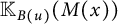 and
$\mathbb {K}_{B(u)}(M(y)^{\mathrm {op}} )$
 by taking the balanced tensor product:

where we write  as short-hand for
 . The norm of this Banach space is, on sums of elementary tensors, given by

We construct an upper semi-continuous Banach bundle over  as follows.
Lemma 3.1 (cf. [Reference Duwenig and Li4, Lemma 5.2])
On the set

consider all cross-sections of the form

for
$\mu ,\nu \in \Gamma _{0} (X;\mathscr {M})$
 . Then there is a unique topology on K making it an upper semi-continuous Banach bundle over
 such that all cross-sections
$\mu \otimes \nu ^{\mathrm {op}} $
 are continuous.
In the literature [Reference Duwenig and Li4, Reference Muhly20], the above bundle is denoted  . But since we fixed
$\mathscr {M}$
 , we will ease notation and instead denote the bundle by
 .
Proof Consider

Recall that
$\mathscr {M}$
 has enough continuous sections, so that for each
$m\in M(x)$
 , there exists
$\mu \in \Gamma _0(X;\mathscr {M})$
 such that
$\mu (x)=m$
 . In particular, it follows that
$ \{\gamma (x,y^{\mathrm {op}}) : \gamma \in \Gamma \} $
 is dense in
$K(x,y^{\mathrm {op}})$
 . If we can show for an arbitrary element
$\gamma =\sum _{i=1}^{k}\mu _{i}\otimes \nu ^{\mathrm {op}}_{i}$
 of
$\Gamma $
 that
$(x,y^{\mathrm {op}})\mapsto \left \| \gamma (x,y^{\mathrm {op}}) \right \|$
 is upper semi-continuous, then the claim follows from [Reference Hofmann12, Corollary 3.7] (see also [Reference Fell and Doran9, p. 13.18], [Reference Williams29, Theorem C.25], [Reference Duwenig and Li4, Remark 2.7]). We have by Equation (3.2)

It was shown in [Reference Raeburn and Williams24, Lemma 2.65] that the
$k\times k$
 -matrix with
$i,j$
 -entry
 is positive for each
$x\in X$
 , so there exists a matrix
$(b_{i,j}(x))_{i,j}$
 over
$B(\sigma (x))$
 such that
 . Note that we may choose each
$b_{i,j}\colon x\mapsto b_{i,j}(x)$
 to be a continuous section of the pullback bundle
$\sigma ^*(\mathscr {B})$
 . For
$1\leq l \leq k$
 , we let
 . By continuity of
 , of each
$\nu _{i}$
 and
$b_{il}$
 , and of summation in
$\mathscr {M}$
 , each
$\nu _{l}$
 is continuous. Moreover,

Since the
$\mathscr {B}$
 -valued inner product on
$\mathscr {M}$
 , summation in
$\mathscr {B}$
 , and each
$\nu _{l}$
 are continuous, and the norm on
$\mathscr {B}$
 is upper semi-continuous, we conclude that
$(x,y^{\mathrm {op}})\mapsto \left \| \gamma (x,y^{\mathrm {op}}) \right \|$
 is upper semi-continuous.
Remark 3.2 The proof of [Reference Duwenig and Li4, Lemma 5.4] shows that, if we have two convergent nets
$m_{\lambda }\to m$
 and
$n_{\lambda }\to n$
 in M with
$\sigma _{\mathscr {M}}(m_{\lambda })=\sigma _{\mathscr {M}}(n_{\lambda })$
 , then
$m_{\lambda }\otimes n_{\lambda }^{\mathrm {op}}\to m\otimes n^{\mathrm {op}}$
 in K.
Implicitly, Lemma 3.1 is making use of the “dual” bundle to the
$\mathscr {B}$
 -demi-equivalence
$\mathscr {M}$
 : given a fibre
$M(x)$
 of
$\mathscr {M}$
 , its conjugate vector space
$M(x)^{\mathrm {op}}$
 is, by definition, the fibre of
$\mathscr {M}^{\mathrm {op}}=(M^{\mathrm {op}}\to X^{\mathrm {op}})$
 over
$x^{\mathrm {op}}$
 . Clearly,
$\mathscr {M}^{\mathrm {op}}$
 is also an upper semi-continuous Banach bundle if
$M^{\mathrm {op}}$
 and
$X^{\mathrm {op}}$
 are given the same topologies as M and X, respectively. Moreover, the right
$\mathscr {B}$
 -action on
$\mathscr {M}$
 induces a left
$\mathscr {B}$
 -action on
$\mathscr {M}^{\mathrm {op}}$
 if we define
 . The reader should compare all of this with [Reference Muhly and Williams22, Example 6.7] in the setting where
$\mathscr {M}$
 is an equivalence.
Note that
$\mathscr {K}$
 is the bundle-analog of the space
 in the world of groupoids and of the unbalanced tensor product
$\mathbf {X}\otimes \mathbf {X^{\mathrm {op}}}$
 of Hilbert
$\mathrm {C}^{*}$
 -modules in the world of
$\mathrm {C}^{*}$
 -algebras. What we are actually after, though, is a bundle-analog of their quotients, that is,
$X\times _{\mathcal {H}}X^{\mathrm {op}}$
 respectively
$\mathbf {X}\otimes _{A} \mathbf {X^{\mathrm {op}}}$
 : To get
$\mathbf {X}\otimes _{A} \mathbf {X^{\mathrm {op}}}$
 from
$\mathbf {X}\otimes \mathbf {X^{\mathrm {op}}}$
 , we quotient out by elements of the form

where
$\mathbf {x}\in \mathbf {X}, \mathbf {y}\in \mathbf {X^{\mathrm {op}}}$
 , and
$a\in A$
 . For bundles, such a difference does not make sense, since the two elementary tensors may live in different fibres: if
$m\in M(x)$
 ,
$n\in M(y) $
 , and
$b\in B(h)$
 are such that
$\sigma (x)=r_{\mathcal {H}}(h)$
 and
$s_{\mathcal {H}} (h)=\sigma (y)$
 , then

In order to identify  with
 , we therefore need a way to identify the above two fibres of
$\mathscr {K}$
 .
Lemma 3.3 (cf. [Reference Duwenig and Li4, Theorem 5.20])
For any  and
$h\in u\mathcal {H} v$
 , there exists a map

determined on elementary tensors by

where
$\sigma _{\mathscr {M}}(m)=u$
 ,
$\sigma _{\mathscr {M}}(n)=v$
 , and
$b\in B(h)$
 . These maps have the following properties:
-
$(\Psi 1) $
When restricted to a single fibre , each
$\Psi _h$
is linear. -
$(\Psi 2) $
Each
$\Psi _{h}$
is isometric, i.e.,
$\left \| \Psi _{h}(\xi ) \right \|=\left \| \xi \right \|$
. -
$(\Psi 3) $
$\Psi _{h'}\circ \Psi _{h}=\Psi _{h'h}$
for . -
$(\Psi 4) $
is inverse to
$\Psi _{h}$
. -
$(\Psi 5) $
$\Psi _{u}$
for is the identity map.

 , each





 .

 is inverse to


 is the identity map.
Proof We construct
$\Psi _{h}$
 on each of the fibres
 . Consider the map

Since it is multilinear, it descends to a linear map with domain
$[M(x) \odot B(h)] \odot M(y)^{\mathrm {op}} $
 , where
$\odot $
 denotes the algebraic tensor product. Because of the
$B(u)$
 -balancing in the codomain, the map descends to a map with domain
$[M(x) \odot _{B(u)} B(h)] \odot M(y)^{\mathrm {op}}$
 . Since
 for any
$b_v\in B(v)$
 , it further descends to a map with domain
$[M(x) \odot _{B(u)} B(h)] \odot _{B(v)} M(y)^{\mathrm {op}}$
 . It is easy to check that that map is isometric (when
$M(x) \odot _{B(u)} B(h)$
 is given the norm of the balanced tensor product of Hilbert modules), and therefore extends to
$[M(x) \otimes _{u} B(h)] \otimes _{v} M(y)^{\mathrm {op}}$
 . Now, Assumption (DE8) implies that every element of
 is the limit of sums of elements of the form
 ; in other words, the linear map
 determined by
 has dense range. We conclude the existence of
$\Psi _{h}$
 . The remaining properties are easy to check.
The collection of maps
$\Psi _h$
 stitch together to give an isomorphism of upper semi-continuous Banach bundles as follows. Let
 be given by
 , and consider the continuous projection map

The pull-back bundle of the upper semi-continuous Banach bundle
$\mathscr {K}$
 via f is the bundle over the domain of f defined by

While this bundle is often denoted by
$f^{*} (\mathscr {K})$
 , we will denote it by
 instead, so that the letter f does not have to be introduced. We make an analogous definition for
 .
It was shown in [Reference Duwenig and Li4, Lemma 2.8] that basic open sets of this upper semi-continuous Banach bundle are of the form  for
$U\subseteq \mathcal {H}$
 ,
$V\subseteq K$
 open, and the sections

for
$\tau $
 a continuous section of
$\mathscr {K}$
 , are the continuous sections that uniquely determine the topology on
 .
Lemma 3.4 (cf. [Reference Duwenig and Li4, Theorem 5.20])
The map

is an isomorphism of upper semi-continuous Banach bundles covering the homeomorphism

In particular,
$\Psi $
 is jointly continuous.
We remind the reader that ‘
$\Psi $
 covers
$\psi $
 ’ means that the following diagram commutes:

So given
$\xi \in K$
 and
$h\in \mathcal {H}$
 with
$s_{\mathcal {H}}(h)=t(q_{\mathscr {K}}(\xi ))$
 , this means that

Proof To see that
$\Psi $
 is an isomorphism, we will invoke Lemma B.2 and [Reference Duwenig and Li4, Proposition A.8]. Because of Lemma 3.1 and our comment preceding Lemma 3.4, the set

is a collection of continuous sections of  . As the fibre of
 over a given
$(h,x,y^{\mathrm {op}} )$
 is just
$K(x,y^{\mathrm {op}})$
 and since the linear span of
$\{{\mu (x)\otimes \nu (y)}^{\mathrm {op}}:{\mu ,\nu \in \Gamma _0(X;\mathscr {M})}\}$
 is dense in
$K(x,y^{\mathrm {op}})$
 , we conclude that the linear span of
$\{{\gamma (h,x,y^{\mathrm {op}})}:{\gamma \in \Gamma }\}$
 is likewise dense in the fibre of
 . We claim that, given any element
$\gamma \colon (h,x,y^{\mathrm {op}} )\mapsto (h,\mu (x)\otimes \nu (y)^{\mathrm {op}} )$
 of
$\Gamma $
 , the section
 of
 is continuous. Indeed, it suffices to check that, if

then

Fix
$\epsilon>0$
 . As mentioned earlier, Assumption (DE8) implies that
 , so we may take finitely many elements
$m_{i}\in M(x)$
 and
$b_{i}\in B(h)$
 such that

For each
$1\leq i\leq k$
 , fix a section
$\mu _{i}$
 of
$\mathscr {M}$
 and
$\tau _{i}$
 of
$\mathscr {B}$
 with
$\mu _{i}(x)=m_i$
 respectively
$\tau _{i}(h)=b_{i}$
 . Since addition in
$\mathscr {M}$
 and the right
$\mathscr {B}$
 -action are continuous, the net
 converges to
 in M. By [Reference Duwenig and Li4, Lemma A.3,
$(i) \Longrightarrow (iii)$
 ], we therefore have

Note that

and likewise without subscript-
$\lambda $
 ’s. Thus, by continuity of
$\mu _{i},\nu ,\tau _{i}$
 , of the involution in
$\mathscr {B}$
 , of the right
$\mathscr {B}$
 -action, and of addition in
$\mathscr {K}$
 , combined with Remark 3.2, this implies that

Since
$\Psi _{h}$
 is isometric (
$\Psi $
 2), we then have for large enough
$\lambda $


where
$(*)$
 follows from (3.6) and continuity of
$\nu $
 . The same computation without subscripts yields

As
$\epsilon $
 was arbitrary, Lemma B.1 states that this combined with (3.7) implies

Because each
$\Psi _{h}$
 is linear, isometric, and surjective, the claim now follows from Lemma B.2 and [Reference Duwenig and Li4, Proposition A.8].
We are now able to proceed with the balancing by defining a relation
$\mathbin {\texttt {R}}$
 on the set K as follows; the results are adapted from [Reference Duwenig and Li4, Section 6].
Lemma 3.5 If
$\xi _{1}, \xi _{2}\in K$
 with
$q_{\mathscr {K}} (\xi _{i})=(x_{i},y_{i}^{\mathrm {op}} )$
 , let

This defines a closed equivalence relation on the total space K of
$\mathscr {K}$
 whose quotient map
$Q\colon K\to K/\mathbin {\texttt {R}}$
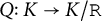 is open.
We often write
$[\xi ]$
 for
$Q(\xi )$
 .
Proof The proof that
$\mathbin {\texttt {R}}$
 is closed is verbatim that given for [Reference Duwenig and Li4, Lemma 6.2], where it is also explained why
$\mathbin {\texttt {R}}$
 is an equivalence relation.
To show that the quotient map Q is open, the proof of [Reference Duwenig and Li4, Proposition 6.8] goes through for  , even though
$\mathscr {M}$
 was assumed to be an equivalence and
$\mathcal {H}$
 was assumed to be étale in [Reference Duwenig and Li4]. In fact, étaleness was only needed to be allowed to invoke [Reference Duwenig and Li4, Lemma 6.10], but that lemma’s proof holds as long as the range map of
$\mathcal {H}$
 is open (which we assumed here).
Lemma 3.6 On the quotient of K by
$\mathbin {\texttt {R}}$
 , the map
$p\colon K/\mathbin {\texttt {R}} \to \mathcal {G}, [\xi ]\mapsto [q_{\mathscr {K}}(\xi )]$
 , is well defined, surjective, continuous, and open.
Proof The proof of [Reference Duwenig and Li4, Lemma 6.5] for  goes through, even though
$\mathscr {M}$
 was assumed to be an equivalence in that lemma.
$\blacktriangleright $
 For the moment, we will write
$\mathscr {A}=(p_{\mathscr {A}}=p\colon A\to \mathcal {G})$
 for the quotient bundle of
$\mathscr {K}$
 by
$\mathbin {\texttt {R}}$
 . Once we have shown that
$\mathscr {A}$
 is a Fell bundle that is equivalent to
$\mathscr {B}$
 via
$\mathscr {M}$
 , we will change notation.
Lemma 3.7 (cf. [Reference Duwenig and Li4, Proposition 6.6. and Lemma 6.7])
Fix  . With respect to the subspace topology of
$A=K/\mathbin {\texttt {R}}$
 on the fibre
$A(g)$
 of
$\mathscr {A}$
 , the restriction of the quotient map
$Q\colon K\to A$
 to the fibre over
$(x,y^{\mathrm {op}})$
 is a homeomorphism:

The above lemma means that we can give
$A(g)$
 the Banach space structure that makes all maps
$Q_{(x,y^{\mathrm {op}})}$
 isomorphisms: for
$[\xi _{1}],[\xi _{2}] \in A(g)$
 , there exists a unique
$h\in \mathcal {H}$
 such that
$q_{\mathscr {K}}(\xi _{1})= q_{\mathscr {K}}(\Psi _{h} (\xi _{2}))$
 , and we may let

Note that, in light of the Hilbert module isomorphism in Equation (3.1), we can also think of the fibres of
$\mathscr {A}$
 as generalized compact operators:

Proof If
$\xi ,\eta \in K(x,y^{\mathrm {op}})$
 , then since the
$\mathcal {H}$
 -action on X is free,
 is the only possible element that allows
$\xi \mathbin {\texttt {R}}\eta $
 , in which case
$\Psi _{h}(\eta )=\eta $
 (since h is a unit) and hence
$\xi =\eta $
 . Thus,
$Q_{(x,y^{\mathrm {op}})}$
 is injective. For surjectivity, note that Q is surjective, so any element a of
$A(g)$
 can be written as
$a=Q(\xi )$
 for
$\xi \in K$
 with
 . In particular, there exists
$h\in \mathcal {H}$
 with
 , so that
$\Psi _{h}(\xi ) \in K(x,y^{\mathrm {op}})$
 and
$a=Q(\xi )=Q_{(x,y^{\mathrm {op}})}(\Psi _{h}(\xi ))$
 .
Since
$p=p_{\mathscr {A}}$
 is continuous,
 is closed in A, and so continuity of Q implies continuity of
$Q_{(x,y^{\mathrm {op}})}$
 . To see that
$Q_{(x,y^{\mathrm {op}})}$
 is closed (and hence a homeomorphism), we follow the idea in the proof of [Reference Duwenig and Li4, Lemma 6.7]: Let
$F\subseteq K(x,y^{\mathrm {op}})$
 be a closed set. To show that
$Q(F)\subseteq A(g)$
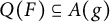 is closed, it suffices to show that it is closed in A, i.e., that
 is closed in K. So assume
$\xi _{\lambda }\to \xi $
 in K with
$Q(\xi _{\lambda })\in Q(F)$
 ; we must prove that
$Q(\xi )\in Q(F)$
 . Since
$Q(\xi _{\lambda })\in F$
 , there exist
$\eta _{\lambda }\in F$
 with
$\eta _{\lambda }\mathbin {\texttt {R}}\xi _{\lambda }$
 . Since
$F\subseteq K(x,y^{\mathrm {op}})$
 , this means there exist
$h_{\lambda }\in \sigma (x)\mathcal {H} $
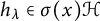 with
 and
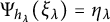
$\Psi _{h_{\lambda }}(\xi _{\lambda })=\eta _{\lambda }$
 . Since
$\xi _{\lambda }\to \xi $
 , we have

Since the
$\mathcal {H}$
 -action on X is proper, it follows from [Reference Williams28, Proposition 2.17] that (a subnet of)
$\{h_{\lambda }\}_{\lambda }$
 converges to, say, h; since X is Hausdorff, it follows that
 . Since
$\Psi $
 is jointly continuous, we conclude that (a subnet of)
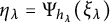
$\eta _{\lambda } = \Psi _{h_{\lambda }}(\xi _{\lambda })$
 converges to
$\Psi _{h}(\xi )$
 in K. Since
$\eta _{\lambda }\in F$
 and F is closed in
$K(x,y^{\mathrm {op}})$
 and hence also in K, we have
$\Psi _{h}(\xi )\in F$
 . Since
$\xi \mathbin {\texttt {R}}\Psi _{h}(\xi )$
 , this means that
 , as needed.
Lemma 3.8 The bundle
$\mathscr {A}$
 —equipped with the quotient topology on
$A=K/\mathbin {\texttt {R}}$
 and with the fibrewise linear structure inherited from
$\mathscr {K}$
 via the maps given in (3.8)—is an upper semi-continuous Banach bundle. With respect to this topology, all sections of the form

are continuous, where
$\mu ,\nu $
 are continuous sections of
$\mathscr {M}$
 .
Proof That
$\mathscr {A}$
 is an upper semi-continuous Banach bundle follows from an application of [Reference Duwenig and Li4, Proposition 6.13]; here, we need that both
 and
$Q\colon {K\to A}$
 are open quotient maps (Lemma 3.5) and that
$Q_{(x,y^{\mathrm {op}})}$
 is surjective (Lemma 3.7) and a linear isometry (by definition of the linear structure on each fibre of
$\mathscr {A}$
 ).
That the given section is continuous follows since  is open,
$\mu \otimes \nu ^{\mathrm {op}}$
 is a continuous section of
$\mathscr {K}$
 (Lemma 3.1), and Q is continuous.
At this point, we will diverge from what was done in [Reference Duwenig and Li4] and prove that
$\mathscr {A}=(p_{\mathscr {A}}\colon A\to \mathcal {G})$
 is not just an upper semi-continuous Banach bundle but actually a Fell bundle; see Theorem 3.17. In particular, we need to construct two maps, namely a multiplication
 and an involution
 . Conceptually, the involution is easier, so this is where we will start.
Lemma 3.9 There exists a unique bijective, fibrewise isometric and conjugate-linear map
$\texttt {Flip}\colon \mathscr {K}\to \mathscr {K}$
 that covers the homeomorphism

and that is fibrewise given on dense spanning elements by

Note that the following diagram commutes:

Proof To see that the map
$\texttt {Flip}$
 exists on each fibre, fix
 and let
$u=\sigma (x)=\sigma (y)$
 . Recall that
$K(x, y^{\mathrm {op}})$
 is isomorphic to
$\mathbb {K}_{B(u)} (M(y),M(x))$
 as bi-Hilbert
$\mathbb {K}_{B(u)} (M(x))-\mathbb {K}_{B(u)} (M(y))$
 -bimodules. With this identification, the restriction of
$\texttt {Flip}$
 to this fibre is given by
 or in other words,
$\texttt {Flip}$
 is the adjoint map
$T\mapsto T^*$
 . In particular,
$\texttt {Flip}$
 is fibrewise antilinear and isometric. Its continuity is built into the topology on
$\mathscr {K}$
 : If
$\mu ,\nu $
 are continuous sections of
$\mathscr {M}$
 , then
$\mu \otimes \nu ^{\mathrm {op}}$
 and
$\nu \otimes \mu ^{\mathrm {op}}$
 are continuous sections of
$\mathscr {K}$
 . Since
$\texttt {Flip}$
 transforms the former into the latter, it is continuous and open by an application of [Reference Duwenig and Li4, Propositions A.7 and A.8].Footnote
5
Continuity of
$\texttt {Flip}$
 and continuity and openness of the quotient map Q now immediately imply the following.
Corollary 3.10 On the quotient bundle
$\mathscr {A}$
 , there exists a unique continuous, fibrewise conjugate-linear map
 given by
$[\xi ]^*=[\texttt {Flip}(\xi )]$
 .
Now that we have (a candidate for) the involution on
$\mathscr {A}$
 , we proceed to construct the multiplication. Recall that our end goal is not only to show that
$\mathscr {A}$
 is a Fell bundle but also that there is a left action
 of
$\mathscr {A}$
 on
$\mathscr {M}$
 . We want this action to behave nicely with respect to the multiplication in the sense that
 ; it is therefore easier to first construct a candidate for the left-action and then use it to construct the multiplication. Like with the involution, we first do everything on the level of
$\mathscr {K}$
 before we move to its quotient
$\mathscr {A}$
 . For clarity, we remind the reader that the fibre of
$\mathscr {K}$
 over
 is given by
$ K(x,y^{\mathrm {op}})=M(x)\otimes _{\sigma (x)}M(y)^{\mathrm {op}} $
 .
Lemma 3.11 For  , there exists a continuous bilinear map

determined on elementary tensors by

For all
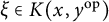
$\xi \in K(x,y^{\mathrm {op}}) $
 and
$k\in M(y)$
 , it satisfies

Proof The existence of
$\Phi _{x,y}$
 follows from the following, well-studied isomorphisms of bi-Hilbert
$A-A$
 -modules for any full right-Hilbert A-module
$\mathbf {Y}$
 : Firstly, the map
$\mathbf {Y}^{\mathrm {op}}\otimes _{\mathbb {K}}\mathbf {Y} \to A$
 determined by
 , and secondly,
$\mathbf {Y} \otimes _{A} A \to \mathbf {Y}$
 determined by
$\mathbf {y}\otimes a\mapsto \mathbf {y}\cdot a$
 . In our situation,
$A=B(u)$
 where
$u=\sigma (x)=\sigma (y)$
 , and we use first
$M(y)$
 and then
$M(x)$
 to take the rôle of
$\mathbf {Y}$
 . To be precise, if we write
$\mathbb {K}$
 for
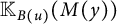
$\mathbb {K}_{B(u)} (M(y))$
 , then

The claim about the norm is also well known, but we add it here for completion. Since
$\Phi _{x,y}$
 is continuous, it suffices to prove the claim for
$\xi =\sum _{i=1}^{\ell } m_{i}\otimes n_{i}^{\mathrm {op}}$
 , a sum of elementary tensors. We have

where the norm on the right-hand side is the operator norm on
$\mathbb {K}_{B(u)}(M(x))$
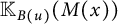 . Note that
 acts by
$\mathbb {K}_{B(u)}(M(x))$
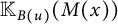 -adjointable operators, so that

Now,  by (DE4). Since
$k,n_{i}\in M(y)$
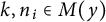 , we further know that
 . Recall that
 is a positive element of
$\mathbb{K}_{B(u)}(M(y))$
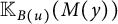 , so we can write it as
$T^*T$
 . In particular,

Since
$\left \| \sum _{i} m_{i}\otimes (Tn_{i})^{\mathrm {op}} \right \|\leq \left \| 1\otimes T \right \|\left \| \sum _{i} m_{i}\otimes n_{i}^{\mathrm {op}} \right \|$
 and
$\left \| 1\otimes T \right \|=\left \| T \right \|=\left \| k \right \|$
 , we conclude that

as claimed.
Bilinearity of
$\Phi _{x,y}$
 helps us prove the following result.
Lemma 3.12 For any  and any
$y\in Xu$
 , there exists a map

determined by

These maps have the following properties:
-
(U1) When restricted to a fibre $K(x,y^{\mathrm {op}})\times K(y,z^{\mathrm {op}}) \to K(x,z^{\mathrm {op}})$
,
$U_y$
is bilinear. -
(U2) Each $U_{y}$
satisfies
$\left \| U_{y}(\xi ,\eta ) \right \|\leq \left \| \xi \right \|\left \| \eta \right \|$
and
$\left \| U_{y} \big (\xi , \texttt {Flip}(\xi )\big ) \right \|= \left \| \xi \right \|^2$
. -
(U3) If $h\in u\mathcal {H}$
, then . -
(U4) We have $ \texttt {Flip} \big ( U_{y} (\xi ,\eta ) \big ) = U_{y} \Big ( \texttt {Flip}(\eta ),\texttt {Flip}(\xi ) \Big ) $
.






 .

Note that “equivariance” of U (Condition (U3)) is equivalent to commutativity of the following diagram for all
$x,z$
 :

Proof of Lemma 3.12
The existence of
$U_{y}$
 follows from observations of general Hilbert
$\mathrm {C}^{*}$
 -modules similar to those following Lemma 1.5: If
$\mathbf {X,Y,Z}$
 are full right-Hilbert
$\mathrm {C}^{*}$
 -modules over a
$\mathrm {C}^{*}$
 -algebra A, then the maps

determined by

are isomorphisms of bi-Hilbert
$\mathbb {K}_{A}(\mathbf {X})-\mathbb {K}_{A}(\mathbf {Z})$
 -modules. The above isomorphism can be precomposed with the universal bilinear map
$\mathbf {X}\otimes _{A}\mathbf {Y}^{\mathrm {op}} \times \mathbf {Y}\otimes _{A}\mathbf {Z}^{\mathrm {op}} \to {(\mathbf {X}\otimes _{A}\mathbf {Y}^{\mathrm {op}})} \otimes _{\mathbb {K}_{A}(\mathbf {Y})} {(\mathbf {Y}\otimes _{A}\mathbf {Z}^{\mathrm {op}})}$
 . We apply this to the case where
$\mathbf {Y}=M(y)$
 and
$A=B(u)$
 . Condition (U1) is therefore by construction.
(U2) Since the maps in (3.16) are isomorphisms of modules (in particular, they are isometric), we have
$ \left \| U_{y}(\xi ,\eta ) \right \|=\left \| \xi \otimes \eta \right \|$
 for
$\xi \in K(x,y^{\mathrm {op}})$
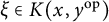 and
$\eta \in K(y,z^{\mathrm {op}})$
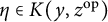 , which is known (or easily shown) to be bounded by
$\left \| \xi \right \|\left \| \eta \right \|$
 . In particular,
$U_{y}$
 is not just linear but also continuous on each fibre. For the second claim, it therefore suffices to consider one of the dense elements
$\xi = \sum _{i}m_{i}\otimes n_{i}^{\mathrm {op}}$
 in which case
$\texttt {Flip}(\xi ) = \sum _{j}n_{j}\otimes m_{j}^{\mathrm {op}}$
 and

Again, since the maps in (3.16) are isometric, we see that

which equals
$\left \| \xi \right \|^2$
 by Equation (3.2).
(U3) The properties of  and of
 imply that

whenever
$ m ,n_{1},n_{2}\in M$
 and
$b\in B$
 are chosen such that the left (and hence each) side of the above equations makes sense. Likewise, we have
 For
$h\in u\mathcal {H}$
 , suppose we are given elements
 . Then

Because of continuity and (bi)linearity of
$\Psi _{h}$
 and of
 , we conclude that
 , as claimed. One likewise checks that (U4) holds for for elementary tensors, and again uses (bi)linearity and continuity of
$U_{y}$
 and of
$\texttt {Flip}$
 to deduce the claim.
Similarly to how we constructed
$\Psi $
 in Lemma 3.4 out of the maps
$\Psi _{h}$
 from Lemma 3.3, we now want to “stich together” the maps
$\Phi _{x,y}$
 on the one hand and the maps
$U_{y}$
 on the other hand, to bundle maps. To do so, we first need a definition.
Definition 3.1 For two upper semi-continuous Banach bundles
$\mathscr {M}=(M\to X)$
 and
$\mathscr {N}=(N\to Y)$
 , consider the product bundle
$\mathscr {M}\times \mathscr {N} = (M\times N\to X\times Y)$
 ; the norm on its fibre over
$(x,y)$
 can be chosen as the maximum of the norms of
$M(x)$
 and
$N(y)$
 , and it is given the component-wise vector space structure. The global topology of the total space
$M\times N$
 of
$\mathscr {M}\times \mathscr {N}$
 is induced by the
$\mathbb {C}$
 -linear span of sections of the form
$ (x,y) \mapsto (\mu (x), \nu (y)), $
 where
$\mu $
 and
$\nu $
 are continuous sections of
$\mathscr {M}$
 respectively
$\mathscr {N}$
 .
If
$f\colon X\to Z$
 and
$g\colon Y\to Z$
 are continuous functions into some other topological space, then we write
 for the restriction of
$\mathscr {M}\times \mathscr {N}$
 to the closed subset
 of the base
$X\times Y$
 .
We now let  be given by
$\texttt {fir}(x, y^{\mathrm {op}})=x$
 respectively
$\texttt {sec}(x, y^{\mathrm {op}})=y$
 (“
$\texttt {fir}$
 ” for “first”, “
$\texttt {sec}$
 ” for “second”).
Lemma 3.13 Writing
$\Phi _{(x,y^{\mathrm {op}})}$
 for the map
$ \Phi _{x,y}$
 of Lemma 3.11, the map

is bilinear, jointly continuous, and covers the continuous surjection

Note that
$\Phi $
 is not a homomorphism of Banach bundles, since
$\Phi $
 is not fibrewise linear.
Proof Since
$\Phi _{x,y}$
 lands in
$M(x)$
 by construction,
$\Phi $
 covers
$(x,y^{\mathrm {op}},y) \mapsto x$
 . To see that
$\Phi $
 is jointly continuous, assume that we are given a convergent net
$(\xi _{\lambda },k_{\lambda })\to (\xi , k)$
 in
 , and let
$q (\xi _{\lambda },k_{\lambda }) = (x_{\lambda },y_{\lambda }^{\mathrm {op}}, y_{\lambda })$
 and
$q (\xi ,k) = (x,y^{\mathrm {op}},y)$
 ; note that
$x_{\lambda }\to x$
 and
$y_{\lambda }\to y$
 in X. To prove that
$\Phi (\xi _{\lambda },k_{\lambda })\to \Phi (\xi , k)$
 , fix
$\delta>0$
 ; we must find
$\kappa \in \Gamma _0(X;\mathscr {M})$
 with
$\left \| \Phi (\xi , k) - \kappa (x) \right \|<\delta $
 and
$\left \| \Phi (\xi _{\lambda },k_{\lambda }) - \kappa (x_{\lambda }) \right \|<\delta $
 for large
$\lambda $
 [Reference Duwenig and Li4, Lemma A.3].
Because of how the topology on
$\mathscr {K}$
 is defined and because
$\xi _{\lambda }\to \xi $
 in
$\mathscr {K}$
 , we can find finitely many nets
$m_{j,\lambda }\to m_{j}$
 and
$n_{j,\lambda } \to n_{j}$
 in M such that

Since  is jointly continuous, this implies that for each j,
 in B. Since
 is jointly continuous, this in turn implies that

That means that we can find a section
$\kappa $
 of
$\mathscr {M}$
 with

for all
$\lambda \geq \lambda _0$
 . Let
$\lambda $
 be large enough such that we also have
$|\left \| k_{\lambda } \right \|-\left \| k \right \|| < 1.$
 Linearity of
$\Phi $
 in the first component yields:

and the exact same computation with subscript-
$\lambda $
 ’s yields
$\left \| \Phi (\xi _{\lambda },k_{\lambda }) -\kappa (x_{\lambda }) \right \| < \delta $
 for large
$\lambda $
 , which proves the claim.
We proceed with stitching together the
$U_{y}$
 ’s.
Lemma 3.14 The map

is bilinear, jointly continuous, and covers the continuous surjection

Moreover, given
$\mu ,\xi ,\eta \in K$
 and
$m\in M$
 with
 and
 , we have

Proof To see that U is jointly continuous, assume that
$\{(\xi _{\lambda },\eta _{\lambda })\}_{\lambda }$
 is a net in
 that converges to
$(\xi ,\eta )$
 . Let
 , which converges to
 , and let
 , which converges to
 . Fix an arbitrary
$\delta \in (0,1)$
 ; by [Reference Duwenig and Li4, Lemma A.3], we should find a section
 with

for large
$\lambda $
 . Because of how the topology on
$\mathscr {K}$
 is defined and because
$\xi _{\lambda }\to \xi $
 ,
$\eta _{\lambda }\to \eta $
 in
$\mathscr {K}$
 , there exist elements

and elements

such that

for large
$\lambda $
 . Here, it is important to point out that
$\odot $
 refers to the algebraic tensor product, so each of the elements considered above is a finite sum of elementary tensors. Note that

so using bilinearity of U and continuity of
$\Phi $
 , the fact that
$\zeta _{\lambda }\to \zeta $
 and
$\chi _{\lambda }\to \chi $
 in K and that addition and scalar multiplication is continuous on
$\mathscr {K}$
 , imply that

for these particular sums of elementary tensors
$ \zeta _{\lambda }, \chi _{\lambda }$
 . This convergence means that we can find a section
$\kappa $
 of
$\mathscr {K}$
 with

Combining this with Condition (U2), we conclude for large
$\lambda $
 :

We likewise get for
$\lambda $
 large enough such that
$|\left \| \xi \right \|-\left \| \xi _{\lambda } \right \||$
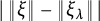 and
$ |\left \| \eta \right \|-\left \| \eta _{\lambda } \right \||$
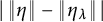 are bounded by
$1$
 ,

Note that

so that

We conclude that

as needed.
For (3.20), it likewise suffices to prove the claims for elementary tensors
$\mu =\ell \otimes m_{1}^{\mathrm {op}}$
 ,
$\xi =m_{2}\otimes n_{1}^{\mathrm {op}}$
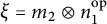 , and
$\eta =n_{2}\otimes k^{\mathrm {op}}$
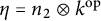 . The computations make use of
$\mathscr {B}$
 -linearity of
 and are left to the reader.
For the next result, we remind the reader that we denote the groupoid  by
$\mathcal {G}$
 and that we write
 and
 .
Lemma 3.15 On the quotient bundle
$\mathscr {A}=(p_{\mathscr {A}}\colon A\to \mathcal {G})$
 , the following map is well defined, continuous, and fibrewise bilinear:

given by

where U is as defined in Lemma 3.14 and
$h\in \mathcal {H}$
 is the unique element such that
$\texttt {sec}_{\mathscr {K}}(\xi ) = \texttt {fir}_{\mathscr {K}}\big (\Psi _{h}(\eta )\big )$
 .
Remark 3.16 If 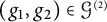 , we may choose representatives
$(x,y^{\mathrm {op}})$
 and
$(y^{\mathrm {op}},z)$
 of
$g_{1}$
 respectively
$g_{2}$
 . If we then identify the fibres
$A(g_{1}), A(g_{2})$
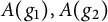 with
$K(x,y^{\mathrm {op}})=M(x)\otimes _{\sigma (x)}M(y)^{\mathrm {op}}$
 and
$K(y,z^{\mathrm {op}})$
 via (3.8), then the map
 is fibrewise on dense spanning sets given by

Proof of Lemma 3.15
Since  , the map
 is well defined. Since
$U_{y}$
 and
$\Psi _{h}$
 are linear, linearity of
 follows directly from the definition of the fibrewise Banach space structure on
$\mathscr {A}$
 .
To see that it is continuous, we will invoke openness of the quotient map Q: Suppose
$\{\chi _{\lambda }\}_{\lambda }$
 is a net in
 which converges to
$\chi $
 . Since it suffices to show that a subnet of
 converges to
 , we can without loss of generality assume that the entire net
$\{\chi _{\lambda }\}_{\lambda }$
 lifts to a net
$\{(\xi _{\lambda }, \eta _{\lambda })\}_{\lambda }$
 in
$K\times K$
 that converges to a lift
$(\xi ,\eta )$
 of
$\chi $
 (here, we have made use of [Reference Williams28, Proposition 1.1 (Fell’s criterion)] for the open map Q). Denote
$q_{\mathscr {K}}(\xi _{\lambda })=(x_{\lambda }, y_{\lambda }^{\mathrm {op}})$
 . Since
 , we may let
$h_{\lambda },h\in \mathcal {H}$
 be the unique elements such that
$q_{\mathscr {K}}\big (\Psi _{h_{\lambda }}(\eta _{\lambda })\big )=(y_{\lambda }, z_{\lambda }^{\mathrm {op}})$
 and
$q_{\mathscr {K}}\big (\Psi _{h}(\eta )\big )=(y, z^{\mathrm {op}})$
 for some
$z_{\lambda },z\in X$
 . Since
$\xi _{\lambda }\to \xi $
 , it follows that
$y_{\lambda }\to y$
 . Since
$\eta _{\lambda }\to \eta $
 and
$q_{\mathscr {K}}\big (\Psi _{h_{\lambda }}(\eta _{\lambda })\big )=(y_{\lambda }, z_{\lambda }^{\mathrm {op}})$
 , we further have that
 . Since both
$y_{\lambda }$
 and
 converge, it follows from properness and freeness of the
$\mathcal {H}$
 -action on X that a subnet of
$\{h_{\lambda }\}_{\lambda }$
 converges to h; again, without loss of generality we can assume that the entire net converges. By continuity of
$\Psi $
 , we conclude that
$ \Psi _{h_{\lambda }}(\eta _{\lambda })\to \Psi _{h} (\eta ) $
 . Since U is jointly continuous by Lemma 3.14, we therefore have

in K, which suffices since Q is continuous.
We arrive at our first main result.
Theorem 3.17 With respect to the multiplication in Lemma 3.15 and the involution in Corollary 3.10, the upper semi-continuous Banach bundle
$\mathscr {A}$
 described in Lemma 3.8 is a saturated Fell bundle over the groupoid
$\mathcal {G}=X\times _{\mathcal {H}} X^{\mathrm {op}}$
 , called the imprimitivity Fell bundle of
$\mathscr {M}$
 .
Proof We will check the conditions as stated in [Reference Duwenig and Li4, Definition 2.9]. It is clear that multiplication  is bilinear and that
 is conjugate linear and self-inverse; this takes care of Conditions (F2), (F6), and (F8). For the following, fix
 , and let
$h\in \mathcal {H}$
 be the unique element such that
$q_{\mathscr {K}}(\xi )=(x,y^{\mathrm {op}})$
 and
$q_{\mathscr {K}}(\Psi _{h}(\eta ))=(y,z^{\mathrm {op}})$
 , meaning that
 .
(F1) Since
$U_{y}\big ( \xi , \Psi _{h}(\eta )\big )\in K(x,z^{\mathrm {op}})$
 and since
$p_{\mathscr {A}}([\xi ])=[q_{\mathscr {K}}(\xi )]$
 , we get the first and last equality in the following computation:

(F3) Associativity of the multiplication can be shown using uniqueness of h, the second identity in (3.20), commutativity of Diagram (3.15), and the fact that
$\Psi _{hh'}=\Psi _{h}\circ \Psi _{h'}$
 ; the details are left as an exercise.
(F4) The definition of the norm on the fibres of
$\mathscr {A}$
 implies that

proving that multiplication is norm-decreasing.
(F5) Since
$p_{\mathscr {A}}([\xi ]^*)= [q_{\mathscr {K}}(\texttt {Flip}(\xi ))]$
 and since
 in
$\mathcal {G}$
 , we have that
 maps
$A(g)$
 to
 .
(F7) We must show that
$([\xi ]\cdot [\eta ])^*=[\eta ]^*\cdot [\xi ]^*$
 . We have

which is exactly
$[\eta ]^*\cdot [\xi ]^*$
 .
(F9) It is clear that
$\|[\xi ]\| = \|[\xi ]^*\|$
 . To show
$\|[\xi ]\cdot [\xi ]^*\| =\|[\xi ]\|^2$
 , note that
 has
$q_{\mathscr {K}}(\eta )=(y,x^{\mathrm {op}})$
 ; in particular,
 is the unique element of
$\mathcal {H}$
 with
$\texttt {sec}_{\mathscr {K}}(\xi ) = \texttt {fir}_{\mathscr {K}}\big (\Psi _{u}(\eta )\big )$
 . Since
$\Psi _{u}$
 is the identity, we conclude that

which has norm equal to
$\left \| \xi \right \|^2=\left \| [\xi ] \right \|^2$
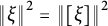 by (U2), as needed.
(F10) To see that
$[\xi ]\cdot [\xi ]^* \geq 0$
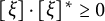 , we again invoke [Reference Raeburn and Williams24, Lemma 2.65]: The matrix with
$i,j$
 -entry
 is positive, so there exists a matrix
$(b_{i,j})_{i,j}$
 over
$B(u)$
 such that
 . In particular, the
$B(u)$
 -balancing in
$M(x)\otimes _{u}M(y)^{\mathrm {op}}$
 allows us to write

If we let  , then this combined with (3.17) shows that

Since the element
$\mathbf {x}_{l}\otimes \mathbf {x}_{l}^{\mathrm {op}}$
 of
$K(x,x^{\mathrm {op}})$
 is positive (it corresponds to the positive operator
 in
$\mathbb {K}_{B(u)}(M(x))$
 ), and since the algebra
$A([x,x^{\mathrm {op}}])$
 is *-isomorphic to
$K(x,x^{\mathrm {op}})$
 (see Remark 3.16), the claim follows.
Lastly, to see that
$\mathscr {A}$
 is saturated, we must show that the linear span of elements of the form
$[\xi ]\cdot [\eta ]$
 for
$[\xi ]\in A([x,y^{\mathrm {op}}])$
 and
$[\eta ]\in A([y,z^{\mathrm {op}}])$
 is dense in
$A([x,z^{\mathrm {op}}])$
 . When we consider that
$A([x,y^{\mathrm {op}}])\cong M(x)\otimes _{u}M(y)^{\mathrm {op}}$
 and that these isomorphisms respect the multiplicative and linear structure we defined on
$\mathscr {A}$
 , then the claim follows directly from the first isomorphism in Equation (3.16).
4 Equivalence from the imprimitivity Fell bundle to the “coefficient bundle”
We now proceed to equip the right
$\mathscr {B}$
 -demi-equivalence
$\mathscr {M}$
 with the structure of a left
$\mathscr {A}$
 -demi-equivalence, where
$\mathscr {A}=(p_{\mathscr {A}}\colon A\to \mathcal {G})$
 is the quotient of
 by the equivalence relation
$\mathbin {\texttt {R}}$
 defined in Lemma 3.5; we have shown in Theorem 3.17 that
$\mathscr {A}$
 is a Fell bundle.
Proposition 4.1 There is a map  given by

where
$y=q_{\mathscr {M}}(m)$
 and where
 is the unique element such that
$q_{\mathscr {K}}(\Psi _{h}(\xi ))=(x,y^{\mathrm {op}})$
 . This map furthermore has the following properties.Footnote
6
-
(LA1) It covers the map
; and -
(LA2)
for all appropriate
$b\in B$
.
 ; and
 for all appropriate

Of course,  will turn out to be an action in the sense of [Reference Duwenig and Li4, Definition 2.10]; in particular, it is continuous, which one can indeed show by hand. But thanks to Proposition 2.3, we can make do with proving fewer properties.
Proof of Proposition 4.1
Write
$p_{\mathscr {A}}([\xi ])=[x_{1},x_{2}^{\mathrm {op}}]$
 . Since
 , we have
$s_{\mathcal {G}}([x_{1},x_{2}^{\mathrm {op}}])=\rho _{\mathscr {M}} (m)=[y,y^{\mathrm {op}}]$
 , which means that there exists a unique
$h\in \mathcal {H}$
 such that
 . Now that the second component is fixed as
$y^{\mathrm {op}}$
 , the first component
 is also uniquely determined, and satisfies
$\sigma (x)=s_{\mathcal {H}}(h)$
 . In other words, we have argued that the equality
$s_{\mathscr {A}}([\xi ])=\rho _{\mathscr {M}} (m)$
 implies that there exists a unique representative
$\Psi _{h}(\xi )\in K$
 of the
$\mathbin {\texttt {R}}$
 -equivalence class
$[\xi ]$
 for which
$q_{\mathscr {K}}(\Psi _{h}(\xi ))$
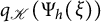 has
$q_{\mathscr {M}}(m)^{\mathrm {op}}$
 as its second component:
$\Psi _{h}(\xi )\in M(x)\otimes _{\sigma (x)} M(y^{\mathrm {op}})$
 . We can now invoke Lemma 3.11 to conclude that
 is a well-defined element of
$M(x)$
 .
(LA1) Follows from  .
(LA2) We compute

so that bilinearity and continuity of
$\Phi $
 implies

for any appropriate
$\eta \in K$
 . The claim follows.
Proposition 4.2 The map  given by

has the following properties.Footnote 7
-
(LIP1) It covers the map
, meaning that ; -
(LIP2) it is continuous and fibrewise linear in the first and antilinear in the second component;
-
(LIP3)
; -
(LIP4)
for all
$[\xi ]\in A$
with
$s_{\mathscr {A}}([\xi ])=\rho _{\mathscr {M}}(m )$
; and -
(LIP5)
.
 , meaning that
 ;
 ;
 for all


 .
Proof The map is clearly well defined. Property (LIP1) follows immediately from Equation (1.3).
(LIP2) Sesquilinearity is obvious. For continuity, it suffices to check that the map  ,
$(m,n)\mapsto m\otimes n^{\mathrm {op}}$
 , is continuous since the quotient map
${\mathscr {K}\to \mathscr {A}}$
 is continuous. But said continuity is built into the definition of
$\mathscr {K}$
 ’s topology; see Lemma 3.1.
(LIP3) Follows from the definition of the involution
${}^*$
 on
$\mathscr {A}$
 .
(LIP4) Recall from Proposition 4.1 that

where
$y=q_{\mathscr {M}}(m_{1})$
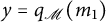 and where
 is the unique element such that
$q_{\mathscr {K}}(\Psi _{h}(\xi ))=(x,y^{\mathrm {op}})$
 , so that

so (LIP4) holds.
(LIP5) Let
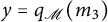
$y=q_{\mathscr {M}}(m_{3})$
 and let
$h\in \mathcal {H}$
 and
$x\in X$
 be the unique elements such that
${q_{\mathscr {K}}(\Psi _{h}(m_{1}\otimes m_{2}^{\mathrm {op}}))}={(x,y^{\mathrm {op}})}$
 . Because of (3.4), we know that
 and
 . In particular, we can approximate
$m_{1}$
 by
 for finitely many
$n_{i}\in M(x)$
 and
$b_{i}\in B(h)$
 . In the following final computation, the first instance of
$\approx $
 is valid because
$\Phi _{x,y}$
 and
$\Psi _{h}$
 are continuous and linear (see (
$\Psi $
 2)), and the second because the right
$\mathscr {B}$
 -action on
$\mathscr {M}$
 is continuous by (DE16).

Corollary 4.3 The saturated Fell bundle
$\mathscr {A}$
 is equivalent to
$\mathscr {B}$
 via
$\mathscr {M}$
 with the
$\mathscr {A}$
 -action and
$\mathscr {A}$
 -inner product specified in Propositions 4.1 and 4.2, respectively. In particular, the left action is continuous.
$\blacktriangleright $
 For the remainder of the paper, we will frequently denote the imprimitivity Fell bundle
$\mathscr {A}$
 of
$\mathscr {M}$
 by
$\mathscr {A}=\mathscr {M}\otimes _{\mathscr {B}}\mathscr {M}^{\mathrm {op}}$
 in analogy with
$X\times _{\mathcal {H}} X^{\mathrm {op}}$
 and with
$\mathbf {X}\otimes _{A}\mathbf {X}^{\mathrm {op}}$
 . However, the notation
$\mathscr {A}=\mathbb {K}(\mathscr {M}_{\mathscr {B}})$
 also lends itself well and has the advantage that it makes explicit reference to the underlying bundle
$\mathscr {B}$
 (and the fact that it is acting on the right-hand side).
Proof of Corollary 4.3
We first check that
$\mathscr {M}$
 is a left
$\mathscr {A}$
 -demi-equivalence. In the following lists, all references are either to Proposition 4.1 or to Proposition 4.2.
-
(DE1) was shown in (LA1);
-
(DE2) was shown in (LIP1);
-
(DE3) was shown in (LIP2);
-
(DE4) was shown in (LIP4); and
-
(DE5) was shown in (LIP3).
For the remaining conditions necessary for a demi-equivalence that we have not checked previously, note that each
$M(x)$
 is a full right-Hilbert
$\mathrm {C}^{*}$
 -module by (DE9), and so it is an imprimitivity bimodule between
$M(x)\otimes _{u} M(x)^{\mathrm {op}}$
 and
$B(u)$
 for
 . All structure with which we equipped the bundle
$\mathscr {A}$
 is compatible with the homeomorphism
$A(\rho (x))\cong M(x)\otimes _{u} M(x)^{\mathrm {op}}$
 in Lemma 3.7; in other words, with the restriction to
$M(x)$
 of the given
$\mathscr {A}$
 -action and
$\mathscr {A}$
 -inner product on
$\mathscr {M}$
 , we recover exactly the structure that
$M(x)$
 naturally carries. In particular:
-
(DE6): We have
in the
$\mathrm {C}^{*}$
-algebra
$A(\rho _{\mathscr {M}}(m))$
, and only if
$m=0$
. -
(DE7): By [Reference Raeburn and Williams24, Lemma 2.30], the norm of
in
$B(\sigma (x))$
coincides with the norm of
$m\otimes m^{\mathrm {op}}$
in
$M(x)\otimes _{u}M(x)^{\mathrm {op}}$
which, by definition, is exactly the norm of in
$A(\rho (x))$
. Since
$\mathscr {M}$
is a right
$\mathscr {B}$
-demi-equivalence, the norm agrees with the norm that the upper semi-continuous Banach bundle
$\mathscr {M}$
already carries, which is therefore in turn identical to the norm . -
(DE8): For each $x\in X$
, the linear span of is dense in
$A(\rho (x))$
, since
$M(x)$
is an imprimitivity bimodule.
 in the


 only if

 in



 in


 agrees with the norm that the upper semi-continuous Banach bundle

 .

 is dense in


That
$A(\rho (x))\cong M(x)\otimes _{u}M(x)^{\mathrm {op}}$
 further implies that Assumption (2) of Proposition 2.3 is satisfied. Since Assumptions (1) and (3) were shown in (LA2) and (LIP5), respectively, we can conclude that
$\mathscr {M}$
 is an equivalence by Proposition 2.3.
5 The imprimitivity Fell bundle: Uniqueness
For the next result, we remind the reader of Remark 1.1: given a
$(\mathcal {G},\mathcal {H})$
 -groupoid equivalence X and two elements
$x,y\in X$
 with the same
$\mathcal {H}$
 -anchor, we write
 for the unique element of
$\mathcal {G}$
 that satisfies
 .
Proposition 5.1 (cf. [Reference Abadie and Ferraro1, Corollary 3.11])
Suppose
$\mathscr {A} =(A\to \mathcal {G})$
 ,
$\mathscr {A}' =(A'\to \mathcal {G}')$
 , and
$\mathscr {B}=(B\to \mathcal {H})$
 are Fell bundles over groupoids
$\mathcal {G},\mathcal {G}',\mathcal {H}$
 respectively, and that
$\mathscr {M}=(q_{\mathscr {M}}\colon M\to X)$
 is both an
$(\mathscr {A},\mathscr {B})$
 - and an
$(\mathscr {A}', \mathscr {B})$
 -Fell bundle equivalence. Then there exists a unique Fell bundle isomorphism
$\Omega \colon \mathscr {A}\to \mathscr {A}'$
 determined by the following commutative diagram.

Proof of Proposition 5.1
By Corollary 4.3, we may without loss of generality assume that
$\mathscr {A}=\mathscr {M}\otimes _{\mathscr {B}}\mathscr {M}^{\mathrm {op}}$
 and
$\mathcal {G}=X\times _{\mathcal {H}}X^{\mathrm {op}}$
 . In that setting,
 is exactly
$[q_{\mathscr {M}}(m),q_{\mathscr {M}}(n)] \in \mathcal {G}$
 ; see Lemma 1.3. We also remind the reader that
 , is known to be an isomorphism of topological groupoids. It is therefore clear that
$\mathscr {A}'\cong \omega ^*(\mathscr {A}')$
 , and so we may without loss of generality assume that
$\mathcal {G}'=\mathcal {G}$
 (and hence
$\omega =\operatorname {id}$
 and
$\mathscr {A}' = \omega ^*(\mathscr {A}')$
 ). As before, we will denote the anchor maps of X by
 and
 . Recall that
 via
 .
To construct
$\Omega $
 , we will first construct a surjective bundle map
$ \tilde {\Omega } \colon \mathscr {K} \to \mathscr {A}' $
 covering the quotient map
 . We will then show that
$\tilde {\Omega }$
 is constant on
$\mathbin {\texttt {R}}$
 -equivalence classes (where
$\mathbin {\texttt {R}}$
 is as in Lemma 3.5), so that
$\tilde {\Omega }$
 induces a bundle map
$\Omega $
 from the quotient
$\mathscr {M}\otimes _{\mathscr {B}}\mathscr {M}^{\mathrm {op}} = Q(\mathscr {K})$
 to
$\mathscr {A}'$
 covering the identity map
$\mathcal {G}\to \mathcal {G}$
 . After we have shown that
$\Omega $
 is injective, we will then prove the conditions in [Reference Duwenig and Li4, Propositions A.7 and A.8] to deduce that
$\Omega $
 is open and continuous and hence the claimed isomorphism of Fell bundles.
We define
$\tilde {\Omega }$
 fibrewise. Fix
 and
$x,y\in Xu$
 , let
 , and consider

By the assumption on the left
$\mathscr {A}'$
 -valued inner product on
$\mathscr {M}$
 , this map is bilinear. Moreover, by [Reference Duwenig and Li4, Corollary 4.6]Footnote
8
, we have
 for all
$b\in B(u)$
 , meaning that the map in (5.1) descends to a linear map

determined by

where
$M(x)\odot _{B(u)}M(y)^{\mathrm {op}}$
 denotes the balanced algebraic tensor product.
We claim that
$\tilde {\Omega }_{(x,y^{\mathrm {op}})}$
 has dense range. Since
$\mathscr {A}'$
 is a Fell bundle,
$A'(g)$
 is an
 -imprimitivity bimodule, so by [Reference Raeburn and Williams24, Proposition 2.33 (Hewitt-Cohen)], any element of
$ A'(g)$
 can be written as
 for some
$a_{g}\in A'(g)$
 and some
 , where the product is the multiplication in the Fell bundle
$\mathscr {A}'$
 . By assumption,
$M(y)$
 is a
 -imprimitivity bimodule. In particular,
 is dense in
 , meaning we can approximate
 by linear combinations of elements of the form
 for
$n',n\in M(y)$
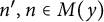 . Since
 and
 , we conclude that the arbitrary element
 of
$ A'(g)$
 can be approximated by linear combinations of elements of the form
 for
$m\in M(x),n\in M(y)$
 , as claimed.
Since
$\mathscr {M}$
 is an equivalence,
$M(x)$
 is an imprimitivity bimodule between
 and
$B(\sigma (x))=B(u)$
 , so that there exists a canonical isomorphism
 of
$\mathrm {C}^{*}$
 -algebras. In particular, the norm with which we equip
$M(x)\odot _{B(u)}M(y)^{\mathrm {op}}$
 , is unambiguously given by Equation (3.2) and, using the
$*$
 -isomorphism, can be rewritten to

Using the properties [Reference Duwenig and Li4, Definition 2.9, (F9)] and [Reference Duwenig and Li4, Definition 2.11, (FE2.b), (FE2.c), (FE2.d)], we therefore see that each
$ \tilde {\Omega }_{(x,y^{\mathrm {op}})}$
 is isometric and hence extends to a map on the completion
$K(x,y^{\mathrm {op}})$
 of
$M(x)\odot _{B(u)}M(y)^{\mathrm {op}}$
 . All in all, we get a fibrewise linear map

determined by

covering the quotient map  .
Next, fix  ,
$h\in u\mathcal {H} v$
 , and
$x\in Xu$
 ,
$y\in Xv$
 . For an arbitrary but fixed element
 of
 , we have

Since
$\tilde {\Omega }_{(x,y^{\mathrm {op}})}(\Psi _{h}(\xi ))=\tilde {\Omega }_{(x,y^{\mathrm {op}})}(\xi )$
 for all
$\xi $
 in the algebraic tensor product, we conclude that
$\tilde {\Omega }$
 descends to a bundle map

covering the identity map
$\mathcal {G}\to \mathcal {G}$
 . We must now show that this map is a continuous open bijection.
Since
$\Omega $
 covers the identity map, surjectivity of
$\Omega $
 follows from the fact that each
$\tilde {\Omega }_{(x,y^{\mathrm {op}})}$
 has dense range, and injectivity of
$\Omega $
 follows since each
$\tilde {\Omega }_{(x,y^{\mathrm {op}})}$
 is isometric. To see that
$\Omega $
 is continuous, suppose that we have a convergent net in
$\mathscr {A}=\mathscr {M}\otimes _{\mathscr {B}}\mathscr {M}^{\mathrm {op}}$
 , say
$[\xi _{\lambda }]\to [\xi ]$
 ; by
$(2)\implies (1)$
 in [Reference Munkres23, Theorem 18.1], it suffices to show that a subnet of
$\{\Omega ([\xi _{\lambda }])\}_{\lambda }$
 converges to
$\Omega ([\xi ])$
 . Since the quotient map
$Q\colon \mathscr {K}\to \mathscr {A}$
 is open (Lemma 3.5), we can without loss of generality assume that
$\xi _{\lambda }\to \xi $
 in
$\mathscr {K}$
 . Let
$q_{\mathscr {K}}(\xi _{\lambda })=(x_{\lambda },y_{\lambda }^{\mathrm {op}})$
 with limit
$q_{\mathscr {K}}(\xi )=(x,y)$
 in
 . We now invoke the definition of the topology on
$\mathscr {K}$
 (Lemma 3.1; see also [Reference Duwenig and Li4, Lemma A.3]): for any given
$\epsilon>0$
 , we can find finitely many continuous sections
$\mu _{i},\nu _{i}$
 of
$\mathscr {M}$
 and a
$\lambda _0$
 such that for all
$\lambda \geq \lambda _0$
 , we have

The norm on each fibre
$A([x,y^{\mathrm {op}}])$
 of
$\mathscr {A}$
 is defined as the norm on one of its lifts under Q, meaning that Q restricted to
$M(x)\otimes _{u}M(y)^{\mathrm {op}}$
 is isometric. Since
$\Omega $
 is likewise isometric, (5.2) implies

By definition of
$\Omega $
 ,

By assumption on
$\mathscr {M}$
 ,
 is continuous, so that continuity of
$\mu _{i},\nu _{i}$
 and of addition in
$\mathscr {A}$
 implies

Combining (5.3) with Lemma B.1, we conclude that
$\Omega ([\xi _{\lambda }])\to \Omega ([\xi ])$
 , so
$\Omega $
 is continuous. Lastly, since
$\Omega $
 is isometric, it follows from [Reference Duwenig and Li4, Proposition A.8] that
$\Omega $
 is open as well.
This also finishes the proof of the main theorem, Theorem 1.6, since it is a combination of Corollary 4.3 and Proposition 5.1.
Remark 5.2 A brief comment on another property related to equivalences that has a version not only in the realm of groupoids and
$\mathrm {C}^{*}$
 -algebras but also of Fell bundles: linking objects.
By [Reference Raeburn and Williams24, Theorem 3.19], two
$\mathrm {C}^{*}$
 -algebras are strongly Morita equivalent if and only if they are complementary full corners of another algebra, called the linking algebra. In [Reference Sims and Williams27, Theorem 4.1], this result was moved into groupoid-land: an equivalence of groupoids gives rise to a linking groupoid whose
$\mathrm {C}^{*}$
 -algebra is the linking algebra that witnesses the strong Morita equivalence. Likewise, a Fell bundle equivalence has a linking (Fell) bundle (see [Reference Sims and Williams26, Section 3], [Reference Abadie and Ferraro1, Theorem 3.2]) whose
$\mathrm {C}^{*}$
 -algebra is the linking algebra of the Fell bundle
$\mathrm {C}^{*}$
 -algebras [Reference Sims and Williams26, Theorem 14].
It would be interesting to study whether “one-sided” versions of these linking objects exist. In the paper at hand, we considered principal groupoid-spaces X, full right-Hilbert
$\mathrm {C}^{*}$
 -modules
$\mathbf {X}$
 , and Fell bundle-demi-equivalences
$\mathscr {M}$
 , and turned them into equivalences between the coefficient object and the “generalized compacts”, that is, the imprimitivity groupoid
$X\times _{\mathcal {H}} X^{\mathrm {op}}$
 , the
$\mathrm {C}^{*}$
 -algebra of compact operators
$\mathbb {K}(\mathbf {X}_A)$
 , and the imprimitivity Fell bundle
$\mathscr {M}\otimes _{\mathscr {B}}\mathscr {M}^{\mathrm {op}} = \mathbb {K}(\mathscr {M}_{\mathscr {B}})$
 , respectively. Do these results have analogs in the language of linking objects?
6 Applications
The original impetus for the paper at hand was Proposition A.2.3 in the appendix of [Reference Mesland and Sengun19]; it can easily seen to be a corollary of our main theorem in the special case that
$\mathcal {H}$
 is a group that acts freely and properly on a space X. Before we study other interesting applications, let us first do some sanity checks. In analogy to the isomorphism of imprimitivity groupoids in Example 1.2, we have:
Corollary 6.1 Let
$\mathscr {B}$
 be a Fell bundle, considered as a self-Fell bundle equivalence [Reference Muhly and Williams22, Example 6.6]. Then there is an isomorphism of Fell bundles
$\mathbb {K}(\mathscr {B}_{\mathscr {B}})=\mathscr {B}\otimes _{\mathscr {B}}\mathscr {B}^{\mathrm {op}}\cong \mathscr {B}$
 determined by
$[b_{1}\otimes b_{2}^{\mathrm {op}}]\mapsto b_{1}\cdot b_{2}^*$
 .
In analogy to the isomorphism of Hilbert
$\mathrm {C}^{*}$
 -bimodules in (3.16), we have:
Corollary 6.2 Suppose that
$\mathscr {M}$
 ,
$\mathscr {N}$
 ,
$\mathscr {K}$
 are right
$\mathscr {B}$
 -demi-equivalences, and let
$\mathscr {A}=\mathbb {K}(\mathscr {N}_{\mathscr {B}})$
 be the imprimitivity Fell bundle of
$\mathscr {N}$
 . Then
$(\mathscr {M} \otimes _{\mathscr {B}}\mathscr {N}^{\mathrm {op}})\otimes _{\mathscr {A}} (\mathscr {N}\otimes _{\mathscr {B}} \mathscr {K}^{\mathrm {op}})\cong \mathscr {M} \otimes _{\mathscr {B}}\mathscr {K}^{\mathrm {op}}$
 as upper semi-continuous Banach bundles.
Proof sketch
First, let us make sure that the objects we have written down are not nonsense: By Theorem 1.6, all three demi-equivalences are equivalences between their respective imprimitivity Fell bundles and
$\mathscr {B}$
 . As explained in [Reference Muhly and Williams22, Example 6.7], their opposites are then likewise equivalences, just in the other direction. It was shown in [Reference Duwenig and Li4] that equivalences can be concatenated:
$\mathscr {M} \otimes _{\mathscr {B}}\mathscr {N}^{\mathrm {op}}$
 is an equivalence from the imprimitivity Fell bundle of
$\mathscr {M}$
 to
$\mathscr {A}$
 , and so forth. In particular, both the left- and the right-hand side of the alleged isomorphism is an equivalence between the imprimitivity Fell bundle of
$\mathscr {M}$
 and that of
$\mathscr {K}$
 .
Since the balanced tensor product of imprimitivity bimodule is associative, it is easy to see that the same is true for
$\otimes _{\mathscr {B}}$
 of Fell bundle equivalences. In particular,

By Proposition 5.1 (applied to
$\mathscr {N}^{\mathrm {op}}$
 ), the Fell bundle
$\mathbb {K}(\mathscr {N}^{\mathrm {op}}_{\mathscr {A}})=\mathscr {N}^{\mathrm {op}}\otimes _{\mathscr {A}} \mathscr {N}$
 is isomorphic to
$\mathscr {B}$
 . Since the balanced tensor product of imprimitivity bimodule absorbs the coefficient algebra (meaning that
$\mathbf {X}\otimes _{A} A\cong \mathbf {X}$
 ), it is easy to see that
$\otimes _{\mathscr {B}}$
 absorbs the coefficient Fell bundle. Thus,

as claimed.
We can also conclude some other, well-known results.
Corollary 6.3 Suppose
$\mathcal {H}$
 is a locally compact Hausdorff groupoid with Haar system
 and
$\mathscr {B}$
 is a Fell bundle over
$\mathcal {H}$
 . Then
$\mathrm {C}^{*}(\mathscr {B})$
 is strongly Morita equivalent to
$\mathrm {M}_n(\mathrm {C}^{*}(\mathscr {B}))$
 .
Note that the right choice of
$\mathscr {B}$
 allows
$\mathrm {C}^{*}(\mathscr {B})$
 to model the full
$\mathrm {C}^{*}$
 -algebras of groupoids (with or without a twist á la Kumjian) and full crossed product
$\mathrm {C}^{*}$
 -algebras.
Proof Take
$X=\mathcal {H}$
 , with
 the source map of
$\mathcal {H}$
 . The existence of a Haar system implies that the source map of
$\mathcal {H}$
 (and hence the anchor map of X) is open [Reference Williams28, Proposition 1.23], so we are in good shape to use our main theorem, provided we can find the right
$\mathscr {B}$
 -demi-equivalence. Let
$\mathscr {M}$
 to be the bundle over X with fibres
 for each
$h \in \mathcal {H}$
 . We define

and

where we choose the inner product on  to be conjugate linear in the first coordinate to match up with our definitions of Hilbert
$\mathrm {C}^{*}$
 -modules. Then, using Corollary 6.1, it is easy to see that

where
$\vec {e}_{i}$
 is the standard basis vector of
 and
$E_{i,j}$
 is the matrix unit with a
$1$
 in the
$i^{\text {th}}$
 row and
$j^{\text {th}}$
 column and
$0$
 s everywhere else. By Theorem 1.6, the bundles
$\mathscr {B}$
 and
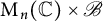 are equivalent. By [Reference Muhly and Williams22, Theorem 6.4], it follows that
$\mathrm {C}^{*}(\mathscr {B})$
 is strongly Morita equivalent to
 .
6.1 Kumjian’s Stabilization trick
In this subsection, we will see that our main theorem implies [Reference Kumjian17, Corollary 4.5], which in its original form was only shown for principal r-discrete groupoids. The approach here is inspired by that preceding [Reference Muhly20, Theorem 15]. We will go through it in great detail to help the reader understand our technical results.
We start with a (saturated) Fell bundle
$\mathscr {B}=(B\to \mathcal {H})$
 over a locally compact Hausdorff groupoid
$\mathcal {H}$
 with Haar system
 . Fix
$h\in \mathcal {H} $
 , and let
 and
 . We define
 , sections of the restriction of
$\mathscr {B}$
 to
 . If
$g\in \mathcal {H}$
 is another element with
$r(g)=v$
 , then we define a sesquilinear form

by

Note that this indeed makes sense: if
$\ell \in \mathcal {H} s(g)$
 , then
$\ell $
 is in the domain of
$\mu $
 and
 is defined. Moreover,
 , so
 is in the domain of
$\xi $
 . Since
 and
 , their product is indeed an element of
 . And since
$\mu $
 and
$\xi $
 are compactly supported, the integral exists.
For
$h=g$
 , the form is valued in the
$\mathrm {C}^{*}$
 -algebra
$B(u)$
 , so we may take the completion
$M(h)$
 of
$M_0(h)$
 with respect to the induced norm

If
$k\in u\mathcal {H} w$
 , so that
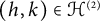 , then the fibre
$B(k)$
 can act on an element
$\xi $
 of
$M_0(h)$
 and deliver an element
 of
$M_0(hk)$
 : if
$\ell $
 is in
$\mathcal {H} w$
 (the domain of any element of
$M_0(hk)$
 ), then
 is in the domain of
$\xi $
 and so

This extends to a map
$M(h)\times B(k)\to M(hk)$
 . In fact, it induces an isomorphism
$M(h)\otimes _{u} B(k)\cong M(hk)$
 of right-Hilbert
$\mathrm {C}^{*}$
 -
$B(w)$
 -modules.
We let
$\mathscr {M} = (q_{\mathscr {M}}\colon M\to \mathcal {H})$
 be the bundle with fibres
$M(h)$
 , which we will now topologize. If
$\tau \in \Gamma _c (\mathcal {H};\mathscr {B})$
 is a section of
$\mathscr {B}$
 and
$h\in \mathcal {H} u$
 is arbitrary, then
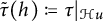 is a continuous, compactly supported section
$\mathcal {H} u \to \mathscr {B}$
 ; i.e.,
$\tilde {\tau }(h)$
 is an element of
$M(h)$
 , so
$\tilde {\tau }$
 is a section of the bundle
$\mathscr {M}$
 . The family
$ \{ \tilde {\tau } \colon \tau \in \Gamma _c (\mathcal {H};\mathscr {B})\} $
 uniquely induces a topology on
$\mathscr {M}$
 making it upper semi-continuous. The attentive reader will have expected what comes next: we will show that
$\mathscr {M}$
 is a right
$\mathscr {B}$
 -demi-equivalence over the principal
$\mathcal {H}$
 -space
$X=\mathcal {H}$
 (Example 1.2).
Remark 6.4 Let us compare what we have done so far with what was done in [Reference Muhly20, Reference Kumjian17]; this will also give us an indicator as to what will happen next. Muhly constructs first an upper semi-continuous Banach bundle  , which is exactly
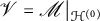 and which Kumjian calls the “Hilbert
 -module bundle over
 ” in [Reference Kumjian17, Section 4.2]; he points out that
$\mathscr {V}$
 is full.
From
$\mathscr {V}$
 , they then construct a bundle
$\mathscr {E}=(E\to \mathcal {H})$
 ; in the notation of the paper at hand,
$\mathscr {E}$
 can be constructed as the pullback bundle of

along the isomorphism  .Footnote
9
It is then shown that
$\mathscr {E}$
 is an equivalence between
$\mathscr {B}$
 and the semi-direct product Fell bundle of a certain
$\mathcal {H}$
 -action on another bundle which Kumjian and Muhly denote by
$\mathcal {K}(\mathscr {V})$
 . Following [Reference Kumjian17, Section 1.7],
$\mathcal {K}(\mathscr {V})$
 is the
$\mathrm {C}^{*}$
 -algebraic bundle with fibre
$\mathbb {K} (V(u)_{B(u)})$
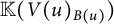 over
 . It is apparent that
$\mathcal {K}(\mathscr {V})$
 coincides with our
 , the imprimitivity Fell bundle of the right
 -demi-equivalence
$\mathscr {V}$
 .Footnote
10
By construction
$\mathscr {E}\cong \mathscr {M}$
 via the map
 , and so in light of our main theorem, we should expect that the imprimitivity Fell bundle
$\mathbb {K}(\mathscr {M}_{\mathscr {B}})$
 of
$\mathscr {M}$
 is (isomorphic to) a semi-direct product of
 by
$\mathcal {H}$
 .
By Example 1.2, the anchor maps of
$X=\mathcal {H}$
 are exactly the range and the source map once we identify its imprimitivity groupoid
$\mathcal {G}=X\times _{\mathcal {H}}X^{\mathrm {op}}$
 with
$\mathcal {H}$
 . This means that the
$\mathscr {B}$
 -valued inner product

covers the map  (Condition (DE2)). Moreover, the map

covers the multiplication map of
$\mathcal {H}$
 (or, in other words, the map that describes the right
$\mathcal {H}$
 -action on
$X=\mathcal {H}$
 ; Condition (DE1)). Let us indicate how to check all other conditions for
$\mathscr {M}$
 to be a demi-equivalence.
(DE3) Follows from the properties of Haar systems (Property (HS2) in [Reference Williams28, Definition 1.19]) and the definition of the topology on
$\mathscr {M}$
 as given above.
(DE4) Straight-forward computation.
(DE5) Follows from the properties of Haar systems (Property (HS3) in [Reference Williams28, Definition 1.19]).
(DE6) Since the integrand of  takes positive values in
$B(s(h))$
 , so does the inner product itself, and
 implies
$\xi (\ell )=0$
 for all
$\ell \in \mathcal {H} s(h)$
 , which is the entire domain of
$\xi $
 .
(DE7) Holds by definition of the Banach space structure on
$M(h)$
 .
(DE8) Note that
$M(h)=M(u)$
 as right-Hilbert
$\mathrm {C}^{*}$
 -
$B(u)$
 -modules, so it suffices to point out that
$M(u)= V(u)$
 is known to be full since
$\mathscr {B}$
 is a saturated Fell bundle.
It follows from Theorem 1.6 that
$\mathscr {B}$
 is equivalent to the imprimitivity Fell bundle
$\mathscr {M}\otimes _{\mathscr {B}}\mathscr {M}^{\mathrm {op}}$
 of
$\mathscr {M}$
 . Let us describe
$\mathscr {M}\otimes _{\mathscr {B}}\mathscr {M}^{\mathrm {op}}$
 as a bundle
$\mathscr {A}=(A\to \mathcal {H})$
 over
$\mathcal {H}$
 . There are multiple variants here, depending on our choice of section
 of the quotient map
 .
In view of
$\mathscr {E}$
 as described in Equation (6.2) and in view of the fact that
 by the Fell bundle properties, let us declareFootnote
11

To describe the multiplication map, we must be a bit careful: if
$k\in \mathcal {H}^u_w$
 , then our choice of section turns the composable pair
$(h,k)$
 into
 in the imprimitivity groupoid. But
 and u do not coincide, and so neither will the “inner” parts of
$A(h)$
 and
$A(k)$
 :

On the level of groupoids, we must therefore replace (for example) the representative  by
 .Footnote
12
On the level of
$\mathscr {A}$
 , this is being done by the
$\Psi $
 -map from Lemma 3.4:

Having found compatible representatives, we can then use the U-map from Lemma 3.14:

where

We therefore see that, with the choice of
$A(h)$
 that we have made, the multiplication
$A(h)\times A(k)\to A(hk)$
 is given by
 . The involution on A is easier to decipher: it is given by

Now,
$M(h)$
 and
$M(s(h))$
 are equal as right-Hilbert
$\mathrm {C}^{*}$
 -modules; the letter h is merely needed to keep track of the “mixed” inner product in Equation (6.1). This means that we have an isomorphism

If we make the canonical identification of
$V(u) \otimes _{u}V(u)^{\mathrm {op}}$
 with
 , then the above can be written as

In other words,
$\Psi $
 encodes an action of
$\mathcal {H}$
 on the bundle
 which covers the map
 . In this picture, the map
$\texttt {Flip}$
 is just the adjoint:

and  is just juxtaposition of compact operators:

If we write

then as sets,  . Moreover, we found that the multiplication
${A(h)\times A(k)}\to A(hk)$
 is given by
 and the involution
 by
 , which we have shown translates to

which are exactly the formulas in the semi-direct product. We deduce that the imprimitivity Fell bundle
$\mathscr {A}$
 of the
$\mathscr {B}$
 -action on
$\mathscr {M}$
 is exactly the Fell bundle
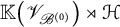 , showing that Theorem 1.6 recoversFootnote
13
Kumjian’s Stabilization trick.
6.2 Higher order operators à la Abadie–Ferraro
As alluded to earlier, a theorem similar to our main theorem has appeared in [Reference Abadie and Ferraro1] in the setting that
$\mathcal {H}=X=\mathcal {G}$
 is a group. Before we can cite it, let us first establish the following bridge between their terminology and ours.
Lemma 6.5 Suppose
$\mathscr {B}$
 is a saturated Fell bundle over a locally compact Hausdorff group
$\mathcal {H}$
 . Then
$\mathscr {B}$
 -demi-equivalences over the same group are exactly right Hilbert
$\mathscr {B}$
 -bundles in the sense of [Reference Abadie and Ferraro1, Definition 2.1] that are fibrewise full.
Proof
A priori, the norm of a demi-equivalence
$\mathscr {M}=(M\to \mathcal {H})$
 is only upper semi-continuous. However, since
$\mathscr {B}$
 is a Fell bundle over a group, it follows from [Reference Buss, Meyer and Zhu2, Lemma 3.30] that
$b\mapsto \left \| b \right \|$
 is continuous (not only upper semi-continuous) on
$\mathscr {B}$
 , and since the norm on
$\mathscr {M}$
 is given by
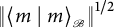 by Assumption (DE7), it is the concatenation of continuous maps and hence itself continuous. Therefore, the upper semi-continuous Banach bundle
$\mathscr {M}$
 is actually a continuous Banach bundle in the sense of [Reference Fell and Doran9, Definition II.13.4], as needed for [Reference Abadie and Ferraro1, Definition 2.1].
As in [Reference Abadie and Ferraro1], the inner product and the right-action are continuous by (DE3) and (DE16), respectively. The assumption that the Hilbert bundle be fibrewise full corresponds to (DE8) (and is stronger than the assumption (7R) in [Reference Abadie and Ferraro1]). The remaining items of [Reference Abadie and Ferraro1, Definition 2.1] correspond to our assumptions as follows.
-
(1R) corresponds to (DE1) and (DE2), using that
as explained in Example 1.2; -
(2R) corresponds to (DE13);
-
(3R) corresponds to (DE3);
-
(4R) corresponds to (DE4) and (DE5);
-
(5R) corresponds to (DE6); and
-
(6R) corresponds to (DE7).
 as explained in Example
We can now restate the result of Abadie and Ferraro to which we want to compare ours, in our terminology. We will artificially add the assumption that the fibres are all full, to align with our situation. We will further use different letters for elements of the group
$\mathcal {H}$
 : we use x if we think of
$\mathcal {H}$
 as a principal
$\mathcal {H}$
 -space; we use h if we think of
$\mathcal {H}$
 as the group acting on the right, and g if it is acting on the left; in particular,
 and
 will just be the products
$xh$
 respectively
$gx$
 in
$\mathcal {H}$
 .
Theorem 6.6 ([Reference Abadie and Ferraro1, Definition 3.6, Theorem 3.9, Corollary 3.10])
Let
$\mathcal {H}$
 be a locally compact Hausdorff group,
$\mathscr {B}=(B\to \mathcal {H})$
 a Fell bundle, and
$\mathscr {M}=(M\to \mathcal {H})$
 a right
$\mathscr {B}$
 -demi-equivalence, also over
$\mathcal {H}$
 . For
$g\in \mathcal {H}$
 , let
$\mathbb {B}_g (\mathscr {M} )$
 be the collection of continuous maps
$S \colon M \to M $
 such that
-
• there exists $c \in \mathbb {R}$
such that
$\left \| Sm \right \|\leq c\left \| m \right \|$
for all
$m \in M $
; -
•
for all
$x \in \mathcal {H}$
; and -
• there exists $S^* \colon M \to M$
such that for all
$m_{i} \in M $
.



 for all


 for all

Then there exists a unique Fell bundle
$\mathbb {K}(\mathscr {M} )$
 over
$\mathcal {H}$
 such that:
-
(i) for all $g\in \mathcal {H}$
, the fibre
$\mathbb {K}(\mathscr {M} )_{g}$
is, as a Banach space, the closure in
$\mathbb {B}_{g}(\mathscr {M} )$
of where;
-
(ii) given $\psi , \varphi \in C_c(M)$
and
$x \in \mathcal {H}$
, the function
$[ \psi , \varphi , x] \colon \mathcal {H} \to \mathbb {K}(\mathscr {M} )$
given by , is a continuous section of
$\mathbb {K}(\mathscr {M})$
.


 ;



 = [psi(g acting on x), phi(x)]](https://static.cambridge.org/binary/version/id/urn:cambridge.org:id:binary:20260713102509599-0260:S0008414X24000907:S0008414X24000907_inline1522.png?pub-status=live) , is a continuous section of

Moreover,
$\mathscr {M} $
 is a
$\mathbb {K}(\mathscr {M} )-\mathscr {B}$
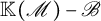 -equivalence bundle with the action
$\mathbb {K}(\mathscr {M} ) \times M \to M$
 given by
$(S, m) \to S(m)$
 and the left inner product
$M \times M \to \mathbb {K}(\mathscr {M} )$
 given by
 .
Abadie and Ferraro call the elements of
$\mathbb {B}_g (\mathscr {M} )$
 adjointable operators of order g. We conclude:
Corollary 6.7 Suppose
$\mathcal {H}$
 ,
$\mathscr {B}$
 , and
$\mathscr {M}$
 are as in Theorem 6.6. The map

which maps
$[m\otimes n^{\mathrm {op}}]$
 in the fibre over
$[x,y^{\mathrm {op}}]$
 of
$\mathscr {M}\otimes _{\mathscr {B}}\mathscr {M}^{\mathrm {op}}$
 to the operator

in the fibre over  of
$\mathbb {K}(\mathscr {M})$
 , is an isomorphism of Fell bundles, covering the map f from Example 1.2.
Proof By Lemma 6.5,
$\mathscr {M}$
 is a right Hilbert
$\mathscr {B}$
 -bundle in the sense of [Reference Abadie and Ferraro1, Definition 2.1]. It is proven in [Reference Abadie and Ferraro1, Corollary 3.10] that
$\mathscr {M}$
 is an equivalence between
$\mathscr {B}$
 and
$\mathbb {K}(\mathscr {M})$
 . Since
$\mathscr {M}$
 is also an equivalence between
$\mathscr {B}$
 and
$\mathscr {M}\otimes _{\mathscr {B}}\mathscr {M}^{\mathrm {op}}$
 , it thus follows from [Reference Abadie and Ferraro1, Corollary 3.11] (or equivalently, from Proposition 5.1), that the displayed map is the claimed isomorphism.
Remark 6.8 As alluded to in Remark 2.4, the description à la Abadie and Ferraro of the imprimitivity Fell bundle
$\mathscr {M}\otimes _{\mathscr {B}}\mathscr {M}^{\mathrm {op}}$
 as “adjointable operators with a shift” is also built into our construction, albeit less visibly so.
Even when we consider Fell bundles over groups, Theorem 1.6 can cover some examples that are not covered by [Reference Abadie and Ferraro1], since there,
$X=\mathcal {H}$
 always. One example is [Reference Mesland and Sengun19, Proposition A.2.3]; another one is Example 6.9.
6.3 Imprimitivity theorems
Earlier, we alluded to a relationship between Theorem 1.6 and imprimitivity theorems; let us give one example.
Example 6.9 ([Reference Muhly20, Example 14])
If X is a locally compact Hausdorff group with closed subgroup H, then H acts on X by right translation ( ) and X is a principal H-space. Its imprimitivity groupoid
$ X\times _{H} X^{\mathrm {op}} $
 is isomorphic to the transformation group groupoid
$X\ltimes X/H$
 of X acting on the quotient space
$X/H$
 via

In terms of  , the anchor map described in (1.2) becomes the quotient map,

and the left action on X as described in (1.3) becomes the action  . We conclude that G is equivalent to the group H via X. To sum up,

Note that  indeed lands in H since
$\rho (x)=\rho (y)$
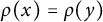 .
Now suppose that A is a
$\mathrm {C}^{*}$
 -algebra with action
$\alpha \colon X\to \operatorname {Aut}(A)$
 . Let
$\mathscr {B}= A\rtimes H$
 be the Fell bundle over H that encodes the restriction
$\alpha |_H$
 , meaning that, for each
$h\in H$
 , the fibre
$B(h)$
 is A and the structure maps of
$\mathscr {B}$
 are given by

Let
$\mathscr {M}=A\times X$
 be the “trivial A-bundle” over X. Then
$\mathscr {B}$
 acts on
$\mathscr {M}$
 via

and we have a
$\mathscr {B}$
 -valued inner product given by

One quickly checks that
$\mathscr {M}$
 is a
$\mathscr {B}$
 -demi-equivalence, so
$\mathscr {B}$
 is equivalent via
$\mathscr {M}$
 to
${\mathscr {M}\otimes _{\mathscr {B}}\mathscr {M}^{\mathrm {op}}}$
 . Let us identify the fibre of the latter Fell bundle over an element
 of G: As explained in Theorem 3.17, we use (3.8) to identify

as  -imprimitivity bimodules. Over a unit
$(1_{G},yH)$
 of G, the fibre is (canonically isomorphic to) the
$\mathrm {C}^{*}$
 -algebra
$\mathbb {K}_{B(e)}(M(y))$
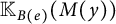 itself, where y is any representative of
$yH$
 . These
$B(e)$
 -compact operators on
$M(y)$
 are generated by
 for
$n_{i}\in M(y)$
 , and one quickly computes that such a rank-one operator just multiplies
$n\in M(y)$
 on the left by
$n_{1}n_{2}^*$
 .
The balancing in
$M(x)\otimes _{e} M(y)^{\mathrm {op}}$
 identifies

for all
$b\in B(e)=A$
 . If we let
 as a Banach space, then we can therefore show that the map

is a Banach space isomorphism. These isomorphisms create a new Fell bundle
$\mathscr {A}=(p_{\mathscr {A}}\colon A\to G)$
 out of
$\mathscr {M}\otimes _{\mathscr {B}}\mathscr {M}^{\mathrm {op}}$
 :
$\mathscr {A}$
 has the fibre
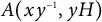 over
 , and the structure maps of
$\mathscr {M}\otimes _{\mathscr {B}}\mathscr {M}^{\mathrm {op}}$
 described in (3.24) and Corollary 3.10 translate to

and

The Fell bundle
$\mathscr {A}$
 is therefore exactly the semi-direct product Fell bundle
${X\ltimes (A\times X/H)}$
 which encodes the left-X action
$x\cdot (a,yH)=(\alpha _x(a), xyH)$
 on the constant
$\mathrm {C}^{*}$
 -algebraic bundle
$A\times X/H$
 over
$X/H$
 . We have therefore recovered the same Fell bundle that was mentioned as being equivalent to
$\mathscr {B}$
 in [Reference Muhly20, Example 14].
Example 6.9 is the extreme case where X is a group; the other extreme case is when X is just a principal H-space: We can likewise define a free and proper action of the transformation group groupoid
$X\rtimes H$
 on X by letting
$(x,h)$
 transform x into
 . The associated imprimitivity groupoid
$X\times _{X\rtimes H}X^{\mathrm {op}}$
 is exactly the quotient
$X/H$
 of the original action on X, and so an application of [Reference Muhly, Renault and Williams21, Theorem 2.8] recovers Green’s theorem that
$C_0(X/H)$
 and
$C_0(X)\rtimes _{r} H$
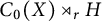 are strongly Morita equivalent.
There is a plethora of generalizations of Green’s result. For example, we can allow the object X that is being acted on to be not just a space (as in Green’s theorem) or a group (as in Example 6.9), but a groupoid
$\mathcal {X}$
 , and we allow the underlying bundles to be more than line-bundles: if
$\mathscr {M}=(M\to \mathcal {X})$
 is a Fell bundle that carries a free and proper action of a group K, then
$\mathscr {M}$
 is an equivalence between the semi-direct product Fell bundle
$\mathscr {B}=\mathscr {M}\rtimes K$
 and the quotient Fell bundle
$K\backslash \mathscr {M}$
 .Footnote
14
Theorem 1.6 can recover such results, in that
$\mathscr {M}$
 is a
$\mathscr {B}$
 -demi-equivalence, and
$\mathscr {M}\otimes _{\mathscr {B}}\mathscr {M}^{\mathrm {op}}$
 can be computed to be isomorphic to the quotient bundle.
A Hilbert C
${}^{\ast}$
-Modules

Lemma A.1 If
$\mathbf {X}$
 is a full right Hilbert
$\mathrm {C}^{*}$
 -module over a
$\mathrm {C}^{*}$
 -algebra B and
$\mathbf {x}_{i}\in \mathbf {X}$
 , then the operator-norm of the B-compact, positive operator
 is exactly the norm of
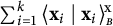 in B.
Proof Denote the compact operator in question by T. For any
$\mathbf {z}\in \mathbf {X}$
 , we have

Note that the right-hand side is a sum of positive elements and hence positive, so T is indeed a positive operator by [Reference Raeburn and Williams24, Lemma 2.28]. By the Cauchy–Schwarz inequality for Hilbert modules [Reference Raeburn and Williams24, Lemma 2.5], we have for each i

in the
$\mathrm {C}^{*}$
 -algebra B, and hence we conclude that

Using [Reference Raeburn and Williams24, Remark 2.29] and positivity of T in the first equality of the following, we deduce

For the reverse inequality, note that
$\mathbf {X}$
 is an imprimitivity bimodule between
$\mathbb {K}_{B}(\mathbf {X})$
 and B, meaning that B is exactly the algebra of
$\mathbb {K}_{B}(\mathbf {X})$
 -compact operators on the left-Hilbert
$\mathrm {C}^{*}$
 -module
$\mathbf {X}$
 . In particular, the same proof for T replaced by
 yields the other estimate.
The following result is well known.
Lemma A.2 Suppose
$\mathbf {X}$
 is an
 -imprimitivity bimodule and
$\mathbf {Y}$
 is a
 -imprimitivity bimodule. Then the balanced tensor product
$\mathbf {X}\otimes _{B} \mathbf {Y}^{\mathrm {op}}$
 is isomorphic to the B-compact operators
$\mathbb {K}_{B}(\mathbf {Y},\mathbf {X})$
 as
 -imprimitivity bimodule s.
Proof First recall that
$\mathbb {K}_{B}(\mathbf {Y},\mathbf {X})$
 is densely spanned by the maps

for
$\mathbf {x}\in \mathbf {X},\mathbf {y}\in \mathbf {Y}$
 . Its bimodule structure is given by

The map

is bilinear, and so it descends to a linear map with domain
$\mathbf {X}\odot \mathbf {Y}^{\mathrm {op}}$
 . For any
$b\in B$
 , we have

Since
$(\mathbf {y}\cdot b^*)^{\mathrm {op}} = b\cdot \mathbf {y}^{\mathrm {op}}$
 , we conclude that we have a linear map

Clearly, this map is an
$A-C$
 -bimodule map and, by definition of
$\mathbb {K}_{B}(\mathbf {Y},\mathbf {X})$
 , it has dense range. Thus, if we can show that the map is isometric, then it extends to an isomorphism of Hilbert bimodules. For
$\mathbf {x}_{i}\in \mathbf {X}$
 and
$\mathbf {y}_{i}, \mathbf {y}\in \mathbf {Y}$
 , we have

As in [Reference Raeburn and Williams24, Lemma 2.65], we can write  so that

Write  . Since

it follows that

where
$(\dagger )$
 follows from [Reference Raeburn and Williams24, Remark 2.29] applied to the positive operator
 . Since B acts by C-adjointable operators on
$\mathbf {Y}$
 , we have

as claimed.
B Upper semi-continuous Banach bundles
The following lemma explains that, in an upper semi-continuous Banach bundle, being arbitrarily close to convergent nets implies convergence. It is, in essence, just a restatement of [Reference Williams29, Proposition C.20], where we drop the assumption that the bundle be a
$\mathrm {C}^{*}$
 -bundle.
Lemma B.1 Let
$\mathscr {M}=(q_{\mathscr {M}}\colon M\to X)$
 be an upper semi-continuous Banach bundle over a locally compact Hausdorff space X. Suppose we are given a net
$(m_{\lambda })_{\lambda }$
 in
$\mathscr {M}$
 and a point
$m\in \mathscr {M}$
 such that
$q_{\mathscr {M}}(m_{\lambda })\to q_{\mathscr {M}}(m)$
 . Then
$m_{\lambda }\to m$
 if and only if, for every
$\epsilon>0$
 , there exists a convergent net
$(n_{\lambda }^\epsilon )_{\lambda }$
 in
$\mathscr {M}$
 with
$q_{\mathscr {M}}(n_{\lambda }^\epsilon )=q_{\mathscr {M}}(m_{\lambda })$
 such that for all large
$\lambda $
 , we have

Proof The forwards implication is trivial. The backwards implication follows from an application of [Reference Duwenig and Li4, Lemma A.3, (i)
$ \ \Rightarrow $
 (ii)] (applied to the convergent net
$(n_{\lambda }^\epsilon )_{\lambda }$
 ), the triangle inequality, and an application of [Reference Duwenig and Li4, Lemma A.3, (i)
$\ \Leftarrow $
 (ii)].
Lemma B.2 (cf. [Reference Duwenig and Li4, Proposition A.7])
Let
$\mathscr {M}=(q_{\mathscr {M}}\colon M\to X)$
 and
$\mathscr {N}=(q_{\mathscr {N}}\colon N\to Y)$
 be two upper semi-continuous Banach bundles. Suppose we have a commutative diagram

and that the maps satisfy the following conditions.
-
(a) for each $x\in X$
,
$\Omega |_{M_x}$
is linear; -
(b) there exists a constant $K>0$
such that
$\|\Omega (m)\|\leq K\|m\|$
for all
$m\in M$
; -
(c) $\omega $
is a continuous map; and -
(d) there exists a collection $\Gamma $
of continuous sections of
$\mathscr {M}$
such that the
$\mathbb {C}$
-linear span of
$\{\gamma (x): \gamma \in \Gamma \}$
is dense in each
$M_x$
and, for each
$\gamma \in \Gamma $
, the section
${\Omega \circ \gamma }\colon {x\mapsto \big (x,\Omega (\gamma (x))\big )}$
of the pull-back bundle
$\omega ^*(\mathscr {N})$
is continuous.










Then
$\Omega $
 is continuous.
Proof First we point out that the proof of [Reference Duwenig and Li4, Proposition A.7] does not require
$\Gamma $
 to be a vector space but only that
 is dense in
$M(x)$
 ; in other words, we already know that Lemma B.2 holds in the case that
$\omega $
 is a homeomorphism.
Consider the commutative diagram

We claim that the map
$\Psi $
 is continuous, which will imply that
$\Omega $
 is continuous since Diagram B.2 commutes. Since the identity map on X is a homeomorphism, we are in good shape to invoke [Reference Duwenig and Li4, Proposition A.7] for the square on the left-hand side; because of Assumption (d), it only remains to verify that
$\Psi $
 is fibrewise linear and bounded. But clearly, Assumption (a) implies linearity of
$\Psi |_{M_{x}}\colon M_{x}\to \omega ^*(\mathscr {N})_{x} = \{x\}\times \mathscr {N}_{\omega (x)}$
 by the definition of the linear structure on
$\omega ^*(\mathscr {N})$
 . And likewise, by definition of the norm on
$\omega ^*(\mathscr {N})_{x}$
 , we have
$\left \| \Psi (m) \right \|=\left \| \Omega (m) \right \|$
 , and hence
$\left \| \Psi (m) \right \|\leq K\left \| m \right \|$
 for all
$m\in M$
 by (b). Using [Reference Duwenig and Li4, Proposition A.7], we conclude that
$\Psi $
 and hence
$\Omega $
 is continuous.
Lemma B.3 (cf. [Reference Duwenig and Li4, Proposition A.8])
Let
$\mathscr {M}=(q_{\mathscr {M}}\colon M\to X)$
 and
$\mathscr {N}={(q_{\mathscr {N}}\colon N\to Y)}$
 be two upper semi-continuous Banach bundles, and suppose we have the commutative Diagram (B.1) and that the maps
$\Omega ,\omega $
 satisfy the following conditions.
-
(a) for each $x\in X$
,
$\Omega |_{M_x}$
is linear; -
(b) there exists a constant $k>0$
such that
$\|\Omega (m)\| \geq k\|m\|$
for all
$m\in M$
; -
(c) $\omega $
is an embedding (i.e., a homeomorphism onto its image); and -
(d) $\Omega $
is continuous.





Then  is continuous.
Proof As in the proof of Lemma B.2, consider the map
$\Psi $
 in Diagram (B.2). Again, since
$\Omega |_{M_x}$
 is linear, so is
$\Psi |_{M_{x}}$
 , and since
$\Omega $
 is bounded below, so is
$\Psi $
 . This time, continuity of
$\Omega $
 implies continuity of
$\Psi $
 . We can therefore apply [Reference Duwenig and Li4, Proposition A.8] to the square on the left-hand side of Diagram (B.2) to conclude that the map
 is continuous.
Since
$ q_{\mathscr {N}}(\Omega (m)) = \omega (q_{\mathscr {M}}(m)) $
 by commutativity of Diagram (B.1), it follows from Assumption (c) that the map
 , is well defined and continuous. By definition of
$\Psi $
 , we have

so that for
$n\in \Omega (M)$
 ,
 . It follows that
 is continuous as concatenation of continuous maps.
Acknowledgements
I would like to thank Bram Mesland for asking me a question that the main theorem answers, and I would further like to thank him and Arthur Pander Maat for multiple helpful discussions during the production of this paper. Lastly, I would like to thank the anonymous referee for their helpful report.






 is constructed in the same fashion as the bundle
 in Lemma
 can be found in [

 along the homeomorphism
 .








