Introduction
The Portsmouth Physiological and Operative Severity Score for the Enumeration of Mortality and Morbidity (‘P-POSSUM’) is a two-part scoring system that includes a physiological assessment and a measure of operative severity.Reference Prytherch, Whiteley, Higgins, Weaver, Prout and Powell1 It was designed to estimate the predicted morbidity and mortality for an individual patient, and to have wide application in general surgery. There are many reports assessing its usefulness in this area.Reference Kodama, Narita, Kobayashi, Yamamoto and Komori2–Reference Jones, Copeland and de Cossart5
The score uses several individual parameters to form a ‘physiological score’ and an ‘operative severity score’. Each variable is given one of a possible four scores graded for severity. When the scoring system equation is applied, a numerical estimate for morbidity and mortality is determined. The percentage mortality risk = −9.37 + (0.19 × physiological score) + (0.15 × operative severity score). The percentage morbidity risk = −5.91 + (0.16 × physiological score) + (0.19 × operative severity score).
When deciding whether to perform surgery and selecting reconstructive options in an individual patient, it is critical to evaluate the patient's overall condition and determine the surgical risk. Given the ageing population and the increased prevalence of co-morbidities in this group, performing surgery in higher-risk patients is more common.Reference Turrentine, Wang, Simpson and Jones6 There are many complications that can occur following major head, neck and reconstructive surgery. These can be local or systemic. Malignancies involving the temporal bone treated surgically often require extensive soft tissue resection and lateral temporal bone resection, with either local or free flap reconstruction. Operative times in these cases can average 10 hours and blood loss may be large, leading to significant physiological stress for the patient.
The Physiological and Operative Severity Score for the Enumeration of Mortality and Morbidity extensively evaluates the patient's condition and the nature of the surgery, and it is easy to calculate. It can be used when counselling a patient during consent, and for surgical audit. Although extensively used and evaluated in general surgery, there are only a few reports of its application in head and neck surgery.Reference Makino, Ishida, Kishi, Kodama and Miyawaki7 This study sought to determine whether the risk estimates for the Portsmouth scoring system could be used in major head and neck reconstructive surgery.
Materials and methods
We performed a retrospective review of patients undergoing resection for a temporal bone malignancy in a single head and neck centre in Dublin, Ireland, from 2002 to 2021. We assessed the correlation between the Portsmouth Physiological and Operative Severity Score for the Enumeration of Mortality and Morbidity and its application in patients undergoing major surgical resection of the head and neck with flap reconstruction. Data collected from patient records included patient demographics, histopathology, smoking and alcohol intake, co-morbidities, management, reconstruction flap type, and complications.
We calculated the Portsmouth Physiological and Operative Severity Score for the Enumeration of Mortality and Morbidity, in order to estimate the predicted morbidity and mortality for each patient. The Portsmouth scoring system includes 12 physiological parameters: age, cardiac, respiratory, electrocardiography, systolic blood pressure, pulse rate, haemoglobin (g/dl), white cell count, urea (mg/dl), sodium (mmol/l), potassium (mmol/l) and Glasgow Coma Scale parameters. It also includes six operative parameters: operation type, number of procedures, operative blood loss, peritoneal contamination, malignancy status and mode of surgery. The percentage mortality risk = −9.37 + (0.19 × physiological score) + (0.15 × operative severity score). The percentage morbidity risk = −5.91 + (0.16 × physiological score) + (0.19 × operative severity score).
The Portsmouth scoring system estimates for morbidity and mortality were compared with observed complications and mortality. Statistical analysis was performed using Stata/SE version 16.0 software (StataCorp, College Station, Texas, USA). This study received ethical approval from the hospital's ethics committee.
Results
We reviewed 67 patients diagnosed with a temporal bone malignancy in a single centre between 2000 and 2021. Nine patients underwent a mastoidectomy without lateral temporal bone resection, 5 patients’ charts were not available for review, and 19 patients were deemed unresectable and were referred for palliative treatment; these patients were all excluded from the study. Surgical treatment with en bloc soft tissue resection, lateral temporal bone resection and flap reconstruction was performed in 34 patients.
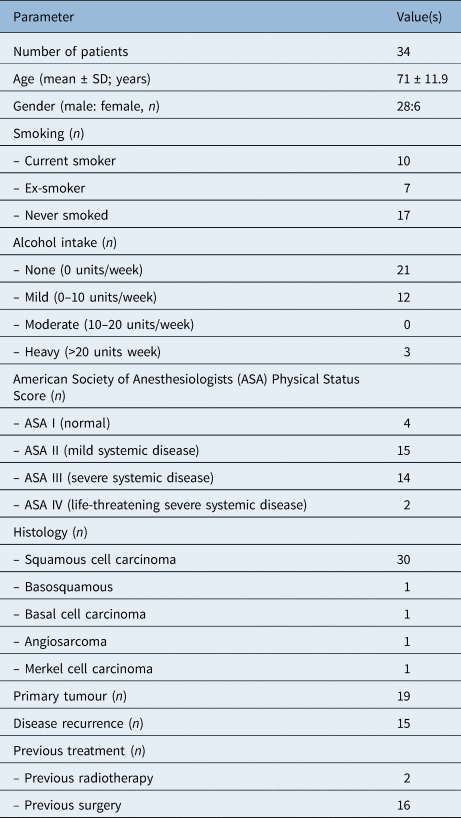
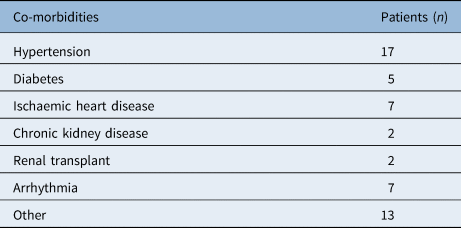
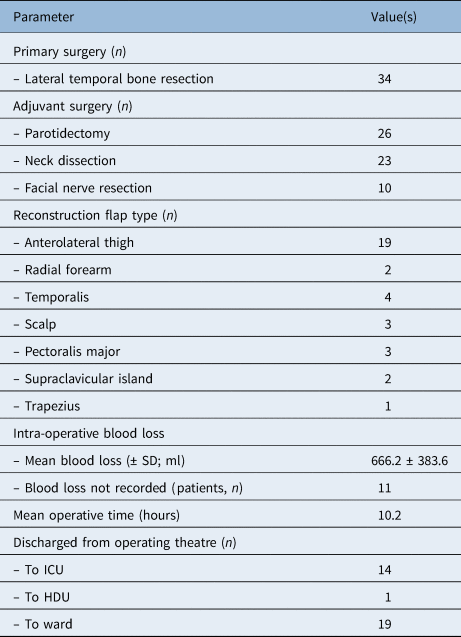
Patient demographics and histopathology are shown in Table 1. Co-morbidities are listed in Table 2 and operative characteristics are shown in Table 3.
Patient demographics and histopathology

SD = standard deviation
Patient co-morbidities

Operative characteristics

SD = standard deviation; ICU = intensive care unit; HDU = high-dependency unit
The actual rate of complications was 47 per cent. Seven patients required a return to the operating theatre. In terms of flap complications, three patients developed flap necrosis, three had a seroma, two developed a haematoma and four required flap revision. There were two infections, one haematoma, one seroma and one dehiscence at the donor site. Medical complications included pneumonia in one patient, delirium in two patients, arrhythmia in one patient, acute kidney injury in one patient and bacteræmia in one patient. There were no 30-day mortalities. The mean length of stay ± standard deviation (SD) was 24.2 ± 19.8 days.
The morbidity estimates calculated using the Portsmouth Physiological and Operative Severity Score for the Enumeration of Mortality and Morbidity scoring system ranged from 14.9 per cent to 89.9 per cent. The mean score ± SD was 47.6 per cent ± 19.5 per cent.
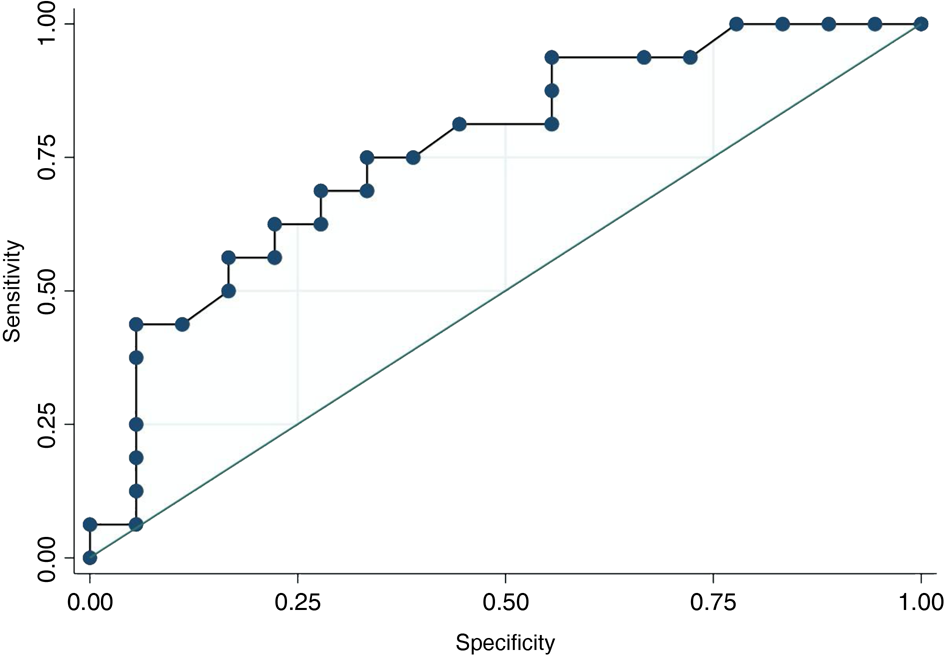
We compared the actual complication rate with calculated estimates, and a receiver operating characteristic curve was obtained to assess the predictive accuracy of the Portsmouth scoring system (Figure 1). The optimal cut-off for the scoring system was then calculated using the Youden index from the receiver operating characteristic curve, which was 40.5 per cent in this case. At this point, the sensitivity and specificity were 75 per cent and 67 per cent respectively.
The receiver operating characteristic curve for the Portsmouth Physiological and Operative Severity Score for the Enumeration of Mortality and Morbidity scoring system. Area under receiver operating characteristic curve = 0.7656.

Discussion
The Portsmouth Physiological and Operative Severity Score for the Enumeration of Mortality and Morbidity is an equation used to predict outcomes in surgery.Reference Copeland, Jones and Walters8 It is a two-part scoring system that includes a physiological assessment and a measure of operative severity. The original Physiological and Operative Severity Score for the Enumeration of Mortality and Morbidity has been shown to overestimate mortality in low-risk patients, and to underestimate mortality in elderly and emergency patients.Reference Whiteley, Prytherch, Higgins, Weaver and Prout3,Reference Tekkis, Prytherch, Kocher, Senapati, Poloniecki and Stamatakis9,Reference Menon and Farouk10 In order to overcome these challenges, the Portsmouth scoring system was developed and now has largely replaced the original scoring system.Reference Prytherch, Whiteley, Higgins, Weaver, Prout and Powell1
Risk prediction models are useful when counselling patients during consent. They allow a numerical prediction of morbidity and mortality specific to the individual patient, rather than a generic mean morbidity or mortality rate for a given procedure. Scoring systems such as the Physiological and Operative Severity Score for the Enumeration of Mortality and Morbidity can also be used for surgical audit. Rather than a comparison of raw morbidity and mortality rates alone, the scoring system considers the case mix of a unit and provides a risk-adjusted outcome.Reference Copeland, Jones and Walters8
The scoring system risk prediction is widely used in general surgery and has been successfully applied in other surgical disciplines.Reference Brunelli, Fianchini, Xiume, Gesuita, Mattei and Carle11,Reference Copeland, Jones, Wilcox and Harris12 The variables included in the equation – the patient's physiological status, the disease requiring surgery and the operative severity – mean that the scoring system should have a wide application in surgery. We sought to determine whether the Portsmouth scoring system risk estimates could be used in major head and neck surgery.
In our study, mean predicted morbidity (47 per cent) closely mirrored actual observed morbidity (47.6 per cent). Although it was a valid predictor of morbidity overall, we found that the Portsmouth Physiological and Operative Severity Score for the Enumeration of Mortality and Morbidity was most useful in higher-risk patients, with an optimal cut-off score of 40.5 per cent. However, we found that predicted mean mortality was 3.6 per cent, which was an overestimate in our population given there were no mortalities.
• The Portsmouth Physiological and Operative Severity Score for the Enumeration of Mortality and Morbidity (‘P-POSSUM’) includes physiological and operative severity assessments
• This study determined whether Portsmouth scoring system risk estimates could be used in major head and neck reconstructive surgery
• The scoring system was useful for predicting morbidity risk in patients undergoing head and neck resection with reconstruction for temporal bone malignancies
• The scoring system was not useful in predicting mortality
• Patients with a calculated score of 40.5 per cent or higher are more likely to experience post-operative complications
Some variables included in the Portsmouth scoring system do not apply to head and neck surgery, such as ‘peritoneal soiling’ and ‘Glasgow Coma Scale’; these variables reflect its original design for use in general surgery. The addition of certain variables may increase its relevance to head and neck surgery. Factors that have been shown to increase complication rates in head and neck surgery include: previous radiotherapy, previous surgery and poor nutritional status.Reference Linn, Robinson and Klimas13,Reference Farwell, Reilly, Weymuller, Greenberg, Staiger and Futran14 The inclusion of these variables may make for a more representative scoring system in head and neck surgery.
We acknowledge that there are limitations to our study; for instance, it was performed in a single centre and it has a small sample size. However, given the rare nature of temporal bone malignancy, there are very few resections with reconstruction performed for this disease outside of our centre in this country.
Conclusion
Our study indicates that the Portsmouth Physiological and Operative Severity Score for the Enumeration of Mortality and Morbidity is useful tool for predicting morbidity risk in patients undergoing head and neck resection with reconstruction for temporal bone malignancies. The scoring system was not useful in predicting mortality. We found that patients with a calculated Portsmouth Physiological and Operative Severity Score for the Enumeration of Mortality and Morbidity of 40.5 per cent or higher were more likely to experience post-operative complications. More research into the application of the Portsmouth scoring system in these patients could help strengthen our findings. The addition of certain variables more relevant to head and neck surgery may make for a more accurate risk prediction.
Competing interests
None declared