Introduction
Producers and scientists are exploring organic systems that reduce intensity of tillage in cropping systems (Carr et al., Reference Carr, Anderson, Lawley, Miller and Zwinger2012; Armengot, et al., Reference Armengot, Berner, Blanco-Moreno, Maader and Xavier Sans2015). We are seeking to develop a continuous no-till system for organic farming for Eastern South Dakota (Anderson, Reference Anderson2015). To guide our research program, we proposed a complex rotation designed to disrupt weed population dynamics and reduce weed density in cropland (Anderson, Reference Anderson2010). The rotation includes a 6-year interval with a diversity of annual crops and a 3-year interval of perennial red clover (Trifolium pratense L.).
To develop a no-till system, however, red clover will need to be converted to annual crops without tillage. We have found that fall mowing of red cover in the third year of establishment effectively suppressed red clover growth the following year (Anderson, Reference Anderson2016). Fall mowing reduces carbohydrate quantity in the crown and roots and promotes winterkill (Haagenson et al., Reference Haagenson, Cunningham, Joern and Volenec2003). Because of suppressed red clover growth, corn (Zea mays L.) seedlings were able to establish and produce grain. However, growth by weeds and volunteer red clover in corn reduced grain yield 45% compared with a plant-free control (Anderson, Reference Anderson2016). Thus, weeds and volunteer red clover in corn will also need to be controlled without tillage. Implements are being developed that can control weeds between corn rows (Melander et al., Reference Melander, Munier-Jolain, Charles, Wirth, Schwarz, van der Weide, Bonin, Jensen and Kudsk2013). For example, Donald (Reference Donald2007) developed a mower that effectively controls weeds between the rows of corn.
Thus, integrating a fall mowing strategy with between-row mowing may enable producers to convert red clover to annual cropping without using tillage. The objective of this study was to test this hypothesis by comparing the combination of fall mowing and between-row mowing to tillage for converting red clover to corn production.
Materials and Methods
The study was established on a Barnes clay loam soil near Brookings, SD, where yearly precipitation is 580 mm. The experimental design was a two-way factorial, with conversion method and in-corn weed management as the two factors. Conversion methods consisted of either tillage or mowing in the fall of the third year of red clover. In-corn weed management involved three treatments: weed-infested (both weeds and volunteer red clover), weed-free and between-row weed control, i.e., mowing or cultivating between rows in the mow or till conversion methods, respectively. The six treatments were arranged as a randomized complete block with four replications; plot size was 7 m × 30 m.
The study lasted for 4 years, with red clover established in 2012, conversion treatments imposed in 2014 and corn planted uniformly across both treatments in 2015. The crop history for the site was a herbicide-based, reduced-till corn–soybean (Glycine max (L.) Merr.)–spring wheat (Triticum aestivum L.) rotation. Red clover (variety not stated) was planted at 14 kg ha−1, and oat (‘Stallion’) as a companion crop was planted at 35 kg ha−1 on April 5, 2012. Oat was planted first at 3 cm depth, followed by legumes planted 1 cm deep on the same day.
In the fall of year 3, conversion treatments were established. Mowing conversion consisted of mowing red clover with a rotary blade mower at a 2 cm height on September 16 and October 11, 2014, when plants reached 15–20 cm in height. Tilled conversion included chisel plowing (September 16, 2014) and discing (October 11, 2014) in the fall and tilling (April 30, 2015) once in the spring with a field cultivator before planting corn.
Corn (DKC 48–37 RR) was planted at 62,000 seeds ha−1 on May 1, 2015 across all treatments. Row spacing was 75 cm and no fertilizers were used. Plants in weed-free treatments were eliminated with two applications of glyphosate at 840 g a.i. ha−1 and hand weeding. We used glyphosate to eliminate weeds with minimum soil disturbance for a no-till environment and to limit field traffic in the plots. This approach provided an estimate of corn yield potential in a no-till system to compare with the mowing technique. For the between-row control treatments, plots were mowed or cultivated twice, June 14 and July 7, 2015. Plots were mowed with a 70-cm wide rotary blade mower or tilled with an inter-row cultivator. Mowing height was 2 cm. Weed height ranged from 10 to 20 cm at time of mowing; corn was 33 cm tall on June 14 and 105 cm tall on July 7. Weeds and red clover were allowed to grow in weed-infested treatments.
Weekly weed emergence in corn was recorded in two permanently marked 0.33 m2 quadrats randomly located in each weed-free subplot. Plants were identified and counted weekly, starting on day of corn planting and continuing for 9 weeks; after counting each week, seedlings were removed by hand. Density and biomass of weeds and volunteer red clover were determined from three 0.5 m2 quadrats randomly located in each plot, but placed to include one corn row in the quadrat. Sampling date was June 25, 9 weeks after corn planting. Samples were oven-dried to a constant weight at 65°C for dry weight biomass. Corn grain yield was determined by harvesting an area, 2 rows by 30 m, with yield adjusted to 15.5% moisture. After data analysis (Statistix 9, Analytical Software, Tallahassee FL), treatments means were compared with Fisher's LSD or the t test (0.05).
Results and Discussion
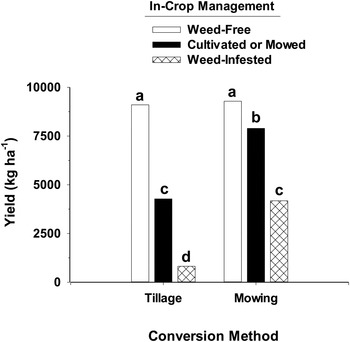
Mowing (fall and in-crop) effectively controlled weeds and volunteer red clover, as weed biomass 9 weeks after planting was only 4 g m−2. In comparison, weed biomass was 30 g m−2 in the tilled (fall and in-crop) conversion. Density of volunteer red clover was approximately 3 plants m−2 in the mowed conversion, but red clover was not observed in tillage conversion. Mowing minimized weed interference such that corn yielded 7900 kg ha−1 compared with 9300 kg ha−1 in the weed-free treatment (Fig. 1). Weed interference with tillage (fall and in-crop) reduced corn yield to 4280 kg ha−1, a 53% yield loss. Mowing in-crop suppressed weeds between the rows, but weeds were present in the corn rows to reduce yield.
Corn grain yield in the three management treatments for the tillage and mowing conversion methods. The cultivated or mowed in-crop management refers to in-crop cultivation or mowing to control weeds in the corresponding tilled or mowed conversion method. Bars with the same letter are not significantly different as determined by Fisher's LSD (0.05).

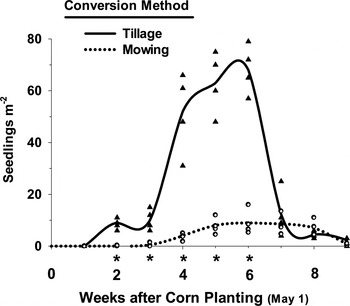
Mowing suppressed weed interference because of reduced weed density and delayed weed emergence compared with tillage conversion. Prominent weeds were common lambsquarters (Chenopodium album L.), a mixture of foxtail species (Setaria species) and common sunflower (Helianthus annuus L.). Six times more weeds emerged with tillage during the 9 weeks following planting (Fig. 2). Ominski and Entz (Reference Ominski and Entz2001) reported a similar trend of tillage increasing weed density compared with no-till for alfalfa conversion to annual crops. Weed emergence in the mowed conversion was also delayed 3–4 weeks compared with tillage conversion. This delay has been observed previously at this location, where weed seedlings emerge later in no-till than after tillage (Anderson, Reference Anderson2015). Also, density of common sunflower in corn was higher with tillage (47 plants m−2 in the tilled conversion compared with 0.7 plants m−2 in mowed conversion). Increased establishment of sunflower seedlings occurs because tillage places sunflower seeds in a more favorable position in soil compared with seeds remaining on the soil surface with no-till (Anderson, Reference Anderson2007). This contrast in weed dynamics among conversion methods also affected weed growth in weed-infested treatments; weed biomass was 92 g m−2 with tillage, but only 26 g m−2 with the mowed conversion. Consequently, weed-infested corn yielded five times more with fall mowing compared with fall tillage (Fig. 1).
Seedling emergence pattern of the weed community during 9 weeks after planting corn, comparing conversion based on tillage or mowing. Asterisk beneath the X-axis indicate that emergence in that week differed between treatments as determined with the t test (0.05). Emergence curves were developed by cubic spline interpolation.

Our study demonstrates the possibility of converting red clover to corn production without needing to till for controlling red clover. Weed interference could be further minimized with recently developed implements, such as finger weeders or grit applicators that can remove weeds in the row without tillage (Van der Weide et al., Reference Van der Weide, Bleeker, Achten, Lotz, Fogelberg and Melander2008; Forcella, Reference Forcella2012).