In the absence of highly effective vaccines and treatment options, personal protective equipment (PPE) is critical for protecting HCPs from EVD during patient care.Reference Edmond, Diekema and Perencevich 1 The 2014–2015 outbreak of Ebola virus disease (EVD) in West Africa resulted in >28,000 cases and >11,000 deaths. 2 Healthcare personnel (HCP) were at high risk for acquiring EVD during patient care, with 800 cases occurring among HCP as of March 2015. 3 EVD spreads through contact with bodily fluids that are produced in high volumes during the acute phase of disease.Reference Kreuels, Wichmann and Emmerich 4 , Reference Lyon, Mehta and Varkey 5 Therefore, effective protection requires more PPE and different items of PPE than HCP ordinarily wear in the care of patients on contact, droplet, or airborne isolation precautions.
PPE recommendations for care of EVD have been formulated by the World Health Organization and Centers for Disease Control and Prevention. 6 , 7 These recommendations for EVD PPE include full wearing of full body, fluid-resistant suits and gowns, footwear, N95 respirators or Powered air purifying respirators (PAPRs), and face shields. The goal of this PPE is to leave no skin or mucous membranes exposed to virus. 6 Achievement of this goal requires the use of complex PPE donning and doffing protocols that are difficult to implement. Previous research has shown that full compliance with recommended PPE doffing methods and sequences is highly variable among staff who use standard contact isolation PPE,Reference Mitchell, Roth and Gravel 8 , Reference Zellmer, Van Hoof and Safdar 9 and numerous studies have shown that HCP are at risk for self-contamination during the process of doffing contaminated PPE.Reference Tomas, Kundrapu and Thota 10 – Reference Zamora, Murdoch, Simchison and Day 13 This risk is likely to be even higher during the complex doffing of EVD PPE. Full adherence to the proper methods and sequence of PPE removal is particularly important when contaminated PPE is removed by personnel caring for patients with EVD.Reference Fischer, Hynes and Perl 14
The Centers for Disease Control and Prevention (CDC) has formulated protocols for the doffing of EVD PPE after patient care to reduce the risk of viral transmission to HCP during doffing. 6 Doffing protocols specify a sequence for PPE doffing and hand hygiene at critical points during doffing. A key component of these protocols is interaction with a trained PPE monitor during the doffing process. The HCP doffing PPE is verbally guided through the sequence by another HCP who has the doffing protocol in front of them in the form of a checklist. The monitor visually assesses the integrity of the PPE, provides verbal instruction at each step, and ensures that the doffing process is performed correctly, including sequence of PPE items, handling of contaminated PPE items, and hand hygiene. Ideally, the presence of a trained monitor reduces the risk of errors in the doffing process that might lead to self-contamination. However, this protocol has not been empirically validated to determine whether self-contamination occurs during the doffing process if PPE is contaminated with viruses.
Self-contamination during PPE is difficult to assess under real conditions in healthcare settings, but it can be done under controlled conditions with surrogate viruses. We have previously used controlled laboratory simulation approaches with human volunteers, incorporating bacteriophages as surrogates for human viruses to assess the risk of self-contamination during PPE doffing under controlled observation conditions.Reference Casanova, Alfano-Sobsey, Rutala, Weber and Sobsey 11 , Reference Casanova, Rutala, Weber and Sobsey 15 The goal of this research was to assess viral self-contamination of skin and clothes during a standard EVD PPE doffing protocol performed by trained HCPs using PPE artificially contaminated with 2 surrogate viruses: MS2 (a surrogate for non-enveloped human viruses) and bacteriophage Φ6 (a surrogate for enveloped viruses such as Ebola).
METHODS
All protocols were approved by the UNC Biomedical Institutional Review Board. Study participants were all members of the Ebola care team at a large tertiary care academic medical center. Members of the Ebola team were >18 years of age and had undergone extensive training in a simulation laboratory in the use of EVD-specific PPE, including donning and doffing. HCP were excluded as team members if they were pregnant, immunocompromised, trainees, allergic to latex, or had non-intact skin on their hands or face.
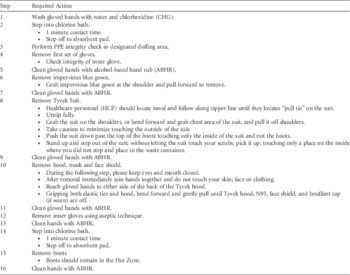
The trained PPE monitor was a registered nurse and certified infection preventionist who underwent training at the CDC to (1) serve as a PPE monitor, and (2) train others to don, wear, and doff EVD-specific PPE. This infection preventionist served as the trained monitor for all simulations. The doffing protocol used in simulations is shown in Table 1. Simulations took place in a patient room. The participant removed their own clothes and donned a scrub shirt and pants. The PPE monitor then verbally guided them through the donning process using the checklist. When finished, each participant was wearing a Tyvek suit with thumb holes to prevent sliding up the wrist, long-sleeved fluid-resistant gown with thumb holes to prevent sliding up the wrist, 2 pairs of long gloves (covering the wrist completely), Tyvek hood, face shield, N95 respirator, and fluid-resistant boots. After donning PPE, a mixture of MS2 and Φ6 suspended in phosphate-buffered saline was applied to 4 sites: (1) the palm of the dominant hand, (2) the shoulder of the gown opposite the dominant hand, (3) the top side of the face shield on the same side as the dominant hand, and (4) the toe of the rubber boot opposite the dominant hand. Contamination sites were chosen in consultation with clinicians who had participated in EVD patient care and had directly observed PPE contamination during patient care. A total of 25 µL was applied to each site in 5 drops of 5 µL each to simulate droplet exposure, particularly small droplet exposure of which the HCP may not be aware. The mean virus titer applied to each site in 25 µL was 1×10⁸ for MS2 and 5×10⁷ for Φ6, based on reports of viral load in body fluids during acute phases of EVD.Reference Kreuels, Wichmann and Emmerich 4 , Reference Wolf, Kann and Becker 16 , Reference Schieffelin, Shaffer and Goba 17 The participants were instructed to close their eyes during application so they did not see the exact location of contamination.
PPE Doffing Protocol

To simulate natural movement while wearing PPE, the HCP then performed a gown change on a mannequin. After the gown change, the PPE doffing process began. The trained monitor guided the HCP participants through the doffing process using the checklist in Table 1. For the first 10 subjects, each step that called for sanitizing gloved hands, as well as the final hand hygiene steps (steps 13 and 16) that called for sanitizing bare hands, were performed using alcohol-based hand rub (ABHR) as a 70% ethanol gel (Purell, Gojo Industries, Akron, OH). For the last 5 subjects, each step that called for sanitizing gloved hands was performed with liquid hypochlorite at a concentration of 1,850 ppm (Fuzion Healthcare Disinfectant, Clorox Co., Pleasanton, CA) applied by spraying onto gloves. The final hand hygiene steps (Steps 13 and 16) that called for sanitizing bare hands were performed using ABHR.
At the doffing step when inner gloves were removed (Step 12), they were collected for sampling. After the doffing process, 3 sites were sampled for virus: bare hands, face, and scrubs worn under PPE. After performance of the final hand hygiene step using ABHR (step #16), hands were sampled for virus using whole-hand sampling.Reference Casanova and Weaver 18 The face was swabbed for virus. After doffing was complete, scrubs were collected for sampling. Samples were immediately transported back to the laboratory for analysis using previously described methods.Reference Casanova, Rutala, Weber and Sobsey 19 All samples were assayed for MS2 and Φ6 using the single agar layer (SAL) assay on the appropriate bacterial host. Virus recovered from each site was expressed as plaque-forming units (PFUs).
RESULTS
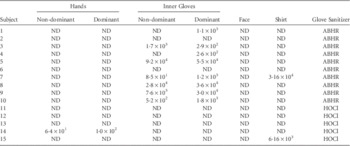
A total of 15 HCP participated: 11 registered nurses and 4 medical doctors. There was no detectable transfer of enveloped bacteriophage Φ6 to inner gloves, hands, face, or scrubs for any participants. There was detectable transfer of non-enveloped bacteriophage MS2 (Table 2). MS2 was detected on both hands of 1 participant (there was no MS2 detected on the inner gloves for this participant). The amount of MS2 detected on the hands was low (<0.00005% of the original inoculum).
Detection of Non-enveloped Bacteriophage MS2 After PPE Doffing

NOTE. ND, not detected; ABHR, alcohol-based hand rub; HOCl, hypochlorite glove sanitizer.
MS2 was detected on the inner glove worn on the dominant hand for 8 of 15 participants, on the non-dominant inner glove for 6 of 15 participants, and on scrubs for 2 of 15 participants. There was no detectable transfer of MS2 to the face. Importantly, 1 participant, who had detectable transfer to scrubs stated that during the doffing procedure, believed that when the Tyvek hood, N95 respirator, and face shield were removed simultaneously, the hood/respirator/face shield combination had made contact with the front of their scrub shirt.
All detectable transfer of MS2 to inner gloves was observed when ABHR was used for the glove sanitizing steps; no transfer was observed when hypochlorite was used for the glove-sanitizing steps. However, 1 participant using hypochlorite for glove sanitizing had virus transfer to hands, and 1 participant using hypochlorite for glove sanitizing had transfer to scrubs.
DISCUSSION
The recent epidemic of Ebola in West Africa was by far the largest Ebola outbreak described to date. For HCP practicing in non-outbreak countries, the 2 greatest risk factors for acquisition of EVD were (1) contact with an infected patient due to failure to screen for travel to or from West Africa and (2) exposure to a person with EVD and self-contamination during the doffing procedure. The importance of preventing acquisition of EVD during patient care cannot be overstated; >800 HCP developed EVD during this outbreak.
Our study is the first to validate the use of the CDC recommended EVD PPE with this type of complex PPE doffing protocol under controlled conditions by observing the fate of both enveloped and non-enveloped viruses on PPE during doffing. Previous research has shown that self-contamination of hands with a non-enveloped virus during doffing is common in routine use of standard contact isolation PPE,Reference Tomas, Kundrapu and Thota 10 and carefully structured, monitored doffing is especially important during EVD patient care.Reference Fischer, Hynes and Perl 14 Using a structured doffing protocol under the direction of a trained monitor, there was no transfer of an enveloped surrogate for Ebola virus to hands, face, or clothing. The enveloped surrogate virus was also not detected on inner gloves for any participants. These results suggest that current doffing protocols, including the use of ABHR, are protective against self-contamination with an enveloped virus.
In 2 previous studies, complex PPE doffing was investigated; both used fluorescent tracers as markers of contamination. Zamora et alReference Zamora, Murdoch, Simchison and Day 13 evaluated complex PPE doffing but found more frequent contamination of hands with fluorescent tracer than was found with viruses in this study. Bell et alReference Bell, Smoot, Patterson, Smalligan and Jordan 20 found contamination with fluorescent tracer after PPE removal; in their study, contamination of PPE was carried out during simulated patient care, and contamination could potentially have come from patient care or PPE doffing. The body of literature evaluating simulated PPE removal using both fluorescent markers and infectious viruses simultaneously is small.Reference Tomas, Kundrapu and Thota 10 , Reference Casanova, Alfano-Sobsey, Rutala, Weber and Sobsey 11 While a single study found that rates of self-contamination with fluorescent tracer and MS2 were similar,Reference Tomas, Kundrapu and Thota 10 there is no published evidence using enveloped viruses, and it is not yet clear whether fluorescent tracers are sensitive and specific markers of self-contamination with infectious viruses. Our study is the first to isolate contamination taking place during the doffing process itself from contamination taking place during patient care and to use infectious viruses as markers of potential transmission.
In this study, we detected transfer of non-enveloped MS2 to the clothing of 2 participants and the hands of 1 participant. MS2 was also detectable on the inner gloves of some participants when ABHR was used to sanitize gloves between doffing steps. In these simulations, hands were sampled after a final hand hygiene step using ABHR. In the doffing protocol, this hand hygiene step using ABHR is the final step before exiting the doffing area to remove scrubs and shower (Table 1). The risk of hand contamination may be further reduced by incorporating a final step of hand hygiene using water and an antimicrobial soap such as chlorhexidine. The fact that participants had detectable MS2 on their inner gloves but not on their hands suggests that inner gloves are playing a vital role as the point of contact with PPE. Because gloves are continually touching new areas on PPE as the doffing process progresses, even repeated use of a hand sanitizer on the outside of the gloves may not completely prevent residual inner glove contamination with a non-enveloped virus. The presence of a low level of MS2 contamination on the hands of 1 participant who did not have detectable MS2 on their inner gloves suggests that random low-level contamination events are still possible. This highlights the importance of reinforcing the message that even when wearing multiple layers of PPE that provide whole-body coverage, hand hygiene after doffing is still critical, as is the careful selection of effective hand hygiene agents for this purpose. In addition, it is reasonable to recommend that HCP involved in care of patients with EVD post-doffing shower using an antiseptic such as chlorhexidine.
There may be differences in the way that lipid-enveloped and non-enveloped viruses survive during PPE doffing. Virus transfers to hands and scrubs were observed only for a non-enveloped surrogate in these simulations. The choice of hand sanitizer agent used on hands and gloves may be important depending on the type of virus of concern. Enveloped Φ6 was not detected on inner gloves when ABHR was used, but MS2 was detected. This result is consistent with previous findings that ABHR is more effective against enveloped than non-enveloped viruses.Reference Grayson, Melvani and Druce 21 – Reference Sickbert-Bennett, Weber, Gergen-Teague, Sobsey, Samsa and Rutala 24 Careful doffing of inner gloves in a manner that minimizes the risk of hand contamination is important. To minimize viral contamination of inner gloves, more conservative control measures may include sanitizing gloves with stronger agents such as hypochlorite. While hypochlorite use directly on hands may not be desirable, its use on gloves does not present the same issues.
The fact that 1 participant recognized unintentional contact of PPE with the front of their scrub shirt underscores the need for both independent monitoring and participant self-monitoring during the complex doffing process. In these simulations, the trained monitor did not observe any deviations from the doffing protocol by the participants, but there may be contact and contamination events that are not readily visible even to a trained monitor. In this and other doffing protocols, scrubs are touched with bare hands and may be removed and handled after exiting the patient care area. The detection of virus on scrubs suggests a need for careful handling of scrubs after doffing, as well as development of guidelines for handling scrubs if contamination is recognized during the doffing process.
A structured doffing protocol using a trained monitor, double gloves, and multiple glove sanitizing steps appears to protect against self-contamination with enveloped viruses. There was a low risk of self-contamination with a non-enveloped virus, possibly due to their higher resistance to agents used to sanitize gloves. Future research can adapt this methodology for evaluating of a variety of doffing protocols, which can vary from facility to facility. Future studies should also incorporate different levels and quantities of contamination on the surface of PPE. If non-enveloped viruses are of concern in the future, improved doffing protocols that are highly protective against all types of viruses may need to incorporate highly effective glove sanitizing and hand hygiene agents.
ACKNOWLEDGMENTS
We thank Emily Bailey and Mark Sobsey of the University of North Carolina Chapel Hill for laboratory support.
Financial support: This work was supported by the Centers for Disease Control and Prevention’s Prevention Epicenters Program (Grant no. U54CK000164). The funding source played no role in the study design, the collection, analysis, and interpretation of data, the writing of the report, or in the decision to submit the paper for publication.
Potential conflicts of interest: All authors report no conflicts of interest relevant to this article.
SUPPLEMENTARY MATERIAL
To view supplementary material for this article, please visit http://dx.doi.org/10.1017/ice.2016.169