Following the death of anti-apartheid activist Steve Biko in 1977, the US government began to impose economic sanctions on South Africa. These measures, designed to express official US disapproval of apartheid, included a ban on technology exports to South Africa's police and military. Although the sanctions had widespread popular backing, support for them was weaker among US firms with business interests in South Africa. As early as 1978, the US embassy in Pretoria was forced to inform the US State Department that, “multinationals, including US subsidiaries, are determined to undercut any sanctions action and have already made plans to camouflage their operations through subterfuges arranged with affiliates in other countries.”Footnote 1 Among the firms ready to undermine official US foreign policy in this way were many household names, including American technology giants Burroughs and IBM. Examples of such evasive activities abound.Footnote 2
A growing body of research investigates why firms engage in foreign direct investment (FDI) and which characteristics make a state attractive to investors. Scholars have largely focused narrowly on the domestic political institutions and policies of potential host states, such as regime type,Footnote 3 participation in trade and investment agreements,Footnote 4 welfare and taxation,Footnote 5 conflict,Footnote 6 and respect for human rightsFootnote 7 to explain what makes a state attractive to investors. More recently, scholars have begun to consider the dyadic context, evaluating how FDI responds to political relations between home and host states. Conflict and cooperation, military alliances, and ethnic diasporas have all been found to shape bilateral investment flows in significant ways.Footnote 8 Although these factors are important, they miss considerations that arise from the broader economic and political environment in which countries and firms interact. This study moves beyond characteristics of the host state and direct home-host relations to examine the extent to which investor decisions are responsive to states' position in the global economy and their relations with third-party states.
Building on recent work on sanctions-busting tradeFootnote 9 and the impact of sanctions on FDI flows,Footnote 10 this study investigates how firms adapt to the imposition of sanctions against a trading partner. In the case of South Africa, when IBM or Burroughs sought a means to skirt US sanctions, they were responding to a politically imposed change in the world economy and the new opportunities and challenges generated by that change. When the solution these companies adopted was to reroute commerce through foreign subsidiaries in third-party countries, the resulting capital flows did not merely reflect a response to the domestic political conditions in these countries. The shift in inward FDI that these countries experienced also reflected an assessment of their changed position in the global economy and the value of their relationship with South Africa.
Our broader argument is that firms investing abroad take into account the host state's relations with third-party states when deciding how to allocate their resources. The presence of economic sanctions is one facet of these third-party relations. We focus on sanctions for two reasons. First, economic sanctions—the threat or imposition of restrictions on international trade and investment to compel political concessions—are a perennial feature of international politics. Governments regularly resort to economic coercion as a first (and often only) step in resolving international conflicts of interest. The ubiquity of sanctions has led prominent scholars to label the 1990s “the sanctions decade”Footnote 11 and their use has become, if anything, more frequent in the following years. Second, recent studies suggest that economic sanctions have a significant distorting effect on the structure of global trade and investment, not least because of the adjustments they force on firms and individuals engaged in international commerce.Footnote 12 As global economic ties expand and multiply, there is reason to believe that restrictions on any one actor in the global economy will affect the flows of goods, services, and capital not only between the sender state and the target but also between each of these states and third-party states, as well as between third-party states.
By restricting commercial activity between the sender state and the target state, economic sanctions create constraints as well as opportunities for firms. Sanctions increase the risks associated with commercial relations with the target state, making some traders and investors reluctant to do business there. Others, however, may perceive the slack that sanctions create in the target's economic relations as an opportunity to engage. Put another way, sanctions can create incentives for firms and governments to shift economic activity in ways that allows them to take advantage of the sanctioned state's misfortune.Footnote 13 We hypothesize that in response to sanctions imposition against a trading partner, sender-state firms will shift investments disproportionately to those third-party states that either have a record of engaging in sanctions-busting activity against the sender state or are likely to become sanctions-busters in the future. We test these propositions using data on US economic sanctions and US FDI outflows between 1966 and 2000. The results suggest that states maintaining strong economic ties with targets of US sanctions see significantly greater inflows of direct investment by US-based firms than other states, ceteris paribus.
These findings have several implications that will be of interest to scholars of both FDI and economic coercion. First, our results suggest that multinational firms indeed consider not only host state characteristics but also their ties with other states in the international system when deciding where to invest. Moreover, the evidence presented in this study suggests that firms respond to particular rent-seeking opportunities—an idea that was widely discussed in earlier scholarshipFootnote 14 but that has become increasingly disregarded in light of mounting evidence that firms are wary of partnering with dictators and tyrants.Footnote 15 This study points to another type of rent-seeking opportunity that firms can take advantage of, arising from a host state's bargaining position vis-à-vis its other trading partners. Second, our findings suggest more broadly that investor decision making is based on a view of the global economy that is more complex than much of the empirical literature assumes. This view recognizes that home and host countries of FDI are embedded in networks in which political developments can encourage firms to seek indirect access to third-country markets.
Finally, although greater global integration has increased opportunities to use economics as political leverage, it has simultaneously made it more difficult for governments to use economic coercion effectively. Not only can those states targeted with sanctions rely on their better and more numerous alternative trading partners to offset economic lossesFootnote 16 but globalization has also empowered sender-state firms who do not share their government's priorities to circumvent sanctions and continue engagement with the target country. Direct investment in states that maintain trade relations with the target of sanctions can go a long way in undermining the intended coercive effect of depriving the targeted economy of goods and income.
Economic Sanctions as a Factor in Investment Decisions: Access and Rents
In their most common form, sanctions involve the government of a sender state imposing (or threatening to impose) restrictions on commercial relations with another state unless that target acquiesces to the sender's demands. The basic logic of economic coercion is that commercial restrictions, such as tariffs or outright blockades, will impose sufficiently high costs on the target to make political concessions to the sender an appealing alternative. Interesting for our purposes is that sanctions also impose costs on the sender, specifically on firms that conduct business in the target state. These costs include the loss of income from reduced exports of goods and services to the target, reduced imports from the target and the need to obtain substitutes of comparable quality, and adjustment costs associated with obtaining new markets and suppliers. Sender firms may also lose their competitive advantage in the target if companies from third countries “backfill” the voids left by sender-state firms.Footnote 17 Additional costs arise if sender firms acquire a reputation for being unreliable business partners, making it more difficult to renew current commercial ties or build new ones.Footnote 18 Moreover, revenue losses and the damage to business relationships are bound to outlast the sanctions themselves.Footnote 19
Despite these costs, existing studies on the dynamics of economic sanctions often implicitly assume that sender-state firms will comply with their governments' policies. These studies rarely ask which alternative opportunities these firms may pursue to make up for the slack created by sanctions. Our theoretical argument starts with the notion that when sanctions cut off one profitable economic relationship because sender-state firms are obligated to stop trading directly with the target state or withdraw their investments from the target, these firms are likely to look for alternatives. The options available to them fall into two broad categories. The sender-state firms can either shift away from engagement with the targeted state toward other trading partners and investment opportunities or continue relations with the sanctions target in some form that generates profits. Although a sizeable literature has sought to identify firms' decision making related to FDI,Footnote 20 few have considered the extent to which distortions caused by economic sanctions against one state can make another economy attractive to potential investors. We argue that sender-state firms have incentives to consider, alongside other factors, the extent to which a potential investment location offers access to the original sanctions target and higher returns due to rents produced by the sanctions.
For some firms that are trading with target states prior to sanctions imposition, the costs associated with complete disengagement from a target state may justify the risk of getting caught doing direct business with the enemy, especially if profits are large and the risk and the associated penalties are low.Footnote 21 Others may choose more indirect means of staying in business with the target state, such as rerouting goods and capital through third-party states. For these firms, third-party states that can provide extensive and reliable access to the target state's market and resources may present particularly attractive alternatives to direct engagement with the sanctioned economy.
Economic sanctions can generate economic opportunities that may entice even firms that were not originally engaged with the target. Restrictions imposed on lawful trade with a target economy can generate significant rents for firms willing to continue commercial relations in the face of sanctions. When the target economy is forced to find replacements for the sender's supplies and customers, firms in third-party states—including subsidiaries of firms at home in the state imposing the sanctions—may be able to expand their business with the target state. Moreover, they may be able to charge a premium for imports demanded by the target state or discounts for goods exported by the target.Footnote 22 As a result, economic sanctions against the target may generate economic opportunities that can provide profits above and beyond those generated by commerce in the absence of sanctions. These rents can make a third-party state with ties to the target economy an attractive destination for foreign firms, including those from sender states.
Thus far, the argument suggests only that sender firms have incentives to engage in indirect commercial relations with the sanctioned state. Specifically, sender firms have incentives to pursue these indirect relations through FDI. The reasons for this stem directly from the logic of FDI. Firms commonly pursue internationalization to gain access to resources and markets beyond their home state's borders. They do this through the establishment of subsidiaries, over which they retain control, rather than through market transactions with other firms to protect intangible assets, such as production methods and management techniques.Footnote 23 Firms also choose to act through subsidiaries to reduce the uncertainty and transaction costs associated with normal market exchange with unaffiliated firms.Footnote 24 From the perspective of sender firms, pursuing trade with sanctioned states through their subsidiaries in foreign countries has important advantages. In principle, a sender-state firm could reroute its trade through third countries, buying goods that originate in the target state in third-country markets or exporting goods intended for the target economy to third countries where they will be reexported. This, however, requires the firm to do its business with the target state at arm's length, and through intermediaries who look after their own interests. Indeed, just as there are incentives to exploit the target state's economic misfortunes, so too is there an incentive to exploit sender-state firms eager to maintain business ties with the target. Engaging the target state through its own subsidiaries rather than through local enterprises in the third-party state allows firms to retain greater control and enables them to capture a larger share of the rents that sanctions generate.
Given the advantages of acting through local subsidiaries, the question arises why sender firms would increase investments in third-party states rather than in the sanctioned state directly. Historically, FDI was often used to “jump” tariff barriers. When tariffs imposed by protectionist governments made it difficult for foreign imports to compete, foreign firms could sidestep these obstacles by moving production directly into the protectionist country.Footnote 25 Although this option may be available to sender firms, there are reasons for investors to be wary of choosing this path.Footnote 26 The imposition of even limited economic sanctions could be a sign of deteriorating political relations between the sender and target governments and may portend further restrictions on sender firms' economic activity in the target economy.Footnote 27 At the extreme, sanctions may raise the risk of nationalization of sender firms' assets by the target government. Being seen as retaining direct economic ties with the target may also be risky for sender-state firms' reputations and profits in other ways. For example, sender governments can blacklist firms with questionable business contacts for government contracts. Consumers may become aware of a firm's business activities in a sanctioned state and push to punish the firm via consumer boycotts or disinvestment campaigns.Footnote 28 Engagement with the sanctioned state through investment in third-party states can spare sender firms some of the risks associated with direct investment in the target state, as it puts the firm's assets beyond the reach of the target government. It also potentially obscures relationships between sender-state and target-state firms in ways that may allow their commercial transactions to escape public and governmental scrutiny.
The ability to provide access to the resources and market of a sanctioned state and the presence of potential rents generated by the changed economic position of the sanctioned state are not the only, or even the most important, characteristic of a potential location for investment. We argue merely that a state's ability to take advantage of distortions created by sanctions against another state is a consideration that can make that state attractive to investors, including those from the state that imposed the sanctions. How would investors identify these opportunities? We argue that investors are likely to look to current or potential “sanctions busters.” These are states that currently trade with the target and are likely to continue doing so in the future and may even increase their trade in the face of sanctions. These states are attractive because, from the investor's perspective, they carry a lower risk of joining the sanctions effort. If the state did so, or if there is a significant probability that it will down the road, the benefits of market access and rents may be less likely to be realized, or firms will have to move on too soon to make investment there profitable.
It can be difficult for firms to gauge ex ante whether or not a host government will actually commit to preserving favorable policies over the long term.Footnote 29 The evidence has generally shown that, to minimize this uncertainty, investors look to indicators of rulers’ credibility, including historical reputation.Footnote 30 In the context of economic sanctions, firms may look to those states that have actively disregarded sanctions efforts, and that have even gone so far as to increase trade with targeted states. The governments of these states have chosen either for economic or political reasons to tie their economic welfare to a policy premised on undercutting sanctions imposed by the sender state on their trading partners. Whether they are pursuing an explicit policy of sanctions-busting or whether they are simply tolerating local firms’ exploitation of business opportunities with a sanctions target, these states would appear likely to continue to provide a safe haven for investment directed at business with the target. This activity is easily observable for investors and should send a clear signal to firms, including those from the sender state, that their continued business with the target state would be well preserved, even further encouraged, if they relocated accordingly. We hypothesize the following:
H1
In response to sanctions imposition, sender-state firms increase FDI disproportionately in host states that have a record of sanctions-busting against the sender state.
Relying on a state's record to predict future policy is intuitive but also problematic. A third-party state that is not currently engaged in sanctions-busting may nevertheless do so if the opportunity (or the need) arises. In these cases, investors may consider the factors that make a state likely to become a sanctions buster. Recent research has sought to identify these factors. Early finds that economic rather than security interests appear to drive decisions to pursue sanctions-busting policies.Footnote 31 In particular, current trading partners of the target state are in a privileged position because firms in the target state may find it less costly to expand their relations with existing partners than to find new ones. Among these trading partners, Early finds, third-party states that are more dependent on trade with the sanctioned state are more likely to become sanctions busters than other states.Footnote 32
Trade dependence on the target could influence the third-party government's position on sanctions-busting in two complementary ways. If trade ties with the target are extensive, they may contribute significantly to national economic performance such that the economic costs of breaking the ties would outweigh any potential benefits to the government of joining the sanctions effort. Extensive commercial ties also create societal groups within the third-party state that have vested economic interests in continued trade with the target. If commercial relations with the target are sufficiently large, these groups will raise the political costs of joining the sanctions for the third-party government. In sum, governments of third-party states that are highly dependent on trade with a sanctions target have incentives to remain economically engaged with that state. The prospect of this continued engagement should make the third-party state an attractive place to invest for sender-state firms. We hypothesize that:
H2A
In response to sanctions imposition, sender-state firms increase FDI disproportionately in host states that are more highly dependent on trade with target states.
In addition to the third-party's dependence on the sanctions target, the target's economic dependence on trade with the third-party state could enter into investors’ calculations, too, because it increases potential rents and makes sanctions-busting more likely. Firms in target states looking to replace trade with the sanctioning state may increase their trade with third-party firms. As we noted, there is reason to believe that states with existing trade ties to the target may benefit disproportionately from this activity. The target's new need may strengthen the bargaining position of third-party states on whom the target is already dependent, in particular, given their existing relationship. Firms in these states are well positioned to demand even better terms from their now increasingly disadvantaged business partners in the target country. Moreover, if third-party states can serve as a conduit for indirect commercial relations with the sender state, for example, by rerouting trade and “laundering” capital flows, governments and firms in target states may be more willing still to grant preferential treatment. These considerations create strong incentives for states on which the sanctioned state is economically dependent to become sanctions busters. In turn, these incentives may reassure foreign investors, including those from the sender state, that the third-party state is unlikely to join the sanctions and that it is thus an attractive place to do business. Based on this discussion, we hypothesize the following:
H2B
In response to sanctions imposition, sender-state firms increase FDI disproportionately in host states upon whom target states are more highly trade dependent.
The type of investment activity we are describing here could reduce the impact of economic sanctions on the targeted state. To the extent that sanctions are designed to compel political concessions through economic deprivation, increased investment in third-party states that maintain commercial relations with the target reduce their coercive potential. If sender governments are serious about the sanctions they impose, they may try to limit investment in third-party states that trade extensively with the target. In principle, sender governments have two approaches at their disposal. They can enforce sanctions laws against firms domestically, threatening violators with legal sanctions and blacklisting them from government contracts. They can also seek enforcement of their sanctions laws in third-party states against foreign subsidiaries of sender-state firms and even foreign firms unaffiliated with the sender state.
If enforcement is effective and the penalties sufficiently large, investment in potential sanctions-busters will be less attractive to firms than it would be otherwise. Even when it is not made illegal by sanctions legislation, indirect trade with the target through foreign subsidiaries may occupy a legal (and possibly moral) gray zone that increases uncertainty for sender firms looking to invest. In his study of US extraterritorial sanctions, Rodman concludes that in the post–World War II era foreign subsidiaries of US firms in third countries were often reluctant to engage in investments, even when doing so did not technically violate US sanctions law.Footnote 33 Policies such as the Helms-Burton Act of 1996, which extended US jurisdiction to foreign corporations on foreign soil, had a chilling effect on global investment even with lackluster enforcement. Societal pressure and congressional commitment to sanctions, in particular, could convince some firms with smaller commercial stakes in the target to forego commercial opportunities that might violate US sanctions.Footnote 34 Developing a formal model of government-firm interactions in a sanctioning state, Morgan and Bapat similarly conclude that the probability of evasion attempts by sender-state firms is a function of the value these firms attach to the affected trade and of the sender government's ability to detect evasion.Footnote 35
That said, there are reasons to believe that government intervention will not always cause firms to refrain from pursuing commercial relations with sanctioned states. First, enforcement within the sender state is often limited by the fact that monitoring the activities of local firms’ foreign subsidiaries is a resource-intensive activity. This is particularly true when the number of multinational corporations with branches on foreign soil is large. Most states are unlikely to possess the administrative capacity to detect and punish firms that subvert sanctions, intentionally or inadvertently, at sufficient levels to deter all such activity.Footnote 36 To the extent that sender governments rely on voluntary restraint by firms, for example, in response to moral or public scrutiny, compliance with sanctions law is more likely when firms—or their customers—identify with the government's goals in imposing the sanctions. This identification cannot be taken for granted; it is likely to vary with the type of goal the government is pursuing through sanctions, broader national political and economic conditions, and over time. Research suggests that in the case of US firms, the general level of identification with the government's foreign policy goals has been waning in the past decades.Footnote 37
Second, sanctions enforcement against subsidiaries on foreign soil is politically delicate. In effect, it requires a sender government to extend its domestic sanctions law into another sovereign country. Such extraterritorial sanctions require the cooperation or at least the acquiescence of the host government. Because host state governments may face significant domestic economic and political costs for siding with sender countries against firms, including subsidiaries of foreign companies, operating on their soil, they are unlikely to be willing to bear those costs unless there is a compelling reason, for example, when their foreign policy goals significantly overlap with those of the sender state. Examples from US policy suggest that foreign governments are increasingly unwilling to comply with policies that are perceived to be violations of their sovereignty.Footnote 38 Although some users of sanctions, most notably the United States, may have the means to compel third-party states to accept extraterritoriality, the potential harm to future political relations with the third-party state may be a deterrent. In the wake of a high-profile failure to compel Western European countries to implement the pipeline sanctions against the Soviet Union, the US government has become increasingly reluctant to insist on enforcement of its extraterritorial sanctions if doing so would harm political relations with allies.Footnote 39 In fact, recent research suggests that some third-party states may be able to exploit their friendly political relations with the sender state as cover for their sanctions-busting activity when the resulting commercial benefits are great.Footnote 40
The presence of effective sender enforcement of sanctions laws has the potential to discourage firms from seeking commercial relations with the targeted state and to discourage potential sanctions-busting states from becoming conduits for such activities. Unfortunately, systematic data for domestic and, in particular, extraterritorial enforcement do not currently exist in sufficient quantity to allow us to control for potential effects on investment flows to third-party states. In this study we proceed with the analysis with the understanding that if enforcement is a factor in our causal mechanism, its presence should bias the results against providing support for our hypotheses.
Research Design
Our causal argument produces hypotheses about the foreign investment behavior of sender-state firms. Ideally, we would want to test these hypotheses using information that would allow us to identify whether individual investors shifted investments specifically in response to the imposition of economic sanctions against a current trading partner.
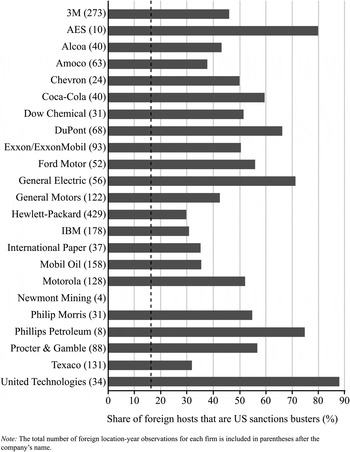
For the purpose of illustration, Figure 1 presents limited firm-level data on the foreign operations of twenty-three randomly selected major US multinationals that provide some preliminary support for our contention.Footnote 41 Among developing states between 1993 and 2000, “busting” US sanctions is observed in about 16.5 percent of all cases, marked by the vertical dotted line.Footnote 42 In comparison, sanction busters make up a disproportionate share of the host states for twenty-two of these twenty-three firms over this same period, and in many cases by a large margin. Indeed, sixteen companies have more than 40 percent of their foreign operations in the developing world located in sanction-busting states.Footnote 43 Unfortunately, such detailed information is not currently available in sufficient quantity to mount a large-n empirical analysis. If the mechanisms we postulate exist more widely, however, we should be able to observe effects at the aggregate level.Footnote 44
Sanction-busting states as a share of twenty-three U.S. MNCs' hosts in the developing world (1993–2000)

Dependent Variable
To assess the impact of economic sanctions on sender-state investment in particular third-party states, we embed our main variables of interest in a standard model predicting FDI flows. We use data on sanctions imposition by the United States and US FDI flows between 1966 and 2000. Our unit of analysis is the recipient country-year. Data on impositions of economic sanctions are drawn from Hufbauer et al.Footnote 45 The dependent variable is a country's total of FDI inflows from US-based investors, measured in millions of real dollars. These data are provided by the US Bureau of Economic Analysis’s (BEA) statistics division.Footnote 46
We focus on the United States for two reasons. First, the US government frequently uses economic sanctions in international relations. It accounts for approximately half of all sanctions cases recorded in the two most widely used data sources.Footnote 47 Second, the US economy is a major source of direct investment. In 2010, US FDI outflows accounted for slightly less than 25 percent of total FDI outflows worldwide.Footnote 48 Activities by US firms and the US government can be expected to have significant ramifications for the structure of the global economy.
Independent Variables
Two sets of predictors form our main independent variables. To test H1, the first set captures the host state's current record of engaging in sanctions-busting trade. The variable sanctions-busting is a simple count of US economic sanctions that the state is observed as busting in a given year. Here we rely on the operationalization developed by Early,Footnote 49 which identifies “major” sanctions busters as those states that increase their total trade with a target state by 5 percent or more following sanctions imposition. A country's status as a sanctions buster persists for as long as it maintains this higher level of trade over the duration of the given sanctions effort.Footnote 50 Opportunities for sanctions-busting activity will necessarily be constrained by the number of sanctions imposed and in place at a given time. We control for this by also including a count of all us sanctions for each year in the sample.
The separate set of independent variables is designed to test H2A and H2B and consists of two directional measures of trade dependence. The variable recipient dependence represents the observed state's dependence on trade with those states that are the target of US sanctions in a given year. The more dependent the third-party state is on trade with targeted states, the more costly it would be for the third-party state to participate in sanctions efforts. The more valuable this bilateral trade, the more likely the income derived from trade with the target is to outweigh any benefits of joining the sanctions regime. It should be noted that this measure is not dyadic but instead represents the sum of a state's bilateral trade shares accounted for by sanctions targets. For example, if there are three ongoing US sanctions in year t, and the three targets account for 1 percent, 2 percent, and 3 percent of the observed state's total trade, respectively, then recipient dependence will take on a value of 0.06. That is, 6 percent of its total trade is with sanctioned states.
The second directional measure, target dependence, represents the extent to which sanctioned states are dependent on the third-party state for their foreign trade. Greater dependence of the sanctions target on trade with the third-party state also generates incentives to engage in sanctions-busting. For example, targets looking to replace lost income from trade with the sender may be willing to grant preferential trade terms to third-party states on whom they already rely. Because there are multiple sanctions targets during any given year, this variable is measured as the mean level of sanctioned states’ bilateral trade shares accounted for by the host state. For example, if the United States has sanctions imposed against three countries in year t, and the observed state accounts for 1 percent of Target 1's total trade, 2 percent of Target 2's total trade, and 3 percent of Target 3's total trade, then target dependence would equal 0.02. That is, on average, 2 percent of target states’ total trade is with the observed state. Thus, higher values indicate that target states rely more heavily on the observed third-party country for their international exchange. Distinguishing between recipient dependence and target dependence allows us to more closely scrutinize how these underlying economic relationships between third party and target affect the behavior of foreign firms looking to find a safe place from which to continue their own business with the target. Our argument suggests that higher levels of recipient dependence and target dependence, respectively, should be associated with greater US FDI inflows into the third-party state.
It is important to note that H1 and the set of H2A and H2B are substitutes rather than complements. Recall that H2A and H2B identify the conditions under which states are likely to become sanctions busters and distinguish between them, whereas H1 directly concerns the third-party state's current record of sanctions-busting. The research that underlies the development of these hypotheses suggests that trade dependence and sanctions-busting should be highly correlated.Footnote 51 Indeed, the point of including H2A and H2B is to isolate the key economic mechanisms thought to drive sanction-busting activity, and shed light on which of these indicators firms consider when shifting their resources abroad. Because including them in the same equation is likely to produce unreliable estimates, we evaluate them in separate models.
Control Variables
Sanctions-busting and economic dependence are clearly not the only predictors of FDI flows. Existing research on the factors that influence foreign investment is large and diverse. We focus in this study on a set of predictors that is common to many of these models.
First, given the motivations that underlie firm-level decisions about FDI, investors are generally assumed to consider a variety of economic conditions in the recipient state. States with larger markets, higher levels of economic development, and more robust economic growth are expected to attract higher levels of foreign investment.Footnote 52 The variable population is included as a measure of the recipient-state's market size. per capita gdp is used to indicate the recipient state's level of economic development. economic growth is measured as the percentage change in gross domestic product (GDP) from the previous year.Footnote 53 The data were taken from the World Bank's World Development Indicators. Another factor likely to influence firms’ investment decisions is government spending in the host state. Although some public expenditure such as those on infrastructure and education may benefit businesses and potential investors,Footnote 54 it often comes at the price of higher taxes, more extensive government regulation of economic activity, and poor fiscal health. Thus, on balance, we expect higher spending to exert a negative influence on FDI.Footnote 55 The variable government spending, drawn from World Bank's World Development Indicators, is measured as a proportion of the national GDP.
A related set of variables concerns the economic relationship between investors’ home state and the host. We thus include a measure of total trade with the United States.Footnote 56 To the extent that FDI is used by firms as an alternative to trade, or as a means of getting around trade barriers, we should expect FDI and us trade to have a negative relationship. However, some investments, especially those in vertical industries intended to produce goods for export back to the parent company, rely on functioning and predictable trade channels. Thus, we are agnostic about this variable's expected effect. Geographical separation may have similarly cross-cutting effects, as more distant markets may be generally less accessible to US firms, but their distance can also make trade relationships more costly, incentivizing FDI as an alternative means of economic exchange.Footnote 57 We therefore also control for the recipient state's total distance from the United States. These variables were generated using EUGene.Footnote 58
Second, a number of domestic political characteristics have also been found to make states more or less appealing to foreign investors. Several scholars have noted that democratic institutions and constraints on leaders’ ability to rescind property rights lower the political risk for foreign investors.Footnote 59 We control for this by including an indicator of liberal democracy. This variable is constructed using the revised Polity scale, which ranges from -10 to 10 with higher values indicating more liberal institutions. Political instability, on the other hand, has been found to depress FDI.Footnote 60 We account for regime durability in the recipient state with a variable that is also taken from the Polity data and measures the number of years since the observed state has shifted three or more points on the polity scale within a three-year span.Footnote 61 At the extreme end of political instability, violence and war are typically thought to deter foreign investment.Footnote 62 To control for civil conflict, we rely on a trichotomous measure. The variable civil conflict, taken from the PRIO Armed Conflict dataset, equals 1 when a country is in the midst of an ongoing civil conflict (less than 1,000 battle-related deaths), 2 when a country is experiencing outright civil war (1,000 or more battle-related deaths), and 0 when no organized armed rebellion is observed.
Third, host states’ external political relations are likely to factor into investors’ assessments of risks and benefits. Of particular interest is the nature of dyadic relations between the investor's home state and the recipient state. Conceptually related to the primary inquiry of this study, we include a dichotomous indicator, us sanctions target, that equals 1 when the observed state is also a target of US sanctions, and 0 otherwise. The effect of sanctions on FDI into targeted states over the course of sanctions imposition is actually quite nuanced, as Biglaiser and Lektzian show.Footnote 63 However, we expect states that already have economic restrictions placed on them by the sender state to be less attractive destinations for sender-state FDI than states that have not been targeted with sanctions. This variable is taken from Hufbauer and colleagues.Footnote 64 We further expect that the potential for escalated conflict between home and host countries will depress FDI flows. US investors should be less inclined to shift resources to states whose policies are diametrically opposed to those of the US government because this makes foreign investment more risky politically and thus less attractive economically.Footnote 65 We gauge this potential for conflict using Signorino and Ritter's measure of the similarity in foreign policy portfolios to create the variable s-score with us.Footnote 66 The measure ranges from -1 (completely opposite) to 1 (completely similar).
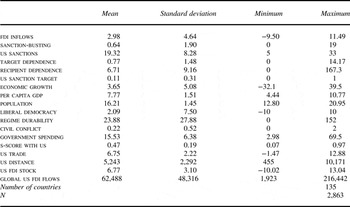
In addition to the host state's characteristics, investment decisions are likely also driven by the extent to which firms have an already established relationship with the potential recipient state. We should expect on average greater inflows into states with a positive history of hosting US FDI. Indeed, much of the movement in FDI flows data stems from new transactions between parent firms and their existing foreign subsidiaries. Thus, we control for the total stock of us fdi present in the observed country. These data were also taken from the BEA and measure the cumulative direct investment position of US firms in a given country.Footnote 67 In addition, the maximum amount of FDI inflows a state could receive during a year is necessarily restricted by the total amount of FDI available. We account for the total amount of global us fdi flows observed during the given year. With the exception of this last indicator, all variables are lagged one year. This is to account for the time it takes for foreign investors to select a host and to sink their investment, and to reduce the risk that endogeneity biases our results. Table 1 presents the summary statistics on each of these variables, as observed in the estimation sample.
Summary statistics, all countries

Notes: Summary statistics correspond with the sample used for obtaining Table 1 results. This includes all countries for which data were available except the United States.
Results and Discussion
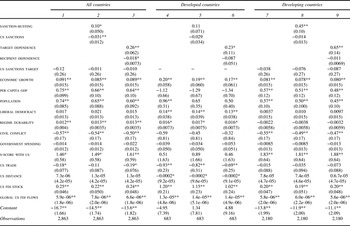
Table 2 reports the results of our analysis. Models 1 to 3 evaluate the theoretical argument for a sample consisting of all countries for which data were available between 1967 and 2001. The sample is limited to only highly developed countries for Models 4 to 6 and only developing countries for Models 7 to 9. All models were estimated using ordinary least squares (OLS) regression with robust standard errors.
Relationship with US sanctions targets and US FDI inflows, 1967–2001

Notes: Robust standard errors in parentheses. *p < 0.05; **p < 0.01.
Previous research suggests the distinction between developed and developing countries may be important when modeling FDI flows.Footnote 68 The total volume of FDI exchanged among developed countries dwarfs the amount that is directed into developing markets. In addition, the composition of FDI in developing countries is thought to be markedly different than that in the most advanced economies. Blonigen and Wang argue convincingly that pooling all countries together may produce misleading inferences.Footnote 69 Indeed, they find that the estimates from standard economic models of FDI are highly sensitive to sample specification, suggesting that the processes driving FDI into developed versus developing countries fundamentally differ. Similarly, recent work has found that investors are more sensitive to certain political stimuli when investing in the developing world than they are when investing in North America or Western Europe, which is attributed to the much higher baseline risk of investing in countries less politically and economically established.Footnote 70
Baseline Models
Models 1, 4, and 7 include only the control variables, drawn from prior research, for the three samples: all countries, developed countries, and developing countries. They represent our baseline models of FDI flows. The predictors perform largely as expected while also showing interesting differences between developed and developing countries’ experiences with FDI. The variables capturing domestic economic conditions—economic growth, per capita gdp, and population—all demonstrate strong, positive relationships with US FDI into developing countries. The negative coefficient on per capita gdp found for the sample of developed states is likely an artifact of the relatively small differences in national wealth among these countries.
In contrast, both liberal democracy and regime durability are estimated to have statistically significant positive effects when comparing across developed countries, but drop from significance in the sample of developing countries. Although inconsistent with some contemporary studies,Footnote 71 these findings may in part reflect the longer time span under consideration and the types of less savory relationships that large multinationals often had with developing states in earlier decades.Footnote 72 The instability associated with civil conflict and war, however, does seem to effectively deter US investors from developing countries, as demonstrated by the significant negative coefficient estimated for the civil conflict variable.
Also consistent with existing studies, our findings suggest that US investors favor host states that maintain friendly relations with the United States. The coefficient for s-score with us is positive, and statistically significant in the sample of developing countries. us trade, on the other hand, is negatively related to US foreign investment. This relationship is most pronounced when we limit the sample to other developed countries. Although trade and direct investment are often found to have a positive relationship in models of aggregate FDI, this finding is less surprising when we consider the longer time period under investigation and the fact that we are examining FDI flows from only a single country. In previous decades, American firms may have used FDI as an alternative to exporting, rather than as the means of linking global production chains that we often see today.Footnote 73 This seems especially likely in the developed world, where foreign investments have more often been horizontally integrated than vertically integrated.Footnote 74 The host state's distance from the United States similarly shows a negative correlation with US FDI in the developed countries sample.
We find that although being a target of US sanctions does show the expected negative relationship with investment by US firms, us sanctions target fails to reach commonly accepted thresholds for statistical significance in any of our models.Footnote 75 However, as Biglaiser and Lektzian suggest, FDI inflows into sanctioned states may reflect a more nuanced process with timing sensitivities that require modeling choices which go beyond the primary focus of this study.Footnote 76 Finally, as anticipated, both existing us fdi stock in the host state, and the total amount of outbound US FDI during a given year, show a positive and highly significant association with new investment flows across the full sample and both subsamples. The fact that our findings are largely consistent with insights from the existing empirical literature gives us confidence in our base model of US FDI flows.
The Impact of Sanctions
The remaining models reported in Table 2 include our variables of chief theoretical interest. Models 2 and 3 analyze a sample containing all countries. The findings suggest that busting US sanctions has a significant positive relationship with inward FDI by US investors (Model 2). When looking at the trade relationships that underlie sanction-busting activity (Model 3), the results show that the strength of existing trade ties also correlates positively with FDI. However, this holds for trade dependence in one direction only: states on whom sanction targets are more dependent for their economic exchange seem best positioned to benefit from the distortionary incentives created by the imposition of economic sanctions. States that are themselves more dependent on targets for their own trade are not so fortunate, as the coefficient for recipient dependence indicates. We return to this issue soon. As a first cut at the data, we take these findings to be generally supportive of our core argument that sender-state FDI is driven disproportionately toward third-party countries that maintain strong economic ties with sanction targets.
As expected, important differences emerge in the effect of our main independent variables when splitting the sample between developed countries (Models 5 and 6) and developing countries (Models 8 and 9). When we limit the sample to only the most-developed countries (Model 5), the coefficient for sanctions-busting takes on a positive sign but fails to reach commonly accepted levels of statistical significance. Instead, the general positive relationship between outright sanction-busting and US FDI inflows found in Model 2 appears to be driven primarily by differences in FDI patterns across developing countries (Model 8). Here, the estimated effect of sanctions-busting is large: for every additional US sanction a developing country busts, it will on average receive 45 percent more FDI from US investors than it would otherwise be expected to receive.
Figure 2 further illustrates this effect for developing countries. It shows the exponential increase in the expected percentage difference in FDI that results from busting several sanctions, relative to busting none at all, as inferred by the estimates produced in Model 8. The cumulative effect of sanction-busting on US FDI inflows into developing countries is considerable. A state that disregards two sanctions is predicted to receive about twice as much investment as it would if it were not engaged in sanctions-busting at all, ceteris paribus. Those states that are ambitious enough to actively undermine even more sanctions may see as much as a three- or even fourfold increase. Even if the true effect is closer to the lower-bound of the estimated coefficient, sanction-busting still exerts a fairly strong, positive influence on the investment behavior of US firms.Footnote 77 That is, a one-unit increase in sanction-busting would yield about a 25 percent increase in new FDI flows, whereas a three-unit increase could serve to double the amount of investment.Footnote 78 These are substantial differences.
Estimated effect of sanction-busting on US FDI inflows in developing countries

Two of the strongest, most consistent correlates of FDI flows into the developing world found in the empirical literature are national wealth (that is, per capita gdp) and market size (that is, population). These variables perform equally well in this study and are estimated to exert strong effects, making them useful for comparison. According to Model 8, a 1 percent increase in per capita GDP is, on average, predicted to increase inward US FDI by about 5.1 percent, and a 1 percent increase in population to increase investment by about 5 percent.Footnote 79 This means that, in each case, it would take an increase of about 7 to 8 percent on the selected variable, all else constant, to yield the same return in FDI that is provided by breaking one US sanction. Further, it would require an approximate increase of 14 to 15 percent in either per capita gdp or population to double the amount of expected investment, which is about equal to the effect of breaking two additional US sanctions.
Importantly, these findings imply that even though market fundamentals still play a major role in determining the geographic distribution of FDI flows, international politics can also shape the movement of capital in substantial, if indirect, ways. In this instance, firms respond to the distortions that result from their home government's use of sanctions by seeking out foreign hosts willing to actively undercut the policy. Consequently, a notable proportion of investment flows are driven not only in the pursuit of particular economic endowments, but also by the opportunities created by political context.
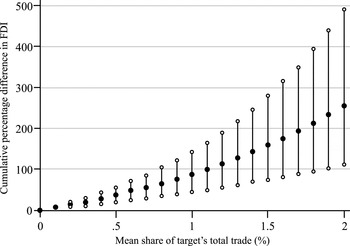
The differences between developed and developing countries persist when we consider trade dependency measures as proxies for incentives to engage in sanctions-busting. The higher a recipient state's average share of target states’ total trade, the more US FDI it is expected to receive. Once again, the magnitude of this effect is notably greater for developing countries (Model 9) than it is for developed countries (Model 6). Specifically, a one-unit change in target dependence, that is, a 1 percent increase in the average trade dependence of target states on the observed developing state, is estimated to correspond with a 65 percent increase in expected US FDI inflows. For advanced economies, however, this change is expected to correspond with only a 23 percent difference in investment. Figure 3 plots the cumulative percent differences in FDI that correspond with multiple-unit increases in the target dependence variable.Footnote 80 Judging from these results, developing states that enjoy stronger, more dominant trade ties with target states are more attractive investment destinations for sender-state firms than their domestic economic and political conditions alone would permit.
Estimated effect of target dependence on US FDI inflows in developing countries

We find support for our expectations in only one direction of trade dependence. Although target dependence demonstrates the strong, positive relationship that we expected, recipient dependence does not. Indeed, the variable takes on a negative sign across all models. However, the strength of the estimated negative effect seems to apply mostly to the developed countries in our sample, which may reflect some anomalies among this small, elite group of states. For example, Greece and Finland frequently score high on this variable, but are not typically among the leading recipients of US FDI—a fact that likely has little to do with their relatively greater trade dependence on target states. It seems more plausible that recipient dependence is simply not a salient factor in driving the investment activity of sender-state firms.
A closer look at the correlations among our key variables provides some insight into why this is the case. Although target dependence is highly correlated with sanctions-busting (.81 among cases in the full sample), recipient dependence is not (.04). This suggests that it may be those states who enjoy the dominant position in their trade relationships with sanction targets, rather than those in a position of dependence, that have the leverage and clout necessary to effectively thwart US sanctions. Although future research is needed to further investigate this particular relationship, one plausible interpretation of these results is that firms are particularly attracted to those states that have both the incentive and the capacity to actively undermine the sanctions imposed by their home government. Indeed, states on whom targets are more dependent are perhaps best positioned to exploit the targets’ economic misfortunes for their own gain, providing both domestic and foreign firms a valuable opportunity to cash in on the rents generated by sanctions.Footnote 81
Although the durability of our primary independent variables gives us confidence in the causal mechanisms proposed in this article, it is worth noting that their addition to the baseline model of FDI inflows does not significantly affect the performance of the control variables in either set of models. This leads us to believe that we are not merely identifying another factor that is itself highly related to established determinants of FDI flows, but rather have isolated a more novel factor that existing studies, to our knowledge, have overlooked.
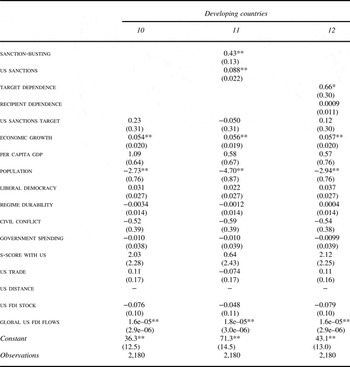
The evidence we have presented so far demonstrates that economic ties with target states help explain the variation in US FDI flows across developing countries. Though this is consistent with our argument, it tests only one of its implications. If the mechanisms we have highlighted work as theorized, we should similarly see evidence that such ties also covary with direct investment patterns within countries over time. That is, FDI inflows should increase or decrease from one year to the next with changes in US sanctions activity and the host state's position vis-à-vis sanctions targets. Table 3 reports the results of a set of models estimated using country fixed-effects, which permits us to evaluate the evidence in light of this more dynamic relationship. We have narrowed the focus onto only developing countries in this table.
Relationship with US sanctions targets and US FDI inflows in developing countries (with country fixed-effects)

Notes: Robust standard errors in parentheses. *p < 0.05; **p < 0.01.
Our key findings are robust to this alternative specification. sanctions-busting (Model 11) and target dependence (Model 12) are both estimated to have statistically significant positive effects on US FDI inflows. This implies that when the US imposes new sanctions, host states that are positioned to exploit the resulting economic disruption stand to benefit in another way, by garnering greater interest from US firms than they received previously.Footnote 82 These variables therefore not only help to explain differences in US FDI flows between countries, but also differences for individual countries over time. Indeed, the magnitude of the effect attributed to each variable changes very little from the previous models, showing a durable and consistent correlation that further strengthens our confidence in the hypothesized relationship.
Although our variables of chief interest perform largely as before, the same cannot be said about the rest of the variables included in the model. Indeed, the inclusion of fixed-effects yields interesting and informative differences in the results. In Model 11, us sanctions now shows a statistically significant positive relationship with US FDI. Developing countries are estimated to experience a near 9 percent jump in investment inflows with each increase in the number of sanctions targets, all else constant. This evidence further supports a basic premise underlying our logic, namely that sender-state firms negatively affected by sanctions generally seek to offset those losses by pursuing opportunities elsewhere. In contrast, some variables that were statistically significant before now fail to reach that threshold. Although the variables per capita gdp, civil conflict, s-score with us, and existing us fdi stock all help explain differences between countries, they do not seem to exert as much of an influence on FDI inflows for any particular countries over time. More dynamic variables, such as economic growth and global us fdi flows, however, continue to demonstrate significant positive effects. population is also still significant, but now takes on a negative sign. Although hosts with larger markets are often more attractive than those with smaller markets, it appears that more rapid population growth leads to declines in foreign investment.
Our theoretical argument is that the politically imposed distortion in international commerce caused by economic sanctions should increase the volume of sender-state capital flows into countries with close economic ties to sanctions targets. Such states should see more direct investment than other states that lack these ties and more direct investment than they typically enjoy in the absence of sanctions against their trading partners. The evidence we have presented in this study is consistent with both of these expectations. Indeed, the findings suggest that strategic investors respond not only to domestic conditions in the host state, nor only to those factors that characterize the home-host relationship. They also take into consideration factors that reflect the host's position vis-à-vis other states in the global political economy. Our model captures important elements along each of these dimensions and shows that they all factor in important ways into the global distribution of capital flows.
Conclusion
A significant proportion of international trade today is conducted by—and within—multinational corporations. These are entities that control and manage production facilities in two or more countries.Footnote 83 Although the expansion of firms across borders is not a new phenomenon, the growing internationalization of trade and progressive lowering of barriers to capital flows have made multinational corporations major actors in the modern global economy. FDI makes up a large portion of the global capital flows. Between 1980 and 2010 alone, worldwide outflows of FDI increased from $51 billion to twenty-five times that amount.Footnote 84 Though certainly propelled in part by the force of its own momentum, this expansion in capital flows has not unfolded entirely independent of politics.Footnote 85 Thus far relatively few studies consider the impact of economic sanctions on the choice of where to invest.Footnote 86
For investors and governments alike, globalization appears to be a double-edged sword. An increasingly global marketplace and ever-lower barriers to flows of goods and capital invite governments to use economic ties for political leverage. At the same time, these features provide economic actors in sender states, target states, and third parties alike with strong incentives to circumvent government restrictions as well as with the means to do so. Current scholarship suggests that major trading partners of a sanctioned state are particularly likely to continue, and even expand, their economic relations with that state after sanctions are imposed.Footnote 87 Our results suggest that the economic incentives that lead states to become sanctions-busters, such as privileged access to the target economy and rents arising from it, also make them attractive destinations for foreign investors—including firms at home in the sanctioning state.
In response to sanctions, US firms shift investments disproportionately to third-party states that are likely to become sanctions busters or already have a record of such activities. We find that being a known sanction buster and having significant trade ties with a target of sanctions are host state characteristics that appear to attract US investment. In particular, third-party states on whom sanction targets are highly dependent for their economic exchange are likely to benefit from increased US FDI inflows. The evidence shows that these traits not only set states apart from their competitors, but also increase the amount of investment that states receive when triggered by new sanctions impositions against economic allies. One explanation for these shifts in FDI is that they reflect decisions by some US firms to both sidestep the obstacles and exploit the profitable opportunities that are generated by the United States’s use of sanctions—ends that can be achieved by rerouting exchange with target states through subsidiaries in affiliated third-party countries.
This study aimed to provide some novel insights into the international political factors that drive investor decisions. Although we have focused on the presence of economic sanctions against the host state's trading partners, other considerations could similarly affect investor decision making. Political competition between states (or more accurately, between governments) may imply that for firms, the optimal link between the economies is sometimes indirect, involving third-party intermediaries.
The results of our analysis speak to a number of additional puzzles, broadly related to how governments and domestic economic actors respond to the challenges and opportunities that global economic integration pose. First, our findings raise questions about the incentives of firms and governments whose major trading partners find themselves the target of sanctions. Existing research on sanctions-busting trade suggests that economic rather than political considerations drive decisions to expand trade with a sanctioned state.Footnote 88 Yet in addition to gains from trade, current and potential sanctions busters may see benefits in terms of greater FDI inflows as well. To the extent that governments are strategic in their decision to join or defy sanctions efforts against major trading partners, demand from foreign investors may well be an important consideration. Acting as sanctions busters, these third-party states may be able to make themselves more attractive to sender firms—and possibly firms from other countries who do not want to run afoul of the sender's sanctions policies—by providing indirect access to the sanctions target. Our findings further suggest that these incentives might be stronger for developing countries because they are generally more dependent on foreign investment for economic growth. Although the findings we generate using aggregated, state-level data on FDI flows are suggestive, a more detailed test could employ firm-level data in a specific sector.
Second, nothing in our study suggests that it would be impossible for the sanctioning government to stop domestic firms from shifting investments to trading partners of the targeted state. Governments could do so, for example, by policing the firms directly or by demanding that governments in third-party states police the subsidiaries of the sender-state firms. Our findings for the United States suggest that the government is either disinclined or unable to tightly regulate compliance effectively when US firms respond to sanctions by shifting FDI to third-party states with significant trade ties to the target. To date, the factors that inform governments’ willingness and ability to monitor firm compliance with sanctions policy remain understudied empirically.
Finally, recent studies find that the presence of black knights and of third-party FDI into targeted states impedes the efficacy of economic sanctions as a coercive tool. The same market forces that grow economies and confer international influence may also undermine the political leverage of even the most powerful states. Assessing the impact of FDI flows on sanctions success, Lektzian and Biglaiser find that decreases in US FDI flows to targeted states can have a positive effect on effectiveness, provided non-US firms do not pick up the slack created by US disinvestment.Footnote 89 The incentives that sanctions create for third-party states are interesting in part because the involvement of third parties on the side of senders or targets has been found to influence the effectiveness of coercive sanctions.Footnote 90 Our findings indicate that foreign economic actors are not the only potential threat to a government's sanctions efforts. A major challenge may arise much closer to home from domestic firms in search of profit. Scholars of globalization have argued that greater economic integration has loosened governments’ hold over the direction of trade and investment because managers of multinational corporations have moved from a home-state ethnocentric orientation to a more global one. If it can be shown that investment flows to third parties undermine the effectiveness of trade sanctions, the conclusions should be of interest to scholars of economic interdependence and to policy-makers alike.
Supplementary Material
Supplementary material for this article is available at http://dx.doi.org/10.1017/S002081831500017X.