Introduction
Nine weed species in Mississippi have developed resistance to glyphosate (Heap Reference Heap2017). Populations of Italian ryegrass in Mississippi were documented resistant to glyphosate in 2005 (Nandula et al. Reference Nandula, Poston, Eubank, Koger and Reddy2007), and 71 of 82 counties in Mississippi currently contain populations of glyphosate-resistant (GR) Italian ryegrass. As one of the 10 most troublesome weeds in Mississippi cropping systems (Heap Reference Heap2017; Webster Reference Webster2012), Italian ryegrass is problematic on account of its resistance to multiple herbicide mechanisms of action, competitiveness, and allelopathy (Bond et al. Reference Bond, Stephenson, Barnes, Bararpour and Oliver2005a; Dickson et al. Reference Dickson, Scott, Burgos, Salas and Smith2011; Heap Reference Heap2017; Taylor and Coats Reference Taylor and Coats1996). Additionally, Italian ryegrass is characterized as a winter annual, biennial, and occasionally perennial plant (Bryson and DeFelice Reference Bryson and DeFelice2009) that is often present at the time of planting for summer annual crops (Bond et al. Reference Bond, Eubank, Bond, Golden and Matthew2014). Competition between an emerging crop and established Italian ryegrass will reduce crop yield if Italian ryegrass is left uncontrolled. Yield reductions of 100% in broccoli (Brassica oleracea var. botrytis L.) (Bell Reference Bell1995) and up to 92% in winter wheat (Triticum aestivum L.) (Hashem et al. Reference Hashem, Radosevich and Roush1998) due to Italian ryegrass interference have been documented. In Mississippi, corn (Zea mays L.) is planted in early spring, when uncontrolled Italian ryegrass may be present at time of planting (Nandula Reference Nandula2014). GR Italian ryegrass present at planting can be highly competitive with emerging corn. In these instances, corn height, density, and yield were negatively affected due to an allelopathic effect from GR Italian ryegrass.
The most effective and economical management strategies for GR weeds are those that incorporate soil-applied residual herbicides (Culpepper et al. Reference Culpepper, Webster, Sosnoskie and York2010). Fall applications of residual herbicides have been reported to control winter annual weeds, because they target weeds at an earlier developmental stage of growth (Hasty et al. Reference Hasty, Sprague and Hager2004; Stougaard et al. Reference Stougaard, Kapusta and Roskamp1984). In Mississippi, fall-applied residual herbicides are commonly recommended for management of Italian ryegrass (Bond et al. Reference Bond, Dodds, Golden, Irby, Larson, Lawrence, Reynolds and Sarver2017). Control of GR Italian ryegrass 180 DAT was 93% or better and dry weight was reduced 98% or more following fall-applied S-metolachlor at 1,760 g ai ha–1 and clomazone at 1,120 g ai ha–1 (Bond et al. Reference Bond, Eubank, Bond, Golden and Matthew2014).
Rice is commonly grown in rotation with soybean [Glycine max (L.) Merr.], grain sorghum (Sorghum bicolor L.), and cotton (Gossypium hirsutum L.) in the midsouthern US rice-producing region (Johnson et al. Reference Johnson, Beaty, Horton, Talbert, Guy, Mattice, Lavy and Smith1995; Zhang et al. Reference Zhang, Webster and Braverman2002). Depending on crop rotation sequence, herbicide persistence in the soil is a major concern for the following season (Johnson et al. Reference Johnson, Beaty, Horton, Talbert, Guy, Mattice, Lavy and Smith1995), and carryover of residual herbicide applications can injure nontolerant crop species (Bond et al. Reference Bond, Eubank, Bond, Golden and Matthew2014; Johnson et al. Reference Johnson, Beaty, Horton, Talbert, Guy, Mattice, Lavy and Smith1995; Zhang et al. Reference Zhang, Webster and Braverman2000).
Zhang et al. (Reference Zhang, Webster and Braverman2000) reported that carryover from herbicides commonly used in soybean, grain sorghum, and cotton can be problematic in fields seeded to rice the following season. Zhang et al. (Reference Zhang, Webster and Braverman2002) concluded that rice was injured 84% or more by norflurazon at one-half and one-fourth the suggested use rates. Additionally, rice height, seedling density, and grain yield were most negatively affected by norflurazon compared with fluometuron, imazethapyr, and S-metolachlor. Similar research reported that norflurazon carryover injured rice the most compared with soil-applied imazaquin, imazethapyr, alachlor, S-metolachlor, clomazone, trifluralin, and atrazine (Johnson et al. Reference Johnson, Beaty, Horton, Talbert, Guy, Mattice, Lavy and Smith1995). Others have reported rice injury from fluometuron, norflurazon, S-metolachlor, and imazethapyr carryover (Barnes and Lavy Reference Barnes and Lavy1991; Braverman et al. Reference Braverman, Lavy and Talbert1985; Johnson et al. Reference Johnson, Jordan, Johnson, Talber and Frans1993; Rogers et al. Reference Rogers, Talbert and Frans1986). Rice fresh weights were reduced 82% or more following applications of fluometuron at 2,200 g ai ha–1 PRE followed by fluometuron plus MSMA at 900 plus 1,600 g ai ha–1, respectively, made to Sharkey silty clay soil during the previous cropping season (Rogers et al. Reference Rogers, Talbert and Frans1986). Braverman et al. (Reference Braverman, Lavy and Talbert1985) reported that rice seedling density was reduced as S-metolachlor concentration increased, and that greater than 0.2 ppm of residual S-metolachlor reduced dry-panicle weight regardless of rice seeding rate, seeding depth, and herbicide safener. Fluometuron applied the previous cropping season at 2,240 g ha–1 injured rice 28%; however, by 9 wk after emergence (WAE), no visual injury was detected (Johnson et al. Reference Johnson, Beaty, Horton, Talbert, Guy, Mattice, Lavy and Smith1995). Chlorimuron applied in the previous cropping season at 140 g ai ha–1 injured rice 48% at 2 WAE and up to 60% at 6 WAE; however, injury to rice was 36% or less from 8 WAE to harvest (Johnson et al. Reference Johnson, Beaty, Horton, Talbert, Guy, Mattice, Lavy and Smith1995).
Rice fields with GR Italian ryegrass not controlled with preplant herbicide applications will contain significant residue at planting (J. A. Bond, unpublished data). Residue will impede planting practices, contribute to competition between rice seedlings and GR Italian ryegrass, and hinder herbicide programs as a result of inadequate coverage. In Mississippi, fall applications of residual herbicides are recommended for control of GR Italian ryegrass (Bond and Eubank 2013; Bond et al. Reference Bond, Dodds, Golden, Irby, Larson, Lawrence, Reynolds and Sarver2017). Recommended residual herbicides for GR Italian ryegrass control in Mississippi include clomazone, pyroxasulfone, S-metolachlor, and trifluralin. Pyroxasulfone, S-metolachlor, and trifluralin are common soil-applied residual herbicides for annual grass control (Shaner et al. 2014a, b, c). Problematically, pyroxasulfone, S-metolachlor, and trifluralin are not labeled for fall application before seeding rice (Anonymous 2010, 2015, 2016; Bond and Eubank 2013; Bond et al. Reference Bond, Dodds, Golden, Irby, Larson, Lawrence, Reynolds and Sarver2017; Shaner et al. 2014a, b, c). Although rice is tolerant to clomazone, plant-back restrictions for rice are longer than 10 mo for pyroxasulfone, longer than 1 yr for trifluralin, and the following spring for S-metolachlor (Anonymous 2010, 2015, 2016; Bond et al. Reference Bond, Dodds, Golden, Irby, Larson, Lawrence, Reynolds and Sarver2017). Clomazone applied from mid-October to mid-November is an effective and labeled treatment for Italian ryegrass control in fields to be seeded to rice (Anonymous 2013; Bond and Eubank 2013; Bond et al. Reference Bond, Dodds, Golden, Irby, Larson, Lawrence, Reynolds and Sarver2017); however, growers have been reluctant to incorporate this treatment into their GR Italian ryegrass management programs. Rice growth and development could be negatively influenced from fall applications of clomazone, pyroxasulfone, S-metolachlor, and trifluralin. Therefore, research was conducted with the objective of determining rice response to residual herbicides applications in the fall the year before seeding.
Materials and Methods
A field study was conducted at the Mississippi State University Delta Research and Extension Center in Stoneville, MS, to evaluate the effect of fall-applied residual herbicides on rice growth and yield. The study was established at two sites in 2010–2011 (site 2010-11A, 33°26′23.4″ N 90°54′11.6″ W; site 2010-11B, 33°26′39.0″ N 90°54′22.16″ W), 2011–2012 (site 2011-12A, 33°25′52.5″ N 90°54′13.5″ W; site 2011-12B, 33°26′39.2″ N 90°54′16.9.2″ W), and 2012–2013 (2012-13 A and B, site 33°26′04.3″ N 90°54′03.8″ W). Soil for each site for each year (site-year) was a Sharkey clay (Very-fine, smectitic, thermic Chromic Epiaquerts) with a pH (1:2) ranging from 8.0 to 8.2 and organic matter content of approximately 2.1%. A majority of rice in Mississippi is grown on fine-textured soils (Buehring and Bond Reference Buehring and Bond2008). Glyphosate (Roundup PowerMax; Monsanto Co., St. Louis, MO) at 1,120 g ae ha–1 and 2,4-D (2,4-D Amine; Agri Star, Ankeny, IA) at 1,120 g ae ha–1 were applied before seeding each year to control emerged early-season monocot and dicot plant species.
Rice was drill-seeded to a depth of 2 cm using a small-plot grain drill (Great Plains 1520; Great Plains Manufacturing, Inc., Salina, KS). Rice cultivar ‘CL151’ (Horizon Ag, Memphis, TN) was utilized each site-year and seeded at a rate of 85 kg ha–1 (385 seeds m–2). Each plot contained eight rows of rice spaced 20 cm apart and was surrounded by a 1.5-m alley that contained no rice. Plots were flooded to an approximate depth of 6 to 10 cm when rice reached the one- to two-tiller stage.
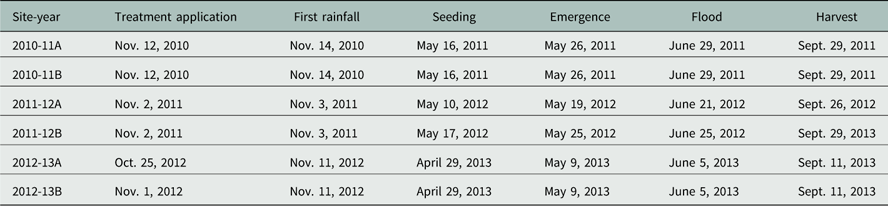
Dates of herbicide treatment application, first rainfall after application, rice seeding, emergence, flood establishment, and harvest are presented in Table 1. The study was designed as a two-factor factorial contained within a randomized complete block design with four replications and was repeated each year (Table 1). Factor A was fall-applied residual herbicide and consisted of clomazone (Command 3ME; FMC Corp., Agricultural Products Group, Philadelphia, PA), pyroxasulfone (Zidua; BASF Corp., Research Triangle Park, NC), S-metolachlor (Dual Magnum; Syngenta Crop Protection, LLC, Greensboro, NC), and trifluralin (Treflan 4 EC; Helena Chemical Co., Memphis, TN). Factor B was application rate and included one and two times (1× and 2×) the suggested rate for each herbicide for control of GR Italian ryegrass in Mississippi (Bond and Eubank 2013; Bond et al. Reference Bond, Dodds, Golden, Irby, Larson, Lawrence, Reynolds and Sarver2017). Clomazone at 840 and 1,680 g ha–1; pyroxasulfone at 170 and 340 g ai ha–1; S-metolachlor at 1,420 and 2,840 g ha–1; and trifluralin at 1,680 and 3,360 g ai ha–1 were surface-applied in early November (Bond and Eubank 2013; Bond et al. Reference Bond, Eubank, Bond, Golden and Matthew2014) in each site-year (Table 1). Trifluralin treatments were incorporated with two passes in opposite directions with a tandem disk within 1 h of application. A nontreated control that received no fall-applied residual herbicide was included for comparison. Plots were left undisturbed from time of treatment application until rice was seeded in late April to early May of each site-year (Table 1). Rice was managed throughout the growing season to optimize yield (Buehring Reference Buehring2008). Residual herbicide treatments were applied using a CO2-pressurized backpack sprayer equipped with extended-range flat-fan nozzles (XR11002 TeeJet nozzles; Spraying Systems Co. Wheaton, IL) set to deliver 140 L ha–1 at 137 kPa.
Dates of treatment application and rice seeding, emergence, flood, and harvest dates in a study evaluating rice response to fall-applied residual herbicides in Stoneville, MS, from 2010 to 2013.

Visual estimates of rice injury were recorded 14 and 28 d after emergence (DAE) on a scale of 0 to 100%, where 0 indicated no visual effect of herbicides and 100% indicated complete plant death. Rice seedling density was determined by counting all plants in two 1-m2 quadrats in each plot 14 DAE and calculating the mean. Plant heights were determined by measuring from the soil surface to the uppermost extended leaf tip and calculating the mean height of 10 randomly selected plants in each plot 14 and 28 DAE. The number of days to 50% heading was determined as an indication of rice maturity by calculating the time from seedling emergence until 50% of rice plants in an individual plot had visible panicles. Rice was harvested with a small-plot combine (Wintersteiger Delta; Wintersteiger, Inc., Salt Lake City, UT) at a moisture content of approximately 20%. Grain weights and moisture contents were recorded, and rough rice yields were adjusted to a uniform moisture content of 12% for statistical analysis. Plant height, density, days to 50% heading, and rough rice yield were converted to a percentage of the nontreated control in each replication. Percentages of nontreated control data were calculated by dividing data from treated plots by that in control plots in the same replication and multiplying by 100.
All data were subjected to ANOVA using the PROC MIXED procedure in SAS (Statistical software Release 9.4; SAS Institute Inc., Cary, NC) with site-year, replication (nested within site-year), and appropriate interactions containing these effects set as random-effect parameters (Blouin et al. Reference Blouin, Webster and Bond2011). Type III statistics were used to test main effects of fall-applied residual herbicide and application rate or interactions among these fixed effects. The square roots of visual injury data were arcsine transformed. Arcsine transformation did not improve homogeneity of variance; therefore, nontransformed data were used in analyses. Least-square means were calculated, and mean separation (P≤0.05) was produced using PDMIX800 in SAS, which is a macro for converting mean separation output letter groupings (Saxton Reference Saxton1998).
Results and Discussion
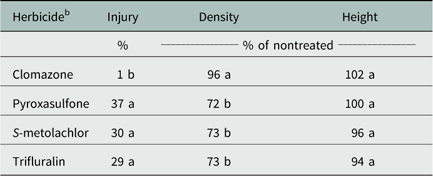
A main effect of fall-applied residual herbicide was detected for rice injury (P=0.0001) 14 DAE. Pooled across application rates, rice injury 14 DAE was at least 28% greater following fall applications of pyroxasulfone, S-metolachlor, and trifluralin than with clomazone (Table 2). Rice injury 14 DAE ranged from 29% to 37% for all fall-applied residual herbicides except clomazone. Brewer et al. (Reference Brewer, Lavy and Talbert1982) reported similar injury to rice from soil-applied fluchloralin, profluralin, and trifluralin. In plots treated with pyroxasulfone, S-metolachlor, and trifluralin compared with nontreated control plots or those receiving clomazone, rice injury 14 DAE consisted of reduction in density and height combined with differences in plant color and/or architecture (prone vs. upright growth).
Main effect of fall-applied residual herbicides on rice injury 14 d after emergence (DAE) and rice density and height expressed as percentages of the nontreated controls at 14 and 28 DAE, respectively, in a study evaluating rice response to fall-applied residual herbicides in Stoneville, MS, from 2010–2011 to 2012–2013.Footnote a

a Data are pooled over six site-years and two herbicide application rates. Means followed by the same letter for each parameter are not different at P≤0.05.
b Herbicide application rates at 1× and 2× included clomazone at 840 and 1,680 g ai ha–1; pyroxasulfone at 170 and 340 g ai ha–1; S-metolachlor at 1,420 and 2,840 g ai ha–1; and trifluralin at 1,680 and 3,360 g ai ha–1.
A main effect of fall-applied residual herbicide was detected for density (P=0.0071) 14 DAE. Rice densities 14 DAE were 72% to 73% of the nontreated control in plots treated with pyroxasulfone, S-metolachlor, and trifluralin (Table 2). In contrast, rice density 14 DAE was 96% of the nontreated control in clomazone-treated plots. Pyroxasulfone, S-metolachlor, and trifluralin inhibit root and shoot cell division (Shaner Reference Shaner2014a, Reference Shanerb, Reference Shanerc); therefore, rice density reductions would be expected. Rice densities in the current research were reduced at least 23% more following fall applications of pyroxasulfone, S-metolachlor, or trifluralin compared with clomazone. However, actual measured rice densities in those plots were 136 to 139 plants m–2, which are within the optimal range of 129 to 215 plants m–2 for rice produced in the midsouthern United States (Bond et al. Reference Bond, Walker, Bollich, Koger and Gerard2005b; Buehring et al. Reference Buehring, Walker and Bond2008). Bond et al. (Reference Bond, Walker, Bollich, Koger and Gerard2005b) reported that ultra-low uniform stand densities (50 to 70 plants m–2) resulted in minimal effect on rice yield of some cultivars but would require greater and intensive management throughout the growing season. Therefore, maintaining rice stand densities at or near the lower bounds of the optimal range would result in added expense to the grower. Rice heights 28 DAE were similar for all treatments (Table 2).
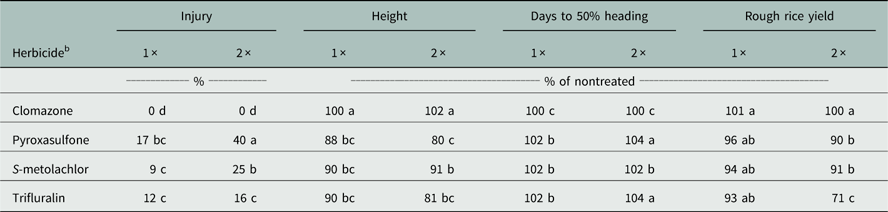
We detected an interaction between fall-applied residual herbicide and application rate for rice height 14 DAE (P=0.0033), injury 28 DAE (P=0.0219), days to 50% heading (P=0.0287), and rough rice yield (P=0.0021). Fall applications of pyroxasulfone, S-metolachlor, and trifluralin applied at both rates reduced rice height to 80% of the nontreated control 14 DAE compared with clomazone (Table 3). Rice heights in plots treated with pyroxasulfone, S-metolachlor, and trifluralin were 90% or less of the nontreated control regardless of rate (Table 3). Pyroxasulfone at 2× reduced rice height to 80% of the nontreated control but was similar to heights following trifluralin at both rates and to S-metolachlor and pyroxasulfone at 1× rates.
Fall-applied residual herbicide–by–application rate interaction for rice injury 28 d after emergence (DAE) and rice height 14 DAE, days to 50% heading, and rough rice yield expressed as percentages of the nontreated controls in a study evaluating rice response to fall-applied residual herbicides in Stoneville, MS from 2010–2011 to 2012–2013.Footnote a

a Data are pooled over six site-years. Means followed by the same letter for each parameter are not different at P≤0.05.
b Herbicide application rates at 1× and 2× included clomazone at 840 and 1,680 g ai ha–1; pyroxasulfone at 170 and 340 g ai ha–1; S-metolachlor at 1,420 and 2,840 g ai ha–1; and trifluralin at 1,680 and 3,360 g ai ha–1.
With the exception of clomazone, either rate of all fall-applied residual herbicides in this study injured rice 9% to 40% 28 DAE (Table 3). Pyroxasulfone at the 2× rate injured rice 40%, and S-metolachlor at 2× caused 25% injury. Injury 28 DAE ranged 9% to 17% among plots treated with S-metolachlor or pyroxasulfone at 1× and both rates of trifluralin. Pyroxasulfone and S-metolachlor at 2× rates increased rice injury to 40% and 25%, respectively. The lack of differences in rice height at that evaluation suggests that the 25% and 40% rice injury 28 DAE observed in plots treated with 2× rates of S-metolachlor and pyroxasulfone, respectively (Table 3) was manifested as reductions in density and differences in plant color and/or architecture rather than reductions in height as was observed 14 DAE.
Rice maturity measured as days to 50% heading was delayed 2 to 4 d with all fall-applied residual herbicide treatments except clomazone (Table 3). Greatest delays in rice maturity occurred following pyroxasulfone, S-metolachlor, and trifluralin at 2× rates; however, all 1× rates of pyroxasulfone, S-metolachlor, and trifluralin produced similar delays in rice maturity. The delays in maturity noted following pyroxasulfone, S-metolachlor, and trifluralin equated to a 2- to 4-d difference in maturity compared with that following clomazone. These delays in maturity expose rice’s inability to completely recover from fall-applied residual herbicide treatments. Although delays in maturity were significant, a delay of 4 d or less would probably not influence harvest timing or efficiency. However, longer delays in maturity could carry practical implications (Bond and Bollich Reference Bond and Bollich2007). A decline in temperature and/or day length as the crop matures could negatively affect rice yields (Jones and Snyder Reference Jones and Snyder1987; Slaton et al. Reference Slaton, Linscombe, Norman and Gbur2003). Furthermore, most rice in Mississippi is harvested in August and September, and these are months when tropical weather systems are common. If a tropical weather system was imminent, then a 2- to 4-d delay in maturity and subsequent harvest could negatively affect a grower’s economic returns.
No differences in rough rice yields were detected between 1× and 2× rates of clomazone, pyroxasulfone, and S-metolachlor; however, the 2× rate of trifluralin reduced rough rice yield 22% compared with the 1× rate (Table 3). Rough rice yields were 91% or more of the nontreated control in plots treated with either rate of S-metolachlor, and these were comparable with rough rice yields from plots treated with both rates of pyroxasulfone and the 1× rate of trifluralin. Although rough rice yields were similar for all herbicides following applications at 1× rates, fall applications of pyroxasulfone, S-metolachlor, and trifluralin applied at 2× rates reduced rough rice yields compared with those from plots treated with either rate of clomazone. Brewer et al. (Reference Brewer, Lavy and Talbert1982) observed greater rice yield loss from trifluralin applied at residual levels incorporated immediately before rice seeding than that observed in the current research. Other research reported that rice yields were reduced 11% to 100% when metolachlor rates increased from 180 to 1,400 g ai ha–1 in a simulated carryover study (Zhang et al. Reference Zhang, Webster and Braverman2002). Rough rice yield reductions were 4% to 10% following S-metolachlor applied at 1,420 and 2,840 g ha–1 in the current research (Table 3).
This research demonstrated that pyroxasulfone, S-metolachlor, and trifluralin applied at 1× rates in the fall before rice seeding negatively influenced rice growth and development. Rough rice yields were similar among all fall-applied residual herbicides applied at 1× rates. Labeling of pyroxasulfone (Anonymous 2016) and S-metolachlor (Anonymous 2015) does not permit fall applications at the 2× rates evaluated in the current research. Furthermore, Bond et al. (Reference Bond, Eubank, Bond, Golden and Matthew2014) indicated that GR Italian ryegrass control was optimized with the 1× rates evaluated in the current work; therefore, irregularities in herbicide application could occur that would make application rates from this research possible under some commercial field situations. These considerations, combined with early-season injury and reductions in seedling density and height 14 DAE, would preclude 1× applications of pyroxasulfone, S-metolachlor, and trifluralin from being viable options for residual herbicide treatments targeting GR Italian ryegrass in the fall prior to rice seeding. Based on these data, only clomazone should be utilized as a fall-applied residual herbicide treatment targeting GR Italian ryegrass prior to seeding rice. Of note, differential susceptibility to clomazone among rice cultivars has been documented (Golden et al. Reference Golden, Lawrence, Bond, Edwards and Walker2017; Scherder et al. Reference Scherder, Talbert and Clark2004; Zhang et al Reference Zhang, Webster, Blouin and Linscombe2004), and the current research included only one inbred rice cultivar, ‘CL151’. Previous research on cultivar response to clomazone included applications at or near the time of rice seeding. Therefore, cultivar sensitivity would probably not be a concern with applications made in the fall during the year prior to seeding.
Acknowledgments
This publication is a contribution of the Mississippi Agricultural and Forestry Experiment Station. Material is based on work supported by the National Institute of Food and Agriculture, US Department of Agriculture, Hatch project under accession number 153190. The authors would like to thank the Mississippi Rice Promotion Board for partially funding this research. We thank personnel at the Mississippi State University Delta Research and Extension Center for their assistance. No conflicts of interest have been declared.