Introduction
Alzheimer's disease (AD) is an irreversible progressive disease that affects cognitive, behavioral and functional abilities (MediFile, 2006). It is the most common cause of dementia, accounting for more than 65% of dementias in the elderly (Beers et al., Reference Beers2006). It is twice as common among females than among males (MediFile, 2006; Beers et al., Reference Beers2006), and affects about 4% of people aged 65–74 years and 30% of those older than 85 years (Beers et al., Reference Beers2006). Its incidence is increasing substantially as the population ages and the number of sufferers is predicted to double for every six years of life expectancy (Möbius, Reference Möbius2003). Prevalence in industrialized countries is expected to increase as the proportion of the elderly population increases (Beers et al., Reference Beers2006).
Three acetylcholinesterase inhibitors (AChEIs) are used in treating AD: donepezil, galantamine and rivastigmine. The AChEIs are registered for treating mild to moderate AD. AChEIs increase the concentrations of acetylcholine and thus benefit cognition, function and behavior, but they do not halt progression of the disease. These products, however, have recently been linked to serious adverse events in older adults with dementia, with higher rates of syncope, bradycardia, pacemaker placement and hip fracture being reported (Gill et al., Reference Gill2009; Barclay, Reference Barclay2009).
Memantine, a neuroreceptor antagonist, was launched in March 2006 in South Africa (MediFile, 2006). Although it has been available in other countries under different trade names for several years, this is the first product in a new drug class registered in South Africa for treating moderately severe to severe stages of AD. Memantine is a low affinity antagonist to glutamate N-methyl-D-aspartate (NMDA) receptors that may prevent excitatory neurotoxicity in dementia (Gibbon, Reference Gibbon2008). Since the mechanism of action of memantine differs from AChEIs, it could be useful as an alternative drug or in combination with these inhibitors.
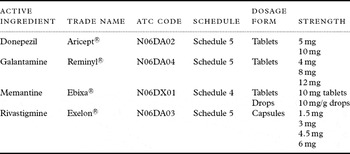
The products currently available in South Africa for the treatment of AD are shown in Table 1.
Products available for the treatment of Alzheimer's disease (Gibbon, Reference Gibbon2008; MediFile, 2007; WHO Collaborating Centre, 2009)

Very few surveys of AD or other dementias have been conducted in developing countries despite the fact that, by 2025, an estimated 68% of the world's elderly population will be living in these countries (Chandra et al., Reference Chandra1994). Even in China, the developing country studied most thoroughly, nearly all the work on dementia has been carried out in cities (Ineichen, Reference Ineichen1996).
According to Ineichen (Reference Ineichen2000), very few of the 100 studies of the prevalence of dementia have been carried out in Africa and much of the early work concerned small hospitalized samples. A series of studies from Ibadan, Nigeria, has produced consistently low rates for dementia, especially for AD (Ineichen, Reference Ineichen2000). The most recent studies reveal higher rates, but still lower than surveys carried out elsewhere (Ineichen, Reference Ineichen2000). No drug utilization or pharmacoepidemiological studies could be found that specifically investigated the treatment of AD in South Africa since the introduction of memantine.
The primary aim of the study was to determine the prescribing patterns and cost of drugs for AD in a private health care sector patient population.
Methods
A retrospective, exposure-cohort pharmacoepidemiological study was conducted. Data were obtained from a South African private pharmacy group for 2008, which is a national group with pharmacies in all nine provinces of South Africa. Approximately 18% of the South African population is served by private medical aid schemes, while the rest of the population is served by the government (public health care sector). Public sector patients do have access to medicine for AD, but they obtain their medicine from public sector pharmacies and clinics. The focus of this study was on private sector patients.
The database consisted of all central nervous system medicine records for 2008 (a total of 1,578,346 medicine records of approximately 230,000 patients). Each medication record contained information on the age and gender of the patient, with a unique number to identify each patient, the date of the prescription, detailed information on the dispensed drug (name, package size, formulation, strength and quantity), price and various reimbursement variables.
All the records of patients who received one or more products for AD were extracted for analysis. A total of 588 patients were included in the study. The South African Medicines Formulary (Gibbon, Reference Gibbon2008), the Monthly Index of Medical Specialities (Snyman, Reference Snyman2007) and the ATC/DDD Index 2009 (WHO Collaborating Centre, 2009) were used to identify and classify the drugs into their main therapeutic groups.
Basic descriptive statistics were used for data analysis. The defined daily dose (DDD) and prescribed daily dose (PDD) methodology, as developed and recommended by the World Health Organization (WHO), has been calculated from the dosage information contained in the database (Capellà, Reference Capellà and Dukes1993). One Euro (€1.00) was equal to R12.29 (South African Rand), one US Dollar ($1.00) was equal to R7.80 and one British Pound (£1.00) was equal to R15.53 at the time of the study (30 June 2008). Ethical approval for the study was obtained from the Faculty of Health Sciences Research, Technology and Innovation Committee of the Nelson Mandela Metropolitan University.
Results
Demographic information of patients
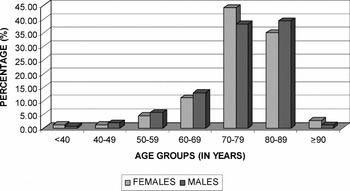
A total of 588 patients (326 females and 262 males) received 2623 medicine items for AD at a cost of R1,563,701.18 (average cost per item R596.15). The average age of the patients was 75.54 (SD = 10.48) years, with 78.40% of patients being between 70 and 89 years of age. The age and gender distribution of patients is shown in Figure 1. The χ2 test was used to detect prescribing differences between female and male patients (χ2 = 5.43; d.f. = 6; p > 0.05). No differences with respect to age distribution were observed between female and male patients.
Percentage of females and males in the different age groups receiving drugs for AD (n = 588)*.
*χ2 = 5.43; d.f. = 6; p > 0.05.

Prescribing frequency and cost of medicine for AD
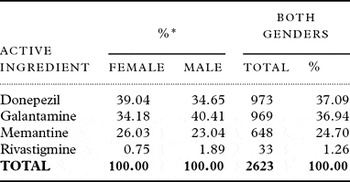
Donepezil was the most frequently prescribed active ingredient (37.09%), followed by galantamine (36.94%), as indicated in Table 2. The χ2 test was again used to detect prescribing differences between female and male patients (χ2 = 19.17; d.f. = 3; p < 0.001). Differences were observed in the prescribing of the different active ingredients to female and male patients. More female patients were prescribed donepezil, while more male patients were prescribed galantamine.
Prescribing frequency of active ingredients for Alzheimer's disease according to gender

*χ2 = 19.17; d.f. = 3; p < 0.001.
The average cost per prescription (item) for Alzheimer's disease was R596.15. The average cost per prescription for donepezil was R634.76, for galantamine R579.58, for memantine R551.35 and for rivastigmine R825.54. Donepezil accounted for 37.09% of the prescribing frequency, and for 39.50% of the cost of AD medication.
The average number of products prescribed for AD per month to the 588 patients in the study was 218.58 (SD = 22.40). Patients received on average 4.46 (SD = 4.02) prescriptions for AD during the year. A third of the patients (32.65% or 192 patients) only received one prescription during the year for one of the active ingredients for AD. The majority of prescriptions (81.62%) were repeat prescriptions. Of these repeat prescriptions, 25.92% were dispensed for the first time, 18.40% were dispensed for the second time, and 15.04% were dispensed for the third time. Only 4.81% of the repeat prescriptions were dispensed for six or more times. Most prescriptions (91.73%) were dispensed in quantities to be taken once or twice a day (42.13% of prescriptions were for quantities of 28 (or 30) tablets or capsules, and 49.60% of prescriptions were for quantities of 56 (or 60) tablets or capsules per day).
Only 5.27% of patients were prescribed more than one active ingredient for AD during the year (not all patients were using the two active ingredients concurrently). Of these 31 patients, 24 patients were prescribed memantine and an AChEI (14 patients were prescribed memantine and galantamine, and 10 patients were prescribed memantine and donepezil).
Dosages in which drugs for AD were prescribed
The defined daily dose (DDD) of a drug corresponds to what is assumed to be the average dose per day for a drug, when used in its main indication in adults (Capellà, Reference Capellà and Dukes1993). The DDD for donepezil, for example, is 7.5 mg (WHO Collaborating Centre, 2009). The prescribed daily dose (PDD) is defined as the actual dose in which the drug is prescribed for its main indication (Capellà, Reference Capellà and Dukes1993).
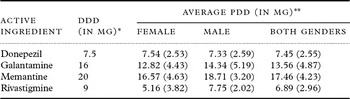
Average PDDs for all active ingredients in this study were generally lower than their respective DDDs (see Table 3). The average PDD for donepezil was 7.45 mg (DDD = 7.5 mg). Nearly half (47.07%) of the prescriptions for donepezil were in a dose of 10 mg per day, followed by 45.02% of prescriptions in an average PDD of 5 mg.
Average prescribed daily doses of active ingredients for Alzheimer's disease according to gender

* Source: ATC/DDD Index 2009 (WHO Collaborating Centre, 2009).
** Standard deviations are indicated in brackets.
The average PDD for galantamine was 84.75% of its DDD of 16 mg. Most prescriptions for galantamine (55.73%) were prescribed in its DDD of 16 mg, followed by 25.39% in a dose of 8 mg. The average PDD for memantine was 87.30% of its DDD. Two-thirds (65.43%) of memantine prescriptions were prescribed in its DDD of 20 mg. The average PDD for rivastigmine was 76.56% of its DDD of 9 mg. Fifteen of the 33 prescriptions for rivastigmine were prescribed in the DDD of 9 mg.
Discussion
A limited spectrum of medication is available as treatment options for AD. However, it is predicted that more patients will suffer from this degenerative disease of the brain in future. No pharmacoepidemiological studies on the treatment of AD in South Africa could be found in the literature. It is also not known what percentage of the South African population suffers from AD.
Medicine records of a large national pharmacy group in the private health care sector were analyzed. The study included patients from all nine provinces in South Africa. Only a small number of patients (588) received medication for AD. Possible reasons for this may be that not all medical aid schemes pay for the treatment of AD or because the treatment is relatively expensive and there is insufficient evidence for the longer term effectiveness of these drugs. Although the patient sample was small, the study nonetheless provided some information about the treatment of AD which it is hoped will be followed up by further studies in South Africa.
The 588 patients in the study represented only 3% of patients aged 65 years and older in the database. There is therefore the possibility that medicine for AD is either under-prescribed in South Africa or that the condition is under-diagnosed (or not properly diagnosed). Further research on this finding is required.
The average age of patients in this study was 75.54 years with 55.44% of the patients being female. The prescribing patterns of four active ingredients were investigated: donepezil, galantamine, memantine and rivastigmine. Donepezil was the most frequently prescribed active ingredient (37.09%), followed by galantamine (36.94%). Donepezil and galantamine therefore accounted for nearly 75% of prescribing frequency. A third of the patients only received one prescription during the year for AD. It was not possible to determine the reason for this finding from the data analyzed, except that the high cost of these products may have been a possible reason for not using the medication for a longer period. As already mentioned, not all medical aid schemes reimburse the cost of drugs for AD and so patients have to pay for these themselves, which may be a barrier to continuation of treatment. Other reasons may have been a lack of improvement of symptoms or adverse effects. The average cost per prescription was R596.15, which is relatively high and may be unaffordable for many patients to continue treatment for an extended period of time.
Average prescribed daily doses (PDDs) of all active ingredients were generally lower than their respective defined daily doses (DDDs). Due to the absence of clinical information, this finding cannot be explained except that there was a definite relationship between the dosage strength of the active ingredient and the average PDD if individual dosages were reviewed. For example, the average PDD for donepezil was 7.45 mg. Donepezil is available in South Africa in 5 mg and 10 mg tablets. Nearly half (47.07%) of the prescriptions for donepezil was in a dose of 10 mg per day, followed by 45.02% of prescriptions in an average PDD of 5 mg.
No South African studies were available to allow comparison with the results of this study, even after the introduction of memantine. It is recognized that the prescribing of medication for AD is highly individualized and should preferably be done by specialists. NICE recommends that only specialists in the care of patients with dementia (that is, psychiatrists, including those specializing in learning disability, neurologists, and physicians specializing in the care of the elderly, should initiate treatment) (NICE, 2007). Carers’ views on the patient's condition at baseline should be sought and patients should be reviewed every six months (NICE, 2007). NICE (2007) also recommends that therapy with an AChEI should be initiated with a drug with the lowest acquisition cost (taking into account the required dose and the price per dose). It is known that in many cases these patients are treated by general practitioners in South Africa, and not by specialists.
Limitations of the study were the absence of clinical information in the database, which meant that treatment outcomes could therefore not be measured. It could also not be determined from the data whether general practitioners, psychiatrists or geriatricians prescribed the drugs for AD patients. It is recommended that qualitative studies be undertaken to determine the effectiveness, as well as the cost-effectiveness, of the different treatment options for AD (pharmacological as well as non-pharmacological) from the perspective of family members and carers.
Conflict of interest
None.
Acknowledgments
Sincere thanks go to the pharmacy group for providing the data for the study, and to the National Research Foundation (NRF) for providing financial support for the study.