The metaphors we associate with consonance and dissonance in music – ‘agreement’, ‘stability’ and ‘resolution’ – exist in other art forms. For ancient artists, correspondences between the arts arose not as arbitrary experiments but as different reflections of a universal ideal. For modern visual musicians such correspondences may present opportunities to explore intermodal connections that share a common emotional basis rather than arbitrary mappings of elemental characteristics from one sense to another. Visual musicians now have the technology to realise not only musical harmony, colour harmony and spatial harmony but also harmony of motion. Visual consonance and dissonance can emerge and resolve in musical ways or even in synchronisation with points of stability and resolutions in music.
1. Harmonia and Musical Proportions
To be sure, the concepts of consonance and dissonance have varied greatly over history, especially if we include the equivalents of related words such as ‘concord’, ‘symphony’ and ‘harmony’. The original meaning of the classical Greek harmonia is frequently given as a fitting together, like a woodworking joint, but John Curtis Franklin traces its Indo-European origins to ‘the Truthful Order from which all things arise and towards which all should aspire’, later personified as the order-creating goddess (Franklin Reference Franklin2002: 1). Heraclitus used the metaphor of the bow to describe harmony as the careful equilibrium of opposites under tension, an analogy at once visual and musical (for the bow can be a musical instrument). Plato found the harmony of the world in the Pythagorean whole numbers and their ratios, abstract ideals that become accessible to our senses through music.
While ‘harmonics’ became the name for the science of musical tuning, this use of the word should be understood in a broader context in which musical tones are the sensory reflection of the order and balance of the cosmos, an algebra of divine forms. Thus when treatises on harmonics discuss the concept that we might reasonably translate as ‘consonance’, symphonia or ‘sounding together’, they are speaking not in the modern sense of chords of simultaneous tones but of relationships between tones.Footnote 1
Harmonious relationships of the parts to the whole also preoccupied artists and architects, for the ideal sculpture or building is also a reflection of the harmony of the cosmos, its parts held together in dynamic stasis like Heraclitus’ bow. As Plutarch described classical sculptor Polykleitos’ canon of proportions, for instance: ‘Now in every piece of work, beauty is brought to perfection through many numbers that come to a congruence, so to speak, guided by some system of commensurability and harmony, whereas ugliness is immediately ready to spring into being if only a single chance element be omitted or added out of place’ (Plutarch 1986: 243). Nor was the concept of art based on a canon of proportions original with the Greeks, as the Egyptians were well known to use canons of their own (Iversen Reference Iversen1975).
For Vitruvius, harmony of proportions was one of the foundational principles of architecture, which he explicitly connected to sculptors’ use of rational proportions: ‘Thus in the human body there is a kind of symmetrical harmony between forearm, foot, palm, finger, and other small parts; and so it is with perfect buildings’ (Vitruvius Reference Vitruvius Pollio1999: I 2:4). Although Vitruvius was Roman, he spoke with authority on the practices of the Greeks. Unfortunately, the Parthenon, like most ancient Greek monuments, is too ruined to be certain about its proportions, but Vitruvius’ proportions and ‘symmetrical harmony’ do seem to fit.
Vitruvius’ diagram of the ideal (musical) proportions of the human body and its relation to architecture is far better known in the version sketched by Leonardo da Vinci. The rediscovery of these ideas by the humanists of the European Renaissance was led by Leon Battista Alberti, who called this concept of visual consonance concinnitas: ‘The very same numbers that cause sounds to have that concinnitas, pleasing to the ears, can also fill the eyes and mind with wondrous delight’ (Alberti Reference Alberti1988: 305). The paintings of the High Renaissance are often pure visual music in which artists achieve the dynamic balance of Heraclitus’ bow through the consonant proportions of space (Bouleau Reference Bouleau1963).
2. Colour Harmony
Whereas these artists found harmony in spatial proportions, Aristotle speculated that colour harmonies could be based on the same musical proportions (Aristotle 1908: III 439b–440a). The Italian Renaissance artist Giuseppe Arcimboldo apparently applied such correspondences in his painting, creating lines of paint representing polyphonic voices whose colours corresponded to their pitches (Caswell Reference Caswell1980). When Isaac Newton quantified this correspondence and wrapped the musical octave around the colour wheel, he set in motion a tradition of speculation that would lead to the ‘colour organists’ of the nineteenth century.
These inventors of light instruments introduced the dimension of time, creating, in the term of Wallace Rimington, an ‘Art of Mobile Colour’ (Klein Reference Klein1937). Rimington, whose performances on his light organ dazzled audiences in Victorian England, insisted that ‘harmonies and discord’ in music have their analogue in colour, and, like others, proposed that the same consonant ratios in music will produce pleasing colour combinations when applied to frequencies of the spectrum (Rimington Reference Rimington1911). Others may find that such conclusions require some generosity on the part of the viewers, who are asked to consider the startling combination of deep red, bright orange and green-blue to be the visual equivalent of a C major triad (Garner Reference Garner1978).
Artists have found much less agreement about what constitutes harmony in colour combinations than musicians have found in pitch combinations, both because of a lack of consensus for a definition of harmony in reference to colour and the difficulties of defining absolute colours (Collopy Reference Collopy2000). Colours next to each other on the colour wheel blend effortlessly; not so, adjacent keys on the piano. The influential colour theorist Michel Eugène Chevreul conceded the difficulty when he defined two ‘harmonies’ of colours: a harmony of contrast and a harmony of analogy (Chevreul Reference Chevreul1854).
Defining a harmony of contrast sounds a little like Stravinsky who, when writing on consonance and dissonance, noted that ‘nothing forces us to be looking constantly for satisfaction that resides only in repose’ (Stravinsky Reference Stravinsky1970: 34). Yet there is value in distinguishing repose from other artistic effects. One can recognise the power of both a dazzling juxtaposition of complementary colours as well as colours from a very restricted palette while still wishing to keep those effects distinct.
The visual music artist Stephen Malinowski has proposed a colour–pitch correspondence in which the light spectrum follows the musical circle of fifths rather than Newton's and Rimington's mapping of frequencies (Reference MalinowskiMalinowski n.d.). The result can be very compelling when applied to the visualisation of existing pieces in conventional harmonies on his Music Animation Machine. Tones closely related by diatonic keys exhibit Chevreul's harmony of analogy, while more dissonant tones clearly contrast. Malinowski's scale was anticipated by a much earlier visual musician, Aleksandr Skryabin, whose tone-poem Prométhée included a part for colour organ.
3. Harmony of Motion
The same enthusiasms for number and proportion that inspired Leonardo, Arcimboldo and so many other Renaissance intellectuals found its way into arts of motion – that is to say, dance. The neo-Pythagorean Plotinus had described the Platonic universe with its harmonic motions of the heavenly bodies as a ‘cosmic dance’, inspiring court choreographers of the sixteenth and seventeenth centuries to create ballets in which groups of dancers would periodically form geometrical and symbolic patterns (Franko Reference Franko1986). Thus dancers could move into patterns of harmonic proportions just as could music cadences with consonant harmonies. Certainly one can feel the visceral connection whenever the motion of dancers corresponds to musical rhythm, but movement in and out of symmetrical patterns in synchronisation to music has a special effect that leads directly to Hollywood choreographer Busby Berkeley.
Unlikely though it may seem, film historian Cecile Starr argued for a connection between Berkeley, choreographer of famously extravagant dances, and Oskar Fischinger, who also worked in Hollywood in the 1930s but to far less success (Starr Reference Starr2001). Fischinger's animations of the 1930s are exquisite explorations of abstract form set in motion. For example, his Liebesspiel (Love Games, c. 1934) is an elaborate choreography drawn in charcoal and projected in negative in which shapes move in and out of symmetrical arrangements. Fischinger apparently intended it to be silent, expressing its consonance of yin and yang relationships independently of music. Fischinger biographer William Moritz wrote: ‘The analogy with yang/yin lingam/yoni theories of the balance of active/passive from oriental philosophies elevates these “love games” to a cosmic revelation, while the graceful “rondo” musicality impresses with the serene inevitability of its harmonics’ (Moritz Reference Moritz2004: 38).
Fischinger influenced another pair of filmmakers in southern California at that time, the brothers John and James Whitney. John Whitney, trained as a musician, came to realise that the dramatic power he heard in music results from the complex interplay of tension and resolution inherent in the tonal harmonic system, and that system has a basis in the harmonic series that governs the vibration of string and wind instruments:
The foundation of my work rests first upon laws of harmony, then in turn, upon proof that the harmony is matched, part for part, in a world of visual design … This hypothesis assumes the existence of a new foundation for a new art. It assumes a broader context in which Pythagorean laws of harmony operate … In other words, the hypothesis assumes that the attractive and repulsive forces of harmony's consonant/dissonant patterns function outside the dominion of music. Attractions and repulsions abound in visual structures as they become patterned motion. This singular fact becomes a basis for visual harmony with a potential as broad as the historic principles of musical harmony. (Whitney Reference Whitney1980: 5)
Although Whitney wrote of musical harmony being ‘matched’ in the visual domain, he resisted automatically mapping one characteristic to another across media, instead referring to this connection as a ‘complementarity’ (the subtitle of his book). He realised his application of ‘Pythagorean laws’ to patterned motion through a technique he called ‘differential dynamics’, in which a large number of elements are set into repetitive motion, the second travelling twice as fast as the first, the third three times as fast as the first, and so on. These speeds represent the same relationships found in the Pythagorean harmonic series used in musical definitions of consonance and dissonance.
Just as waves in the harmonic series create harmonic structures, so elements in differential dynamics converge to create exquisite patterns (depending on the motion the artist defines) at harmonic or ‘resonant’ points. Such images can resemble the mandala patterns Fischinger created in works such as Liebesspiel, but Whitney knew that such precise and patterned motion as in differential dynamics could be reasonably realised only with the aid of a digital computer. Fortunately, Whitney had met IBM engineer Jack Citron, who helped him obtain a grant and position as IBM's artist-in-residence in 1966 and programmed differential dynamics software for him. Whitney's first exploration of the consonance and dissonance of patterned motion was appropriately titled Homage to Rameau (1967), after the Baroque composer and harmony theorist.
In subsequent films created at IBM and California Institute of Technology, Whitney explored many variations of differential dynamics, using elements moving along lissajou figures (in Matrix I, 1971, and Matrix III, 1972), in rose curves in polar coordinates (Permutations, 1968), and linear motion wrapping around the edge of a frame (Arabesque, 1975). In each of these works, each point of resonance is, to Whitney, analogous to the resolution of musical consonance or point of tonal stability. Now in place of a major triad at a cadence, for example, we have images of arresting symmetry.
The association of symmetry, an aspect of visual form, with consonance is significant first of all because it is a property which, like consonance, exists in many varieties and degrees. Musical consonance can be defined by the closeness of the constituent tones of harmony to the integer ratios found in the harmonic series. However, the term refers more generally to musical resolution or repose, or the satisfying fulfilment of expectations that occurs when consonance follows dissonance. Symmetry also suggests Heraclitus’ dynamic stasis but to the eye.
Other artists who arrived at this correspondence of symmetry and musical consonance include Ronald Pellegrino (Reference Pellegrino1983), and Gordon Monro and Jeff Pressing (Reference Monro and Pressing1998). However, Whitney's approach defines a more general principle that can be applied artistically in many ways rather than an algorithm for visualisation.
4. The Correspondence of Visual and Musical Consonance
Although Wallace Rimington's colour organ performances largely consisted of the translation of accompanying music into projected colours, other colour organ performers, such as Mary Hallock-Greenewalt, synchronised their performances to music in a more intuitive and evocative way. Aleksandr Skryabin's part for colour organ (‘tastiera per luce’) in his Prométhée followed the harmonic and tonal structure of the piece (Peacock Reference Peacock1976). None of these examples demonstrates a successful correspondence and visual and musical consonance and, because of this lack of correspondence, risked one medium becoming accompaniment for the other. Thomas Wilfred insisted that the art of colour projection, which he called ‘lumia’, was best presented in silence (Wilfred Reference Wilfred and Edwin1948: 273).
John Whitney recognised both the technical and aesthetic complexities involved in adding music to abstract animation when he began working with computers in 1965. He said, ‘Of course even these actions on the screen might work better if there were music of some sort related to them. I think of sound as a kind of partner to this visual experience, but I do not want the graphics to play the role of the lesser, subservient partner’ (Whitney Reference Whitney1968). Perhaps the difficulty with coordinating the points of tension and resolution in his motion graphics with the resolutions of conventional Western harmony influenced his distinct preference for soundtracks without traditional harmonic progressions (a preference also found in the abstract films of his brother James).
Modern software tools offer visual music composers much more flexibility than the Whitneys’ laborious non-realtime methods. In addition to the obvious synchronisation of visual and musical consonance other possibilities present themselves, such as withholding resolution in one medium while finding it in another. Film composers call this artistic confounding of expectations ‘composing against the action’, and it is one of several techniques for audiovisual composition I have explored in my own work.
5. Examples of Harmonia in Visual Music
Working with John Whitney during the last decade of his life, I developed a system of correspondence by which patterns of differential motion could be translated directly into their musical equivalent pitches. The simplest form of symmetry (aside from the circle) is bilateral, which would correspond to frequency ratio of 2:1, or the musical octave. Radial symmetry in thirds would give musical pitches of 3:2:1, and would add the perfect fifth, or next most consonant interval, and so on (Alves Reference Alves2005).
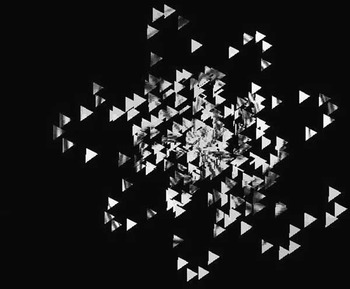
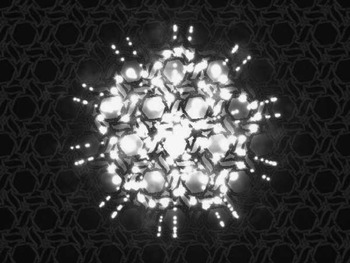
In my work Static Cling (2000), for example, I used these ratios, known in music as just intonation, in coordination with symmetrical patterns derived from Whitney's method of differential dynamics, but extrapolated into three dimensions (figure 1). Like Whitney, I sought a complementarity based on a structure in which points of musical stability would correspond to relative visual symmetry and coherence. Stellation (2008) coordinated differential dynamics to sliding tones of melodies to create a delicate choreography of shape and proportion (figure 2). Stellation combines a string quartet with electronics in the soundtrack, tuned to the same just intonation ratios as the proportions in the symmetries in the images.
Still from Static Cling © 2000 Bill Alves

Still from Stellation © 2008 Bill Alves

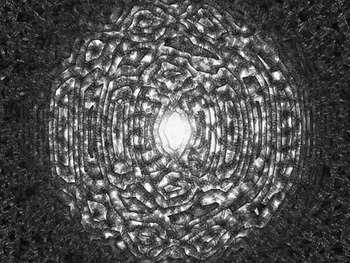
The dynamic symmetries of Arabic geometric abstractions also inspired Whitney, especially his film Arabesque. These intricate designs tessellate two-dimensional space in dazzling patterns and represent another line of development of Pythagorean divine proportions (Critchlow Reference Critchlow1976). In such works as aleph (2002, figure 3) and Celestial Dance (2006, figure 4), I have ‘unfrozen’ such patterns and arranged for them to emerge together with points of musical stasis, often based on the same rational proportions.
Still from aleph © 2002 Bill Alves

Still from Celestial Dance © 2006 Bill Alves

I created Breath of the Compassionate (2009) for the combination of live gamelan orchestra with an electronic soundtrack and video projection (figure 5). It is named for a type of pattern in Islamic geometric abstract art in which adjacent tiles alternately expand and contract into one another. This sense of visual inhalation and exhalation is known as the ‘breath of the compassionate’ (al-nafas al-rahmânî) after the teachings of Ibn al‘Arabi, who named this universal principle of creation, joining the elements of fire, air, water and earth (Sutton Reference Sutton2007: 8). The complementarity of gentle back-and-forth alternation of just intonation pitch sets, the alternating colour hues, and the motion of the small flexible shapes form the Arabic-inspired visual patterns and evoke this breathing cycle. The work also synchronises shifts in colour with the ‘breath cycle’ as well as points of colour tension (or Chevreul's ‘harmony of contrast’, such as greens and reds) with points of musical dissonance and colour stability (or Chevreul's ‘harmony of analogy’, such as blues and greens) with points of musical resolution.
Still from Breath of the Compassionate © 2009 Bill Alves

6. Conclusion
Technology has given artists the ability to manipulate light with the same ease and precision that musicians can manipulate sound waves. However, music visualisers that merely map the most elemental characteristics of one sensory mode to another create at best a naïve and predictable synesthesia. The journey of emotions that music can awaken in an audience does not automatically emerge when one characteristic (pitch, for example) is mapped to a characteristic in another sense (colour, for example).
The principles of consonance and dissonance, broadly understood to encompass concepts of stability and instability or tension and resolution, provide a structural model for the arts of visual music that is at once new and ancient. At this higher level of artistic correspondences, artists can modulate an expressive time-art of expectation and surprise, anticipation and emotional satisfaction.