Here's what I see: long-term Black American residents leaving the city, and not by choice. Their old neighborhoods are being taken over by young, white professionals who are the beneficiaries of educational and social opportunities that this African American population never had. Many of these African Americans raised families in the old brownstones in my neighborhood, but they rented from absentee landlords who now have been more than happy to sell out to developers. A historically disadvantaged people has been disadvantaged once again.—Carl Foster, The Washington Post, February 03, Reference Foster2012
According to the U.S. Census Bureau, between 2000 and 2010 the black population of Washington, DC declined by about 40,000 residents; at the same time, its overall population had increased by 16,000. In a city of just 650,000, over 55,000 residents were of a different color than they had been just ten short years before. As a result, “chocolate city” was no longer majority black by 2010, and many neighborhoods that as of the 1990s were over 90% black, were majority white by 2010. DC, however, was not alone in this rapid change; urban areas across the country have experienced a rapid process of “white return” marked by the displacement of long-time minority residents with new, financially more secure, young, educated, and importantly, white residents. City officials are generally thrilled with this type of demographic turnover, as it brings in residents who contribute larger sums to the tax base and the businesses that cater to them. Likewise, commentators have viewed this process as a renewed hope for diverse, revitalized, and de-segregated cities (Morello and Keating Reference Morello and Keating2011). However, while fast-paced white in-migration into minority neighborhoods increases (at least short-term) local racial and economic diversity, it can also displace marginalized groups from the very neighborhoods that grant them social and political power. This observation has resulted in the use of a term that does not allude to the positive qualities of diversity and desegregation often imparted by white return: gentrification.Footnote 1
What are the effects of gentrification on black communities?Footnote 2 More specifically, what are the effects of residing in a gentrifying context, characterized principally by the simultaneous or sequential occurrence of white in-migration and increasing housing costs? At present, despite its relevance and importance to the study of racial and urban politics, we know of no published quantitative work in political science addressing the topic of gentrification.Footnote 3 The most direct answer to these questions comes from the developing literature on gentrification emerging from urban planning and sociology. While this literature offers valuable insights, two distinct characteristics limit its usefulness in providing a definitive answer to our research question: (1) the literature is largely qualitative and based upon many single city/community case studies, and (2) mixed findings have emerged concerning residential displacement and the reactions of minority residents. For example, while an analysis of gentrification in seven metropolitan statistical areas presents evidence of the displacement of younger and lower SES minority households (Glick Reference Glick2008), other work has failed to replicate these findings (Freeman and Braconi Reference Freeman and Braconi2004; Freeman Reference Freeman2005; Vigdor Reference Vigdor2002). Moreover, a recent case study tracing the evolution of gentrification in Chicago found that neighborhoods evincing early signs of gentrification in the 1990s only continued to gentrify in the following decades if at least 35% of the residents were white—in other words, gentrification in Chicago avoided majority minority low income neighborhoods (Hwang and Sampson Reference Hwang and Sampson2014). Studies on reactions to gentrification among citizens in urban centers also yield mixed results. A handful of studies document conflict between newcomers and longtime residents in gentrifying contexts (Betancur Reference Betancur2002; Goldfield Reference Goldfield1980; Levy and Cybriwsky Reference Levy and Cybriwsky1980), while others document reactions ranging from ambivalence to positive reception of neighborhood changes (Boyd Reference Boyd2005; Freeman Reference Freeman2006). Despite the plethora of case studies, the developing gentrification literature lacks a national-scope study relying upon a large sample of minority respondents across multiple cities in which we can compare minority attitudes in gentrifying and non-gentrifying areas. The value of such a study would lie in its potential to clarify previous results and offer findings that are not case-driven. In addition, a large-scale national study would also aid in the construction of theories that explain the general impact of gentrification on social and political life in communities of color.
In this paper, we attempt to break ground by analyzing the consequences of gentrification on social capital (SC) and political engagement in black communities. We offer a theory of gentrifying contexts that draws upon the black empowerment and qualitative gentrification literatures to guide an adaptation of a dominant theory of intergroup relations—realistic group conflict (RGC) theory—to a context where the configuration of key elements have been inverted; namely, where the focus is on black communities and the entrance of whites, and the in-migrating group is both the dominant majority group in the larger society and of higher socioeconomic status than many of the residents in the communities of entry. Our theory argues that for black Americans, residing in a predominantly black context experiencing white growth (i.e., gentrifying context) should evoke the threats of residential and political displacement and erode trust in one's neighbors. Through this, our theory contends that gentrification should ultimately negate the politically empowering and mobilizing aspects of residing in a predominantly black context. We test our theory using the 2000 Social Capital Benchmark Survey (2000 SCBS), and replicate some of our key findings using the 2006 Social Capital Community Survey (2006 SCCS). The findings from our analyses support our theory by demonstrating that gentrification has negative consequences for civic society and political representation in black communities. Our results constitute unprecedented and robust empirical support for Washington, DC resident Carl Foster's (Reference Foster2012) claim that “A historically disadvantaged people has been disadvantaged once again.”
WHITE-LED DIVERSITY: INVERTED DYNAMICS AND THE CHALLENGE TO EXISTING THEORIES
One starting point for theorizing about the consequences of gentrification in black communities is to focus on its most immediate impact: diversification. This in turn leads to the question: what are the political consequences of diversity? Two bodies of literature are useful in answering this question: the SC and the RGC literatures. A common finding in the SC literature is that greater diversity is associated with lower levels of interpersonal trust, social cohesion, and investment in public goods (e.g., Alesina and La Ferrara Reference Alesina and La Ferrara2000; Costa and Kahn Reference Costa and Kahn2003; Hopkins Reference Hopkins2009; Masuoka Reference Masuoka2006; Putnam Reference Putnam2007).Footnote 4 SC scholars explain these findings by arguing that the connection to neighbors like yourself (i.e., “bonding social capital”) is important for the development and transfer of shared norms of reciprocity and civic institutions, and that ethnic change in the short to medium-run hampers the communication of these norms, alters expectations concerning the future, and causes neighborhood trust to breakdown. Complimenting the SC literature, RGC theory (e.g., Taylor and Moghaddam Reference Taylor and Moghaddam1994) and associated racial and power threat hypotheses (Blalock Reference Blalock1967; Key Reference Key1949) hold that diversity activates intergroup competition over finite economic and political resources, which in turn spurs feelings of prejudice and racial hostility. From a RGC perspective, declines in SC associated with racial diversity result from the undermining of relations of trust and reciprocity by mounting perceptions of threat and resource competition.
Despite generating many valuable insights, we find these two bodies of literature limited in their applicability to the study of gentrification. The predominant orientation of these theories, and their corresponding empirical literatures, is toward assessing “majority-minority” and “white-nonwhite” intergroup dynamics. In the SC literature, the interest in studying the implications of the “transition to a multicultural society for ‘social capital’” (Putnam Reference Putnam2007, 137) primarily focuses on the effect of minority-led diversification of white communities.Footnote 5 Similarly, in the RGC literature the dominant work on racial and power threat (e.g., Blalock Reference Blalock1967; Key Reference Key1949) in the American context is primarily oriented toward explaining the reaction of whites to nearby minority populations. When shifting our focus from minority-led diversity to white-led diversity and gentrification, we find that the majority–minority/white–nonwhite intergroup terrain serving as the backdrop for these two literatures is upended. In contrast to whites in diversifying majority-white communities, minorities in majority–minority communities undergoing gentrification are only a majority locally, have lower levels of political power relative to whites at the state and national level, and have historically experienced discrimination at the hands of the very group that now seeks to establish residence in their communities. Further, in contrast to minority-led diversification of white communities, in the case of gentrification, members of the entering group are typically of higher socioeconomic status.
These facts suggest an inversion of the traditional dynamics of race and group status present in the bulk of the SC and RGC literature, which in turns limits their applicability to the study of gentrification. Thus, the study of gentrification requires a new theoretical framework. In response, we offer a theory of gentrifying contexts . Our theory uses the qualitative literature on gentrification, as well as the literature on black empowerment, to inform a revision in our thinking about the economic and political threats explicated by core “threat” theories of political behavior when analyzing the case of white-led gentrification of black communities. In this paper, we do not seek to reinvent the wheel but instead use the unique qualities of gentrification to refine existing theories of intergroup dynamics. Our synthesis of existing theories to study gentrification produces a new framework through which we can understand the social and political impacts of gentrification on black communities.
GENTRIFYING CONTEXTS: THE REALISTIC THREATS OF APPROPRIATION AND DISPLACEMENT
The RGC literature assumes that the presence of a new minority group will undermine housing values and increase competition over finite economic resources (e.g., jobs). These concerns do not apply to gentrification. First, the introduction of new wealthier white residents typically increases real estate values and the costs of retail goods. Second, inmigrating whites are typically not in direct competition with extant minority residents for jobs in the local community, as they typically work in higher-skill professions outside of the neighborhoods they enter (Freeman and Braconi Reference Freeman and Braconi2004). These facts suggest the operation of a different set of economic threats. First, as whites enter minority communities, minority residents may feel threatened, not because their property values go down, but because property values go up. As housing becomes more expensive and rents inflate, minority renters may get “priced out” of the neighborhoods they call home and aspiring minority homeowners may no longer be able to afford to buy into the neighborhood in which they were raised (e.g., Freeman Reference Freeman2005; Glick Reference Glick2008; Houstoun Reference Houstoun1976; Levy and Cybriwsky Reference Levy and Cybriwsky1980). Second, as businesses develop that cater to the new residents, older residents may feel excluded from the new establishments, as they may be too expensive or may not sell goods the established residents wish to purchase (Patch Reference Patch2008; Shaw and Sullivan Reference Shaw and Sullivan2011; Zukin Reference Zukin2008; Zukin et al. Reference Zukin, Trujillo, Frase, Jackson, Tim and Walker2009). Third, in contrast to “white flight,” where whites choose to exit their community and have ample options for relocation to white dominated communities, rising housing costs do not give longtime minority residents in gentrifying contexts the same element of choice in exiting their community nor the same breadth of options for relocation to minority-dominated communities. In short, the ability of the contemporary “white gentry” to enter minority communities and alter the residential and retail landscape arguably escalates the situation in gentrification from one of resource competition to one threatening resource appropriation and residential and commercial displacement.
The political threat posed by gentrification may far surpass that theorized to be experienced by whites in the face of entering minorities. Within historically segregated black neighborhoods, black Americans often hold power that is otherwise inaccessible (Laveist Reference LaVeist1993; Vedlitz and Johnson Reference Vedlitz and Johnson1982). In gentrifying contexts, entering whites can challenge the current political structure of the neighborhood, and threaten to displace minorities in the sociopolitical hierarchy. For example, establishing white populations in majority–minority areas may begin running for local offices, voting for candidates challenging entrenched incumbents, and forming their own organizations, all of which may work to upend minority-dominated local political structures (Auger Reference Auger1979; Fraser Reference Fraser2004; Levy and Cybriwsky Reference Levy and Cybriwsky1980). In contrast to minority-led diversification, in gentrifying contexts, those who are likely to lose political position and who fear (for good reason) being on the losing side of development and resource allocation debates are the longtime minority residents (Betancur Reference Betancur2002; Smith Reference Smith1996). The consequence of this process is that longtime minority residents may lose leadership and authority positions and feel that they no longer “have a say” in the community (Chernoff Reference Chernoff, Shirley and Spain1980; Martin Reference Martin2007). In short, white entry to majority-minority communities imparts the realistic threat of political displacement.
Gentrification Threat and Neighborhood Social Trust
The preceding section documents how the entrance and growth of white populations in historically black neighborhoods should arouse the threat of the usurpation of space and place held by minorities. Here, we connect this process to community social capital, and argue that this “diversification” should undermine SC in black communities by eroding black residents’ feelings of neighborhood trust and expectations of reciprocity. Since trust is an indicator of comfort with interpersonal relations and expectations of reciprocity (Putnam Reference Putnam1995), and SC among blacks is theorized to be very sensitive to social and market exclusion by whites (Orr Reference Orr1999), we expect that as a result of the economic and political threats felt from white in-migration, black residents will experience a substantial diminution of neighborhood trust in gentrifying contexts.Footnote 6 We argue that trust in one's neighbors should experience the strongest decline among blacks residing in neighborhoods where (1) there has been high growth in the white population, and (2) where the surrounding community is predominantly black (i.e., gentrifying contexts). In line with existing research on ethnic change (Horton and Calderon Reference Horton and Calderon1995; Reider 1985; Suttles Reference Suttles1972; see also Green, Strolovitch, and Wong Reference Green, Strolovitch and Wong1998 and Hopkins Reference Hopkins2009), we argue that neighborhood social trust should decline the most under these joint conditions because it is the initial entry of whites that challenges black homogeneity, evokes the threats of appropriation and displacement, instigates uncertainty about the future of one's community, and weakens relations of trust and reciprocity. We label this prediction the Gentrification Threat Hypothesis ( H 1 ).
Building upon this initial hypothesis, we expect that the hypothesized dynamic between white population growth and black population percentage should be conditioned upon over-time changes in the cost of housing. Indeed, threatened and actual displacement (versus voluntary out-migration) is one of the key features that differentiate minority-led diversification from white-led gentrification. Therefore, in keeping with past research (Freeman and Braconi Reference Freeman and Braconi2004), we focus on over-time changes in housing costs (i.e., price inflation) and expect that the erosion of neighborhood trust predicted among blacks residing in black dominated communities should be most pronounced where white growth coincides with increases in property values and rents. Further, it stands to reason that those most at risk of displacement as a result of rising housing costs, and thus those experiencing the largest loss in neighborhood trust, will be those who rent. We refer to this prediction as the Displacement Threat Hypothesis ( H 2 ).
From Empowerment to Disempowerment: Gentrification, Trust, and Demobilization
Having established these core predictions concerning the impact of gentrification on neighborhood trust, we now address its possible ultimate political consequences. A key finding in the black political behavior literature is that residing in contexts where black Americans are numerically dominant is symbolically and substantively empowering (e.g., Spence and McClerking Reference Spence and McClerking2010) and promotes political engagement, at least partially, by creating a more trusting and efficacious orientation toward politics (Bobo and Gilliam Reference Bobo and Gilliam1990). We argue that when whites enter predominantly black neighborhoods, alter the “face” of the neighborhood, and evoke the threats of appropriation and displacement, the symbols and substance of black empowerment are greatly compromised. In predominantly black contexts, the entrance and incremental ascendancy of whites represents in symbol and substance a re-assertion of white group dominance. Given this, we expect that white in-migration into black communities should ultimately result in disempowerment and political demobilization among black Americans. Further, we expect that these effects should occur through the mechanism of eroded neighborhood social trust.
With respect to empowerment, we expect that Chernoff (Reference Chernoff, Shirley and Spain1980) is correct in his assessment that in gentrifying contexts, “the loss of political control in an area can lead to demoralization,” and as a result, residents may feel compelled to leave the neighborhood. Consistent with Chernoff, we argue that residing in a gentrifying context should lead blacks to feel stripped of their political power and more tenuous about their tenure in their community. Importantly, we expect that these subjective outcomes should be effectuated by gentrification indirectly, through the mechanism of eroded neighborhood trust. As the entry of whites into predominantly black communities erodes black homogeneity and generates uncertainty about the future of the “black community,” this uncertainty—captured by eroded neighborhood trust—should feed into heightened uncertainty about one's own future in the community and feelings of political marginalization. With respect to political behavior, given that neighborhood trust is an established source of civic and political engagement (e.g., Putnam Reference Putnam1995), residing in a gentrifying context should indirectly dampen such engagement via the predicted erosion of neighborhood trust. SC scholars argue that trust in one's neighbors serves as a “social lubricant” facilitating collective action because it fosters expectations of reciprocity and heightens anticipated returns for time and effort invested in civic life (Campbell Reference Campbell2006; Putnam Reference Putnam2001). To the extent that residing in a gentrifying context supplants expectations of reciprocity with the threat of residential and political displacement, then gentrification should undermine this lubricant by increasing the costs of participation while decreasing the expected payoff.
Succinctly put, in gentrifying contexts, we predict that black residents will lose trust in their neighbors, and through this, we should see gentrification indirectly producing a “hunkering down,” where black residents report a higher likelihood of leaving their neighborhood, feel disempowered politically, and stop participating in local governance and engaging in the broader political arena. We label this the Disempowerment and Demobilization Hypothesis ( H 3 ).
DATA AND METHODS
To test our hypotheses, we draw upon the 2000 Social Capital Community Benchmark Survey (SCBS) conducted by the Saguaro Seminar at the John F. Kennedy School of Government, Harvard University.Footnote 7 The 2000 SCBS includes a very large total sample (N = 29,233) and contains a large sample of black respondents (N = 3,663). For the purposes of our analysis, we focus on the responses of black respondents only. In addition to containing an array of relevant survey items and a large sample of black Americans, the SCBS includes the census tract and zip code of residence for each respondent, which is key given our hypotheses pertain to neighborhood and community-level processes.Footnote 8
The main independent variable in our theory is over-time growth in the white population. To measure white growth in each respondent's neighborhood, we rely upon the 1990 and 2000 Decennial Censuses to obtain census tract level data on the size and growth of white populations. We constructed a percentage point change variable, labeled ∆White.
 ${\rm \bar x}$
= −9.2, sd = 11.3, range = −68.4, 35.9), by subtracting the percent non-Hispanic white in 1990 from the percent white in 2000.Footnote
9
The distribution of this variable indicates that the average black respondent in the 2000 SCBS resided in a context experiencing “white flight,” however, roughly 15% resided in tracts experiencing white growth. Given that our hypotheses specify effects for white growth conditional upon the black composition of the community in which one's immediate neighborhood is situated, we rely upon the % Black (
 ${\rm \bar x}$
= 43.2, sd = 28.1, range = 0, 97.8) measured at the zip code level in 2000 as the key measure of the degree to which respondents are residing in a “black” community, and thus as the key moderator in our analyses. Last, as
H
2
identifies changes in housing costs as an additional factor conditioning black Americans’ reaction to growth in white populations in their immediate neighborhood; we include two alternative measures of changes in housing costs. Drawing upon the 1990 and 2000 Censuses, we created variables labeled ∆Value (
 ${\rm \bar x}$
= $34,472, sd = $51,286, range = −$500,000, $659,101) and ∆Rents (
 ${\rm \bar x}$
= $144, sd = $97, range = −$338, $1,000) that measure the change in median home values and median gross rents between 1990 and 2000 in respondents’ census tract.
To measure neighborhood-level social trust, we rely upon a standard item asking respondents: “We'd like to know how much you trust different groups of people. Thinking about the people in your neighborhood, would you say you can trust them a lot, some, only a little, or not at all?” From this item we created a variable, labeled Trust in Neighbors, that was coded to range from (1)-“trust them not at all” [12.6%] to (4)-“trust neighbors a lot” [21%]. To measure social and political disempowerment, we rely upon two measures. The first item, labeled Leave Community, asks: “Do you expect to be living in your community 5 years from now?” This item is dichotomous, and coded “0” for “Yes” and “1” for those stating “No.” [38.2%]. To measure political disempowerment, we rely upon an item asking respondents to report their level of agreement with the statement: “The people running my community don't really care much what happens to me.” From this item, we created a variable labeled Political Marginalization, with five ordered categories, ranging from (1)-“Strongly Disagree” [25.3%] to (5)-“Strongly Agree” [15.9%]. To measure respondents’ level of local civic participation, we rely upon items asking whether or not “in the past 12 months” respondents have participated in “a neighborhood association, like a block association, a homeowner or tenant association, or a crime watch group?” and whether they had “worked on a community project?” Both items are dichotomous, with the former labeled Neighborhood Association and the latter Community Project, and coded “1” to indicate having participated in the civic activity [29.9% and 36.3%]. We analyze respondents’ attitudinal engagement with political life with a standard item asking: “How interested are you in politics and national affairs?” This item, labeled Political Interest, has four ordered categories, ranging from (1)-“Not at all interested” [13.6%] to (4)-“Very interested” [30.7%]. Finally, to measure behavioral Political Participation, we rely upon a composite measure comprised of respondents’ answers to questions tapping whether or not they are registered to vote, voted in the 1996 Presidential election, attended a political meeting, attended a march/rally, attended a demonstration/protest, signed a petition, or participated in a group that took action for reform.Footnote
10
The combination of these types of items into a single overall measure of political participation is in-line with past research (e.g., Brady et al. Reference Brady, Verba and Schlozman1995), and we recoded this measure to range from 0 to 1 (
 ${\rm \bar x}$
= .35, sd = .22).
Our analyses included a series of relevant contextual and individual-level controls. First, we control for economic context by including the median household income in each respondent's census tract in 2000. The inclusion of this control is essential, as it ensures that the effects we observe for white growth are not simply capturing variation in the affluence or poverty of neighborhoods.Footnote 11 In addition, we control for the total population in each respondents’ tract to hold constant variation in the size and density of neighborhoods. Turning to the individual level, we include a set of standard demographic controls for education, income, age, gender (1 = male), and citizenship (1 = born in the United States). Additionally, we include several other variables of potential importance in predicting neighborhood social trust, such as the tenure in one's community, homeownership, liberal-conservative political orientation, and religiosity. Last, we include a control for the racial diversity of respondents’ social network, to hold constant variation in interracial contact in assessing the effect of residing in a gentrifying context. For more information about question wording or variable measurement, see the Supplemental Appendix.
Analytic Strategy
To test H 1 , we conducted moderated regression analysis employing multiplicative terms between ∆White and % Black, thus enabling us to estimate the marginal effect of growth in white populations in respondents’ immediate neighborhood (i.e., census tract) conditional upon variation in the racial composition of the surrounding community (i.e., zip code). To test H 2 , we estimated a three-way interaction between ∆White, % Black, and ∆Value (or ∆Rents); further, we estimate this model for all black respondents, and then again for black renters only, in order to determine whether the joint effects of white growth and inflation in housing costs in majority-black communities are more pronounced when looking exclusively at those for whom cost increases are most deleterious. To test H 3 , given its specification of indirect effects, we estimated a mediated-moderated effects (Muller, Judd, and Yzerbyt Reference Muller, Judd and Yzerbyt2005) structural equation model (SEM). Our SEM simultaneously estimated the regression of Trust in Neighbors on ∆White, % Black, ∆White × % Black, and all contextual and individual controls, and each of our outcome dependent variables on Trust in Neighbors, ∆White, % Black, ∆White × % Black, and all contextual and individual controls. The use of this type of SEM enables us to estimate the conditional indirect effect of ∆White an outcome variables via its effect on neighborhood social trust and the effect of trust, in turn, on the given outcome variable. Given the categorical nature of our trust and outcomes variables, we used probit and ordered probit link functions and estimated parameters using weighted least squares in the software package Mplus® (Muthén and Muthén Reference Muthén and Muthén2007). In addition to presenting the results from our hypothesis tests using the 2000 SCBS, we replicate some of our core results using the 2006 SCCS (N = 1,133 black respondents).
RESULTS FOR OUR FIRST HYPOTHESIS
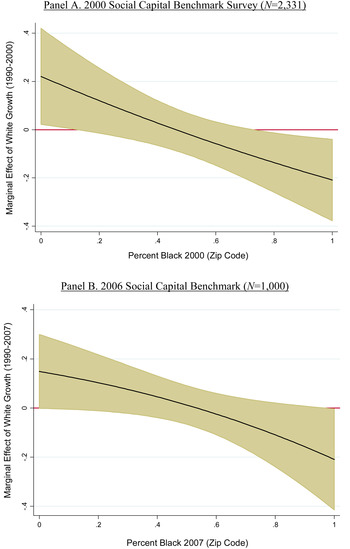
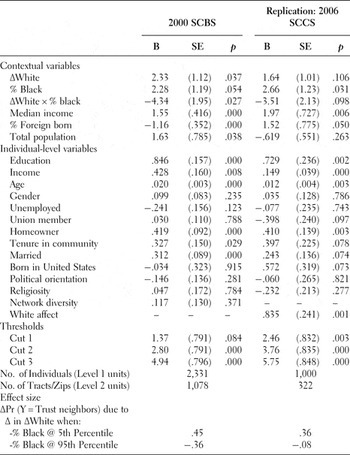
We present the results from our primary test of H 1 in column 1 of Table 1.Footnote 12 As hypothesized, the results reveal a significant and negative coefficient on the interaction term between ∆White and %Black, indicating that growth in the white population in one's immediate neighborhood decreases trust in one's neighbors, but only where the surrounding community is predominantly Black. These effects are depicted graphically in Figure 1, Panel A, which displays the marginal effect of white growth at the tract level when moving from mostly white to black zip codes. The graph shows how in communities with a minimal black population, growth in the white population is associated with a significant increase in neighborhood trust, that along a large portion of %Black (i.e., multiethnic communities) there is no effect of white growth on trust, and that in communities that are predominantly black, white growth is associated with a significant reduction in neighborhood social trust. We find that the exact tipping point in the data, where white growth starts to exert a significant negative effect, begins in communities that are roughly 75% black, which represents communities at or above the 85th percentile of %Black. While arguably at the margins of the data, these are precisely the communities of interest, as they are gentrifying contexts—places where blacks almost exclusively reside that are experiencing a novel growth in neighborhood white populations. In the 2000 SCBS data and looking at black respondents only, there are 96 neighborhoods (i.e., tracts) that experienced at or above 90th percentile growth in white populations and were situated in surrounding communities (i.e., zips) that were 75% or more black. Moreover, these 96 neighborhoods were scattered across 25 different metropolitan areas spread across 22 states; thus, rather than being driven by gentrification in a handful of places (e.g., NYC, Chicago, etc.), our results reflect a pattern of response to gentrification occurring in a range of neighborhoods across an array of cities. It is also important to note that trust is not lowered by residing in a black neighborhood alone, as an increase in percent black is only associated with increased trust in contexts with high white growth. Indeed, consistent with the black empowerment literature, in contexts with shrinking white populations, moving from non-black to black dominated communities is associated with a marginally significant increase in neighborhood trust.
Conditional marginal effects of neighborhood white population growth on trust in neighbors among black Americans. (A) 2000 Social Capital Benchmark Survey (N = 2,331). (B) 2006 Social Capital Benchmark (N = 1,000). Note: For both panels, plotted line represents conditional marginal effect estimates and shaded region represents 90% confidence intervals

The impact of growth in neighborhood white populations on trust in neighbors among black Americans

Source: 2000 and 2006 Social Capital Benchmark Surveys.
Note: Entries are unstandardized regression coefficients from random-intercept ordered logistic regression models estimated using gllamm in the software package Stata®.
Reported effect sizes are in terms of the predicted probability of trust in one's neighbors “some” or “a lot”.
Reported significance levels are based upon two-tailed hypothesis tests.
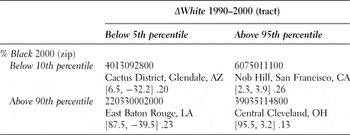
Turning to the magnitude of these effects, the bottom row of Table 1 displays the effect of neighborhood white growth conditional upon the racial composition of the surrounding community. As can be seen, white growth exerts substantially meaningful effects; for example, in the case of predominately black communities (i.e., %Black at 95th percentile), moving from minimum to maximum levels of ∆White is associated with a .36 decrease in the probability of trusting one's neighbors either “some” or “a lot.” To give some geographic identity to these effects, Table 2 provides case illustrations of the effects of neighborhood white growth and surrounding community racial composition across four different scenarios. While the control variables perform as expected, what is perhaps most important to note is that we observe an effect of residing in a gentrifying context holding constant variation across neighborhoods in income levels.Footnote 13 This is an important feature of our results, as income level is associated with important neighborhood characteristics, such as “blight” or quality, and our analyses account for this type of variation, thus ensuring that the estimated effects of our core variables are not tapping into unmeasured variation in wealth and associated characteristics.
Predicted probabilities of trust in neighbors across different neighborhood scenarios

Note: Entries in bold are the estimated predicted probability, holding all other contextual variables at their true values and individual variables at their means, of trusting one's neighbors “a lot” in each given scenario. Predicted probabilities were estimated using CLARIFY (King, Wittenberg, and Tomz Reference King, Tomz and Wittenberg2003) in Stata®.
Replication: 2006 SCCS
To assess the robustness of the results from the 2000 SCBS, we performed a replication test using the 2006 SCCS.Footnote 14 The 2006 SCCS was conducted by the Seguaro Seminar at Harvard University and all control variables included in the 2006 analysis are identical in question wording to those in the 2000 analysis, making the two models nearly identical to one another.Footnote 15 A few key differences between the 2000 and 2006 analysis are that in the 2006 analysis all of the contextual data is measured at the zip code level, and that ∆White is now the percentage point differences between the zip code percent White in 1990 and 2007 and all other contextual variables are updated to 2007 zip code estimates.Footnote 16 The results from this replication analysis are presented in column 2 of Table 1. The results mirror those found with the 2000 data, as the effect of white growth on trust in one's neighbors significantly reverses when moving from communities that are minimally to mostly black. Figure 1, Panel B depicts the marginal effect of neighborhood-level growth in the white population across levels of %Black, and reveals a pattern of conditional marginal effects comparable to those displayed in Panel A, where white growth is associated with a significant decline in neighborhood trust only in contexts that are nearly exclusively black. We find these results to constitute a powerful demonstration of the robustness of our findings.
RESULTS FOR THE SECOND HYPOTHESIS
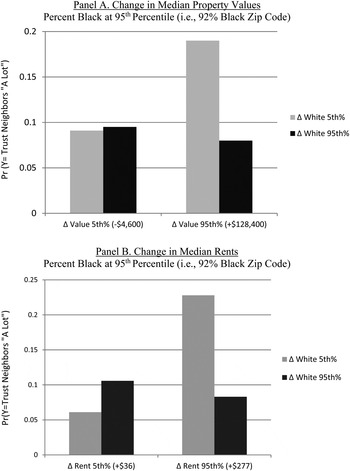
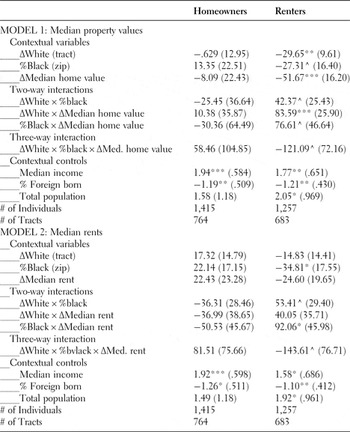
The results from our test of H 2 are presented in Table 3. The top half of the table presents the results focusing on changes in median home values and the bottom half on changes in median gross rents. The results presented in column 1 are for all black respondents and those presented in column 2 are for black renters only. Whether looking at values or rents, the results reveal that the interactive dynamic observed in Table 1 between ∆White and %Black is further conditioned by changing costs in housing, as indicated by the positive coefficients for the two-way interaction terms between ∆White and %Black and the negative coefficients for the three-way interaction terms in Table 3. As hypothesized, white growth in one's immediate neighborhood is only found to erode trust in one's neighbors when the surrounding community is predominantly black (85% black or greater) and when changes in home values or rents are at their maximum values. Further, as expected, residential status plays an important part in the results, as the three-way interaction terms, while negative across the board, only attain statistical significance when restricted to Black renters.Footnote 17 Given the complexity of these results, we present them in graphical form in Figure 2, Panels A and B. These figures present the predicted probability of trust in one's neighbors among black renters residing in predominantly black communities at varying levels of white growth and changes in home values and rents. The figures reveal that among blacks residing in black communities where home values decreased or rents remained relatively unchanged, an increase in the white population either has no effect on neighborhood social trust or has a negligible positive effect. However, among blacks residing in black communities where home values and rents greatly increased, an increase in the white population is associated with a significant decrease in the probability of trust in one's neighbors. Interestingly, the figures reveal that an increase in real estate values is associated with a spike in neighborhood trust, however, this effect is suppressed when such changes are accompanied by white growth. What is important to note about these results is that they hold after controlling for variation across neighborhoods in absolute levels of affluence, again ensuring that the core dynamics observed are not picking up variation across neighborhoods in income levels or income-related characteristics. Further, the demonstrated importance of housing cost inflation provides evidence in support of our realistic conflict approach to gentrification and against an approach focusing on racial identity that downplays material threat (e.g., social identity theory). Last, we should note that the results presented in Table 3 are robust against alternative analytic approaches. For example, we estimated our ∆White × %Black two-way interaction model presented in Table 1 on high and low ∆Rents subsets of the data. When focusing on the subset of blacks residing in tracts where ∆Rents is below its 25th percentile value, we find that the constituent term for ∆White (B = .86, SE = 2.6) as well as the interaction term for ∆White × %Black (B = −4.2, SE = 4.1) are both insignificant. However, among a subset of blacks residing in tracts where ∆Rents is above its 75th percentile value, ∆White (B = 3.7, SE = 1.9, p = .06) and the interaction term for ∆White × %Black (B = −6.8, SE = 3.7, p = .07) are statistically significant.
Predicted probability analysis of impact of white growth in predominantly black contexts on trust in neighbors among black renters conditional upon changes in housing prices—2000 SCBS data. (A) Change in Median Property Values. Percent Black at 95th Percentile (i.e., 92% Black Zip Code). (B) Change in Median Rents. Percent Black at 95th Percentile (i.e., 92% Black Zip Code)

The impact of neighborhood white growth conditional upon surrounding racial context and changes in property values and rents (2000 SCBS)

Source: 2000 Social Capital Benchmark Survey.
Note: Entries are unstandardized coefficients and standard errors from ordered logistic regression models with standard errors clustered by tract. To simplify presentation, all estimates for individual-level control variables and cutpoints have been omitted from the table. All models include individual controls for education, income, age, gender, employment status, tenure in community, citizenship status, ideology, and religiosity.
^p < .10, *p < .05, **p < .01, ***p < .001. Reported significance levels are based upon two-tailed hypothesis tests.
RESULTS FOR THE THIRD HYPOTHESIS
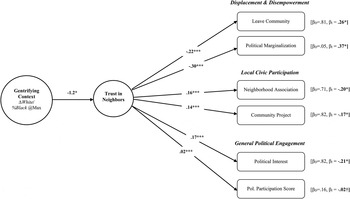
The results from our test of H 3 are presented in Figure 3. The figure depicts the direct and indirect effects of ∆White (conditional upon %Black) on neighborhood trust and political empowerment and engagement, as well as the direct effects of trust on empowerment and engagement. All coefficients listed along arrowed paths are direct effects, and the column of bracketed coefficients listed to the right of the figure displays the direct effect (β D ) and the indirect effects (β I ) of white growth on each outcome variable. As previously established, we see that white growth in mostly black communities is associated with a significant decrease in trust in one's neighbors. Next, as established or implied by extant research on SC and black empowerment, those that trust their neighbors are significantly less likely to expect leaving their community and to feel marginalized by local elites, and are significantly more likely to participate in neighborhood political activities and to engage with politics outside of the community. Turning to the direct effects of white growth on these ultimate outcome variables, the results listed in the column reveal that residing in a gentrifying context did not have any direct effect on these outcomes; however, residing in a gentrifying context exerted consistent indirect effects on these outcomes through its effect on neighborhood social trust. By eroding ties to one's neighbors, we find that residing in a gentrifying context indirectly augments forecasted community exodus and feelings of disempowerment, and dampens involvement in neighborhood activities and general political life.Footnote 18
Indirect effects of residing in a gentrifying context on black Americans. Note: Entries are mean and variance adjusted weighted least squares estimates (WLSMV) using delta parameterization and 1,000 iterations in Mplus (v.5.21). For all models, because Mplus treats categorical dependent variables as latent variables, the coefficient estimates listed along the paths represent the standard deviation unit change in the latent variable underlying the observed categorical variable associated with a unit change in the predictor variable. β D indicates the direct effect of ∆White on the outcome variable and β I is the indirect effect of ∆White on the outcome variable. ***p < .001, **p < .01, *p < .05, †p < .10 (one-tailed)

In sum, our results reveal that two important ultimate consequences of gentrification for black Americans are disempowerment and demobilization. While such findings are implied by existing research on black empowerment, our analysis empirically ties these outcomes to gentrification as the factor “breaking” the empowerment obtained by majority status. Additionally, our analysis highlights the critical importance of broken bonds of neighborhood trust and reciprocity in effectuating these outcomes.Footnote 19
ALTERNATIVE HYPOTHESES: DISORGANIZATION, SELECTION-BIAS, AND REVERSE CAUSALITY
One potential problem with contextual research such as ours, where the goal is to identify the causal effect of context on attitudes and behavior, is that the treatment variable may be non-randomly assigned, a function of selection bias, and potentially endogenous. As with any analysis, concern over such problems, if not defined in terms of research design alone, grows with the ability to articulate a theoretically plausible alternative explanation subsuming the operation of such damaging elements for causal inference. With respect to our research, such an alternative explanation comes in the form of what we label the “disorganization counter hypothesis.” This alternative hypothesis, informed by social disorganization theory (Shaw and McKay Reference Shaw and McKay1942) and work on “broken windows” (Sampson and Raudenbush Reference Sampson and Raudenbush2004; Wilson and Kelling Reference Wilson and Kelling1982), begins with the logic that gentrification does not occur randomly and may be more likely in poor, blighted, and “disorganized” communities. Thus, according to this counter hypothesis, trust in one's neighbors is low in gentrifying contexts because gentrification tends to occur in disorganized minority neighborhoods characterized by low levels of general social trust and low neighborhood quality. It is also worth noting here that perceived social disorganization is also associated with reductions in political participation (Michener Reference Michener2013). Thus, finding support for this counter-hypothesis would not only call our claims about trust into question but also our overall claims about political participation. In sum, white growth is not causing distrust; rather, neighborhood distrust is a characteristic of locations that predicts where gentrification tends to occur.
We have identified three testable deductions from the disorganization counter hypothesis. First, disorganized neighborhoods are characterized by poverty, crime, and high levels of general distrust; therefore, if gentrification tends to occur in such neighborhoods, we should expect to observe low levels of general social trust among blacks in gentrifying contexts. Following this, we should also expect to observe low levels of intraracial trust among blacks residing in gentrifying contexts as it is a subcategory of general social trust. Last, the social disorganization literature finds a link between objective disorganization and perceived disorganization and neighborhood quality. If gentrification occurs in disorganized neighborhoods, then we should also expect to find blacks residing in gentrifying contexts to be more likely to perceive their community as being of poor quality.
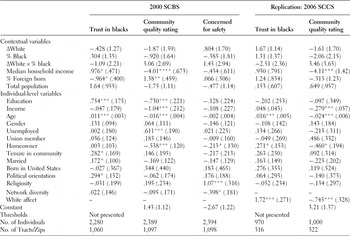
Drawing upon both the 2000 SCBS and the 2006 SCCS, we put these expectations to test, with the assumption being that, if the disorganization counter-hypothesis is correct, we should expect to find that the pattern of results (i.e., negative and significant interaction terms for ∆White and %Black) when analyzing general social trust, intraracial trust, and community quality ratings, mirror those when analyzing trust in one's neighbors. If, however, we fail to find such results, one could interpret such null findings as evidence against disorganization. Table 4 reveals that null results are precisely what we find. Across two datasets, we fail to find evidence that residing in a gentrifying context is associated with a range of manifestations of residing in a disorganized neighborhood, such as low trust across the board or rating of one's community as an undesirable place to live. Instead, we find that residing in a gentrifying context is only associated with lower levels of trust in one's immediate neighborhood. While these null results do not prove that the operative factor causing neighborhood distrust is white growth in black dominated contexts, they do cast doubt on the operation of a competing theoretical explanation.Footnote 20
The effect of residing in a gentrifying context on intra-racial trust, community quality rating, and safety concerns among black Americans

Sources: 2000 and 2006 Social Capital Benchmark Surveys.
Note: Entries are unstandardized regression coefficients from random-intercept logistic and ordered logistic regression models estimated using xtlogit and gllamm in the software package Stata®.
*p < .05, **p < .01, ***p < .001 (two-tailed hypothesis tests).
CONCLUSION
In this paper, we take an important first step in directing the attention of political science to a timely and previously overlooked topic. While case studies focusing on various gentrifying neighborhoods have found mixed results in terms of how minorities react to the entrance of whites—which is strongly suggestive of a complex operation of factors that likely vary from neighborhood to neighborhood—our analyses find, when averaging across neighborhoods throughout the nation as a whole, that gentrification is damaging to black communities: gentrification “loosens” the social fabric of black communities, and results in political disempowerment and demobilization.
Our results suggest against both uniformity and simplicity in our thinking about the political consequences of racial diversity and segregation. While scholarly treatments of segregation primarily focus on its harms to the black community and facilitation of racial prejudice in white communities, the black empowerment literature has led scholars to recognize that segregated contexts can have some social and political benefits that are not available to black Americans in multiethnic or white dominated communities. Thus, while research on interracial contact tends to forecast a high degree of promise associated with the diversification of white communities for creating a more racially tolerant and harmonious society, our results suggest caution when applying such expectations to black communities. Thus, while it may be the case that gentrification involves a reinvestment in urban centers previously suffering from divestment, our results support the skepticism voiced by opponents of gentrification in casting doubt on proponents’ optimism regarding the distribution of the benefits of new investment.
Our analyses corroborate the fears of opponents of gentrification by suggesting a detrimental effect on minority participation and representation. While we view our findings as an improvement over prior research, we see the need for future work exploring longitudinal and experimental research designs, as well as work assessing whether our findings hold when applied to other non-Black minority communities. Further, as gentrification spreads, results such as ours give heightened urgency to the question of the occurrence and success of resistance efforts to gentrification enacted by black communities. While our study documents a demobilizing effect of gentrification on individual blacks—which we link in theory to threats of economic and political displacement—prior work has positioned the experience of racial degradation and social and market exclusion as a mobilizing resource available to black communities for political action (Orr Reference Orr1999). Thus, it would be of interest for future research to systematically analyze how gentrification resistance movements form, and whether the individual-level effects observed in our study are drawn upon by black elites to empower and mobilize individual blacks in anti-gentrification efforts.
Another avenue for future research could involve assessing the effects of individual differences in gentrifying populations and how those differences interact with the behaviors of long-time residents. Japonica Brown-Saracino (Reference Brown-Saracino2009) creates a typology of gentrifiers that is defined by the extent to which new residents strive to preserve the existing social ecology of a neighborhood. In contrast to “social preservationists” and “social homesteaders”, Brown-Saracino argues that “urban pioneers” are detrimental to gentrifying communities due to their economic motivations and apathy toward the community. It is possible that gentrifying communities with a larger mix of “social preservationists” and “social homesteaders” relative to “urban pioneers” are better able to combat the negative effects of gentrification than areas defined by a large number of “urban pioneers.” Such a study could analyze the prospects for “bridging social capital” to emerge between entering whites and long-time black residents in order to procure perhaps the most ideal outcome of urban reinvestment without displacement.
Supplementary Material
The supplementary material for this article can be found at http://dx.doi.org/10.1017/rep.2016.8.