Introduction
To date, a large number of helminthological studies have focused on the descriptions of trematode parthenitae. However, this is not enough to correlate the taxonomic position of trematode larvae with the systematic status of the maritae with only morphology. Identification of parthenitae has previously been on the basis of morphological characteristics, but it is very difficult to compare the morphological characteristics of trematode larval stages with that of adults. With the advent of current molecular studies, however, it has become possible to reconstruct the life cycles of trematodes through the comparison of larval and adult stages using genetic markers.
Abra segmentum (Recluz, 1843) is a common and abundant mollusc in the Black Sea (Kiseleva et al., Reference Kiseleva, Revkov and Kopytov1996) and Mediterranean Sea (Denis, Reference Denis1981) coastal lagoons, sometimes playing a dominant role in these habitats and is an important food for a variety of marine species (Cilenti et al., Reference Cilenti, Scirocco and Florio2009). Sinitzin in his work (Reference Sinitzin1911) described two closely related species, which have subsequently been considered to represent the family Faustulidae – Cercaria pennata in Polititapes aureus (Gmelin, 1791) (=Tapes rugatus) and Cercaria plumosa in Abra alba (Wood, 1802). The species differ in several characters (size of the body, the length of the tail and finlets and in the number of longitudinal lamellae) (Sinitzin, Reference Sinitzin1911).
In this study, first complex data, including morphological descriptions and molecular characteristics of parthenitae of Cercaria pennata from bivalve molluscs A. segmentum in the Black Sea are presented. The molecular phylogeny was reconstructed based on the nucleotide sequences of the 28S rRNA gene fragment.
Material and methods
Sample collection
A total of 1053 A. segmentum specimens were collected in two different biotopes – the estuary of the Chernaya River (44°27′49″ N, 33°51′37″ E) and in Kazachya Bay (44°36′29″ N, 33°35′54″ E) (Sevastopol, Black Sea) monthly during 2011–2013. All snails were examined for helminthic infections using standard methods (Bykhovskaya-Pavlovskaya, Reference Bykhovskaya-Pavlovskaya1969). Parthenitae of trematodes were studied alive and stained using an Olympus CX41 microscope equipped with a CX50 camera with software Infinity Analyze. Trematodes were fixed under a cover glass with slight pressure and stained with acetocarmine. The degree of colour was differentiated by ‘iron water’ (water + iron(III) oxide) and acidified alcohol (70% ethanol + 3% hydrochloric acid). After dehydration in ethanol of increased concentrations (70, 80, 90 and 100%) and clarification in clove oil, trematodes were mounted in Canada balsam (Roskin & Levinson, Reference Roskin and Levinson1957).
Morphological data
All measurements were made on stained parasites. The abbreviations for the metrical features are as follows: BL, body length; BW, body width; OSL, oral sucker length; OSW, oral sucker width; PL, prepharynx length; PHL, pharynx length; PHW, pharynx width; OL, oesophagus length; VSL, ventral sucker length; VSW, ventral sucker width;TL,testis length; TW, testis width; OVL, ovary length; OVW, ovary width; CEND, post-caecal field length; TEND, post-testicular field length (Blasco-Costa et al., Reference Blasco-Costa, Montero, Balbuena, Raga and Kostadinova2009). The excretory system of the larvae was researched on living individuals when the larvae were stained with neutral red, as a result of which the flickering of the flame cells was observed. Drawings were made using a drawing software Inkscape 0.48.2.-1 (Scalable Vector Graphics, 2011).
Scanning electron microscopy (SEM)
Live sporocysts and spontaneously emitting cercariae were fixed in 2.5% (v/v) glutaraldehyde buffered with 0.1 M Sorensen phosphate for 24 h at 5°C, after which samples were dehydrated through an ethanol series (70–96°C) and dried in a Leica EM CPD 300 critical point dryer using liquid carbon dioxide as a transitional medium. After drying, they were mounted on aluminium stubs and coated with gold in an ion-sputtering apparatus Leica EM ACE 200.
Molecular data
One cercaria was fixed in 96% ethanol. Total DNA was extracted using innuPREP Mini Kit (Analytik Jena, Germany). The specimen was incubated in 100 μl of lysis buffer with 5 μl of Proteinase K at 56°C for one hour with following mix by vortex for 20 s. DNA extraction was carried out according to the manufacturer's protocol. The elution volume was 20 μl. The DNA was stored at −20°C.
The ribosomal 28S RNA gene fragment was amplified using the 28S-A forward primer (5′ GCA CCC GCT GAA YTT AAG 3′) (Matejusova & Cunningham, Reference Matejusova and Cunningham2004) and 1500R (5′ GCT ATC CTG AGG GAA ACT TCG 3′) (Tkach et al., Reference Tkach, Grabda-Kazubska, Pawlowski and Swiderski1999, Reference Tkach, Pawlowski and Mariaux2000). An initial polymerase chain reaction (PCR) was performed in a total volume of 25 μl containing 0.25 mm of each primer pair, 25 ng of total DNA in water and 12.5 μl of Promega GoTaq Green Master mix (Madison, Wisconsin, USA). Amplification of a 1200-base pairs (bp) fragment of the 28S rRNA gene was performed in a GeneAmp 9700, Applied Biosystems, with a 5-min denaturation at 96°C, 35 cycles of 1 min at 96°C, 20 s at 55°C and 2 min 30 s at 72°C, and a 10-min extension at 72°C. Negative and positive controls were made with the use of both primers.
The PCR product was directly sequenced using an ABI Big Dye Terminator v.3.1 Cycle Sequencing Kit (Applied Biosystems, USA), as recommended by the manufacturer, with the internal sequencing primers, described by Tkach et al. (Reference Tkach, Littlewood, Olson, Kinsella and Swiderski2003) for 28S rDNA. The PCR product was analysed using an ABI 3500 genetic analyser at the Federal Scientific Center of the East Asia Terrestrial Biodiversity, Far Eastern Branch of the Russian Academy of Sciences. The sequence was submitted to the United States National Center for Biotechnology Information (NCBI) database with accession number: (will be available after manuscript acceptance).
Alignment and phylogenetic analysis
Ribosomal DNA sequences were assembled with SeqScape v.2.6 software. Alignments and estimation of the number of variable sites and sequence differences were performed using the MEGA 7.1 (Kumar et al., Reference Kumar, Stecher and Tamura2016).
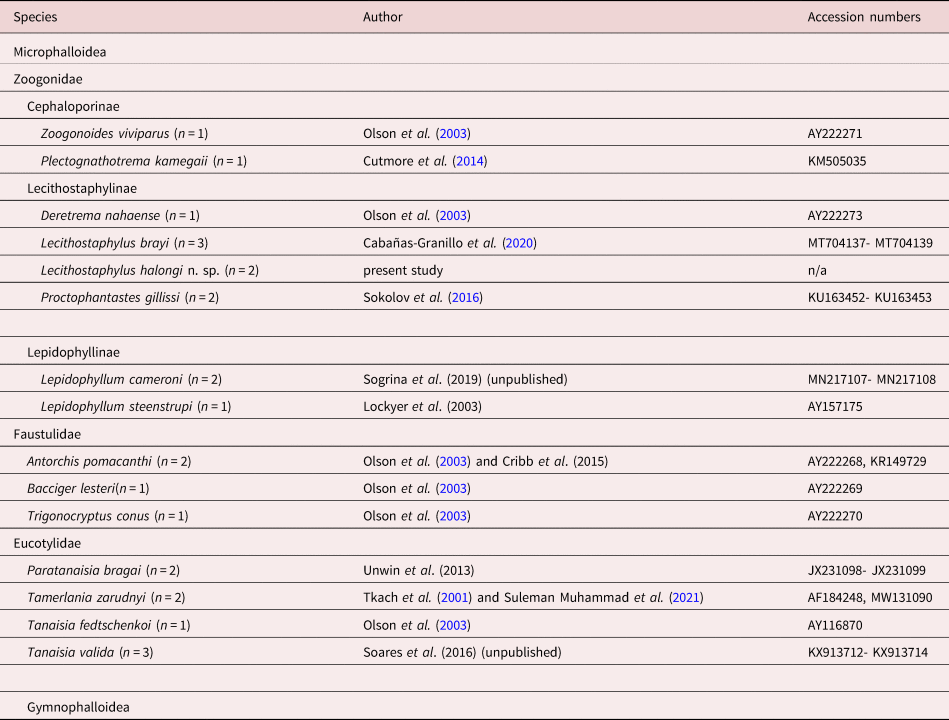
Phylogenetic relationships were inferred from our data and the nucleotide sequences of 28S rDNA from other trematode specimens from the families Faustulidae, Zoogonidae, Tandanicolidae and Gymnophalloidea incertae sedis (Pseudobacciger cheneyae) obtained from the NCBI GenBank database (table 1).
List of taxa incorporated in the molecular analysis of the superfamily Microphalloidea with the number of 28S rDNA sequences given in parentheses.

Phylogenetic analysis of nucleotide sequences was undertaken using maximum likelihood (ML) and Bayesian (BI) methods. Prior to analysis, the nucleotide substitution model was estimated using Akaike's information criterion for ML (Akaike, Reference Akaike1974) and Bayesian information criterion for BI (Huelsenbeck et al., Reference Huelsenbeck, Ronquist, Nielsen and Bollback2001) using jModeltest v.3.07 software (Darriba et al., Reference Darriba, Taboada, Doallo and Posada2012). The model TVM + I + G (Posada, Reference Posada2003) was estimated as those best fitting the 28S rDNA sequence data of the dataset used for both ML and BI analyses. Phylogenetic trees were reconstructed with PhyML 3.1 (Guindon & Gascuel, Reference Guindon and Gascuel2003) and MrBayes v.3.1.2 software (Huelsenbeck et al., Reference Huelsenbeck, Ronquist, Nielsen and Bollback2001). A Bayesian algorithm was performed using the Markov chain Monte Carlo option with ngen = 10,000,000, nruns = 2, nchains = 4, temp = 0.5 and samplefreq = 100. Burning values for ‘sump’ and ‘sumt’ options composed 25% of number of generations (ngen). Phylogenetic relationship significance was estimated using approximate likelihood-ratio test using eBayes support (Anisimova & Gascuel, Reference Anisimova and Gascuel2006) for ML and posterior probabilities for BI analyses (Huelsenbeck et al., Reference Huelsenbeck, Ronquist, Nielsen and Bollback2001).
Statistical methods
After the parasites were detected, we assessed the infection indexes in the Abra, including invasion intensiveness (prevalence) (IE), invasion intensity (II), and abundance index (AI). For each morphological parameter, the arithmetic mean with standard error (mean ± SE) was calculated. To calculate the statistical parameters, the Statistica 6 software package for Windows (Statsoft) was used.
Results
Cercaria pennata Sinitzin, Reference Sinitzin1911
Host: Abra segmentum (Recluz, 1843)
Locality: Black Sea, near Sevastopol (44°27′49″ N, 33°51′37″ E); (44°36′29″ N, 33°35′54″ E)
Site: Hepatopancreatic gland
IE = 2%: II = 1–30
Description
Sporocysts long, saccular, 2082–5110 (3852) × 437–645 (552) μm, and fill hepatopancreatic gland of their host.
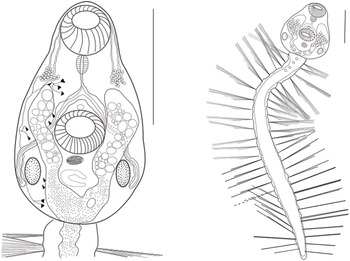
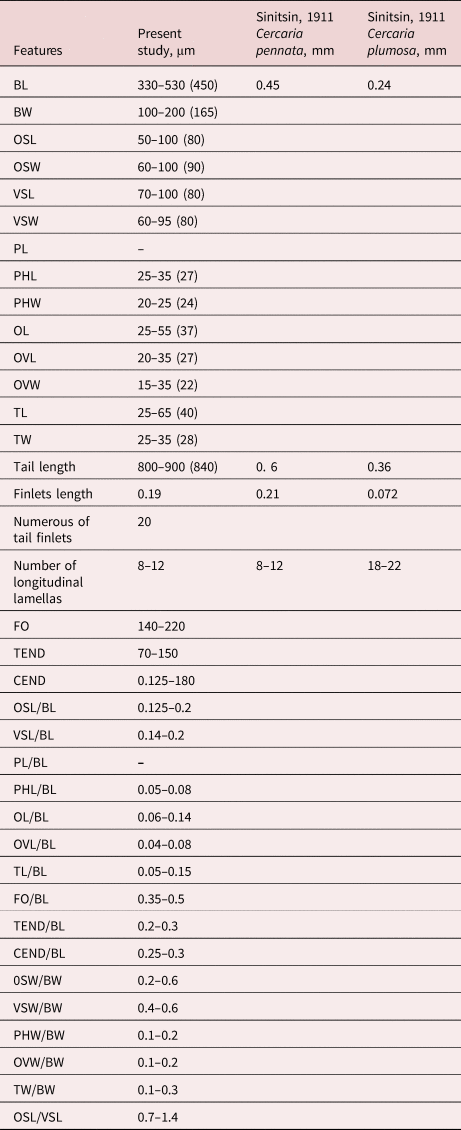
Cercariae (based on 15 specimens, table 2, figs 1 and 2).
Live Cercaria pennata from the mollusc Abra segmentum: (A) morphology of the cercaria body; (B) position of cercaria tail finlets. Scale: 200 μm.

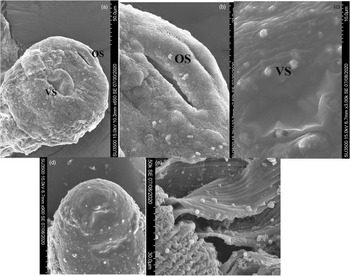
Scanning electron microscopy photomicrographs of Cercaria pennata from mollusc Abra segmentum: (A, B) views of suckers: OS – oral sucker; VS – ventral sucker; (C, D) body surface structure;and (E) tail feathers and longitudinal lamellae.

Comparing morphological features of faustulid cercariae in the Black Sea.

All measurements and body proportions are listed in table 2.
Body oval. Tegument spined: spines small. Oral sucker subterminal, almost the same size as ventral sucker. Ventral sucker in middle of body. Oral to ventral sucker distance slightly less than ventral sucker to end of body distance. Prepharynx absent. Pharynx muscular, well-defined. Oesophagus narrow. Intestinal bifurcation slightly anterior to ventral sucker. Caeca reach posterior margin of testes. Testes two, arranged symmetrically, laterally, posterior to ventral sucker. Ovary oval slightly posterior to testes. Tail length 0.8 mm, almost twice as long as body length, with row of feathers on each side perpendicular to tail surface, 20 pairs in number. Number of longitudinal lamellae on feathers ranged from eight to 12 in number. Excretory bladder V-shaped, both branches approach level of ventral sucker. Formula of excretory system is 2 [(3 + 3) + (3 + 3)] = 24.
Molecular data
Partial 28S rRNA gene sequence of a single specimen of Cercaria pennata of 1182 bp in the length (GenBank accession numbers will be provided after acceptance) was generated and aligned with all available ribosomal large subunit sequences of Faustulidae from gymnophalloid and microphalloid clades and also representatives of Gymnophalloidea and Microphalloidea and trimmed to the most optimal alignment length (1114 bp) for the available dataset.
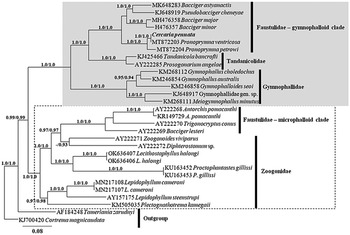
Based on these data, ML and Bayesian algorithms generated phylogenetic trees with identical topologies (fig. 3). Results of phylogenetic analysis indicate that C. pennata ex A. segmentum from the Black Sea from our material clustered with Pronoprymna ventricosa (Rudolphi, 1819) Poche, 192 with high statistical support within gymnophalloid clade of Faustulidae as nucleotide sequences of 28S rDNA fragment of C. pennata and P. ventricosa (Rudolphi, 1819) Poche, 1926 were identical. Pronoprymna petrowi (Layman, 1930) Bray & Gibson, Reference Bray and Gibson1980 appears as sister species to [C. pennata + P. ventricosa] subclade. Cercaria pennata and P. ventricosa differed from that of P. petrowi on 3.25 ± 0.55%. Genetic p-distance values between C. pennata and other species within gymnophalloid clade ranged from 12.2 ± 1.04% to 13.9 ± 1.2%.
Phylogenetic tree showing the relationships of various members of the families Faustulidae, Zoogonidae, Tandanicolidae and Gymnophalloidea based on 28S rDNA.

Discussion
The family Faustulidae is a member of the superfamily Microphalloidea. On the basis of molecular, morphological and life cycle data, Hall et al. (Reference Hall, Cribb and Barker1999) removed the subfamily Baccigerinae from the Fellodistomiae. The Baccigerinae Yamaguti, 1959 was considered as the junior synonym of the Faustulidae, Poche, 1926. Members of family Faustulidae are known to present gymnocephalous cercariae.
Daughter sporocysts of С. pennata were found in the hepatopancreatic gland of A. segmentum hemipopulations. This type of parthenitae with similar characteristics were firstly detected by Sinitzin (Reference Sinitzin1911), who described them as C. plumosa and С. pennata. The author registered these two morphologically similar faustulid cercariae in the bivalve molluscs Abra alba and Polititapes aureus (Gmelin, 1791) (=Tapes rugatus) in the water off Sevastopol. The trematode fauna of molluscs in the Black Sea was widely studied by Dolgikh (Reference Dolgikh1965). In this work there were no mentions on C. plumosa and C. pennata in any of the studied areas.
Based on morphological data, our samples belong to family Faustulidae. Most of the morphological characteristics of the specimens investigated agree with those of C. pennata and C. plumosa, reported by Sinitzin (Reference Sinitzin1911). Nevertheless, some morphological differences are present. According to Sinitzin (Reference Sinitzin1911), C. pennata differs from C. plumosa in the size of the body, the length of the tail and finlets, and in the number of longitudinal lamellae. Our specimens differ from C. plumosa in the numbers of finlets on the tail (20 pairs vs. 25–28 pairs for C. plumosa), the number of longitudinal lamellae (8–12 vs. 18–22 for C. plumosa), and body and tail length (table 1). Samples from the present study are most similar to C. pennata by shape and length of the body, tail length, arrangement and shape of internal organs, shape and measurements of both suckers, pharynx, testicular rudiments, and the number and position of the longitudinal lamellae on the tail finlets (table 2). Thus, morphological data support the identification of faustulid cercaria from mollusc A. segmentum in the Black Sea as C. pennata.
The body surface structure, number and precise arrangement of feathers and longitudinal lamellae on the tail described in the present SEM study were not reported for P. ventricosa trematode larvae by other authors. Thus, the new characters are described here. The entire surface of the cercaria was armed with sharp, single-pointed spines arranged in regular rows in the tegumentary papillae. Number and precise arrangement of feathers and longitudinal lamellae of the cercariae of P. ventricosa appears well established by SEM. SEM observations of the cercarial tail feathers confirm its composite character, the rib-like supports acting as a skeleton.
Based on molecular data, C. pennata from our study is a synonym of P. ventricosa based on their identical partial 28S rDNA sequences. At present, there are no morphological or molecular studies on cercariae of P. ventricosa from bivalve molluscs (Bray & Gibson, Reference Bray and Gibson1980). Pronoprymna ventricosa is the type-species of the genus. These trematodes have been recorded from the intestine of various species of marine shads in the Black Sea (Chulkova, Reference Chulkova1939; Nikolaeva, Reference Nikolaeva1963; Popjuk, Reference Popjuk2009; Ozer et al., Reference Ozer, Ozturk and Kornyychuk2013), Azov Sea (Solonchenko, Reference Solonchenko1982), Mediterranean Sea (Bray, Reference Bray, RA, DA and A2008), Pontic and Caspian Seas (Kurochkin, Reference Kurochkin1964; Kornijchuk & Barzegar, Reference Kornijchuk and Barzegar2005; Youssefi et al., Reference Youssefi, Hosseinifard, Halajian, Amiri and Shokrolahi2011), north-eastern Atlantic Ocean (Bray, Reference Bray, RA, DA and A2008), Dnieper River (Komarova, Reference Komarova1964), and Severn and Rhine Rivers (Bray & Gibson, Reference Bray and Gibson1980). An adult specimen of P. ventricosa ex Alosa volgensis (Berg, 1913), used in phylogenetic analysis, was described from the delta of the Volga River and genotyped by Sokolov et al. (Reference Sokolov, Shchenkov and Gordeev2021).
In the Black Sea, mature worms of P. ventricosa described from different definitive hosts, including Alosa tanaica (Grim, 1901), Alosa immaculata Bennett, 1835, Atherina boyeri Risso, 1810, Alosa fallax (Lacepède, 1803) (Cetindag, Reference Cetindag1993), Gobius niger Linnaeus, 1758, Neogobius fluviatilis (Palas, 1814), Neogobius melanostomus (Palas, 1814), Proterorhinus marmoratus (Palas, 1814), Zosterisessor ophiocephalus (Palas, 1814), Symphodus roissali (Risso, 1810), and Sciaena umbra Linnaeus, 1794 (Gaevskaya & Kornijchuk, Reference Gaevskaya, Korniychuk, Eremeev and Gaevskaya2003). These records indicate that P. ventricosa has a wide spread of distribution and range of definitive hosts. In the Black Sea, A. segmentum is found to be a first intermediate host for P. ventricosa. However, this mollusc is widespread from the coasts of England through the Atlantic Ocean, Mediterranean Sea (Denis, Reference Denis1981) and up to the Caspian Sea (Romanova, Reference Romanova1977; Latypov, Reference Latypov2004). Abra spp. natural habitats cover all northern, western and southern littoral areas of the Caspian Sea (Romanova, Reference Romanova1977). Based on our molecular results we propose a role of this bivalve species as first intermediate host of P. ventricosa larvae.
Faustulid trematodes can use different species of bivalves from different orders as first intermediate hosts: Polititapes aureus, Chamelea gallina (Linnaeus, 1758) (Venerida), Donax vittatus (da Costa, 1778) (Cardiida), Barnea candida (Linnaneus, 1758) (Myida) (Palombi, Reference Palombi1934a, Reference Palombi1940; Dolgikh, Reference Dolgikh1968). In the present study we registered the A. segmentum mollusc as a first intermediate host from the order Cardida for P. ventricosa.
In the life cycle of some faustulid trematodes, marine clams act as first intermediate host, and crustaceans as second intermediate hosts. For example, these hosts are known to be used by Cercaria lata (Faustulidae) (Gargouri et al., Reference Gargouri, Menif and Maamouri2008). The life cycle of C. lata was described as cercariae after escaping from sporocysts parasitizing the first intermediate host, Ruditapes decussatus (Linnaeus, 1758) (=Tapes decussata), penetrate and encyst as metacercariae in the Amphipoda Erichthonius difformis, and develop into adults in the alimentary tract of Atherina spp. (Palombi, Reference Palombi1934b). In the Black Sea Grintsov & Sezgin (Reference Grintsov and Sezgin2011) registered the Amphipoda Erichthonius difformis in Sevastopol Bay.
Thus, we can expect that the P. ventricosa trematode completes its life cycle in the Black Sea, using molluscs A. segmentum as first intermediate host, the Amphipoda Erichthonius difformis can be used as second intermediate host and the definitive host are shad fishes. However, to accurately prove this fact, additional studies on the experimental equipment of the life cycle are required to recover this life cycle completely.
Conclusion
Morphological characteristics of cercariae emerging from A. segmentum from the Black Sea, correspond to C. pennata. Analysis of partial 28S rDNA sequences indicates that these cercariae are identical to P. ventricosa mature worms. Accepting that P. ventricosa is a widespread trematode species in the Black Sea, we suppose that the life cycle of this species involves the bivalve molluscs A. segmentum in this region.
Acknowledgement
The authors are grateful to PhD Makarov M.V., a researcher of the Institute of Biology of the Southern Seas, for collection and identification of Black Sea molluscs.
Financial support
The study was funded by the federal budget of the Russian Academy of Sciences, projects No 121030100028-0 and No 121031000154-4.
Conflicts of interest
None.
Ethical standards
All applicable institutional, national and international guidelines for the care and use of animals were followed.