Nearly 50 years ago Paul Meehl (Reference Meehl1962) hypothesized that constitutional vulnerability to schizophrenia may be expressed through schizotypal personality symptoms that resemble, but are less severe than, the symptoms of schizophrenia. Schizotypal personality symptoms are and are of three primary types: cognitive–perceptual symptoms such as unusual sensations and perceptions or odd beliefs, interpersonal symptoms such as social withdrawal and social anxiety, and disorganized symptoms such as odd behavior (Reynolds, Raine, Mellingen, Venables, & Mednick, Reference Reynolds, Raine, Mellingen, Venables and Mednick2000). These parallel the positive, negative, and disorganized symptoms that are characteristic of schizophrenia. Genetic studies have, in fact, confirmed that schizotypal personality disorder is increased in first degree relatives of individuals with schizophrenia, and these disorders are now often described as being linked as part of a schizophrenia spectrum (Ingraham & Kety, Reference Ingraham, Kety, Tsuang and Simpson1988; Siever & Davis, Reference Siever and Davis2004; Tienari et al., Reference Tienari, Wynne, Laksy, Moring, Nieminen and Sorri2003).
Because schizophrenia psychosis typically emerges suddenly during adulthood in a manner that is experienced as strikingly discontinuous from previous functioning, early theories of the etiology of schizophrenia had not traditionally adopted a developmental perspective. However Meehl's theory was implicitly a developmental theory, in that before becoming fully expressed as schizophrenia, constitutional vulnerability to schizophrenia might be expressed as schizotypal personality symptoms and through other signs of “neural integrative deficits.” Schizophrenia is increasingly being viewed as a neurodevelopmental disorder in which symptoms of psychosis may be preceded by a variety of clinical, social, neurobehavioral, and morphologic indicators of vulnerability many years before the onset of the disorder (Bearden, Meyer, Loewy, Niendam, & Cannon, Reference Bearden, Meyer, Loewy, Niendam, Cannon, Cicchetti and Cohen2006; Cicchetti & Cannon, Reference Cicchetti and Cannon1999; Fish, Reference Fish1977; Marenco & Weinberger, Reference Marenco and Weinberger2000; Walker, Reference Walker1991). This constitutional vulnerability can be genetic and/or derive from insults during fetal life, such as exposure to viral infections (Cannon, Kendell, Susser, & Jones, Reference Cannon, Kendell, Susser, Jones, Murray, Jones, Susser, Van Os and Cannon2003).
Strong evidence for the developmental origins of schizophrenia has gradually accumulated. Replicated data from prospective studies of young people with schizotypal symptoms confirm that they are at increased risk of developing later schizophrenia psychosis (Chapman, Chapman, Kwapil, Eckblad, & Zinser, Reference Chapman, Chapman, Kwapil, Eckblad and Zinser1994; Fenton & McGlashan, Reference Fenton and McGlashan1989; Mehlum et al., Reference Mehlum, Friis, Irion, Johns, Karterud and Vaglum1991; Miller et al., Reference Miller, Byrne, Hodges, Lawrie, Owens and Johnstone2002; Yung et al., Reference Yung, Phillips, Yuen, Francey, McFarlane and Hallgren2003). Data from retrospective follow-back designs studies confirm that individuals who develop schizophrenia were more likely to have displayed schizotypal symptoms during childhood or the immediate premorbid period (Angst & Clayton, Reference Angst and Clayton1986; Cuesta, Peralta, & Caro, Reference Cuesta, Peralta and Caro1999; Walker, Kestler, Bollini, & Hochman, Reference Walker, Kestler, Bollini and Hochman2004). Although data are limited, some investigators have hypothesized that interpersonal schizotypal features may be more strongly linked with later schizophrenia illness and concurrent schizotypal symptoms than are cognitive–perceptual schizotypal features (Gooding, Tallent, & Matts, Reference Gooding, Tallent and Matts2005; Raine, Reference Raine2006). Other prospective studies of large population-based cohorts that have examined children's interpersonal functioning or adjustment (which might be analogous to interpersonal schizotypal symptoms) have also shown that, long prior to emergence of schizophrenia illness, young people are prone to problems with social attachments and social responses (Bond & McDonel, Reference Bond and McDonel1991; Jones, Rodgers, Murray, & Marmot, Reference Jones, Rodgers, Murray and Marmot1994; Malmberg, Lewis, David, & Allebeck, Reference Malmberg, Lewis, David and Allebeck1998; Walker, Grimes, & Davis, Reference Walker, Grimes and Davis1993).
Consistent with Meehl's ideas of neurointegrative deficits, there is also evidence from clinical and naturalistic observational studies that subtle premorbid motor signs may be related to the development of schizophrenia and schizotypal personality. Individuals who develop schizophrenia are more likely during childhood to have displayed delays in acquisition of motor milestones and or motor dyscoordination compared to those without schizophrenia illness, including their own healthy siblings (McNeil & Cantor-Graae, Reference McNeil and Cantor-Graae2000; Walker & Lewine, Reference Walker and Lewine1994). Adolescents who have schizotypal personality disorder are more likely to display dyskinesias than individuals with no or other mental health problems (Walker, Logan, & Walder, Reference Walker, Logan and Walder1999).
It is also consistent with a developmental theory of schizophrenia that minor physical abnormalities (MPAs) are elevated in schizophrenia patients (Weinberg, Jenkins, Marazita, & Maher, Reference Weinberg, Jenkins, Marazita and Maher2007), as well as in individuals with schizotypal personality disorder (Corcoran et al., Reference Corcoran, Walker, Huot, Mittal, Tessner and Kestler2003; Mittal, Dhruv, Tessner, Walder, & Walker, Reference Mittal, Dhruv, Tessner, Walder and Walker2007; Weinstein, Diforio, Schiffman, Walker, & Bonsall, Reference Weinstein, Diforio, Schiffman, Walker and Bonsall1999) and individuals from nonclinical populations with schizotypal symptoms (Bollini et al., Reference Bollini, Compton, Esterberg, Rutland, Chien and Walker2007; Spring, Weinstein, Freeman, & Thompson, Reference Spring, Weinstein, Freeman, Thompson, Steinhauer and Gruzelier1991; Weinstein et al., Reference Weinstein, Diforio, Schiffman, Walker and Bonsall1999). MPAs are subtle morphological abnormalities of the face, feet, and hands that are believed to result from developmental insults during the prenatal period, such as viral infections, that also cause morphological abnormalities of the brain (Hata, Iida, Iwasaka, Negoro, & Kishimoto, Reference Hata, Iida, Iwasaka, Negoro and Kishimoto2003). MPAs do not seem to be a direct reflection of genetic risk for schizophrenia, as the relatively limited information available suggest that children with first-degree relatives with schizophrenia do not have increased numbers of congenital malformations (McNeil, Blennow, & Lundberg, Reference McNeil, Blennow and Lundberg1992) or minor physical anomalies (Marcus, Hans, Byhouwer, & Norem, Reference Marcus, Hans, Byhouwer and Norem1985; Orvaschel, Mednick, Schulsinger, & Rock, Reference Orvaschel, Mednick, Schulsinger and Rock1979), although it remains possible that they are particularly increased in individuals who have both genetic risk and prenatal insults (Gourion, Goldberger, Bourdel, et al., Reference Gourion, Goldberger, Bourdel, Bayle, Loo and Krebs2004; O'Callaghan, Larkin, Kinsella, & Waddington, Reference O'Callaghan, Larkin, Kinsella and Waddington1991).
Other important clues to the developmental psychopathology of schizophrenia come from studies of young people at genetic risk for schizophrenia. Developmental studies of schizophrenia or related disorders such as schizotypal personality disorder are constrained by the limits of retrospective research designs and the difficulties of gathering population-based prospective data on subtle behavioral phenomena when the illness of interest emerges in adulthood and then occurs in only one percent of the population. Over three decades ago, scientists called for use of longitudinal high risk methods in the study of schizophrenia (Garmezy, Reference Garmezy1974; Rosenthal, Reference Rosenthal1970). Prospective studies were launched with samples of infants and children who were at high risk of developing schizophrenia because of this illness in a mother or father (Watt, Anthony, Wynne, & Rolf, Reference Watt, Anthony, Wynne and Rolf1984). These studies have yielded important information on young people at genetic risk, including their increased prevalence of neurobehavioral deficits including attention and memory problems (Asarnow, Steffy, MacCrimmon, & Cleghorn, Reference Asarnow, Steffy, MacCrimmon and Cleghorn1977; Hans et al., Reference Hans, Marcus, Nuechterlein, Asarnow, Styr and Auerbach1999a; Nuechterlein, Reference Nuechterlein1983; Rutschmann, Cornblatt, & Erlenmeyer-Kimling, Reference Rutschmann, Cornblatt and Erlenmeyer-Kimling1977, Reference Rutschmann, Cornblatt and Erlenmeyer-Kimling1986) and neuromotor deficits (Erlenmeyer-Kimling et al., Reference Erlenmeyer-Kimling, Cornblatt, Friedman, Marcuse, Rutschmann, Simmens, Nasrallah and Henn1982; Marcus, Hans, Auerbach, & Auerbach, Reference Marcus, Hans, Auerbach and Auerbach1993; Marcus, Hans, Lewow, Wilkinson, & Burack, Reference Marcus, Hans, Lewow, Wilkinson and Burack1985; McNeil, Harty, Blennow, & Cantor-Graae, Reference McNeil, Harty, Blennow and Cantor-Graae1993). Although longitudinal follow-up data into adulthood are still limited, data from the New York High Risk Study indicate that attention, memory, and motor abnormalities in late childhood and early adolescence among children with a parent who has schizophrenia are predictive of later schizophrenia-related psychoses (Cornblatt, Obuchowski, Roberts, Pollack, & Erlenmeyer-Kimling, Reference Cornblatt, Obuchowski, Roberts, Pollack and Erlenmeyer-Kimling1999; Erlenmeyer-Kimling et al., Reference Erlenmeyer-Kimling, Rock, Roberts, Janal, Kestenbaum and Cornblatt2000).
Although prospective studies of children at risk for schizophrenia have provided important information on the development of schizophrenia (Auerbach et al., Reference Auerbach, Erlenmeyer-Kimling, Fish, Hans, Ingraham, Marcus and Kim2009), they have been surprisingly silent on the issue of schizotypal symptoms during childhood and adolescence. Carlson and Fish (Reference Carlson and Fish2005), in the New York Infant Study, reported the presence of schizotypal symptoms during childhood and adolescence in 5 of the 12 high-risk young people in the study, and in the New York High Risk Study, adolescent offspring of parents with schizophrenia had increased numbers of interpersonal schizotypal symptoms, compared to adolescents whose parents had no disorder or other mental disorders (Squires-Wheeler, Skodol, & Erlenmeyer-Kimling, Reference Squires-Wheeler, Skodol and Erlenmeyer-Kimling1992). Social withdrawal, one of the interpersonal symptoms of schizotypal personality, has been reported as elevated in several samples of children at genetic risk for schizophrenia (Dworkin, Reference Dworkin1990; Hans, Auerbach, Asarnow, Styr, & Marcus, Reference Hans, Auerbach, Asarnow, Styr and Marcus2000; Hans, Marcus, Henson, Auerbach, & Mirsky, Reference Hans, Marcus, Henson, Auerbach and Mirsky1992), but none of the high-risk studies have conducted systematic assessments of a range of schizotypal symptoms in young people at genetic risk. Although neurodevelopmental theories of schizophrenia would suggest that schizotypal symptoms in young people at genetic risk should co-occur with indicators of neurodevelopmental problems or MPAs, no data are available on such such co-occurrence. Several studies suggest, however, that among young people at risk for schizophrenia, social withdrawal and other signs of poor social competence during childhood are associated with concurrent neuromotor signs in three studies (Dworkin et al., Reference Dworkin, Cornblatt, Friedmann, Kaplansky, Lewis and Rinaldi1993; Hans et al., Reference Hans, Marcus, Henson, Auerbach and Mirsky1992, Reference Hans, Auerbach, Asarnow, Styr and Marcus2000) and attentional dysfunction in one study (Dworkin et al., Reference Dworkin, Cornblatt, Friedmann, Kaplansky, Lewis and Rinaldi1993).
The goal of the present paper is to explore the emergence of schizotypal personality features in a sample of Israeli young people that includes youth at genetic risk for schizophrenia, but who have not developed psychotic illness. Within this sample we will examine the three types of risk factors that are part of a neurodevelopmental theory of schizophrenia and schizotypal personality: genetic risk, minor physical anomalies that reflect prenatal developmental disruption, and neurobehavioral dysfunction. We predict that the number of schizotypal symptoms will be elevated in young people at genetic risk for schizophrenia, in those with minor physical anomalies, and those with concurrent neurobehavioral dysfunction and neurobehavioral dysfunction earlier in development. Moreover, we predict that interpersonal schizotypal symptoms will be more strongly linked to neurodevelopmental factors than will cognitive–perceptual schizotypal symptoms. Finally, because minor physical anomalies are nonspecific risk factors for schizophrenia spectrum symptoms, we predict that it is their co-occurrence within individuals that distinguishes those at greatest risk for symptoms. We predict that individuals whose developmental history includes genetic risk, prenatal disruption (assessed by minor physical anomalies), and poor neurobehavioral performance will be at the highest risk for schizotypal personality features.
Methods
Sample
Data are reported on 114 Israeli adolescents from 60 families (Hans, Auerbach, Styr, & Marcus, Reference Hans, Auerbach, Styr and Marcus2004): (a) 39 young people in which at least one biological parent had schizophrenia, (b) 39 young people in which at least one parent had a major lifetime nonschizophrenic mental disorder (affective disorder or personality disorder), and (c) 36 young people in which neither parent had diagnosable mental illness. Two additional subjects from the parent with schizophrenia group were not included in the analytic sample for this paper, because one of these young people had already developed schizophrenic illness; the other did not complete the portion of the interview related to the assessment to schizotypal personality. Families were recruited into the study in two waves.
Sixty-one of the adolescents were participants in the longitudinal Jerusalem Infant Development Study whose methods have been described previously (Hans et al., Reference Hans, Marcus, Nuechterlein, Asarnow, Styr and Auerbach1999b; Marcus, Auerbach, Wilkinson, & Burack, Reference Marcus, Auerbach, Wilkinson and Burack1981; Marcus et al. Reference Marcus, Hans, Auerbach and Auerbach1993). These families participating in the longitudinal study were recruited while the mothers were pregnant through community mother and child health centers and mental health clinics and hospitals. During the mother's pregnancy, all Jerusalem Infant Development Study parents were diagnosed with Research Diagnostic Criteria (Spitzer, Endicott, & Robins, Reference Spitzer, Endicott and Robins1975) using a Hebrew-language version of the Current and Past Psychopathology Scale (Endicott & Spitzer, Reference Endicott and Spitzer1972) and/or psychiatric and social work records for individuals who had received treatment. When the children were approximately 10 years of age, more than 80% of biological parents were interviewed using the Schedule for Affective Disorders and Schizophrenia—Lifetime Version (SADS-L; Spitzer & Endicott, Reference Spitzer and Endicott1975) and mental health records were reviewed for parents receiving mental health treatment. If parents were deceased or unavailable, spouses provided mental health history updates. Based on all available information, revised lifetime parent diagnoses were made using the Diagnostic and Statistical Manual of Mental Disorders—Third Edition, Revised (DSM-III-R) criteria (American Psychiatric Association, 1987) and for five families, changes made in group assignment. Seven parents were unavailable for research psychiatric interviewing at the infant and/or school-age assessment, but had sufficiently complete psychiatric records to make group assignment.
Fifty-three adolescents from 23 families were recruited during the adolescent wave of the project to add power to the sample for the cross-sectional data. These families were recruited from mental health clinics in Jerusalem and from the files of families who had previously participated in studies at the Falk Institute for Mental Health and Behavioral Studies. Diagnoses were made using DSM-III-R criteria (American Psychiatric Association, 1987) based on SADS-L interviews and reviews of clinic records (Endicott & Spitzer, Reference Endicott and Spitzer1972).
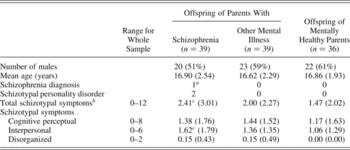
The 65 males and 49 females in the adolescent sample ranged in age from 12 to 22 years, with a mean age of 16.79 (SD = 2.26; see Table 1. The sample reflected the varied ethnic and socioeconomic backgrounds typical of Jewish families living in Jerusalem, but was predominantly a working class sample. Youth in the longitudinal cohort had also been assessed during middle childhood, when they were a mean age of 10.35 years (SD = 2.07). Young people from the cohort recruited at adolescence were demographically similar to the original longitudinal cohort.
Offspring demographics and personality disorder symptoms by three parent diagnosis groups

aThe subject is not included as one of the 39 subjects used in the statistical analyses.
bNote that total symptoms does not equal the sum of the dimensions, because one of the items is included in two dimensions. Each of the nine symptoms is scored at two levels of severity.
cOffspring of parent schizophrenia group > offspring of parent no mental illness group, controlling for age and sex.
Assessment methods
Youth mental disorder and schizotypal symptoms
Adolescents and parents were administered a Hebrew translation of the Semi-Structured Kiddie Interview for Personality Syndromes (K-SKIPS; Asarnow & Talovic, Reference Asarnow and Talovic1986; Asarnow, Tompson, & Goldstein, Reference Asarnow, Tompson and Goldstein1994). Youth reports formed the basis for the ratings of diagnostic symptoms, although parent information was used to confirm and corroborate youth reports. In a few cases, usually with older youth, it was not possible to interview the parents independently about youth mental disorder. Interview assessments of adolescent mental disorder were made during home visits. Interviewers included a psychiatrist and two other experienced clinicians. All interviewers had completed K-SKIPS training from one of the authors of the instrument (J.R.A.). Interviewers were blind to parent diagnoses.
For the present paper, analyses focus on items drawn from the nine schizotypal personality questions of the K-SKIPS, representing each of the nine DSM-III-R symptoms of schizotypal personality disorder. K-SKIPS items are scored on 3-point scales: 0 = no symptom present, 1 = symptoms below threshold, and 2 = symptoms above threshold. The schizotypal personality symptoms were summed into the three dimensions of schizotypal symptoms described by Raine (Reference Raine1991): cognitive–perceptual symptoms (ideas of reference, odd beliefs or magical thinking, unusual perceptual experiences, suspiciousness), interpersonal symptoms (social anxiety, no close friends, constricted affect, suspiciousness), and disorganized symptoms (odd or eccentric behavior, odd speech). Note that suspiciousness is included in two of the dimensions.
Minor physical anomalies
Minor physical anomalies were assessed by a psychiatrist using items from the Waldrop Scale (Waldrop & Halverson, Reference Waldrop, Halverson and Hellmuth1971). Fourteen anomalies were coded as absent (0), present (1), and for some of them, extreme (2). These included fine hair, epicanthus, hyperteliorism, low-seated ears, adherent ear lobes, malformed ears, asymmetrical ears, high-steepled palate, furrowed tongue, electric hair, curved fifth finger, single transverse palmar crease, a longer third toe than the second, partial syndactylia of two middle toes, and a gap between the first and second toe. For data analysis, the fourteen anomaly codes were summed.
Neurobehavioral functioning
Adolescent neurobehavioral assessments were made during two sessions conducted at the Hebrew University.
Fine motor function was assessed by a psychiatrist using an examination of neurological soft signs modeled after the work of Touwen and Prechtl (Reference Touwen and Prechtl1970). A fine motor dyscoordination variable was constructed by asking children to perform with dominant and nondominant hands, a variety of tasks including finger opposition, diadochokinesis, placing matchsticks into a box. These items were scored for dyscoordination and summed into a fine motor dyscoordination score.
Six different neuropsychological tasks were administered to adolescents. A computerized version of the visual Continuous Performance Test (Rosvold, Mirsky, Sarason, Bransome, & Beck, Reference Rosvold, Mirsky, Sarason, Bransome and Beck1956) was used to assess vigilance. The test included a degraded stimulus condition (Nuechterlein & Asarnow, Reference Nuechterlein and Asarnow1990), which in previous studies had been linked with genetic risk for schizophrenia (Asarnow et al., Reference Asarnow, Nuechterlein, Subotnik, Fogelson, Torquato and Payne2002; Nuechterlein, Reference Nuechterlein, Steinhauer, Gruzelier and Zubin1991; Nuechterlein, Reference Nuechterlein1983). A computerized version of the Forced-Choice Span of Apprehension Test (Asarnow & Nuechterlein, Reference Asarnow and Nuechterlein1991; Estes & Taylor, Reference Estes and Taylor1966) was used that in previous work has detected deficits in remitted schizophrenia patients and children at risk for schizophrenia (Asarnow, Granholm, & Sherman, Reference Asarnow, Granholm, Sherman, Steinhauer, Gruzelier and Zubin1991). This test is believed to assess the speed and efficiency with which iconic memory can be searched for predesigned target stimuli. The Hebrew version of the Wechsler Intelligence Scale for Children—Revised digit span subtest (Mirsky, Reference Mirsky1987; Wechsler, Reference Wechsler1974) was used to assess short-term memory. Executive functioning was assessed using the Trail Making B test from the Halstead–Reitan neuropsychological battery (Reitan, Reference Reitan1958), a Hebrew version of the Stroop Color–Word Test (Ingraham, Chard, Wood, & Mirsky, Reference Ingraham, Chard, Wood and Mirsky1988; Stroop, Reference Stroop1935), and a measure of perseverative errors from a computerized version of the Wisconsin Card Sorting Test (Grant & Berg, Reference Grant and Berg1948).
During middle childhood, those young people in the longitudinal study had also been administered a neurobehavioral assessment battery (Marcus et al., Reference Marcus, Hans, Auerbach and Auerbach1993). This battery included the same neurological assessment of fine motor dyscoordination used during the adolescent assessment and a test of executive functioning including The Porteus Maze Test (Porteus, Reference Porteus1950).
Data analysis plan
We first examined whether schizotypal symptoms, neurobehavioral dysfunction, or minor physical anomalies differed by parent diagnostic group, making planned contrasts of the parent with schizophrenia group to the parent no mental illness group and parent with other mental illness group, covarying for sex and age. Then we examined whether schizotypal symptoms are associated with minor physical anomalies and neurobehavioral signs for the sample as a whole and for the offspring of parents with schizophrenia separately, using Pearson coefficients partialing out the effects of sex and age. Finally, we counted the number of neurodevelopmental indicators that each young person had (parental risk, neurodevelopmental dysfunction, and minor physical anomalies) and explored whether individuals with multiple risk factors were at particularly high risk for schizotypal symptoms.
Results
Schizotypal symptoms and genetic risk for schizophrenia
Table 1 presents the mean scores between the three parent diagnosis groups on the three dimensions of schizotypal symptoms. The only two cases receiving a diagnosis of schizotypal personality disorder both had parents who had schizophrenia.
The adolescents whose parents had schizophrenia had more total schizotypal symptoms than the adolescents whose parents had no mental illness, even after controlling for sex and age of the young person, F (1, 71) = 2.72, one-directional p < .05, ηp2 = .037. Similarly, the adolescents whose parents had schizophrenia also had more interpersonal type schizotypal symptoms than the young people whose parents had no mental illness, controlling for sex and age of the young person, F (1, 71) = 2.70, one-directional p < .05, ηp2 = .037. Adolescents whose parents had other (nonschizophrenia) forms of mental illness fell between the schizophrenia and no mental illness groups with respect to total and interpersonal schizotypal symptoms.
The young people whose parents had schizophrenia did not differ from the other groups with respect to cognitive–perceptual schizotypal symptoms. Because disorganized schizotypal symptoms was so rare in this sample and did not occur among adolescents with mentally healthy parents, valid statistical tests could not be performed. Five of the young people with any disorganized schizotypal symptoms were offspring of parents with schizophrenia and four were offspring of parents with other mental disorders.
None of the three schizotypal symptom dimensions were related to age of child. Males were somewhat more likely than females to have disorganized schizotypal symptoms, with eight of the nine young people who had any disorganized schizotypal symptoms being males.
Minor physical anomalies, neurobehavioral functioning, and genetic risk for schizophrenia
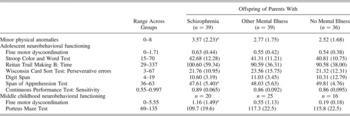
Table 2 presents the mean scores between the three parent diagnosis groups on the minor physical anomalies and neurobehavioral scores. Young people whose parents had schizophrenia had more minor physical anomalies than those whose parents had no mental illness, F (1, 71) = 5.29, directional p < .05, ηp2 = .069, after controlling for age and sex.
Offspring neurodevelopmental risk factors by three parent diagnosis groups

aOffspring of schizophrenia group > offspring of no mental illness.
On only one of the adolescent neurobehavioral tests was there a significant group difference, with offspring of parents who had schizophrenia performing less accurately on the Span of Apprehension Test than offspring of parents with no mental illness, after controlling for age and sex, F (1, 66) = 3.01, directional p < .05, ηp2 = .026. On the smaller sample with assessments during middle childhood, offspring of parents who had schizophrenia had more motor dysfunction than other young people, F (1, 57) = 6.33, directional p < .05, ηp2 = .135.
Associations between schizotypal symptoms and neurodevelopmental indicators
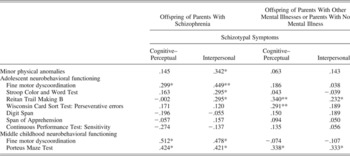
Table 3 presents Pearson correlation coefficients between schizotypal symptoms and minor physical anomalies and neurobehavioral assessments at adolescence, partialling out the effects of age and sex. These analyses were computed separately for those adolescents whose parents have schizophrenia illness and other youth in the sample.
Pearson partial correlations among schizotypal symptoms, minor physical anomalies, and neurobehavioral dysfunction

Note: Signs have been adjusted so that positive signs indicate that schizotypal symptoms are related to more neurobehavioral impairment.
*p < .05. **p < .01.
For young people at genetic risk for schizophrenia, cognitive–perceptual schizotypal symptoms were related only to fine motor dyscoordination. Interpersonal schizotypal symptoms were related more strongly to fine motor dyscoordination, as well as to poor performance on the Stroop Color and Word Test, poor performance on the Reitan Trail Making B Test, and minor physical anomalies. Thus, there is evidence that among those at genetic risk, interpersonal schizotypal symptoms are more linked than cognitive–perceptual symptoms to neurobehavioral functioning and minor physical anomalies.
For the adolescents not at genetic risk, cognitive–perceptual schizotypal symptoms were related to poor performance on the Reitan Trail Making B Test and perseverative errors on the Wisconsin Card Sort Test. Interpersonal schizotypal symptoms were related somewhat less strongly to poor performance on the Reitan Trail Making B Test only. Thus, there is evidence among those adolescents not at genetic risk, that cognitive–perceptual schizotypal symptoms are more strongly linked than interpersonal schizotypal symptoms to neurobehavioral dysfunction.
Table 3 also presents correlations between schizotypal symptoms and neurobehavioral dysfunction during middle childhood for the subsample of subjects who were followed longitudinally. Poor performance on the Porteus Maze Test during middle childhood was associated with schizotypal symptoms during adolescence for young people at genetic risk and those not at genetic risk. Fine motor dyscoordination during middle childhood was associated with adolescent schizotypal symptoms only for young people at genetic risk.
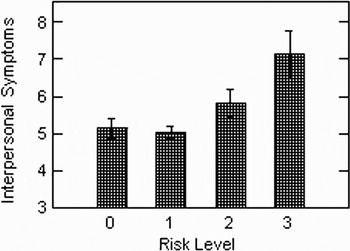
Finally, a neurodevelopmental perspective would suggest that the individuals at greatest risk for schizotypal personality symptoms should be those who are at genetic risk, who have minor physical anomalies and who display neurobehavioral dysfunction. A combined risk score was calculated by summing the presence of risk in the three domains. Adolescents were considered to be at genetic risk if they had a parent with a diagnosis of schizophrenia (n = 39). Adolescents were assumed to have morphological risk if they had a score at or above the 75th percentile for the group whose parent did not have mental illness (four or more minor physical anomalies; n = 39). Adolescents were considered to have neurobehavioral risk if they had scores greater than 1 standard deviation in any of the seven neuromotor or neurocognitive scores used in the data analysis (n = 47). Sums were computed of these three neurodevelopmental risk factors. Twenty-seven adolescents had zero of the risk factors, 57 had one, 22 had two, and 8 had all three.
One-way analyses of variance were computed on cognitive–perceptual schizotypal symptoms and interpersonal schizotypal symptoms with the four levels of risk as the independent variable, and age as a covariate. For cognitive–perceptual schizotypal symptoms there was not a significant effect of risk, F (3, 110) = 1.09. For interpersonal schizotypal symptoms there was a significant effect of risk, F (3, 110) = 6.338, p < .001, multiple R = .384. Tukey post hoc tests showed significant differences between interpersonal schizotypal scores for those with three risk factors and those with none (mean difference = 1.98, SE = 0.56, p = .004) and those with one (mean difference = 2.11, SE = 0.53, p = .001), but not those with two risk factors (mean difference = 1.31, SE = 0.58, p = .115; see Figure 1).
The results of Tukey post hoc tests showing significant differences between interpersonal schizotypal scores and risk factors.

Discussion
In this sample of high-risk families, adolescents whose parents had schizophrenia were more likely to show schizotypal symptoms (with two reaching diagnostic criteria for schizotypal personality disorder) than were young people whose parents had no mental disorder. They did not show statistically significant higher numbers of schizotypal symptoms than young people whose parents had other disorders. These findings are consistent with other literature suggesting that adult first-degree relatives of schizophrenia patients are at increased risk for a variety of disorders that are considered to be within the schizophrenia spectrum, especially schizotypal personality disorder (Baron et al., Reference Baron, Gruen, Rainer, Kane, Asnis and Lord1985; Franke, Maier, Hardt, Hain, & Cornblatt, Reference Franke, Maier, Hardt, Hain and Cornblatt1994; Kendler & Diehl, Reference Kendler and Diehl1993; Kendler & Gardner, Reference Kendler and Gardner1997; Kety, Reference Kety1983; Webb & Levinson, Reference Webb and Levinson1993), and may show elevations of schizotypal symptoms whose number or severity do not reach diagnostic criteria for schizotypal personality disorder (Calkins, Curtis, Grove, & Iacono, Reference Calkins, Curtis, Grove and Iacono2004; Grove et al., Reference Grove, Lebow, Clementz, Cerri, Medus and Iacono1991; Kendler, McGuire, Gruenberg, & Walsh, Reference Kendler, McGuire, Gruenberg and Walsh1995; Squires-Wheeler et al., Reference Squires-Wheeler, Friedman, Amminger, Skodol, Looser-Ott and Roberts1997). However, not all prior studies found elevated rates of schizotypal symptoms among first-degree relatives of schizophrenia patients (Bollini et al., Reference Bollini, Compton, Esterberg, Rutland, Chien and Walker2007). This study replicates the one other report in the literature showing elevations of schizotypal symptoms in first-degree relatives who are still in the adolescent stage of development (Squires-Wheeler et al., Reference Squires-Wheeler, Skodol and Erlenmeyer-Kimling1992). It is important to note that young people whose parents had other nonschizophrenia illness showed schizotypal symptoms that were intermediate between those of the young people at risk for schizophrenia and the no parent illness contrast group. This suggests that although elevated schizotypal symptoms may mark genetic vulnerability to schizophrenia, that they are not specific to schizophrenia.
In addition, in the present paper, the association between genetic risk and schizotypal symptoms was present for the interpersonal symptoms, but not the cognitive perceptual symptoms of schizotypal personality, supporting Raine's contention (2006) that the interpersonal features are characteristic of schizotypal personality with a neurodevelopmental eitiology. The interpersonal symptoms, which include lack of close friends and constricted affect, are parallel to the negative symptoms of schizophrenia, which are those features of illness that may endure even when the individual is not in an active psychotic state. The link of social–interpersonal schizotypal symptoms with genetic risk is consistent with most of the above-cited studies of adult first-degree relatives of schizophrenia patients that have tended to find symptoms primarily elevated in interpersonal/negative symptom domains (see review in Calkins et al., Reference Calkins, Curtis, Grove and Iacono2004), and is consistent with the longstanding claim that negative schizotypal symptoms may be more related to the genetic risk for schizophrenia than positive symptoms (Gunderson, Siever, & Spaulding, Reference Gunderson, Siever and Spaulding1983). In the present study, disorganized symptoms were rare and too limited to subject to statistical analysis, but appeared elevated in the adolescent offspring of parents with schizophrenia compared to offspring of parents with no mental illness.
Although genetic risk differences in neurobehavioral functioning were not the focus of this paper, it is notable that only one of the nine neurobehavioral tests administered at adolescence differentiated young people at genetic risk for schizophrenia from those not at genetic risk, and this was the Span of Apprehension Test. This replicates other literature suggesting the Span of Apprehension Test may be a useful vulnerability indicator (Asarnow et al., Reference Asarnow, Steffy, MacCrimmon and Cleghorn1977, Reference Asarnow, Granholm, Sherman, Steinhauer, Gruzelier and Zubin1991), but differs from a larger literature that has found poorer performance by at-risk youths on many of the tests used in this study, particularly the Continuous Performance Test (Cornblatt, Lenzenweger, Dworkin, & Erlenmeyer-Kimling, Reference Cornblatt, Lenzenweger, Dworkin and Erlenmeyer-Kimling1992; Nuechterlein, Reference Nuechterlein, Steinhauer, Gruzelier and Zubin1991; Nuechterlein, Reference Nuechterlein1983; Snitz, MacDonald, & Carter, Reference Snitz, MacDonald and Carter2006). Our own analyses on the Jerusalem Study sample that formed the basis for the present analyses has reported that young people at genetic risk for schizophrenia are more likely than others to show neurobehavioral deficits during infancy and middle childhood (Hans et al., Reference Hans, Marcus, Nuechterlein, Asarnow, Styr and Auerbach1999b; Marcus et al., Reference Marcus, Auerbach, Wilkinson and Burack1981, Reference Marcus, Hans, Auerbach and Auerbach1993). Although the present report from the adolescent assessments, at first blush, appears inconsistent with those prior reports, it should not be viewed as such. Within the prior reports from the Jerusalem Study, genetic risk was primarily associated with motor dyscoordination and with composited scores of neurocognitive functioning, rather than individual instruments—meaning that different high-risk children had different patterns of neurobehavioral impairment.
Highly related with level of genetic risk, however, were elevated minor physical anomalies. The offspring of parents with schizophrenia had higher levels of MPAs than either the offspring of parents without mental illness or offspring of parents with nonschizophrenic mental illness. These findings add to the inconsistencies within the previous research on anomalies in first-degree relatives of schizophrenia patients. At least one study of adult first-degree relatives has shown no differences in MPAs (Green, Satz, & Christenson, Reference Green, Satz and Christenson1994), but others have found elevated MPAs in first-degree relatives compared to controls (Gourion, Goldberger, Olie, & Krebs, Reference Gourion, Goldberger, Olie and Krebs2004; Ismail, Cantor-Graae, & McNeil, Reference Ismail, Cantor-Graae and McNeil1998, Reference Ismail, Cantor-Graae and McNeil2000). Among studies of children and adolescents, several studies have found no elevation in MPAs (Marcus, Hans, Byhouwer, et al., 1985; McNeil et al., Reference McNeil, Blennow and Lundberg1992; Orvaschel et al., Reference Orvaschel, Mednick, Schulsinger and Rock1979), although one with older adolescents has (Lawrie et al., Reference Lawrie, Byrne, Miller, Hodges, Clafferty and Owens2001). These findings are obviously difficult to interpret, but demand further attention. The prevailing interpretation is that MPAs result from various types of prenatal insult early in pregnancy (Green, Bracha, Satz, & Christenson, Reference Green, Bracha, Satz and Christenson1994; Waddington et al., Reference Waddington, Lane, Scully, Meagher, Quinn and Larkin1999). An increased incidence, however, related to genetic risk leaves open alternative interpretations, most notably that youth at genetic risk are more vulnerable to the effects of prenatal insults.
Neurodevelopmental theory of schizophrenia would suggest that schizotypal symptoms should be associated, not only should genetic risk, but with minor physical anomalies and/or neurobehavioral signs that might also be markers of biological vulnerability to disorder. In the present analyses, schizotypal symptoms were associated with minor physical anomalies, but only among adolescents at genetic risk for schizophrenia. This association was limited to interpersonal schizotypal symptoms. The only other report we are aware of that examined correlations between MPAs and schizotypal symptoms found a different pattern of results. Bollini et al. (Reference Bollini, Compton, Esterberg, Rutland, Chien and Walker2007) reported associations between MPAs and schizotypal symptoms for individuals with no family history of psychosis, but not for first-degree relatives of schizophrenia patients.
Schizotypal symptoms were associated with poor neurocognitive performance for adolescents whose parents had schizophrenia and those whose parents did not. For both groups, schizotypal symptoms were most strongly related to the neurocognitive tests that assess executive function and are believed to reflect underlying prefrontal cortex deficit: the Reitan Trail Making Test (B), the Wisconsin Card Sort Test, and the Stroop Color–Word Test. For neither group were schizotypal symptoms associated with neurocognitive tests that measure attention or working memory. Executive function was assessed in a subsample of the young people in this study using the Porteus Maze Test during middle childhood, an average of 7 years prior to the assessment of schizotypal personality features. Poor maze scores during middle childhood were associated with schizotypal symptoms during adolescence for both young people at genetic risk and those not at genetic risk for schizophrenia.
Consistent with these results, other studies have reported impaired performance on executive functioning tests among individuals with schizotypal personality disorder (Diforio, Walker, & Kestler, Reference Diforio, Walker and Kestler2000; Trestman et al., Reference Trestman, Keefe, Mitropoulou, Harvey, de Vegvar and Lees-Roitman1995; Voglmaier et al., Reference Voglmaier, Seidman, Niznikiewicz, Dickey, Shenton and McCarley2005; Voglmaier, Seidman, Salisbury, & McCarley, Reference Voglmaier, Seidman, Salisbury and McCarley1997), although at least one study has not (Condray & Steinhauser, Reference Condray and Steinhauser1992; Mitropoulou et al., Reference Mitropoulou, Harvey, Maldari, Moriarty, New and Silverman2002). Other studies of individuals sampled from general populations have also reported associations between schizotypal symptoms and executive functioning deficits (Lenzenweger & Korfine, Reference Lenzenweger and Korfine1994; Lyons, Merla, Young, & Kremen, Reference Lyons, Merla, Young and Kremen1991; Poreh, Ross, & Whitman, Reference Poreh, Ross and Whitman1995; Suhr, Reference Suhr1997), although not all have (Noguchi, Hori, & Kunugi, Reference Noguchi, Hori and Kunugi2008; Spitznagel & Suhr, Reference Spitznagel and Suhr2002). Few other studies examining executive functioning and schizotypal symptoms have drawn contrasts between cognitive perceptual and interpersonal symptoms of schizotypy, but have reported associations between executive functioning deficits and interpersonal, but not cognitive–perceptual symptoms in both first-degree relatives of schizophrenia patients (Delawalla et al., Reference Delawalla, Barch, Eastep, Thomason, Hanewinkel and Thompson2006; Giraldez, Caro, Rodrigo, Pineiro, & Gonzalez, Reference Giraldez, Caro, Rodrigo, Pineiro and Gonzalez2000; Laurent et al., Reference Laurent, Biloa-Tang, Bougerol, Duly, Anchisi and Bosson2000) and general university populations (Dinn, Harris, Aycicegi, Greene, & Andover, Reference Dinn, Harris, Aycicegi, Greene and Andover2002), and others have found no associations between executive functioning and either cognitive perceptual or interpersonal schizotypal symptoms (Vollema & Postma, Reference Vollema and Postma2002).
For young people with familial risk for schizophrenia, adolescent neuromotor dysfunction was strongly associated with interpersonal schizotypal symptoms. No similar association was found for adolescents whose parents did not have schizophrenia. For the smaller sample with prospective data, middle childhood neuromotor dysfunction was related to adolescent schizotypal symptoms, but also only for young people whose parents had schizophrenia. Other studies of youth at genetic risk, including our own, have previously demonstrated correlations between neuromotor dysfunction and social withdrawal and low social competence in young people at genetic risk (Dworkin et al., Reference Dworkin, Cornblatt, Friedmann, Kaplansky, Lewis and Rinaldi1993; Hans et al., Reference Hans, Marcus, Henson, Auerbach and Mirsky1992, Reference Hans, Auerbach, Asarnow, Styr and Marcus2000). Studies of adult first-degree relatives of schizophrenia have tended to ignore neuromotor signs. A notable exception is Bollini et al. (Reference Bollini, Compton, Esterberg, Rutland, Chien and Walker2007), who examined neuromotor functioning and schizotypal symptoms in first-degree relatives of schizophrenia patients, but found no statistically significant relation with schizotypal symptoms. Several studies of youth with schizotypal personality disorder found interpersonal symptoms to be associated with motor dysfunction and movement abnormalities (Corcoran et al., Reference Corcoran, Walker, Huot, Mittal, Tessner and Kestler2003; Mittal, Tessner, et al., Reference Mittal, Tessner, Trottman, Esterberg, Dhruv and Simeonova2007; Walker, Lewis, Loewy, & Palyo, Reference Walker, Lewis, Loewy and Palyo1999).
Finally, although familial risk for schizophrenia, minor physical anomalies, and neurobehavioral deficits all showed modest associations with schizotypal personality symptoms, adolescents who had all three of these risks were particularly likely to have elevated interpersonal schizotypal symptoms. Raine (Reference Raine2006) has suggested that there may be two types of schizotypy: one genetically linked to schizophrenia and characterized by neurobehavioral problems and interpersonal and disorganized schizotypal symptoms, and the second genetically unlinked to schizophrenia and characterized by cognitive–perceptual schizotypal symptoms. In this study of young people at high genetic risk, the findings are consistent with the first type.
The findings from this study add to the increasing evidence that, as is the case for schizophrenia, at least some types of schizotypal personality may emerge as part of a neurodevelopmental trajectory. The neurodevelopmental trajectory described in this study is characterized with family genetics of schizophrenia, disruptions in fetal development, and cognitive and interpersonal deficits from infancy through adolescence that culminate in interpersonal schizotypal symptoms by adolescence. It is possible, but not tested empirically in this study, that this developmental course could culminate in schizophrenia psychosis for some young people.
There are a number of limitations to the present study. The sample of youth at familial high risk is small, which limits the power to detect significant differences and associations. The other mental illness group in our study includes parents with an assortment of psychiatric diagnoses, which make it impossible to detect possible associations between adolescent schizotypal symptoms and specific types of nonschizophrenia parental mental illness. Finally, and perhaps most importantly, conclusions about an etiological pathway to schizophrenia than includes genetic risk, disruptions in fetal developmental, neurobehavioral deficits, interpersonal schizotypal symptoms are limited until the young people reach an age at which some of them develop actual schizophrenic illness.