Are texts necessary to identify—much less interpret—religion in the archaeological record? This question rests on a definition of religion in terms of doctrine and the written word, a pervasive supposition that Gregory Schopen (Reference Schopen1991, 20) has shown to have roots in Protestant ‘Reformation theological values’ emphasizing the primacy of scripture as the fundamental ‘location’ of religion (1991, 15). What does this say about rituals: those actions, times and places strategically distinguished in relation to others (Bell Reference Bell1992, 74)? When rituals are expressions of religion—effectively materializing the immaterial and ethereal (Rowan Reference Rowan2012, 1)—does this mean that they are expressions of scripture?
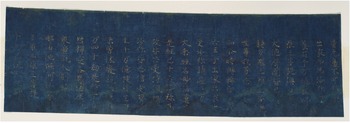
In 1671, monks at the mountain Kinpusen in Nara, Japan, discovered a group of underground pits containing large numbers of incised mirrors and gilt bronze images in the likeness of Buddhas and local gods. What drew the greatest attention were immaculately preserved Buddhist scriptures (sutras) on indigo-dyed scrolls, copied in gold-dust ink (Fig. 1). The scrolls were encased in an engraved bronze tube bearing the name Fujiwara no Michinaga (966–1028 ce), among the most famous statesmen in Japanese history (Rosenfield et al. Reference Rosenfield, Cranston and Cranston1973, 50–51). Corroborations from the textual record made it clear that he had personally copied and buried these scriptures at the culmination of a pilgrimage in the early eleventh century.
Section from the Parable of the Magic City, Lotus Sutra (Hokke-kyō) chapter 7. (Harvard Art Museums/Arthur M. Sackler Museum, Bequest of the Hofer Collection of the Arts of Asia. Photograph: © President and Fellows of Harvard College, 1985.365.)

Since the discovery of this cache, archaeologists have identified hundreds of similar deposits throughout the Japanese archipelago dating from the eleventh century onwards. Since sutras are a shared feature among these deposits, they are commonly known as sutra mounds (kyōzuka). The eleventh-century start of this practice coincided with what was believed to be the onset of mappō, ‘the end of the Buddha's teachings’ in 1052 ce. Sutra mounds have therefore been interpreted as representative ‘time capsules’ (Moerman Reference Moerman and Myrvold2010) that allude to the religious aspirations—and anxieties—of a specific historical context.
Much valuable work has been done on sutra mounds, but certain assumptions have limited our ability to account for the scope of their contents. Foremost is an emphasis on their scriptural components, even though in many deposits scriptures are vastly outnumbered by other objects, which are customarily seen as supplementary: rough-hewn icons, ritual implements and personal effects. This has resulted in an assumption that the contents of sutra mounds were homogenous and deposited in unison at a specific point in time, foregrounded in decidedly scriptural meanings. In this article, I argue that sutra mounds were, on the contrary, characterized by dizzying variability. Rarely are two deposits alike, and it is often the case that individual deposits themselves are equally varied assemblages, composed of unrelated materials deposited by different people, at different times, and for different reasons. Rather than time capsules, as they have often been framed, it may be more useful to think of sutra mounds as wishing wells, tarpits, or even archives: accumulated aggregations of agency, aspiration and temporality.
In bringing attention to the example of sutra mounds, this article grapples with methodological issues in the study of intentional deposition to raise questions about the archaeology of religion and ritual. Richard Bradley (Reference Bradley1998, 4) has used intentional deposits to ask larger questions about society. What can intentional deposits tell us about the relationship between ritual and society? Are the meanings of intentional deposits more self-evident when they are in association with religious texts? The example of sutra burial suggests that this is not always the case, and instead foregrounds the social complexity of religious ritual that can be inferred from burial contexts. As inherently heterogeneous assemblages—complex wishing wells or even subterranean archives—the wide distribution and contents of sutra mounds can illuminate a diversity of social registers, meanings and temporalities of religious practice in their own historical contexts. Sutra mounds can also be instructive, even provocative, examples for thinking about what religious rituals are, what they do and what they can tell us about society. It is important that archaeologists working elsewhere in the world be aware of these deposits, as they raise questions about what religion and ritual look like in the archaeological record.
Sutra mounds as archaeological sites
Surveying the development of sutra mounds as a category for study is essential to challenging previous interpretations of these deposits. Kyōzuka, the Japanese term for sutra mound, has a relatively recent history. Yabuta Kaichirō (Reference Yabuta1976, 91) has affirmed that the term kyōzuka is a neologism with little to no precedent in the historical record contemporaneous with the beginning of the practice. From at least the twelfth century onwards, the most common term used to refer to the burial of a sutras was nyohōkyō, which can be translated as the ‘copying of sutras according to the Dharma (the Buddha's teachings)’ (Yamakawa Reference Yamakawa and Andō2011, 88; Yanagisawa Reference Yanagisawa1972, 146). This initially referred to the specific protocols for copying the Lotus Sutra, which appears in most deposits.
The word kyōzuka seems to have been a product of the Edo period (1603–1867), appearing prominently in historical gazetteers from the late seventeenth century onwards (Seki Reference Seki1985, 1). Many hundreds of places called kyōzuka were identified throughout the archipelago (Seki Reference Seki1984). The proliferation of these place names demonstrated an increasing awareness of these deposits as places of historical import. Well served by Keith Basso's understanding of place as something that presents itself as ‘bearing on prior events’, kyōzuka began to achieve the status of patrimony (Basso Reference Basso1996, 4).
The proliferation of kyōzuka as a place name was entangled with the identification of kyōzuka as sites for archaeological study. Deposits were consistently discovered from the seventeenth through the nineteenth centuries, and this intensified into the twentieth century (Seki Reference Seki1985, 8). This development was tightly linked to the construction of the discipline of archaeology in Japan. The ‘disciplinisation process’ of archaeology in Japan has a storied and complex history (Mizoguchi Reference Mizoguchi2006, 20). Like the development of other national archaeologies, findings from the past were instrumental in the construction of the nation state and Japanese identity at various points in time (Il Pai Reference Il Pai2000; Tsude Reference Tsude and Ucko1995). Archaeological materials served as evidence of a premodern past that both legitimated and served as a stark contrast to an ideal modernity (Fawcett Reference Fawcett and Kohl1995; Mizoguchi Reference Mizoguchi2006, 21). The late nineteenth and early twentieth centuries were characterized by massive urban development projects accompanied by the excavation of ancient capital cities, Buddhist temples and Shinto shrines. Sutra mounds were discovered on the precincts of many sites dating to the late Heian period (794–1185 ce). Heather Blair demonstrates how material heritage, notably inscribed bronzes, that could be attributed to this era became the subject of great interest in the context of early twentieth-century national ideologies. The contents of sutra mounds, with their bronze containers inscribed with the names of famous Heian era figures, quickly rose to the level of national treasures, a status still ascribed to many as central exhibition pieces in Japan's National Museums (Blair Reference Blair2011, 39).
As key sources for the construction of national history, archaeologists began excavating deposits near temples, shrines and pilgrimage routes of historical import. One of the earliest of these reports covered the excavation of the deposits at Mount Asama, which contained Buddhist scriptures and implements associated with the nearby Ise shrine (Ishida Reference Ishida1977, 233–7). These findings were soon after published by the pioneering archaeologist of Japanese Buddhism, Ishida Mosaku. In the following years, sutra mounds quickly gained currency as a subject of archaeological study, with a variety of short reports, primarily on deposits excavated from shrines, appearing in the premier Kōkogaku zasshi [Journal of Archaeology]. Book-length reports entered the scene by the 1920s, beginning with a study on the oldest and most famous deposit at Kinpusen, first published in 1927 and reprinted twice (Ishida & Yajima Reference Ishida and Yajima1937). The following years saw the release of numerous book-length excavation reports detailing deposits associated with famous temples and shrines at Kurama temple (Tazawa Reference Tazawa1933), Fushimi Inari shrine (Inarisan kyōzuka 1966), and Nachi (Nachi kyōzuka ihō 1985). Many of these sites, particularly Kinpusen, became reference points for later studies as quintessential examples of sutra mounds.
Interpretations of sutra burial
Early twentieth-century presentations of sutra mounds as archaeological sites and sources of patrimony spurred the imaginations of archaeologists and historians of religion alike. Interpretations were foregrounded by an attempt to understand the motivations behind these deposits. Ishida, who catalogued the many objects and manuscript fragments from Kinpusen, provided some of the earliest interpretations. His analysis centred on Michinaga's sutra container bearing an inscribed vow (Ishida & Yajima Reference Ishida and Yajima1937, 54):
In my desire to save innumerable beings I have … ascended Kinpusen and offered sutras that I copied with my own hands … I took fifteen scrolls and placed them in a copper container, burying them on Kinpusen and erecting a bronze lantern with an eternal flame overtop … To the great deity Zaō I offer the Lotus Sutra to win favor with Śākyamuni [the historical Buddha] and meet Maitreya [the Buddha of the age to come], become close with Zaō, and to achieve peerless enlightenment … I offer the Amida Sutra so that when I die… I will be reborn in the Pure Land. I offer the Maitreya Sutras to expunge nine billion eons of bad karma … and to meet the Buddha of the age to come. I vow that when Maitreya becomes a Buddha, I will journey to the place where the Buddha preached the Lotus Sutra and gave prophecies of enlightenment, and these sutras that I have buried will, of their own accord, spring from the earth and cause the assembled masses to join together in celebration …
In his analysis of this inscription, Ishida underscored how the vow conveys Michinaga's reasons for burying sutras. He argued that, in addition to expressing wishes for enlightenment and connections with Buddhist divinities, Michinaga's choice to bury his copied sutras on Kinpusen was motivated by the benefits that were believed to have been associated with local deities such as Zaō. These benefits ranged from protection for future scions and aversion of illness and misfortune to the prolonging of life (Ishida & Yajima Reference Ishida and Yajima1937, 55). Although much work had already been produced on sutra mounds by the time that Ishida published this report, his interpretations regarding the intentionality of sutra burial were foundational.
Drawing from Ishida's work on this inscription, another interpretation came to emphasize the future-oriented rhetoric in Michinaga's inscription. This interpretation held that sutra burial is best understood in the wider context of millenarian anxieties during the mid–late Heian period. It was widely believed that the cataclysmic period of mappō, ‘the end of the Buddha's teachings’, would set in starting at the year 1052. This was calculated as being roughly a thousand years after the Buddha Śākyamuni had given his last sermon before dying (Moerman Reference Moerman and Myrvold2010, 73). The ‘mappō thesis’ became the dominant reading of sutra burial for nearly a century, becoming a subject of great debate among scholars. Those who have attempted to interpret the meaning and motivations behind sutra burial have almost always positioned themselves in relation to the mappō thesis.
A related idea that reinforced the mappō interpretation was the notion that the practice of sutra burial derived from earlier scriptural practices. Seki Hideo frames the burial of texts in terms of broader forms of scriptural practice from the Heian period, especially sutra copying, as a key form of Lotus Sutra devotion and propagation in times of moral decay (Seki Reference Seki1999). Most frequently cited are descriptions of text and relic veneration from the 10th chapter of the Lotus Sutra, in which the Buddha affirms that devotees can receive blessings by making offerings, regardless of whether they are made to the Buddha himself, his relics, or to scriptures containing his words (Blair Reference Blair2015, 176–7; Yanagisawa Reference Yanagisawa1972, 147). Scriptures are thus read as material manifestations, and indeed relics, of the Buddha's teachings (Eubanks Reference Eubanks2011; O'Neal Reference O'Neal, Baffelli, Castiglioni and Rambelli2021). It follows, then, that the burial of a sutra was akin to the burial—and preservation—of the Buddha's own relics as a method for managing the absence of the Buddha in the world (Moerman Reference Moerman and Myrvold2010, 71). One might even draw similarities between earlier Japanese and even practices throughout greater Buddhist Asia of burying relics under stupas (Walley Reference Walley2016).
Other scholars have taken the mappō thesis as evoking social, rather than theological, issues. Yabuta Kaichirō was one of the first to consider the origins of this practice as well as the significance such origins held for its meanings. Yabuta argued that the burial of Buddhist paraphernalia in Japan was transmitted from late Tang (618–907) and early Song (960–1279) Dynasty China by means of travelling Tendai monks. Many of these figures were in China at the time of the Great Anti-Buddhist Persecutions, during which time Buddhist objects, images and texts were buried to escape destruction (Yabuta Reference Yabuta1976, 21). Along these lines, Kamikawa Michio (Reference Kamikawa2013) emphasizes the role of regional relations in the development of sutra burial in Japan, reading Michinaga's momentous dedication to Kinpusen, innovations in ritual practice and mappō anxieties in a broader context of international interchange.
Although the mappō thesis has been the most dominant reading, it has not gone unchallenged. Blair and Inokuchi Yoshiharu both emphasize the localized dimensions of kyōzuka, suggesting that the interpretation of Lotus Sutra-based millenarian theologies may only be feasible in specific contexts (Blair Reference Blair2015, 82; Inokuchi Reference Inokuchi and Ando2011, 15). Max Moerman has questioned to what extent mappō anxieties were the driving force behind Michinaga's and indeed other burials during the Heian period. Moerman shows how sutra burial could be an inherently personal affair, with Michinaga's vow suggesting various interlocking soteriological aspirations as much as it does his desires for the future of his family line (Moerman Reference Moerman and Myrvold2010, 84). Moerman's recent work on the deposits at Mount Asama likewise illustrates the importance of broadly defined pure land aspirations to the sutra burials, with the practice seeming to be just as current among families of Shinto priests as it was among city-dwelling aristocrats (Moerman Reference Moerman2018, 117).
Although recent scholarship has made great strides in using sutra mounds to draw both larger and finer-grained inferences about East Asian religious history, it continues to reproduce a series of biases. Foremost is the language used in the analysis of these deposits: ‘sutra mound’ and ‘sutra burial’. In the very analytical construction of the sutra mound as a site for study, there has been a lingering tendency to afford primacy to their textual, or rather, scriptural characteristics. It is not necessarily difficult to see why scholars would make this assumption. Every deposit has a sutra. Moreover, the select number of extant written accounts that describe the process of creating these deposits are inarguably focused on the scriptures being buried. Even so, buried sutras are rarely found in isolation. In fact, the texts excavated from the deposits on Kinpusen, as is the case with most deposits, were vastly outnumbered by bronze images and ritual implements. Some scholars have accounted for these objects, but interpretations have remained invariably text-centred, reading these other, non-scriptural materials as secondary interments, interred at the time of burial to protect the buried sutras from looting, destruction, or sinister influences (Moerman Reference Moerman and Myrvold2010, 78; Naniwada Reference Naniwada1982, 87).
A related interpretive bias has to do with the timeframe of a given deposit. On one hand, this largely derives from the limited number of dated materials in each deposit, often forcing scholars to date the entirety of the contents of an excavated deposit to a single inscribed date. On the other hand, this problem is largely entangled with the first issue, with the assumption of a homogenous ritual programme and hierarchical relationship between texts and objects. This has led to a homogenization of their ritual timeframes in which the establishment of a deposit is seen as a singular ritual moment, resulting in a sort of insular time-capsule. By this reading, each pit was excavated, lined with stones, filled with sutras encased in bronze tubes and supplementary bronze objects, and then filled back in, topped with either a stupa tower or lantern. Although buried texts were not necessarily treated in the same way as buried human bodies, such interpretations of sutra burial betray an analogy with human death and burial as ‘punctuated’ moments (Taylor Reference Taylor and Insoll2011, 3). Maurice Bloch (Reference Bloch, Cederroth, Corlin and Lindstrom1988, 15) problematizes the largely western orientation towards death as a discrete, ‘punctual’ event, and instead calls for us to broaden our view of death and burial as gradual and part of longer social and ritual processes. The mapping of our present understandings of death as a singular, momentous event have, it would seem, resulted in an interpretation of the interred text as analogous to an interred body, and the surrounding non-textual objects as supportive or protective objects.
A final issue is the tendency to asymmetrically hold the earliest, and loftiest, deposits as the standards of comparison for other deposits. The tradition of constantly referring to Michinaga's deposit, for example, may be rooted in what David Ilan and Yorke Rowan (Reference Ilan, Rowan and Rowan2012, 89) refer to as the sequence or ‘serendipity of discovery’, as something which ‘works in dialectic with ad hoc interpretation to form frameworks for understanding’. In other words, the tendency to draw from this example may merely derive from what was once a paucity of materials, with Michinaga's deposit initially being the most complete and contextualized example of a sutra mound. Even so, most deposits are not attributed to individuals even close to the power and prestige held by Michinaga. Individual deposits were attributed to groups and confraternities just as much as they were to single patrons (Tazawa Reference Tazawa1933, 19). Michinaga's deposit at Kinpusen may be ultimately unfit for understanding these practices at other scales of social life.
Scaling up: variability across deposits
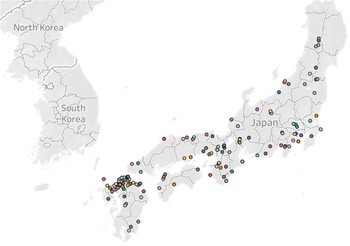
Much prior work on sutra burial has tended to discuss single deposits as unified wholes centered around scripture. Although sutras were a shared feature across all deposits, attention to broader trends in their distribution and frequencies of object types makes it clear that scriptures were by no means the only things deposited. To consider larger trends across sutra mounds, this section examines data for every sutra burial dated between the years 1007 and 1220 ce, discovered prior to 1999, the publication date of Seki Hideo's comprehensive catalogue (1999, 636–708) (Fig. 2). This time frame contains the beginning and subsequent height of the practice through the mid–late Heian period, beginning with Michinaga's initial deposit at Kinpusen and ending with the ostensive end of the rule by abdicated sovereigns (Insei period, c. 1087–1221 ce).Footnote 1
Distribution of sutra deposits.

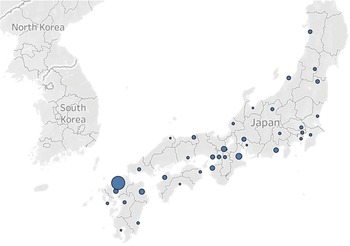
Based on Seki's catalogue records, approximately 173 sutra mounds that were identified before 1999 can be firmly dated between 1007 and 1220 ce based on dated inscriptions discovered within the deposits. These 173 dated deposits are distributed widely throughout Japan, stretching across 37 of its 47 modern prefectures (Fig. 3). The prefecture with the largest number of deposits is Fukuoka at 28 per cent. Kyushu, the island on which Fukuoka is located, is the region with the largest number of deposits in general at 40.8 per cent of all dated deposits. These are followed by Wakayama-Mie and Kyoto Prefectures, in which approximately 9 per cent and 4.5 per cent have been discovered.
Quantity of sutra deposits by prefecture.

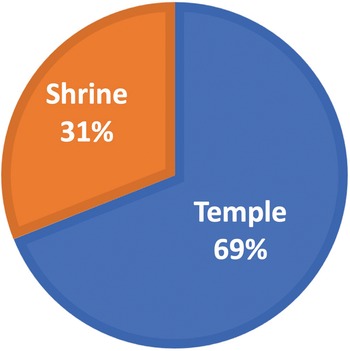
The 173 surveyed sites demonstrate further diversity in their connections with religious institutions. There is site-specific information for 105 deposits. Seventy-two were excavated at religious institutions and properties connected to Buddhist temples, and 33 were connected to Shinto shrines and other institutions connected to family, local and regional deities (Fig. 4). While these are, admittedly, framed in terms of modern institutional categories that are unlikely to reflect the institutional hybridity that characterized this period (Grapard Reference Grapard1992, 8), they do suggest the status of these deposits as cutting across multiple types of religious centres. They were in no way limited to burial on the grounds of Buddhist institutions. This confirms some of Moerman's interpretations of the deposits at Mount Asama at a considerably larger scale.
Deposits by religious institution.

Each sutra mound contains, on average, around nine objects.Footnote 2 These values are skewed by some of the largest deposits discovered, such as those at Kurama with 140 objects and at the Nachi waterfall, containing 109. On the other hand, many of the smaller deposits, especially those from Kyushu, often contain nothing more than a single sutra container (Muraki Reference Muraki1998; Oda et al. Reference Oda, Hirao and Iinuma2008). According to Seki's typology, there are roughly 66 object types across all 173 deposits. Most prevalent are ceramic containers (13 per cent of all deposits), bronze mirrors (24 per cent), paper manuscripts (22 per cent), ceramics (27 per cent), daggers (14 per cent) and incense containers and white porcelain wares (10 per cent). Apart from these, nearly half of the objects in Seki's typology are entirely unique, appearing only in a single deposit. Rarer artifacts include coal, prayer beads, mica, nails, spearheads, projectile points, inkstones, flint and steel, and silver. As Yiwen Li has shown (Reference Li, Ebrey and Huang2017), some deposits also contain objects produced in China.
Among the many diverse objects found in deposits, inscribed sutra containers, normally tubes, are the most prevalent and consistent. Tubes are present in roughly 92 per cent of all the deposits included in this study. They are in a range of materials from ceramic (10 per cent of all tubes), stoneware (9 per cent), wood (2 per cent) and iron (less than 1 per cent). The majority (78 per cent) are made of bronze.
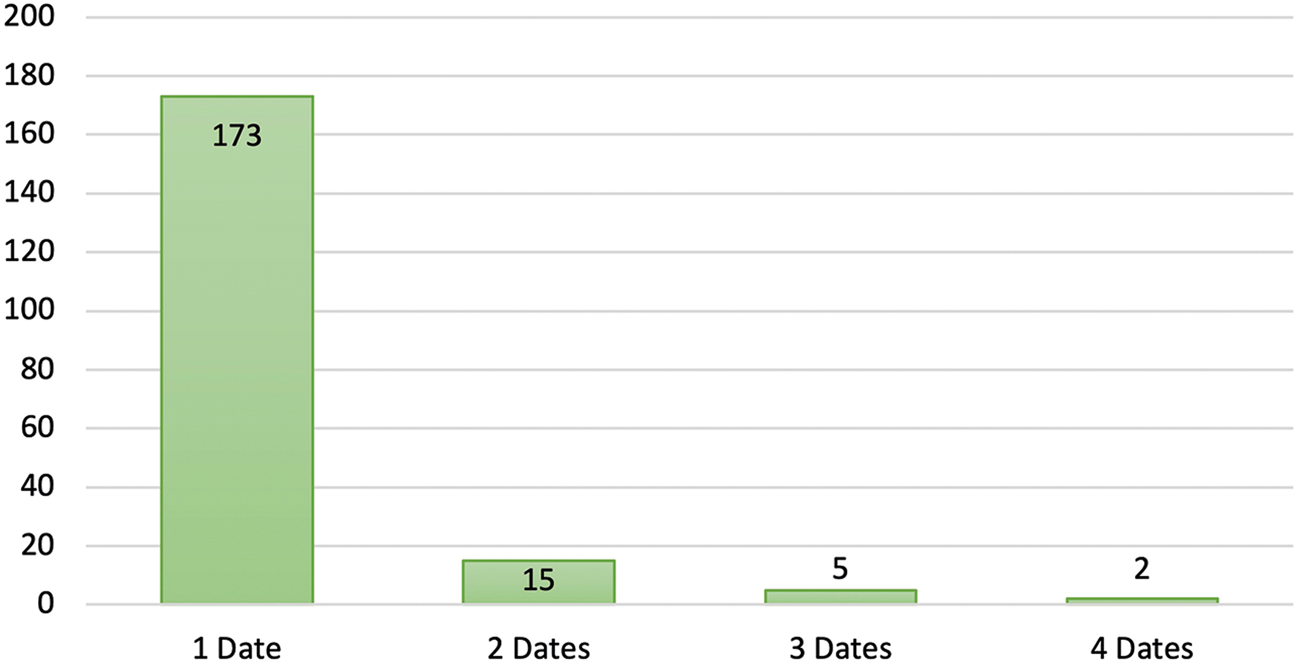
In addition to their consistency across deposits, bronze sutra tubes are often present in multiples, averaging approximately 2.1 bronze tubes per deposit across the 173 deposits surveyed in this study, ranging from 1 to 19 tubes, not including fragments, amounting to 267 dated bronze tubes. Moreover, there are several cases in which different tubes from a single deposit bear different dates on their surface inscriptions. Since we are looking only at dated deposits, each has at least one inscribed object bearing a date. However, 15 (9 per cent) of all the surveyed deposits include inscriptions for two separate dates, five (3 per cent) have three dates and two deposits, one at Shōrenji in Tokyo and the other at the Nachi waterfall shrine in Wakayama, have separate inscribed tubes with four different dates (Fig. 5).
Deposits with more than one dated inscription.

While perhaps unimpressive on their own, cases of individual deposits containing objects inscribed with different dates become particularly striking if we consider that these deposits are normally dated according to a single object. In other words, deposits containing more than one sutra tube tend to have only one that is dated, with the others bearing no recognizable inscriptions. Considering that roughly 13 per cent of deposits contain more than one inscription providing two or more dates and that approximately 65 per cent of all deposits contain more than one sutra tube, it may be reasonable to suggest that sutra mounds could be subject to lateral cycling: secondary use and re-use over time (Schiffer Reference Schiffer1987, 29). An individual sutra mound can therefore include materials from diverse individuals at different times.
Scaling down: variability within deposits
Specific examples reinforce the variability of sutra mounds suggested by large-scale analysis. The largest, in terms of number of objects, Heian-period sutra deposit ever recorded was discovered on the summit of Mount Kurama directly behind the main hall of Kurama temple, a few kilometres north of present-day Kyoto. A related set of smaller deposits were also identified in the nearby mountain hamlet of Hanase Bessho. Both sites were excavated in the early twentieth century. These sites lie within present-day Sakyō-ku [Sakyō ward] and are part of a handful sites that, during the late Heian period, operated as Buddhist hermitages (bessho) in an area called the Kitayama bessho (Nishiguchi Reference Nishiguchi2004, 271). In their simultaneously semi-remote status and relative proximity to the capital, these areas were popular destinations for reclusion by hermits, poet-monks and aristocrats, and therefore boast modest paper trails. The most substantial materials pertaining to these sites have been excavated from their sutra mounds, which contain hundreds of bronze and porcelain objects, including incised mirrors, portable shrines, deity images, daggers and short swords, coins, incense burners, bells, lanterns, inscribed sutra tubes and manuscript fragments (Sato Reference Sato1930; Tazawa Reference Tazawa1933; Uozumi & Umehara Reference Uozumi and Umehara1930).
These two deposits provide valuable evidence for the variability of sutra mounds in terms of their ritual time-frames and breadth of social actors. The earliest dated material in the deposit at Kurama, for instance, is an inscribed sutra tube dated to 1120, attributed to Kiyohara Nobutoshi (1077–1145) and four hermits (Tazawa Reference Tazawa1933, pl. 9). Together, the five men buried a copy of the Lotus Sutra as well as the three Maitreya Sutras to memorialize Nobutoshi's parents. According to his 1151 ce biography, Nobutoshi would regularly go on brief excursions to the mountains north of the capital to stay at a mountain temple in the Ōhara bessho where he performed at least 30 sutra burials as part of a confraternity of hermits (Honchō shinshū ōjōden 1972–1974, 163). An inscription from another sutra tube from Kokawadera in Wakayama bearing Nobutoshi's name as well as those of hermits from Ōhara suggests the geographic breadth of this confraternity's activities (Miyake Reference Miyake1983, 24–5).
Although Nobutoshi's tube is the earliest dated object in the Kurama deposit, it is by no means the only one possessing a date. A small iron door, bearing an image of Kurama's patron deity Bishamonten, was also found among the objects excavated from the same deposit. This door had originally broken off an extant large iron lantern that was made and donated to Kurama temple. The lantern bears an inscription for 1260, more than a century after Nobutoshi's deposit (Naniwada Reference Naniwada1984, 7).
Because the Kurama deposit contained objects from at least two different time periods, Naniwada Tōru called for a reconsideration of sutra mounds in general as ‘composite’, potentially containing within them a range of temporalities and historical contexts (Naniwada Reference Naniwada1984, 7). Although Naniwada's revelation went largely unheeded by contemporary scholars, it is helpful in reinforcing the previous discussion based on large-scale analysis of numerous mounds containing multiple bronze tubes with different dates. Sutra mounds were often used over time and by a variety of actors. Rather than a punctual moment in time in which the deposit was filled and then sealed, what we are seeing here is a distinctly emic temporality playing out in the long-term production of a sutra mound, not unlike what Alice Yao notes (Reference Yao2016, 47) in the context of death rituals in southwest China.
If the Kurama deposit can assist in rethinking the temporalities of sutra mounds, reading it alongside the deposits at Hanase suggests the social diversity that can be read from them. Of the many types of objects buried in the Hanase deposits, rough-hewn bronze swords are most prevalent. Second only to coins, swords are also among the most numerous object types in the Kurama mound, which contains 51 shards that amount to 26 short swords (Tazawa Reference Tazawa1933, 96). Swords have been found in numerous deposits (Suenaga Reference Suenaga1931, 728). Previously mentioned excavation reports identified a sword appearing in the mound at Kinpusen (Ishida & Yajima Reference Ishida and Yajima1937), two swords in the deposit at Inari shrine (Inarisan kyōzuka 1966, 12), and a handful of daggers in the mounds at Kumano (Nachi kyōzuka ihō 1985, 243–5, 265). The examples of swords unearthed from the mounds at Kumano and Kinpusen have even been the bases for inferences regarding the secondary importance of ‘extra-scriptural’ materials, deposited to protect the buried teachings of the Buddha (Moerman Reference Moerman and Myrvold2010, 78). The examples of buried swords at Hanase and Kurama, on the other hand, allude to practices outside the purview of Buddhist scripture, as well as, compared to the examples of Michinaga and Nobutoshi, more local and less lavish social contexts.
The sources that can best contextualize the Hanase swords are two bronze sutra tubes discovered in the same deposit. Both tubes are dated to 1153. Suenaga Masao believed that the swords were manufactured shortly before this time (Suenaga Reference Suenaga1931, 733), although Tazawa speculated that they may have been used for some time before this. His reasoning comes from the fact that fragments of wooden scabbards were discovered in the Hanase cache. The swords in the Kurama deposit show no evidence of having wood scabbards. Due to the proximity and similar environmental to Hanase, Tazawa rejected the possibility that the Kurama scabbards may have been subject to rot and instead postulated that they may have been manufactured specifically for burial in the mound (Tazawa Reference Tazawa1933, 98–9). Due to the inclusion of scabbards, it may be that the Hanase swords were subject to use prior to deposition.
Inscribed names on the Hanase tubes provide further contextual evidence. The inscription on the first tube is attributed to an individual named Saeki Masachika of the Senior Sixth Rank, Upper Grade, a lower-ranking noble associated with the bottom court ranks, a group that would have been entitled to comparatively small plots of land in the provinces or the capital's margins (Hall & Shively Reference Hall and Shively1988, 119–20). The second tube, while the same size and shape as a sutra tube, was found to contain a bronze image of Bishamonten (Naniwada Reference Naniwada1985, 38–9). The main inscription on this tube is longer and gives several names of those who raised funds to sponsor the creation and burial of this icon, beginning with an unnamed woman from a nearby mountain clan. The name Saeki appears again, as do the names Fujii Sadanaga and Fujii Arisada.
The family name Fujii may be useful in understanding the social context of the burial of swords at Hanase and Kurama. In their report on the excavations of the Hanase deposit in the early twentieth century, Uozumi Sōgorō and Umehara Sueji noted that members of the Fujii clan lived in the Kitayama area where Kurama and Hanase were located (Uozumi & Umehara Reference Uozumi and Umehara1930, 10). Sato Torao (Reference Sato1930, 6–7) postulated that the Fujii family in Hanase were a clan of royal bodyguards connected to warrior lineages. The following century saw an accumulation of lore about the Kitayama area in general as a place for dwelling and devotion by legendary warriors, concurrent with the rise of Japan's warrior class towards the end of the Heian period. Minamoto no Yoshitsune (1159–1189), probably the most famous of these, is said to have been raised by monks at Kurama in the thirteenth-century Heiji monogatari (Tochigi et al. Reference Tochigi, Kusaka, Masuda and Kobota1992, 276). Azuma Kagami, another thirteenth-century text, states that Yoshitsune's brother and the military general Minamoto no Yoritomo (1147–1199) presented an offering of swords to Kurama in 1195 (Azuma Kagami 2000, 539).
Were bronze swords meaningful interments for those who patronized and occupied sites in this area? The offering of swords was, admittedly, a broad practice. Bronze swords deposited as offerings appear in a variety of archaeological contexts throughout Japan, predating the rise of a warrior class in the medieval period and even the influx of Buddhism to the Japanese archipelago (Kokugakuin Daigaku Hakubutsukan 2019). Even so, the association of sword offerings with figures such as Yoritomo and Bishamonten, a deity of martial conquest among other boons, suggests connections to warrior clans and adjacent social groups. I say adjacent because the deposition of swords in sutra mounds was clearly not limited to famous warriors. Rather, we might consider it as something that indicated the status of this group, perhaps not unlike what Richard Bradley (Reference Bradley1998, 4) has demonstrated with offerings of weapons in north and northwest Europe, buried in the earth or submerged in water as enactments of Arthurian legends about the sword Excalibur. The deposition of swords in Japan was similarly a ritual performance, perhaps inspired by the offering of swords to deities down through Japanese antiquity. We might consider depositions of swords as performances of bonds, identity and affiliation by the socially varied individuals who created these deposits. If swords were offerings associated with the rising warrior class, then this gets us a step closer to using the contents of sutra mounds to illuminate the diversity of actors who made them.
While the contents of these deposits open possibilities for rethinking their uniformity, their diversity occludes certain details about the people and institutions involved in their creation. In his research on sutra mounds from the Kinki region, including Kurama and Hanase, Muraki Jiro demonstrates how sutra tubes and chambers can provide evidence for interpreting social and production networks. Muraki (Reference Muraki1998, 227) notes that mounds from Kinki tend to contain an unusually large number of ‘supplementary’ materials, such that the stone-lined chambers of mounds were designed to protect both the sutras and other buried goods. In Kyushu, on the other hand, sutra tubes are more often found in isolation, which could help explain why bronze casters devoted so much attention to crafting such distinct, and ornate, sutra tubes (Harada Reference Harada, Oda, Hirao and Iinuma2008). For Muraki, this implies a closer relationship between the bronze casters who made the sutra tubes and the individuals—often local recluses from hermitages affiliated with larger urban monasteries—who orchestrated the construction of mounds. This also suggests that, in Kyushu, sutra burial was formalized and centralized within prescribed networks of production and communication between monks, the religious institutions that underwrote the production of mounds, and bronze casters (Muraki Reference Muraki1998, 230). In Kinki, however, the relationship between those who dedicated materials in a sutra mound and those who produced the materials is often unclear due to different objects and types of sutra tubes (Muraki Reference Muraki1998, 220). Like many other deposits from the Kinki region, the relative messiness of the Kurama and Hanase deposits makes it difficult to generalize about production networks and unnamed social actors linked to the objects in each mound.
Analysing a visual representation of the spatial arrangement and locational relationships between the sutras, sword fragments and other materials in these deposits could provide further evidence of the time-frames of deposition as well as the significance of buried swords in relation to other materials, social actors and production networks. Examining spatial arrangements of deposits has been demonstrated to be of great use in other burial ritual contexts, particularly for raising questions about social systems (Flad Reference Flad2002). Unfortunately, we do not have information regarding the spatial relationships of artifacts for the relatively early excavations at Kurama and Hanase. A recently excavated example, the Tōgaya sutra mound in Makinohara city in Shizuoka Prefecture, is dated to the twelfth century and contains 63 short swords. The report for this site provides ample visual representations of their locations in relation to other objects (Shizuoka Prefectural Buried Cultural Property Research Institute 2010, 86). Further attention to this and other deposits with similar assemblages may provide comparative data to understand better the wider social significance of buried swords and other deposited materials found in these deposits.
Although these two deposits suggest a diversity of time-frames and social actors involved in the practice of sutra burial, it becomes easy to draw an analogy between these deposits and human burials. It would be an understatement to say that formal human burials are important for archeological inferences to society, much less religion and ritual. Unlike the ephemera of daily life, human burials—as sources of memory—were built to last, becoming highly visible in the archaeological record. The uniqueness of death beckons monumentality, and interpretation by those left behind. There is in this way a sense that formal burials contain within them the traces of belief, religion and their ritual expressions in past societies, what Timothy Taylor (Reference Taylor and Insoll2011, 4) calls a ‘death-religion nexus’. As the contents of many sutra deposits suggest, however, this relationship is not always self-evident, such that ‘it is often a mistake to attempt to “read” the patterns [of burial and death] for any particular archaeological culture as reflective of a unitary religious practice’ (Taylor Reference Taylor and Insoll2011, 8). In other words, formal burials, including sutra deposits, do not necessarily allude to a singular world view or even belief, scriptural or otherwise. It would be a mistake, likewise, to assume linear relationships between burial contexts and the statuses of the individuals that they contain, or in this case, those who deposited objects (Ucko Reference Ucko1969). This recalls Lars Fogelin's observations on recent interpretations of mortuary rites and material culture, moving away from a perspective seeing ‘mortuary ritual as passively reflecting society toward studies that see mortuary ritual as actively constructing social orders’ (Fogelin Reference Fogelin2007, 64). Rather than merely confirming to us the kinds of people who participated in sutra burials, these two deposits suggest an alternative perspective from which to consider the proliferation of sutra mounds as the grounds at which social ties were articulated and affirmed, and moments in time set in stone and bronze.
Sutra mounds as votive deposits
The above examples across the past two sections suggest that in terms of their contents, spatial and institutional distribution, temporality and currency across society, sutra mounds were highly diverse. Their interpretation therefore requires recourse to alternative methodological frameworks. A potentially useful way to conceptualize sutra mounds as variable or, as Naniwada refers to them, composite, rather than as meaningful wholes or totalities, comes by way of Manuel DeLanda's ‘assemblage theory’. DeLanda demonstrates how interpretations of the relationships between parts within and in relation to larger wholes are often characterized by a totalizing ‘organismic metaphor’ which assumes ‘relations of interiority’ between component parts (DeLanda Reference DeLanda2006, 8–9). Drawing from Deleuze, DeLanda works through the concept of the assemblage, which gestures towards relations of varying degrees of exteriority. This takes a more open-ended stance towards the ontological status and relationships of entities as complex, unrelated, and even sharply chaotic, rather than totalistic or meaningful in their entirety.
DeLanda's observations are helpful in conceptualizing sutra mounds as assemblages of fractured, disparate entities. The emphasis placed on dated scriptures from sutra deposits has resulted in a series of interpretations regarding the place of surrounding objects as having functioned solely in relation to them, buried for their protection and the maintenance of presumably uniform soteriological aspirations. Sutra mounds have, in this way, been interpreted as totalistic organisms, or perhaps ritual or scriptural programmes comprised of interlocking component parts engaged in intimate relations of interiority. By this reading, these component parts, as well as their meanings, places, and actors, were singularly scriptural in orientation.
DeLanda's notion of the assemblage resonates with the large- and small-scale examples in the two previous sections. This concept can capture the diversity of institutional and cultic interests that cut across deposits, as well as their wide variety of interments and temporalities through use and re-use. While some sutra mounds were singular, totalistic programmes, others were complex composites reflecting the interests of numerous historical actors over time. Pushing back against prior totalistic scriptural interpretations of mounds in terms of their contents and intentionality, we might say that sutra mounds are themselves ‘assembled’ structures, with sutra burial being an ‘assembling’ practice, bringing together disparate materialities, agencies and temporalities. The practice, distribution and leavings of sutra deposition was inherently variable, oscillating between instances of similarity and radical difference (Schiffer Reference Schiffer1987, 13).
Referring to these deposits as ‘sutra mounds’ does little to capture this variability. The aristocrat Kujō Kanezane's (1149–1207) personal journal provides an account of a sutra burial from 1182, during which time Kanezane buried the Lotus Sutra in memory of his late sister Kōkamon'in (1122–1182):
The weather was gloomy all day today, so I finished copying out the Lotus Sutra to deposit (hōmai) at Saishō kongō’in, near my sister's grave. Before burying it, I wrote up a vow as well as a ledger of the names of those who participated, and inserted them into a tube … My retinue and I were assisted by four hermits … Together, we buried everything to the side of the temple, lining the pit with stones, and placing a stone pagoda inscribed with Sanskrit characters directly over the top. (Gyokuyō 1906, 560)
Like Michinaga's earlier vow, this later account highlights the diversity of reasons for burying sutras, in this case as part of a larger series of mortuary rituals. Unlike Michinaga's vow, this example suggests a standardization of protocol, personnel and descriptive language. Kanezane regularly uses the word hōmai, which means to ‘bury reverently’ or ‘deposit’. This underscores a votive quality of the burial act, not unlike the more common usage of the verbal compound hōnō, ‘to dedicate’, with its implications of an offering given in exchange for the fulfilment of a vow, wish, or desire. Having the humble supplementary verb tatematsuru, or hō, to ‘offer’, before the verb in both cases significantly broadens the implications of burial in mounds as having not only diverse meanings but diverse material compositions, with all interred objects serving meaningful, albeit specific, functions for their patrons, be they bejewelled sutras or copper coins. Unlike the term ‘sutra mound’, which emphasizes the scriptural components of these deposits, Kanezane's language, while used in relation to texts, is in no way limited to them.
To call these deposits ‘sutra mounds’ perpetuates a hegemony of scripture. In their material and discursive contexts, they were assemblages of offerings and dedications. To capture the broad terms in which they were set, I suggest that ‘votive mound’ or ‘votive deposit’ may be a useful, albeit heuristic alternative that reaches beyond a chiefly scripture-oriented reading. Bradley's work on intentional deposits from northern Europe is instructive here. In his earlier work, Bradley called these ‘votive deposits’ due to their perplexing status as mixed hordes or troves of objects that defied utilitarian explanations (Reference Bradley1998, 4). Bradley would later dismiss the votive deposit label in favour of ‘specialized deposits’ (Reference Bradley2016, 3), rejecting the former as a residual category for collections of objects ‘that resisted a practical interpretation’ (Reference Bradley2016, 1). Even so, Bradley's previous framing is useful for thinking about sutra, or votive, mounds. Through its latin root votum, the word votive implies a promise or vow and, more broadly, one's will, desire, or determination; a resolute intention. A votive deposit is called as such because it is an aggregation of artifacts that were intentionally buried (Bradley Reference Bradley1998, 37). It is for this reason that these assemblages can occupy a position of such ‘fundamental importance to our perception of early society’ (Bradley Reference Bradley1998, 4). The votive mound was a site for the performance of intention, ranging from articulations of social belonging to aspirations for salvation. Rather than synecdochal tombs for sutra manuscripts, the votive mounds of Heian and medieval Japan were votive deposits, diverse troves, or hordes that represented an equally diverse set of intentions and meanings. To call sutra mounds votive deposits better encapsulates the significance of these deposits for inferring religion, ritual and their relationship with society.
Conclusion
Scripture is not our only resort for inferring religion and ritual from the archaeological record. Despite their associations with scripture, interpretations of Japanese votive deposits—and the intentional ritual act of deposition—do not need to be entirely contingent on it. Rather than comprising homogenous productions centred around specific texts, moments in time and social groups, these deposits gesture towards a wide range of temporalities, actors and meanings. It is clear, from a large-scale perspective, that the contents of these deposits were just as mixed and diverse as their cultic and geographic distribution. Although hand-copied scriptures were included in every assemblage, they were rarely by themselves. Smaller-scale analyses of specific examples suggest that individual deposits were used and re-used over time by a range of social actors. These deposits are highly variable, complex and far from limited to their scriptural components and meanings. Even when in association with it, not all rituals are expressions of scripture, and not all inference ‘to spiritual life’ must be aided with such (Hawkes Reference Hawkes1954, 162).
What, then, was the role of scripture in these deposits? The fact remains that every sutra mound contained at least one sutra. Let us recall, however, that sutras were not just texts. They were material manifestations of the Buddha's teachings: relics endowed with power and agency. A common generic trope in early and medieval Buddhist literature even concerned the ability of scripture miraculously to transform those things, and people, that encountered it. Scriptures were, therefore, sources of physical vivification, protection and transcendence for those in contact with them (Eubanks Reference Eubanks2011, 151).
What did this transformative power mean for the goods, inscribed vows and discarded ritual objects that were buried alongside scriptures in votive deposits? That already established deposits were subject to re-use over time, especially as places of disposal for sacred objects, as in the case of the broken lantern door at Kurama, suggests that deposits were rendered distinct, and sacred, through the initial deposition of scripture. We might be inclined, therefore, to interpret scripture as occupying a supplementary role in the creation of a deposit as a shared votive space, a wishing well at which devotees could toss in—or press into the dirt—personal effects, sacred rubbish and small handfuls of coins. In this way, scripture was not the focus of the rite, but rather the medium by which it transpired. Scriptures were important—even necessary—features in demarcating mounds as votive spaces, supercharging the efficacy of their associated vows and aspirations. They were integral actors, yes, but ultimately supporting ones.
That buried sutras themselves may have served decidedly supportive, rather than central, roles in these deposits can be furthered through considering the very meaning of the term sutra. Although commonly understood to refer to ‘scripture’ or ‘discourse’, as in ‘sermon’, another meaning is ‘thread’ and ‘yarn’. Its Indo-European cognate suō (to sew) is linked to the similar Latin term sūtūra, or ‘suture’, that which pulls and holds two things together. It was no coincidence that early Chinese translators of Buddhist sutras chose the term jīng (pronounced kyō in Japanese) to translate the Sanskrit term sutra, with this term itself referring to the vertical warp of a loom, the stationary baseline of longitudinal threads over and beneath which the weft is threaded in the process of weaving textiles. Ryūichi Abé notes how this metaphor became especially popular in Japan, with exegetes such as Kūkai (774–835) stating its meaning as referring to ‘stringing or weaving’ (Abé Reference Abé1999, 293) and maintaining the important role of sutras as ‘brocades’ from which the Buddhist cosmos manifests (Abé Reference Abé1999, 303). Recognition of this etymology, and the currency of its knowledge, provides a valuable way to think conceptually about the meaning and function of sutras within these deposits. The nature of their agency was not merely in underwriting and sacralizing adjacent objects and inscriptions, but as devices for interweaving—or perhaps suturing—disparate vows, practitioners and moments in time. Sutras were the tapestries on which the ritual of deposition was orchestrated and rendered meaningful by people, underwriting the creation of earthen, stone-lined deposits as shared, votive spaces.
Votive deposits wove together the lives and aspirations of hermits, locals and even the capital elite, who, alongside the sutras they buried, underwrote these ritual projects. Buried scriptures were just one of many interlocking agencies. Whether or not you agree that ritual is something that reflects or forms society, one aspect of its character is undeniably that of binding. Ritual creates and articulates bonds, uniting and dividing social groups (Kyriakidis Reference Kyriakidis and Kyriakidis2007, 295). It is a force and habit of connection, binding people to gods, places, times past, and one another. Wrested from the hegemony of scripture, the multi-scalar and diverse temporal resolutions of Japan's votive deposits show how ritual weaves society and time.
Acknowledgements
Portions of this article were presented in 2018 at the Nagoya-Harvard Graduate Student Workshop at Nagoya University, led by Ryuichi Abé, James Robson, Abe Yasuro, and Chikamoto Kensuke, the Japanese Religions Study Group at the Center for the Study of World Religions, and two graduate seminars at Harvard University: Gabriel Pizzorno's ‘History from Things’ and Rowan Flad and Matt Liebmann's ‘Archaeology of Religion and Ritual’. My thanks go to all the organizers and participants of these workshops and seminars for their valuable feedback.