Introduction
All animals need to absorb phosphorus (P), mainly as phosphate, from the intestine to cover their requirement. The amount needed varies widely, and depends on animal factors such as species, age, physiological state and targeted level of performance. The desired P concentration in the diet does not only depend upon these animal factors. They are fulfilled by combinations of different raw materials that vary in their content and binding forms of P as well as in the level of intrinsic phytase.
Avoiding deficiencies for maintaining animal health and optimising performance is the major objective in optimising dietary P concentration. However, P supplements are expensive and cost is an important consideration. Furthermore, excessive P excretion may lead to accumulation in the soil in areas with high animal stocking density, which may be detrimental to the environment. Global raw phosphate resources, which are needed for feed phosphate production, are limited. Europe has hardly any raw phosphate deposits, and a high proportion of phosphate irreversibly disappears from the nutrient cycle. Hence, responsible handling of P sources is an important issue of sustainable agricultural production.
The precise supply of dietary P to meet the specific needs of an animal requires sound knowledge about the availability of P from feed raw materials. In addition, phytase supplements need to be evaluated as to what extent they are able to increase the availability of P from certain raw materials and mixed diets.
Different definitions of available P have been proposed and several approaches are in use to determine P availability (Shastak and Rodehutscord, Reference SHASTAK and RODEHUTSCORD2013). This pluralism in definition not only causes confusion in communication, but also makes it almost impossible to compare data that originate from various laboratories. Compiling comprehensive feeding tables, which are needed by the feed and poultry industries, has been hampered by this lack of harmonisation.
During the 17th European Symposium on Poultry Nutrition, which was held in Edinburgh from 23rd to the 27th August 2009, this topic was discussed. As a result Working Group No 2 formed a sub-committee which was asked to develop ideas for the harmonisation of P evaluation and requirement standards. In several meetings the sub-committee developed a standard trial protocol for the determination of available P, and this paper reports the suggested protocol. The second working package is the compilation of data for feedstuffs that were determined in agreement with the principles of the standard protocol and to initiate a WPSA table of available P. As part of this process feedstuffs which have not been sufficiently studied will be identified and new research projects encouraged. The objective of the third working package will be the modelling of the requirement of available P for different poultry species. The whole process aims at establishing a unique and commonly accepted system of available P and in this way helping the industry to become more efficient in the use of P sources. Another aim is to encourage future collaborative research activities in this field that can further improve the system.
Based on the progress of the work completed so far, the objectives of this communication are (1) to define a standard protocol for the determination of available P based on the current scientific knowledge and (2) to address specific aspects that still need scientific clarification. This implies that the protocol defined herein will be revised if new results allow for improvements. It is expected that this protocol will be accepted by the community as the technical standard for P availability studies and that researchers contribute to further improvement of this standard and answering unresolved questions. Scientific journals are encouraged to use the protocol as a reference in the review process. The table of available P of feedstuffs and subsequent requirements will be considered in future publications.
Definition of available P and glossary of other relevant terms
Available P (aP) is the part of dietary total P that, at marginal level of P supply, can be utilised to cover the P requirement of the animal. Availability describes the potential of a diet or a raw material. Specification of ‘marginal levels’ of P supply largely depends upon the species and age of the animal, and will be detailed below.
This definition of aP is different from previous interpretations that were linked to the binding form of P or to a certain approach of determination. The NRC (Reference NRC (NATIONAL RESEARCH COUNCIL)1984; Reference NRC (NATIONAL RESEARCH COUNCIL)1994), for example, considered only non-phytate P available to poultry, and used the terms ‘available P’ and ‘non-phytate P’ interchangeably. The system used in Germany ignores the fact that phytate P is available to a certain extent and implies that non-phytate P has an availability of 70%, irrespective of its origin (GfE, 1999). In the French system, aP refers to the proportion of P retained in the animal's body compared to a highly available reference source, assumed to have a biological value of 100 (monocalcium phosphate) (Sauvant et al., Reference SAUVANT, PEREZ and TRAN2004). Bone mineralisation parameters (% tibia or toe ash) were used as response criteria in the French system. The system used in The Netherlands is based on quantitative measurements of retainable P (Van der Klis and Blok, Reference VAN DER KLIS and BLOK1997).
Related terminology is defined and explained as follows:
• Total P (tP) comprises all P contained in a feed as chemically analysed, irrespective of the binding form.
• Phytate P (PP) is all the P contained as phytic acid (myo-inositol-1,2,3,4,5,6-hexakis dihydrogen phosphate, InsP6) and its salts.
• Non-phytate P (nPP) is the difference between analysed tP and analysed PP. The nPP fraction is composed of different organic and inorganic compounds. The composition of the nPP fraction varies between feedstuffs. This implies that the availability of nPP for animals is not constant. For this reason, and because a variable proportion of PP also can be utilised by birds, it is not appropriate to use the terms aP and nPP interchangeably.
• Retainable P (rP) is that proportion of dietary total P that is deposited in the body of an animal. The determination of rP needs animal studies with quantitative determination of P intake and P in excreta (faeces plus urine). Alternatively, rP can be determined by using an indigestible marker.
• Digestible P (dP) is that proportion of dietary total P that is not recovered in faeces. The determination of dP needs animal studies with quantitative determination of P intake and P excretion with faeces. Alternatively, dP can be determined by using an indigestible marker. Per definition, determination of dP needs colostomised birds to exclude the urine. However, the P content of the urine is negligibly low when P intake is below the requirement. If dP is determined at an intake level below the requirement then it is similar to rP as determined with intact birds.
• Precaecally digestible P (pcdP) is that proportion of dietary total P that is not recovered in the content of the terminal ileum. It is determined by including an indigestible marker in the feed.
• Relative bioavailability of P uses responses in bone data (ash content, breaking strength, etc.) or other biological data (e.g. body weight gain, blood inorganic P concentration). Responses to a certain P source are compared with the response to a standard reference P source.
Using relative bioavailability may be advantageous for comparative purposes based on the bone as an important target tissue. However, it is not a quantitative measure, which makes it difficult to use in feed formulation. The choice of the reference P source is highly relevant for the outcome of the experiments. The availability of P varies not only between different mineral P sources, but also between different batches of the same mineral P source. Furthermore, experiments need to be long enough and started at the right time in order to allow the bone to express the necessary response.
The Working Group recommends using pcdP as the method of choice for future determination of aP. Compared to rP, pcdP has the major advantage that homeostatic mechanisms due to P intake exceeding the requirement are less relevant, e.g. P excretion with urine (Rodehutscord et al., Reference RODEHUTSCORD, DIECKMANN, WITZIG and SHASTAK2012), and that no metabolic cages are needed. Methodological details in determination of pcdP have great relevance for the outcome of the experiments and they will be addressed in following sections. Studying rP yields results that are very similar to pcdP when the regression technique is used and the P supply is low (Shastak et al., Reference SHASTAK, WITZIG, HARTUNG and RODEHUTSCORD2012). Specifications for rP determination are also included. Although the Working Group does not recommend using rP in future, the consideration of these specifications is necessary when published data are evaluated.
Researchers are responsible for treating animals in experiments so that welfare aspects are considered. Because animal care and welfare standards differ between countries, they cannot be considered as part of this protocol. Researchers have to make sure that the respective standards are followed and official approval, if necessary, is given before onset of an experiment.
Protocol details
Precaecal digestibility of P of a certain feed is tested by a regression analysis. This implies that a low-P basal diet is used, and a minimum of two levels of the P source under test is supplemented in the test feeds. At the highest level of inclusion, P supply must not exceed the requirement. Such conditions allow for the determination of pcdP of the P source under test from the slopes of linear regressions. This implies that correction for basal endogenous P losses is not necessary.
animals and general procedures
P availability is similar, but not equal, for different avian species. This protocol uses broilers as the initial standard. If measurements with other avian species are intended, adjustments to the protocol will be necessary, especially with regard to diet composition. Studies with laying hens need a different protocol. Protocols directions include the following:
• Male broilers of fast growing strains must be used. They must be penned in groups of at least eight birds per pen, and the minimum number of replicated pens per experimental diet is six.
• Management and housing conditions consider the respective guidelines to make sure that birds are in good health condition. Body weight at the beginning of the experiment does not deviate more than 10% from the breeders’ management guide for the respective strain.
• Before the experiment starts, broilers are fed a starter diet that is adequate in all nutrients, including P and Ca. Excessive nutrient levels should be avoided.
• Experimental diets are offered for ad libitum intake for at least five days preceding digesta collection.
• Digesta from the ileum is collected when birds are between 21 and 28 days old.
• If birds are kept on intermittent lighting, collection is made approximately six hours after onset of the light cycle.
• The ileum of the birds is immediately dissected after asphyxiation. The section between Meckel's diverticulum and 2 cm prior to the ileo-caeco-colonic-junction is exised - only the posterior half is used. The content is flushed out with distilled water, pooled for all birds from one pen, immediately frozen and later dried and ground.
• Official standard methods are applied for sample hydrolysis and element analyses.
experimental diets
Approaches are slightly different when P sources of mineral and animal origin or plant origin are tested. Phytase efficacy testing again needs some special adjustment of the method. Matters applying in all circumstances are:
• Experimental diets are adequate in all nutrients, but except P and Ca as detailed later. Diets are free of feed additives such as enzymes, micro organisms, organic acids, essential oils or medication. Concentrations of Ca and P in the ingredients are analysed and results considered in diet formulation.
• Vitamin D3 concentration is about 2500 IU per kg of the diet.
• Diets contain an indigestible marker such as TiO2, Cr2O3, or acid-insoluble ash. Laboratories have to ensure that recovery of the applied marker in ileal digesta is complete and the concentration of the marker in digesta constant under the respective laboratory conditions. General principles and demands of marker inclusion in digestibility studies apply as explained for example by Sales and Janssens (Reference SALES and JANSSENS2003).
• Particle size distribution of the experimental diets and the test sources must be determined.
Experimental diets for testing P sources of mineral and animal origin
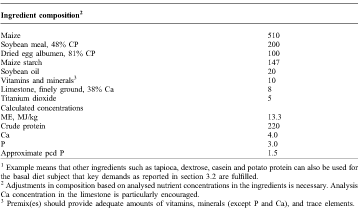
In selection of raw materials for the basal diet, the protein sources need special attention, because they should provide amino acids in adequate amounts, but contain as little P as possible. Intrinsic phytase should not be contained in the basal diet. Favourable raw materials include maize, soybean meal, potato protein (low ash quality) or other protein isolates such as egg albumen, starch and tapioca. The mineral premix must not contain P. Table 1 shows an example for the composition of the basal diet. In addition, the intended level of aP in the basal diet should not exceed 0.15%. This is equivalent to approximately 0.3% tP. Other protocol requirements include:
• The P source under test must be supplemented in at least two levels to the basal diet. Levels are chosen, depending on the P concentration of the test source, to achieve increments of up to 0.15% tP from the test source (e.g. 0.075 and 0.15% tP when two levels are used, or 0.05, 0.10 and 0.15% tP when 3 levels are used). Supplements are made at the expense of a P-free ingredient from the basal diet (e.g. starch). Low-P animal sources such as feather meal or blood meal should be investigated as explained for low-P plant feedstuffs.
• The total Ca to tP ratio in the diets can vary between 1.3:1 and 1.4:1. This avoids negative effects of excessive Ca intake but also ensures that Ca does not limit P utilisation. Finely ground limestone is used as the standard source of Ca.
• It is recommended that diets are pelleted and pellets have a diameter of 3 mm. Pelleting conditions need to be reported together with the temperature of the hot pellet measured immediately after extrusion of pellets from the press.
• Concentrations of tP and Ca in the complete diets after pelleting must be confirmed by analyses.
Example1 for the ingredient composition of a basal diet for studying the availability of P sources of mineral or animal sources with high P concentrations (g/kg).
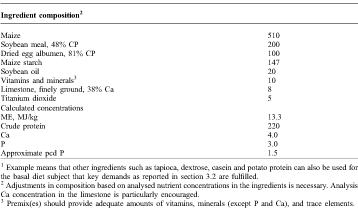
1 Example means that other ingredients such as tapioca, dextrose, casein and potato protein can also be used for the basal diet subject that key demands as reported in section 3.2 are fulfilled.
2 Adjustments in composition based on analysed nutrient concentrations in the ingredients is necessary. Analysis Ca concentration in the limestone is particularly encouraged.
3 Premix(es) should provide adequate amounts of vitamins, minerals (except P and Ca), and trace elements.
Experimental diets for testing plant P sources and plant by-products
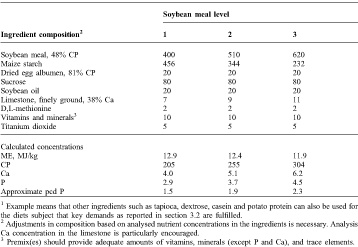
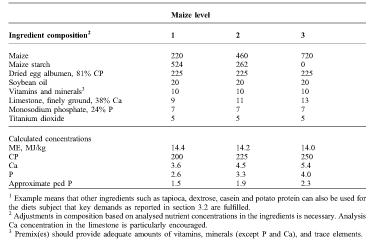
In general, specifications with regard to levels of P, Ca, and vitamin D3 apply as stated above for the testing of mineral and animal sources. Because many plant P sources contain intrinsic phytase, raw materials in the basal diet must not contain phytate and intrinsic phytase. Because the P concentrations in plant ingredients are very different it is necessary to adjust the composition of the diets for different test feeds. The test feeds can be contained in the basal diet. Examples for a high-P (e.g. soybean meal) and a low-P raw material (e.g. maize) are shown in Tables 2 and 3. When low-P raw materials are tested, the diet may need supplementation with a mineral P source to achieve a minimum aP level of approximately 0.15% in the diet (Table 3).
In order to supplement a sufficiently high amount of P from the P source under test, the inclusion level of the plant P source must be high. It should be calculated in a way that the plant P source supplies 0.075 and 0.15% tP in the test diets. With very low-P raw materials this may not be possible and then the maximum possible inclusion of the test feed should be used. Inclusion is made at the expense of P-free ingredients from the basal diet.
It is recommended that diets are pelleted to a diameter of 3 mm. High temperatures should be avoided to maintain intrinsic phytase. Pelleting conditions need to be reported together with the temperature of the hot pellet measured immediately after extrusion of pellets from the press. In addition, intrinsic phytase activity of the plant P source should be analysed, and concentrations of P and Ca and phytase activity in the complete diets after pelleting must be confirmed by analyses.
Example1 for the ingredient composition of diets for studying P availability of soybean meal (g/kg).
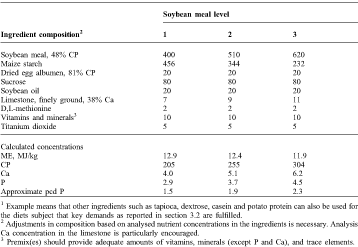
1 Example means that other ingredients such as tapioca, dextrose, casein and potato protein can also be used for the diets subject that key demands as reported in section 3.2 are fulfilled.
2 Adjustments in composition based on analysed nutrient concentrations in the ingredients is necessary. Analysis Ca concentration in the limestone is particularly encouraged.
3 Premix(es) should provide adequate amounts of vitamins, minerals (except P and Ca), and trace elements.
Example1 for the ingredient composition of diets for studying P availability of maize (g/kg).
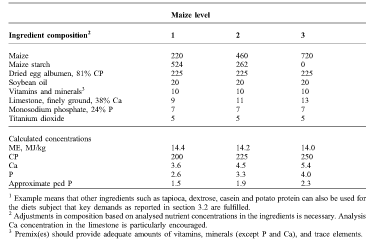
1 Example means that other ingredients such as tapioca, dextrose, casein and potato protein can also be used for the diets subject that key demands as reported in section 3.2 are fulfilled.
2 Adjustments in composition based on analysed nutrient concentrations in the ingredients is necessary. Analysis Ca concentration in the limestone is particularly encouraged.
3 Premix(es) should provide adequate amounts of vitamins, minerals (except P and Ca), and trace elements.
Experimental diets for testing efficacy of supplemented phytase
Raw materials of the basal diet must be selected to provide sufficient PP (at least 0.23%). No mineral P should be added, and intrinsic phytase should not exceed 150 FTU/kg of the basal diet. In all diets, the total Ca to tP ratio in the diets has to be between 1.4:1 and 1.5:1. The basal diet must be mixed in one batch for all treatments, and subsequently divided into as many parts as treatments are planned. Phytase is then added to each part in the intended concentration and diets are mixed again.
At least four supplementation levels should be used for description of the dose-response-relationship. Phytase products differ in their characteristics and therefore adjustment of supplementation levels is needed. Steps should be smaller at low than at high level of supplementation (for example 125, 250, 500, 1000 units/kg).
Pelleting and analysis of feeds should be applied as previously stated. In addition, intrinsic phytase activity of the plant P source should be analysed, and concentrations of P and Ca and phytase activity in the complete diets after pelleting must be confirmed by analyses.
It is important to note that comparison of different phytase products can only be made within the same experiment. The measurement of InsP6 degradation in the ileal digesta can give additional information regarding the efficacy of the enzyme.
Calculations
The pcdP is calculated for each diet and replicated pen. This is based on the concentrations of the marker and P in the feed and ileal digesta samples:
pcdP (%) = 100 – [100 × (MDiet × PDigesta) / (MDigesta × PDiet)] [equation 1]
where
MDiet and MDigesta = analysed marker concentration in the diet or digesta (g/kg DM); PDiet and PDigesta = analysed P concentration in the diet or digesta (g/kg DM).
The content of pcdP in the diet is calculated as:
pcdP (g/kg of diet) = pcdP (%) × PDiet /100 [equation 2]
evaluation of p sources
The pcdP (expressed in g/kg of diet) is plotted against tP concentration (g/kg of diet) in a linear regression analysis. The slope of the regression line, multiplied by 100, gives the percentage precaecal digestibility of P from the supplemented source. If two or more P sources are tested in the same experiment, common-intercept multiple linear regression is used and the tP concentration originating from the supplement is the x-variable. This allows for simultaneous determination of pcdP for all tested P sources including comparison of slopes. Results are expressed as percentage pcdP, calculated as the slope of the linear regression, multiplied by 100. No decimal digit is given. The standard error of the estimated slope, multiplied with 100, is reported as the measure of variation and displayed with one decimal digit. A full example of these calculations is given in the annex to this paper.
evaluation of phytase
The pcdP (expressed in g/kg of diet) is plotted against supplemented phytase activity in the diet. The response usually follows a non-linear shape and, in such cases, an exponential model should be used to describe the dose-response relationship. Estimated equations are used to calculate phytase-related P release. Multiple regressions are calculated if two or more origins of phytase are tested in the same experiment.
Determination of rP as an alternative to pcdP
The guidelines for the determination of pcdP in principle are the same for the determination of rP, with the following specifications and modifications.
• Experiments with total excreta collection should use either individuals or groups of broilers in metabolism cages. The minimum number of replicates per diet is six.
• The excreta collection period lasts a minimum of four days. Prior to starting the collection period the respective diets are fed for at least five days.
• Excreta are collected from trays underneath the cages at least once a day and are bulk-stored for each replicate in a freezer for the entire collection period. Collected excreta must be free of spilled feed and feathers. Thawed excreta must be thoroughly mixed, weighed, dried and ground.
• Official standard methods are applied for sample hydrolysis and element analyses.
Unresolved questions
This protocol is intended as the initial step for a standard of P evaluation and phytase efficacy and is open for improvement. Several details had to be set in spite of a lack of experimental evidence and they should be clarified in future. Unresolved questions and suggestions for future investigations can be grouped into animal-related, feed-related, and management-related. The following list arose during generation of the protocol, but it is not exhaustive. These questions can be studied by using this protocol with special adjustment in the details that are relevant for the specific question.
animal level
In terms of animals, the differences in P availability between male and female broilers and fast- or slow-growing strains are not known. The differences are believed to be small, if they exist at all, but this is worth further investigation. It is important to note that the effects of age, maternal nutrition and early feeding on aP still need to be studied. A few studies have shown differences in the availability of P between different avian species. More comparative studies are needed in order to better evaluate whether availabilities determined with broilers can be used in feed formulation for other avian species or laying hens. This includes the question whether the Japanese quail can be used as a model for broilers in rP studies. Finally, the effect of gut microflora and dietary factors related to the hind gut microbial composition can be expected to have some relevance, in particular in plant feedstuffs (endogenous phytate breakdown). Studies with germ-free birds have been suggested in order to study this aspect in more detail.
feed level
The effect of level, source and physical form of Ca in P availability studies must be considered. As a long-term goal, Ca inclusion should be calculated based on its availability. The relevance of feed form (pellets compared to mash feeding), particle size distribution, and whole grain feeding on P availability should not be omitted when designing trials. Other considerations include:
• Effect of pre-experimental feeding (P and Ca-levels, enzyme activities, ingredient effects, etc.).
• Interactions between ingredient composition of the basal diet and the test feed (e.g. electrolyte balance, interaction with other minerals).
• Effects of feed additives.
management level
Considerations should include the effect of environment, e.g. hot temperatures, vaccination and medication and challenge with pathogens that may impair phosphate and calcium absorption.
Conclusions
The above protocol is suggested for standardised testing of feed raw materials used in poultry feeding. It can be used for testing P availability of complete diets, with specifications, as given for the testing of plant P sources. Effects of feed additives (single or in combinations) on P availability can also be investigated by using this protocol. Specific modifications of the protocol can make it suitable to study the availability of other minerals and trace elements. This, however, needs to be done separately for each element in order to consider the specific aspects of requirements and homeostatic regulations.
Acknowledgments
The Working Group No 2 is very grateful for the work done by the P Sub-Committee in several meetings. The members appointed to serve on the Sub-Committee were M. Bedford (United Kingdom), M. Blok (Netherlands), F. Calini (Italy), E. Delezie (Belgium), D. Feuerstein (Germany), M. Francesch (Spain), P.-A. Geraert (France), G. Huyghebaert (Belgium), A. Narcy (France), Y. Noy (Israel), M. Rodehutscord (Germany), and S. Steenfeldt (Denmark). Contributions by the experts who are not members of Working Group No 2 are especially acknowledged. Olayiwola Adeola is thanked for constructive comments on the draft of the protocol and Yauheni Shastak for his continuous support of the work. Financial sponsorship of meetings and travel expenses by BASF SE and Adisseo France SAS also is gratefully acknowledged.
Annex
Example for the calculation of pcdP for two virtual test ingredients
A and B are the feed ingredients to be investigated for P availability. The experiment has 5 diets:
BD: Basal diet
TDA1: Test diet containing test ingredient A at the first level of inclusion
TDA2: Test diet containing test ingredient A at the second level of inclusion
TDB1: Test diet containing test ingredient B at the first level of inclusion
TDB2: Test diet containing test ingredient B at the second level of inclusion
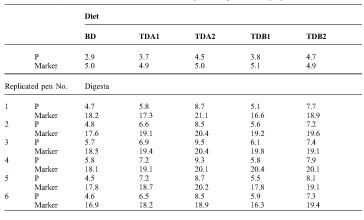
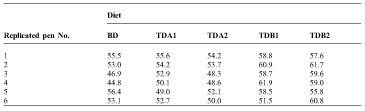
The diets were composed and the experiment conducted as outlined above. Diet and digesta samples were analysed and results are shown in Table A1.
Table A1 Analysed concentrations in the diets and digesta samples are in (g/kg DM).
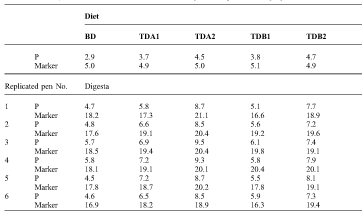
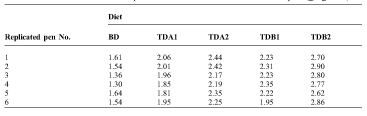
The pcdP is calculated for each pen according to equation 1 and results are displayed in Table A2. The corresponding concentrations of pcdP in the diets according to equation 2 are shown in Table A3.
Table A2: Digestibility calculated for each pen (%)
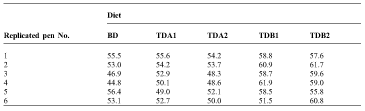
Table A3: Concentrations of pcdP in the diets calculated for each pen (g/kg DM)
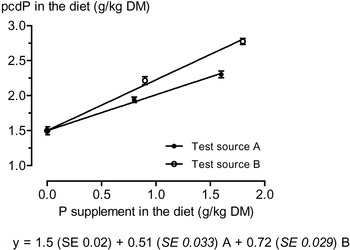
Digestibility of P from the test ingredients is calculated by common-intercept multiple linear regression.
The following equation is used: y = a + bnxn,
where y = concentration of pcdP in the diet (g/kg DM), a = intercept, bn = slope for test source n and xn = P concentration originating from test source n (g/kg DM). The parameters a, b A and b B are estimated simultaneously, for example through the GLM procedure of SAS (SAS Institute, Cary, NC).
The parameter estimate in the present example gives the following equation:
y = 1.51 (SE 0.023) + 0.51 (SE 0.033) A + 0.72 (SE 0.029) B. Figure 1 shows the corresponding graph.
As the result, test ingredient A has a pcdP of 51% (SE 3.3%) and test ingredient B has a pcdP of 72% (SE 2.9%).
Calculation of pcdP for the two test ingredients A and B by linear regression analysis.