The nation-state has long offered a powerful framework within which to understand modern economic growth. To some it provides “a natural unit in the study of economic growth,” especially when measuring such growth; to many others states have often significantly influenced the performance of their economies.Footnote 1 On this second point Barry Supple observed that “frontiers are more than lines on a map: they frequently define quite distinctive systems of thought and action. The state is, of course, pre-eminently such a system.”Footnote 2 In the British case, however, national frontiers have long been highly distinctive, as has recently been made plain by the “new British history” and work by political scientists on devolution since 1997.Footnote 3
By exploring patterns of the use of legislation for economic ends, this article considers the implications of such distinctiveness for the relationship between the nation-state and Britain’s precocious economy between 1660 and 1800. The focus is mainly upon legislation at Westminster, but comparisons are also made with enactments at Edinburgh and Dublin to enrich the account. It is argued that if some legislation sought to affect the British economy as a whole, the practical application of such legislation often varied between England, Scotland, and Wales. Similarly, public funds, usually with legislative underpinnings, were spent to develop the economies of Ireland and Scotland more directly than was the case in England and Wales. Moreover, such general measures existed alongside many thousand very particular ones, established at the behest of specific propertied interests, that penetrated deep into the interstices of the domestic economy. Here, however, such English interests utilized legislative authority much more readily than their Scottish or Welsh counterparts. Generally the relationship between nation, state, and the first industrial revolution lacked all the clarity one would expect of a composite multinational polity operating amid an unanticipated epochal change.Footnote 4 That relationship was multifaceted and multilayered, but it also operated differently from one nation to the next within Britain. It may be that such variations in the relationship between political power and economic change is what distinguished the British case, not merely the advent of constitutional monarchy or a heightened attachment to “liberty.” This raises doubts about reminted Whig or celebratory accounts of British history promulgated over the past quarter century and incidentally of Britain’s supposed exemplary history.
The article begins by considering briefly some of the main broad arguments that have been made about the relationship between the British nation-state and industrialization, including the new Whig accounts. Some national variations in the experience of economic change are then suggested. The heart of the article lies in various counts of patterns of parliamentary legislation relating to economic matters in the period, which leads to a summary of the efforts made at the time to improve “national” economies. Finally, the article concludes by considering the implications of national variations in British practical political economy.
The existing literature on the relationship between the state and the economy in Britain between 1660 and 1800 has typically not been much concerned with the significance of nationhood, of similarities and differences in the experiences of Britain’s three nations.Footnote 5 A range of fine studies exists about particular instances when the central state sought to influence the economy. Where they focus upon largely local measures, such as enclosures and turnpike roads, understandably the national dimension has been little considered. But even where scholars have examined legislation that was not locally orientated, they have not often engaged with the national dimension. Fine work by Bob Harris and Patrick O’Brien and his colleagues are unusual in doing so.Footnote 6 Similarly, it is often forgotten that John Brewer’s brilliant study of the growth of the fiscal-military state concentrated on England, not Britain, as its title made clear.Footnote 7 Even mercantilism, often viewed as an expression of economic nationalism, has largely been studied with reference to the English case before 1707 and seamlessly expanded to Britain thereafter. Alternatively, English or British mercantilism is seen as having pursued the same strategic objectives as French or Dutch mercantilism and, consequently, as not nationally distinctive save at the tactical level.Footnote 8 Where national distinctions have been drawn most fruitfully, especially by O’Brien, is in relation to the British state’s success in raising revenue and waging war, helping in the process to underpin the expansion of important export markets for British industrial goods.Footnote 9 But even here Britain is not usually approached as a multinational polity, and the approach pays little attention to the use of the state’s authority to aid growth generated domestically within the important agricultural and service sectors.
The significance of nationhood and the state to economic performance was, of course, considered long and hard in the seventeenth and eighteenth centuries. One strand of this was that in the eighteenth century foreigners began to expatiate upon English exceptionalism (using England and Britain indiscriminately). For example, Johann Archenholz, the Prussian soldier and historian who lived in England between 1769 and 1779, thought that “Great Britain, which cannot naturally be considered, in the balance of Europe, but as belonging to the second order of kingdoms, has been elevated to the rank of one of the first powers in the world by bravery, wealth, liberty, and the happy consequences of an excellent political system.”Footnote 10 Like so many, he believed that England and Great Britain were synonyms, with a single political system, introduced after the Glorious Revolution of 1688–89, experienced by all, and productive of power and prosperity across the whole island. Anglomaniacs praised the emergence of stable, mixed government, the extent of entrepreneurialism, and the flexible and open nature of British thought.Footnote 11
Such views sat easily enough with Herbert Butterfield’s description of the Whig interpretation of history: that England was a favored nation, which progressed because of an attachment to liberty.Footnote 12 Such an interpretation was never as dominant as is often supposed and by 1930 had been sufficiently challenged for W. C. Sellar and R. J. Yeatman brilliantly to mock its glib pieties in 1066 and All That. But historical fashions do sometimes go round in circles, and in the past quarter century a number of prominent scholars and public figures have declaimed upon the supposedly exceptional national aspects of economic change in England or Britain. This has taken two main forms.
A few have emphasized the importance of nationhood, national identity, or nationalism in explaining Britain’s early industrialization. David Landes has argued that “Britain had the early advantage of being a nation … a self-conscious, self-aware unit characterized by common identity and loyalty and by equality of civil status.”Footnote 13 Liah Greenfeld, in a prizewinning (though controversial) book published in 2001, took this further and argued that Britain’s “rise was in the nature of a miracle” that is best explained by the fact that “Nationalism first appeared in England … which it was the only one to possess for some two centuries,” and this appearance “liberated natural economic energies from the constraining tutelage of ethical considerations and social concerns, and therefore … did not inhibit economic growth.”Footnote 14
Such views of nationhood tend to focus upon England or to elide distinctions between England and Britain. Moreover, while Colley has shown some ways in which ideas of Britishness developed after 1707, Graeme Morton has illustrated the danger that “Whiggish principles of state formation have masked national tensions which have never yet been eradicated.”Footnote 15 There was plenty of evidence in the eighteenth century of such tensions, but some also noted differences in the intensity of national identity across the three kingdoms. In 1750, for example, Sir James Lowther believed that the Irish and the Scotch “are both more national than the English.”Footnote 16 After 1707 many English and Scots had different ideas of what Britain was: most Scots saw themselves as both Scottish and British, but most English made little distinction between England and Britain.Footnote 17 No less importantly, Ireland, both as “other” and then, from 1801, as part of the United Kingdom, further muddied the waters of national identity in Britain. Nationhood and national identity in Britain have been so uncertain since at least the seventeenth century that they are not concepts that can be employed to understand the emergence of the first industrial revolution in any reasonably testable way.
A second conventional argument about the national exceptionalism of the first industrial revolution has considered the implications of constitutional developments, along two main lines. At the most general level there are views such as Thomas Sowell’s that Britain’s early economic transformation happened when it did because Britain had established before almost everywhere else “a framework of law and government that facilitated economic transactions,” particularly by pioneering the establishment of “freedom.”Footnote 18 Yet, as David Armitage has noted, “Though it has been argued that the Glorious Revolution represented the victory of law, liberty and localism against absolutism, subordination and centralisation, this perspective is only true of England and, possibly, the American mainland colonies.”Footnote 19 The politics and teleology behind arguments such as Sowell’s are highlighted in Gordon Brown’s identification of a “golden thread” of liberty running through British history, as well as the view of the then recently retired Chairman of the Federal Reserve, Alan Greenspan, that the most “free” of the leading modern economies “all have roots in Britain.”Footnote 20 Such views bring to mind Condorcet’s warning of the dangers of circular reasoning, whereby “liberty will be no more, in the eyes of an avid nation, than the necessary condition for the security of financial operations.”Footnote 21
The second line of constitutional exceptionalism has emphasized how the Glorious Revolution led to a more powerful state that was better able to protect and project the nation’s interests, while securing property rights at home in ways conducive to capitalist enterprise.Footnote 22 For example, in an article that has been very influential among some economic historians, economists, and political scientists, D. C. North and Barry R. Weingast argue that the Glorious Revolution firmly established property rights and balanced the interests of crown and parliament. This led to the transformation of public finances, allowing Britain to rise as France fell, so that “in 1765 France was on the verge of bankruptcy while England was on the verge of the Industrial Revolution.”Footnote 23 In a similar vein, Niall Ferguson has argued that Britain led the way in providing the best institutional arrangements for the accumulation of power and wealth: “It was in the eighteenth century that the British state developed the peculiar institutional combination of bureaucracy, parliament, debt and bank that enabled Britain at once to empire-build and to industrialize.”Footnote 24
Such approaches operate at a fairly high level of generalization, being concerned with governmental measures only and are usually untroubled by whether the experiences of England and Britain were one and the same under the revolution constitution. On this latter point historians of Ireland and Scotland have naturally been more inquisitive, exploring the implications for economic development in those nations of the union of crowns of 1603 and, more particularly, the parliamentary unions of 1707 and 1801. Such approaches have particularly considered the consequences of the level and conditions of access to English or British domestic and imperial markets before and after the unions, including the protection afforded by British armed forces. These considerations are commonly weighed against the importance of factors endogenous to Scotland and Ireland, including the survival after union of institutions distinctive to both.Footnote 25 This article builds upon such approaches by looking at patterns of parliamentary legislation that directly related to the economy. But it is important to begin by recalling some broad
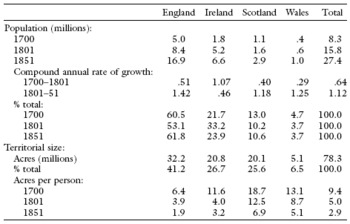
Population Size in Britain and Ireland, 1700–1851

Sources For populations for England 1700, Scotland 1801 and 1851, and Ireland 1801 and 1851, see B. R. Mitchell, British Historical Statistics (Cambridge, 1988), 7, 11. For England and Wales, 1801 and 1851, see British Parliamentary Papers (BPP), 1852–53, vol. 86; and for the 1851 census of Great Britain, number of inhabitants, see BPP, 1801–51, vol. 2. For Ireland 1700 and Scotland 1700, see R. A. Houston, The Population History of Britain and Ireland, 1500–1750 (Basingstoke, 1992), 29, 30. For Wales 1700, see John Williams, Digest of Welsh Historical Statistics, 2 vols. (Cardiff, 1985), 1:6.
differences in the experience of economic change in Britain and Ireland in the period.
It should be noted that the conventional estimates for economic performance, national income or product, exist for Britain but not, for want of evidence, separately for England, Scotland, and Wales. But an alternative demographic approach that considers changes in population size, urbanization, and the size of the agricultural labor force, powerfully developed by Wrigley, offers a way through this impasse.Footnote 26 Save for England, statistics of population growth and urbanization in Britain and Ireland before the first census in 1801 should be considered as rough estimates or best guesses, but nonetheless, as table 1 shows, the numbers are very suggestive.
England comprises just over 40 percent of the total surface area of Britain and Ireland. Yet, in 1700 it had over 60 percent of the population of those islands, giving it a population density of about twice that of Ireland and Wales and three times that of Scotland. Though the population of all four nations grew in the eighteenth century, about 46 percent of the total growth took place in Ireland.
Proportion of National Population in Towns of at Least 10,000 in Britain and Ireland, 1700–1851

Sources For England 1700 and 1800, see E. A. Wrigley, People, Cities and Wealth: The Transformation of Traditional Society (Oxford, 1987), 177. For Scotland and Ireland 1700 and 1800, see I. D. Whyte, “Scottish and Irish Urbanisation in the Seventeenth and Eighteenth Centuries: A Comparative Perspective,” in Conflict, Identity and Economic Development: Ireland and Scotland, 1600–1939, ed. S. J. Connolly, R. A. Houston, and R. J. Morris (Preston, 1995), 16. For England and Scotland 1851, see Lynn Hollen Lees, “Urban Networks,” in The Cambridge Urban History of Britain, ed. Peter Clark (Cambridge, 2000), 3:70. For Ireland 1851, see W. E. Vaughan and A. J. Fitzpatrick, eds., Irish Historical Statistics: Population, 1821–1971 (Dublin, 1978), 3, 28–40. Wales 1700 is a guess on the basis that the largest Welsh town in 1801 was Swansea with 10,117; for Wales 1801 and 1851, see John Williams, Digest of Welsh Historical Statistics, 2 vols. (Cardiff, 1985), 1:62–65.
Strikingly, by the first census of 1801 England and Ireland were equally densely populated, both about two and three times as densely populated as Wales and Scotland, respectively. Over the next half century, the populations of England, Scotland, and Wales each roughly doubled, but terrible famine in Ireland in the 1840s reversed its growth, though it was still the second most densely populated of the four nations in 1851. Despite significant absolute growth, the share of both Scotland and Wales of the total population of Britain and Ireland was slightly smaller in 1851 than in 1700.
This picture of demographic change can be refined a little by considering patterns of urbanization (see table 2).Footnote 27 Ireland’s exploding population in the eighteenth century was associated with only modest urbanization. In contrast, the less rapid population growth in England and Scotland took place with considerable growth of their great towns and cities. Notably, by 1851 Scotland was the least densely populated of the four nations but the second most urbanized. Wales, however, changed little in the eighteenth century in terms of either total population or its distribution. But in the first half of the nineteenth century, its population doubled, and rapid urbanization had begun.
Such figures of population and its distribution show that the timing and patterns of economic change in Britain and Ireland varied from nation to nation—and, of course, from region to region, though there is not room here to develop that analysis. In the context of the concerns of this article, the contrast in the eighteenth century between Ireland and Wales is worth noting. Ireland’s population grew vigorously, but that of Wales did not. Ireland urbanized somewhat, Wales hardly at all. Without the benefit of hindsight, it might be wondered which economy was the more vibrant in 1800. Similarly, it is clear that English and Welsh economic development took very different paths before 1801, despite the two nations sharing the same government. How, then, did parliaments legislate for economic change across all four nations between 1660 and 1800?
Building upon earlier work done partly in collaboration with Joanna Innes, counts of numbers and types of legislation are used to begin to explore the relationship between the state and the economy. It is easy enough to identify the 18,761 acts passed by the parliaments at Edinburgh from 1660 to 1707 and at Dublin and Westminster from 1660 to 1800.Footnote 28 Most acts can also be categorized in terms of subject matter or where they were to apply, not least because most were so specific, not that there is one agreed way of categorizing the subject matter of acts, and some acts might straddle categories. Additionally, the true meanings of others might require more research than has been undertaken.Footnote 29 Furthermore, interpreting counts produced within any given categorization may not be straightforward. Joel Hurstfield nicely hinted at the dangers when questioning G. R. Elton’s enumeration of Thomas Cromwell’s legislative fertility under Henry VIII when he observed that “I am myself reluctant to attempt to measure the quality of parliamentary government by weight.”Footnote 30 Of course, one act might be momentous, the other fairly trivial. Plainly acts such as the 1689 Corn Law were significant in ways in which a private estate act never was, but by keeping this in view, there are meaningful patterns that can be identified that help to shed distinctive light on the relationship in Britain (and Ireland) between parliaments and the economy, of its multifaceted nature and the extent of national variation within Britain. Initially those findings are presented in a largely descriptive way; the following section then seeks to explain the findings and tease out their significance.
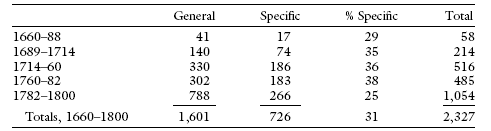
Unquestionably, Westminster’s capacity to enact legislation expanded dramatically after 1688, indeed, to an extent that is still underappreciated.Footnote 31 In the ten parliamentary sessions before then only 10 percent of attempts to obtain an act succeeded. Thereafter regular, predictable, much better-ordered sessions saw the success rate change profoundly, so that for most of the eighteenth century it was around 75 percent. This contributed to an explosion in the numbers of enactments. In the previous 200 years some 2,700 acts had been passed. In the period between
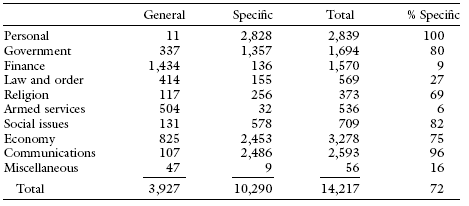
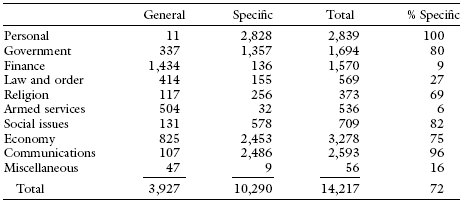
Main Subject Matter of Westminster Acts, 1660–1800, with Proportion Designated “Specific”
1688 and union with Ireland in 1801, over 13,600 acts were passed, marking a rise from an average of under 15 per annum to an average of over 290 per annum in the 1790s, or a nearly twentyfold increase.
The eighteenth century was an era of unprecedented and extraordinary legislative fruitfulness at Westminster, but how much did all this legislation weigh? This can be approached by trying to assess what each act broadly attempted to do in terms of place, subject, and scope. For the last of these criteria acts have been distinguished between those that appear to have applied across at least one of the four nations (classed as general) and those of more limited scope, very largely relating to individuals and particular places (classed as specific). As in all such schemes, some cases straddle the divide, but these are very few in number. (The formal contemporary distinction between public and private legislation inconsistently reflected the scope of legislation and so is not used here.)
Between 1660 and 1800 Westminster passed 14,217 acts. Nearly 28 percent of these can be classed as general, 72 percent as specific. In fact, the Glorious Revolution led to the growth of all types of acts but particularly of acts that were limited in their reach, the proportion of these rising from 64 percent between 1660 and 1688 to 73 percent thereafter. This is a vital distinction, but it needs to be explored in relation to the subject matter of acts. To do this, each act has been placed within one of ten major categories (themselves resting on many more subcategories).Footnote 32
As table 3 shows, three categories accounted for a little over six out of ten of all acts passed in the period: personal, communications, and the economy. As will become clear, all three of these affected economic matters, with only the “finance” category among the others potentially doing so, mainly because of public finance measures. Crucially, legislation classed as “personal,” “communications,” and “the economy” was overwhelmingly specific rather than general in scope.
Personal acts were dominated by two main types: those dealing with wealth, which almost always concerned issues surrounding land ownership, such as marriage or strict settlements, numbering almost 3,000, and those dealing with status, such as naturalization and dignities, numbering a little over 1,100. Economy acts were similarly dominated by landownership; in this case, enclosure. Over 2,300 economy acts dealt with land issues, and a little over 500 concerned overseas trade, but fewer than 500 addressed the other six subcategories combined. In the communications category, there were nearly 2,000 road acts, usually relating to turnpikes, and over 600 relating to inland navigation, river improvement, and canals.
Four main points might be made about these general counts of Westminster enactments between 1660 and 1800. First, specific economic interests secured an unprecedented number of acts to aid their ambitions after 1688. Parliament provided vital authority, especially to reorder or redefine property rights and improve the infrastructure.Footnote 33 Second, in a number of areas Westminster rarely legislated generally. For example, it passed separate acts for each of the more than 2,000 enclosures it endorsed, not a general enabling one that could serve in all instances. Such measures were largely initiated by individuals or local bodies, motivated largely by self-interested considerations, though they might be legitimated by reference to the national good in ways similar to those social measures analyzed by Innes.Footnote 34 Also important was that executive government rarely developed measures dealing directly with either agriculture or industry—the Corn Laws and some attempts at regulation were the main efforts.Footnote 35 With regard to the economy, only in the area of imperial trade, with the navigation acts, was there something that approximated a policy or system.Footnote 36 In part this was because few contemporaries would contemplate a more interventionist state domestically, but most would countenance closer regulation of overseas trade by the customs service and Royal Navy. Parliament would respond to proposals to enhance economic opportunities, but relatively few such proposals were governmental. The third key point is related to this last observation. As historians from the Webbs onward have shown, parliament created a huge number of local bodies or agencies in the eighteenth century, not only for roads and enclosure but for the poor law, health care, charities, education, the urban infrastructure, and so on.Footnote 37 Again, this was almost always done on a case-by-case basis, and even though these efforts might be short-lived or time limited, they significantly enriched and complicated the nature of local governance. A centralized fiscal-military state was brought to fruition after the Glorious Revolution, but there was also a substantial change in the architecture of authority locally. Finally, some of this legislation, such as that concerning turnpikes and enclosure, involved compelling people to sell property and could take away or alter the use rights of local people, making them more dependent upon the market economy. Those people affected may have doubted that what they judged as their property rights had become more secure.Footnote 38
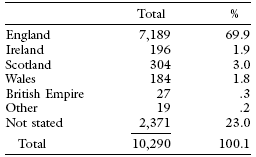
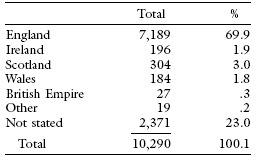
Where did this legislation apply?Footnote 39 Nearly two-thirds of acts gave a clear indication of their geographical scope—ranging from particular buildings to nations and portions of empire. Of those that did not, rather more were, in absolute terms, general than specific in scope. Relatively, however, 70 percent of general acts did not make their reach explicit in their titles, whereas only 23 percent of specific acts were similarly vague. Presumably most of the unspecified general acts affected the whole of England and Wales before 1707 and the whole of Britain thereafter. While some acts did purport to affect only England or Scotland or Wales, numbers were never great, and the distinctions between England and Wales are compromised by sloppy draftsmanship before 1746 when it was enacted that with regard to “England … the same has been and shall henceforth be deemed and taken to comprehend and include the dominion of Wales, and town of Berwick upon Tweed.”Footnote 40 Consequently, at this stage it is much more meaningful to pursue the topic of the national patterns of acts passed at Westminster by focusing upon specific legislation only. I return to legislation that might be considered British in scope later.
The evidence in table 4 is complicated a little by the large number of specific acts that have not been placed within a geographical category. Often these related to particular individuals, as with those concerning naturalization or estates. Detailed work could doubtless allow many to be categorized, but probably the overwhelming majority would be placed within “England.” With this caveat in mind, the meaning of table 4 needs little elaboration. Local and personal interests in England obtained legislation at Westminster in very much greater numbers than those in Scotland or Wales (or Ireland).
The position of Wales is worth pondering, given that its government was so similar to that of England after the abolition of the Council of Wales and the Marches in 1689. Westminster passed 192 acts clearly relating only to Wales or
Specific Acts Passed at Westminster by “Nation,” 1660–1800
parts thereof between 1660 and 1800. Of these just eight were general in scope: six related to issues of law and order and two to government. (Governmental measures usually applied to England and Wales or to Britain.) That is, almost all legislation classed as Welsh was specific in scope and the response to applications made by the propertied. Only fifty-one such specific acts were passed between 1660 and 1760, but in the final forty years of the eighteenth century 133 were passed. That growth was overwhelmingly caused by heightened numbers of acts for communications and the economy. Before 1760 they accounted for only 14 percent of all acts relating to parts of Wales (71 percent of such acts were personal); after 1760 they accounted for 82 percent. But whereas for England between 1760 and 1800 the volume of enclosure legislation surpassed that for turnpikes, in Wales the reverse was true, albeit at very much lower levels.Footnote 41 Some possible explanations for this are offered later.
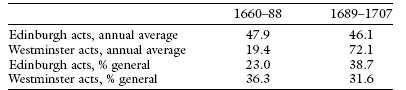
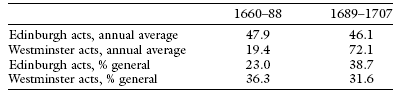
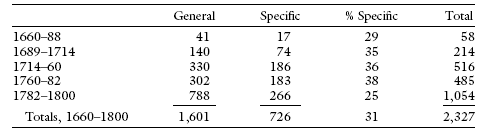
Even more than Wales, relative to population, Scottish specific interests secured remarkably few acts at Westminster between 1707 and 1800. As shown above, in this period England’s population was about five times that of Scotland, but its specific interests obtained over twenty-three times more legislation than those of Scotland. Previously, however, specific Scottish interests had obtained legislation from the Edinburgh parliament much more frequently. Between 1660 and union in 1707 the Edinburgh parliament was highly active, passing over 2,200 acts, compared to nearly 1,900 at Westminster in the same period, only three of which related to Scotland. Given Scotland’s small population and lack of colonies or empire, this hints that legislation played a somewhat different role north and south of the border before 1707. In Scotland, even more than England and Wales, it was often extremely particular in complexion. Nonetheless, though nearly three-quarters of the legislation was specific in scope, the Glorious Revolution led to an important change in the pattern, as table 5 shows.
The average annual rate of legislation passed at Edinburgh remained steady on either side of the revolution, but after 1688–89 significantly more of it was general in scope—a rise from an annual average of eleven to seventeen acts—and there was also a steep decline both absolutely and relatively in numbers of personal legislation, falling from nearly one-third to under one-fifth of legislation. This was
Number of Edinburgh Acts, by Scope, 1660–1706

a very different pattern from that at Westminster, as table 6 shows. The parliament at Edinburgh had been more closely controlled by the executive before the revolution, but once that weakened, thereafter legislators were better able to address more general matters, including establishing a standing committee for trade.Footnote 42 By subject matter, almost all types of acts became more general and less specific. However, while numbers of acts relating to the economy grew more quickly than for any other subject after 1688, the change to more general legislation was less marked. Before then there were 254 acts in this category, with 14 percent of them general. Afterward there were 231 acts, some 20 percent of them general. The particular driver here was obtaining acts to regulate local markets. There is no denying the legislative fecundity of the Edinburgh parliament in this period and that there were significant changes in the nature of what was enacted. Yet, despite this, the Edinburgh parliament was voted out of existence.Footnote 43
A significant number of Scots had been in favor of the union, largely on the economic grounds that it would remove almost all barriers to doing business across England and its empire.Footnote 44 This benefit they gradually came to exploit to the full. But importantly, in the eighteenth century they rarely turned to Westminster to provide further legislative underpinnings to bring about change, certainly less often than might have been expected. Of legislation passed at Westminster from 1707 to 1800, which made clear its local, regional, or national relevance, only 464 acts, or under 6 percent, related only to Scotland as a whole or in part—160 general
Comparison of Legislation at Edinburgh and Westminster, 1660–1707
Number of Dublin Acts, by Scope, 1660–1800
acts, 304 specific.Footnote 45 Under the revolution constitution, the Edinburgh parliament passed an average of forty-six acts per year, but between 1707 and 1800 there were only five per year addressing exclusively Scottish matters—though some of the many “not stated” would also have done so but probably not in any great number.
If legislation relating to Scotland shrank dramatically after the union, there are nonetheless some other general points to be made. First, while a little more of this was specific rather than general in scope compared to that passed at Edinburgh before the union, there was still relatively more general legislation than that passed at Westminster as a whole (one-third compared to one-quarter). Moreover, the subject matter involved was more widely distributed than for England. Crucially, Scottish landowners did not turn to Westminster for legislation to reorder or enclose their estates: only to undertake urban and infrastructural improvement did Scottish interests seek acts at Westminster with any frequency.
A comparison can now usefully be made between the legislative activities of the Dublin and Westminster parliaments.Footnote 46 As in England and Scotland, from one perspective Ireland’s parliament was energized by the Glorious Revolution. Having passed only 58 acts between 1660 and 1666, it did not meet again until the revolution, thereafter usually meeting biennially. This enabled it to pass over 2,200 acts before union in 1801, a huge increase, but only about one-sixth the number passed at Westminster, even though in 1800 Ireland’s population was nearly one-half that of Britain’s.
Unsurprisingly, there were important differences in the character of legislation passed at Dublin and Westminster. As table 7 shows, at Dublin general legislation purporting to affect the whole island, or very large parts of it, predominated, accounting for 69 percent of acts passed between 1689 and 1800, whereas just 27 percent of acts passed at Westminster were general. Most legislation passed in Dublin in this period was, therefore, much more governmental in nature, relating to public finance; the economy, particularly overseas trade; and law and order. Put another way, recalling the earlier discussion, at Westminster around 60 percent of acts fell under three main headings: personal, economy, and communications. At Dublin these accounted for only 43 percent of acts, and in the case of the economy acts, the subcategory of “the land” accounted for only one in twelve, compared to two out of every three at Westminster. Yet, private economic interests did look to the Dublin parliament for statutes. For example, just as in Britain, acts of the Dublin parliament were used to authorize river and road improvement.Footnote 47 That is to say, there is no reason to suppose that Irish economic interests were unable to get the sorts of specific legislation they might have wanted. Indeed, arguably they could obtain legislation more easily than their Scottish counterparts.
Between 1660 and 1800 the parliaments of Britain and Ireland passed 18,761 acts, with nearly 90 percent of this legislation occurring after the Glorious Revolution. Westminster accounted for nearly 76 percent of all legislation passed by the three parliaments, but both the Edinburgh and Dublin parliaments were notably active between 1688 and their abolitions. Yet, little legislation passed at Westminster in the eighteenth century dealt with Scotland or Wales, while the legislation passed at Dublin was far more general in scope. Put most simply, specific propertied interests in England sought legislation in much greater numbers than such interests in the other three nations, even when allowance is made for differences in population and territorial size.
Part of the explanation for this lies in the relative significance of propertied interests across the four nations.Footnote 48 Because England’s economy was much larger and better developed, it had many more interests that might seek legislation to further their ambitions than in the other three nations: demand was both absolutely and relatively greater. For example, there is no reason to suppose that propertied interests in Wales were reluctant to seek legislation at Westminster. They had local MPs available to help them, and, unlike Ireland and Scotland, Wales was not seen as a threat by the English. That is, the relatively low numbers of acts relating specifically to Wales, and their distribution over time and by subject, likely reflected the nature of the Welsh economy and the production of opportunities and problems that the propertied might have sought to exploit or solve via legislation. The most significant explanation is that much land in Wales was already enclosed because of the greater relative extent of pastoral agriculture. Moreover, pastoralism perhaps afforded fewer opportunities to develop rural domestic industries (helping to account for the lower population density in Wales) and, thereby, created less pressure for interregional trade and infrastructural improvement.Footnote 49 Only much later than in England did Welsh roads begin to look in need of improving via turnpikes. Wales’s position under the revolution constitution was no different to that of England, but, because of the nature of its society and economy, it was unable to exploit the benefits of parliament’s greater accessibility after 1688 until very much later.
Such factors can clearly also be extended to Ireland and Scotland, for in very general terms both economies were less successful than England’s. But other considerations may also have been at work in the Scottish case. Four important reasons for the seemingly hesitant use by Scots of the Westminster parliament after 1707 might be emphasized. First, the English showed relatively little interest in governing Scotland after the union, and indeed, except for matters of security, tended to neglect it.Footnote 50 This suited many propertied interests north of the border, who were happy with such semi-independence or “salutary neglect.”Footnote 51 Second, the Scottish were distant from and a minority at Westminster. It was more difficult and costly for them to use it than their English or Welsh counterparts, and perhaps they were less optimistic about legislative proposals being heard sympathetically. Third, and closely related, in certain areas they had less need to request legislation because there were authorities more easily to hand, specifically the Convention of the Royal Burghs, the General Assembly of the Church of Scotland, and the Court of Session. So, for example, the Convention of the Royal Burghs, a representative assembly for dozens of towns and cities in Scotland, which, despite enjoying considerable trading privileges, had been in decline before the union, was somewhat revived thereafter because of its convenience as a forum for the airing of grievances and ambitions and, critically, because it had some teeth—it passed what were called acts. As Harris noted, it “constituted a national lobbying body for Scottish economic interests of considerable scope and sophistication.”Footnote 52 Perhaps by providing such a focal point and being willing to engage with executive government in London, the convention aided the consolidation of issues, helping thereby to explain the rather higher proportion of legislation relating to Scotland that was general in scope when compared to all Westminster legislation. Finally, Scottish law, which of course continued to be quite separate from English law after the union, sometimes already provided the propertied with what their English counterparts could only dream of. Thus, not a single enclosure act was passed with regard to Scotland between 1707 and 1800—there were over 2,000 for England and Wales—because of the greater power and concentration of Scottish landowners (“Scottish landowners were the most absolute in Britain”) and, crucially, because they could use general enclosure acts passed at Edinburgh in the seventeenth century.Footnote 53 Both the third and fourth factors here introduce the important consideration that propertied interests could seek state-sanctioned authority from elsewhere than parliament.
In Ireland too there was virtually no enclosure legislation, and levels of legislation were relatively low even though the Dublin parliament continued to legislate until the union with Westminster took effect in 1801. There are obvious enough reasons for this, relating to highly unequal patterns of landownership in Ireland, the strength and extent of the pastoral economy, the restrictions formally in place against the Catholic majority and Presbyterian minority, and, until 1782, the clear subservience of the Dublin parliament to Westminster and Whitehall. Not only under the terms of Poynings’s law, dating back to 1495, did legislation proposed at Dublin have to be cleared in London but in 1720 Westminster’s Declaratory Act claimed a historic and continuing right to legislate for Ireland.Footnote 54 Westminster had indeed long been doing this and passed over 270 acts relating to Ireland between the revolution and the abolition of the Dublin parliament (compared to just three relating to Scotland between 1660 and 1707). If over a hundred of these were personal acts, probably explained by the Anglo-Irish nature of the landowners involved, most of the remainder related to the governance of Ireland, especially its security and its economy, especially that the Irish economy should not compete with England’s. In these two fundamental regards Ireland was seen as a threat at Westminster. Irish cattle and woolens were considered especially dangerous to English interests, leading to their exclusion from England and Wales.Footnote 55 Ireland thus fell under one crown but, unlike the other three nations, two parliaments.
The significance of the volume of specific legislation is not, of course, the whole of the story of the relationship between the nation, the state, and economic change in Britain before 1800. Clearly, some general legislation was vitally important, and some of it was or came to be British. Perhaps this was most true in the area of regulating overseas trade. The Scots were brought within England’s empire from 1707, gradually allowing them to forget the Darien catastrophe of less than a decade earlier. The Act of Union was quickly distributed to colonial governors, with instructions that it be strictly observed, though ideas of Britishness were not yet invoked: they were told that “Scotchmen are … to be looked upon for the future as Englishmen to all intents and purposes whatsoever.”Footnote 56 Another good example of practical political economy that affected Britain as a whole would be the protection afforded to textile producers by bans on imported printed calicoes.Footnote 57 Other such measures might be cited.
But not all economic legislation that purported to apply across Britain actually did so. As has already been noted, the efficient fiscal-military state depicted by Brewer was English, not British. There is mounting evidence of the extent of evasion well into the second half of the eighteenth century, especially on the coasts of the Irish sea, with the Isle of Man playing a pivotal role until 1765.Footnote 58 Similarly, union may have created the largest free-trade area in Europe, but its requirement that English standards of weights and measures be applied across Britain was often ignored before the introduction of the “imperial system” in 1824. For example, in Scotland corn often continued to be measured not by the Winchester bushel but by the boll, which varied considerably between Scotland’s counties. Much the same was true of the “acre.”Footnote 59 In a related vein, some legislation that was apparently British might particularly favor English or Scottish economic interests (Welsh interests do not appear to have figured in such instances). Bounties provide several telling examples here. Thus, the Corn Laws, made permanent as the first major piece of economic legislation after the Glorious Revolution, were modified at the union to try to offer some benefits to Scotland, but with little success. Over £6 million were spent on corn export bounties in the eighteenth century, very little of it north of the border. As one informed Scottish commentator noted, “Scotland has hardly been as yet in any respect benefited by the British corn-laws; as these laws have never yet been properly adapted to the nature and circumstances of that part of the island.”Footnote 60 Rather, the reverse was true with regard to bounties on fishing, which again the union had sought to equalize across Britain, Anna Gambles noting that “British fisheries legislation seems to have privileged Ireland and Scotland through what amounted to regional fiscal subsidies.”Footnote 61 Another significant area of difference, albeit arguably more social than economic in its implications, was the poor laws. There were well-known distinctions between England and Wales, on the one hand, and Scotland, on the other, with James Anderson judging in this case the advantage to the latter, the poor rates being “a burthensome tax, fraught with many growing evils, which has a natural tendency to enervate industry.”Footnote 62 But there was also some variation between parts of Wales and England. In 1770 the assize judges complained (interestingly to the Treasury) that in the counties of Anglesey and Caernavon local magistrates “after our repeated Admonitions, seem determined not to Execute the [Poor] Laws.”Footnote 63
Such variations sat alongside differences in levels of direct public spending on economic projects. Contemporaries appreciated some of the economic weaknesses of Scotland and Ireland, often feeling that greater public efforts were needed there to compensate for the lack of private enterprise and, in the Irish case, Anglocentric trade regulations. Crucially, the culture of improvement that was reasonably well articulated in England by 1660 came over the next century to exert considerable force in the other three nations.Footnote 64 Selfless and selfish motivations were involved: improvement patriotically sought to make one’s country as strong as possible, even if the national origin of the ideas involved was immaterial, while higher rents or profits for individuals increased their chances of status enhancement. In England, the selfish motives were powerful because of reasonably widely diffused private capital that was, where necessary, buttressed by acts of parliament provided by a “reactive state.”Footnote 65 As has been seen, this was much less common in Ireland and Scotland, but there the state was more willing and able to employ directly public funds for economic ends.
Scotland received public funds at and after the union to stimulate the domestic economy, funds that came to be particularly directed at the linen and fishing industries.Footnote 66 Article 15 of the union provided £2,000 annually for seven years to encourage the woolen industry, fisheries, and other manufactures. In 1718 a further annuity of £2,000 was created, and from 1724 the surplus yield on the malt tax was also to be made available. This prompted the Convention of the Royal Burghs to argue for the funds to be administered by an independent body, leading to the statutory creation of a Board of Trustees for Fisheries and Manufactures in 1727, with an initial budget of £6,000 per annum.Footnote 67 Attention soon focused upon the linen industry, whose fortunes were significantly enhanced with the introduction of an export bounty in 1742 for British linens, in place (with a brief hiatus in the 1750s) until 1832. The board expended £236,000 on the linen industry and £150,000 on flax production between 1727 and 1815.Footnote 68 Scotland’s linen industry prospered under these stimulants, its output doubling every twenty years from 1730 to 1800.Footnote 69
The considerable attempts to encourage the Scottish fishing industry were rather less successful. Governmental enthusiasm for this trade was very apparent between the restoration and the union, with several acts passed at Edinburgh, though the Royal Fishery Company established in 1670 was dismantled in 1690. In 1711 the Convention of the Royal Burghs and the Board of Trade in London investigated the Scottish fishing industry but to little significant effect. From 1727 the Board of Trustees gave out premiums to encourage the Scottish fisheries but gave this up in 1742 because of the losses incurred.Footnote 70 In 1749 the Free British Fishery Society was created by statute as a public-private venture to try to restart the Scottish fisheries in particular. The society’s capital came from private subscriptions, but state bounties were provided to encourage both the building of shipping busses and the export of herring. Initially successful, the society ran into serious difficulties with the advent of war in 1756.Footnote 71 But £647,000 were spent in bounties for the herring fisheries in Scotland between 1765 and 1796.Footnote 72
Both before and after the union Scottish burghs often gained statutory authority to impose further duties on the sale of beer to help fund urban improvements of various sorts. “Scots burghs, by such means, gained less tightly constricted additions to their disposable funds than English corporations ever did by their local acts.”Footnote 73 Not all such funds were spent on projects to improve local economies, notably markets and infrastructure, but a significant amount appears to have been. Moreover, other sources of public funds might be accessed. Thus, for example, the port of Greenock, developed by Sir John Shaw and opened in 1710 at a cost of £5,555, was paid for via a local tax on malt for 30 years.Footnote 74
Comparable developments to those in Scotland also took place in Ireland. If Ireland lacked sufficient private capital to lead to a large number of specific acts to aid agricultural and infrastructural change, the public purse was very much fuller, encouraging legislators in Dublin to fund various economic projects, often through direct subsidies. The efforts made via the Linen Board (1711–1828) are the best known of these. Established with funds arising from the excise on tea, it also received effectively annual grants from 1721, totaling £247,340 by 1800.Footnote 75 The Linen Board was to encourage an industry judged well suited both to Irish conditions and to English interests and, if not entirely successful, was in a way “a remarkably progressive achievement for an eighteenth-century government,” an “undeniable triumph.”Footnote 76 A similarly constituted and funded body to aid river improvement, canal building, and agricultural development began life in 1729, and some £900,000 of public money was spent on canals by 1787.Footnote 77 Many other grants were also made, proliferating from midcentury. For example, in a two-week period in the autumn of 1755 the Irish House of Commons received fifty petitions seeking “encouragement” for various projects, including twenty-six relating to manufactures and thirteen to infrastructure. Grants totaling £55,800 were awarded. Moreover, a raft of bounties were also provided to encourage various areas of economic activity. As Conrad Gill nicely put it, “‘Parliamentary Colbertism’ had become as strong a force in Ireland as in any country in Europe.”Footnote 78 As yet no overall figure is available for the amount of public finance pumped into the domestic Irish economy in the eighteenth century by the Dublin parliament, but it was certainly very substantial, dwarfing what was attempted in England and Scotland. Yet, as Barnard has remarked, “how far into society the benefits reached, may be questioned”; certainly in the end such funds were unable to make up for the lack of private capital.Footnote 79
I have tried in this article to heed S. R. Epstein’s cogent warning against projecting “backwards in time a form of centralised sovereignty and jurisdictional integration that was first achieved in Continental Europe in the nineteenth century.”Footnote 80 It is, of course, tempting to see nationhood and state formation in Britain between 1660 and 1801 as involving marked consolidation and centralization, with England coming to exercise increasing authority over Ireland, Scotland, and Wales, especially through the efforts of the sovereign parliament after 1688.Footnote 81 Certainly some such developments took place, but, as this article has shown, the Glorious Revolution generated both centrifugal and centripetal forces. The legislative activity of all three parliaments of the four nations was significantly invigorated after 1688, marking an important step in the evolution of Britain and Ireland from a “multiple kingdom” to a “composite state” of unequal parts.Footnote 82
It was also the case that domestically the state in Britain was more multilayered and multistranded than is usually appreciated, such that to focus only upon fiscal-military or mercantilist considerations is to miss too much. Moreover, neither the authority of the British fiscal-military state nor the pursuit or experience of legislation was felt consistently across Britain (or indeed the four nations). The application of general legislation was often patchy in national terms, but this article has also stressed the need to consider all types of legislation—that parliament influenced the economy through both broad and specific measures. The latter were very numerous, collectively influencing economic activity profoundly and extensively. But there were very clear differences in the scope and subject matter of the legislation of the three parliaments; specific interests sought legislation at all three, but this was much more marked in the case of the English at Westminster. Crucially, Scotland, which had generated so much legislation before 1707, developed in the eighteenth century without resorting to Westminster for legislation on a significant scale. Moreover, if the explanation for its economic success is put down to incorporation within England’s empire with union, then such an argument plainly cannot be made in the Irish case after 1800. Before then, the Dublin parliament was available to economic interests through the eighteenth century, especially from 1782, and invested significant amounts of public funds in schemes for economic improvement, yet even then Ireland’s economy did not develop along British lines.Footnote 83
The Welsh case has pointed to the need to take into account differences in the demand for legislation from propertied interests, demand that reflected the perceived potential of the underlying economy. From this perspective the state can reasonably be designated as “reactive.” In turn, the power of political institutions should not be exaggerated relative to fundamentals such as the geographical distribution of vital raw materials. But that does not mean that Westminster was a neutral or passive institution that can be lightly discounted. Not only did it legislate extensively relating to economic matters, but such legislation might be consequent upon significantly changing notions of property rights and market fundamentals, as the cases of the Corn Laws, enclosure, and slavery attest.
A further crucial point suggested by this article is that the Westminster parliament was not straightforwardly the sovereign power at the center of a single, unitary jurisdiction. In practice it also sat amid other forms of authority, often quite strong ones. The Scottish case is especially important here. Its propertied interests sought relatively little legislation at Westminster. An important part of the explanation appears to be due to the strength of other institutions closer to home, especially the Convention of the Royal Burghs and the Court of Session. As yet very little is known about the work undertaken in them, either in the round or in relation to economic activity, but it does seem reasonable to conclude that the strength of Scotland’s civic institutions was indeed such that in this period “Scottish sovereignty became modern and dynamic, but it was not associated with a parliament.”Footnote 84 Even in the case of England and Wales it is worth remembering that many disputes over property might be resolved either by act of parliament or by a chancery decree and that the latter were numerous both before and after 1688.Footnote 85 And if parliament made laws, judges applied them, often with considerable discretion, perhaps especially in Scotland.Footnote 86 The proliferation of statutes in this period only increased the opportunity for judicial discretion.
Such complexities play, of course, upon broader visions of the trajectories of British history. Britain has been an inherently multinational state since at least 1603 but not a unitary, federal, or confederal one. If it might be called a “union state,” the nature of the union has gone through more substantial twists and turns than is often acknowledged.Footnote 87 The Glorious and the industrial revolutions were part of that, while the links (and, in places, the absence of links) from the former to the latter bring out some of the meaning of the twists and turns. This can suggest a very different view than both the old and the new Whig interpretation, of fluctuation as well as achievement; of divergence as well as of convergence; and, in particular, of uncertainty and ambiguity in connections between the individual, the nation, and the state. Mischievously, it might be recalled that, in fact, the Whig interpretation always existed alongside that of “perfidious Albion,” of a country inclined to kill its kings, abandon its allies, bully its neighbors, and posture hypocritically.Footnote 88
This is not, however, to deny the distinctive nature of Britain’s history between the late seventeenth and late eighteenth centuries. The consequences of the Glorious Revolution and the growth of Britain’s economy in the eighteenth century were unusual.Footnote 89 But a distinctive history is not necessarily an exemplary one. Indeed, as O’Brien and Bates have argued, on a priori grounds it seems reasonable to argue that Britain’s economic precocity made it ill suited to provide a guide for later industrial revolutions.Footnote 90 This article has provided considerable evidence in support of such a revision, for the British state was multinational and multilayered in ways impossible to mimic. Not the least of its achievements was to provide various ways in which political and legal power might be used to pursue economic opportunities. If not all of those variations arose because of three or four nations’ considerations, it is nonetheless clear that a single nation-state perspective is only a part of the story; better, indeed, to recognize the plurality of Britain’s political economies.