Bovine mammary glands go through cyclic phases of growth, differentiation and involution throughout the entire productive life of the animal. The two transition periods of cows that exert great impacts upon subsequent milk production, fertility, and health and, therefore, warrant proper management include the first 2 weeks after drying off and from late gestation to early lactation. Cows experience a higher risk of mastitis during the transition periods (Mehrzad et al. Reference Mehrzad, Dosogne, Meyer and Burvenich2001, Reference Mehrzad, Duchateau and Burvenich2009; Chagunda et al. Reference Chagunda, Larsen, Bjerring and Ingvartsen2006) probably due to the state of immunosuppression associated with altered endocrine and metabolic status. Yet, relatively less effort has been directed to optimise management during the dry period compared with the periparturient period (Drackley, Reference Drackley1999; Ingvartsen & Andersen, Reference Ingvartsen and Andersen2000; Ingvartsen & Friggens, Reference Ingvartsen and Friggens2005). Intramammary application of commercial dry-cow formula has been a routine practice for dairy farmers in many parts of the world. The active component in most commercial dry-cow formulae is long-acting β-lactam antibiotics such as penicillins, through which new udder infections during dry period could be prevented until after parturition. Because the target peptidoglycan layer of bacterial cell walls is species specific, the resistance problem remains an issue.
Polymorphonuclear neutrophils (PMN) and macrophages represent two major defence cell types in cow mammary gland (Paape et al. Reference Paape, Shafer-Weaver, Capuco, Van Oostveldt and Burvenich2000). PMN counts increase substantially during the early dry period (Chou et al. Reference Chou, Yu, Chen, Peh, Liu, Chen, Nagahata and Chang2009; Ho et al. Reference Ho, Chang, Liu, Peh, Chen, Chen, Chen and Nagahata2010; Yu et al. Reference Yu, Chen, Ho, Peh, Liu, Tiantonga, Nagahata and Chang2012). Upon activation, the membrane-associated NADPH oxidase complex of PMN triggers a cascade generation of reactive oxygen species (ROS) (Babior et al. Reference Babior, Lambeth and Nauseef2002; Mehrzad, Reference Mehrzad and Kanwar2012). This rapid and transient ROS generation is accompanied by significant oxygen consumption, a phenomenon referred to as respiratory or oxidative burst, and is regarded as one of many bactericidal mechanisms of PMN (Cross & Segal, Reference Cross and Segal2004; Bedard & Krause, Reference Bedard and Krause2007).
Chemiluminescence (CL) assay has been commonly used for quantifying ROS (Piccinini et al. Reference Piccinini, Bronzo, Moroni, Luzzago and Zecconi1999; Mehrzad et al. Reference Mehrzad, Dosogne, Meyer and Burvenich2001). Phorbol 12-myristate 13-acetate (PMA) is frequently adopted as an artificial activator for NADPH oxidase (Sheppard et al. Reference Sheppard, Kelher, Moore, McLaughlin, Banerjee and Silliman2005). The CL response of bovine blood PMN decreased during physiological transition from pregnancy to lactation (Hoeben et al. Reference Hoeben, Monfardini, Burvenich and Hamann2000) and during coliform mastitis (Heyneman et al. Reference Heyneman, Burvenich and Vercauteren1990; Vandeputte-Van Messom et al. Reference Vandeputte-Van Messom, Burvenich, Roets, Massart-Leën, Heyneman, Kremer and Brand1993). The CL response of milk PMN isolated from infected cow quarters was lower than that from uninfected quarters (Mehrzad et al. Reference Mehrzad, Dosogne, Meyer and Burvenich2001). Besides PMA, CL responses of bovine blood PMN and milk PMN could also be induced by the bacterial cell wall component lipopolysaccharides (LPS) (McClenahan et al. Reference McClenahan, Fagliari and Evanson2000; Mehrzad et al. Reference Mehrzad, Dosogne, Meyer and Burvenich2001). Therefore, CL assay has been regarded a meaningful and sensitive tool for preliminary evaluation of the defence functionality of PMN.
The presence of microbial resistance due to antibiotics abuse has caused concerns about antibiotics usage in animal production. On the other hand, probiotics have gained more and more attention in animal industries, including pigs (Kenny et al. Reference Kenny, Smidt, Mengheri and Miller2010), poultry (Vila et al. Reference Vila, Esteve-Garcia and Brufau2010) and dairy cattle (Kim et al. Reference Kim, Shin, Koo, Youn, Paik and Park2010) especially around weaning (Broom et al. Reference Broom, Miller, Kerr and Knapp2006; Scharek et al. Reference Scharek, Guth, Filter and Schmidt2007; Sun e al. Reference Sun, Wang and Zhang2010). Among the most used probiotics, Enterococcus faecium SF68 (SF68) has established its reputation in enhancing the immunity of pets (Veir et al. Reference Veir, Knorr, Cavadini, Sherrill, Benyacoub, Satyaraj and Lappin2007; Simpson et al. Reference Simpson, Rishniw, Bellosa, Liotta, Lucio, Baumgart, Czarnecki-Maulden, Benyacoub and Bowman2009; Bybee et al. Reference Bybee, Scorza and Lappin2011) and pigs (Tsukahara et al. Reference Tsukahara, Bukawa, Kan and Ushida2005; Scharek et al. Reference Scharek, Guth, Reiter, Weyrauch, Taras, Schwerk, Schierack, Schimidt, Wieler and Tedin2005, Reference Scharek, Guth, Filter and Schmidt2007; Broom et al. Reference Broom, Miller, Kerr and Knapp2006). The purpose of the current study was to explore whether SF68 could be otherwise applied intramammarily in dairy cows during the early dry period as an enhancer of local innate immunity. Our preliminary experiments in vitro demonstrated a favourable ROS stimulating effect of ultrasonicated SF68 on bovine PMN over viable or dry-heated SF68. In the animal infusion trials when ultrasonicated SF68 was applied intramammarily to four cows on the first day of milk stasis, enhancements of both PMN recruitment into the mammary lumen and ROS generation capacity of in situ somatic cells were observed within the first week following infusion. From our results, we conclude that ultrasonicated SF68 has the potential of being used intramammarily in drying-off cows in order to enhance the local innate immunity.
Materials and methods
Experiments in vitro
Animal donor and cell preparation
Use and care of animal donors were approved by the responsible committee of National Chung Hsing University. Clinically healthy Holstein cows in mid lactation were selected from the experimental dairy farm of National Chung Hsing University, where the raw milk produced complied with Taiwan official regulations for consumer use in bulk tank somatic cell count, SCC (<3×10⁵/ml) and bulk tank bacterial counts (<2000 cfu/ml).
A 15-ml tail vein blood sample was collected into a heparinised (200 IU) 50-ml conical centrifuge tube. After several gentle inversions, an equal volume of Dulbecco's phosphate buffered saline (DPBS, deprived of Ca+2/Mg+2, Sigma-Aldrich, St. Louis MO, USA) was added and followed by careful loading of 15 ml Histopaque-1077 (Sigma-Aldrich). The PMN-enriched pellet was retrieved by centrifuging at 400 g at 4 °C for 30 min, and was then treated for 1 min with ice-cold and 3-fold diluted DPBS aqueous solution for hypotonic erythrocyte lysis. Afterwards, 15 ml DPBS was added to restore the tonicity before recovering the cell pellet by centrifuging at 400 g at 4 °C for 15 min. After repeating the hypotonic lysis protocol twice, the cell pellet was finally reconstituted in 1 ml Hanks’ balanced salt solution (HBSS, enriched with 0·25 mm Ca+2/Mg+2, Sigma-Aldrich), which was enumerated, PMN differentiated, and viability determined under a microscope (Mehrzad et al. Reference Mehrzad, Dosogne, Meyer and Burvenich2001; Chou et al. Reference Chou, Yu, Chen, Peh, Liu, Chen, Nagahata and Chang2009). For the current experiments in vitro, three batches of bovine blood PMN were prepared with an average 95% PMN purity and 3% sd while the overall viability averaged 93% with 4% sd.
To prepare bovine PMN conditioned in milk, 25 ml of fresh raw milk was skimmed by centrifuging at 400 g at 4° for 20 min and the clear milk serum was retrieved avoiding contamination with fat and bottom pellet. The skimming procedure was repeated two more times before 1 ml of the final cleared milk serum was used to incubate with 2×10⁶ bovine blood PMN in the above HBSS suspension at 37 °C for 1 h. Then this mixture was replaced in ice bath for immediate use in vitro.
Somatic cells were isolated from 20 ml raw milk using the same skimming procedure as above. Total somatic cell pellet was washed three times with cold DPBS and retrieved by centrifuging at 400 g at 4 °C for 20 min before final reconstitution in 1 ml HBSS. Total cell enumeration and PMN differentiation were performed on the final somatic cell HBSS suspension (Mehrzad et al. Reference Mehrzad, Dosogne, Meyer and Burvenich2001; Chou et al. Reference Chou, Yu, Chen, Peh, Liu, Chen, Nagahata and Chang2009) while viability was not determined on somatic cell suspension. For the current experiments in vitro, three batches of somatic cell HBSS suspension were prepared with an average 53% PMN purity and 8% sd.
The above three different cell preparations, blood PMN, PMN conditioned in milk, and somatic cells, were maintained in ice bath before promptly being used in the experiments in vitro. Each experiment in vitro was repeated three times and same batch of cell preparation was used within each experiment in vitro.
Preparation of ROS generators for experiments in vitro
PMA working solution in HBSS (1 μg/ml) was prepared as described (Ho et al. 2010; Yu et al. 2011). The commercial SF68 product (1×10⁹ cfu/g, Cylactin_ME10, Cerbios-Pharma, Barbengo, Switzerland) was directly added with DPBS for preparing the viable SF68 working solution of high colonisation potential (1×10⁸ cfu/ml) and low colonisation potential (5×10⁷ cfu/ml), respectively. Each viable SF68 working solution was dispensed into separate 2·5-ml eppendorf tubes, which were stored at −20 °C for direct use in vitro or were further treated either with100 °C dry heating for 10 min or with intermittent 20 KHz ultrasonication (Vibra cell, Model VC 50T, Sonics & Materials Inc., Danbury CT, USA) for 20 min in an ice bath. The respectively treated SF68 working solutions in 2·5-ml storage tubes were also stored at −20 °C until use in vitro. The same batch of viable, dry-heated, or ultrasonicated SF68 working solutions was used throughout the current experiments in vitro.
Determination of the ROS generation capacity of cells using luminol-CL assay
Aliquots of PMA working solution containing 0, 1, 5, 10 and 50 ng PMA or 20 μl of high or low colonisation potential of viable SF68, dry-heated SF68 and ultrasonicated SF68, respectively, was added to the above three different cell suspensions containing 2×10⁶ cells before luminol solution was added to initiate the CL assay as described (Ho et al. 2010; Yu et al. 2011). Because ROS generation is rapid and transient, the reading on lunimometer (Triathler, Hidex Oy, Finland), expressed as counts per second (CPS), generally returned to basal level within 15 min after the start of CL assay. The obtained time curve of CPS also served to indicate the peak CPS value.
Intramammary infusion trials
Animals
Clinically healthy, late lactation (280±30 d in milk) Holstein cows were selected from the herd of National Chung Hsing University. Late lactation cows were dried when milk production was lower than 5 kg/d. Infection-free was reassured for all quarters of the cow at the last milking based on the udder appearance, quarter milk texture, quarter milk SCC (<5×10⁴/ml), and quarter milk bacterial count (LB agar plant, Becton, Dickinson and Company, USA). After milk stasis, cows were fed a commercial dry-cow concentrate (12·5 MJ/kg metabolisable energy, 16% crude protein; Lee Han Co. Ltd., Kao Hsiung, Taiwan) twice per day with free access to water and pangola hay.
Preparation of ultrasonicated SF68 infusion solution
All required reagents and materials were properly autoclaved or UV irradiated and the preparation procedures were aseptic. Twenty-millilitres of endotoxin-free PBS (Sigma-Aldrich) was added to 2 g of the same commercial SF68 powder product used in experiments in vitro (Cerbios-Pharma) to obtain the SF68 stock solution (1×10⁸ cfu/ml), which then was treated with intermittent 20 kHz ultrasonication (Vibra cell, Model VC 50T, Sonics & Materials Inc.) for 20 min in an ice bath. Afterwards, 10 ml and 5 ml of the ultrasonicated SF68 stock solution was aspirated, respectively, and made up to 50 ml using endotoxin-free PBS to prepare the high-dose (2×10⁷ original cfu/ml) and low-dose (1×10⁷ original cfu/ml) infusion solutions. Each infusion solution was fully loaded in separate 5-ml syringes and stored at −20 °C for infusion uses within 2 months. The same batch of ultrasonicated SF68 infusion solution was used in the present infusion trial.
Design of intramammary infusion trial
Intramammary infusion was performed only once for each cow at the day of last milking (day 0). The two front quarters were randomly assigned to receive one 5-ml syringe of either high- or low-dose ultrasonicated SF68 infusion solution while one of the rear quarters was assigned to receive 5 ml of endotoxin-free PBS to serve as vehicle controls. Prior to the evening feeding, the final residual milk of day 0 was removed and the exterior skin of quarters was disinfected with 75% ethanol solution and wiped dry. The respectively loaded syringes were thoroughly thawed ahead, fitted to a blunt-end teat infusion cannula (length 11/3′, J-12, Jorgenson Laboratories, Inc. Loveland CO, USA), and the syringe content administered through the teat into the lumen followed by upward massage of the quarter skin. All four quarters then received the same intramammary infusion of 2·5 ml of a commercial dry-cow therapy (Cepravin, Schering Plough Animal Health Ltd. Uxbridge, UK) to avoid possible new infections during the following sampling period.
Sampling and preparation of mammary secretion
Prior to infusion and the evening feeding of day 0 and days 3 (day 3), 7 (day 7) and 14 (day 14) after infusion, a 25-ml sample of mammary secretion was aseptically collected by hand from each individual quarter. Samples were maintained in an ice bath until fractionation by centrifuging at 400 g at 4 °C for 20 min (Yu et al. 2012). Then the skimmed cell-free supernatant was separated into small aliquots for immediate CL assay as described below.
On the other hand, the pellet of total somatic cells was washed thoroughly with DPBS and finally suspended in HBSS as described (Yu et al. 2012) for direct enumeration on a haemocytometer to obtain microscopic somatic cell counts (MSCC) or cytospin centrifuged (Kubota Co., Tokyo, Japan) and Wright-Giemsa stained for differential cell typing under a microscope according to the criteria described by Mehrzad et al. (Reference Mehrzad, Dosogne, Meyer and Burvenich2001). Enumerated cell suspension was used fresh in the luminol CL assay described below.
A 20-ml sample of tail vein blood was also obtained at day 0 and day 14 for evaluating cow health based on blood total leucocyte counts. In general, cows with blood total leucocyte counts less than 1×10⁶/ml were considered not to have systemic inflammation.
Measurement of ROS level in mammary secretion and ROS generation capacity of in situ somatic cells
A 400-μl aliquot of skimmed supernatant was mixed with 600 μl 1 mm-luminol solution to initiate the CL assay as described (Ho et al. Reference Ho, Chang, Liu, Peh, Chen, Chen, Chen and Nagahata2010; Yu et al. Reference Yu, Chen, Ho, Peh, Liu, Tiantonga, Nagahata and Chang2011). On the other hand, an aliquot of HBSS suspension containing 2×10⁶ somatic cells was first mixed with 300 μl 1 mm-luminol solution, then 50 μl of PMA working solution was added followed by using HBSS to make up to the 1000-μl total reaction volume. Reading of luminometer was recorded instantaneously once per min for at least 10 min as described above.
Statistical analyses
Overall, four cows participated the intramammary infusion trial and different quarters of each individual cow received infusion of high and low doses of ultrasonicated SF68, as well as PBS, respectively. Therefore, while the individual variation within quarters of each cow was regarded as negligible, the possible effects of individual variation in animals were minimised in the current intramammary infusion design. Analyses of variance, GLM, and Mixed model procedures of SAS (2008) were performed to test the significance of difference in means±se of peak CPS values obtained from each time profile of CL assay between the control cells and cells stimulated with various PMA doses or SF68 preparations of experiments in vitro, as well as between the control quarters and quarters infused with low or high dose of SF68 in animal trials. The significance of difference in means±se of SCC between the control quarters and quarters infused with low or high dose of SF68 in animal trials were also tested.
Results
Responsiveness of ROS generation to PMA in vitro
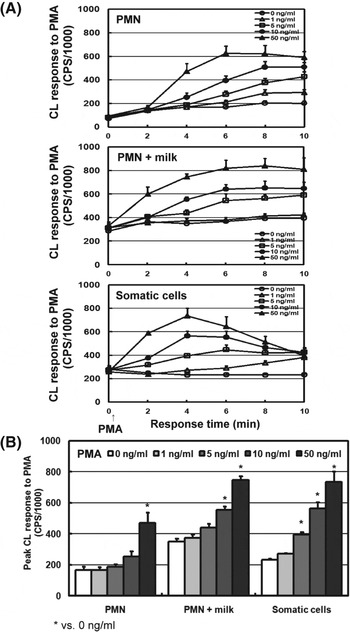
Blood PMN, PMN conditioned in milk, and somatic cells after PMA challenge in vitro are displayed in Fig. 1a and all cell types showed similar dose-responsive (P<0·05) ROS generation (Fig. 1b) with the peak CPS value of blood PMN appearing to be slightly lower and reached more slowly in comparison with PMN conditioned in milk, and somatic cells.
Phorbol 12-myristate 13-acetate (PMA)-induced chemiluminescence (CL) responses of different bovine cell preparations, expressed as counts per second (CPS). (A) Time course of CL response from 2×10⁶ cells of blood PMN, PMN+milk (PMN conditioned in milk), and somatic cells, respectively, on exposure to 0, 1, 5, 10 and 50 ng PMA/ml, respectively. (B) Peak CPS values obtained from (A). PMN+milk (PMN conditioned in milk) were prepared by pre-incubating bovine blood PMN with skimmed cow milk at room temperature for 1 h, and somatic cells were total milk cells isolated from milk of mid-lactation cow. Data are expressed as mean±se of three independent experiments. * Significantly different from results of 0 ng PMA/ml (P<0·05). The purity of PMN in blood PMN and PMN+milk preparations was 95±3% (sd) while PMN ratio in somatic cells was 53±8% (sd)

Responsiveness of ROS generation to different SF68 in vitro
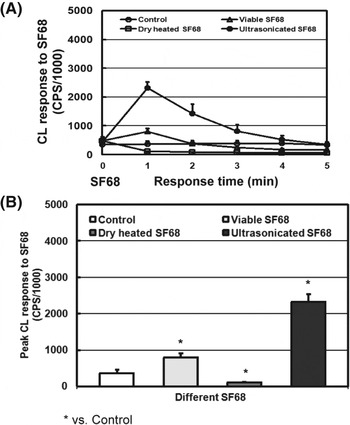
Time curves of CPS level in the CL assays for blood PMN after exposure to viable, ultrasonicated, and dry-heated SF68 are displayed in Fig. 2a and the results showed elevated ROS generation response to ultrasonicated SF68 with peak CPS attained approximately 1 min after exposure but diminished ROS generation response to dry-heated SF68 (Fig. 2a). The peak CPS value for ultrasonicated SF68-exposed PMN was apparently higher than viable SF68-exposed PMN (Fig. 2b).
Chemiluminescence (CL) response of bovine blood PMN on exposure to different SF68 preparations, expressed as counts per second (CPS). (A) Time course of CL response from 2×10⁶ cells of bovine blood PMN at exposure to viable, dry-heated, and ultrasonicated SF68, respectively. (B) Peak CPS values obtained from (A). Each different SF68 preparations contained 5×10⁷ original cfu/ml. Dry heating was performed at 100 °C for 10 min, and ultrasonication was performed at 20 kHz intermittently for 20 min at 0 °C. Data ares expressed as mean±se of three independent experiments. * Significantly different from control (P<0·05). The purity of PMN in blood PMN preparation was 95±3% (sd)

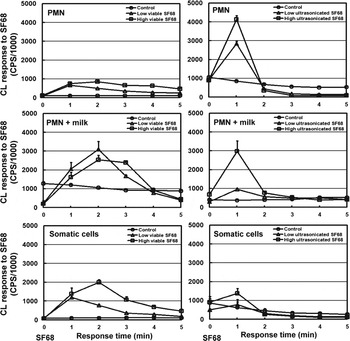
Time curves of CPS level in the CL assays for blood PMN, PMN conditioned in milk, and somatic cells after exposure to different doses of either viable or ultrasonicated SF68 were paralleled in Fig. 3 and the results showed obviously stronger response to high-dose than to low-dose of both viable and ultrasonicated SF68 for all three cell preparations (Fig. 3). Furthermore, the peak CPS level seemed to be attained earlier on exposure to ultrasonicated SF68 compared with viable SF68 for all cell preparations (Fig. 3). Among the three different cell preparations, the ROS generation responses of PMN conditioned in milk, and somatic cells to viable SF68 seemed to be stronger than blood PMN whereas a reverse trend in ROS generation response to ultrasonicated SF68 was noticed (Fig. 3).
Time course of chemiluminescence (CL) response from 2×10⁶ cells of bovine blood PMN, PMN+milk, and somatic cells on exposure to viable and ultrasonicated SF68, respectively, expressed as counts per second (CPS). PMN+milk (PMN conditioned in milk) were prepared by pre-incubating bovine blood PMN with skimmed cow milk at room temperature for 1 h, and somatic cells were total milk cells isolated from milk of mid-lactation cow. Each different SF68 preparation contained 5 (low dose) and 10 (high dose)×107 original cfu/ml, respectively. Ultrasonication was performed at 20 kHz intermittently for 20 min at 0 °C. Data are expressed as mean±se of three independent experiments. The purity of PMN in blood PMN and PMN+milk preparations was 95±3% (sd) while PMN ratio in somatic cells was 53±8% (sd)

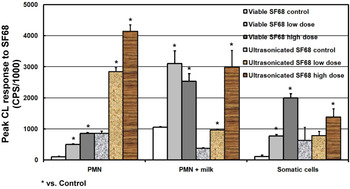
The peak CPS levels following the stimulation of viable and ultrasonicated SF68, respectively, were displayed in parallel for blood PMN, PMN conditioned in milk, and somatic cells in Fig. 4 and the results showed significantly greater peak CPS value (P<0·05) following the stimulation with high doses than low doses of both viable and ultrasonicated SF68, with the exception for PMN conditioned in milk, in response to viable SF68.
Peak CPS values obtained from the time course of chemiluminescence (CL) response from 2×10⁶ cells of bovine blood PMN, PMN+milk, and somatic cells as described in Fig. 3. PMN+milk (PMN conditioned in milk) were prepared by pre-incubating bovine blood PMN with skimmed cow milk at room temperature for 1 h, and somatic cells were total milk cells isolated from milk of mid-lactation cow. Each different SF68 preparation contained 5 (low dose) and 10 (high dose)×107 original cfu/ml, respectively. Ultrasonication was performed at 20 kHz intermittently for 20 min at 0 °C. Data are expressed as mean±se of three independent experiments. *Significantly different from control (P<0·05). The purity of PMN in blood PMN and PMN+milk preparations was 95±3% (sd) while PMN ratio in somatic cells was 53±8% (sd)

Somatic cell counts and typing for the animal infusion trial
None of the four experimental cows exhibited redness or swelling in the SF68-infused udders, nor did they experience fever or have total leucocyte counts over 1×10⁶/ml during the 2-week infusion trial.
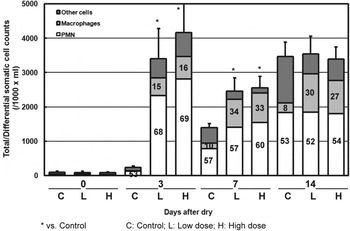
Total and differential SCC in the mammary secretion of experimental cows along the 2-week infusion trial are profiled in Fig. 5 and the results showed significantly (P<0·05) greater total SCC and total PMN counts at day 3 and day 7 but not at day 14 in ultrasonicated SF68-infused quarters compared with control quarters. Nevertheless, no apparent difference in the total SCC and PMN counts was observed between high and low doses of ultrasonicated SF68-infused quarters (Fig. 5).
Total and differential somatic cell counts in the mammary secretion of dry cows during the intramammary infusion trial. Five-ml ultrasonicated SF68 solution was applied to the two front quarters through the teat canal at the dry day (Day 0) while both rear quarters were infused with PBS (Control, C). Ultrasonicated SF68 solution contained 5 (low dose, C) and 10 (high dose, H)×107 original cfu/ml, respectively. Ultrasonication was performed at 20 kHz intermittently for 20 min at 0 °C. Mammary secretion was aseptically collected individually from each quarter at d 3 (Day 3), 7 (Day 7) and 14 (Day 14) after dry and total milk cells were isolated. Data are expressed as mean±se of the four experimental cows. Number on figure indicates the average ratio of each cell type of total somatic cell counts. *Significantly different from control udders (P<0·05). The average sd was 10%

Increase of PMN counts apparently contributed the majority of SF68-induced increments of total SCC at day 3 but increase of macrophage counts seemed to be more prominent than increase of PMN counts at day 7 and day 14 (Fig. 5).
Responsiveness of ROS generation to PMA challenge for in situ somatic cells during the animal infusion trial
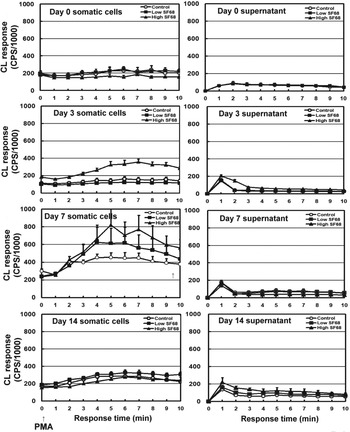
Time curves of CPS level recorded for PMA-challenged somatic cells that were isolated from the mammary secretion collected during the 2-week infusion trial are shown in Fig. 6 and the results showed that at day 3 and day 7, but not at day 14, the ROS generation response of somatic cells recovered from high dose, but not low dose, SF68 infused-quarters appeared to be stronger than that from control quarters (Fig. 6a).
Time course of chemiluminescence (CL) response from 2×10⁶ cells of somatic cells at exposure to phorbol 12-myristate 13-acetate (PMA) and non-stimulated CL readings of supernatant prepared from the mammary secretion of dry cows during the intramammary infusion trial. Five-ml ultrasonicated SF68 solution was applied to the two front quarters through the teat canal at the dry day (day 0) while both rear quarters were infused with PBS (Control, C). Ultrasonicated SF68 solution contained 5 (low dose, C) and 10 (high dose, H)×107 original cfu/ml, respectively. Ultrasonication was performed at 20 kHz intermittently for 20 min at 0 °C. Mammary secretion was aseptically collected individually from each quarter at day 3 (day 3), 7 (day 7) and 14 (day 14) after dry and total milk cells were isolated. Each CL assay used 2×10⁶ somatic cells and 50 ng PMA/ml or 400-μl of skimmed supernatant. Data are expressed as mean±se of the four experimental cows, each three repeated CL assays

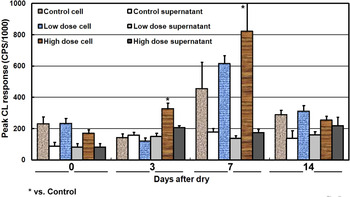
The peak CPS value obtained from the CPS time curves of PMA-challenged somatic cells prepared during the 2-week infusion trial are profiled in Fig. 7 and the results showed significantly (P<0·05) greater peak CPS value for in situ somatic cells isolated at day 3 and day 7 from high dose SF68-infused quarters compared with control quarters.
Peak CPS values obtained from the time course of chemiluminescence (CL) response from 2×10⁶ cells of somatic cells as described in Fig. 6. Five-ml ultrasonicated SF68 solution was applied to the two front quarters through the teat canal at the dry day (Day 0) while both rear quarters were infused with PBS (Control, C). Ultrasonicated SF68 solution contained 5 (low dose, C) and 10 (high dose, H)×107 original cfu/ml, respectively. Ultrasonication was performed at 20 kHz intermittently for 20 min at 0 °C. Mammary secretion was aseptically collected individually from each quarter at d 3 (day 3), 7 (day 7) and 14 (day 14) after dry and total milk cells were isolated. Each CL assay used 2×10⁶ somatic cells and 50 ng PMA/ml or 400 μl of skimmed supernatant. Data are expressed as mean±se of the four experimental cows, each three repeated CL assays. *Significantly different from control (P<0·05)

A spontaneous gradual elevation of peak CPS value was observed at day 3 and day 7 for PMA-challenged somatic cells from control quarters.
Free radical level of mammary secretion during the animal infusion trial
Time curves of CPS level recorded for the supernatant of mammary secretion collected during the 2-week infusion trial are shown in Fig. 6 and the results showed relatively low and stable CPS level throughout the infusion trial with CPS peaked around 1 min.
The peak CPS value obtained from the CPS time curves of the supernatant of mammary secretion collected during the trial are profiled in Fig. 7 and the results showed no apparent difference between control and SF58-infused quarters throughout the infusion trial.
Discussion
The introduction of probiotics to the gastrointestinal tract has become a popular option for better health (FAO & WHO, 2001). Scientists have found that many of the beneficial effects obtained from viable cells of probiotics are also obtained from populations of dead cells (Sakai et al. Reference Sakai, Tsukahara, Bukawa, Matsubara and Ushida2006, Reference Sakai, Tsukahara and Matsubara2007; Chuang et al. Reference Chuang, Wu, Pai, Hsieh, Tsai, Yen and Lin2007). The use of dead probiotics as biological response modifiers has several attractive advantages such as better safety and longer shelf-life (Adams, Reference Adams2010).
Bovine mastitis is the most costly disease for dairy farmers. It has been reported that the local defence mechanisms of the mammary gland play a critical role against mastitis pathogens in cows (Sordillo & Streicher, Reference Sordillo and Streicher2002). Exploitation of probiotics through the teat canal directly into the glandular cistern has been adopted as an alternative to antibiotics for the prevention and treatment of mastitis in dairy production. Different animal models have been used in those intramammary infusion trials including normal lactating cows (Beecher et al. Reference Beecher, Daly, Berry, Klostermann, Flynn, Meaney, Hill, McCarthy, Ross and Giblin2009; Frola et al. Reference Frola, Pellegrino, Espeche, Giraudo, Nader-Macias and Bogni2012), cows with naturally acquired mastitis (Crispie et al. Reference Crispie, Alonso-Gomez, O'Loughlin, Klostermann, Flynn, Arkins, Meaney, Ross and Hill2008; Klostermann et al. Reference Klostermann, Crispie, Flynn, Ross, Hill and Meaney2008) and cows at drying off (Ryan et al. Reference Ryan, Flynn, Hill, Ross and Meaney1999). Also in those intramammary infusion trials, various probiotic preparations have been tested, such as live, heat-killed and freeze-dried probiotic cultures, cell-free culture broth (Crispie et al. Reference Crispie, Alonso-Gomez, O'Loughlin, Klostermann, Flynn, Arkins, Meaney, Ross and Hill2008; Klostermann et al. Reference Klostermann, Crispie, Flynn, Ross, Hill and Meaney2008; Beecher et al. Reference Beecher, Daly, Berry, Klostermann, Flynn, Meaney, Hill, McCarthy, Ross and Giblin2009; Frola et al. Reference Frola, Pellegrino, Espeche, Giraudo, Nader-Macias and Bogni2012) and subcellular components (Ryan et al. Reference Ryan, Meaney, Ross and Hill1998, Reference Ryan, Flynn, Hill, Ross and Meaney1999).
The commercial SF68 product used in the current study is originally recommended for PO-administration. This probiotic strain has proven beneficial for pets (Veir et al. Reference Veir, Knorr, Cavadini, Sherrill, Benyacoub, Satyaraj and Lappin2007; Simpson et al. Reference Simpson, Rishniw, Bellosa, Liotta, Lucio, Baumgart, Czarnecki-Maulden, Benyacoub and Bowman2009; Bybee et al. Reference Bybee, Scorza and Lappin2011) and pigs (Scharek et al. Reference Scharek, Guth, Reiter, Weyrauch, Taras, Schwerk, Schierack, Schimidt, Wieler and Tedin2005, Reference Scharek, Guth, Filter and Schmidt2007; Broom et al. Reference Broom, Miller, Kerr and Knapp2006), yet has not been thoroughly tested in dairy cattle. Choosing a commercial probiotic product in the current research was regarded advantageous over laboratory-prepared probiotic cultures because it is biologically tested and has stable and uniform colonisation potential (1×10⁹ cfu/g). The purposes of our present research were to explore whether SF68 could be applied in cow intramammarily during the dry period to enhance the local innate immunity, and to determine which form of SF68 is most effective. We firstly designed experiments in vitro to observe, under a simulated cow mammary gland environment, the ROS generation response of bovine PMN on exposure to different SF68 preparations. Based on the CL assay, we found that the ROS generation of blood PMN was nearly dose-responsive to both viable and ultrasonicated SF68 (Fig. 3), as well as to the positive control PMA (Fig. 1). Furthermore, similar ROS generation responsiveness to SF68 and PMA was observed for PMN conditioned in milk, and the post-diapedesis model somatic cells (Figs. 1 & 3) suggesting that factors inside the cow mammary gland exert no obvious harm to the ROS generation capacity of local defence cells.
Our experiments in vitro also found that the ROS generation responses of blood PMN were promoted after ultrasonication treatment of the commercial SF68 product while dry-heating, on the contrary, completely abolished it (Fig. 2). Nevertheless, no apparent change was observed in the ROS generation responses of milk-primed PMN or somatic cells by similar ultrasonication treatment of this probiotic product (Fig. 3). Dry-heating and ultrasonication treatment were performed directly on the freshly reconstituted commercial SF68 without pre-culture, which means all three SF68 preparations were started with exactly the same bacterial counts and broth composition. SDS-PAGE analyses of both soluble and suspension showed no difference in the major proteinous components among the three SF68 preparations (data not shown). Also, Bio Rad dye-binding protein assay found higher soluble protein content for dry-heated SF68 compared with viable and ultrasonicated SF68 (data not shown). It is suspected that dry-heating, but not ultrasonication, significantly increased the release of intracellular proteins which might not be detected by SDS-PAGE owing to the sensitivity limit. It is more likely that the degraded and exposed structural protein resulting from the ultrasonication treatment modified the immunogenic properties of SF68 toward PMN. Further characterisation of the three SF68 preparations including the proportions of live and dead cells would be helpful for elucidating the underlying mechanisms involved in modifying the ROS generation capacity of PMN.
The observations from our experiments in vitro favoured our choice of ultrasonicated SF68 in intramammary infusion trial and seem to agree with that of Adams (Reference Adams2010) who pointed out that dead probiotics stimulated beneficial biological responses probably through the mode of action of an immune modifier rather than through interaction with gastrointestinal microflora as live probiotics. Similarly based on the preliminary CL assay, we found that single infusion of ultrasonicated SF68 on the first day of the dry period not only could accelerate the recruitment of PMN from the circulation into the mammary lumen during the first week of dry period (Fig. 5) but also could enhance the ROS generation capacity of newly recruited immune cells (Fig. 6). Despite its transience, the prompt acceleration of PMN infiltration during the early dry period is critical for mastitis control because the risk of new infection is also reported to be high meanwhile (Mehrzad et al. Reference Mehrzad, Dosogne, Meyer and Burvenich2001).
Crispie et al. (Reference Crispie, Alonso-Gomez, O'Loughlin, Klostermann, Flynn, Arkins, Meaney, Ross and Hill2008) and Beecher et al. (Reference Beecher, Daly, Berry, Klostermann, Flynn, Meaney, Hill, McCarthy, Ross and Giblin2009) infused live probiotic strains into the mammary gland of mastitis cows and found substantial recruitment of not only PMN but also lymphocytes into to the udders over the first 48 h post infusion. Both studies, however, found almost no viable probiotics recovered by 48 h post infusion, implying that it was the released or exposed components of the dead probiotic cells that were likely to be responsible for recruitment of immune cells.
In the observations of Crispie et al. (Reference Crispie, Alonso-Gomez, O'Loughlin, Klostermann, Flynn, Arkins, Meaney, Ross and Hill2008), boiling-killed probiotics were only slightly less efficient in inducing PMN recruitment than live or freeze-dried probiotics, or cell-free culture broth. This seems somewhat conflicting with our observations in vitro (Fig. 2). Also, contradictory outcomes were obtained from different live probiotics when infused directly into the mammary gland of healthy dairy cows. In the study of Beecher et al. (Reference Beecher, Daly, Berry, Klostermann, Flynn, Meaney, Hill, McCarthy, Ross and Giblin2009) all experimental cows showed signs of systemic and udder inflammation with elevated SCC and cytokine expression. While in the study of Frola et al. (Reference Frola, Pellegrino, Espeche, Giraudo, Nader-Macias and Bogni2012) neither SCC nor udder or milk appearance was apparently affected. Consequently, for prevention of new mastitis in healthy cows, intramammary infusion of inactivated probiotics seems consistently more promising than live probiotics in that the local defence system could be promoted without the risk of udder inflammation.
In our intramammary infusion trial, besides the findings that the ROS generation capacity of in situ somatic cells was promoted during the first week after ultrasonicated SF68 infusion (Fig. 6), a spontaneous elevation of the ROS generation capacity of in situ somatic cells in control quarters was also noticed during the same period (Fig. 6). This spontaneous activation of somatic cells observed in situ could be regarded self explanatory to the current observations in vitro of slightly better ROS generation responsiveness of somatic cells compared with blood PMN (Figs. 1 & 3). However, it is generally acknowledged that milk PMN are less effective defence cells than their blood counterparts (Mehrzad et al. Reference Mehrzad, Dosogne, Meyer and Burvenich2001; Tian et al. Reference Tian, Chang, Chiang, Peh, Huang, Lee and Zhao2005) although blood PMN functionality is solely theoretical and of little physiological relevance.
In conclusion, using CL assay, in both experiments in vitro and an animal intramammary infusion trial suggest potential benefits of ultrasonicated SF68 to local innate immunity in drying-off dairy cows. The potential intramammary application of probiotics in other production stages of dairy cows warrants further exploration. Observations on the innate immunity of PMN other than ROS generation such as cytokine expression, degranulation, phagocytosis and the biochemical changes of mammary secretion will be adopted in our future studies.