Introduction
Frontline work matters: civil servants working at the frontline of public human service organisations play a key role in the implementation of social policies and the delivery of social services. This was the key conclusion of Michael Lipsky's study of street-level bureaucrats. Lipsky (Reference Lipsky1980) argued that frontline workers have considerable room for discretionary decision making, that their decisions ‘effectively become the public policies they carry out’ (Lipsky, Reference Lipsky1980: xii, italics in original) and that street-level bureaucrats ‘hold the key to a dimension of citizenship’ (Lipsky, Reference Lipsky1980: 4). In a similar way emphasising the active role of frontline workers, Jewell (Reference Jewell2007) talks about the agents of the welfare state in his comparative study of frontline workers in local welfare agencies. Vinzant and Crothers (Reference Vinzant and Crothers1998) introduced the concept of street-level leadership to denote frontline workers’ roles of exercising discretion, acting legitimately and giving account of their decisions and actions in a complex environment comprised of laws, the agency in which they work, supervisors, clients, other agencies, co-workers, media, the court and citizen expectations.
Against this background, it is rather surprising that we know relatively little about frontline workers’ role in implementing and delivering one of the most far-reaching reforms welfare states have experienced over the last decades: the shift from passive to active welfare arrangements and the introduction of welfare-to-work or activationFootnote 1 programmes and services to promote the labour-market entry of unemployed people. This is especially the case in Europe, where only a few studies of activation frontline work have been published; in the US, there is a more developed tradition of examining the actual implementation of welfare-to-work reforms (Henman and Fenger, Reference Henman and Fenger2006; Jewell, Reference Jewell2007). As a consequence, the study of activation in European social policy research remains predominantly a study of formal, national activation policies. We consider this focus on formal policies problematic for the following reasons.
First of all, the argument developed by Lipsky and other authors on the role of public frontline workers implies that we cannot assume that formal policies and policy practices are similar, and that frontline workers are merely implementers of formal policies. Lipsky himself talked about ‘street-level bureaucrats as policy makers’, thus clearly criticising the dichotomy between policy making and policy implementation. Marston et al. (Reference Marston, Larsen and McDonald2005: 154) approvingly quoted Clarke who argued that ‘welfare states are more than the proclamations of governments and sets of institutional arrangements, they are a multitude of complex social and cultural spaces that resist easy categorisation’. Frontline practices are one of these spaces. As Vinzant and Crothers (Reference Vinzant and Crothers1998) argue, frontline workers not only work under specific policy conditions, they also for example work under conditions set by the organisations they work in, the professions they belong to, the governance structures they are part of. In the context of activation policies, this implies that, intended or unintended, the ways in which frontline workers in activation deal with unemployed people, the services that these workers provide and the decisions that they make are structured by various rationales (see Fletcher, Reference Fletcher2011).
Secondly, welfare-to-work reforms change the ways in which welfare states deal with unemployment and the unemployed and imply a shift – using the terminology of Hasenfeld (Reference Hasenfeld1983) – from people processing technologies to people changing technologies: activation services are aimed at changing people's situation, behaviour and attitudes. According to Jewell (Reference Jewell2007), who compared the work of benefit administrators and activation workers in local welfare agencies in three countries, activation work is less rule-bound and less regulated in detail than the provision of income support, in order to enable responsive, individualised and personalised activation. Kazepov (Reference Kazepov2010) showed that processes of rescaling social policies reduced the role of national regulation of activation in many European countries, rendering regional and local actors more power and authority in determining the nature of activation policies. Decentralisation and deregulation trends may differ considerably across welfare states (Van Berkel et al., Reference Van Berkel, de Graaf and Sirovatka2011), so that the role of discretionary decision making in implementing activation policies becomes an important ‘variable’ in activation research.
These considerations bring us to the conclusion that public frontline workersFootnote 2 involved in activating unemployed people have room to exercise discretion in providing activation services, that this room may be considerable and that activation workers exercise influence over what activation practically means and how it affects the lives of the unemployed. This unavoidably raises issues concerning the use and management of discretion and the design of activation frontline work: should activation work be organised as a rule-oriented administrative function or as a professional task? In addition, we raise the question: does the design of activation work matter in terms of the effectiveness of activation services? In other words, are decisions concerning how activation work is organised relevant from the point of view of the successfulness of activation policies? The objective of this article is to analyse how the available literature on activation frontline work discusses and deals with these questions. In doing so, we will use the following approach.
In the next section, we analyse the literature examining the nature, organisation and management of activation work in public agencies involved in providing welfare-to-work services. The authors of the studies use various theoretical perspectives in analysing the nature of activation work, partly reflecting the broader issues they address, such as the impact of new public management on activation work in public agencies (Brodkin, Reference Brodkin2007; Brodkin, Reference Brodkin2011; Soss et al., Reference Soss, Fording and Schram2011; Considine, Reference Considine2000), the consequences of welfare-to-work reforms for social work (Marston et al., Reference Marston, Larsen and McDonald2005; McDonald and Marston, Reference McDonald and Marston2006), the ethical and moral dilemmas that frontline workers are confronted with (Kjørstad, Reference Kjørstad2005) and administrative decision making by frontline workers (Adler, forthcoming; Sainsbury, Reference Sainsbury2008). Nevertheless, the studies reveal considerable heterogeneity in the design and nature of activation work, the discretion of activation workers, the ways in which discretion is used and the conditions that structure (the use of) discretion.
The third section will focus on another strand of literature; namely, studies of the effectiveness of activation. Most evaluation studies focus on the effectiveness of specific activation programmes. A second, more recent type of evaluation studies focuses on the effects of governance characteristics of the provision of welfare-to-work, such as quasi-markets for service provision. Most relevant for the purpose of this article is a third type of evaluation that focuses on the impact of frontline work characteristics on the effectiveness of welfare-to-work. In selecting studies for this part of our analysis, we decided to focus on studies that examine net effectiveness by using advanced statistical and econometric methodologies, as these types of studies are often considered to provide more robust insights into the effects of certain variables.Footnote 3 Of course, this selection has certain limitations. The number of studies we found is small, making it difficult to reach firm conclusions, especially because the findings of the studies are not always unanimous. In addition, the studies use a rather narrow range of indicators of success and effect. However, for the purpose of this article – exploring whether activation work characteristics have an impact on the effects of activation – these limitations are acceptable.
Activation work: professional service delivery or bureaucratic programme administration?
Raising the question − ‘what is it that activation workers in public agencies actually do?’ − is a lot easier than answering it. One of the reasons for this is that the contexts that structure the nature of their work differ considerably between, and often also within, countries:
• The activation policies that activation workers implement differ for example in terms of the diversity of programmes, the nature of rights and obligations of unemployed people and the nature of sanctions and the strictness of enforcing sanctions.
• Activation work varies with the characteristics of the service provision model through which the provision of activation is organised. Activation workers may for example be fully responsible for activation when services are produced ‘in house’, they may be co-producers in the context of service networks and they may be referral agents when service provision is outsourced. In addition, variety exists in the degree and nature of national regulation concerning how activation work should be organised and managed locally;
• Organisational contexts vary for example in terms of resources available for activation;
• Professional contexts vary: activation workers have different educational profiles and backgrounds in different countries. In some countries, activation workers are ‘traditional’ social workers, in others they used to be benefit administrators.
In this article, we will need to abstract from all these country-specific contextual factors. Our focus will be on some core issues that arise from the available studies of activation work and activation workers. In these studies, the question whether activation work should be considered a profession is hardly discussed explicitly: apparently it is taken for granted that the provision of activation involves, or rather should involve (elements of) professional work. Instead, the debate concentrates on the issue whether activation workers can work as professionals: that is, whether the conditions exist under which activation workers can provide activation services in a professional way.
Activation work: a profession?
In answering this question, we find two approaches in the literature. The first approach is reflected in studies that use social work as the referential professional model for activation work. In these studies, the debate focuses on the issue whether activation policies are compatible with the professional standards of social work. In an interesting and, in this context, rather provocative article, Hasenfeld (Reference Hasenfeld1999) explored the prospects for the social work profession and raised the question whether a service orientation can be introduced into public welfare agencies that introduce employment or activation services in the context of US welfare-to-work policies. He described this service orientation as follows: ‘a) a belief system that ascribes high moral worth to the clients; b) a service technology that is individualised . . . and c) staff–client relations that are based on mutual trust’ (Hasenfeld, Reference Hasenfeld1999: 185). According to Hasenfeld (Reference Hasenfeld1999) the mandatory nature of welfare-to-work policies and the fact that these policies make welfare entitlements dependent on participation in activation programmes ‘compromises and corrupts’ the social service orientation. Firstly, the professional model that is required for providing social services such as activation is overshadowed by the bureaucratic work of monitoring and sanctioning clients in cases of non-compliance. Hasenfeld (Reference Hasenfeld1999) seems to attribute this to the fact that, in the US case, the functions of income maintenance and providing welfare-to-work services are integrated. But one can argue that the problem will persist when both functions are separated, as tensions between client-oriented service provision and sanctioning and monitoring processes are inherent to mandatory activation policies, and not merely the consequence of how the income maintenance and activation functions are organised (also see Hill, Reference Hill2006). Secondly, Hasenfeld (Reference Hasenfeld1999) argues that the mandatory nature of activation makes relations of mutual trust between frontline workers and clients hard to establish: ‘a social service orientation cannot flourish when embedded in a mandatory program’ (Hasenfeld, Reference Hasenfeld1999: 193). This argument resonates in several publications on activation work (e.g. Handler, Reference Handler, Henman and Fenger2006; Wright, Reference Wright2003; Thorén, Reference Thorén2008). Monitoring and sanctioning unemployed people are considered incompatible with a professional work (or, at least, social work) repertoire, which makes the prospects of the social work profession rather gloomy given the increasing emphasis in social policies on obligations, sanctions, reciprocity and individual responsibilities.
The educational and occupational backgrounds of frontline workers in welfare and benefit agencies vary across countries, so that the introduction of activation policies has had various consequences on ‘traditional’, pre-activation frontline work. In some countries, frontline workers used to be benefit administrators, in others they used to be social workers (who were sometimes also responsible for benefit administration tasks). Several studies elaborate upon the transformation of social work into activation work. Marston et al. (Reference Marston, Larsen and McDonald2005) compared frontline practices in Australia and Denmark and showed that activation affected social work in different ways in both countries. Danish activation workers have considerably more discretion than their Australian colleagues and draw on ‘a much thicker description of the “social” in their understanding of unemployment’ (Marston et al., Reference Marston, Larsen and McDonald2005: 154). The authors also pay attention to the use of sanctions (coercive authority) and find that contrary to Denmark, in Australia ‘the policy guidelines do not allow case managers to “use” coercive authority differentially for developmental reasons’ (Marston et al., Reference Marston, Larsen and McDonald2005: 150). This seems to indicate that the authors do not consider the use of sanctions as incompatible with a professional work ethos per se.
Recent developments in Danish activation policies have increased pressures on social workers (Jørgensen et al., Reference Jørgensen, Nørup and Baadsgaard2010) and reveal that the nature of ‘professional’ activation work and how it relates to ‘traditional’ social work are part of a political struggle. The discretion of activation workers has been reduced, activation work has become more standardised and the more holistic approach to the problems of unemployed people that Marston et al. (Reference Marston, Larsen and McDonald2005) saw as making Danish activation work distinct from Australian activation work is challenged. Against that background, Jørgensen et al. (Reference Jørgensen, Nørup and Baadsgaard2010) conclude that a de-professionalisation of activation work is taking place. At the same time, they point at re-professionalisation trends, for example as a consequence of the fact that activation workers increasingly collaborate with other actors in the context of service markets and networks. Processes of de-professionalisation and re-professionalisation of frontline work in the context of activation are also found in the Norwegian case (Kjørstad, Reference Kjørstad2005). On the one hand, similar concerns are expressed as were discussed by Hasenfeld (Reference Hasenfeld1999) concerning the possible corruption of the ethical norms of the social work profession as a consequence of activation. On the other hand, Kjørstad's (Reference Kjørstad2005) outlook on the prospects of the social work profession is not as gloomy as Hasenfeld's: ‘(o)ne of the great challenges for the practice of social work under the policy of workfare is being able to tackle several interconnected practices and rationalities simultaneously’ (Kjørstad, Reference Kjørstad2005: 395). In other words, de-professionalisation is not considered to be unavoidable, although, like Hasenfeld (Reference Hasenfeld1999), Kjørstad (Reference Kjørstad2005) considers the broader policy context of crucial importance in enabling activation workers to deal with ethical dilemmas.
The second approach in the literature looks at activation work as a ‘new’ profession. These studies argue that the development of this profession (substantially as well as institutionally) is still in its infancy. Taking a Freidsonite approach to professions (Freidson, Reference Freidson2001) as a starting point, several authors are critical about the professional status of activation work. Sainsbury (Reference Sainsbury2008), for example, argues that although British activation workers (‘personal advisers’) are expected to act in a professional way and have considerable room for discretionary decision making, their profession lacks several characteristics usually assigned to full professions. He argues that the professional status of activation workers should be strengthened by ‘(e)stablishing them as a profession, with accredited training and qualifications, a code of conduct and registration with a regulatory body responsible for maintaining professional standards’ (Sainsbury, Reference Sainsbury2008: 336). Along quite similar lines, Jørgensen et al. (Reference Jørgensen, Nørup and Baadsgaard2010) characterise Danish activation workers as pre-professionals. These workers often do not have appropriate training and education in activation work, no systematic knowledge is produced and no professional community exists. Van Berkel et al. (Reference Van Berkel, van der Aa and van Gestel2010), who typify Dutch activation workers as professionals without a profession, characterise the status of the activation profession in exactly the same way: there is no officially recognised body of knowledge to guide professional decision making, there are no vocational associations, there are no accredited training and education programmes. These authors argue that, in as far as activation workers are expected to act as professionals, some crucial conditions that should enable them to do so are lacking. It is argued that this jeopardises the transparency of activation workers’ use of professional autonomy and discretion (Van Berkel, Reference Van Berkel, Betzelt and Bothfeld2011; also see Fletcher, Reference Fletcher2011). For if it is not professional guidelines and standards that guide the use of discretion, then what does?
The mix of administrative and professional elements and the use of discretion
Most studies of activation work emphasise that administrative elements are inherent to this type of work, but scholars disagree when it comes to the issue of whether these administrative elements are incompatible with professional work or whether they are a characteristic of this specific type of professional work. Sainsbury (Reference Sainsbury2008) points at the tension that activation workers experience between the professional treatment and the bureaucratic rationality models that they are confronted with. In a similar way, Wright (Reference Wright, Henman and Fenger2006) characterised British activation workers as hybrid bureau-professionals. Again, some authors point specifically to the compulsory nature of activation and the use of sanctions as the source of bureaucratic, rule-bound elements in activation work. For example, Howard (Reference Howard, Henman and Fenger2006) discusses the tensions between Australian frontline workers’ roles of welfare policeman and caring, compassionate officer, and Sainsbury (Reference Sainsbury2008) argues that activation workers are required to reconcile the roles of bad cop and good cop in their work. As we saw in the above already, compulsion and sanctions are core issues in the debate concerning the nature of activation work. Whereas some authors consider compulsion and sanctions irreconcilable with professional work (cf. Hasenfeld, Reference Hasenfeld1999), others adopt a more qualified position on this issue (Marston et al., Reference Marston, Larsen and McDonald2005; Nybom, Reference Nybom2011). In a study of Dutch activation workers, it was found that some activation workers apply sanctions in a bureaucratic, rule-bound way, whereas others apply them – in as far as discretionary room allows them to – for, in the words of Marston et al. (Reference Marston, Larsen and McDonald2005), developmental reasons (Van der Aa, forthcoming).
The debate about the professional and administrative elements characterising activation work is also echoed in analyses of the room for discretionary decision making of activation workers, and of the decision-making rationalities underlying activation workers’ use of discretion. We can illustrate this by focusing on one of the tasks of activation workers: the assessment of clients and the resulting match of clients and activation services. Sainsbury (Reference Sainsbury2008) characterises the work of British activation workers as professional: these workers have a conversation with their clients in order to make a diagnosis (a concept he uses to underline similarities with the doctor–patient relationship) of their clients’ situations and work barriers, which results in an action plan. In his comparative study of activation workers in the US, Germany and Sweden, Jewell (Reference Jewell2007) distinguished two important dimensions structuring the nature of assessment and matching processes: the range of programme offerings available and the nature of worker–client contacts (short-term or longer-term). Jewell argues that when the range of programme offerings is extensive and workers are able to develop longer-term contacts with their clients, workers can be more responsive to clients’ needs than when offerings are limited and workers only have short-term contacts. Activation workers have more room for professional decision making when they can select from a wider range of services and when their contacts with clients are long-standing. Seen from this perspective, German and Swedish activation workers have more room for professional work than their US colleagues. Jewell's findings help to explain why US studies seem to emphasise the bureaucratic and administrative nature of activation work more strongly than European studies do.
Whether or not activation workers have something to choose when offering the unemployed activation services also depends on the criteria that define whether or not groups of clients have access to available services and programmes. When criteria are strict and unambiguous, activation work may become a lot more administrative (determining whether or not a client meets access criteria for programme participation) than when criteria are flexible, ambiguous or both. The UK case is illustrative in this context: various New Deal programmes for specific target groups were replaced by a flexible New Deal in order to enable the provision of more tailor-made services at the frontline (Wright, Reference Wright, van Berkel, de Graaf and Sirovatka2011). Potentially, this increases the room for frontline decision making and for a more personalised and professional approach in matching clients and services. Similar processes of deregulating or flexibilising activation took place in other countries as well, as was mentioned in the above.
Furthermore, the assessment process itself may involve more or less professional decision making. Several countries experimented with or introduced statistical profiling instruments (for example, Germany, Switzerland, Denmark; also see the next section) for assessing clients’ needs and guiding the process of matching clients and services. These instruments may serve varying purposes (Behncke et al., Reference Behncke, Frölich and Lechner2007b): they may provide information that supports activation workers in making a professional decision, but they may also be used as an instrument to reduce activation workers’ room for discretion and to make their work more rule-bound and administrative. In other words, the introduction of profiling instruments and other forms of work process standardisation in itself tells us little about the professional or administrative nature of activation work. Standardisation may take place in bureaucratic, administrative work settings as well as in professional work practices.
The organisational context and new public management
Public organisations involved in activating unemployed people are often proto-typical street-level bureaucracies, which are confronted with high caseloads and limited resources. Many authors (e.g., Jewell and Glaser, Reference Jewell and Glaser2006; Thorén, Reference Thorén2008; Morgen, Reference Morgen2001; Sainsbury, Reference Sainsbury2008; Brodkin, Reference Brodkin2011) consider high caseloads as an important if not crucial determinant of frontline workers’ practices. It may, for example, encourage them to adopt speed-over-need strategies (Brodkin, Reference Brodkin2011), prioritise quick employment placements rather than training or career shift services (Sainsbury, Reference Sainsbury2008), be more selective in deciding what clients will be served (Wright, Reference Wright, Henman and Fenger2006) or treat some clients in a professional, individualised way while others are served in a more administrative way and receive standardised services (Van Berkel et al., Reference Van Berkel, van der Aa and van Gestel2010). All these and similar strategies to cope with high caseloads are well known from the literature on street-level bureaucracies. In combination with a lack of time for clients and a lack of resources for adequate services, high caseloads make it hard for activation workers to work according to professional standards and provide personalised services, at least when they want to serve all their clients professionally.
Most activation work studies also agree that new public management styles of managing activation workers have a considerable impact. Brodkin (Reference Brodkin2011) shows how in a context of increased discretion, which theoretically could provide more room for professional activation work, the use of discretion may be seriously affected by performance management, which is often considered as one of the most outstanding new public management instruments. She argues that performance targets may help to realise certain policy objectives but may at the same time jeopardise objectives that are not counted – which brings her to the conclusion that the selection of targets is not a technical, but a political decision. Her article mentions several examples of how frontline workers focus on what is counted: numbers of programme referrals become more important than adequate referrals, and realising targets becomes more important than responding to unemployed people's needs. For the Australian case, McDonald and Marston (Reference McDonald and Marston2006) conclude that new public management curtailed professional autonomy, among others, by an increase in accountability procedures and by more narrow definitions of what are considered as ‘good outcomes’. In Denmark, new public management implied a shift from professional responsibility towards accountability, which increased the administrative workload of activation workers (Jørgensen et al., Reference Jørgensen, Nørup and Baadsgaard2010). Several authors point out that performance management may result in strategies where activation workers try to realise quick wins, by focusing their time and resources on people that are considered as easy to reintegrate into the labour market (Sainsbury, Reference Sainsbury2008; Van Berkel et al., Reference Van Berkel, van der Aa and van Gestel2010). This does not imply that new public management is always successfully implemented. Brodkin (Reference Brodkin2011) found activation workers who bent the rules for favourite clients; but she adds that these practices may not be without risk for workers. Some authors found instances where the impact of performance targets on activation work was relatively minor (Sandfort, Reference Sandfort2000; Lurie and Riccuci, Reference Lurie and Riccucci2003). Nevertheless, several authors conclude that new public management jeopardises professional activation work and influences the use of discretion by introducing an organisational logic (which some authors see as incompatible with the professional logic) in street-level decision making.
These studies show that organisational conditions may put professional activation work under pressure and may elicit administrative coping strategies among activation workers. In addition, they reveal that the dichotomy between administrative and professional work is made more complex as a consequence of the introduction of managerialism in public agencies. It is clear that specific forms of new public management challenge the professional use of discretion. But the literature is less univocal on the issue of whether this is true for new public management strategies generally.
Activation work and the effectiveness of activation
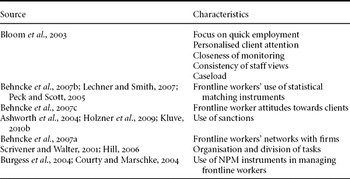
Whereas the studies discussed in the former section provide insight into the design of activation work and explore the potential impact on service provision processes of activation work characteristics, the evaluation studies discussed in this section systematically investigate the consequences of activation work design variables on specific outcome indicators. One of the first evaluation studies – as far as we know – that investigated how frontline work characteristics are related to the effectiveness of welfare-to-work policies is an American study carried out by Bloom et al. (Reference Bloom, Hill and Riccio2003). They made a research synthesis based on data from three random assignment experiments, using short-term client earnings as the dependent variable. Five frontline work characteristics were examined. The first characteristic concerns the emphasis that frontline workers put on quick employment in their interactions with clients. Clearly communicating this objective to the unemployed was expected to have a positive impact on programme outcomes. Secondly, the study looked at the impact of personalised client attention. Among others, this refers to the degree to which frontline workers try to gain insight into unemployed people's situations and needs, and the degree to which they try to offer them corresponding welfare-to-work services. The third frontline work characteristic refers to closeness of monitoring. This involves the degree to which frontline workers follow the progress of their clients and clients’ compliance with obligations while they participate in welfare-to-work programmes. The fourth characteristic involves consistency of staff views: the consensus among frontline workers as well as among frontline workers and their supervisors concerning the purpose and usefulness of welfare-to-work programmes. The final characteristic Bloom et al. (Reference Bloom, Hill and Riccio2003) looked at is considered a crucial factor for activation work, as we saw before: workers’ caseloads. Bloom et al. (Reference Bloom, Hill and Riccio2003) found that the emphasis on quick employment and personalised client attention contributed positively to effectiveness. High caseloads and inconsistency of views among frontline workers and supervisors affected effectiveness in a negative direction. For closeness of monitoring, no significant impact on effectiveness was found.
One of the tasks of activation workers is matching clients and activation programmes or services. As we saw before, their discretion in this varies, depending, amongst other things, on the range of available programmes and services, on profiling procedures and instruments and on the access criteria of programmes and services. Many studies evaluating the effectiveness of specific activation programmes argue that finding the right match between client and programme is an important factor in making activation successful (see Kluve, Reference Kluve2010b). Against this background, several studies compared welfare-to-work effectiveness in a context where frontline workers make matching decisions independently, with a situation in which frontline workers’ decisions were supported and steered through statistical matching instruments. In a Swiss randomised experimental study, Behncke et al. (Reference Behncke, Frölich and Lechner2007b) found no significant differences. In an attempt to explain this result (which they did not expect), they looked deeper into frontline workers’ use of the statistical matching instrument. They found that some frontline workers did not use the instrument at all, whereas others only used it for some of their clients. Another Swiss study (Lechner and Smith, Reference Lechner and Smith2007) found a positive impact of the use of statistical tools in programme assignments. The study concluded that frontline worker allocation produced roughly the same post-programme employment rate as random programme assignment, whereas assignment on the basis of statistical information produced considerably better results. An American study (Peck and Scott, Reference Peck and Scott2005) reached somewhat different conclusions. This study found that clients of frontline workers who used the tool received more services and realised higher programme participation, but their short-term employment outcomes were not different compared to clients whose frontline workers did not use the tool.
Attitudes towards the unemployed are another issue where frontline workers differ. For example, some frontline workers may adopt a more harmonious and cooperative attitude towards their clients, while others may decide to be stricter and more confronting. Behncke et al. (Reference Behncke, Frölich and Lechner2007c) conducted a study in Switzerland where they investigated the impact of frontline workers’ attitudes on clients’ employment probabilities. They found that unemployed people's employment probabilities were two percentage points higher when their frontline workers had a less cooperative and more demanding attitude towards them.
In this context, we can also point to the use of sanctions. Sanctions are often studied as a subcategory within one type of welfare-to-work programme, namely ‘sanctions and services’ (Kluve, Reference Kluve2010a). However, one could consider the use of sanctions also as a characteristic of activation workers’ attitudes towards clients, as activation workers are actively involved in deciding whether or not a sanction should be applied in certain cases (alternatively, workers may decide to threaten with a sanction without actually applying it). Various studies found positive effects of the use of sanctions (Ashworth et al., Reference Ashworth, Cebulla, Greenberg and Walker2004; Holzner et al., Reference Holzner, Munz and Büttner2009; Kluve, Reference Kluve2010b). Interestingly, Kluve (Reference Kluve2010b) points at a study that concluded that the effect of a sanction warning is as large as that of actually imposing a sanction.
A recurrent critique in debates about welfare-to-work is that it focuses very strongly on the unemployed while ignoring the willingness of employers to hire unemployed people, especially those with a marginal and vulnerable labour-market position. In terms of activation work, one could argue that it might be beneficial for the labour-market opportunities of the unemployed if frontline workers not only provide support to the unemployed but also develop networks with employers. This proposition was investigated in a study conducted by Behncke et al. (Reference Behncke, Frölich and Lechner2007a). Their study found that frontline workers who developed a network of employers and maintained contacts with firms were more successful in reintegrating the unemployed.
As a consequence of active welfare state reforms, integrating the provision of income protection and welfare-to-work services has become more important and this in turn has triggered a wave of reforms of the structures through which income protection and welfare-to-work programmes are implemented. One of the consequences of this is that an increasing number of public agencies now combine tasks related to testing eligibility for benefits and benefit administration with the provision of welfare-to-work programmes and services. As we discussed before, this raises issues concerning the tasks of frontline workers. In a US study, Scrivener and Walter (Reference Scrivener and Walter2001) compared the impact on various welfare-to-work outcomes of two frontline work models: traditional case management, where income maintenance and welfare-to-work related tasks are separated, and integrated case management, where frontline workers carry out all tasks. The study found that integrated case management was superior in several respects: it provided more personalised attention to clients, placed more people in welfare-to-work activities and performed slightly better in reducing welfare receipt and welfare payments.
Another organisational issue concerns task specialisation within the domain of activation. In a US study, Hill (Reference Hill2006) examined the relation between different task configurations of activation work and activation outcomes (measured, among others, in terms of clients’ average earnings). She found that two types of activation work configurations are most successful: unified case management which combines the tasks of assessing clients’ needs, working with them to make an employability plan, arranging and coordinating services and monitoring clients’ progress; and creating a specialised function for the development of job opportunities.
A final issue that has been studied concerns the management of frontline work, more specifically the increasing use of new public management instruments. Burgess et al. (Reference Burgess, Propper, Ratto and Tominey2004) examined the impact of team-based performance pay on various performance indicators of the British Jobcentre Plus agency. One of their findings was that overall, team-based performance pay has a positive impact on job placements. However, effect heterogeneity is considerable: in small teams the effect was positive, but in large teams it was negative. According to the authors, the free-rider risk in large teams is considerable when team-based performance pay is introduced. In small teams, free-rider behaviour is more easily counteracted by peer monitoring. A second study investigated timing strategies in US training agencies as a consequence of the introduction of performance incentives (Courty and Marschke, Reference Courty and Marschke2004). The study found that timing strategies are used to report better employment outcomes, and that these strategies have a negative impact on welfare-to-work effectiveness.
In summary, the studies discussed in this section identify a range of variables in the nature, organisation and management of activation work that have an impact on the effectiveness of welfare-to-work service provision (see Table 1 for an overview). Although no systematic evaluation studies exist on the impact on activation's effectiveness of administrative versus professional work designs, the studies discussed here reveal some evidence in favour of a professional design of activation work: in terms of the attitude of workers towards clients, in terms of personalised attention, in terms of the process of matching clients with services, in terms of dealing with sanctions and in terms of contacts with employers. At the same time – and more extensively discussed in the literature – organisational and managerial characteristics (caseloads, integration, specialisation of tasks, performance management) have an impact on activation's effectiveness as well.
Characteristics of activation work and its organisation/management with a potential impact on welfare-to-work effectiveness

Conclusion and discussion
This article discussed the issue of whether activation work is, and should be, designed as administrative or professional work, and whether the design of activation work has an impact on the effectiveness of activation services. In doing so, we used a two-step approach. First, we analysed publications providing insight into the nature of activation work. As we saw, it is impossible to derive a uniform picture from the existing literature. The authors agree that activation workers are confronted with rules and regulations that make their work administrative to a certain extent, and that activation work is affected by the policy, organisational and managerial contexts in which workers operate. But although none of the studies we discussed argued that activation work should be organised as an administrative task, there is considerable debate concerning the question whether activation workers can operate as professional workers. In the debate on the issue whether a professional design of activation work is possible and feasible, the following questions are raised:
• Do activation policy characteristics (especially its obligatory and disciplining nature) prevent activation work from being organised as professional work? Whereas some authors answer this question with a straightforward yes – using traditional social work as the point of reference – others come to a different conclusion and argue in favour of a further development and institutionalisation of the activation profession.
• What does the activation profession look like, and how does it relate to other professions, especially social work? What are the consequences for the activation profession of the administrative aspects activation workers are confronted with in their work? Apart from the issue whether activation work can be designed as a profession, the nature of the profession itself is still unclear and in need of being elaborated;
• What exactly sets an administrative design of activation work apart from a professional design? Whereas some authors are inclined to see the use of sanctions and of work process standardisation (for example, through profiling instruments) as indications of activation as an administrative function, others argue that the use of sanctions and work standardisation can be embedded in administrative as well as professional practices;
• How do organisational and managerial characteristics influence professional work? This issue has been discussed extensively, not only in the context of activation policies and programmes (cf. Noordegraaf, Reference Noordegraaf2011). But the debate is still on-going, especially where the impact of new public management is concerned: will it de-professionalise frontline work in public agencies, or will it lead to new forms of professionalism?
The second strand of literature we analysed investigated whether and how specific characteristics of activation work affect the effectiveness of activation. These studies not only show that a professionalisation of activation work might be desirable from the point of view of the effectiveness of activation work, but also shed light on some of the relevant ingredients of this profession. Of course, a more systematic comparison of the impact of administrative and professional work characteristics on a variety of success and effect indicators would be most welcome, but the studies we discussed show that involving work characteristics in studies of the effectiveness of activation is a useful expansion of evaluation research, both for making decisions concerning the design of activation work and for elaborating the nature of the activation profession.
Many policy makers, managers and social scientists – including the authors of this article – have argued that individualised, personalised and tailor-made services are the key to successful activation services. In doing so, they implicitly or explicitly make a strong appeal to the professional decision making of the activation workers providing these services. However, as we tried to show in this article, this may remain a rather gratuitous appeal when policy makers and managers do not invest in developing this profession and in facilitating the conditions for professional work; and when the nature of activation work and the activation profession do not acquire a more prominent place on the research agenda of social policy scholars. With this article, we hope we have provided a critical distillation of the issues that should be included in the agenda.