The incidence of Clostridium difficile infection (CDI), a common, costly, and potentially life-threatening healthcare-associated infection, has increased dramatically.Reference Miller, Chen, Sexton and Anderson 1 Several practices are recommended to prevent CDI in acute care hospitals.Reference Dubberke, Carling and Carrico 2 , Reference Dubberke, Gerding and Classen 3 Little is known about the extent to which US hospitals are implementing these recommended practices to prevent CDI. It is also useful to understand how those who might champion infection prevention activities view current CDI prevention recommendations. We therefore conducted a national study to address these issues.
METHODS
Data Collection
The current study was part of an ongoing panel survey that began in 2005 in which we asked hospitals across the United States what practices they are using to prevent common healthcare-associated infections.Reference Saint, Kowalski and Kaufman 4 The most recent survey was sent in May 2013 to infection control coordinators at 571 hospitals across the nation. The survey sample included a stratified random sample of non-federal general medical and surgical hospitals with 50 or more beds and with intensive care beds. Description of the sample selection using the AHA Annual Survey Database and sample stratification is described elsewhere.Reference Saint, Kowalski and Kaufman 4 Surveys were mailed to all hospitals along with a cover letter, a pre-paid return envelope, and a $10 incentive. Survey reminders were sent after the initial mailing.
Institutional review board approval was obtained from the University of Michigan and the Veterans Affairs (VA) Ann Arbor Healthcare System.
Survey Measures
The survey instrument, which has been previously described,Reference Saint, Kowalski and Kaufman 4 – Reference Krein, Kowalski, Damschroder, Forman, Kaufman and Saint 6 included questions about facility characteristics, the infection control program, infection preventionists, and frequency of use and perception of evidence to determine hospital practices related to prevention and monitoring of device-associated infections. The present survey included questions related to CDI prevention. Respondents were asked how frequently certain CDI practices were used for adults in their acute care facility. Frequency was measured on a scale from 1 (never) to 5 (always), with “regular use” defined by a rating of 4 or 5. The CDI prevention practices of interest, derived primarily from the 2008 Society for Healthcare Epidemiology of America (SHEA) Compendium and other studies,Reference Dubberke, Gerding and Classen 3 were the following: (1) contact precautions (gloves and gowns) while caring for infected patients; (2) private rooms or cohorting of infected patients; (3) soap and water hand hygiene before entering and exiting the room of infected patients; (4) terminal cleaning and disinfecting of an infected patient’s room with a cleansing product containing chlorine bleach; (5) routine daily cleaning of high-touch surfaces of infected patients; (6) disposable (not reusable) thermometers for infected patients; and (7) participating in an antimicrobial stewardship program. Respondents were also asked about their perceptions of the strength of evidence for each of the above practices, using a Likert scale from 1 (no evidence) to 5 (extremely strong evidence). For our descriptive analysis of perceived strength of evidence, ratings of 4 or 5 represent “strong” evidence.
Sampling weights based on the inverse probability of selection and response in each bed size stratum were utilized to create nationally representative estimates for CDI practices and hospital characteristics. Descriptive statistics are reported as weighted proportions for categorical variables and weighted means for continuous variables.
RESULTS
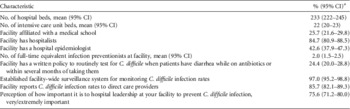
The overall survey response rate was 71% (403 of 571); an additional 5 respondents did not answer the CDI questions, leaving a final sample of 398. Table 1 provides an overview of the responding hospitals along with their responses to several CDI-related questions. While 97% of hospitals reported having an established facilitywide surveillance system for monitoring CDI rates, only 24% have a written policy to routinely test for C. difficile when patients have diarrhea while on antibiotics or within several months of taking them. A total of 76% of hospitals reported that preventing CDI was very or extremely important to the leadership of their hospital.
Hospital Characteristics and C. difficile Prevention Practices (N=398)

NOTE. CI=confidence interval.
a Data presented as percentage (95% CI) unless otherwise noted.
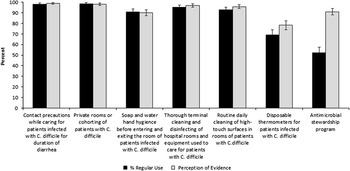
Figure 1 shows the frequency of regular use and perceived strength of evidence for each of the key CDI preventive practices examined. Greater than 90% reported that their hospitals regularly use several practices to prevent CDI: contact precautions, private rooms or cohorting of infected patients, enhanced room cleaning of infected patients, and use of soap and water for hand hygiene for infected patients. However, only 69% reported regular use of disposable thermometers, and 52% reported employing an antimicrobial stewardship program. Greater than 80% of respondents also perceived the strength of evidence for several practices to prevent CDI to be high: use of contact precautions in patients with CDI, private rooms or cohorting of infected patients, appropriately enhanced room cleaning of infected patients, use of soap and water for hand hygiene for infected patients, and antimicrobial stewardship. The only practice for which there was a sizeable gap between practice use and perceived strength of evidence was antimicrobial stewardship. Strength of evidence for antimicrobial stewardship was rated as high by 91% of respondents but by only 52% in regard to regular use.
Use and perception of strength of evidence of key practices to prevent C. difficile infection.

DISCUSSION
Several key findings emerged from our national survey. First, most US hospitals reported using a surveillance system to monitor for CDI among their patients. Herzig et alReference Herzig, Reagan, Pogorzelska-Maziarz, Srinath and Stone 7 reported that among the 37 US states and territories that have enacted laws requiring reporting of healthcare-associated infection data, over half have mandated reporting of CDI rates. Second, reported use of several recommended practices is very high, along with the corresponding perceived strength of evidence for many of these practices. Finally, the gap between our respondents’ reported regular use of antimicrobial stewardship and their perceived strength of evidence to support antimicrobial stewardship was the highest of any practice.
We are aware of 1 other national study that characterized to some extent what US hospitals are doing to prevent CDI. Specifically, a survey by Jarvis et alReference Jarvis, Schlosser, Jarvis and Chinn 8 in 2008 found that more than 91% of US hospitals used contact precautions for patients with CDI.
The practice for which we found the largest discrepancy between reported regular use and perceived strength of evidence was antimicrobial stewardship. The overuse of antimicrobials can lead to patient harm. Thus, antimicrobial stewardship has recently emerged as an important patient safety practice.Reference Dellit, Owens and McGowan 9 Greater than 60% of hospitalized patients receive antibiotics.Reference Pakyz, MacDougall, Oinonen and Polk 10 Unfortunately, as much as 50% of antibiotic use in the hospital setting may be inappropriate.Reference Dellit, Owens and McGowan 9 The 2014 SHEA Compendium states “appropriate antimicrobial use as a CDI prevention measure is essential to any CDI prevention program.”Reference Dubberke, Carling and Carrico 2
Several important limitations of our survey must be considered. First, we relied upon self-reporting by the lead infection control coordinator at each site. Second, while our sampling strategy was designed to obtain a nationally representative sample, it is possible that participating hospitals were different from nonparticipating hospitals, thereby making the results less generalizable. Finally, we did not distinguish between practices routinely used in CDI outbreak settings from those used in nonoutbreak settings. We are aware that certain interventions (eg, hand washing with soap and water, use of bleach) are only recommended in outbreak settings rather than endemic settings.Reference Dubberke, Carling and Carrico 2
We have provided a snapshot of practices US hospitals currently use to prevent CDI. While nearly all US hospitals report using surveillance to detect CDI, the use of antimicrobial stewardship programs to prevent CDI is lacking in 48% of hospitals despite the perceived high strength of evidence to support such programs. Better understanding this discrepancy and, more importantly, resolving it will be important for clinicians, policy makers, and patients.
Acknowledgments
The authors would like to thank Andrew Hickner for his assistance with conducting the survey mailing, and Jason Mann for his help with manuscript preparation.
Financial support: This work was supported by the Blue Cross Blue Shield of Michigan Foundation (grant no. 1907.II), and by a Patient Safety Center of Inquiry funded by the Veterans Affairs National Center for Patient Safety.
Potential conflicts of interest: All authors report no conflicts of interest relevant to this article.