The maternal body is a complex and contradictory site, one that challenges the dominant codes of popular culture and its associated power relations. Visual representations of the pregnant body were largely absent from Anglo-American popular culture as a whole until the 1990s, when a photograph of Demi Moore appeared on the cover of Vanity Fair, making it de rigueur for ‘celebrities’ to pose when pregnant. Although Tyler (Reference Tyler, Ahmed and Stacey2001) argues that the Moore photograph offered a challenge to dominant discourses of female bodies and sexuality, the boundaries of such poses do remain highly regulated and the proliferation of ‘celebrity baby bump’ images across the media in the post-Moore years has lessened the challenge that these photographs make.
In popular music culture, however, there is a distinct lack of visibility of the pregnant body in music video, live performance and as represented in song. The pregnant musician extends a series of taboos associated with pregnancy, due to the physicality, aurality and temporality of musical performance. In this paper, I explore these taboos in more detail and highlight how the pregnant performing woman, by both moving her body and making sound through time, enlarges the threatening possibility of maternities. She is both visible and audible.Footnote 1
Representations of maternities have the same effect when maternal voices and bodies are given musical space. Therefore, while the visual element of pregnancy is indeed absent from popular music culture, I would also extend this statement further to highlight a sonic absence of pregnant bodies, or – in a wider conception – of maternal bodies. Here, I am concerned with a number of questions around sound, embodiment and physicality within recorded music. Can we hear the maternal body in popular music? How might female performers ‘sound out’ a maternal embodiment?
Embodiment studies offer modes of analysis for music that move forward from a simple understanding of representing the body in music. Embodiment is defined as an experiential term, which focuses on lived and unmediated experience. Within popular music studies, and indeed in musicology more broadly, recorded music is regarded as both mediated and disembodied, particularly in relation to the voice. Embodied music and recorded music might then appear to be antithetical. However, feminist scholars such as Cusick (Reference Cusick, Brett, Thomas and Wood2006[1994]) and McMullen (Reference McMullen2006) have been exploring modes of listening and performing that access an experiential and embodied mode. My work explores how recorded music might also be able to express modes of embodiment that are closer to an unmediated experience and to study embodiment within Amos's music, as opposed to simply studying representations of the body itself. Theoreticians working in disciplines such as philosophy, human sciences and anthropology have debated and redefined meanings related to the study of the body. As Gail Weiss and Honi Fern Haber (1999) argue in their book Perspectives on Embodiment: The intersections of nature and culture, ‘embodiment’ is increasingly being prioritised over the term ‘the body’, the latter having been problematised through the work of theoreticians critiquing the devaluation of the body within Western philosophy and metaphysics. They argue that:
The move from one expression to another corresponds directly to a shift from viewing the body as a nongendered, prediscursive phenomenon that plays a central role in perception, cognition, action, and nature to a way of living or inhabiting the world through one's acculturated body. (Weiss and Haber Reference Weiss and Haber1999, p. xiii)
It is precisely this experiential mode that I am interested in exploring within Amos's work. How can having a ‘female’ body affect performance practices and how does the lived experience of composition and performance communicate to listeners through recorded music? As Thomas Csordas argues, embodiment studies are concerned with understanding ‘culture and experience insofar as these can be understood from the standpoint of bodily being-in-the world’ (Weiss and Haber Reference Weiss and Haber1999, p. 143). In Amos's case, this analysis focuses on how she uses this standpoint as a musician and composer.
Embodying the maternal is particularly problematic because of the discourses around female musicians and sexuality. The role of women in music is highly regulated through the male gaze, and through concepts of excessive sexuality. Female bodies are sexualised and subject to the male gaze; however, the pregnant body is considered to be outside the realms of sexual desire. Therefore drawing attention to the maternal body – either visually or aurally – troubles these discourses and challenges norms around women in music.
Drawing on the work of Tori Amos, I will define the concept of the maternal body, looking specifically at the idea of ‘maternal traces’, and will explore the strategies through which Amos makes the maternal body both visible and audible, through the lens of embodiment. Furthermore, I will explore how Amos uses the figure of the maternal body to challenge dominant tropes around sexuality and therefore to redefine common conceptions of ‘mother’ and ‘mothering’.
Popular music and the maternal body
Performances by pregnant musicians still carry a ‘shock’ value. Twenty years after Neneh Cherry's pregnant performance of ‘Buffalo Stance’ on Top of the Pops,Footnote 2 which at the time provoked media response of shock and indignation, M.I.A. performed ‘Paper Planes’ at the Grammys while heavily pregnant. Commentary on websites such as bittenandbound.com – whose strapline is ‘the not so pretty side of Hollywood’ (my emphasis) – describe M.I.A.'s outfit as ‘shocking’. It is not the clothes that are shocking in themselves, as popular music culture encourages performances by women wearing tight or revealing clothes. On a pregnant body, these clothes take on a different cultural resonance; it is maternity combined with sexuality that becomes shocking. In Maternities (2008), Robyn Longhurst explores the discourses of pregnant bodies described through the use of negative words and phrases that draw upon cultural notions of fatness, disability and ugliness. For example, in terms of popular celebrities, media responses to Kim Kardashian's pregnancy illustrate this, as she was branded ‘fat’ as she gained weight.Footnote 3 In addition to this, the pregnant body is culturally very clearly defined as a non-sexual body, no longer sexually available or sexually active. Longhurst notes that this non-sexuality is the case ‘despite the fact that at the same time they are clearly marked as having been sexually active’ (Longhurst Reference Longhurst2008, p. 53). The performative nature of popular music heightens this sexual paradox, as the female performer is subjected to the gaze of the audience, as voyeur, and the female musician connotes ‘to-be-looked-at-ness’.Footnote 4 The pregnant performer troubles and disrupts the sexuality of the gaze, by being simultaneously sexually available, in a voyeuristic sense, and non-sexual as a pregnant woman.
The gaze is also at play in the imagination of the listener, and artists who use strategies of embodiment draw out physicality within their work. This then replicates the gaze, and concurrent discourses of sexuality, within an aural context. Amos is one of a number of female singer-songwriters debuting in the early to mid-1990s who were particularly interested in embodying experience in their recordings.Footnote 5 I will be looking specifically at recorded music, as opposed to live performance, to demonstrate just how embodied recorded music can be on a number of varying levels.Footnote 6 I also want to show how the discourses around performing pregnancy/maternities also translate to the recorded medium.
Theorising the maternal body
My use of the term ‘the maternal body’ foregrounds a body which is formed of overlapping temporal stages – stages that leave traces and imprints and a body that is fluid with problematic boundaries. In this conception the maternal body moves from pregnancy to motherhood, encompassing such potential stages as miscarriage, childbirth and lactation. Tyler (Reference Tyler, Ahmed and Stacey2001) makes a distinction between pregnancy and motherhood in order to conceptualise pregnancy as a form of ‘transitional subjectivity’, arguing that ‘motherhood already implies a self/other, mother/child distinction, which does not exist in any simple binary form for the pregnant subject’ (Tyler Reference Tyler, Ahmed and Stacey2001, p. 124). Whereas Tyler discusses transitional subjectivity as only applying to the pregnant body, the bodily experiences of motherhood – moving from pregnancy, through birth, to being a mother – also require a conception of a transitional form of subjectivity. For example, it is not clear when one becomes a mother. When a woman miscarries, or has a stillborn baby, a relationship has often already begun between the woman and the foetus. She may have made conscious decisions around her bodily practices – such as reducing caffeine intake, taking pregnancy vitamins, curtailing exercise – in order to nurture the growing foetus. In effect, she has become a mother well before the point of childbirth. Miscarriages or stillbirths evoke feelings of maternal grief for women who experience them. The ‘beginning’ point of motherhood is unpredictable and therefore can begin much earlier than at the point of childbirth.
The epistemological framework by which motherhood implies mother/child and self/other distinctions is a problematic one. Not only can motherhood begin earlier than at the point of childbirth, but a neat mother/child division does not occur at the moment of birth. The pregnant body does not simply vanish post-birth. There is a significant recovery period, where a woman may still look pregnant as her uterus shrinks. Stitches and wounds from birth mark a woman's body as ‘Other’ – she is not pregnant, yet is still bearing the bodily marks of carrying a child. Post-childbirth bleeding, yet lack of periods, locates the maternal body in a liminal, in-between space. Pregnant/not pregnant and pregnant/mother are not clear-cut distinctions; they overlap, clash and blur.Footnote 7
These physical experiences of motherhood are also accompanied by emotional or conceptual shifts. When a child is born a mother is learning – learning to become a mother and adopting new identities in the process. As the child grows, these identities shift, multiply and change. The definition of ‘mother’ is not fixed. It is a ‘becoming’ – like De Beauvoir's (Reference De Beauvoir1997[1949]) conception of becoming a woman. This process of becoming is bound up in cultural constructions of acceptable (or non-acceptable) forms of mothering.Footnote 8 My definition of the ‘maternal body’ is a fluid body upon which the varying temporal stages of maternities – such as pre-conception, conception, pregnancy, miscarriage, stillbirth, childbirth, post-birth and lactation – leave traces and imprints.
The pregnant body can also be conceptualised as abject, in Kristeva's (Reference Kristeva1982) definition of the term – as a body to be feared and controlled, due to its fluidity, lack of boundaries and the problematisation of the self/other boundary. Longhurst (Reference Longhurst2001) shows how discourses around pregnancy serve to encourage women to withdraw from public spaces and to confine their activities to private spaces as their pregnancies progress. The abject status of pregnancy, as threatening, leaking, seeping and problematic, requires control and confinement. Longhurst argues that pregnancy highlights sexual difference and ‘Otherness’. Drawing on the work of Elizabeth Grosz (Reference Grosz1994), she discusses how academics often talk about ‘the body’ in a way that seems to neglect the material realities, the messiness, of bodies. Longhurst is concerned with ‘The leaky, messy, awkward zones of the inside/outside of bodies and their resulting spatial relationships […]’ (Longhurst Reference Longhurst2001, p. 2). Masculine knowledge production is based upon rationality and is divorced from the material body. The Cartesian duality of mind/body is mapped upon the masculine/feminine binary, with the masculine being rational, contained, clean, ordered and located in the mind, the feminine being emotional, fluid, messy, amorphous and materially embodied. Longhurst argues that:
when geographers speak of the body they still often fail to talk about a body that breaks its boundaries – urinates, bleeds, vomits, farts, engulfs tampons, objects of sexual desire, ejaculates and gives birth. The reason this is significant is that the messiness of bodies is often conceptualised as feminised and as such is Othered […] Ignoring the messy body is not a harmless omission, rather, it contains a political imperative that helps keep masculinism intact. (Longhurst Reference Longhurst2001, p. 23)
It is therefore important to analyse representations of maternal bodies with these gendered power relations in mind. Discourses around maternal bodies are concerned with the abject and these bodies are Othered as such. In Maternities (2008), Longhurst discusses the politics and queering of breastfeeding. Lactation is another element where the maternal body is considered abject; yet, also, lactation symbolises female power.Footnote 9 Longhurst discusses how women can queer breastfeeding and she problematises concepts of ‘the naturalness’ of breastfeeding by introducing examples of interspecies breastfeeding and adult breastfeeding. The maternal body, as a lactating ‘Other’, is a body with porous boundaries, and can signify as the site of transgressive movement.
Tori Amos in context
The work of Tori Amos has been explored by a number of scholars who are interested in gendered aspects of her work and who have situated her in an important group of female singer-songwriters in the early 1990s.Footnote 10 There are two specific writings on Amos that form the foundation of my theorisation. First, Amos has been positioned as a ‘disruptive diva’ by Burns and Lafrance (Reference Burns and Lafrance2002), who explore ways in which her work challenges hegemonic discourses of femininity, desire and sexuality through an analysis of her 1991 track ‘Crucify’. Secondly, Jennifer Rycenga's engaging and thought-provoking chapter on lesbian listening and heterosexual women's rock music (Reference Rycenga, Schwartz, Kassabian and Siegler1997) provides a springboard for thinking about an embodied physicality in Amos's work. Also concentrating on ‘Crucify’, Rycenga argues that the song signifies a particular kind of musical materiality and opens out her discussion of the track into a broader understanding of the physicality and sensuality across all of Amos's output, both live and recorded.
Visible maternities
Two maternal images in particular illustrate the ways in which the singer complicates the maternal body: a photo of her while pregnant, taken for Vanity Fair in November 2000, and the artwork to her Amos (Reference Amos1996) album Boys for Pele, in which she is seen breastfeeding a piglet. In both, Amos plays with different ways of making the maternal body visible.
Amos's photograph for Vanity Fair fits into the trend for the pregnant celebrity, and while she makes the maternal body – and therefore its disruptive potential – visible there, the challenge to dominant norms around femininity is minimal. Amos is lying on her back, reclining on what appears to be a bed, covered in white sheets. She wears white trousers and a white shirt, cropped just above her belly, which leaves her bump uncovered. Across the double page of the shot, her body is laid on the diagonal with her head in the left-hand bottom corner, in the foreground and slightly lower than the rest of her body. This unusual pose suggests that the body is retreating away from the viewer, giving a certain lack of focus or dreamlike quality to the scene. While her pregnant belly is exposed, with one hand protectively resting on it, Amos gazes into the distance, past the viewer rather than at them. Her hair is spread around, under and above her head, in a naturalistic fashion as though unstyled. These elements, together with her reclining – and therefore compliant – pose, her protective hand on the pregnant stomach, and the lack of direct eye contact, all combine to suggest a soft, ‘dreamy’ aesthetic that does not challenge the viewer. While many visual representations of reclining female nudes have, in the past, been used to suggest sexual solicitation, here the photograph cancels that possibility.
Four years earlier, Amos (Reference Amos1996) had represented the maternal and lactating body in a way that challenged dominant tropes around sexuality, childrearing and body politics. In the artwork to Boys for Pele, she sits upright in a chair, next to a window, with her shirt opened and her two breasts, partially visible, in the exact centre of the photo. In her lap and held against her skin, in a traditional breastfeeding posture, is a piglet. With only the natural daylight filtering in from the side window, the scene is rather dark and creates an air of interiority, which is reinforced by her gaze going out through the window, as if lost in thought and ignoring the camera. Her sense of detachment renders the presence of the breastfeeding piglet more shocking, since Amos does not seem to acknowledge the situation as in any way ‘abnormal’. Her lost gaze prevents the scene from being seen as provocative, while a challenge to dominant norms remains central to its existence.
‘Spark’ video (1998)
The video for Amos's Reference Amos1998 single ‘Spark’, taken from the album from the choirgirl hotel (1998), highlights a significant theme in her work – the control and regulation of the female body. This is crucial to understanding how the Othering of the female body – and then specifically the maternal body – works, on a general basis, and how Amos's representations allow for female agency. Her output clearly explores how female bodies are curtailed and controlled, and by challenging this she highlights the relationship between embodiment, power and sexuality. The symbolism in this video is powerful and draws on a number of themes that occur frequently in Amos's songs. Most importantly, the video is an embodied narrative, featuring images and visual cues that directly reference notions of power and control and also bodies moving through time and space.
The album from the choirgirl hotel shows Amos exploring the maternal body in relation to miscarriage. Amos notes in her largely autobiographical book, Piece by Piece (2005), that the album deals directly with loss and comes ‘from a place of grief’ (Amos and Powers Reference Amos and Powers2005, p. 163). In ‘Spark’, Amos sings of her central character: ‘but she couldn't keep baby alive’. In the audio commentary for the video, she explicitly references her own personal experiences of miscarriage. However, the video also deals with broader themes around miscarriage, pregnancy and bodily control. If a pregnant woman is a threatening presence due to her problematic body boundaries – the possibility of her waters breaking, splitting herself into two, the ‘leaky’ status of her body – then the miscarrying body is even more problematic in its fluidity. Her body is not only leaky, but also an aberration which society prefers to hide. The miscarrying body is feared in multiple ways, and representations of miscarriage are silenced due to cultural stigmas.
The video begins with a close-up of the central character, Amos, lying on a forest floor, blindfolded with her hands bound behind her.Footnote 11 She is writhing and her feet are moving around in the soil. The camera then pans out and we see that Amos lies next to a car that has crashed into a tree, in woodland. In the video commentary, Amos describes how she had been influenced by Twin Peaks, in terms of the feel and the look of the video and the complexity of plot. The colour palette of the video is a clear homage, with its muted and earthy tones, and the shroud-like dress that Amos wears is reminiscent of Laura Palmer's wrapped body. Amos's character, still blindfolded and bound, gets up onto her feet and starts walking, trying to find where she is. At this point, a second character is introduced, a male figure whose face is never seen, who keeps checking his watch. The camera focuses on close-ups of his smart, shiny shoes and his expensive watch. He is moving around, searching for someone, and the assumption is made that he is looking for Amos. We realise that something traumatic has happened and that she is stumbling through the woods trying to escape.
Images of Amos bound and blindfolded suggest how she and her body are subject to regulation and control. As the male figure is only ever partially visible in the video, the faceless man represents not one single man, but patriarchy itself; as he is faceless, with a ‘corporate’ image, he is not an individual but rather part of a system. The image of constant watch-checking supports this idea of control – set against the surroundings of the organic or ‘natural’ world, his world is ordered, controlled and measured, with time. Time, in this image, represents a masculinist and linear function, against the cyclical reproduction that we will hear later in Amos's track ‘Your Cloud’. He is searching for Amos in order to exert his control.Footnote 12 Here, Amos is acknowledging that the female body is subject to regulation and control within a patriarchal culture. Following this, we then have imagery which may suggest that Amos is referencing the miscarrying body more specifically, within broader tropes around the female body.
As Amos moves through the woods, she comes across a tree with the name ‘Skeeter’ etched into it. Being still blindfolded and bound, she runs her fingers over the word, with her senses coming into play with a softness of touch. In the audio commentary, Amos notes that ‘Skeeter […] was a fond name that we called the little person before I miscarried’. Referencing her own loss, Amos draws attention to the name through touch, and embodies her maternal grief through language (‘Skeeter’), yet also through the language of the body. This sensuality and materiality draws attention to the maternal body in a very subtle way.Footnote 13
In the next section of the video, Amos finds her way to a river, which is a pivotal point in the narrative. She walks quite calmly into the water, rather than fleeing swiftly as the narrative so far would suggest. It is as if she is aware that this is a positive action, which will be beneficial to her. As her head moves under the water she starts to shake it from side to side. Her blindfold falls from her eyes, and she emerges from the water able to see. Although her hands are still tied behind her back, she regains some of her own agency and control over the situation.Footnote 14 In relation to the themes of control and power over the maternal body, one could read this image as an acceptance, or a re-claiming, of the fluidity and leaky status of female bodies. Through her experience of plunging her body into the water her boundaries are even more fluid.
We can read ‘Spark’ as a contestation of power, in which a woman is trying to escape regulation and control and to engage more fully with the fluidity and immeasurability of her maternal body. By resisting the ‘measuring’ of the patriarchal figure – who is trying to measure her in time – and by plunging herself into the water to find release, she is able to ‘help herself’Footnote 15 through and beyond the impact of her miscarriage, and regain agency. However, the threatening status of the leaky maternal body is not resolved in this video. The last image that we see is Amos kneeling in the road, as a car which had stopped pulls away without her, with blood running down her fingers and a single droplet hitting a leaf. This could be suggestive of either miscarriage bleeding or of the resumption of menstruation, and as such the narrative is unclear and unresolved. The people in the car have not rescued her, and therefore she has to rely on herself. Although the central character ‘has a will to live’ (http://www.hereinmyhead.com) and learns to use her own power, she is still feminine, still potentially maternal and still fluid.
‘Your Cloud’ (2002)
In much of her recorded work, Amos sounds out the possibility of reproduction – foregrounding the reproductive potential in the female body. This is where the maternal body begins, at a point even before conception. Prior to conception, there is possibility. This idea of maternal traces – where each possible stage of maternity overlaps and leaves traces – can be seen clearly in ‘Your Cloud’, which appears on the 2002 album, Scarlet's Walk. This album was written when Amos (Reference Amos2002) was pregnant with her daughter and, in Piece by Piece, Amos reflects upon the ways in which the creative process of songwriting was inextricably linked to this pregnancy:
During the pregnancy with Tash, the Scarlet seed started coming. During the first half of the pregnancy, while I was at the beach house in Florida, I would play piano for three hours every day. So the songs were developing daily, as was this little girl inside me. I would […] play to Tash, who would kick to the rhythm […]. (Amos and Powers Reference Amos and Powers2005, p. 176)
The album Scarlet's Walk is also about a journey towards motherhood and as such sounds out the reproductive possibility of the female body. This is a concept album, portraying a journey across America taken by protagonist Scarlet (loosely based on Amos herself). Scarlet's journey moves through various emotional states and relationships, ending when she gives birth to a baby girl, mirroring Amos's (Reference Amos2002) own experiences of becoming a mother.Footnote 16 In comparison to from the choirgirl hotel, with its theme of miscarriage and loss, Scarlet's Walk is both sonically and thematically very different. The production values are lighter, and the effects and electronics that are employed on from the choirgirl hotel to make the sonic landscape dark, to sound out her grief, are absent. This lighter, acoustic and more ‘upbeat’ sound could be read as optimistic, moving forward from her earlier work to a place where childbirth might be possible.
Amos explicitly references the symbiotic relationship between mother and child when discussing ‘Your Cloud’. According to Amos, the song discusses the forcible removal of Native American people from their land, but also explicitly references relationships among mothers, their bodies and their children:
[it's about] the separation [… and] the tearing apart of a tear […] Cutting that apart – the division. It's about separating that which you cannot separate. Not really. There will be strands, there will be molecules […] taking a child away from its mother. That doesn't mean that there aren't pieces of that child still in that mother just because it's been, you know, delivered from her womb.Footnote 17
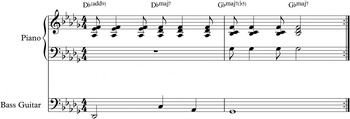
Lyrically, Amos represents the maternal body as a transitional subject – to borrow and re-define Tyler's phrase – with unclear boundaries between mother/body/child. For instance, she sings ‘Do you think just like that you can divide this/ You as yours, me as mine, two before we were us?’ This idea is mirrored harmonically thanks to the track's cyclical chord progression from I (D ♭ maj7) to IV (G ♭ maj7), which moves round and round throughout the verse, setting up the theme of inseparability. The indivisibility of mother and child that Amos describes in her commentary is dramatised musically by the use of inversions, voice leading and an unsatisfactory resolution to the tonic (see Figure 1).
The introductory four bars of ‘Your Cloud’.

There is a repeated piano motif in this introductory section, which gives a sense of enclosure, as the motif moves from an E ♭ to a D ♭ over chord I, to a C and then back to D ♭ over chord IV. The key note of D ♭ occurs on the IV but when we return to the I (which is in this case a D ♭ add9) the motif has moved to the 9th which is E ♭ . This repeating turning movement does not resolve, and as such the theme of indivisibility and circularity is musically manifested.
Similarly, when the voice enters, the melody only resolves to the tonic at one point at the end of the fourth bar of the verse, and again at end of the sixth bar. These D ♭ melody notes also sit over the IV chord (G ♭ maj7), frustrating any real sense of resolution. The repetition of the chords here is also matched by their rhythm, which Amos articulates in four phrases across the introductory two bars (see Figure 1). This rhythmic repetition adds to the cyclical feel of the verse. This is further extended through the formal structure of the track. It is difficult to say exactly which section should be named as ‘verse’ or ‘chorus’, due to these cycling and repeated chords. A slightly higher melody, first entering at 1:00, is the only shift in the musical material that could be interpreted as a move from a verse to a chorus, and this is certainly not a definitive sectional break. The first significant harmonic break in this cyclical chord progression does not occur until 1:26, at what structurally feels like the bridge. However, after returning to the original harmony at 2:00, this bridge section repeats at 3:25, making the listener question whether this is actually the bridge, or the chorus. This structural indivisibility also gives a sense of reproduction and cycles, supported also by the harmonic material.
In the bridge, the idea of reproduction is further enhanced through the use of the voice, with one central vocal line overdubbed in repetition and giving the impression of multiple voices singing in unison. While this form of overdubbing is a standard production technique in popular music, its presence here aptly supports the subject matter of the album. One vocal line is sung by more than one version of Amos – it is unclear where each voice ends and begins, mirroring and doubling the reproductive possibility of the maternal body. This overlapping voice also sits centrally in the stereo field. At the very beginning of the bridge, supporting voices (sung by Amos) enter behind the melody, singing ‘stay here, stay right here’. But this ‘here’ is a further multiplication of voices towards the outer left and outer right of the stereo field, locating it in multiple places simultaneously. The stereo field thus makes the body of the listener more apparent in relation to the plural bodies of the vocalists, and multiplies the situated bodily experience.
In ‘Your Cloud’ we have a sense of fertility and the possibility of pregnancy, the idea of cycles standing for female reproductive cycles as a sonic representation of the womb.Footnote 18 The narrative isn't contained in this womb, as during the bridge Amos refers to ‘body maps’:
If there is a horizontal line that runs from the map off your body
Straight to the land shooting up right through my heart
The corporeal ‘line’ of this narrative has movement and trajectory. In the context of a song that focuses on the maternal body, talking about the body as land infuses it with a sense of fertility and possibility. Amos is mapping out a fecund, reproductive and multiple body. Therefore, it is apparent that the physical, emotional and geographical location of the narrative subject's body has an impact on how we read the harmonic structure of the track. Moreover, when we consider this spatial location, it becomes clear that the maternal body is embodied in movement. The narrating body is moving towards pregnancy and is temporally configured, in tandem with the embodied yet unborn child, in a state of eternal motion, running off the map and into uncharted territory. Linguistic representations of bodily movement are employed by Amos throughout the track, with metaphors of ‘running’, ‘shooting up’ – which again can be related to the notion of fecundity – and ‘jumping off’; it is clear that the maternal body is mobile. By blurring the boundaries between mother and child, Amos problematises ‘where you end, where I begin’ and ensures that there is movement even across definitions of the self. In her conception, movement leaves traces across maternal subjectivities.
‘Playboy Mommy’ (1998)
Theorising Amos's work through the lens of ‘maternal traces’ allows a view of the maternal body as a shifting, overlapping terrain – a corporeal geography that encompasses fertility, pregnancy and childbirth, yet also more problematic maternities such as miscarriage and the sexualised mother. The track ‘Playboy Mommy’, from the album from the choirgirl hotel, was written after Amos had suffered miscarriages. This miscarrying maternal body structures much of the musical material on the album, which was released four years prior to Scarlet's Walk. ‘Playboy Mommy’ brings together a number of the themes discussed so far and clearly shows how Amos's (Reference Amos2002) representation provides a challenge to dominant cultural conceptions of mothering, the maternal body and sexuality.
In the introduction to ‘Playboy Mommy’, Amos uses the theme of openness to signify loss. The track begins with drums and a melodic motif, played on a Kurzweil synthesiser. The timbre of this introductory section is reedy and strong, the Kurzweil sound being reminiscent of a harmonium or melodica. At 0:19 the vocal enters and the Kurzweil drops out. The vocal is accompanied by piano, playing chords Am, F major, C major and G major in shell voicings – we have open roots and fourths/ fifths of E and A for the Am, and F and C for the C major, and then root notes only for the last two chords. The initial melody moves between B and C, filling in the third of the A major chord, but otherwise the ear is left to ‘fill in’ the absent notes, to get a sense of the tonality. The introduction then removal of a strong timbral palette, and the openness – and possible ambiguity – of the initial chords give the verse an opening sense of space. Similarly, the 12-bar verse begins without bass, which only enters in bar five of the verse at 0:25. While the initial spatial and harmonic world that Amos sets up in the first four bars of the verse could possibly signify the reproductive potential, with possibility of gestation, located in the open and empty womb of the ‘Playboy Mommy’, in the context of from the choirgirl hotel, the harmonic openness better signals a loss.
Lyrically, this motif is spelt out quite explicitly:
In my platforms I hit the floor
Fell face down
Didn't help my brain out
Then my baby came before I found
The magic how to keep her happy
The song's narrator is a woman speaking about (and later in the track directly to) her miscarried child, as she loses a baby. The lyrics foreground loss as central to the narrative and are supported by the musical material in the opening bars of the track.
‘Playboy Mommy’ is constructed around a paradox that is central to Amos's conception of the maternal body: the unashamedly sexual mother. Being dressed for a night on the town, in her high heels, the narrative reveals that she has a few ‘friends’ and among these are ‘American soldiers’. While this could be read in a number of ways, the term ‘playboy’ – with its connotations of sexual promiscuity – clearly outlines the sexual narrative at work here. The lyrics go on to talk about the possibility of the miscarried child being ‘ashamed’ of this name of ‘Playboy Mommy’.Footnote 19 However, the central character – clearly understanding the importance and potency of a nameFootnote 20 – is not afraid to ‘say it loud’ and in the chorus repeatedly asks her daughter to ‘tell’ em my name'. Amos is inverting the gender of the playboy, appropriating a masculine sense of sexuality, and is playing with the sexual expectations and bodily norms associated with femininity. In revealing that the playboy is not only an unashamedly sexual woman, but is an unashamedly sexual mother, Amos transgresses multiple conventions of female and maternal sexuality.
There is a relationship in this track between unashamed sexuality and notions of blame – from both the narrator and the miscarried child who ‘judge[s] so harsh’ – that undercut the idea that the narrator has simply appropriated a masculine sexuality. In verse two, when the narrator poignantly says ‘I'll say it loud, here by your grave, those angels can't ever take my place’, this tussle between pride and blame concludes in an acceptance of sexual status, and an opposition to the notion of angelic motherly femininity. It is important to note that this woman is a mother – a Playboy Mommy – before she has given birth to a baby. For this woman, the act of carrying a child, to whatever point in the pregnancy, and the potential to give birth, makes her a mother. The overlapping traces on her body of motherhood, mothering potential, pregnancy, miscarriage and future fertility, are apparent. The song plainly shows a woman who is full of maternal love and maternal feeling as she sings to her miscarried child, ‘I'll be home to take you in my arms’. She is mothering while pregnant, and continues to mother – and keep the name ‘mommy’ – post-miscarriage. Traces of varying identities overlap upon her body.
Overall, the lyrics depict a series of boundaries and boundary transgressions, which make clear how the maternal body is a site of contestation, where power is negotiated. At once sexual and non-sexual, a mother and a non-mother, the central narrator sits somewhere in transgressive territory. The repeated image of crossing a bridge occurs throughout the track, and supports this analysis. A bridge might be termed a ‘non-place’,Footnote 21 and highlights the liminal status of this mother. The narrative also moves between the physical world and the spiritual world of the afterlife. We have the invocation of angels and a miscarried child being embodied spiritually, after death. There is also an important break in the ‘feel’ of the track in the musical bridge. The latter occurs straight after the pedal steel solo section during which the piano also features prominently and the band has a fullness of sound, in more of a country rock style. At the introduction of the bridge at 2:57, however, the pedal steel drops out, the drums become more understated – although the shuffling rhythmic pattern that features throughout the track is still heard – and the piano is played more sparsely. We move from a full band rock feel to a quiet and more introverted world, signifying a shift in tone and approach. Lyrically, there is an evocation of a spiritual world that has warranted this quietening, as Amos sings:
Somewhere where the orchids grow
I can't find those church bells
That played when you died
Played Gloria
Talking about HosanahFootnote 22
Religious symbolism is present with the symbolism of church bells and the introduction of two Christian words – ‘Gloria’ and ‘Hosanah’ – usually used to worship God.Footnote 23 Amos is representing a holy world, but this is a world that the Playboy Mommy cannot find. Her compromised morals and her deviation from motherly norms have prevented her from finding spiritual salve. I am reading the use of orchids here as symbolic of fertility and childbirth – more material than spiritual and also with an anti-religious undertone and sexual suggestion.Footnote 24 Situating herself ‘where the orchids grow’, in a place of sensuality and materiality, the divine becomes inaccessible. In bar seven of the 10-bar bridge, at 3:11, with the introduction of ‘Gloria’, the shuffling rhythmic pattern of the track changes for the first time, highlighting this movement to another world. The shuffle ends and a cymbal hit is placed on beats one and three of each of the remaining four bars of the bridge. The introduction of a harmony vocal line pitched above the melody also supports this representation of a transition between the material and spiritual worlds. This harmony line is also sung by Amos and comes in on the word ‘Gloria’. The vocal tone in this line is breathy, with vibrato, which signifies an angelic otherworldly voice. Playboy Mommy's miscarried child is crossing a bridge between the material and the spiritual, being embodied in the track yet without physical form – moving, in a metaphorical or spiritual sense, across this liminal non-place. The bodies of the central characters of this song are crossing the boundaries between our world and the next.
‘Playboy Mommy’ also evidences an ambiguous relationship between the embodied subject and movement, which shows that the narrator can neither fully embody the role of ‘playboy’ nor of ‘mommy’ without troubling norms and expectations. From the first line of the lyrics we have a metaphor that works on two levels of oppositional meaning. Initially, the line ‘In my platforms I hit the floor’ could be read as the narrator being ready and ‘glammed up’ in her shoes, about to begin dancing, using the colloquial phrase ‘hitting the dance floor’. However, the missing word – ‘hit the [dance] floor’ – is telling, and the following line – ‘fell face down’ – shows movement, but of a different kind. Instead of a dancing body, we have a falling body – in motion, yet moving away from dance, involuntarily and with force, or violence. The embodied perspective represented is one where control of the body, and of movement, is lacking. The ability to dance evades this embodied maternal subject. The musical material provides opportunity for dance, with a groove being set up by the drum pattern that begins at the start of the track. The rhythm of the drums throughout – except the four-bar ‘Gloria’ section of the bridge – emphasises the offbeat with a shuffling snare and hi-hat rhythm on beats two and four. However, despite this rhythmic groove, the narrator is only embodied lyrically in two places during the track: on the floor, when she falls at the start of the first verse, and ‘here by your grave’ in the second. Despite the presence of a groove, the danceability of the track is inaccessible for the playboy mommy, whose transgressive maternal body is restricted by spaces of loss – loss of movement and loss of her child.
Conclusion
Tori Amos uses a range of strategies to make visible and audible the maternal body. Through musical and extra-musical approaches, Amos challenges dominant notions of both maternities and sexualities, which regulate and structure the culturally situated maternal body. She draws attention to the limitations of stereotypical conceptions of maternities, and more specifically of maternal female sexualities, both through visual representations – in photographs and videos – and through her musical sound world. By embodying female experience, she locates the female body as a site where power is contested and reworked, and highlights the possibilities for resistance and agency. As she draws attention to sexual maternal bodies and highlights their liminal status, she allows us to identify new modes of conceptualising embodied female experience. In particular, she draws attention to trauma and loss as potential sites of opposition to patriarchal norms.
My theorisation of maternal traces, and of a complex understanding that allows for maternal sexualities to be recognised, needs to be extended to include analyses of how a range of artists engage with concepts of maternities and mothering. In particular, it is vital to think about – in a music industry that focuses on the sexualisation of women's bodies for voyeuristic pleasure – how other embodied standpoints can be suggested. How do women convey embodied maternities through music and through performance? How can women articulate maternal sexualities, or highlight the complex liminalities of the maternal body through musical expression? What do these cultural expressions say about female power and agency?
In Amos's case, her work communicates a nuanced understanding of female bodily experiences. By highlighting maternal bodies, and embodying them sonically and visually with a multifaceted, plural approach, she allows us to conceive of female power within popular music in a new way. Recognising the absence of maternal bodies in the music industry, she draws attention to a key female experience, and presents a complex, multidimensional account.
Acknowledgements
The author gives thanks to Sherril Dodds, Susan Cook, Tim Hughes and Benjamin Piekut for their helpful and insightful comments on the various incarnations of this paper. Many thanks also go to Patricia Schmidt and Laurie Stras for their commitment to and enthusiasm for the author's work and for the many productive and challenging discussions that have helped shape her thinking. Finally, thanks go to Lizzie Lidster and Amy M. Russell for their open-heartedness, generosity and humour.