





Introduction
On 6 December 2024, the Romanian Constitutional Court decided to annul the first round of presidential elections on the grounds of Russian interference. This controversial decision was vehemently contested by supporters of candidate Calin Georgescu and far-right ‘sovereigntist’ political parties, including the Alliance for the Unity of Romanians (AUR), SOS Romania, and POT. It also showed the fragility of Romanian democracy. The ensuing political polarization continued to affect the country throughout 2025.
In January, Romania joined the Schengen space and the Visa Waiver program; as a result, Romanian citizens can travel freely within the European Union and to the United States. These diplomatic accomplishments ended what Romanians perceived as discriminatory treatment. On 2 May, the Trump administration reintroduced visa requirements for Romanians wishing to enter the United States. Two days later, the first round of presidential elections took place.
Presidential elections
President Klaus Werner Iohannis (elected in 2014 and again in 2019) was supposed to step down once a new president was sworn in December 2024. However, after the Constitutional Court annulled the December 2024 presidential elections and postponed them for May 2025, Iohannis prolonged his mandate (Stan and Zaharia Reference Stan and Zaharia2025). He resigned on 10 February as the most unpopular president of post-communist Romania, after Parliament threatened to initiate dismissal procedures (Marica Reference Marica2025). According to the constitution, Senate Speaker Ilie-Gavril Bolojan served as interim president from 12 February to 26 May, the day when Nicușor-Daniel Dan was sworn in. Dan won the second round of the presidential elections, held on 18 May.
Thirteen candidates registered with the Central Electoral Bureau, which rejected Călin Georgescu (who won the most votes in the annulled first round of 2024) and Diana Iovanovici-Șoșoacă (the head of the far-right SOS Romania party, disqualified from running in the 2024 elections). Of the 11 candidates who did compete in the first round, George-Nicolae Simion and George-Crin-Laurențiu Antonescu were considered favorites. The leader of the far-right AUR, Simion ranked fourth in the first round in 2024 and Antonescu, once leader of the National Liberal Party, was backed by the ruling Social Democrats (PSD), the Liberals (PNL), and the Democratic Union of Magyars in Romania (UDMR), representing the Transylvanian Hungarian minority (Benea Reference Benea2025). Independent candidate Dan was a former founder and leader of the Save Romania Union and was elected Mayor of Bucharest in 2024.
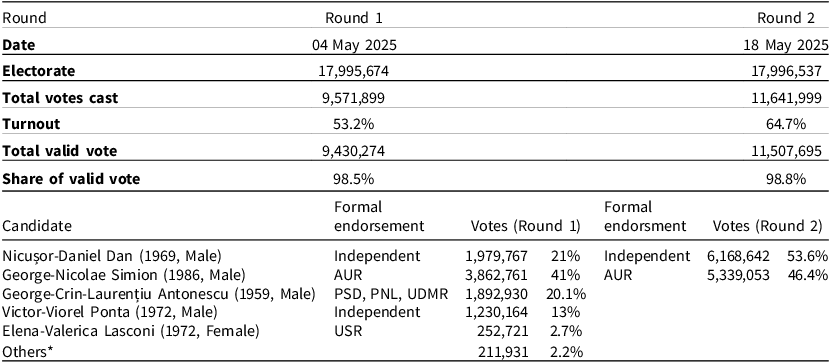
In the first round, Simion won double the number of votes gathered by Dan (41% compared to 21%, respectively). PNL candidate Crin Antonescu won around 20%, whereas PSD candidate Victor Ponta, a former Prime Minister in 2012–2015, won 13%. An extraordinary mobilization of the pro-European electoral segment allowed Dan to win the second round with 53.6% of the vote and secure the presidential office. See Table 1 for election results.
Elections for President in Romania in 2025

Table 1. Long description
The table compares election results for the first and second rounds of the Romanian presidential election in 2025. It has two main sections: Round 1 and Round 2, each with several rows and columns. The columns include Date, Electorate, Total votes cast, Turnout, Total valid vote, Share of valid vote, and Candidate details with Formal endorsement and Votes. Round 1 took place on 04 May 2025 with 17,995,674 electors, 9,571,899 votes cast, a 53.2% turnout, 9,430,274 valid votes, and a 98.5% share of valid votes. Candidates include Nicusor-Daniel Dan (Independent) with 1,979,767 votes (21%), George-Nicolae Simion (AUR) with 3,862,761 votes (41%), George-Crin Laurenţiu Antonescu (PSD, PNL, UDM) with 1,892,930 votes (20.1%), Victor-Viorel Ponta (Independent) with 1,230,164 votes (13%), Elena-Valeria Lasconi (USR) with 252,721 votes (2.7%), and Others with 211,931 votes (2.2%). Round 2 took place on 18 May 2025 with 17,996,537 electors, 11,641,999 votes cast, a 64.7% turnout, 11,507,695 valid votes, and a 98.8% share of valid votes. Candidates include Nicusor-Daniel Dan (Independent) with 6,168,642 votes (53.6%) and George-Nicolae Simion (AUR) with 5,339,053 votes (46.4%).
Notes: 1. In the first round, six other candidates together obtained 2.2% of the vote.
Source: Biroul Electoral Central website 2025.
Cabinet report
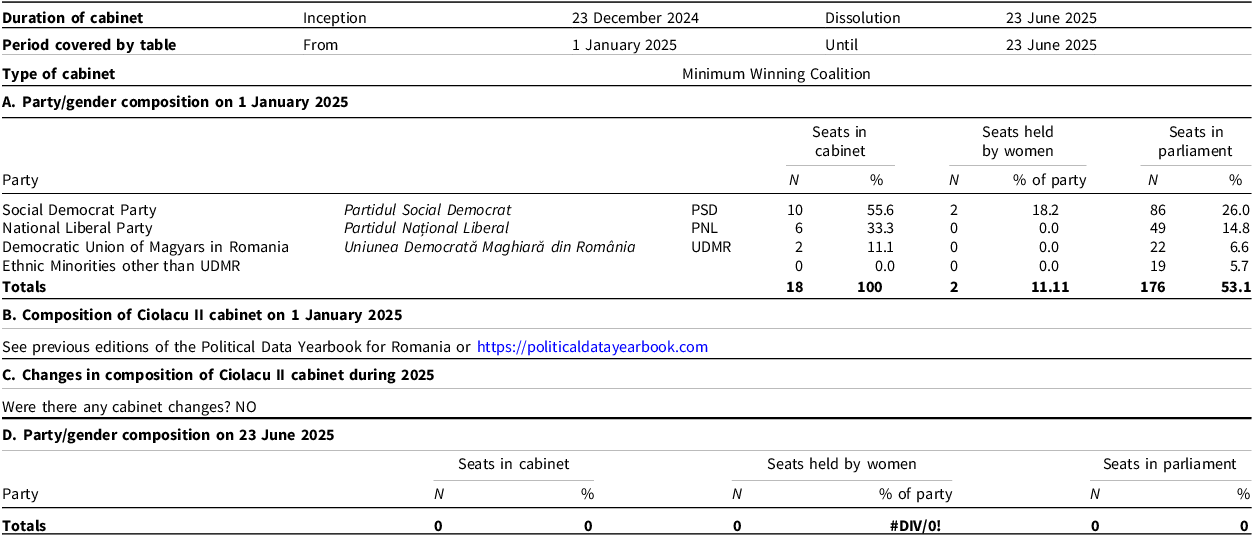
A new cabinet was formed on 23 December 2024 after the parliamentary elections of 6 December 2024. The PSD and the PNL invited the UDMR to join the ruling coalition, which was also supported by deputies representing other ethnic minorities (Stan and Zaharia Reference Stan and Zaharia2025). The PSD leader Ion-Marcel Ciolacu was appointed Prime Minister, with the PNL leader Bolojan becoming Senate Speaker. See Table 2 for the composition of the Ciolacu II cabinet.
Cabinet composition of Ciolacu II in Romania

Table 2. Long description
A table detailing the cabinet composition in Romania from January to June 2025. The table has four rows and three columns. Column headers are Inception, Dissolution, and Period covered by table. Row labels include Duration of cabinet, Type of cabinet, and Party/gender composition on 1 January 2025. The table lists the Social Democrat Party, National Liberal Party, Democratic Union of Magyars in Romania, and Ethnic Minorities other than UDMR with their respective seats in cabinet, seats held by women, and seats in parliament. The table also includes totals for seats in cabinet and seats in parliament. There were no changes in the composition of Ciolacu II cabinet during 2025.
Source: Guvernul Romaniei website, 2025.
The candidate supported by the ruling coalition, Antonescu, scored third in the first round of the presidential election on 5 May. As a result of this disappointing result, Prime Minister Ciolacu resigned. Interim President Bolojan appointed PNL leader Marian-Cătălin Predoiu, Vice Prime Minister, and Minister of Interior in the Ciolacu II cabinet, as Prime Minister.
Dan’s election as President was followed by negotiations among pro-EU parties in view of appointing a new cabinet. The Save Romania Union (USR), the party closest to elected President Dan, was brought into the ruling coalition to support a cabinet formed by the PNL, the PSD, the USR, and the UDMR and headed by Bolojan. The cabinet, which started its activity on 23 June 2025, promised to streamline public finances to avoid an economic crisis, to promote good governance and reforms of the administration, as well as to respect citizens to counter chronic public distrust in government and mainstream parties. The coalition decided that in April 2027 the prime minister position will be allocated to a PSD member (Agerpres 2025).
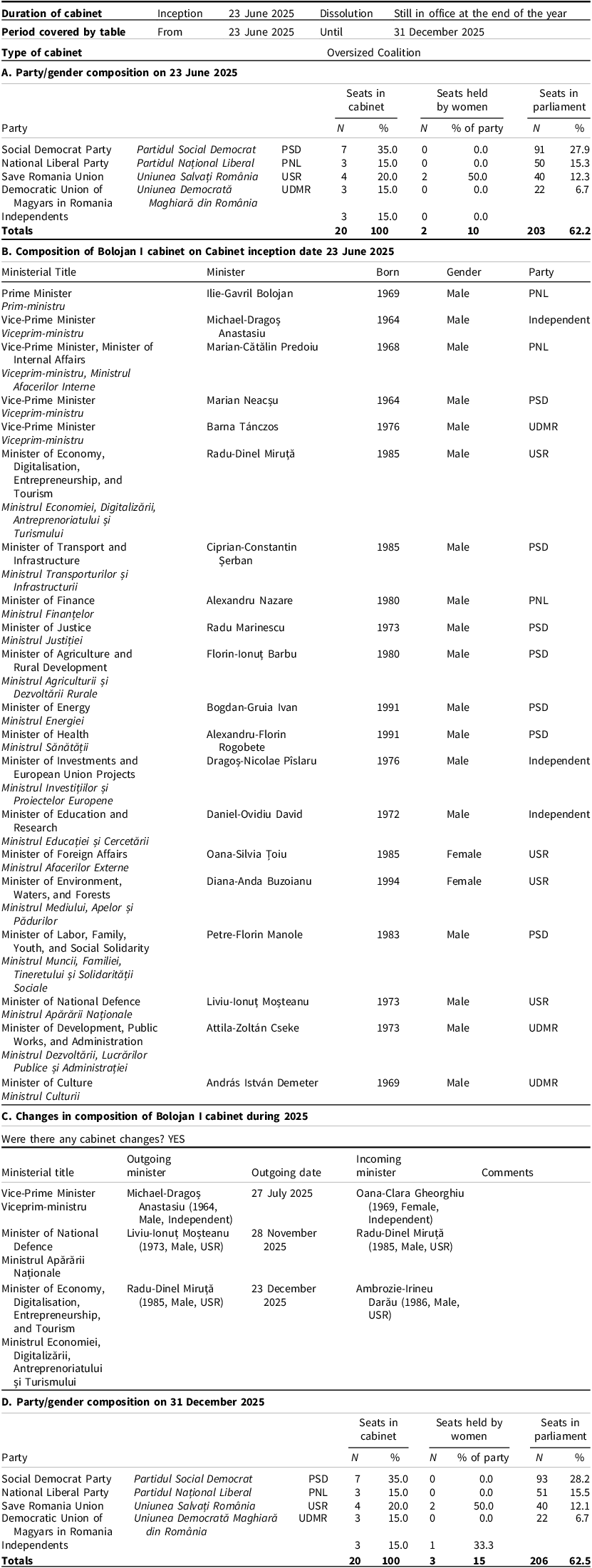
The Ciolacu cabinets encouraged enormous public spending ahead of the elections, but that move did not dampen support for populist radical-right parties (the so-called sovereigntist parties such as AUR, SOS, POT) which together gained 31.83% of the vote for the Chamber of Deputies in the 2024 parliamentary election (Pop-Eleches Reference Pop-Eleches2025). Given these conditions, President Dan hoped that the austerity measures proposed by the broad coalition of pro-EU parties supporting the Bolojan cabinet will help Romania to avoid economic collapse. See Table 3 for the composition of Bolojan I cabinet.
Cabinet composition of Bolojan I in Romania

Table 3. Long description
The table details the composition of Bolojan I cabinet in Romania, covering the period from 23 June 2025 to 31 December 2025. It includes party and gender composition, ministerial titles, and changes in the cabinet. The table has 20 rows and 10 columns. Column headers are N, %, Party, Seats in cabinet, Seats held by women, Seats in parliament, Ministerial Title, Born, Gender, and Party. Row labels include party names and ministerial titles. Notable parties include Social Democrat Party, National Liberal Party, Save Romania Union, and Democratic Union of Magyars in Romania. The table also lists the composition of the cabinet on 23 June 2025 and 31 December 2025, detailing seats in cabinet, seats held by women, and seats in parliament for each party. Changes in the cabinet composition during 2025 are also noted.
Notes: 1. Michael-Dragoș Anastasiu resigned after admitting that he offered bribe in 2009–2017. Prime Minister Bolojan served as acting Vice Prime Minister between 14 August and 30 October 2025. Gheorghiu was nominated in that post on 30 October 2025.
2. Liviu-Ionuț Moșteanu resigned because he misrepresented his university studies on his CV. Miruță served as interim Minister of National Defence in 28 November-23 December 2025. He was appointed in that post on 23 December 2025.
3. The three independent cabinet members included: two in portfolios allocated to the PNL (Minister of Investments and European Union Projects and Minister of Education and Research) and one in a portfolio allocated to the USR (Vice-Prime Minister Anastasiu, respectiv Gheorghiu).
Sources: Guvernul Romaniei (2025), www.gov.ro; Camera Deputatilor (2026), www.cdep.ro.
Parliament report
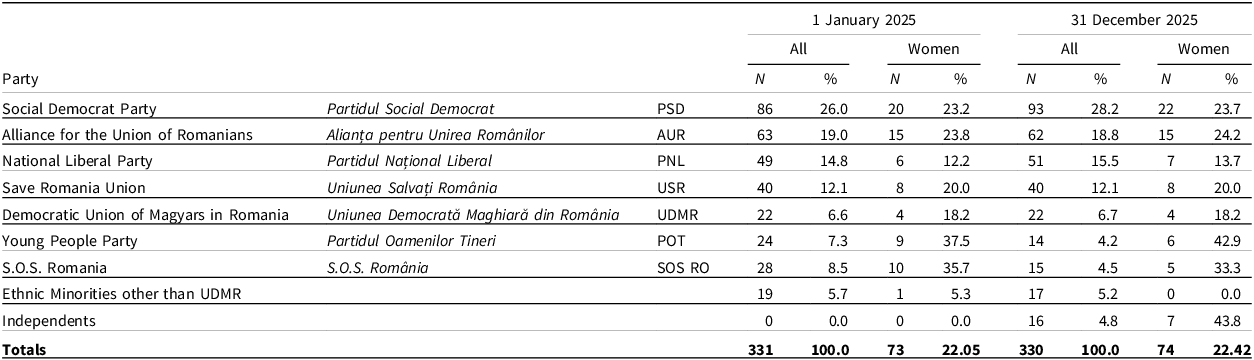
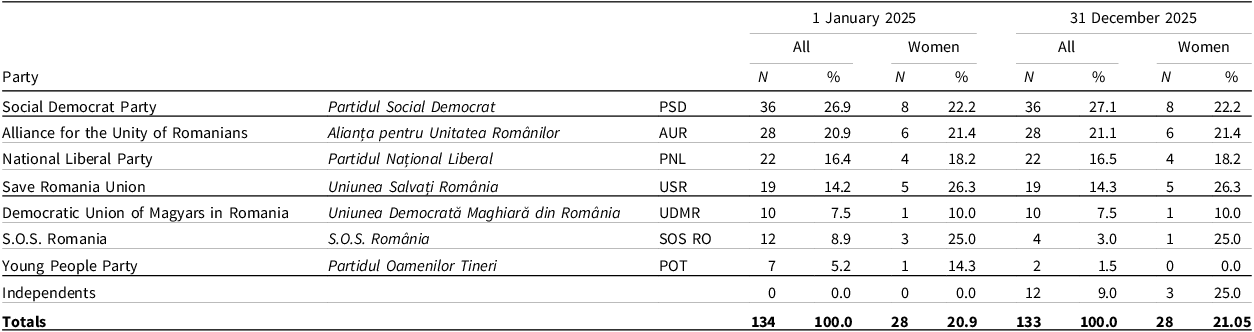
No significant changes affected the two chambers of the Romanian Parliament in 2025. In the Chamber of Deputies, the two smaller far-right parties lost some deputies. Indeed, SOS Romania lost 13 of its 28 deputies, whereas POT lost 10 of its 24 deputies. Most of these deputies chose to become independent, while a fraction of them crossed the floor to the PSD. Table 4 shows the composition of the Chamber of Deputies.
Party and gender composition of the lower house of Parliament (Camera Deputaților) in Romania in 2025

Table 4. Long description
The table presents the party and gender composition of the lower house of Parliament in Romania for the year 2025. It includes data for 1 January 2025 and 31 December 2025. The table has 8 rows and 10 columns. Column headers are Party, All N, All %, Women N, Women %, All N, All %, Women N, Women %. Row labels include Social Democrat Party, Alliance for the Union of Romanians, National Liberal Party, Save Romania Union, Democratic Union of Hungarians in Romania, Young People Party, S.O.S. Romania, Ethnic Minorities other than UDMR, Independents, and Totals. Each row lists the number and percentage of deputies for each party and gender.
Source: Camera Deputaților website 2026.
On 9 September, 12 of the 19 senators representing SOS Romania and POT decided to set up a new parliamentary caucus named PACE – Romania First (PACE – Întâi România), where PACE stands for Patriots’ Alliance Conservative European. In Romanian, pace means peace. Table 5 shows the composition of the Senate.
Party and gender composition of the upper house of Parliament (Senat) in Romania in 2025

Table 5. Long description
The table presents the party and gender composition of the upper house of Parliament (Senat) in Romania for the year 2025. It includes data for 1 January 2025 and 31 December 2025. The table has 9 rows and 10 columns. The columns are labeled as Party, All N, All %, Women N, Women %, All N, All %, Women N, and Women %. The rows list different political parties and their respective data. Row 1: Social Democrat Party, 36, 26.9, 8, 22.2, 36, 27.1, 8, 22.2. Row 2: Alliance for the Unity of Romanians, 28, 20.9, 6, 21.4, 28, 21.1, 6, 21.4. Row 3: National Liberal Party, 22, 16.4, 4, 18.2, 22, 16.5, 4, 18.2. Row 4: Save Romania Union, 19, 14.2, 5, 26.3, 19, 14.3, 5, 26.3. Row 5: Democratic Union of Magyars in Romania, 10, 7.5, 1, 10.0, 10, 7.5, 1, 10.0. Row 6: S.O.S. Romania, 12, 8.9, 3, 25.0, 4, 3.0, 1, 25.0. Row 7: Young People Party, 7, 5.2, 1, 14.3, 2, 1.5, 0, 0.0. Row 8: Independents, 0, 0.0, 0, 0.0, 12, 9.0, 0, 25.0. Row 9: Totals, 134, 100.0, 28, 20.9, 133, 100.0, 28, 21.05.
Source: Senatul României website 2026.
Political party report
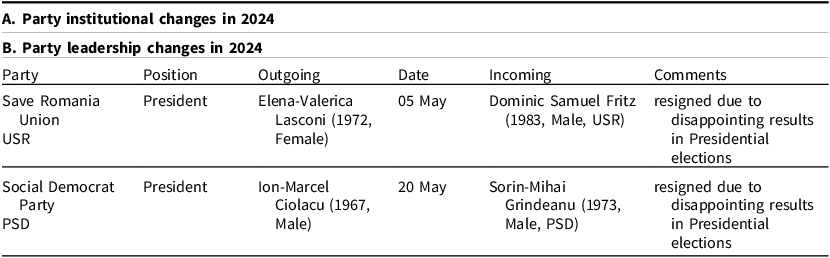
Two important parties elected new leaders. The USR president Elena-Valerica Lasconi resigned after the first round of presidential elections in May, in which she gathered only 2.7% of the vote. This disappointing result was also prompted by the decision of some party members to support Dan’s candidature. Lasconi was replaced by Dominic Samuel Fritz. Born and raised in Germany, Fritz obtained Romanian citizenship only in December 2025. In 2020, he became Mayor of Timisoara, an important city in Western Romania where the Revolution of 1989 originated and was re-elected in 2025.
Prime Minister Ciolacu stepped down as PSD leader and was replaced by PSD Vice-President Sorin-Mihai Grindeanu. Ciolacu gave up the PSD presidency after Antonescu, the presidential candidate the party supported, was unable to enter the second round. Table 6 explains changes in political parties.
Changes in political parties in Romania in 2025

Table 6. Long description
The table is divided into two sections: Party institutional changes in 2024 and Party leadership changes in 2024. The first section is empty. The second section lists changes in party leadership, including the party name, position, outgoing leader, incoming leader, date of change, and comments. The table has two rows of data. Row 1: Save Romania Union, President, Elena-Valeria Lasconi, Dominic Samuel Fritz, 05 May, resigned due to disappointing results in Presidential elections. Row 2: Social Democrat Party, President, Ion-Marcel Ciolacu, Sorin-Mihai Grindeanu, 20 May, resigned due to disappointing results in Presidential elections.
Sources: Uniunea Salvați Romania (2025), www.usr.ro; Partidul Social Democrat (2025), www.psd.ro.
Issues in national politics
Indictment of Călin Georgescu
The 2024 round of presidential elections was annulled allegedly because a foreign state (Russia) influenced the vote in favor of independent candidate Călin Georgescu. Despite promises, no evidence has ever been produced by the Romanian authorities to substantiate those allegations. The only information available in the public space originated with Western intelligence services or investigative journalists (Toșa Reference Toșa2024; Coman Reference Coman2025; Mazilu Reference Mazilu2025). In the absence of evidence, the Constitutional Court decision to annul the vote was vehemently contested both inside and outside of Romania. A series of street protests occurred in early 2025 in several Romanian towns and Bucharest in support of Georgescu, organized by sovereigntist parties. An IRES survey conducted in December 2025 found that 61% of respondents considered the decision wrong, while 35% considered it correct (IRES 2025). As a result of the decision, the Economist Intelligence Unit Democracy Index downgraded Romania from the status of a flawed democracy to that of a hybrid regime, the only such country in the EU (Economist Intelligence Unit 2025). The Venice Commission also criticized the decision (Miron Reference Miron2025).
The radical decision of annulling the vote was followed by the indictment of Georgescu, accused of having manipulated the vote through an aggressive campaign conducted mainly on social media channels like Tik Tok. In 2025, the Romanian judiciary indicted him not for rigging the vote but for his older fascist and antisemitic statements and for having publicly promoted Marshall Ion Antonescu, the World War II leader who aligned Romania with Nazi Germany. On 26 February, the Prosecutor’s Office placed Georgescu under investigation and throughout 2025, the law enforcement gathered evidence against the former presidential candidate. On 2 July, he was indicted for right-wing propaganda, whereas on 15 September he was again indicted for attempts to initiate actions that run against the constitution (juridice.ro 2025; recorder.ro 2025).
Soured relations with the United States
Since 2004, successive Romanian presidents have tried to improve relations with the United States, which soured during 2025 (Friedrich Ebert Stiftung 2026). First, Romanian authorities were bitterly criticized by the American Vice-President J.D. Vance at the Munich Security Conference in February. Vance used the annulment decision as a negative example to underscore the fragility of Romanian democracy and the difference between the United States and the EU in understanding fundamental values like freedom of speech, democracy, and censorship, a difference understood by Vance to place the EU at a net disadvantage (RFE/RL Romanian Service 2025).
On 2 May, Romania was excluded from the Waiver program. This measure, which annulled a decision of the Joe Biden administration, was part of the numerous anti-migration policies adopted by the Trump administration. Its timing, just two days before the first round of presidential elections were held in Romania, was criticized as possibly benefiting the far-right candidate Simion who, as Georgescu, criticized the EU and vocally supported Trump and his policies.
In October, the US administration withdrew some of the troops stationed in Romania, Hungary, Bulgaria, and Slovakia, but not from Poland or the Baltic republics. The decision, which generated frustration, was part of a realignment of American focus away from Europe and NATO support. As a result of this ‘strategic reconfiguration’, around 700 troops from the 101st Airborne Division’s 2nd Infantry Brigade Combat Team was redeployed to Kentucky without replacement, leaving only some 1,000 troops on Romanian soil (Atlantic Council 2025).
Austerity measures, protests, and the appeal of sovereigntist parties
Romania’s economic situation was difficult at the beginning of 2025. The previous year, the country registered the largest budget deficit (9.3%) and the highest inflation rate (5.1%) in the EU, for the third consecutive year (European Commission 2026). In late July, the Bolojan cabinet approved the first of three austerity packages designed to balance the national budget. The packages included measures such as: a tax increase from 19% to 21% on all goods; a tax increase from 9% to 11% for food items, medicine, books, and energy; a tax increase of 10% for alcohol, benzene, and tobacco products; compulsory medical contribution for all those receiving pensions over 600 Euros; no salary and pension increase for government employees until end of 2026; limited hiring in the public administration sector; a reduction in student scholarships; and a reduction by 40% in subsidies allocated to political parties from the national budget (Carlugea Reference Carlugea2025). Note that, as of 2025, Romania had the second lowest income taxes in the EU. These austerity measures led to labor union protests, criticisms of the government by opposition parties, and efforts by the PSD, part of the ruling coalition, to distance itself from these unpopular measures.
Other developments
Dan’s victory in the presidential elections meant that the Bucharest mayoral seat remained vacant. Elections organized on 7 December 2025 brought Ciprian Ciucu (PNL, male, born 1978) into the position of Mayor of Bucharest. Ciucu served as Mayor of a Bucharest district no. 6 from 2020 to 2025.
Ion Iliescu died on 5 August at 95. A former communist official and collaborator of dictator Nicolae Ceausescu, Iliescu was sidelined in the 1980s. A major figure of the 1989 Revolution, he emerged as an alternative to Ceausescu trusted by Soviet leaders. Iliescu had graduated from the Soviet Union with a university degree. By stoking nationalist concerns and discrediting exiled politicians who returned to Romania after Ceausescu’s fall, Iliescu was able to secure the presidency in 1990. The 1991 Constitution turned Romania into a semi-presidential republic. Iliescu stood for re-election in 1992 and 2000, in defiance of constitutional provisions limiting presidential mandates to two in a lifetime. He was indicted but never sentenced for his role in the 1989 Revolution and the crimes perpetrated by the miners he encouraged to descend on Bucharest in 1990, 1991, and 1999 in the mineriade. Under his leadership, the former Communist Party transformed into the Social Democrat Party. In his last presidential mandate (2000–2004) Iliescu promoted Romania’s entry into NATO and the EU and created a presidential International Commission on the Holocaust in Romania. He blamed Ceausescu, not communism, for Romania’s problems in the 1980s.
The year 2025 represented a return to (fragile) stability for Romania, after the controversy surrounding the 2024 vote which tarnished its international image and undermined public trust in mainstream parties and state institutions. The austerity measures adopted by the Bolojan cabinet eroded living standards and increased public support for sovereigntist parties. At the same time, Dan’s electoral victory over the far-right sovereigntist Simion brought a measure of moderation in what remains an unstable political system.
Data availability statement
The data for this article can be found at the PDY Interactive website: http://politicaldatayearbook.com
Competing interests
The author declares none.

 Open access

