Introduction
Currently, we do not know what ‘life’ is (Cockell, Reference Cockell, Schwartz and Milligan2016) so we seek learning experiences with putatively living extraterrestrial entities. In this light, scientific searches for life beyond Earth manifest in five forms. First is SETI, which uses radio, gravity waves and other sources of data to locate highly intelligent life elsewhere (Shostak, Reference Shostak and Dick2015). Related to but different from SETI, a second search involves locating exoplanets and peering into their atmospheres to find signs of biology as we know it (Shostak, Reference Shostak and Dick2015). Another search involves isolating the origins of life in laboratories (Race, Reference Race and Bertka2009).
Two more searches remain localized within our Solar system, in which extraterrestrial microbes are, using the rhetoric of law enforcement posters, wanted dead or alive. In one of these searches, fossils of dead microbes could show that life developed on Mars 3.5 billion years ago, when the Red Planet enjoyed warmer temperatures and more abundant liquid water than today (Brack, Reference Brack, Cabrol and Grin2018). Such fossils may be found in locations like phyllosilicates (Bishop, Reference Bishop, Cabrol and Grin2018), ancient lakebeds (Cabrol et al., Reference Cabrol, Grin, Zippi, Noffke, Winter, Cabrol and Grin2018) or hydrothermal deposits (Cady et al., Reference Cady, Skok, Gulick, Berger, Hinman, Cabrol and Grin2018). In addition, campaigns exist to discover living, extant microbial life in the waters of Jupiter's moon Europa (Hand et al., Reference Hand, Chyba, Priscu, Carlson, Nealson, Pappalardo, McKinnon and Khurana2009), in the volcanic outflows of Jupiter's moon Io (Schulze-Makuch, Reference Schulze-Makuch and Dick2015), in the waters of Saturn's moon Enceladus (Shostak, Reference Shostak and Dick2015) or in the hydrocarbons of Saturn's moon Titan (Farmer, Reference Farmer, Cabrol and Grin2018).
The first two of these searches, SETI and the hunt for exoplanets, remain subjects for a larger study of mine, so I set them aside in this article. Up front, I also bracket laboratory searches for the origins of life, although, as I briefly will describe in Section 4, my conclusions offer ramifications for these searches. Instead, in this work, I focus on the searches for potential microbial life and specifically on how these searches unfold on Mars. Mars, ‘at the center of astrobiology in many ways’ (Jakosky et al., Reference Jakosky, Westall, Brack, Sullivan and Baross2007), at present provides the clearest and most-studied avenues for microbial research. For example, the Viking missions sought living microbes, whereas many missions since, such as the Opportunity, Spirit and Curiosity rovers as well as in large measure the upcoming Mars 2020 and ExoMars rovers, have studied or will study microbial histories. For these reasons, Mars provides an ideal focus for examining the search for microbial life, yet the results of this essay should be widely applicable beyond Mars.
These Martian searches for dead or alive microbes raise several important ethical questions that have not been fully resolved in the space ethical literature. Do scientific ethics designed for Earthly life forms apply beyond Earth? Does microbial life beyond Earth enjoy ethical value? How do we develop ethical plans for dealing with the discovery of extraterrestrial microbial life? Finally, how may space ethics alter our understanding of Earth-based scientific ethics?
Because we need a space ethic for dealing with microbes (Cockell, Reference Cockell, Schwartz and Milligan2016), in this essay, I implicitly and explicitly explore these questions as I propose a secular, science-ready ethic for the search for ‘dead or alive’ Martian extraterrestrial life. I conclude that both fossil and extant microbial searches on Mars, although in different ways, ethically benefit from following the principles of default non-harm extended to potential forms of life, default non-harm extended to the habitats of life, yet also limited scientific sampling that is as respectful as possible as an exception to these default modes as long as the benefit of humanity orients that research. The first two principles ensure that our scientific approaches to other living beings arise as ethically as possible, while the third principle enables responsible science yet still avoids the ‘wanton destruction’ of microbes described by the space ethicist Milligan (Reference Milligan2015).
I submit that anyone potentially can agree to these three scientific ethical principles, regardless of religion or lack thereof, rendering this a secular ethic on which scientists, astronauts and engineers in theory can unite. By ‘secular’ I follow Taylor's (Reference Taylor2007) description of a situation in which ‘the norms and principles we follow, the deliberations we engage in, generally don't refer us to God or to any religious beliefs; the considerations we act on are internal to the “rationality” of each sphere.’ Indeed, in spirit, this ethic mirrors Race and Randolph's secular principles for planetary protection (Race and Randolph, Reference Race and Randolph2002). The religious respect for microbes that emerges in this essay also enjoys a secular parallel in Lupisella's (Reference Lupisella and Dick2015) notion of ‘cosmic evolution’, while ecological personhood attitudes that implicitly reside in the Buddhist materials that I utilize here (Capper, Reference Capper2016a) dovetail with Kramer's (Reference Kramer2019) secular ethic of treating Martian microbes as legal persons. Therefore, adopting this secular ethic moves us towards meeting the need to ‘resolve our policies regarding extraterrestrial ethical issues prior to their [microbes’] discovery, before we know whether or not they exist; prior to learning of their possible commercial value and before we can assess their capacity for suffering’ (Kramer, Reference Kramer2011).
A capable secular environmental ethic must be built on the back of something that retains solid cultural regard, so although my end result remains a secular ethic, in this essay, I turn to the authority of the 2500-year-old tradition of Buddhism as a foundation. As I will describe more fully, among world religions Buddhism maintains a strong ethic of care and concern for life, for the most part effectively can coexist with space sciences like astrobiology, and offers space sciences some helpful conceptual tools (Traphagan and Traphagan, Reference Traphagan, Traphagan and Dick2015). In examining Buddhist ethics, along with a qualitative moment regarding scriptural Buddhist ethics, I add a quantitative ethnographic survey study of contemporary American Buddhists regarding ethical issues in space exploration, enabling the application of Buddhism's traditional care for living things specifically in terms of relevant issues in astrobiology.
Put historically, in this essay, I examine many Buddhist voices from the Buddha to the present day in order to propose a secular ethic of default non-harm to potentially living beings, default non-harm to the potential habitats of living beings, yet also purposeful, non-excessive scientific study in exception to the default modes. These secularized principles, manifesting not as religious injunctions but as the desired ‘space humanism’ of the ethicist Arnould (Reference Arnould2011), then can be embraced by any human being who understands their value. It would be both unwise and unfair to expect space scientists and explorers always to adhere to Buddhist principles, yet we can expect space professionals to live by sensible, secular ethical codes, and the provision of such a code constitutes the main aim of this essay.
Research context
Such a secular path is the only one that I can take as a researcher, for I am a critical scholar at a non-religious public university, not a monk, seminarian or member of any Buddhist group, including of course the groups studied in this essay. Instead, in order to strengthen humanity's secular relationships with the non-human natural world, in my academic research, I have produced a number of works about multireligious environmental ethics in which I specifically highlight problems as well as strengths in many different moral ecologies. For instance, careful readers will note that I build part of the qualitative argument of this essay on some moments in which Buddhists fail to practice what they preach, showing that I do not intend to lead cheers for any religion. I endeavour to contribute improved astrobiological ethics.
Our conversation about how to interact with microorganisms on Mars began when Carl Sagan asserted his undeveloped secular ethic, ‘If there is life on Mars…Mars then belongs to the Martians, even if the Martians are only microbes’ (Sagan, Reference Sagan1980). Since Sagan's time, numerous Western philosophical writers have expressed themselves on the issue, as have those from some more or less relevant Jewish (Samuelson, Reference Samuelson and Peters2018), Christian (Randolph, Reference Randolph and Bertka2009) and Muslim (Iqbal, Reference Iqbal and Peters2018) perspectives. However, these religions embrace some biblical environmental ethics and therefore maintain attitudes towards the natural world that do not arise within Buddhist realms. In addition, some Western philosophical ethics formulations such as Kantian thought and utilitarianism involve similar notions of biblical environmental ethics, since these philosophical orientations arise from cultural contexts related to the Abrahamic religions and share some intellectual elements with them (Lovejoy, Reference Lovejoy1976). Thus, Buddhists can offer some unique and valuable new elements to our conversation about how to engage microbial Martians.
For instance, the Abrahamic religions of Judaism, Christianity and Islam embrace the environmental doctrine of dominion or stewardship as asserted in Genesis 1:20–31 in the Bible (Foltz, Reference Foltz2006; Hobgood-Oster, Reference Hobgood-Oster2008). In Genesis, God, the absentee owner of the natural world, delegates management of non-human nature to human beings, God's empowered stewards or overseers (Hobgood-Oster, Reference Hobgood-Oster2008). This doctrine of stewardship thereby creates an inherent anthropocentric hierarchy which portrays human superiority to the rest of the natural world (Hobgood-Oster, Reference Hobgood-Oster2008). With the stewardship doctrine, humans enjoy power and discretion while non-human entities obey human wishes. Historically often allied with the versions of Aristotle's Great Chain of Being (Lovejoy, Reference Lovejoy1976), this hierarchical biblical attitude typically privileges humans to the detriment of animals, plants and other entities (Capper, Reference Capper2016b). The biblical attitude of stewardship therefore would appear to demand the a priori presumption that humans are the appointed managers of Martian microbes before any ethical deliberation has begun. Unfortunately, this presumption arbitrarily restricts ethical possibilities for microorganisms on Mars before they ever are discovered, should that happen, within Abrahamic religious realms as well as within many Western philosophies.
For its part, Buddhism faces its own environmental ethics dilemmas, such as its curtailed protections for stone and water ecologies (Capper, Reference Capper2016b) and recurring divergences between theory and practice (Capper, Reference Capper2015). However, Buddhism is not a Bible-based religion, does not subscribe to the biblical worldview of human stewardship of the natural world and was not developed in the context of biblical religiosity like many Western philosophies were. Unlike biblical religions, Buddhism posits the doctrine of reincarnation, in which beings may be born within realms of existence including hell beings, ghosts, animals, humans and non-creator gods (Waldau, Reference Waldau2002). In this light, Buddhist texts teach the superiority of a human rebirth above even that of the gods, so that Buddhism is not lacking some of its own hierarchical attitudes of human supremacy to non-humans (Waldau, Reference Waldau2002).
Nonetheless, because humans and animals are reborn as each other, the Buddhist boundary between humans and specifically animals is permeable and relative, not fixed, thus mitigating against outright attitudes of human superiority towards animals (Harris, Reference Harris, Waldau and Patton2006). Humans are superior, but only temporarily. All humans have been animals before and hence should treat animals with kindness. Because of this more peer-like attitude, Buddhism explicitly asks its followers to extend measures of non-harm, compassion and lovingkindness to non-human animals much like they do to humans (Cooper and James, Reference Cooper and James2005).
As the rest of this article reveals, the presence of these three principles of non-harm, compassion and lovingkindness creates distinctive ethical possibilities for Martian microbes alternative to those of the biblical stewardship model. Hence, by turning to Buddhist environmental ethics, we clarify the moral boundaries of human behaviour on Mars in the novel and advantageous ways. Simultaneously, though, in following this path, we discover limits on Buddhist respect towards possible tiny Martian residents, such as an allowance of killing for science, precisely because, as I mentioned, Buddhism retains its own notions of human superiority to non-human nature (Waldau, Reference Waldau2002).
Therefore, as much as any of the imperfect philosophical or religious traditions that humans have devised, Buddhism delineates useful moral guidelines for how human beings beneficially should interact with living non-humans (Waldau, Reference Waldau2002), and guiding human interactions with living non-humans on Mars is the point of this study. Buddhism thus should be in the conversation that Sagan started regarding how we should treat potential tiny living Martians, as long as we remain critical and ready to wield Occam's razor. In this essay, I simply allow American Buddhists their turn to speak on this theme, so that secular scholars better may pursue the goal of together advancing diverse astrobiological ethics wholesomely, rationally and critically on the basis of the quality of the ethics themselves.
In the pages to follow, I first delineate the origins of this ethic in the Buddhist scriptures before describing the results of my ethnographic field work. The resulting Buddhist ethic will be set in context within the literature of space ethics, thus secularizing the Buddhist voice. In the course of the argument, the value of these principles for science will be explored. For instance, as I will explain more fully, American Buddhist support for taking the lives of Martian microbes in the name of science not only clarifies ethical contours of doing science on Mars, it also provides a vital new voice within the unresolved controversy regarding harvesting microbes for science here on Earth, such as potentially within the laboratory search for the origins of life.
Methods
In this essay, I seek both to tap the authority of the Buddhist tradition and to realize the specificity required by contemporary astrobiology, so I combine both qualitative and quantitative moments in my arguments. The qualitative moments arise first in terms of an examination of scriptural and lived Buddhist environmental ethics principles. Afterwards, quantitative ethnographic data collected among American Buddhists chart updated positions on traditional principles, thereby injecting grounded yet innovative made-for-space ethical positions into the context provided by traditional Buddhist perspectives. I turn first to the Buddha of the scriptures.
Four relevant Buddhist precepts
Given the long history and wide geographic spread of the Buddhist tradition, there exist many different Buddhist ways of thinking and acting, and I cannot begin to describe them all in one essay. Nonetheless, the following summary is one with which a wide variety of Buddhists essentially can agree.
Living in what is now India and Nepal around 500 BCE, the Buddha taught a unique religious code. The Buddha preached non-theism, having no need of the monotheistic God familiar to us from Christianity, Judaism and Islam. The Buddha believed in unseen spirits, but not in almighty creators, and in the teaching of the Buddha even invisible spirits remain unenlightened and must pursue spiritual practices. Instead, the Buddha asserted that human problems are just that, human problems, and require human solutions, not the interventions of deities. Since Buddhism lacks a creator God in this way, its universe is eternal, limitless and cyclic (Zajonc, Reference Zajonc2004).
According to the Buddha, the central problem human beings face is known in the scriptural Pāli language as dukkha. Difficult to translate, dukkha means something like suffering, imperfection or unsatisfactoriness. Humans wish for lasting happiness, according to the Buddha, but remain stymied by the dukkha caused by inevitable things like sickness, old age and death (Bodhi, Reference Bodhi2000). Given the wish for happiness but a material guarantee of suffering, the Buddha taught that we find lasting happiness by fundamentally changing how we mentally regard the universe (Bodhi, Reference Bodhi2000). Rather than identify self-centredly, the Buddha claimed, we should deeply realize our interconnections with the broad cosmos, thus transcending suffering in a powerful religious experience known in the scriptural Pāli language as nibbāna, or, as it has entered the English language from Sanskrit, nirvana.
Because of its relative lack of concern with deities as well as its enthusiasm for empirical examinations of reality, Buddhism in many ways remains compatible with contemporary science (Cabezón, Reference Cabezón and Wallace2003). To be sure, this compatibility should not be stretched too far, since for instance Buddhist notions of the origin of consciousness diverge from scientific explanations (Ricard and Thuan, Reference Ricard and Thuan2001) and sometimes Buddhists employ concepts that cannot be validated non-subjectively (Lopez, Reference Lopez2008). Nonetheless, Buddhists such as Tibet's current Lama (Reference Lama2005) encourage the integration of Buddhist and scientific points of view, with this integration's being useful to space science (Traphagan and Traphagan, Reference Traphagan, Traphagan and Dick2015).
Buddhist monasticism institutionalizes the quest for the experience of nirvana, and monastic precepts intend ethically to train the mind as a part of that quest. There exist different codes of monastic precepts, known as Vinaya texts, across the three great branches of Buddhism: Theravāda, the ‘Way of the Elders’; Mahāyāna, the ‘Great Vehicle’; and Vajrayāna, the ‘Diamond Vehicle’. In Asia, Theravāda commonly exists in Burma, Cambodia, Laos, Sri Lanka, Thailand and Vietnam; Mahāyāna usually appears in China, Japan, Korea, Taiwan and Vietnam; whereas Vajrayāna remains centred in Bhutan, Mongolia and Tibet.
Despite minor differences in Vinaya monastic codes between these schools, the monastic precepts that I discuss in this essay appear similarly in every active Vinaya standard from across the three great sects, so that Buddhists from different schools in my field study should be expected to offer similar survey responses. That is what I find in my field data, because there manifest no significant differences between the groups on any question related to this essay, with this significance tested using pairwise two-tailed Fisher's exact statistical tests. Thus, because neither qualitative nor quantitative data in this study vary much by sect, in this essay, I focus my overall analysis on American Buddhism on the whole rather than on its subdivisions. Given this approach, for the sake of economy, I will refer to monastic precepts only as they appear in the Pāli language Theravāda Tipiṭika scriptures.
The four precepts that I discuss derive from the Pācitiyya section of the Pāli Vinaya, meaning the monastic rules that require confession if broken as well as forfeiture if the wrongful acquisition occurred. Pācitiyya 61 from the code for monks, or the similar Pācitiyya 142 from the code for nuns, remains one of the most important strictures within Buddhism, since it asserts, ‘Should any bhikkhu [monk] intentionally deprive an animal of life, it is to be confessed’ (Bhikkhu, Reference Bhikkhu2013). With this precept, Buddhism strongly encourages refraining from killing any animals. This rule of non-harm to animals, or familiarly ahiṃsā from Sanskrit, grounds Buddhism so much that it remains incumbent not just upon monastics but also upon all Buddhists in the form of the first lay ethical precept.
Of course, on-the-ground realities, especially within the lives of lay people, constrain the application of this principle of non-harm, and notably so when it comes to microbes. Each day monastics and lay people consume plant- and animal-based foods and thereby at least kill small creatures resident in these foods, other Buddhists take antibiotics that they know will kill microbes (McCormick, Reference McCormick2013), while yet other Buddhists intentionally will eliminate bathroom ‘germs’ in their homes. These microbicidal activities often remain encouraged by some anthropocentric dimensions of Buddhism (Capper, Reference Capper2015), for the extension of human life to seek nirvana (something generally unavailable to animals and microbes) remains more valued than the lives of complex animals as well as microbes themselves (Waldau, Reference Waldau2002). Moreover, at times microbes may not be considered sentient or animals and hence not subject to the precept on non-harm (Eisen and Konchok, Reference Eisen and Konchok2018).
Thus, through its precept on non-harm, Buddhism stresses the ideal value of not harming living beings, but in practice with microbes as a default, rather than an inviolate, position, especially for lay people. Remembering that space scientists typically are not Buddhist monastics, this lay person ethic of default but not complete non-harm seems appropriate for space science endeavours.
Two more monastic precepts of environmental ethical import, nuns' Pācitiyyas 116 and 143 or the similar Pācitiyyas 20 and 62 for monks, contribute to my second space ethical pillar. Pācitiyya 116 for nuns states, ‘Should any bhikkhunī [nun] knowingly pour water containing living beings – or have it poured – on grass or on clay, it is to be confessed,’ while Pācitiyya 143 reads, ‘Should any bhikkhunī knowingly make use of water containing living beings, it is to be confessed’ (Bhikkhu, Reference Bhikkhu2007). While microorganisms as we know them today remained unknown in the Buddha's culture, there still existed a sense that water and other places could harbour life forms that appear too small for humans to see, giving rise to these monastic rules against disturbing the habitats of small living beings. Here the Buddha showed his respect for the ecologies upon which tiny life forms depend.
Of course, this outlook becomes compromised at times for lay people. Many non-monastic Buddhists daily make use of water ecologies for food and stone ecologies for construction, even though water and stone microecologies could house tiny life. In fact, for both monastics and lay people, the Buddha approved of using stone (Pāli: pāsāṇo) for constructing housing, monastery halls, fencing, footpaths and even in powdered form to keep needles from rusting (Bhikkhu, Reference Bhikkhu2013). Therefore, given that we cannot expect scientists to be Buddhist monastics, as followed by lay people, these norms can be understood as providing stress on protecting the habitats of living beings but not rigidly so. That is, this ethic demands default but not absolute non-harm to the ecologies that potential small life forms may inhabit.
Pācitiyya 11 (nuns: Pācitiyya 107) from the Pāli Vinaya code for monks provides the foundation for my third ethical principle for the search for microbial life. In response to some monks who had created a commotion by chopping down trees to make a rustic residence, the Buddha of the Pāli scriptures issued the following injunction for monks: ‘The damaging of a living plant is to be confessed’ (Bhikkhu, Reference Bhikkhu2013). In theory, this precept means that monastics will not harvest living plants, and, following this rule, in many places, Buddhist monastics avoid farming. Nonetheless, agriculture as practiced by Buddhist monastics has appeared numerous times in diverse places (Yun, Reference Yun1988). Moreover, lay people can harvest plants and then offer the harvested plants to monastics, and in fact without this mechanism, Buddhist monastics everywhere would have no wooden monasteries in which to live and would starve to death anyway. Hence, on the ground, Pācitiyya 11 results in circumstances in which the harvesting or cutting of living plants can occur as long as pursued as respectfully as possible, generally by lay people, and without excess.
Translated into the science on Mars, this ethical principle results in a scientific standard in which microbes may be harvested and perhaps even killed, as long as the harvesting transpires as respectfully as possible, without excess, and for legitimate scientific ends. Because it balances ecological respect and concern for human needs, this secular ethical standard can provide valuable moral guidance in space science settings.
A wise anonymous reviewer of this article inspires some comments about this respectful harvesting. From the standpoint of potential Martian microbes, no human culling of Martian life in the name of science is respectful. Indeed, no Martian microorganisms will offer their voluntary consent as research subjects. Thus, the respect that is intended here, arising within the context of the anthropocentric endeavour of benefitting human science, remains limited by human-centred colouring and should be recognized as such. Put differently, we should appreciate that harvesting living Martian microbes for human science never can be pursued perfectly respectfully but can be enacted as respectfully as possible from human points of view.
Taken together, these monastic precepts and their contexts appear helpfully to provide a foundation for Buddhist environmental ethical sensibilities in space. Tested over 2500 years, these ethical principles argue for an ethic for the search for microbial life consisting of default non-harm towards possible living beings, default non-harm towards their habitats, yet limited scientific use that is respectful in intent.
However, Earth environments alone conditioned the production of these principles, and there exist no direct hints in the Buddhist scriptures regarding their relevance in other worlds. Perhaps these ideas remain hopelessly Earthbound. In order to obtain clarity regarding the use of these principles beyond Earth, I engaged in quantitative ethnographic field work among contemporary American Buddhists so that Buddhists themselves can shape our comprehension. I turn now to this ethnographic dimension.
American Buddhists on space ethics
Buddhism entered the United States from Asia beginning in the mid-19th century primarily through immigration from Japan and China, and now Buddhist centres exist in every state. While Buddhist centres thrive most in the ‘Buddhist Belts’ of California and New York, they also can be found in the ‘Bible Belt’ of the southeastern United States (the data collection region of this study), where they tend to be fewer in number and smaller in population size (Wilson, Reference Wilson2012).
One feature that long has defined American Buddhism is its environmentalist sensibility in comparison to other religions and even some other Buddhist places (Capper, Reference Capper2016a). American Buddhists in word and practice frequently place effort into combining their spirituality with ecological activism (Koizumi, Reference Koizumi and Payne2010), and, because of these environmentalist impulses, the scholar of Buddhism Seager (Reference Seager1999) has called American Buddhism an ‘eco-centric’ religious community. This environmentalist tone sometimes made my field work easier, since some Buddhists appreciated the environmental ethical dimensions of my project and therefore seemed eager to participate.
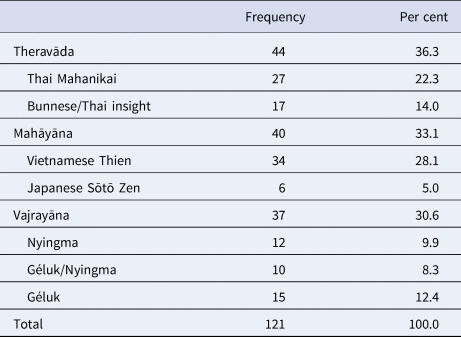
Survey-based ethnographic field work, approved by my university's Institutional Review Board, was conducted between March and June of 2019. In the field, I obtained significant samples from all three Buddhist main branches of Theravāda (N = 44), Mahāyāna (N = 40) and Vajrayāna (N = 37). Taken together, these centres supplied 121 overall Buddhist samples, as indicated within Table 1.
Buddhists by sect and denomination

Characterizing these centres demographically requires some comment. Since the beginning of the study of American Buddhism in the 1970s, scholars usually have portrayed differences in Buddhism in terms of a ‘two Buddhisms’ model typified by the work of Prebish (Reference Prebish1979) or the ‘three Buddhisms’ model as described by Nattier (Reference Nattier, Prebish and Tanaka1998). Recently, though, these models have fallen under a variety of attacks in terms of their obscuring of the true contours of American Buddhist practices (Han, Reference Han2017) as well as their failing to comprehend diversity (Spencer, Reference Spencer2014). Out of respect for these latter critiques, in this essay, I take a fresh approach to Buddhist demographics.
There appears to exist a spectrum of views and practices that American Buddhists adopt or embody. On one end of this spectrum rest conservative positions, which I define here as seeking to reproduce on-the-ground Asian Buddhist realities as faithfully as possible in the United States. In contrast, a liberal American Buddhist position, while still concerned with questions of authenticity, seeks to redefine Buddhism in light of American realities. Of course, this represents a spectrum of myriad positions, and one individual, whether an immigrant or a ‘convert’ (Prebish, Reference Prebish1979), may hold views on divergent subjects that fall at different locations on the spectrum. For instance, it remains not uncommon for one Buddhist to be conservative in choice of practice but somewhat liberal in executing that practice and vice versa (Capper, Reference Capper2014), and there exist many other possible scenarios. Here I intend a true spectrum of personal views and practices, not a set of sociological categories for people.
With this spectrum in mind, we can appreciate that every centre will entertain both conservative and liberal perspectives, but centres often focus their existence and methods in terms of a place on the spectrum. Some centres self-consciously purvey predominantly conservative messages and practices, while other centres intentionally embrace significantly liberal approaches to being Buddhist. Such cultivated centre identities positively can aid in the necessary functioning of and recruitment for a religious establishment.
In terms of this typology, two of my field sites exist as decidedly mixed centres that cater to both conservative and liberal sensibilities at different moments. The other five centres, while consisting of a variety of views among individuals, in terms of centre identity involve more clearly liberal American Buddhist organizations. In my research, I reached out as well to centres that may be described as conservative without successfully inviting their participation. Sometimes language problems like my inability to translate my survey into Sinhalese or Laotian perhaps understandably negated my outreach. Regardless of orientation, though, commitment to Buddhism in the centres that I studied includes casual interest in Buddhism, serious lay participation and monastic devotion of one's life to the tradition. On this note, six monastics from different sects form a part of my survey cohort.
All of these Buddhists are American Buddhists, so that additionally I collected survey samples from a general population control group in order to allow discernment of what is distinctively Buddhist from what is more broadly American in terms of points of view. To create the control set, I surveyed 78 random undergraduate students at a small state university in the southeastern United States, the same region as this study's Buddhist centres. Within this control sample, 82% self-reported as Christian, 9% as having no religion, 2.6% as Hindu and 1.3% each self-reported as Wiccan, Stoic, Ecumenical or Agnostic. Additionally, within this control set, 1.3% were Buddhist, which mirrors the same fraction as within the overall United States population (Mitchell, Reference Mitchell2016).
Whether a member of the Buddhist group or the control group, all field subjects took the same 16 prompt surveys. Four of these prompts pertain to the subject of this essay. The four prompts are:
(1) I think that Buddhist principles should be utilized to guide our interactions with microbial life beyond Earth. (responses on a five-point scale from strongly agree to strongly disagree)
(2) If we do use Buddhist principles to guide our interactions with microbial life beyond Earth, those principles should be? (choices offered but alternative responses welcomed)
(3) We should protect from harm the extraterrestrial habitats of life, the ecologies on which life depends, whenever possible. (responses on a five-point scale)
(4) If it intends to alleviate human suffering through the advancement of science, it is acceptable to take the lives of a small number of microbes from beyond Earth for the sake of their scientific study. (responses on a five-point scale)
Now I turn to the quantitative data to see what contemporary Buddhists have to say about the ethical search for microbial life.
Results
American Buddhists, perhaps unsurprisingly, expressed highly sanguine views about the effectiveness of applying Buddhist ethical principles to issues within the search for microbial life. Almost two-thirds (64%) strongly agreed that Buddhist principles should be used in the search and another 25% of Buddhists agreed with using Buddhist principles, so that in total 89% of Buddhists argued for the deployment of Buddhist principles in the search for extraterrestrial life settings. Of the overwhelmingly Christian (82%) control sample, 36% strongly agreed or agreed that Buddhist norms be in the conversation, thereby exhibiting a measure of Christian tolerance. Nonetheless, without controversy and supported by a Fisher's exact test (p < 0.0001), Buddhists on the whole chose to employ Buddhist values in the search for life much more than did members of the control group. By the way, the presence of zeros in some data preclude the use of χ2 tests for some measures in this article, so I test independence utilizing two-tailed Fisher's exact tests and for uniformity do so across measures.
In line with the previous discussion about Pācitiyya 61, which extends ahimsa non-harm to animals, in terms of active norms, 84% of Buddhists either agreed or strongly agreed to extend non-harm as an operant value specifically towards microbes in extraterrestrial settings. Fruitfully, we can compare this result with the about half (59%) of control group subjects who, when faced with an ‘If we do use Buddhist principles’ scenario, chose to identify the value of non-harm in this instance. A Fisher's exact test demonstrated the relative independence of the Buddhist and control samples, with p = 0.0001. Buddhist insistence on non-harm towards microbes in space thus arises clearly against the larger cultural backdrop.
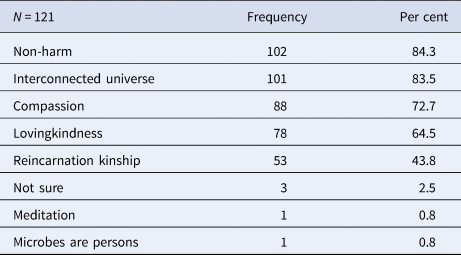
I should note that Buddhist ethics are not a zero-sum game, since the Buddha on many occasions counselled simultaneous actions of non-harm, compassion (karuṇā) and lovingkindness (mettā). Because of this potential concurrence of value choices, survey subjects were invited to choose more than one norm if they wished. In this light, Buddhists chose to employ a variety of values as exhibited within Table 2.
If we do use Buddhist principles to guide our interactions with microbial life beyond Earth, those principles should be

A large 84% of Buddhists underlined the importance of realizing our interconnectedness with all things (Pāli: paṭicca-samuppāda), perhaps instructively indicating that this central Buddhist concept can offer ‘a philosophical basis for a meaningful astroethical paradigm’, like Irudayadason (Reference Irudayadason, Impey, Spitz and Stoeger2013) states. Intriguingly, only 44% felt that reincarnation impacts ethical calculations regarding proper behaviour with microorganisms beyond Earth, possibly intimating that many American Buddhists do not subscribe to the reincarnation of microbes into humans or vice versa.
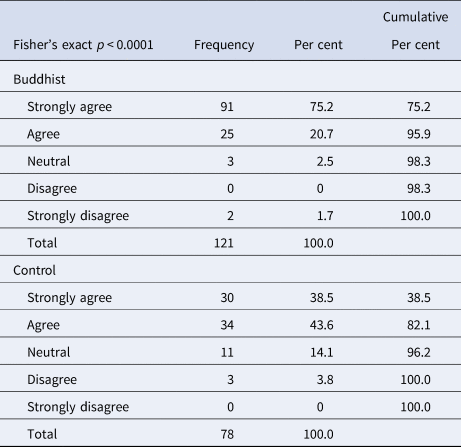
In addition to non-harm towards living beings, as I have discussed, the Pācitiyya 116 and 143 precepts of the Buddhist nuns' code protect the ecologies on which living beings depend, and American Buddhists overwhelmingly chose to protect Martian ecologies. More than three-quarters (75%) strongly agreed that the habitats of living beings must be protected, with another 21% agreeing to this principle, creating a 96% overall approval margin among Buddhists, which Table 3 shows. As a follower of Vietnamese Buddhism stated, ‘We should consider that we may disrupt the evolution of other life forms (even microbial ones) if we interfere with their environments.’ This result contrasts with the members of the control group, among whom 82% at least agreed with habitat protection although only 38% strongly agreed. As a Fisher's exact test result of p < 0.0001 supports, these American Buddhists thus distinguish themselves from the larger public by asserting that the habitats of extraterrestrial living beings should be treated with respect and default non-harm.
We should protect from harm the extraterrestrial habitats of life, the ecologies on which life depends, whenever possible

Previously, I developed an argument in which the Buddhist monastic standard Pācitiyya 11 serves as a starting point which allows limited utilization of resources, even killing living things, as long as harvesting occurs as respectfully as possible, without excess and for reasons of true scientific merit. From this principle arose what many field subjects described as the toughest prompt on my survey, or, as one field subject said, ‘The most difficult for me to know the answer to’: ‘If it intends to alleviate human suffering through the advancement of science, it is acceptable to take the lives of a small number of microbes from beyond Earth for the sake of their scientific study.’ This prompt relates to contentious arguments in current Buddhist bioethics because of a Buddhist moral dilemma (Eisen and Konchok, Reference Eisen and Konchok2018) that relates to compromises concerning the practice of Buddhist non-harm that I mentioned previously.
On one hand, Buddhists should not kill, as we have seen, including presumably for scientific research. This non-killing may include microorganisms, since some Buddhists debate the sentience of microbes (Eisen and Konchok, Reference Eisen and Konchok2018), with sentience designating one as a Buddhist moral actor (Keown, Reference Keown2001). At the same time, Buddhism treasures the human species above all others, for only humans can join the monastic community and, aside from apocryphal stories, realize nirvana (Capper, Reference Capper2015). Hence, a common Buddhist opinion holds that killing microbes remains acceptable if it prolongs a human life, and Buddhists act practically on this principle every time they cook food or clean their kitchens. Because of the dilemma between the desire to avoid killing and the demand to kill microorganisms to further humanity, current Buddhist bioethics remain quite vague when it comes to issues like the acceptability of killing microbes. Of course, even non-Buddhist bioethics remain unclear about microbes, given that humans regularly kill them in everyday life despite their potential intrinsic value in terms of biodiversity as well as their utilitarian value to science (McKay, Reference McKay and Peters2018).
This ambivalence about microbe lives appears in the survey comments of some Buddhists. In sympathy with tiny beings, one Zen Buddhist subject said, ‘Who are we to assume that our lives are more valuable than the microbe that we do not understand?’ A Vietnamese Buddhist emphasized that ‘only a SMALL number of microbes’ should lose their lives for science, while a Nyingma Vajrayāna Buddhist averred, ‘Bacteria are not sentient so far as we know but they may play a role in the universe that is beneficial and unrecognized.’ More stridently, one Buddhist asserted, ‘I do not support the scientific search for microbial life. This is not a “sanctity of life” response.’ Conversely, a practitioner of Theravāda insight meditation claimed, ‘I don't feel that microbial life is capable of suffering so I don't feel there is much value in protecting it from harm,' and a Zen practitioner frankly stated, ‘Microbes don't count.’
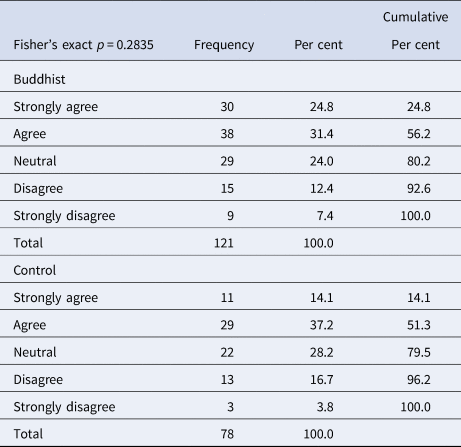
An important contribution of this study therefore derives from Buddhist opinions about the limits of science as found in the survey prompt under discussion. As one can see in Table 4, among Buddhists 25% strongly agreed that taking the lives of a small number of microbes for science is ethically acceptable, and another 31% agreed with this position, making 56% of Buddhists total in approval.
If it intends to alleviate human suffering through the advancement of science, it is acceptable to take the lives of a small number of microbes from beyond Earth for the sake of their scientific study

The control group generally evidenced slightly less approving attitudes towards the taking of microbial life than did the Buddhists in the survey. Nonetheless, and interestingly, overall little separated Buddhist from non-Buddhist responses to this issue, as Table 4 indicates. A Fisher's exact test failed to indicate independence between the Buddhist and control samples on this point, with p = 0.2835.
Perhaps against some expectations, therefore, these Buddhists do not diverge much from the control sample in favour of the responsible and limited intrusive scientific study of Martian microbes. In both Buddhist and control groups, large numbers remain neutral about harvesting microbes for science, thus highlighting the dilemmatic nature of the issue, but only about 20% in each group express disagreement with the practice. Thus, the overall result in this essay in terms of an endorsement, if an ambiguous one, of the scientific harvesting of microbes appears to be a generally American perspective, rather than being specifically American Buddhist.
Whether this admittedly ambivalent support for science represents an American or an American Buddhist phenomenon, though, in the end, these Buddhists nonetheless support the extension of all three of this article's proposed ethical standards. These contemporary American Buddhists remain quite willing to apply all three scripturally-derived norms – default non-harm to living beings, default non-harm to their habitats and scientific use that is as respectful as possible – specifically to the protection of extraterrestrial microbes. Thereby, maybe these American Buddhists overall exhibit a measure of what the astrobiologist Cockell (Reference Cockell, Schwartz and Milligan2016) has called beneficial and virtuous ‘telorespect’ for microorganisms, which is an attitude that attends to the ‘rudimentary interests’ and non-instrumental value of microbes.
Discussion
The Pāli Vinaya literature regarding monastic behaviour gave us ethical argumentative tools in terms of the nuns' Pācitiyya 107, 116, 142 and 143 precepts. In order to provide the appropriate secular ethic for space exploration, however, these precepts experienced secularization into an ethic of default non-harm towards living beings, default non-harm towards their habitats and exceptions to these defaults arising from legitimate and respect-oriented scientific study. American Buddhists in this study, through ethnographic voices, then strongly validated these standards for extraterrestrial use regarding default non-harm to living beings (84% approval) as well as default non-harm to the ecosystem abodes of life forms (96%). Approval among these American Buddhists in terms of harvesting microbes for science was less clear (56%) but still supports the scriptural ethical complex regarding the taking of resource lives as respectfully as possible. Thus, in this study, these American Buddhists strongly affirm the theory behind the tripartite secular ethic for searching for extraterrestrial microbial life that this essay develops while they decisively direct the practical application of that theory.
Being designed for this purpose, this secular ethic can effectively shape approaches to Martian microbes that we want dead or alive. For instance, the upcoming Mars 2020 rover has a tool for drilling into rocks to obtain possible fossil-bearing samples and find biosignatures, yet it is not well-equipped for examining extant life forms in situ (Williford et al., Reference Williford, Farley, Stack, Allwood, Beaty, Beegle, Bhartia, Brown, Torre Juarez, Hamran, Hecht, Hurowitz, Rodriguez-Manfredi, Maurice, Milkovich, Wiens, Cabrol and Grin2018). Therefore, if potential extant life could exist in a Mars 2020 study area, following this ethic, the rover's handlers should move to another, apparently lifeless candidate spot for its drill to ensure an outcome of default non-harm. When it remains unclear whether a phenomenon should be considered living or dead, default non-harm counsels restraint of intrusiveness, since when in doubt we should presume the ‘highest moral relevance’ (Cockell, Reference Cockell2007). Similar thinking should be applied to the principle of default non-harm towards potential habitat ecologies. To be sure, kind and wise rover handlers may already choose to act in these ways (Vertesi, Reference Vertesi2015), but this ethic codifies such behaviour.
However, if some future mission, better oriented towards examining extant life, should encounter something that could be living, all three ethical standards demand application. In the case of possible extant life, default non-harm should be extended to that potential life form, default non-harm should be extended to its environment and, if done as respectfully as possible and without excess, a small number of beings respectfully may be captured for responsible scientific study, even if their apprehension results in a death sentence.
Because microbial ethics exist unresolved both on Earth and in space, this acceptance of the scientific harvesting of microbes bears ramifications for both scientific settings, resulting in a side benefit to the erection of this space ethic emerging from this study. As discussed, Earthly Buddhist bioethical attitudes towards microbes remain unclear, and a good deal of the literature on this subject probes Buddhist microbial bioethics by invoking abstract ideals rather than empirical results. However, while abstract ideals play an important part of this article, through its ethnographic data, this study also usefully provides unique quantitative insight into lived Buddhist attitudes about the morals of harvesting tiny beings for science. As we have seen, while not united in opinion, a majority of American Buddhists in this study supported the limited but possibly-lethal scientific study of microbes that leads to human benefit, and this support retains relevance to Earth as well as Mars, such as within laboratory searches for the origins of life. Through this interaction space, ethics assist astrobiology in shaping Earth-based sciences, as the astrobiologist Cockell (Reference Cockell, Schwartz and Milligan2016) has requested, while further, they help to expand our universal notions of value (Lupisella, Reference Lupisella and Bertka2009).
By integrating qualitative and quantitative approaches, this study provides an authoritative basis for a Buddhism-inspired space ethic that yet remains secular in Taylor's (Reference Taylor2007) sense and, therefore, potentially universally attractive. Given that this ethic arises from its internal rationality, remains founded upon principles on which any reasonable person theoretically can agree, and does not appear to retain ethical elements that significantly conflict with those of various religions (Capper, Reference Capper2016b), this ethic can appeal to spacefarers from many different religions or no religion at all.
Conclusion
Four precepts with environmental ramifications from the Pāli Buddhist monastic code provide the pillars for an appropriate ethic for the search for microbial extraterrestrial life, while the voices of contemporary Buddhists provide crossbeams for the structure by delineating specific relevance to space situations. The resulting ethic, emerging from the voices of Buddhists themselves and hence enjoying the authority of a multimillennial tradition, supplies secular, focused practical direction in space research situations. A tripartite standard of default non-harm towards living beings, default non-harm towards their habitats and exceptions to these defaults for limited, respect-oriented scientific study highlights appropriate standards of scientific behaviour to which any scientist or explorer potentially can agree. Employed together, these principles stimulate ‘responsible exploration for all’, thus meeting a central standard for space ethics as described by Race (Reference Race and Bertka2009).
Financial support
No competing financial interests exist. This research did not receive any specific grant from funding agencies in the public, commercial, or not-for-profit sectors.