Introduction
Eczematous external otitis is a chronic relapsing inflammatory skin condition of the ear. It involves the external ear, including the ear canal. It affects both males and females in similar proportions, at any age, and can be quite troublesome, especially for elderly individuals who wear hearing aids.
Eczematous external otitis is an umbrella term referring to various auto-inflammatory skin conditions including seborrhoeic dermatitis and atopic dermatitis. The clinical features and symptoms (i.e. redness, desquamation, flaking and itching, which can also significantly affect quality of life), are very similar, and the differential diagnosis can therefore be challenging.
The pathophysiology of seborrhoeic dermatitis is not completely understood. It usually occurs in skin areas rich in sebaceous glands.Reference Cicek, Kandi, Bakar and Turgut1 Environmental factors (i.e. changes in humidity), hormonal levels (androgen), endogenous and genetic factors, certain neurological conditions (Parkinson's disease), psychiatric diseases, and immunosuppression can trigger the symptoms.Reference Gupta and Versteeg2,Reference Ang-Tiu, Meghrajani and Maano3 The over-proliferation of Malassezia yeast appears to act as a trigger for seborrhoeic dermatitis, as, on entering the skin, it releases lipases, resulting in free fatty acid formation inducing the inflammatory skin process.Reference Ang-Tiu, Meghrajani and Maano3,Reference Clark, Pope and Jaboori4
The pathogenesis of atopic dermatitis is also complex and possibly not completely understood. Patients diagnosed with atopic dermatitis often have other atopic diseases, such as food allergy, asthma and allergic rhinitis.Reference Avena-Woods5,Reference Eichenfield and Beck6 Environmental (urban environment) and genetic (defect in filaggrin gene required for adequate skin barrier function) factors all seem to contribute to the development of the condition and related symptoms.Reference Avena-Woods5,Reference Torres, Ferreira, Goncalo, Mendes-Bastos, Selores and Filipe7 The impaired skin barrier leads to aberrant immune system stimulation, causing the vicious cycle typical of atopy.Reference Avena-Woods5,Reference Meurer, Lubbe, Kapp and Schneider8 The presence of elevated immunoglobulin E (IgE) autoantibodies in serum may suggest an autoimmune element to the condition, although IgE autoantibodies are not key mediators in the pathogenesis of atopic dermatitis and are not always present in the serum of individuals suffering from atopic dermatitis.Reference Torres, Ferreira, Goncalo, Mendes-Bastos, Selores and Filipe7,Reference Meurer, Lubbe, Kapp and Schneider8
Treatment of eczematous external otitis is challenging given the difficulty in applying topical medications into the restricted space of the ear canal, which is difficult for patients to access. Treatment aims to suppress acute flare ups and prolong the symptom-free remission periods. Pruritus and discharge are usually the more troublesome aspects of the condition. Scratching can exacerbate inflammation, and can contribute to acute bacterial or fungal infection, and to a more persistent course of the condition.Reference Eichenfield and Beck6
The first-line treatment for otitis externa is topical antibiotic and steroid ear drops; these are easy to apply into the ear canal, but are not suitable as a long-term treatment. Patients can develop antibiotic resistance, and the long-term complications of steroid treatment are well known (telangiectasia, cutaneous thinning and atrophy). The same also applies for topical steroid creams.
Elidel® is a steroid-free, anti-inflammatory cream containing pimecrolimus 1 per cent, which is a topical calcineurin inhibitor.Reference Eichenfield and Beck6,Reference Warshaw, Wohlhuter, Liu, Zeller, Wenner and Bowers9 It selectively targets T-cells and mast cells, which play important roles in inflammatory conditions.Reference Gisondi, Ellis and Girolomoni10 Pimecrolimus inhibits T-cell activation, as well as inhibiting the production of T helper type 1 and 2 cytokines including interleukin (IL)-2, IL-4, interferon gamma and tumour necrosis factor alpha.Reference Ang-Tiu, Meghrajani and Maano3,Reference Eichenfield and Beck6,Reference Warshaw, Wohlhuter, Liu, Zeller, Wenner and Bowers9,Reference Gisondi, Ellis and Girolomoni10 It also prevents the degranulation of mast cells and the release of pro-inflammatory mediators.Reference Eichenfield and Beck6,Reference Warshaw, Wohlhuter, Liu, Zeller, Wenner and Bowers9,Reference Gisondi, Ellis and Girolomoni10 It does not affect endothelial cells, fibroblasts and dendritic cells, and therefore does not cause skin atrophy and telangiectasia.Reference Warshaw, Wohlhuter, Liu, Zeller, Wenner and Bowers9–Reference Ozden, Tekin, Ilter and Ankarali11 It permeates much less through the skin than corticosteroids; therefore, the potential risk of systemic absorption is low.Reference Ang-Tiu, Meghrajani and Maano3,Reference Eichenfield and Beck6,Reference Meurer, Lubbe, Kapp and Schneider8 It has mild and transient local side effects, such as burning and stinging sensations, increased erythema, irritation, and pruritus.Reference Ang-Tiu, Meghrajani and Maano3,Reference Warshaw, Wohlhuter, Liu, Zeller, Wenner and Bowers9,Reference Gisondi, Ellis and Girolomoni10,Reference Zhao, Sun, Zhang, Wu, Le and Huang12 Concerns about a possible increased rate of malignancy (lymphoma, skin cancer – ultraviolet radiation mediated) using high doses of pimecrolimus have been shown to be unfounded.Reference Clark, Pope and Jaboori4,Reference Warshaw, Wohlhuter, Liu, Zeller, Wenner and Bowers9,Reference Gisondi, Ellis and Girolomoni10
Materials and methods
We performed a randomised, controlled trial on 22 patients clinically diagnosed with eczematous external otitis seen between February 2015 and August 2019, at: the Princess Alexandra Hospital NHS Trust, Harlow; Rivers Hospital, Sawbridgeworth; and the London Dermatology Centre. Patients were treated with either topical pimecrolimus 1 per cent (Elidel cream) or topical steroids (clobetasone butyrate 0.05 per cent cream, among others Eumovate® cream). Clobetasone butyrate is a moderate potency steroid. In this study, it was chosen for its safety profile, including minimal systemic absorption and low risks of skin atrophy (which represent a concern with higher potency topical steroids), and for its higher efficacy when compared with hydrocortisone or other mild steroids.
Eleven patients received pimecrolimus 1 per cent cream (‘cream A’), and 11 received clobetasone butyrate 0.05 per cent cream (‘cream B’). Allocation of the medication was random, in the sense that patient one was prescribed ‘cream A’, patient two ‘cream B’, patient three ‘cream A’ and so on, in an alternating fashion. The two groups were homogeneous in terms of age, sex, co-morbidities and severity of the condition being treated. All patients had suffered with the condition for a long time, and received a number of treatments, although rather randomly and not following well-structured, long-term strategies.
Patients started on pimecrolimus were instructed to use the medication twice per day until a significant improvement was noted (in general, two to three weeks), then to reduce to once per day for an additional two to three weeks, and, finally, to use it three times per week continuously, also in the absence of any symptoms. In the event of a flare up, the process was then repeated, with application of the cream intensified back to two times per day. Patients on the steroid were asked to use it twice per day until an improvement was noted, in general for one to two weeks, and to use a moisturiser of their choice after and between steroid cycles. In the event of a flare up, the steroid was restarted with the same modality. Both groups were allowed to use cotton buds to help with the application of the medications inside the ear canal.
Each patient was assessed at the initial consultation, then at 3 months and finally at 12 months from the start of the treatment. The severity of the condition was assessed at each timepoint using a four-point Physician Global Assessment scale (0 = none, 1 = mild, 2 = moderate and 3 = severe). Analysis was conducted to compare the scores for the two different types of treatment. The outcome of interest was the Physician Global Assessment findings. Because of the ordinal nature of the outcome scale, the analysis was performed using non-parametric statistical methods. The Mann–Whitney test was used to compare the two groups at each of the study timepoints separately.
Results
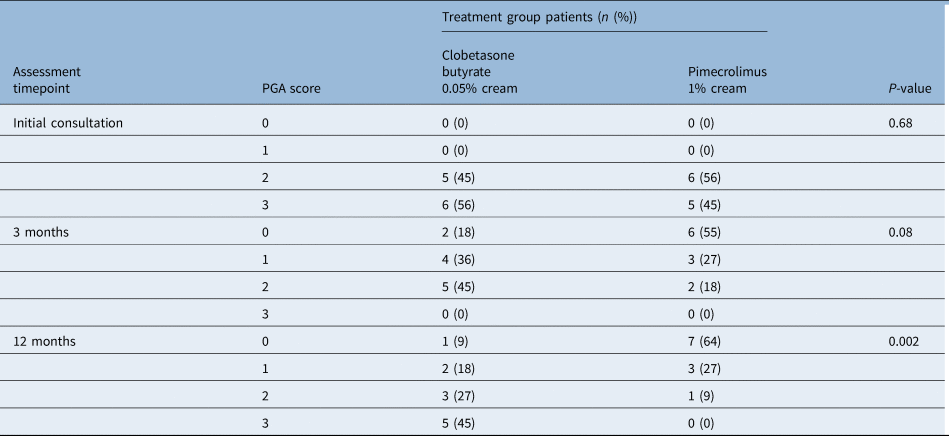
The analyses compared the Physician Global Assessment scores between the two treatment groups at each of the study timepoints. The results are summarised in Table 1. The first sets of values show the number and percentage of patients with each Physician Global Assessment score, at each timepoint. The final column presents the p-values, indicating the significance of the differences between the two groups.
Comparison of Physician Global Assessment scores between treatment groups

PGA = Physician Global Assessment
The results showed no difference in scores between the two groups at the time of the initial consultation. At three months, there was slight evidence of a difference between the groups, with lower scores in the pimecrolimus group than in the topical steroid group; however, the difference did not quite attain statistical significance (p = 0.08). The difference in scores between the two groups was statistically highly significant at the 12-month timepoint. Again, the pimecrolimus group was found to have significantly lower scores. Almost two-thirds (64 per cent) of this group had a score of 0 at this last assessment timepoint, compared to only one patient (9 per cent) in the topical steroid group.
Interestingly, although not statistically evaluated, the number of flare ups and recurrences reported were a lot lower in the group treated with pimecrolimus than in the group treated with steroids, with over 50 per cent of the patients on pimecrolimus not having suffered a single recurrence for an average of five months.
Discussion
There are many studies in the literature that provide evidence of the effectiveness of pimecrolimus cream in the treatment of seborrhoeic dermatitis and atopic dermatitis. Warshaw et al., in a randomised, double-blind, vehicle-controlled study, found a statistically significant improvement in the symptoms of seborrhoeic dermatitis patients treated with pimecrolimus compared to the vehicle group, with maximum improvement at two weeks after starting treatment.Reference Warshaw, Wohlhuter, Liu, Zeller, Wenner and Bowers9
Firooz et al. compared the effectiveness of pimecrolimus 1 per cent cream to hydrocortisone acetate cream 1 per cent in a randomised, investigator-blinded clinical trial, and found no significant differences in the response to the treatment of seborrhoeic dermatitis and the relapse rate between the two groups.Reference Firooz, Solhpour, Gorouhi, Daneshpazhooh, Balighi and Farsinejad13
Rigopoulos et al. compared the efficacy of pimecrolimus 1 per cent cream to betamethasone 17-valerate 0.1 per cent cream in the treatment of seborrhoeic dermatitis.Reference Rigopoulos, Ioannides, Kalogeromitros, Gregoriou and Katsambas14 They found that both drugs reduced erythema and scaling after 3 days, with betamethasone acting slightly more quickly (not statistically significant), but pruritus disappeared more quickly in the pimecrolimus group (statistically significant). The symptoms reappeared at day 21 in the pimecrolimus group in 55 per cent of patients, and reappeared at day 15 in 78 per cent of patients in the betamethasone group with the symptoms also being more severe.Reference Rigopoulos, Ioannides, Kalogeromitros, Gregoriou and Katsambas14
Pimecrolimus 1 per cent cream appeared to be more effective than methylprednisolone aceponate 0.1 per cent cream in a study by Cicek et al.Reference Cicek, Kandi, Bakar and Turgut1 Their study also showed that patients treated with the steroid cream had a relapse in their skin condition much earlier than those in the pimecrolimus group.Reference Cicek, Kandi, Bakar and Turgut1
Zhao et al., in a six-week study, demonstrated that four weeks of twice daily use of pimecrolimus 1 per cent cream for facial seborrhoeic dermatitis was more effective, and was associated with a longer remission period, than two weeks of twice daily use followed by a further two weeks with or without once daily use.Reference Zhao, Sun, Zhang, Wu, Le and Huang12 There are also case studies where pimecrolimus 1 per cent cream was reported as effective for seborrhoeic dermatitis resistant to topical corticosteroids.Reference Ozden, Tekin, Ilter and Ankarali11,Reference Cunha15
Pimecrolimus 1 per cent cream also proved effective in the treatment of atopic dermatitis both for acute flare up and for long-term control, reducing the number of flare ups requiring topical corticosteroid treatment or specialist opinion.Reference Eichenfield and Beck6,Reference Meurer, Lubbe, Kapp and Schneider8 It significantly reduces itchiness, which in turn helps to prevent scratching leading to further inflammation, acute infection and flare ups.Reference Meurer, Lubbe, Kapp and Schneider8
In a study by Eichenfield and Beck, of children aged 1–12 years with moderate atopic dermatitis, pimecrolimus 1 per cent cream was significantly more effective than moisturisers only, especially in controlling pruritus, which was considerably reduced within the first week.Reference Eichenfield and Beck6 The authors demonstrated similarly significant improvements with Elidel in infants aged 3–12 months with mild-to-moderate atopic dermatitis.Reference Eichenfield and Beck6 These authors also conducted a 12-month study of children (aged 2–17 years) and infants (aged 3–23 months), showing similar results; the researchers demonstrated that long-term use of pimecrolimus, with early intervention, provided significant improvement in atopic dermatitis symptoms, with fewer flare ups and less need for topical corticosteroids.Reference Eichenfield and Beck6
• Eczematous external otitis is a chronic, auto-inflammatory condition that can have a significant impact on sufferers’ quality of life
• Common treatments include topical steroids, moisturisers and occasionally topical antibiotics
• Long-term response to treatment is limited
• Topical pimecrolimus is an effective treatment for eczematous external otitis and has a more favourable safety profile than topical steroids
• Topical pimecrolimus is as effective as a moderate potency topical steroid in the short term
• Efficacy of topical pimecrolimus is greater than for topical steroids long term, and its use can lead to enduring remissions, representing a beneficial treatment for eczematous external otitis
In a six-week study and a one-year-long study, Gisondi et al. also showed that the early application of pimecrolimus when there are flare ups can prevent further progression of symptoms and reduce the need for topical corticosteroids.Reference Gisondi, Ellis and Girolomoni10
A number of studies have investigated the use of topical tacrolimus for eczematous external otitis specifically.Reference Kesser16 The presence of the typical burning sensation, however, represented a limitation to this treatment.Reference Caffier, Harth, Mayelzadeh, Haupt and Sedlmaier17,Reference Harth, Caffier, Mayelzadeh, Haupt, Sedlmaier and Richard18 Pimecrolimus, on the other hand, seems not to cause this unpleasant sensation, with better compliance to the treatment. This was the main reason for its use in our patients.
Conclusion
Pimecrolimus is an anti-inflammatory cream targeting specific immunological pathways that are important in the development of atopic dermatitis and seborrhoeic dermatitis.Reference Eichenfield and Beck6 The benefit of using pimecrolimus 1 per cent cream is particularly remarkable in areas covered by thin and delicate skin, where the use of topical corticosteroids has limitations because of its potential adverse effects.Reference Meurer, Lubbe, Kapp and Schneider8 Many studies have shown its effectiveness in treating atopic dermatitis and seborrhoeic dermatitis, and we believe it would be effective in treating eczematous external otitis, even in those individuals who wear hearing aids.
Pimecrolimus can be used for prolonged periods, thus breaking the vicious cycle leading to auto-inflammatory conditions, such as seborrhoeic dermatitis and atopic dermatitis. By initiating a personalised long-term treatment regimen with pimecrolimus for patients suffering with chronic ear skin conditions, we can hopefully provide them with an effective and safe treatment, and reduce the number of healthcare attendances, and, therefore, reduce the burden of eczematous external otitis on specialist care.
Although there are studies on tacrolimus used for eczematous external otitis, pimecrolimus used for this condition seems not to have been previously reported in the scientific literature. Despite the small size of this study, the results are of interest. A larger, high-powered study is required to further explore the full potential of pimecrolimus in eczematous external otitis cases.
Competing interests
None declared