Introduction
The financial system of Japan weathered the storm of the Great Financial Crisis of the late 2000s relatively unscathed. This is all the more intriguing as Japan is no stranger to financial calamities. In fact, in what has been variously referred to as the non-performing loan (NPL) problem or bank insolvency (consolidation/resolution/distressed debt etc.) crisis, it suffered from the mother of all modern financial crises for more than a decade starting in the early 1990s.
The fact that in the domain of financial regulation the Japanese political elite felt no need to react to the most recent crisis with major institutional overhauls and delegations of new authority to technocratic institutions may be rooted in its decade-long history of such innovations and delegations prior to the great crisis. Nevertheless, while theoretical accounts of the Japanese financial crisis abound (see, e.g., Amyx, Reference Amyx2004; Laurence, Reference Laurence2001; Rosenbluth and Thies, Reference Rosenbluth and Thies2001; Schoppa, Reference Schoppa2006; Vogel, Reference Vogel1996), the question of delegation during the crisis between the legislature and the executive, and within the executive has not been at the forefront of the debates.
Hence, Japan – as the third pole of the erstwhile Trilateral Commission of advanced industrialized countries – is an obvious case for extending the external validity of mainstream delegation theory initiated by the likes of Epstein and O'Halloran (Reference Epstein and O’Halloran1999) and Huber and Shipan (Reference Huber and Shipan2002). While extant research focuses on the US, and, to some extent, the European polity, for the purposes of studying comparative financial policy Japan is an equally promising case due to its level of development and sophistication of financial services. Japan also provides variation on the independent variable side as the historical path of the political and policy processes is markedly different vis-à-vis Western Europe and the US. Therefore, incorporating Japan into the research design – as in the case of this paper, as a standalone case study in political development – provides a thicker description of the general politics of bank bailouts in advanced industrial countries.
In the following, an overview is provided of the period between the implosion of the Bubble Economy in the early 1990s and the global financial crisis of the late 2000s. According to Schoppa (Reference Schoppa2006: 144), Japanese officials ‘hesitated to act decisively to clean up the banking system’ because this ‘threatened to impose concentrated costs on certain segments of the economy’ – notably firms ‘operating in the red’. This article, in turn, focuses on institutional stability, and also the major events disrupting this stability, such as the big bang of financial reforms and Koizumi's proposals. I do this by analyzing the legal-regulatory and institutional structure in which the jusen (the housing financing affiliates of banks) and more general financial bailouts were undertaken.
This paper posits that the link between political fragmentation (i.e. unified or divided government) and delegation is weaker than believed. In systems of strong informal oversight and with a large overlap between the political and bureaucratic elites, agency design is not uniquely rooted in this formal balance of power at any given time. Furthermore, institutional change develops through time, and in this sense it is not possible to neglect the general economic environment.
A more general theory, striving for an expanded external validity, therefore, cannot overlook various sources of the variation in delegation. Besides this paper's approach based on political economy and financial crises, it has to incorporate path dependency and cultural factors in shaping new delegations and institutional change. That said, the focus of this paper is on the cause, or impetus that moves the process forward along a path, or in a cultural and institutional context. In this respect, the article contributes to an emerging literature that weighs the relative usefulness of explanatory variables beyond unified and divided government.
I undertake this task in four steps. First, I reconstruct the development of Japanese bailout institutions for the period in question. This exercise yields a reliable account of the major dependent variable, delegation. Second, I compare and evaluate two competing accounts of changes over time for the degree and structure of delegation in the given policy sub-system of financial policy. Third, a detailed review of bailout legislations is provided for the given period. The final section discusses the relative merits of both approaches in light of evidence and concludes.
History: the development of bailout institutions
The evolution of the Japanese bureaucratic structure pertinent to bailout operations is well documented in the literature on the financial crisis. The level or degree of delegation incorporated in decisions about delegation and agency design, however, is seldom addressed explicitly. As my aim here is not to provide a comprehensive and numerical evaluation of all acts of delegation, but only to unearth some general trends in the flow of delegation (authorizations, the strings attached to them, and the revoking of powers), I adopt a simple, measure of increasing and decreasing delegation. The most straightforward measure of delegation is direct monetary authorizations and the delegation of power to supervise the allocation of the funds in question. Capital injections were initiated for a wide variety of reasons during the crisis, including reinforcing bank capital ratios, increasing lending to avoid a ‘credit crunch’, increasing write-offs of non-performing loans, and encouraging restructuring (Montgomery and Shimizutani, Reference Montgomery and Satoshi2005).
What is common in all cases, however, is the significant degree of delegation involved and, just as important, that the direction of delegation is unambiguous. From the major policy tools – identified by Hoshi and Kashyap (Reference Hoshi and Kashyap2010) – utilized during the crisis, asset management companies, recapitalization programs, and resolution mechanisms of failed banks introduced by the Financial Revitalization Act of 1998 and the Takenaka Plan of 2002 all fit this notion of delegation.
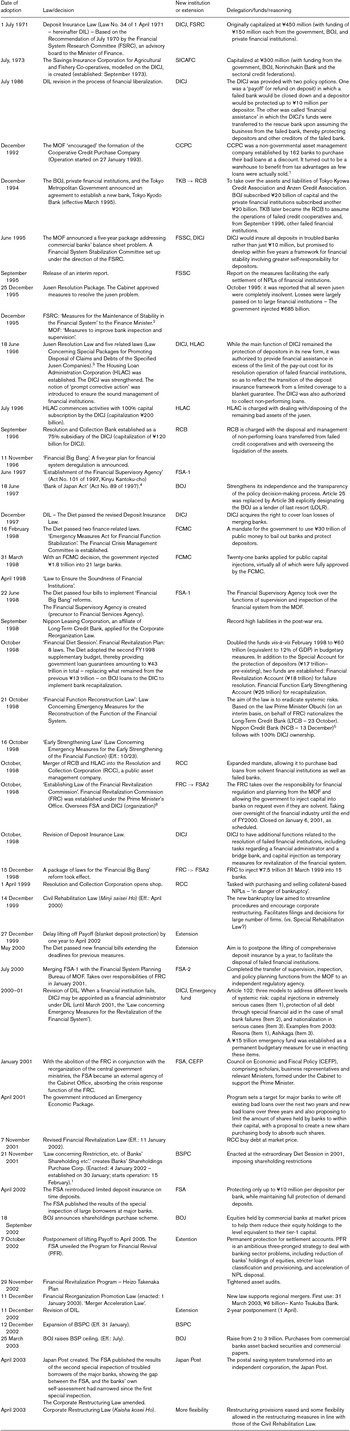
In light of the relatively brief period in question, a more or less comprehensive account of institutional development is very much within reach. Individual pieces of legislation are more numerous, and in this respect I rely on the standard approach of singling out ‘landmark’ legislation (Mayhew, Reference Mayhew1991; Epstein and O'Halloran, Reference Epstein and O’Halloran1999). As I focus on the institutional fabric and structure of delegation, individual acts making use of these powers by forcing specific firms to suspend operations, applying ‘prompt corrective action’, placing assets under financial reorganization administration, and various measures of liberalization (interest rates, etc.) did not prove sufficient. This also yields a manageable sample size for a deeper description of events. Appendix Table A1 summarizes the results.
What is clear from the account presented in Table A1 is that there is a constant flow of delegation from the Diet to the executive. Consider the number of separate new laws in Japan during and in the wake of the jusen crisis and in the US during and immediately after the great financial crisis of the late 2000s. In Japan, between 1996 and 1998, arguably the most difficult period of the crisis, at least a dozen major proposals were adopted, with an unprecedented flurry of activities in June 1996 (jusen resolution) and October 1998 (Financial Diet), and a number of landmark legislations – such as the BOJ act and the ‘financial big bang’ – in between.
Lawmaking in the US, however, presents a striking divergence from this pattern. A cursory overview of Public Laws adopted between January 2007 and July 2010 (110th and 111th Congress) yields only two matches out of a sample of 460 (110th) and 220 (111th) public laws: one sanctioning emergency stabilization (the Troubled Asset Relief Program) and the other introducing an overhaul of the financial supervisory system (Dodd–Frank).Footnote 1
On the other hand, the case for intra-executive delegation in Japan is less clear-cut. To start with the more obvious cases of inter-executive delegation, four main (groups of) beneficiaries can be discerned, even if their actual relationship was closer to an interconnected regulatory network than a hierarchy of principals and agents. First, the Deposit Insurance Corporation of Japan (DICJ) emerges as the major player in government-sponsored bailouts. Second, the Bank of Japan (BOJ) constantly improves on its autonomy and discretion. Third, the Financial Services Agency (FSA) in its two incarnations gradually siphoned off power from the more politically constrained Financial Revitalization Commission (FRC) and Ministry of Finance (MOF). Fourth, asset management companies (AMCs, such as the CPC, TKB, RCB, HLAC, RCC, BSPC – for more details see AppendixTable 1A) played a major role in the process in various shapes and forms. Compared with the pre-1992 organizational structure, it is safe to say that government authority was bestowed on a significantly more complex and ever-more autonomous institutional structure.
Highlighting some major stepping stones in the institutional development of financial regulation substantiates this point. Ever since the 1970s, the MOF used ‘administrative guidance to orchestrate the rescue of troubled financial institutions’ (Van Rixtel, Reference Van Rixtel2002: 123). Changes in the legal environment (the Deposit Insurance Law) only enhanced these powers. The MOF had the right to sanction ‘emergency mergers’ and the DICJ could borrow extensively to foot the bill. On the deposit insurance side, the legal limit of protection was gradually increased in multiple steps (notably in 1986 and 1996).
The DICJ had also acquired the right to purchase bad loans from failing financial institutions, which was extended in 1998 and 2000 (Fan et al., Reference Fan, Hanazaki and Teranishi2004: 132). The BOJ enjoyed an ever-extending facility to lend to both AMCs and private financial institutions. The creation of a full-fledged non-majoritarian institution in the form of the Financial Services Agency capped this developmental process.
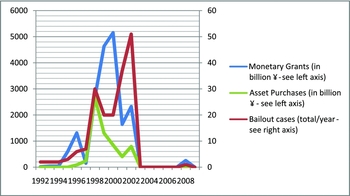
This trend towards a more insulated bureaucratic structure and wider delegated autonomy is also discernible when it comes to fiscal authorizations in light of official data published by the FSA (see Figure 1). Between 1992 and 2000, the trend of actual financial assistance in monetary grants and asset purchases for bank bailouts increased in an almost linear manner. Similarly to the case-by-case government decisions, the trend points in the same direction when it comes to loans, loan guarantees, emergency stand-by funds, and other permanent bailout facilities. Over time a huge bailout buffer was built up, increasing executive discretion even if it was only partially used eventually, as witnessed – among others – by the doubling of relevant funds in October 1998.
The number and value of cases of financial assistance
Note: As of 31 March 2010. Figures are based on the date when financial assistance was implemented. Monetary grants include subsequent reductions. An asset purchase in FY1998 and monetary grant in FY1999 is counted as the case for FY1998 only. Data source: Deposit Insurance Corporation of Japan, http://www.dic.go.jp/english/e_katsudou/e_katsudou1–2.html.

A third element in accounting for transfers of authority is the extension of previously granted powers (whether they were eventually ‘sun-setted’ (left to expire) beyond the period of analysis is a different question). This was especially the case with the repeated delaying of the lifting of blanket deposit protection. Despite all these extensions of bureaucratic autonomy, it is important to emphasize that not all delegated power involved a transfer of authority between the legislature and the executive. On a number of occasions, institutional change was entailed by intra-executive reorganizations (see, e.g., the creation of Resolution and Collection Corporation (RCC)). These cases may be best understood as an evolutionary quest for the most adept bureaucratic structure.
Theory: competing explanations of delegation
There are a number of possible theoretical frameworks that may be suitable to explain the trends described in the previous section. On the one hand, it was demonstrated that a discernible trend of delegation of authority was underway from the legislature to the executive (both organizational/supervisory/decision-making authority and monetary funds). On the other hand, cases of intra-executive institutional change involving transfers of authority also abound.
In this section, I consider a ‘conventional’ approach that has some inherent appeal when it comes to explaining the problem at hand (the divided/unified government paradigm). It is demonstrated that it misses the relevance of a major extra-political factor: the role of crisis situations emerging in the political economy. I consider this neglected side of the story – here described as crisis-induced delegation – in the following section.
Divided/unified government
Despite some important recent European contributions, the field of delegation research is dominated by a group of American scholars who work within the realms of rational choice. One of the most widely acclaimed models of bureaucratic delegation was developed by Epstein and O'Halloran (Reference Epstein and O’Halloran1999). According to their hypothesis, more delegation is undertaken by the legislature in a unified government setting which was defined by a single party controlling both houses of the legislature and executive power at the same time. On the other hand, independent agencies (non-majoritarian institutions) are the beneficiaries of delegation under divided government.
While the original framework is – apparently – tailored to the needs of a separation of powers system, this may be proxied by the more general notion of the fragmentation of the ruling political elite. This approach draws on the more straightforward application of the notion of divided government to bicameral parliamentary systems, with divided government referring to cases in which ‘the executive fails to enjoy majority support in at least one working house of the legislature’ (see Elgie, Reference Elgie and Elgie2001: 5n6, 11]). Thus understood, fragmentation in bicameral systems fundamentally shapes policy outcomes as, for instance, ‘governments with an upper-chamber majority last substantially longer than those without’ (Druckman and Thies, Reference Druckman and Thies2002: 760).
Japan has experienced this structure recently (since 2007), with the media coining a new term to refer to a situation where the ruling coalition controls the Lower House but not the Upper House: ‘Twisted Diet’ (nejire kokkai). Much more common in parliamentary systems is the fragmentation caused when several parties share power in a coalition, which can reinforce or weaken the effect of divided/unified government. All in all, this approach allows for an application of the baseline framework to a parliamentary system, such as Japan.
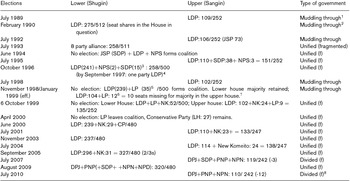
An analysis of Japanese politics throughout the period in question shows that a fragmented, but unified government was in place for most of the time. In the Heisei period between 1994 and 2007 a de facto (1994–6) or de jure (1996–2007) LDP-led coalition controlled both houses of the Diet (see Table 1). A similarly fragmented (coalition) government controlled both houses immediately before this period, between the July 1993 elections and the collapse of the eight-party government in June 1994, with the Japanese Socialist Party (JSP) switching sides in the meantime.
Elections and the type of government in Japan (1989–2010)

1 ‘The electoral results reflected a kind of mini revolution’ (Baerwald, Reference Baerwald1989). ‘With the exception of budget legislation, the LDP had lost its legislative majority’ (Christensen, Reference Christensen2000: 151).
2 ‘Until the 1989 House of Councilors elections [opposition parties] failed to win a majority in any election’ (Stockwin and Ainscow, Reference Stockwin and Ainscow1999: 151).
3 SDP supported a minority LDP government (Christensen, Reference Christensen2000: 124).
4 Political Parties in Japan: 1874–1998, http://www.kanzaki.com/jinfo/PoliticalParties.html.
5 Richard Katz, Ozawa: The Shiva of Japanese Politics, creator and destroyer. East Asia Forum, 18 February 2010. http://www.eastasiaforum.org/2010/02/18/ozawa-the-shiva-of-japanese-politics-creator-and-destroyer/.
6 Obuchi vows to work with LP to pass guideline bills, Japan Policy and Politics, 7 December 1998.
7 The New Frontier Party had been disbanded by Ichiro Ozawa on 27 December 2008. A new coalition was assembled in January 1999 between the LDP and the Liberal Party (now led by Ozawa). When a new coalition was formed between the New Komeito and the governing LDP, Ozawa moved back to the opposition with most of the LP's representatives leaving some MPs behind, who formed the Conservative Party.
8 High barriers to creating new coalition, The Yomiuri Shimbun, 14 July 2010, http://www.yomiuri.co.jp/dy/national/20100714TDY03T04.htm.
Note: (f) denotes fragmented goverments.
These facts would render any attempt to explain the change in delegation trends with unified/divided government useless, as there would be no variation on the independent variable side. That said, the political dynamics of Japan in this period needs more elaboration.
It was widely reported that the July 2007 House of Councilors election was the first to produce a Diet in which the LDP did not hold a majority or plurality in both houses. Furthermore, ‘for the first time in Japanese history, the lower and upper houses of the Diet are controlled by different parties’ (Kesselman et al., Reference Kesselman, Krieger and Joseph2009: 212). Even if there were such cases, the rules governing bicameralism in parliamentary systems usually feature work-arounds that empower one house over the other in order to avoid legislative gridlock. Legally speaking, in the ‘MacArthur’ constitution of 1947 the powers of the upper house are substantially limited in regards to salient issues such as the budget and treaties and naming the prime minister, since the Lower House is allowed to over-rule the Upper House on these issues with a simple majority. That said, legislative veto in the upper chamber has been very much an option since World War II. If a non-budget, non-treaty bill is blocked in the upper house, the lower chamber can only override it with a two-thirds majority.
Making use of this option is a different story. It is a telling fact that before the late 2000s this ‘had not been invoked since the late 1950s’ (ibid.: 235). If we exclude various instances of open conflict between the opposing parties, such as the 1960 lock out of the opposition, and attempts at filibustering or ‘ox walking (walking slowly to the ballot box)’, the fact remains that the reconciliation process ‘has not been used since the 1950s, reflecting the penchant for resolving disputes behind the scenes’ (Hayes, Reference Hayes2009: 53).
This is not to say that the upper house had no chips to bargain with in the political process. According to Cowhey (Reference Cowhey, Cowhey and McCubbins1995) in 1989, the LDP lost control of the upper house by a narrow margin, ‘thereby giving the opposition the power to block some legislative actions’. This is true, even if the LDP was able to cobble together majority votes in an extremely fragmented and divided upper-house whenever it needed them, usually with Komeito support.Footnote 2 Scheiner (Reference Scheiner2006: 218) shares a similar story, which is pertinent to the problem at hand: in the debate on the financial reform bills in October 1998 ‘the LDP controlled the government but held a minority of seats in the House of Councillors. Led by the DPJ, the opposition pushed its own proposal, which the LDP, lacking a majority in the upper house, was forced to accept’. No wonder, then, that the LDP, ‘which controlled a lower-house majority, created a coalition anyway, specifically to avoid the perils of parliamentary “divided government”’ (Druckman – Thies, Reference Druckman and Thies2002: 761). I note these periods in Table 1 by ‘muddling through’ as they represent a hybrid between purely divided and unified government (regardless of fragmentation).
Despite these skirmishes between the two chambers, the pre-existing literature implies that the first ‘Twisted Diet’ in the Heisei period was the one between 2007 and 2009. Vogel and Govella (Reference Vogel and Govella2007) argue that the LPD's defeat in July 2007 created ‘an unprecedented situation in which the LDP-led coalition lost its majority in the upper house while retaining a two-thirds majority in the lower house’ (emphasis added). And in the more fluid period between 1989 and 1994, the LDP made use of divide-and-rule tactics, its ‘strong ties (with) each of the opposition parties’ and ‘significant divisions within the opposition camp’ (Christensen, Reference Christensen2000: 46).
This is not to say, that political animosity did not play a role in shaping the emerging laws and bureaucratic structure. A more extended analysis could include factors such as the internal divisions of the pre-dominant LDP. In fact, this is the approach adopted by McCubbins and Thies (Reference McCubbins and Thies1997), among others. They contend that while the ‘lack of partisan turnover in government has frustrated attempts to explain Japanese government policy changes using political variables’, a new project focusing on the fluctuating agenda-setting power of LDP factions could shed light on said changes.
Furthermore, the direction of delegation is less than straightforward in these cases. For instance, Amyx (Reference Amyx2004: 176–7) argues that the MOF, the institution losing authority in the re-shuffle, displayed more bureaucratic autonomy vis-à-vis the legislature than the eventual beneficiary, the FSA. For the latter was to be overseen by the Prime Minister's Office. Also, it is important to keep in mind that the MOF had a decisive touch in shaping the proposal for the newly created FSA. The flow of delegation between the legislation and the executive and inside the executive is murky at best. The least we can say is that the patterns of delegation in the Japanese case cannot be explained by the divided/unified government factor emphasized in mainstream delegation theory.
In sum, an analysis of the relevance of the conventional approach yields a mostly negative picture. Whereas the years of formally divided governments in the early and late 1990s deserve special attention (and I will return to this question later on), it is questionable that these years were shaped by a de facto divided government due to the LDP's success at muddling through and the limited constitutional powers of the upper house. With the rational choice approach thus dismissed, I now turn to an alternative explanation, which might best be described as crisis-induced delegation.Footnote 3
An alternative account: crisis-induced delegation
An alternative to the conventional approaches injects the notion of crisis into the narrative. This approach, although far from being general, is in use to some extent in US and European studies of the legislative politics of finance (see Müller, Reference Müller2002: 202, who argues that the 1984 revision of the Banking Act was a ‘crisis-induced project’ due to the ‘SMH-Bank crisis’; and Uche, Reference Uche2001, who claims that ‘the establishment of the Securities and Exchange Commission is yet another example of a crisis-induced regulation’). A volume, edited by Foljanty-Jost (Reference Foljanty-Jost2004) on Japan in the 1990s corroborates this point in its title by claiming that crisis was an ‘impetus for change’ (Unfortunately, there is no chapter in the volume on banking policy.)
Crisis-induced delegation is a result of critical junctures in the political economy. The causal logic is as follows. Due to factors external to politics, the policy sub-system is overloaded and proves unable to contain the emerging crisis situation. The new tasks entail new authorizations of money and powers to those best-equipped to handle the emergency: the experts in standing bureaucracies. The degree of new delegations is determined by the needs of crisis resolution, whereas its form follows expert advice. This latter – by assumption – leads to institutional arrangements that are more detached from ‘politics’ than before. In this respect, government bureaucrats and policy experts are supposedly interest-driven, with a preference for more autonomy.
This crisis-induced delegation – in the final analysis – yields trustee-like institutions. Power and authority to act is bestowed on technocratic institutions that are variously referred to as quasi-governmental organizations (‘quangos’ – Flinders and Smith, Reference Flinders and Smith1999), non-majoritarian organizations, semi-autonomous organizations, distributed public governance agencies/authorities, or hybrid organizations (Koppell, Reference Koppell2003). Besides more autonomous institutions, unprecedented levels of authorities are delegated to bureaucrats in cabinet departments or agencies as the legislature has no matching capacity to assess the necessary level of discretion to act in an evolving crisis. This tendency is reinforced by a heuristic short-cut that feeds off of similar crisis situations abroad: policy transfers.
This process was undeniably present during the Japanese financial crisis. Institution-building was driven by individual cases of financial failure, contributing to an ever-growing pile of stand-by emergency funds and authority for trustee-type institutions to act independently. According to an analysis by the BIS (2004: 7–14) ‘up to March 2002, 180 deposit-taking institutions were dissolved under the deposit insurance system . . . with the total amount spent dealing with the problem of NPLs from April 1992 to September 2001 was ¥102 trillion (20% of GDP)’.
These data mark a rapid transformation in delegation, as from the post-war period until 1994 Japan experienced no major bank failures and – in line with our predictions – limited demand for extensive bailout authorities. Under the so-called ‘convoy system’, banking supervision and regulation was conducted in such a way as not to undermine the viability of the weakest banks. The public and – up to a point – LDP politicians trusted this semi-formal system with managing financial stability. The jusen crisis, then, was a watershed in Japanese bailout history as it was the first case of a bailout with taxpayer money.
The policy regimes adopted by successive governments naturally fall into four stages.Footnote 4 The immediate link between individual and cumulative crisis situations and a subsequent change in the form and degree of delegation has become more pronounced over these stages. These periods follow the cycle of crisis–policy problem–policy solution–new exogenous shock/endogenous anomaly, crisis–policy problem–policy solution etc.
Empirics
1992–5: credit cooperatives
The early stages, until the end of 1995, were characterized by a collective participation method that was later referred to as the hougacho approach. It implies that the MOF ‘solicits healthy banks for funds to prop up a weak bank’ (Harada et al., Reference Harada, Takatoshi and Shumei2010). A major institutional development that followed this line of thinking was the Cooperative Credit Purchase Company. It was established by commercial banks to purchase their bad loans at a discount – no delegation of public authority was involved. The collection rate was extremely low: by 1997 it managed to sell ¥1.1 trillion on an original portfolio of ¥15 trillion (Adams et al., Reference Adams, Mathieson, Schinasi and Chadha1998: 122).
By the mid-1990s, it became clear that these more or less ‘informal means of problem resolution’ began to ‘falter’ (Amyx, Reference Amyx2004: 153). These rescue mergers were not feasible to start with were it not for the liquidity support provided by the BOJ under Article 25 in the period between bankruptcy and the actual takeover. And then the convoy system started to fall apart, starting with its weakest links, the credit cooperatives (CCs). When two urban CCs failed in December 1994, the limits of hougacho became evident. This external shock, rooted in the political economy, created repercussions for delegation and the bureaucratic structure. No financial institution was willing to assume the assets and deposits of the failed CCs and there was also a legal limit in place as to what the DICJ could offer in financial assistance. The institutional result was the creation of Tokyo Kyodo Bank (TKB) with capital injections and other financial assistance from the DICJ and the BOJ.
This was a 2.0 version of hougacho as it involved a significant taxpayer contribution. TKB was also a precursor to Resolution and Collection Bank (RCB), which had a more general mandate for assuming the assets of failed financial institutions. Another notable difference was that the RCB was a 75% subsidiary of DICJ, and eventually was merged with Housing Loan Administration Corporation (HLAC) to form a 100% state owned Resolution and Collection Corporation (RCC). This gradual layering implied an ever-growing financial involvement of the government in crisis resolution.
The creation of a Financial System Stabilization Committee and the introduction of a 100% deposit insurance scheme for five years were also the direct consequences of this external shock and the failure of extant institutional structures (and cultural norms) to deal with it. A counterfactual assumption, most probably, would not yield the same results: visible signs (actual CC failures) of the underlying problems were necessary (if not necessarily sufficient) pre-conditions for institutional change.
1995–6: the jusen
This trigger effect was even more proclaimed in the second period of the crisis. In this period, between late 1995 and 1996, the focus of the debate gradually shifted to the problems of jusens, the housing financing affiliates of banks. The failure of the eight big jusen companiesFootnote 5 resulted in losses that were ‘far beyond the amounts that could be covered by founder banks’ (BIS, 2004: 8).
The source of the shock initiating a change in the approach adopted by the governing parties and MOF/BOJ is less clear-cut than in other cases. With the NPL problem getting worse by the day, a provisional estimation was finally revealed in June 1995. The research into the actual state of non-performing assets was initiated by the Banking Bureau of the MOF. When it was reported that all eight major jusen had become completely insolvent, financial regulators suddenly had an emergency situation on their hands.
Based on these facts, it is an intuitively appealing argument that the subsequent delegation was not crisis induced as there was no crisis to start with save for the report itself. After all, it was the MOF that revealed the findings and, therefore, a deliberate act served as the impetus for institutional change – as opposed to an emerging crisis rooted in the political economy.
This interpretation is reinforced by the – otherwise information-driven – account of Amyx (Reference Amyx2004: 166) who claimed that the ‘information obtained made it clear [that the] resolution of the jusen problems could no longer be postponed’. A series of minor bank failures also played into the hands of the reformers along with a rise of a ‘Japan premium’ in the international inter-bank market (Toya-Amyx, Reference Toya and Amyx2006: 160).
In this sense, the deliberate decision of MOF bureaucrats had an impact on only the timing of institutional change and this does not affect the causal logic linking a deteriorating economic situation and subsequent institutional change. Following this line of reasoning, it is no exaggeration to claim that the form and degree of the change throughout the subsequent six months or so can be directly derived from the crisis itself.
The Jusen Resolution Package, approved by the Cabinet in December 1995, served as the basis for the relevant parts of the FY1996 national budget bill and the so-called Jusen Resolution Laws. A new institution, the Housing Loan Administration Corporation (HLAC) was created with government and BOJ capital injections; the TKB was reorganized into the RCB, which had wider powers in assuming NPLs; and the DICJ's access to public funds was extended with the temporary removal of the payoff cost limit.
This flurry of legislation was a direct consequence of the untenable jusen situation, of the incapability of private financial institutions to deal with the problems of their subsidiaries, and of an ever-impatient group of international investors. In short, it was a consequence of underlying structural problems originated in the political economy. Political actors and the general public either opposed the resolution package (see the picketing of Shinshinto lawmakers against the budgetary bailout authorizations, Toya-Amyx, Reference Toya and Amyx2006: 162) or remained on the sidelines in the debates shaping the actual degree and form of intervention.
1997–8: financial institution failures
The third phase of the financial crisis proved to be a return to a more straightforward version of crisis-induced institutional development. The jusen resolution created a caesura in what Tiberghien (Reference Tiberghien2010: 10) called ‘the sequence of non-response and dithering in response’. This was due not only to the decisive legislative action,Footnote 6 but also to subsequent discretionary interventions. While the public, the bankers, and the political elite were deeply immersed in a national blame game, a new crisis period entailed another set of wide-ranging legislation, and two rounds of capital injections were undertaken drawing on these new-found powers.
The starting point for all these developments was an immediate emergency, a harbinger of a contagion that – unlike the previous two phases centered around the problems of non-bank affiliates – threatened with taking down the very banks on which the Japanese financial system was built. While the announcement of a restructuring plan at Nippon Credit Bank (NCB) in April 1997 indicated of more calamities to come, eventually ‘the government ended up reacting to events’ (Schoppa, Reference Schoppa2006: 146).
Whereas previous crisis situations were resolved with a combination of private funds, government guarantees, and BOJ capital injections, a change in the political culture of Japanese society, due to a number of scandals and inevitable interventions, created a situation that was finally ripe for large-scale bailouts. According to Montgomery-Shimizutani (2005: 3n2) ‘by the end of 1997, sixteen credit cooperatives, shinkin banks, and regional banks had failed and mergers had been arranged with healthier institutions under the so-called convoy system’. Amyx (Reference Amyx2004: 166) highlights the revelations of MOF officials accepting ‘wining and dining by the management of financial firms’ during the jusen crisis.
The changing environment notwithstanding, it was a series of financial firm failures in November 1997 that undermined the extant bureaucratic structure and prompted new delegation. Let us now consider the four failures in turn and then the general, but still immediate, reaction as each of these affected the regulatory environment in a special way.
The failure of Sanyo Securities, a first for a publicly listed security company, was peculiar as it was outside of the coverage of the deposit insurance system. While the BOJ decided systemic risk was low, the inter-bank market plunged into a credit crunch (Fukao, Reference Fukao2009). A massive liquidity injection duly followed. Two weeks later, Hokkaido Takushoku Bank (HTB) became the first so-called City bank to go down. Once again, the BOJ provided liquidity support to finance massive deposit outflows and the bailout operation cost the DICJ more money ‘than had been used in all’ its previous history (Montgomery and Shimizutani, Reference Montgomery and Satoshi2005: 3). This highlighted the limits of a case-by-case approach.
A week later Yamaichi Securities collapsed. Once again, the bailout decision was shrouded in uncertainty as it was unclear if and when the funds could have been recovered. Before Yamaichi went bankrupt in June 1999 it had become clear that the net losses were ‘too large to be covered by the Compensation Fund for Deposited Securities’ (BIS, 2004). And finally, just a couple of days later the failure of Tokuyo City Bank signalled the forth collapse in a month and a possibility of a general bank run nudged closer by the day. Although a joint statement by the MOF and BOJ was improvised on the spot, confirming a universal protection of deposits, and the DICJ shortly acquired new rights to cover loan losses, a structural response could not wait much longer.
This arrived in the shortest feasible period – in less than two months – in the form of new legislation introduced in February 2008. As a direct reaction to the events of November 1997, a ¥30 trillion public fund was made available. And a newly created Financial Crisis Management Committee (FCMC) was made responsible for identifying the banks that needed a capital injection. A general recapitalization of the banking system was also sanctioned.
As these measures served preventive and prompt reaction purposes, the underlying instability of the financial system, and the NPL problem in particular, remained intact. The consequence was a second installment of bank failures starting in September 1998, which sent shockwaves of previously unimaginable magnitude through the banking sector.
The failure of Long Term Credit Bank of Japan (LTCB) meant the largest bankruptcy in Japanese history and also that of a bank – just like NCB the year before – that was a major pillar of the Japanese banking system. Due to its systemic nature, an orderly wind-down was unattainable without amending the rules governing deposit insurance and the more general regulatory framework. The emergency Diet session had adopted the Financial Function Reconstruction Law under which LTCB – and later on, NCB – was nationalized. The newly created FRC was also vested with the authority to inspect and supervise financial institutions – a move forward vis-à-vis FCMC. In this, the FRC was a precursor to the Financial Supervisory Agency.
In light of these developments, the LTCB debacle is one of the most persuasive cases of crisis-induced delegation. The sheer magnitude of the funds delegated (doubling the fund established only ten months before), the outright nationalization of LTCB and NCB, and the widespread changes in the regulatory environment were all rooted in the economy. The freefall of the Nikkei index was just one sign of a meltdown that created a situation in which the ‘LDP had virtually no option but to accede to the revised package of opposition led bills’ (Amyx, Reference Amyx2004: 206). The untenable situation of LTCB was compounded by turbulence in the Japanese inter-bank market (Adams et al., Reference Adams, Mathieson, Schinasi and Chadha1998) and by instability imported from Russia and the countries directly afflicted by the Asian financial crisis.
The legislation passed in the Diet entailed more room in which to maneuver for virtually all government agencies involved, besides creating a new one with freshly ‘minted’ delegated authority. While the upper house election of July 1998 somewhat reshuffled the political context, the real impetus for a change in delegation, for the reasons presented above, was clearly an external shock. The crisis of November 1997 ‘helped pave way to use public money to help stabilize [the] financial system’ (Ito, Reference Itō2001).
1999–2003: the NPL problem and consolidations
The multiple rounds of government re-capitalizations that followed the meltdown of November 1997 constituted a classic case of policy learning as they reinforced the crisis–policy problem–policy solution-new crisis etc. logic of our hypothesis (if not the hypothesis itself). As previous interventions did not address the NPL problem, and banks limped on with unsustainably low capital ratios, this first capital injection in March 1998 was ‘uniformly handed out regardless of the condition of the recipient banks and the banks’ proposed use of the injected capital’ (Montgomery-Shimizutani, Reference Montgomery and Satoshi2005: 12).
The general view of this first round was rather negative, while the second round received more favorable reviews. That said, most pundits agreed with the assessment by Ito (2001) who contended that the ‘capital injections of March 1998 and March 1999 helped stabilize bank fragility, only temporarily [because] they were too small to induce banks to provide for past, present, and expected losses from all NPLs’.
What is important to note here, however, is that despite its failure in terms of its outcome a policy package will still represent the same legal output of delegation. The two rounds of capital injection followed an extension of bureaucratic autonomy sanctioned by the Diet. The policy followed of these measures are important only insofar as they were not adequate to solve the roots of the problem of NPLs. This is why further delegation was inevitable.
As the next logical step was to remove bad loans from the bank's balance sheet ‘the RCB was reorganized into the Resolution and Collection Corporation (RCC)’ as ‘an infrastructure to achieve this’ (BIS, 2004: 11). This resulted in an enlarged DICJ, one that (along with its RCC unit) has ‘developed into a significantly larger independent organization with more than 2,000 staff members’. This fourth phase was also characterized by a return to a hougacho-type public–private partnership in financial sector consolidation.
As financial institutions continued to fold on an almost monthly basis in May 2000, the Deposit Insurance Law was again amended and the lifting of the blanket deposit protection was further delayed by one year to April 2002. This crisis-induced measure served the primary purpose of instilling some calm on the markets.
The inept crisis management of the MOF – not to mention its complicity in prolonging and exacerbating the crisis – was duly followed by regulatory reform proposals. The end of a long road, through numerous overhauls, was the creation of the Financial Services Authority in July 2000. By the legal standards of Japanese financial regulation, the FSA was a particularly insulated bureaucracy. Whether the policy preferences and actions of FSA were less closely aligned with that of the Diet (a central assumption of the baseline model by Epstein and O’Halloran) is less clear. The failure of Ishigawa Bank in December 2001 is a telling example of this ambiguity.
In standard accounts of the causes of the Japanese financial crisis, illegal lending practices are often relegated to a secondary role. That said, previous bank failures related to criminal activities made a clear point for a supervisory authority more insulated from party politics. In the Ishigawa case, even a more autonomous agency proved vulnerable to political pressures and ‘indecent’ proposals. While the FSA ‘did discover, in January 2001, that Ishikawa had made dud loans and that the extra provisioning required would leave the bank with a capital deficit’Footnote 7 it assented to fake overhauls and re-capitalizations throughout the rest of the year. The DICJ found that Ishikawa had a minus 37% capital adequacy ratio, ‘compared with minus 6% that the FSA had calculated just three months earlier’.
The Ishigawa crisis and similar misconducts cried for an about face at the FSA, which first arrived with an Emergency Economic Package and eventually the Takenaka plan in October 2002 which would have stripped LDP politicians from having any clout over issues of financial reconstruction. Along with the establishment of a new ¥15 trillion emergency fund, the DICJ acquired the right to serve as financial administrator of failed institutions and had extensive powers to cajol (or sometimes, as in the case of Shokichi Takagi, then commissioner of the FSA: bully) ‘white knights’ into mergers and acquisitions.
These measures notwithstanding, the Japanese financial system was sitting on a time bomb in the form of the so-called deferred tax assets (DTA). By this time, in 2003, ‘about half the capital of Japan's big four city banks’ was made up of DTAs (Montgomery-Shimizutani, Reference Montgomery and Satoshi2005: 2). As independent auditors were taking a stiffer stance, they clamped down on out-of-control DTAs, which, in turn, drastically lowered the bank's capital adequacy ratio.
Even though the BOJ stepped up its purchases of commercial papers, a complete unraveling of the financial system was just a matter of time – or the next major bank failure.
The final major bank bailout package, then, came in the wake of the failure of Resona Bank, Japan's fifth largest, in May 2003. On 17 May, Resona was bailed out with ¥1.96 trillion by the Koizumi administration. According to Pop and Pop (Reference Pop and Pop2009), this bailout was an ‘event justifying the use of the [too big to fail] label’. It was also an effective nationalization of the financial institution, an unexpected move, as the two predecessors, Daiwa and Asahi, received ‘1 billion yen in capital injections’ not long before (Montgomery and Shimizutani, Reference Montgomery and Satoshi2005).
The agency in charge of the operation was the DICJ. The deal was finalized by the end of June, with DICJ subscribing for new common and preferred shares of Resona based on Chapter 7 of the Deposit Insurance Law (Measures against Financial Crises). These decisions were taken at an emergency cabinet meeting and amidst a stock market falling to its lowest point in 20 years – final evidence of the closely interrelated nature of economic crisis and political delegation.
Discussion and conclusion
By way of recapitulation, let us now briefly overview and validate the argument in this section. The conclusion to take away from this analysis is not that crises can exclusively account for developments in delegation and changes in bureaucratic structure. The point, rather, is that besides stability (as in Japan in the early 1990s) and the gradual development of political institutions (as in the case of the FSA), crises are a major source of institutional change. Delegation between the legislature and independent agencies, and within the executive, is driven by events in the economy or the financial sector. These events shape the form and degree of delegation as they pose problems for the political elite. The result is an evolutionary layering of decisions; and each layer belongs to a specific case of an emergency situation. Once there were no more failures, reform activity duly receded.
The overview of the history of institutional development in the domain of financial bailouts has proved to be, by and large, in line with our expectations. A small-n political economy account, such as the one presented in this paper, is always far from being a general theory of institutional change. Actual delegation decisions are deeply affected by the results of the power struggle between politicians and bureaucrats, and between different groups of politicians (leaders and back-benchers). That said, the mismatch between the underlying crisis of the political economy and the regulatory environment proved to be a potent story in explaining institutional change in the period in question.
Moreover, the theory of crisis-induced delegation – at least regarding the case at hand – proved to be a more forceful explanation of Japanese bailouts understood as delegation than the more widely used unified/divided government approach.
In conclusion, the crisis-induced approach successfully accounts for most of the delegation decisions both in terms of form and degree. In this respect, it provides a shortcut through cultural and institutional complexities, which, on the other hand, cannot be excluded from a more holistic account of the events in general. Nevertheless, this paper has a narrower focus – i.e. the sources of variation in delegation, which in the event are explained by an empirically falsifiable and, at the same time, simple explanatory framework.
It was demonstrated that due to a string of individual emergency situations, Japan experienced a shift towards a more flexible, trustee-type institutional structure in the domain of financial regulation. Whether these institutions and emergency funds were to stay or left to expire, and under what conditions, is a question for another study. It is evident, however, that some major elements of the institutional framework set up during the crisis period were still in place at the end of the 2000s, shaping the landscape for future government interventions.
About the author
Miklós Sebők is a Research Fellow at the Centre for Social Sciences, Hungarian Academy of Sciences. Based in Budapest, his scholarly interests include the political economy and public policy of advanced industrial countries, with an emphasis on Japan, the EU and the US.
Appendix
Bailout-related legislations and institutions (1990–2003)