Introduction
An accumulating body of research demonstrates that chemotherapy has adverse effects on cognitive performance in women treated for early breast cancer. Less is known about cognitive functioning in the period before chemotherapy. Findings from prospective longitudinal studies indicate that a subset of women (approximately 20 to 30%) diagnosed with breast cancer demonstrate cognitive impairment after surgery and before chemotherapy on neuropsychological tests (Bender et al., Reference Bender, Sereika, Berga, Vogel, Brufsky, Paraska and Ryan2006; Jansen, Cooper, Dodd, & Miaskowski, Reference Jansen, Cooper, Dodd and Miaskowski2011; Quesnel, Savard, & Ivers, Reference Quesnel, Savard and Ivers2009; Wefel, Saleeba, Buzdar, & Meyers, Reference Wefel, Saleeba, Buzdar and Meyers2010). Hermelink et al. (Reference Hermelink, Untch, Lux, Kreienberg, Beck, Bauerfeind and Münzel2007) assessed women diagnosed with breast cancer before both surgery and chemotherapy, and reported that 27% of the sample (n=101) performed poorer than expected compared with published normative data for neuropsychological tests. This suggests that impairments can be observed before any therapy, such as surgery and/or exposure to general anesthesia and chemotherapy.
Additionally, pretreatment cognitive performance was not associated with depression, anxiety, or fatigue (Bender et al., Reference Bender, Sereika, Berga, Vogel, Brufsky, Paraska and Ryan2006; Hermelink et al., Reference Hermelink, Untch, Lux, Kreienberg, Beck, Bauerfeind and Münzel2007), and impairment persists after statistically controlling for these factors (Jansen et al., Reference Jansen, Cooper, Dodd and Miaskowski2011). Recent evidence suggests that other influences including tumor-related factors and comorbidities (Mandelblatt et al., Reference Mandelblatt, Stern, Luta, McGuckin, Clapp, Hurria and Ahles2014), as well as post-traumatic stress symptoms (Hermelink et al., Reference Hermelink, Voigt, Kaste, Neufeld, Wuerstlein, Buhner and Harbeck2015) may be related to cognitive impairment before any adjuvant treatment. These findings suggest that pretreatment impairment may be attributed to several factors, such as adverse biological response to the cancer itself (e.g., cytokine activity), stress response to having a cancer diagnosis (e.g., “battle brain” rather than chemobrain), or pre-existing cognitive vulnerability.
Functional magnetic resonance imaging (fMRI) studies of brain activity when engaged in tasks of working memory and response inhibition reveal differences between women who were in the period between breast cancer surgery and chemotherapy and healthy controls (Cimprich et al., Reference Cimprich, Reuter-Lorenz, Nelson, Clark, Therrien, Normolle and Welsh2010; McDonald, Conroy, Ahles, West, & Saykin, Reference McDonald, Conroy, Ahles, West and Saykin2012; Scherling, Collins, MacKenzie, Bielajew, & Smith, Reference Scherling, Collins, MacKenzie, Bielajew and Smith2011, Reference Scherling, Collins, MacKenzie, Bielajew and Smith2012). Notably, although task performance was equivalent between patients and controls, the patients showed increased activation in the frontal cortex relative to controls, (McDonald et al., Reference McDonald, Conroy, Ahles, West and Saykin2012; Scherling et al., Reference Scherling, Collins, MacKenzie, Bielajew and Smith2012). Thus, neural activity as revealed by fMRI does not necessarily correspond to behavioral task performance. Greater cortical activation observed in patients may represent compensatory processes for neural dysfunction necessary to achieve performance that is comparable to healthy controls. Overall, these studies highlight the importance of characterizing pretreatment cognition in women with breast cancer, and indicate that examination of task performance does not provide a complete understanding of underlying neural dysfunction.
There is increasing recognition that within-person variability in performance is an important behavioral indicator of cognitive function and underlying central nervous system integrity. Intraindividual variability (IIV) reflects fluctuations in task performance that occur over short periods of time (Hultsch, Strauss, Hunter, & MacDonald, Reference Hultsch, Strauss, Hunter and MacDonald2008; Nesselroade, Reference Nesselroade1991). Numerous studies demonstrate that increased IIV in reaction time (RT) is associated with other behavioral and functional indices including lower general intellectual level (Jensen, Reference Jensen1992; Rabbitt, Osman, Moore, & Stollery, Reference Rabbitt, Osman, Moore and Stollery2001; Strauss, MacDonald, Hunter, Moll, & Hultsch, Reference Strauss, MacDonald, Hunter, Moll and Hultsch2002), poorer functional capacity in instrumental activities of daily living (Burton, Strauss, Hultsch, & Hunter, Reference Burton, Strauss, Hultsch and Hunter2009), and closer proximity to death (MacDonald, Hultsch, & Dixon, Reference MacDonald, Hultsch and Dixon2008). Increased IIV in RT also represents a risk factor for declines in cognitive status, including mild cognitive impairment and dementia (e.g., Dixon et al., 2007; Hultsch, MacDonald, Hunter, Levy-Bencheton, & Strauss, Reference Hultsch, MacDonald, Hunter, Levy-Bencheton and Strauss2000; Murtha, Cismaru, Waechter, & Chertkow, Reference Murtha, Cismaru, Waechter and Chertkow2002).
Furthermore, studies demonstrate a relationship between IIV and severity of neurological dysfunction, such that greater variability is associated with increasing severity of dementia (Murtha et al., Reference Murtha, Cismaru, Waechter and Chertkow2002), and multiple areas of impairment in people with mild cognitive impairment (Strauss, Bielak, Bunce, Hunter, & Hultsch, Reference Strauss, Bielak, Bunce, Hunter and Hultsch2007). In contrast, individuals with diseases that are not typically linked with neurological symptoms such as arthritis do not show increased IIV compared to healthy controls (Hultsch et al., Reference Hultsch, MacDonald, Hunter, Levy-Bencheton and Strauss2000; Strauss et al., Reference Strauss, MacDonald, Hunter, Moll and Hultsch2002). The link between IIV and neurological function is relevant for women diagnosed with breast cancer given the alterations observed in fMRI studies, which may underlie cognitive symptoms. In addition, greater IIV in RT may indicate presence of frontal lobe pathology (Stuss, Murphy, Binns, & Alexander, Reference Stuss, Murphy, Binns and Alexander2003), a finding that is relevant to the study of women with breast cancer as the frontal cortex appears particularly susceptible to the effects of breast cancer and its treatments (for a review see: Anderson-Hanley, Sherman, Riggs, Agocha, & Compas, Reference Anderson-Hanley, Sherman, Riggs, Agocha and Compas2003).
In a preliminary study from our group, we evaluated whether IIV may be a useful marker of cognitive dysfunction in women treated for breast cancer (Bernstein, Catton, & Tannock, Reference Bernstein, Catton and Tannock2014). We evaluated women with breast cancer treated with chemotherapy and healthy controls on a simple sustained Go–No Go attention task, and found group differences under certain conditions. Women with breast cancer were more variable than controls at short interstimulus intervals and less variable at longer intervals, suggesting greater sensitivity to stimulus presentation rate. IIV in that study was conceptualized using the coefficient of variation (CoV), which accounts for mean group differences but does not account for potential confounds of age or practice on RT. That study provided proof of concept that examination of IIV in women diagnosed with breast cancer might be informative for characterizing cognitive dysfunction.
Based on evidence that inhibitory control in women treated for cancer differs from healthy controls (Bernstein et al., Reference Bernstein, Catton and Tannock2014), as well as fMRI findings reviewed above of increased pretreatment activation in the frontal cortex, we might expect pretreatment fluctuations in inhibitory control in women diagnosed with breast cancer. Inhibitory control as required in the Stroop task is thought to result from attentional/executive control processes that maintain the goals of a task and control competing pathways, and rely on the prefrontal cortex. Decreased efficiency of these processes have been associated with increased IIV, which may be a behavioral manifestation of more frequent attentional lapses (Bunce, Warr, & Cochrane, Reference Bunce, Warr and Cochrane1993) or fluctuations in executive control (West, Murphy, Armilio, Craik, & Stuss, Reference West, Murphy, Armilio, Craik and Stuss2002) that result in lapses of intention (i.e., when responses become dissociated from the intended action; Heilman & Watson, Reference Heilman and Watson2012). The Stroop task has been shown to be sensitive in distinguishing between normative and pathological aging (Duchek et al., Reference Duchek, Balota, Tse, Holtzman, Fagan and Goate2009) and has task conditions that place varying demands on attentional/executive control processes.
The primary goal of the present study was to examine IIV in women with breast cancer before chemotherapy or surgical intervention. A secondary aim was to explore possible mechanisms underlying IIV by examining its relationship to demographic, clinical, and self-report variables.
Method
This study is part of an on-going longitudinal investigation of women with breast cancer conducted at Princess Margaret Cancer Centre in Toronto, Canada. Only those aspects of the method that are relevant to the current study are detailed here.
Participants
Participants included women with newly diagnosed breast cancer scheduled to be treated with neoadjuvant chemotherapy before surgery, most of whom had locally advanced breast cancer (n=31). A group of healthy women (n=25) matched on age and education also participated in the study. All participants were between the ages of 25 and 65 and fluent in English. Exclusion criteria included impaired color vision, health conditions known to be associated with elevated serum levels of cytokines or other inflammatory markers (e.g., cardiovascular disease, diabetes, autoimmune systemic disease), previous history of other cancer, chemotherapy, psychiatric or neurological conditions known to be associated with cognitive deficits (e.g., schizophrenia, dementia, stroke), significant history of substance abuse, or current use of psychotropic medication.
Women attending medical oncology clinics (before any cancer treatment) were screened for possible inclusion in the study by a clinical trials coordinator. Potentially eligible candidates were introduced to the study by their oncologist. If their eligibility was confirmed and they gave written informed consent, demographic information was collected first, and then participants completed the objective measures followed by the self-report measures described below. Women were compensated $25/hour to compensate for their time and/or transportation costs for each study visit. This study was approved by the University Health Network Research Ethics Board.
Measures
Stroop RT task
This task was presented using E-Prime 1.2 software (Psychology Software Tools, 2006) on a laptop computer. An external Serial Response Box (Psychology Software Tools) was configured with four buttons representing red, blue, green, and yellow from left to right and allowed 1 ms accurate RT recording. A single word was displayed on the computer screen in one of the four colors (red, blue, green, or yellow) against a black background in each trial. Participants responded as quickly and accurately as possible by pressing the key on the external response box that corresponded to the color of the word.
The task included three phases: color-to-key acquisition, practice, and test phases. Each block began with a message instructing the participant to press any button to begin the block of trials. The word appeared after a 1-s delay and remained on the screen until a response was made. The color-to-key acquisition phase was designed to establish strong mapping between stimulus color and the corresponding response keys. Each of the four colors was presented 10 times in random order in the form of “XXXX” in a single block of 40 trials. The practice and test phases consisted of both congruent and incongruent trials. On congruent trials, the words were written in the color corresponding to the meaning of the word (e.g., “RED” written in red). On incongruent trials, the words were displayed in a color that did not match the meaning (e.g., “BLUE” written in red). Practice trials were presented in one block of 24 trials, and test trials were presented in four blocks of 96 trials with 48 congruent trials and 48 incongruent trials randomly intermixed in each block. Between blocks of trials, participants could take a break before initiating the next block of trials by pressing any response button. Response times were recorded as the time between the onset of the stimulus on the screen and the response recorded by the computer. The dependent measures were accuracy and RT responses calculated separately for congruent and incongruent test trials.
Self-reported measures
To investigate other potential pretreatment differences, participants completed self-report questionnaires evaluating mood, fatigue, and cognitive symptoms.
Mood
The Hospital Anxiety and Depression Scale (HADS) is a 14-item self-report measure designed to assess depression and anxiety symptoms in patients with medical conditions (Zigmond & Snaith, Reference Zigmond and Snaith1983), and has been shown to be valid and reliable for use in people with cancer (Moorey et al., Reference Moorey, Greer, Watson, Gorman, Rowden, Tunmore and Bliss1991). It contains two seven-item subscales assessing frequency of depression and anxiety over the previous week. Higher scores indicate more distress (maximum score for each scale is 21).
Fatigue
The Functional Assessment of Chronic Illness Therapy Fatigue (FACIT-F) is a validated 13-item measure of fatigue in cancer patients (Yellen, Cella, Webster, Blendowski, & Kaplan, Reference Yellen, Cella, Webster, Blendowski and Kaplan1997). Participants rate the frequency of fatigue-related symptoms (five items) or activity-related consequences of fatigue (eight items) over the past week on a 5-point scale. Eleven of the items are negatively worded (e.g., “I feel weak all over”). The two positively worded items (e.g., “I have energy”) are reverse scored. We coded answers such that higher scores reflect more fatigue.
Cognitive function
The Functional Assessment of Cancer Therapy Cognitive Scale – Version 3 (FACT-Cog-3) is a 37-item measure designed to evaluate subjective cognitive impairment in cancer patients (Wagner, Sweet, Butt, Lai, & Cella, Reference Wagner, Sweet, Butt, Lai and Cella2009). The FACT-Cog-3 assesses cognitive impairment (20 items), comments from others (4 items), cognitive ability (9 items), and impact on quality of life (4 items). Participants rate the frequency with which each statement has occurred over the past week on a 5-point scale. Positively worded items were reverse scored so that higher total scores reflect more cognitive problems.
Data Preparation
RT data were prepared before calculation of IIV measures to be consistent with previous approaches (Hultsch et al., Reference Hultsch, MacDonald, Hunter, Levy-Bencheton and Strauss2000, Reference Hultsch, Strauss, Hunter and MacDonald2008). Significant group differences in mean level of performance are often positively associated with differences in SD values. Thus, IIV may be large in women with breast cancer because their mean RT is larger than healthy controls. In addition, systematic changes across trials may also be present (e.g., practice, learning effects). Therefore, it is recommended that these systematic effects be removed from RT data before calculating measures of IIV (Hultsch et al., Reference Hultsch, MacDonald, Hunter, Levy-Bencheton and Strauss2000; Hultsch, MacDonald, & Dixon, Reference Hultsch, MacDonald and Dixon2002). The distribution of raw latency scores was first examined at the level of individual trials. Outliers with extremely slow or fast responses that might reflect error (e.g., accidental key press, task interruption) were excluded.
A lower bound for valid responses was set at 150 ms based on minimal RTs suggested by prior research on four-choice RT measures (Strauss et al., Reference Strauss, Bielak, Bunce, Hunter and Hultsch2007). An initial upper bound was determined based on examination of frequencies of RTs (i.e., 4000 ms), and extreme outliers were excluded relative to the rest of the sample. A subsequent upper bound was based on computing the mean and standard deviation separately for each group and task condition (congruent and incongruent) using correct trials only and dropping any trials exceeding the mean by three or more standard deviations. The percentage of trials excluded across the entire Persons by Trials data matrix was 2.04%. The procedure of excluding outlying data points represents a conservative approach to examining IIV as this method underestimates variability somewhat.
Intraindividual standard deviation (ISD) scores
IIV was indexed by computing the ISD scores across correct response latency trials of congruent and incongruent conditions of the Stroop task (Hultsch et al., Reference Hultsch, MacDonald, Hunter, Levy-Bencheton and Strauss2000, Reference Hultsch, Strauss, Hunter and MacDonald2008). To control for age and group as well as systematic changes associated with practice, we used a regression procedure to adapt the RT data before calculating ISDs. Using a Person by Trial matrix, we corrected for the effects of age, group, trial and their higher order interactions to yield adjusted residual scores:
 $$\eqalignno{y\,{\equals}\,a{\plus}(age)b{\plus}(group)c{\plus}(trial)d{\plus}(age{\times}group)e\cr{\plus}(age{\times}trial)f{\plus}(group{\times}trial)g{\plus}(age{\times}group{\times}trial)h{\plus}e$$
This process (Hultsch et al., Reference Hultsch, MacDonald, Hunter, Levy-Bencheton and Strauss2000, Reference Hultsch, Strauss, Hunter and MacDonald2008) yields scores that can be subsequently converted to T scores to facilitate interpretation. Larger scores indicate relatively uneven performance across trials, whereas smaller ISD scores reflect a more consistent performance.
Slowest/fastest ISD scores
Adapting methodology from the literature on age-related differences in RT distributions (Hultsch et al., Reference Hultsch, MacDonald and Dixon2002; Salthouse, Reference Salthouse1993), further analyses were conducted to differentiate variability within the slowest RT trials from all responses. If increased IIV in RT reflects attentional lapses resulting from reduced attention and executive control resources, then we should observe long RTs and a positive skew in the RT distribution. Thus, group differences should occur only in the slowest RT trials and even after controlling for variability in the fast trials. ISDs corrected for effects of age, group, and trial were calculated for the trials that fell within the 20th (slowest) and 80th (fastest) percentile of the RT distribution.
Statistical Analyses
RT data preparation was performed with IBM SPSS Statistics 22.0. All subsequent statistical analyses used SAS 9.4. Independent samples t tests and Fisher’s exact tests were used to assess differences between groups at baseline. To assess interactions of task condition and group, separate mixed effects model analyses were computed for each Stroop performance variable (i.e., accuracy, mean RT and ISD for all, fast, and slow trials). Alpha levels of p < .05 were set as the threshold to indicate statistical significance. A final set of analyses used Pearson correlations to compare Stroop performance variables, self-report measures, demographic (i.e., age and education), and clinical characteristics (i.e., days since diagnosis). To account for multiple comparisons, a threshold of p < .001 was used for the resulting correlations.
Results
Participant Characteristics
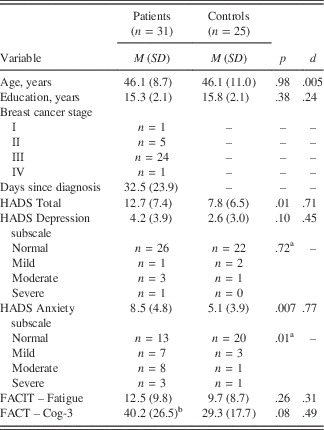
Table 1 summarizes demographic, clinical, and self-report characteristics of women with breast cancer and healthy controls. Total HADS scores and HADS Anxiety subscale scores were higher for women with breast cancer (ps < .01). More women with breast cancer expressed clinically significant levels of anxiety (i.e., score > 7) compared to controls (see Table 1). There were no significant differences in age, education, HADS Depression subscale, FACIT-Fatigue, or FACT-Cog-3 scores between groups.
Participant demographic, clinical, and self-report characteristics

a Fisher exact test compared frequency of normal and clinically significant levels of affective distress.
b n=30 due to incompletion of FACT- Cog-3.
HADS=Hospital Anxiety and Depression Scale; FACT=Functional Assessment of Cancer Treatment; FACIT=Functional Assessment of Chronic Illness Therapy.
Stroop Mean Level Performance
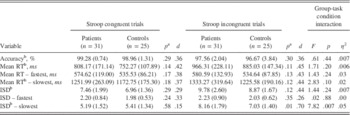
Differences as a function of condition (congruent vs. incongruent) and group (women with breast cancer vs. healthy controls) were examined using 2 (group) by 2 (condition) mixed-model analyses of variance (ANOVAs) on accuracy and mean RT: all, fastest, and slowest trials (Table 2). Both breast cancer and healthy control groups performed at a very high level on the Stroop task (mean accuracy > 96%). There was a significant main effect of condition on accuracy and mean RT for all and slowest trials, such that participants were less accurate and slower on the incongruent trials compared to congruent trials. No significant group effects or group by condition interactions were observed on Stroop accuracy or mean RT scores.
Participant performance variables on the Stroop task

Note. Values in parentheses are standard deviations.
a Independent samples T test p-value.
b Significant main effect of task condition at ps < .001.
ISD=intraindividual standard deviation; RT=reaction time.
Stroop IIV Performance
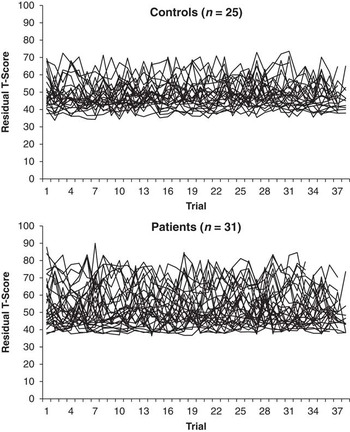
A mixed-model ANOVA revealed a significant interaction between groups and performance on congruent versus incongruent trials of the Stroop task (p < .01; see Table 2). Independent samples t tests showed that women with breast cancer were significantly more variable than healthy controls on the slowest trials in the incongruent condition (p < .01). Responses of women with breast cancer became more variable with increased task difficulty, whereas variability did not change as much with task difficulty in healthy controls. The interaction remained significant even after controlling for group differences in speed of performance (i.e., mean RT of the slowest trials), F(1,52)=5.30; p=.03; η 2 =.03. No significant interaction effects were observed between groups and performance on the fastest trials and across all trials.Footnote 1 Figure 1 displays RTs from the slow portion of the distribution for each participant within the incongruent condition.
Stroop residual T scores of the slowest reaction time (RT) responses across incongruent trial items for each participant in breast cancer patient and healthy control groups.

Using procedure recommended by Hultsch et al. (Reference Hultsch, MacDonald and Dixon2002), a one-way analysis of covariance was conducted to examine group differences in the slowest trials in the incongruent condition while controlling for the effects of the fastest trials. The magnitude of the group effect observed in the uncontrolled analysis was retained, F(1,53)=5.82; p=.01; η 2 =.09.
Potential Covariates
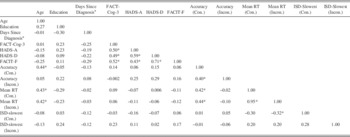
Table 3 shows the correlations between demographic, clinical, self-report characteristics, and select Stroop performance variables for all participants. Across all participants, FACT-Cog-3 scores were not significantly correlated with congruent or incongruent trials on accuracy, mean RT (all, fastest, and slowest trials), or ISD (all, fastest, and slowest trials), although they were significantly related to HADS Depression, HADS Anxiety, and FACIT-Fatigue scores (ps < .001). That is, women who reported a greater number of depressive, anxiety, and fatigue symptoms also reported more cognitive problems. Age was correlated with mean RT and accuracy; older women were slower across conditions but more accurate on congruent trials. Otherwise, education, days since diagnosis, HADS Anxiety, HADS Depression, or FACIT-Fatigue scores were unrelated to Stroop performance.
Pearson correlations of demographic, clinical, self-reported measures, and Stroop performance variables for patients and controls (n=56)

a Analyses performed on patient group only (n=31).
*p < .001.
Con.=congruent condition; Incon.=incongruent condition; FACIT-F=Functional Assessment of Chronic Illness Therapy-Fatigue; FACT=Functional Assessment of Cancer Treatment; HADS-A=Hospital Anxiety and Depression Scale-Anxiety Subscale; HADS-D=Hospital Anxiety and Depression Scale-Depression Subscale; ISD=intraindividual standard deviation; RT=reaction time.
Discussion
The primary objective of this study was to examine IIV in RT on an inhibitory control task in women with breast cancer prior to any treatment. There were no differences between groups on overall accuracy, mean RT or variability; however, patients demonstrated greater variability in their performance compared to healthy controls as the difficulty of the task increased and greater executive control was required. Consistent with other studies that have examined IIV and various health and neurological conditions (Burton, Strauss, Hultsch, Moll, & Hunter, Reference Burton, Strauss, Hultsch, Moll and Hunter2006; de Frias, Dixon, & Camicioli, Reference de Frias, Dixon and Camicioli2012; Fuentes, Hunter, Strauss, & Hultsch, Reference Fuentes, Hunter, Strauss and Hultsch2001; Hultsch et al., Reference Hultsch, MacDonald, Hunter, Levy-Bencheton and Strauss2000), our results suggest that IIV is more sensitive than a measure of central tendency (mean RT) for detecting differences in cognitive performance between patients and healthy controls. Specific to the breast cancer population, the current data are also in keeping with our prior study in which examination of IIV revealed that on a test of sustained attention requiring inhibitory control, patients had greater IIV at faster stimulus presentation rate, suggesting that they are more variable with increased cognitive load (Bernstein et al., Reference Bernstein, Catton and Tannock2014). Thus, IIV appears to provide an important behavioral measure of function even at pretreatment assessment.
We found that group differences varied across the RT distribution, such that women with breast cancer were more variable in the slow portion of the RT distribution on incongruent trials of the task, but variability was equivalent between groups on the congruent trials and in the fast portion of the RT distribution. IIV appears to result from a specific variability-driving process, such as attentional lapses, present only at the slow end of the RT distribution under conditions that require increased inhibitory control.
Our results are consistent with reports within the aging literature that demonstrate IIV in RT changes across task conditions that require increased executive control. For example, performance variability is greater for older adults compared to younger adults under task conditions requiring active recruitment of executive processes (West et al., Reference West, Murphy, Armilio, Craik and Stuss2002), probably because decreased attentional resources associated with aging results in more fluctuations in executive control. These fluctuations produce longer RTs, increase the variability of an individual’s performance, and lead to greater positive skew in the RT distribution of older adults. Such findings have been described as failures of attention or intention within the IIV and cognitive aging literature.
Although attention and intention may be subserved by different neural networks (with greater involvement of the parietal lobes for attention and of the frontal lobes for intention), they nevertheless share reciprocal connections (Heilman & Watson, Reference Heilman and Watson2012) and are likely overlapping constructs. The findings obtained from the Stroop task used in this study primarily reflect lapses of attention, which resulted in higher IIV in the slowest trials in the incongruent trial for the breast cancer group despite highly accurate overall performance across all participants.
If IIV is a marker of neural integrity, then our results indicate that the biological or psychological response to breast cancer diagnosis may have adverse effects on brain function. We found that women with breast cancer reported more anxiety compared to controls but anxiety was not related to mean RT or ISD measures. Hermelink et al. (Reference Hermelink, Untch, Lux, Kreienberg, Beck, Bauerfeind and Münzel2007, Reference Hermelink, Voigt, Kaste, Neufeld, Wuerstlein, Buhner and Harbeck2015) suggested that cognitive impairment seen prior to neoadjuvant treatment may be related to stress-response symptoms that do not necessarily coincide with symptoms of depression and/or anxiety. Persistent stress-response symptoms may have adverse effects on neurological functioning and behavior in high cognitive-demand circumstances. The finding of differences between patients and controls prior to treatment is important to better understand the long-term cognitive impairment associated with breast cancer and its treatment; any pretreatment deficits may be compounded by the neurotoxic effects of chemotherapy.
The source of performance variability has been attributed to both neurobiological (e.g., disruptions or damage to neural networks) and behavioral (e.g., fluctuations in affective state) factors (Montgomery, Reference Montgomery1995). Previous research suggests that affective influences are more likely to impact IIV that is measured across longer time periods (e.g., hours, days, or weeks). In contrast, changes in neural integrity are more likely to affect IIV that is measured over shorter intervals, such as the present trial-to-trial RT data (Hultsch et al., Reference Hultsch, MacDonald, Hunter, Levy-Bencheton and Strauss2000; Strauss et al., Reference Strauss, MacDonald, Hunter, Moll and Hultsch2002). Given the substantial psychological distress associated with breast cancer diagnosis and treatment, IIV may also be a useful measure in that it is primarily sensitive to neurological changes rather than affective states.
A methodological strength of this study is the computation of IIV that controls for the systematic effects of age, group, and practice that could impact mean RT. In addition, we examined the slowest and fastest RT responses to address potential variability-driving mechanisms. Another strength of this study is recruitment of women with breast cancer who were scheduled to undergo neoadjuvant chemotherapy followed by surgical treatment, which provided an opportunity to examine pretreatment cognitive performance. In contrast, most studies of breast cancer patients before chemotherapy are conducted after surgery (e.g., mastectomy, lumpectomy; Cimprich et al., Reference Cimprich, Reuter-Lorenz, Nelson, Clark, Therrien, Normolle and Welsh2010; McDonald et al., Reference McDonald, Conroy, Ahles, West and Saykin2012; Scherling et al., Reference Scherling, Collins, MacKenzie, Bielajew and Smith2011, Reference Scherling, Collins, MacKenzie, Bielajew and Smith2012).
Limitations of our study include an inability to rule out pre-existing cognitive vulnerabilities that might contribute to pretreatment group differences (e.g., stress response). Second, the effect sizes were small and in the range of η 2=.03 to .09, although they are comparable to those reported in other studies examining executive function in comparison to controls (see: Anderson-Hanley et al., Reference Anderson-Hanley, Sherman, Riggs, Agocha and Compas2003; Ono et al., Reference Ono, Ogilvie, Wilson, Green, Chambers, Ownsworth and Shum2015). Our statistical power was low given a relatively small sample size and small effects, which may be why we did not observe a group effect in IIV across all trials or detect the influence of potential covariates (e.g., age, education, days since diagnosis, other self-report indices). However, there was sufficient power to detect IIV differences at the group level in the slowest RT responses, consistent with a priori hypotheses.
Our study is also limited by the examination of a single measure of intraindividual variability. Although we contrasted performance on the congruent condition of the Stroop task with the incongruent condition, the inclusion of tasks assessing other domains (e.g., semantic or lexical decision) would strengthen the view that executive functioning is selectively impaired in women newly diagnosed with breast cancer. Lastly, although our patients and controls were equivalent in education level, both groups were composed of well-educated women, which limit the generalizability of the results to populations with a fuller range of educational attainment.
In future studies, it will be important to replicate these findings in a larger and more diverse sample. It will also be important to examine IIV and change in cognitive function following adjuvant treatments, which we will be doing with these women. Additional task manipulations to investigate other aspects of executive function (e.g., working memory, task switching) would be useful in providing additional information on the nature of cognitive impairment. An important question is whether pretreatment IIV can predict cognitive functioning after breast cancer treatment. Such information might help identify those at risk and inform treatment options for those individuals. Further elucidation of the mechanisms that drive differences in IIV should be examined as well. If differences in IIV are due to a persistent stress-based response, then the inclusion of objective measures of stress (e.g., basal cortisol levels, cortisol reactivity to stress) will contribute to better understanding of pretreatment cognitive impairment. Additionally, if pretreatment cognitive impairment results from a biological response to the cancer itself, then examining associations to cancer stage would be important, which we were unable to do because of homogeneity in our sample.
The present study provides evidence that untreated women with breast cancer have greater IIV when performing cognitive tasks that require inhibitory control than do healthy controls. In particular, conditions demanding increased load on the executive system produced greater variability in patients than healthy controls, even after controlling for affective distress. Our results highlight the importance of examining IIV in addition to measures of central tendency to better understand the subtle nature of cognitive impairment in women with breast cancer. It would be worth exploring if IIV is a reliable indicator of cognitive change due to breast cancer and its treatments in other tasks. If it is, then this measure of variability holds promise as a predictor of cognitive change. Furthermore, the results have methodological implications for the design and analysis of future studies, namely to include pretreatment assessment, tasks that vary in executive control demands, measures of variability, and larger and more diverse patient populations.
Acknowledgments
Research reported in this publication was supported by the Canadian Breast Cancer Foundation. This work was undertaken as part of a dissertation project by C.Y., who was supported by a doctoral scholarship from the Canadian Institutes of Health Research. No financial conflict of interest to report.