

There are several types of evidence for plant–insect interactions in the fossil record (Labandeira et al. Reference Labandeira2007) and most of them are related to terrestrial plants. Aquatic interactions are more unusual, but also important because they show different interaction patterns due to the singular features of this environment. The oldest known evidence for plant–insect interaction evolution in aquatic habitats comes from Palaeozoic times and consists of records of Protodonata oviposition on Equisetaceae (Kukalová-Peck Reference Kukalová-Peck1991; Grauvogel-Stamm & Kelber Reference Grauvogel-Stamm and Kelber1996). Two Lower Jurassic events are also highlighted in previous papers: the expansion of Hemiptera in lotic and lentic aquatic environments (Popov Reference Popov1971) and the nematocerous Diptera radiation, which started during the Middle–Upper Triassic (Shcherbakov et al. Reference Shcherbakov, Lukashevich and Blagoderov1995) and continued during the Jurassic (Wootton Reference Wootton1988; Labandeira Reference Labandeira1997). The latter event is well supported by the vast number of herbivory and detritivory records corresponding to that period (Shcherbakov et al. Reference Shcherbakov, Lukashevich and Blagoderov1995). In the Cretaceous, which is known as the fundamental period for radiation and development of the angiosperms, the diversity of aquatic insect-feeding types continues to the present day (Labandeira Reference Labandeira2002).
It is also relevant to highlight the close relationship between beetles and angiosperms. Both suffered critical evolutionary changes during the Early Cretaceous, suggesting some coevolutionary relationship. A good example has been provided by Wang et al. (Reference Wang, Ma, McKenna, Yan, Zhang and Jarzembowski2013), who studied the correspondence between Early Cretaceous angiosperms and some of their pollinators: Scarabaeoidea, Tenebrionoidea, Curculionoidea and Chrysomeloidea, relating the success of both groups (beetles and plants) in that period. In this paper, we present evidence of feeding interactions between insect and nymphaealean leaves in Early Cretaceous deposits from the NE Iberian Peninsula during a critical epoch for the radiation of aquatic angiosperms. These records might lead to a better understanding of Albian aquatic ecosystems.
1. Geological and geographical location
The fossil records presented here came from the Plou and Estercuel localities in Teruel Province, Spain, in the SW of the Aragonese Branch of the Iberian Chain (Fig. 1). Geologically, both fossil sites belong to the top of the fluvial sands of the Utrillas Formation, referred to as the ‘Boundary Marls' unit (for the ‘Margas de Transición' unit of Aguilar et al. Reference Aguilar, Ramírez del Pozo and Riba1971), which has been dated uppermost Albian by its palynological assemblage (Villanueva-Amadoz et al. Reference Villanueva-Amadoz, Sender, Diez, Ferrer and Pons2011). In a sedimentary context, these deposits reflect the transition between the fluvial deposits of the Utrillas Formation and the overlying shallow marine sandstones of the Mosqueruela Formation, which is Cenomanian in age based on the assemblages of benthic foraminifera (Lendínez et al. Reference Lendínez, Ruíz and Carls1989). The stratigraphic succession at Plou containing the beds with Ploufolia cerciforme Sender et al., Reference Sender, Gomez, Diez, Coiffard, Martín-Closas, Villanueva-Amadoz and Ferrer2010 leaves, shows two distinct intervals. One is level 2B formed by more than 2m of alternating grey, laminated sandy marls with layers of ferruginous, cross-bedded sandstones. The influence of lake inlets is evident from the presence of sand in the marls from the alternation of lacustrine marls with fluvial sandstones. The second interval corresponding to level 2C is formed by alternating grey, finely laminated marlstones with mm-thick white sandstone horizons (see Sender et al. Reference Sender, Gomez, Diez, Coiffard, Martín-Closas, Villanueva-Amadoz and Ferrer2010). Most of the specimens of P. cerciforme occur at this stratigraphic level along with terrestrial plant remains. The presence of laminated marls containing well-preserved plant remains and the absence of bioturbation indicate deposition in a relatively quiet lacustrine environment. Nevertheless, the stratigraphic section in the plant fossil site of Estercuel containing the Aquatifolia cf. fluitans Wang & Dilcher, Reference Wang and Dilcher2006 leaves is composed of grey claystones intercalated with fine- to coarse-grained yellow sandstones, which were deposited in a tidally influenced fluvial sedimentary environment (Sender et al. Reference Sender, Villanueva-Amadoz, Diez, Sánchez-Pellicer, Bercovici, Pons and Ferrer2012).
Geographic map and stratigraphic sections of Plou and Estercuel outcrops, Teruel province, NE Iberian Peninsula. Plou section modified from Sender et al. (Reference Sender, Gomez, Diez, Coiffard, Martín-Closas, Villanueva-Amadoz and Ferrer2010) and Estercuel section modified from Sender et al. (Reference Sender, Villanueva-Amadoz, Diez, Sánchez-Pellicer, Bercovici, Pons and Ferrer2012).

2. Material and methods
The fossil samples bearing the studied phenomena are stored at the Museo de Ciencias Naturales de la Universidad de Zaragoza, Spain (MPZ). The evidence for insect feeding is present in the fossil leaves of two species of aquatic angiosperms: Ploufolia cerciforme (samples MPZ 2007/2279, MPZ 2007/2303, MPZ 2007/2329, MPZ 2007/2330, MPZ 2007/2332 and MPZ 2007/2335) and Aquatifolia cf. fluitans (sample MPZ 2010/1130). Ploufolia cerciforme was described as an aquatic angiosperm with a possible affinity to the Nymphaeaceae family, which, during the Upper Albian, occupied shallow lacustrine habitats in coastal areas of the W of Eurasia. It was found in outcrops of that age in the NE of Spain, at the Plou fossil site (Sender et al. Reference Sender, Gomez, Diez, Coiffard, Martín-Closas, Villanueva-Amadoz and Ferrer2010) and in the centre of Portugal at the Cercal site (Saporta Reference Saporta1894). This taxon was also recorded at the Jaunay-Clan outcrop in France, where it was dated as Lower Cenomanian (Valentín et al. Reference Valentín, Gómez, Daviero-Gómez, Charbonnier, Ferchaud, Kirejtshuk, Licht, Néraudeau, Vullo and García2014).
Aquatifolia cf. fluitans was described for the first time in Upper Albian deposits in the mid-W area of the US (Wang & Dilcher Reference Wang and Dilcher2006), with only one other record located in eastern Eurasia, at the Estercuel outcrop, in the NE of Spain, and of similar age (Sender et al. Reference Sender, Villanueva-Amadoz, Diez, Sánchez-Pellicer, Bercovici, Pons and Ferrer2012). This taxon, whose petiole is remarkable because of its central bulge which could act as a float, was described as an aquatic angiosperm phylogenetically related to the Nymphaeaceae family (Wang & Dilcher Reference Wang and Dilcher2006).
The fossil leaves were prepared using a micro-pneumatic hammer and sharp needles under a stereomicroscope to remove matrix material covering the fossils. Photographs were taken using a Nikon D-90 camera with an AF-S Micro Nikkor 60-mm macro lens.
3. Results
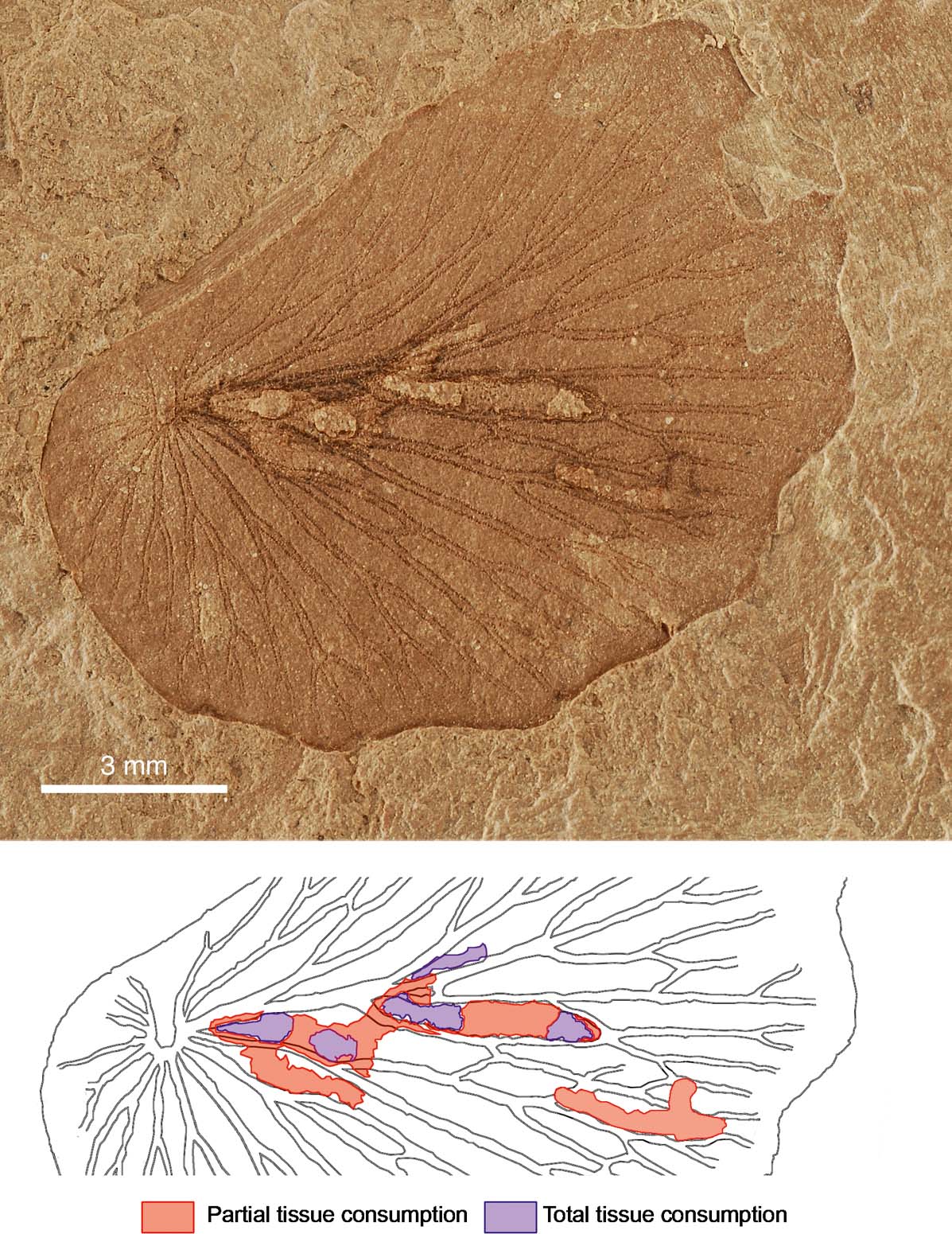
The recorded interactions belong to the feeding type with two different subtypes present: hole feeding and margin feeding, sensu Labandeira et al. (Reference Labandeira2007). In both cases, the two sides of the leaf blade were consumed, except for the interaction on sample MPZ 2007/2330 (corresponding to Ploufolia cerciforme; Fig. 2). This interaction is due to the evasion of vascular bundles, whereas the margin feeding causes the consumption of all the foliar tissues without exception. Additionally, the darker tone present in the edge of some feeding marks suggests a wound reaction by the plant, which implies that the interaction happened while the leaf was still connected to the living plant, allowing the discard of possible detritivory activity (Labandeira Reference Labandeira2007).
Two discontinuous hole-feeding marks on a Ploufolia cerciforme leaf, which do not always respect foliar veins (MPZ 2007/2330). Original photography and schematic representations are shown.

3.1. Interactions on Ploufolia cerciforme
On this taxon, both subtypes of herbivory interactions (hole feeding and margin feeding) were identified.
3.1.1. Hole feeding
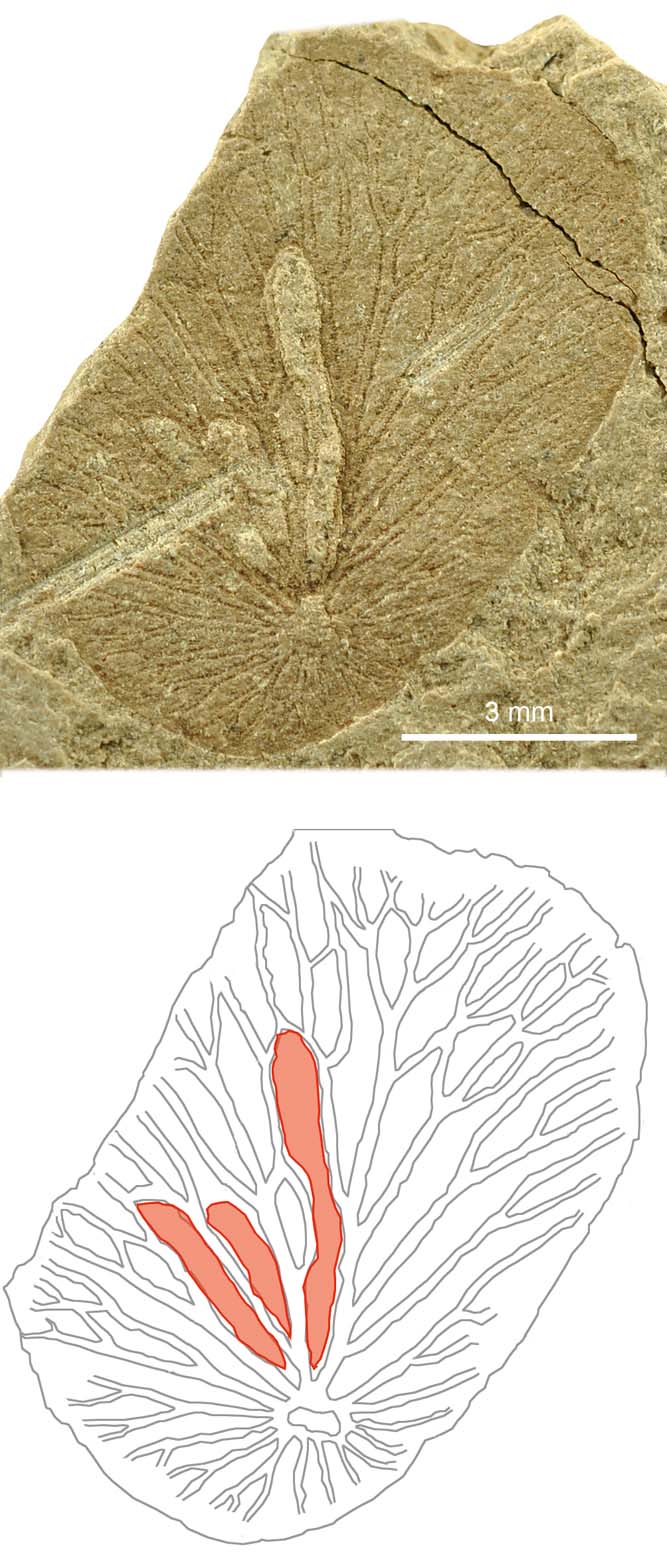
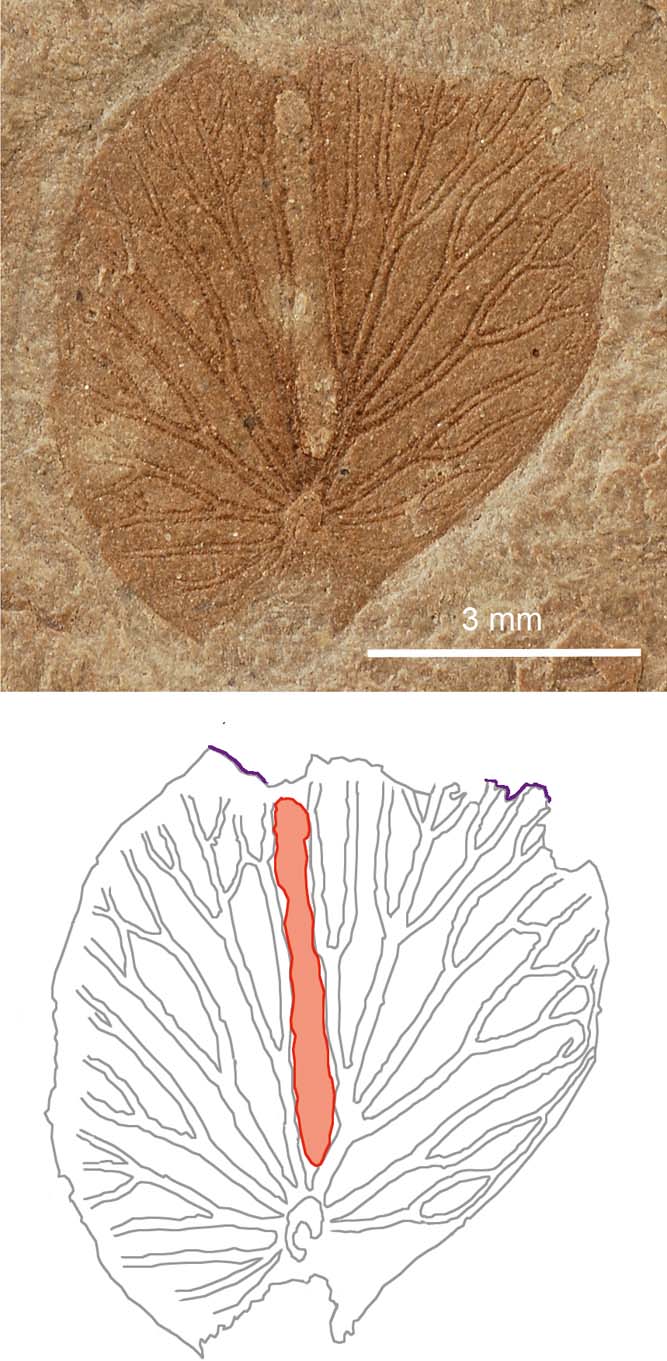
Hole feeding is the most frequent and remarkable interaction in this taxon. This evidence consists of oval to elongated holes of <2 to >4–6mm in length, with width determined by the space between foliar veins. These holes usually extend from the petiolar insertion and they do not affect the leaf vascular bundles. They often make visible the underlying sediment, which means that it had to involve a full intake of the leaf (except the specimen in Fig. 2). This morphology was identified as Damage Type 78 (DT78) according to Labandeira et al. (Reference Labandeira2007) due to its length–width ratio, which is higher than 2.5, and its edges, which are rectilinear or slightly curved but always parallel to each other. However, its distribution between foliar veins is more similar to DT08. Three marks of hole feeding are shown in the specimen in Figure 3, ranging 2–4mm in length, whereas the specimen in Figure 4 shows a single mark about 4mm long. All of the specimens present the general features previously described. The sample in Figure 2 shows two hole-feeding marks. One of them, the largest one, is approximately 6mm in length, extending from the petiolar insertion point. Nevertheless, it could be considered as an association of three sections (2–3mm in length) caused by the prospective feeding behaviour of the insect. The other mark, the smallest one, consists of two sections of 1–2mm in length. In addition to the previous features, sometimes the foliar veins are not respected during the feeding process and they are totally or partially consumed. It is also remarkable that the feeding is partial in some areas, where it seems to be a consumption of only one leaf face. Additionally, a darkening of wound edges is clearly visible.
Hole-feeding evidence on a Ploufolia cerciforme leaf, original photo and schematic representations, showing three marks (MPZ 2007/2335).

3.1.2. Margin feeding
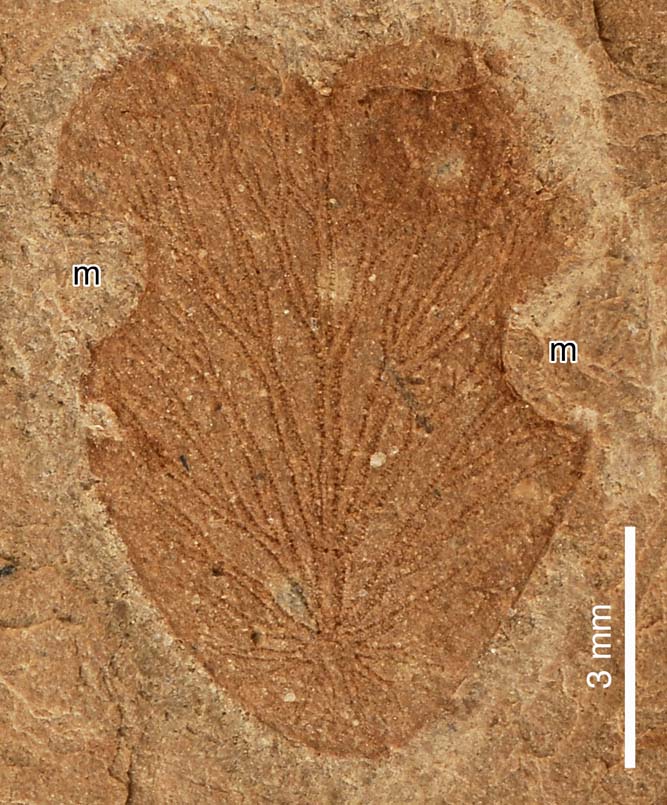
The putative evidence of margin feeding could be discontinuous (Fig. 4) or continuous (Fig. 5), depending of the specimen. If the specimens are compared with the reference guide of Labandeira et al. (Reference Labandeira2007), the most accurate description will correspond to DT12; because they are approximately circular with less than 180° of arc, they are isolated from each other and never reach the main vein. The darkening in the edge of the wounds is also remarkable, perceptible in specimens MPZ 2007/2332 (Fig. 4) and, above all, in specimen MPZ 2007/2279 (Fig. 5).
An isolated hole-feeding mark on a Ploufolia cerciforme leaf (MPZ 2007/2332), original photography and schematic representations. There is also discontinuous margin-feeding evidence (purple line).

Continuous margin-feeding evidence (m) on Ploufolia cerciforme leaf. This consists of two semicircular marks at opposite positions on the leaf (MPZ 2007/2279).

3.2. Interactions on Aquatifolia cf. fluitans
3.2.1. Hole feeding
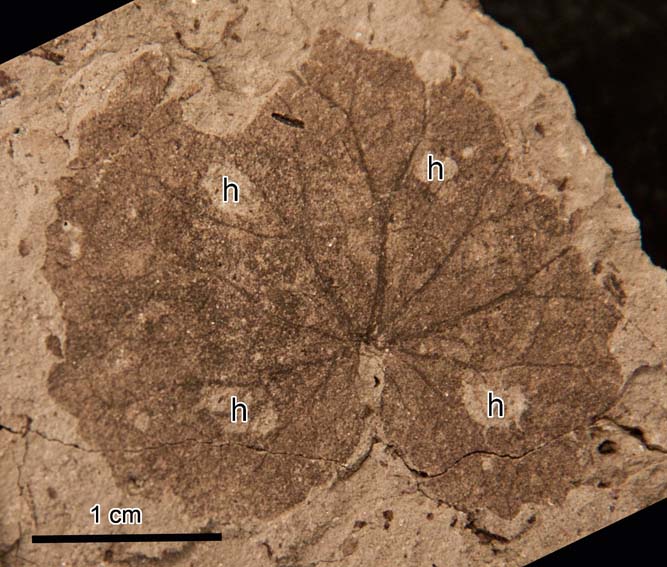
In the case of this species, only hole-feeding evidence is identified in the studied sample. It consists of four oval holes of 3.35–6.20mm maximum diameter and 1.87–3.35mm minimum diameter (Fig. 6) – they could be associated with the DT02 type damage of Labandeira et al. (Reference Labandeira2007).
Hole-feeding evidence (h) on Aquatifolia cf. fluitans leaf. Four oval marks are shown on the same leaf (MPZ 2010/1130).

4. Discussion
The most similar interactions described in the literature, due to the age and the host, were those published by Braz et al. (Reference Braz, Utida, Bernades-de-Oliveira, Mohr and Wappler2011), who describe many different plant–insect interactions (e.g., margin feeding, galling, piercing and sucking) on Pluricarpellatia peltata Mohr et al., Reference Mohr, Bernardes-de-Oliveira and Taylor2008 (also corresponding to Nymphaeaceae) from the Albian of Brazil (Mohr et al. Reference Mohr, Bernardes-de-Oliveira and Taylor2008). In the same way, Labandeira (Reference Labandeira1998) presents similar interactions in age (Mid-Cretaceous) and type (hole feeding and margin feeding), but on terrestrial plants of the family Lauraceae found in the Cenomanian Dakota Formation from the central area of the USA. One of them, which can be associated with weevil activity according to the author, is quite similar in shape to the marks of hole feeding present on Ploufolia cerciforme (Figs 2–4), but not in their position on the leaf. Krassilov & Shuklina (Reference Krassilov and Rasnitsyn2008) studied Albian–Turonian deposits of Israel and identified mines, but also hole feeding on Nelumbites aravensis Krassilov et al., Reference Krassilov, Lewy, Nevo and Silantieva2005, a taxon related to aquatic angiosperms of the family Nelumbonaceae (Krassilov et al. Reference Krassilov, Lewy, Nevo and Silantieva2005). As we consider later, some of these interactions could be related to chrysomelid beetles (Krassilov & Rasnitsyn Reference Krassilov and Rasnitsyn2008). The similarities between late Early Cretaceous Iberian floral assemblages and the North American ones from the Potomac Group have already been demonstrated (Sender et al. Reference Sender, Diez, Ferrer, Pons and Rubio2005, Reference Sender, Villanueva-Amadoz, Diez, Sánchez-Pellicer, Bercovici, Pons and Ferrer2012, Reference Sender, Doyle, Víllanueva-Amadoz, Pons, Diez and Ferrer2016). In research based on Middle–Upper Albian Potomac floral assemblages, Upchurch et al. (Reference Upchurch, Crane and Drinnan1994) mentioned the evidence of galling in angiosperm leaves, but elements of the published material might be attributable to margin- and hole-feeding interactions. There are also other similar interactions of the same age but produced on very different hosts, geographical location and type: possible margin feeding on a bennettitalean leaf from the Rajmahal Basin, India (Banerji Reference Banerji2004) and a boring on a gymnospermous cone from Russia (Falder et al. Reference Falder, Rothwell, Mapes, Mapes and Doguzhaeva1998). Similar hole-feeding damage to that in the Ploufolia cerciforme leaves has been found on current water lilies caused by chrysomelid beetles like Galerucella nymphaeae (Suvák et al. Reference Suvák, Gregorek and Pľuchtová2012; Carvalho et al. Reference Carvalho, Wilf, Barrios, Windsor, Currano, Labandeira and Jaramillo2014). According to Wallace & O'Hop (Reference Wallace and O'Hop1985), the feeding pattern followed by this species was described by Scott (Reference Scott1924) and then by Wilson (Reference Wilson1928) as ‘irregular trenches in the upper leaf surface'. Other works refer to the relationship between chrysomelid beetles and nymphaeales. Thus, Labandeira (Reference Labandeira1998) attributed hole-feeding marks over a terrestrial plant, a lauralean of the genus Pandemophyllum, to chrysomelid activity, also in the Middle Cretaceous. Furthermore, Krassilov & Rasnitsyn (Reference Krassilov and Rasnitsyn2008) affirm that chrysomelid beetles are common in marsh habitats and that these beetles interact with aquatic angiosperms of the family Typhaceae. There are also some studies of the pollination of nymphaeales by chrysomelid beetles, which is another different interaction that contributes to an understanding of the close relationship between insects and aquatic angiosperms (Bernhardt Reference Bernhardt2000; Bernhardt et al. Reference Bernhardt, Sage, Weston, Azuma, Lam, Thien and Bruhl2003). Finally, Cronin et al. (Reference Cronin, Wissing and Lodge1998) studied the feeding behaviour of current insects, including chrysomelid beetles (Galerucella and Donacia), and a curculionid (Bagous). These authors showed that water lilies suffer more attacks because their leaves lie at the water–air interface, allowing terrestrial insects to feed on them, like Galerucella, which cannot survive long periods under water. This fact could indicate that an insect with similar mouthparts and feeding ethology, but smaller than the current ones (existent host plants are larger and, consequently, their feeding marks are larger too) could be the cause of the damage on Ploufolia cerciforme leaves. Moreover, some chrysomelid beetles were described in other fossil outcrops of similar age, albeit geographically distant, in the Lower Cretaceous of China (Wang et al. Reference Wang, Ma, McKenna, Yan, Zhang and Jarzembowski2013) and the Upper Cretaceous of Canada (Poinar Reference Poinar2005). There appear to be no Cretaceous records of these interactions in the S of Europe. For Ploufolia cerciforme margin feeding and Aquatifolia cf. fluitans hole feeding, and given their common morphology, the list of candidates could not be reduced, except that some Ploufolia cerciforme samples show wound reaction, which allows detritivores to be discarded. It is notable that the A. cf. fluitans hole-feeding marks studied in this paper look very similar to the marks present in samples reported by Wang & Dilcher (Reference Wang and Dilcher2006), although such phenomena were not mentioned in that article.
5. Conclusions
This study establishes the first record of plant–insect interactions on aquatic angiosperms from the Upper Albian of Laurasia, and it also constitutes the first evidence of this kind of interaction on both studied taxa (Ploufolia cerciforme and Aquatifolia cf. fluitans, related to Nhymphaeales) in the fossil record worldwide. However, the P. cerciforme margin feeding and A. cf. fluitans hole-feeding interactions are much more difficult to relate to any insect family because of their common morphology. In addition, the interpretation of the marks reported here leads us to think that it is likely that the P. cerciforme hole feeding would correspond to insects from the Chrysomelidae family, due to the similarities of our samples with the multiple fossil and current records of interactions between this taxon and the Nymphaeaceae family.
6. Acknowledgements
We thank the ‘Dirección General de Patrimonio Cultural' of Aragón region Government for permissions and grants to conduct fieldwork. This work is a contribution from the project CGL2015-69805-P and CGL2015-66835-P supported by the ‘Ministerio de Ciencia e Innovación', project CGL2013-41295-P of the ‘Ministerio de Economía y Competitividad' of the Spanish Government to LMS and JBD and project GRC2015/020 of the ‘Consellería de Cultura, Educación y Ordenación Universitaria' of the Galician Government to PEG and JBD.