Introduction
Aphodius fimetarius (Linnaeus, 1758) (Coleoptera: Scarabaeidae: Aphodiinae: Aphodiini) sensu lato is a common species associated with livestock dung. Of Eurasian origin, it is adventive in Australia, New Zealand, and throughout North America (Stebnicka Reference Stebnicka2001, Reference Stebnicka2009; Dellacasa and Dellacasa Reference Dellacasa and Dellacasa2003; Bezanson and Floate Reference Bezanson and Floate2019). Characterised by a black head and pronotum with contrasting reddish elytra, it was originally described as one species. However, variation in the visual appearance of chromosomes (karyotype differences) in combination with subtle differences in morphological characters led to the conclusion that the old concept of A. fimetarius comprised two species (Wilson Reference Wilson2001; Whitehead Reference Whitehead2006). The second species was named Aphodius pedellus (De Geer, 1774) based on the re-examination of type specimens (Wilson Reference Wilson2001). Recognition of these two species is now generally accepted (for further discussion, see Klimaszewski et al. Reference Klimaszewski, Langor, Smith, Hoebeke, Davies and Pelletier2017).
Confirmation of A. fimetarius and A. pedellus as different species was obtained by the elegant work of Miraldo et al. (Reference Miraldo, Krell, Smalén, Angus and Roslin2014), which combined karyotyping, CO1 gene sequencing, morphological examinations, and ecological data. The authors of that study showed that gene sequencing identifies two genetic clades, which correspond to the two karyotypes previously reported by Wilson (Reference Wilson2001). The two groups can be separated by subtle morphological differences and, in regions of sympatry, exhibit different seasonal phenologies (Miraldo et al. Reference Miraldo, Krell, Smalén, Angus and Roslin2014). On the basis of the specimens examined from North America, Miraldo et al. (Reference Miraldo, Krell, Smalén, Angus and Roslin2014) concluded that northern regions of North America “are dominated by A. pedellus alone”, with mixed regions of sympatry between A. fimetarius and A. pedellus further south in the United States of America. This finding suggests that A. pedellus is the only member of this species complex present in Canada.
In the present study, we set out to validate the conclusion of Miraldo et al. (Reference Miraldo, Krell, Smalén, Angus and Roslin2014) regarding the dominance of A. pedellus in Canada. The North American material that they examined from the United States of America comprised 3565 specimens (from approximately 150 locations in 37 states), for which 50 individuals were sequenced. The material that they examined from Canada comprised 22 specimens (six locations in four provinces), for which no individuals were sequenced (Miraldo et al. Reference Miraldo, Krell, Smalén, Angus and Roslin2014, table S1 (supporting information)). For this validation, we examined the morphologies of specimens from sites spanning the Canadian distribution of A. fimetarius sensu lato. For a subset of specimens, we obtained CO1 gene sequences to compare with those deposited in GenBank by Miraldo et al. (Reference Miraldo, Krell, Smalén, Angus and Roslin2014) and other researchers to confirm our morphological identifications.
Materials and methods
Morphological determinations
Specimens labelled as A. fimetarius or A. pedellus were obtained from collections held at various institutional repositories in North America. These repositories included Agriculture and Agri-Food Canada research centres (Charlottetown, Prince Edward Island, Canada; Lethbridge, Alberta, Canada; Saint John’s, Newfoundland and Labrador, Canada); the Biodiversity Institute of Ontario, University of Guelph (Guelph, Ontario, Canada); the California Academy of Sciences (San Francisco, California, United States of America); the Canada Forest Service (Corner Brook, Newfoundland and Labrador, Canada); the Canadian Food Inspection Agency (Ottawa, Ontario, Canada); the Canadian Museum of Nature (Gatineau, Québec, Canada); the Canadian National Collection of Insects, Arachnids, and Nematodes (Ottawa, Ontario, Canada); the Enns Entomology Museum, University of Missouri (Columbia, Missouri, United States of America); the Essig Museum of Entomology, University of California (Berkeley, California, United States of America); the Insect Collection, University of Guelph (Guelph, Ontario, Canada); the J.B. Wallis/R.E. Roughley Museum of Entomology, University of Manitoba (Winnipeg, Manitoba, Canada); the University of Calgary (Calgary, Alberta, Canada); the Lyman Entomological Museum, McGill University (Sainte-Anne-de-Bellevue, Québec, Canada); the Memorial University of Newfoundland (Saint John’s, Newfoundland and Labrador, Canada); the New Brunswick Museum (Saint John, New Brunswick, Canada); the Northern Forest Research Centre (Edmonton, Alberta, Canada); Olds College (Olds, Alberta, Canada); the Royal British Columbia Museum (Victoria, British Columbia, Canada); the Royal Ontario Museum (Toronto, Ontario, Canada); the Spencer Entomological Collection, University of British Columbia (Vancouver, British Columbia, Canada); the University of Nebraska State Museum (Lincoln, Nebraska, United States of America); the University of Prince Edward Island (Charlottetown, Prince Edward Island, Canada); and Western University (London, Ontario, Canada). Collectively, the specimens examined were from sites that spanned the full reported Canadian distribution of A. fimetarius sensu lato. Eight specimens from a site near Hardtner, Kansas, United States of America also were examined (Table 1).
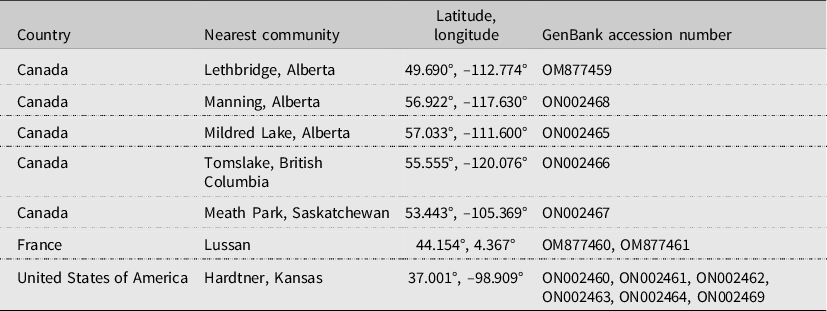
Collection localities of specimens sequenced in the present study.

Each specimen was carefully examined using a microscope by a scarab taxonomist (ABTS) to verify the species identification using the morphological characters described in Miraldo et al. (Reference Miraldo, Krell, Smalén, Angus and Roslin2014) and comparison with voucher material deposited in the Canadian Museum of Nature. Morphological characters included the shape of the head, the extent of microsculpture at the subapical area of the elytra, and features of elytral intervals at the apical end of the elytra (see Miraldo et al. Reference Miraldo, Krell, Smalén, Angus and Roslin2014, table 3).
Extraction and amplification of DNA
Genomic DNA was extracted from pinned museum specimens or from specimens collected live into 70% ethanol. Some of these specimens were recovered at sites in France and in the United States of America, where it was anticipated that A. fimetarius might co-occur with A. pedellus (Miraldo et al. Reference Miraldo, Krell, Smalén, Angus and Roslin2014). We hoped that some of the sequences from these sites would be for A. fimetarius, for comparison with sequences for specimens from Canada, where only A. pedellus was expected to occur. The Canadian specimens that we sequenced were for sites mainly in Alberta, where we previously had collected dung beetles for unrelated projects. Site localities for all of the specimens that we sequenced are reported in Table 1.
To generate sequences for the mitochondrial DNA CO1 gene, we used two approaches. On an initial set of specimens, we extracted DNA from single legs using DNeasy® Blood & Tissue Kits (Qiagen Group, Hilden, Germany). The extracted DNA was amplified in our lab with the universal primers HCO2198 (5′-TAA ACT TCA GGG TGA CCA AAA AAT CA-3′) and LCO1490 (5′-GGT CAA CAA ATC ATA AAG ATA TTG G-3′; Folmer et al. Reference Folmer, Black, Hoeh, Lutz and Vrijenhoek1994) and general methods described in Hebert et al. (Reference Hebert, Cywinska, Ball and deWaard2003). As previously reported by Miraldo et al. (Reference Miraldo, Krell, Smalén, Angus and Roslin2014), DNA yield and amplification from single legs were low, such that we used whole-body extraction for some specimens. Amplicon sequencing was done at the University of Calgary (University Core DNA Services, Calgary, Alberta, Canada). This approach rarely provided CO1 gene sequences of sufficient length. Therefore, for the remaining specimens, single-leg samples were sent to the Canadian Centre for DNA Barcoding (University of Guelph, Guelph, Ontario, Canada) for DNA extraction, amplification, and sequencing.
Resultant sequences were deposited in GenBank (see Table 1). When identical sequences were obtained from multiple species at the same site, only one representative sequence was deposited.
Similarity analysis
The CO1 sequences that we recovered in our study were pooled with the CO1 sequences for A. fimetarius and A. pedellus available in GenBank. A subset of sequences spanning the full range of genetic diversity and specimen localities was retained for analyses. Sequences were trimmed and aligned using the ClustalW method, resulting in sequence lengths of 308 base pairs. The sequences were used to obtain a “best fit” similarity tree derived from 1000 iterations of a distance matrix using the neighbour-joining method. Mean genetic distance within species was calculated using a maximum composite likelihood method with a bootstrap test of 1000 repetitions. Sequence analysis and tree construction were done in Mega 7 (Kumar et al. Reference Kumar, Stecher and Tamura2016). When two or more identical sequences were available from the same locality, only one sequence was used in the analysis.
Results and discussion
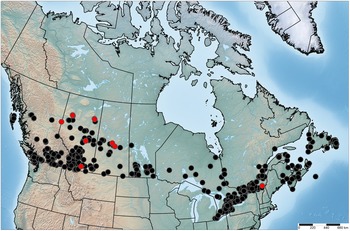
Our findings support the conclusion of Miraldo et al. (Reference Miraldo, Krell, Smalén, Angus and Roslin2014) that all individuals of the A. fimetarius–A. pedellus complex in Canada are A. pedellus (Fig. 1). All of the Canadian specimens examined (n = 2091) had morphologies consistent with A. pedellus; no specimens were clearly identifiable as A. fimetarius. This examination included specimens from the southernmost regions of British Columbia, Ontario, and Québec, where warmer climates should be most amenable to the establishment of A. fimetarius. Our findings also provide evidence for regions of sympatry for the two species in the United States of America, as previously reported by Miraldo et al. (Reference Miraldo, Krell, Smalén, Angus and Roslin2014). The only specimens with morphologies fully consistent with A. fimetarius were from Kansas, from which we also received specimens with morphologies consistent with A. pedellus.
Localities in Canada from which specimens of the Aphodius fimetarius–Aphodius pedellus complex were obtained for either morphological examination (black circles) or DNA barcoding (red circles; see Fig. 2). Map generated using https://www.simplemappr.net/ and site coordinates in Supplementary materials, Table S1.

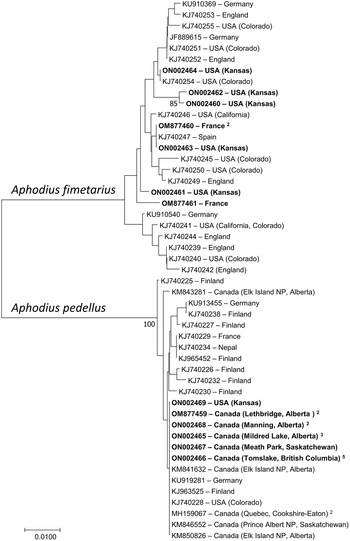
The morphological identifications were supported by the similarity analysis, which separated sequences into two genetic clades (Fig. 2). The 13 sequences that we obtained in the present study for Canadian specimens were members of the genetic clade documented by Miraldo et al. (Reference Miraldo, Krell, Smalén, Angus and Roslin2014) as A. pedellus (Fig. 2). Six additional sequences for Canadian specimens obtained from GenBank also were members of this clade. Although labelled as A. fimetarius, the sequences clearly identify them as A. pedellus. For the present study, we obtained eight sequences that were members of the genetic clade corresponding to A. fimetarius. These include five sequences for specimens from Kansas and three sequences for specimens from France. We note that the specimens from Kansas that we barcoded also included one individual with a sequence corresponding to A. pedellus. The co-occurrence of both species in Kansas is consistent with our morphological determinations and with the reported sympatry of both species in the adjacent state of Colorado, United States of America (Miraldo et al. Reference Miraldo, Krell, Smalén, Angus and Roslin2014).
Similarity analysis separates Aphodius fimetarius and Aphodius pedellus into two clades based on differences in CO1 gene sequences; all sequences from Canadian specimens correspond to the latter taxon. Sequences obtained in the current study are in bold font with superscript numbers to identify the total number of identical sequences recovered from that site. Sequences for North America include locality details for state (United States of America)/province (Canada) and community (Canada) to better convey geographic distance between collection sites. Bootstrap values greater than 70 are not reported. A data file with the sequence alignments used for this analysis is provided in Supplementary materials, Table S2.

The similarity analysis also identifies a greater level of genetic diversity among sequences for A. fimetarius compared to those for A. pedellus (Fig. 2). For sequences used in this analysis, mean genetic distances (± standard error) within species were 0.019 ± 0.004 for A. fimetarius and 0.003 ± 0.002 for A. pedellus. This pattern was previously observed by Miraldo et al. (Reference Miraldo, Krell, Smalén, Angus and Roslin2014) and is strengthened in the present study by the examination of additional sequences from a greater number of geographic locations.
Although based on a limited data set, all but one (KM843281) of the 21 sequences for A. pedellus from North America (Canada: British Columbia, Alberta, Saskatchewan, and Québec; United States of America: Colorado and Kansas) form a subclade of identical sequences within the A. pedellus clade. This apparently more limited diversity among North American specimens is consistent with the suggestion by Miraldo et al. (Reference Miraldo, Krell, Smalén, Angus and Roslin2014) that A. pedellus is a recent introduction onto the continent. Brown (Reference Brown1940) lists a number of dung-breeding insects adventive in Canada that may have been introduced during European settlement when vessels from Europe discarded livestock bedding and soil ballast near ports of entry. Aphodius pedellus (identified as A. fimetarius) is included on this list and was reported to be common in Atlantic Canada and adjacent states by the mid-1800s and common across Canada by 1872. Collection localities for A. pedellus (identified as A. fimetarius) in Canada are provided in Floate and Gill (Reference Floate and Gill1998).
The present study confirms and strengthens the findings reported in Miraldo et al. (Reference Miraldo, Krell, Smalén, Angus and Roslin2014). The key result is that past and future reports of A. fimetarius recovered from Canada should be assumed to be A. pedellus unless otherwise confirmed by DNA barcoding or morphological study of the specimens in question. This change in name recognition does not invalidate any ecological interpretations of these reports. However, it does further clarify the North American distributions of the two species.
Supplementary material
To view supplementary material for this article, please visit https://doi.org/10.4039/tce.2022.26.
Acknowledgements
For providing specimens for morphological examination or barcoding, the authors thank A. Benn, C. Copley, S. Dufton, V.A.D. Hervet, M.L. Jameson, N. Kadiri, J.-P. Lumaret, S. Marshall, W. Olson, J. Otani, and all of the curators and collections managers of the above-mentioned institutions.
Competing interests
The authors declare no competing interests.