If you are a university administrator or faculty member today it is likely that you have, at one point, received a phone call or e-mail from a concerned parent of one of your students. These calls or e-mails often involve grade grievances, requests for excused absences, or even admonitions for perceived slights—all relatively common transactions between college faculty and their students. However, it is becoming increasingly common that faculty will be asked to have these discussions not with their students, but with their students’ parents (Fingerman et al. Reference Fingerman, Cheng, Wesselmann, Carit, Furstenberg and Birditt2012; Gude Reference Gude2014). This phenomenon is known as helicopter parenting—aptly named for the parental tendency to hover over their offspring and resolve problematic circumstances for them.
In this study, we show that the rise of helicopter parenting is doing more than just reshaping student–professor interactions; it is influencing students’ policy attitudes as well—which is of particular importance for the political science classroom. College students with helicopter parents are, on average, more supportive of government interventions into the private lives of citizens than are students without helicopter parents. Specifically, we show that helicopter parenting has a potentially counterintuitive effect on students’ policy attitudes—increasing support for both liberal and traditionally conservative policies. “Helicoptered” students tend to express strong support for programs that purport to protect national security as well as for public welfare policies (e.g., mandatory helmet laws). We argue that the rise of helicopter parenting may signal significant and imminent shifts not just in the political science classroom but in public opinion as well.
HELICOPTER PARENTING AND STUDENTS’ POLICY ATTITUDES
Helicopter parenting is a relatively new phenomenon of interest to social science—and its psychological effects on one’s offspring are sizable. Helicopter parenting is linked to increased anxiety and depression as well as low self-efficacy in college students (Givertz and Segrin Reference Givertz and Segrin2012; Schiffrin et al. Reference Schiffrin, Liss, Miles-McLean, Geary, Erchull and Tashner2014; Segrin et al. Reference Segrin, Woszidlo, Givertz, Bauer and Murphy2012). Studies have also shown that adult offspring of helicopter parents perform poorly in the workplace and many have considerable difficulty in obtaining a job—frequently attributed to parental involvement in negotiating job terms or salary (Barnes Reference Barnes2009; Bradley-Geist and Olson-Buchanan Reference Bradley-Geist and Olson-Buchanan2014). Helicopter parenting is often a lifelong experience for the offspring, typically beginning in early childhood and continuing indefinitely (Givertz and Segrin Reference Givertz and Segrin2012). In short, helicopter parenting is associated with several adverse psychological traits and reduced confidence in one’s abilities.
There is also evidence that helicopter parenting leads children to develop an external locus of control, in which they believe that they have little control over events that affect them (Ballash et al. Reference Ballash, Pemble, Usui, Buckley and Woodruff-Borden2006; Kwon, Yoo, and Bingham Reference Kwon, Yoo and Bingham2016; Spokas and Heimberg Reference Spokas and Heimberg2009). In other words, when a problem arises, individuals with an external locus of control are unlikely to believe that there is anything they can personally do to control or manage the situation. And as we have seen with children of helicopter parents, they are, on average, accepting of parental intervention to resolve conflicts that arise in their everyday lives (Padilla-Walker and Nelson Reference Padilla-Walker and Nelson2012; Segrin et al. Reference Segrin, Woszidlo, Givertz, Bauer and Murphy2012).
Importantly, children of helicopter parents also tend to be highly anxious, particularly in early adulthood when greater responsibilities and expectations of independence are placed upon them (Schiffrin et al. Reference Schiffrin, Liss, Miles-McLean, Geary, Erchull and Tashner2014). Increased anxiety is strongly associated with a tendency to seek out threatening news, to trust relevant political actors (to resolve a problem), and to support policies designed to protect individuals (Albertson and Gadarian Reference Albertson and Gadarian2015). Thus, we argue that the development of this relationship between parent and student predisposes the student to be more accepting of government intervention in the resolution of conflict. That is, helicopter parenting makes college students less likely to believe that they are capable of resolving social or political problems on their own, as many have become accustomed to having their parents resolve difficulties or disputes for them (Spokas and Heimberg Reference Spokas and Heimberg2009). Simultaneously, the anxious, overparented individual is likely to trust that “someone else” (e.g., political leaders) can and will resolve problems that arise (Albertson and Gadarian Reference Albertson and Gadarian2015). Given this, helicoptered college students should be relatively supportive of government interventions to resolve social dilemmas.
That is, helicopter parenting makes college students less likely to believe that they are capable of resolving social or political problems on their own, as many have become accustomed to having their parents resolve difficulties or disputes for them (Spokas and Heimberg Reference Spokas and Heimberg2009).
DATA AND METHODS
To assess the impact of helicopter parenting, we surveyed college students at seven public and private universities in the United States in March 2016. A total of 1,857 students participated in the survey. We asked respondents to offer their opinion on a number of policy issues and queried them on the extent to which a parent has assisted in resolving conflicts that have arisen during their time at college.
Measuring Helicopter Parenting
All students are given a battery of six potential types of parental involvement in one’s college life and are asked that they select all that apply. Students are asked whether a parent has:
-
• Helped to register for courses
-
• Contacted a professor on the student’s behalf
-
• Contacted an academic adviser on the student’s behalf
-
• Attended an academic advising meeting with the student on campus
-
• Helped the student select his or her major
-
• Helped to arrange an internship
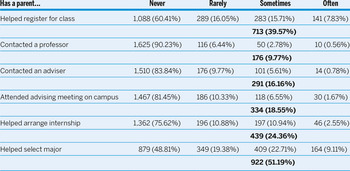
For each item, a student may respond that a parent has (1) never, (2) rarely, (3) sometimes, or (4) often provided that type of assistance to the student. As table 1 shows, the most common types of parental involvement in a college student’s life is helping the student register for classes each semester and assisting them in selecting a major. Nearly 40% of all respondents report that a parent has, at one point or another, helped them register for classes, while over 50% of students said that a parent has helped them select a major. In contrast, the least common types of parental involvement involved contacting a professor or academic adviser on a student’s behalf. Nonetheless, over 16% of students said that a parent has, at one point or another, contacted an academic adviser, while nearly 10% of respondents reported that a parent has contacted a professor.
Self-Reported Helicopter Parent Activities

If a student responds that a parent has engaged in one of the listed activities they are denoted as “1” for that item. Footnote 1 If a parent has never participated in the activity the student is assigned a value of “0.” We add each of the six indicators together to form an index, denoted as the H-Index, which ranges from 0–6, where higher values denote greater helicopter parenting of a college student. The six indicators do appear to be internally consistent, with a Cronbach’s alpha value of .740. Moreover, upon performing an exploratory factor analysis, the six items load on a single underlying dimension. Footnote 2 Among all respondents, the average index value is 1.730 with a standard deviation of 1.702. We use this index to operationalize the extent to which a college student can be said to have a helicopter parent.
We also include a second potential indicator of helicopter parenting that assesses how often a student communicates with his or her parents, a measurement strategy used in previous works (Harper, Sax, and Wolf Reference Harper, Sax and Wolf2012; Segrin et al. Reference Segrin, Woszidlo, Givertz, Bauer and Murphy2012). With the growing reliance on communication technologies, such as Facebook, Twitter, and other social media platforms, parents are more aware of and involved in students’ everyday lives. It is through continued communication that helicopter parents bridge the distance that university attendance traditionally provides. Above average communication between a student and his or her parent(s) (i.e., once a day or more) is often indicative of helicopter parenting. Thus, we also ask respondents to indicate how often they communicate, in any form, with their parents—a variable denoted as Speak. Students may respond that they speak with their parents (1) less than once a month, (2) about once a month, (3) several times each month, (4) about once a week, (5) several times each week, (6) about once a day, or (7) several times a day. Among the 1,781 respondents, the average value for Speak is about 4.470—indicating that most student respondents speak to their parent or parents about once each week; the standard deviation is 1.136. Over 22% of the sample (405 students) report that they speak with their parent(s) several times each day.
Notably, we do not have different theoretical expectations for the two indicators of helicopter parenting. Our expectation is that these two indicators are tapping the same underlying concept and should have comparable associations with students’ policy attitudes. In other words, the goal of including two separate measurement strategies is to show that the relationship between helicopter parenting and students’ policy attitudes is not sensitive to how helicopter parenting is measured.
In our sample, there are four key demographic factors that are strongly associated with helicopter parenting. Footnote 3 First, we find that it is actually conservatism that is positively correlated with helicopter parenting. Conservative students score significantly higher on the two indicators of helicopter parenting than do students that report being liberal. Similarly, those that identify as Republicans are, on average, the most highly helicoptered. Interestingly, students that claim to be independents tend to have the lowest values on both the H-Index and Speak. Third, parental income is unsurprisingly associated with helicopter parenting—families with higher incomes tend to helicopter more than those with a lower socioeconomic status. Finally, white students are the most helicoptered group, while Hispanic students are the least.
Similarly, those that identify as Republicans are, on average, the most highly helicoptered. Interestingly, students that claim to be independents tend to have the lowest values on both the H-Index and Speak.
Policy Attitudes Toward Government Intervention
In this study, we examine the potential impact of helicopter parenting on student support for government intervention. We focus on two broad policy areas: national security policy and public welfare. We ask three specific policy questions pertaining to each area. In selecting questions for each issue area, we attempted to focus on salient dimensions of each policy area (e.g., warrantless wiretaps, e-mail interception). For each question, students may respond that they support the policy, do not support the policy, or that they don’t know whether they support or oppose the policy.
National Security Policies
-
1. Should the US government be required to obtain a warrant before it can listen in on phone calls made by Americans who are suspected of being terrorists?
-
2. Should the US government be allowed to intercept Americans’ private e-mails to help protect national security?
-
3. Should the US government require all airline passengers to undergo an extensive security screening before they can board an airplane?
Public Welfare Policies
-
1. Do you believe that government should see to it that individuals can find a job and maintain a good standard of living?
-
2. Should government enact mandatory helmet laws for motorcycles and bikes?
-
3. Should government require all individuals to purchase or obtain health insurance?
Controls and Caveats
We include a total of seven control variables. Four of the controls pertain to student demographics: gender, race, parental income, and university affiliation. Two variables capture the political orientation of students: party identification and ideology. And one control variable attempts to tap into students’ personalities: propensity for anxiety. Anxiety is closely tied to the Big Five personality trait of neuroticism (Albertson and Gadarian Reference Albertson and Gadarian2015; Rammstedt and John Reference Rammstedt and John2007), which may potentially shape students’ support for government intervention and may also make parents more likely to helicopter.
The inclusion of Anxiety, a key personality trait, underscores a significant limitation of this study’s design. That is, we cannot definitively determine causality; given how new this topic is, we cannot be sure whether some omitted relevant variable, apart from those already controlled for, is shaping both political attitudes and the propensity for parents to helicopter. Rather, our design can only show strength and direction of the general association between policy attitudes and our two indicators of helicopter parenting.
RESULTS
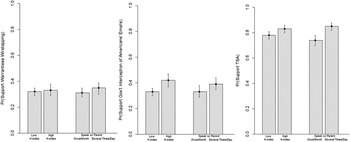
Figure 1 presents the probabilities that a student supports warrantless wiretapping, government interception of e-mails, and extensive security screening at US airports. These probabilities are calculated controlling for partisanship, ideology, anxiety, race, gender, family income, and university affiliation. To calculate these probabilities, each control variable is set to its mean value. High and low values of helicopter parenting are represented by the 90th and 10th percentile values for the H-Index and Speak. For the predicted probabilities, we graph the 95% confidence intervals for each estimate. As figure 1 shows, there appears to be an overall strong, positive relationship between students with helicopter parents and support for national security policies. Footnote 4
Support for the National Security Policies

The first panel in figure 1 shows the probability that a student supports warrantless wiretapping by the US government. Controlling for partisanship, gender, race, and family income, students low on the H-Index will support wiretapping with .32 probability; those that speak with their parents about once a month will support warrantless wiretapping with a .31 probability. In contrast, students that are high on the H-Index or that speak with their parents several times each day support wiretapping with a .33 (p = .359) and .36 (p = .145) probability, respectively. While there is a positive association between helicopter parenting and support for warrantless wiretapping, these changes in the probability of support, however, are not statistically significant at either the .05 or .10 level.
The second panel in figure 1 shows student support for government interception of Americans’ private e-mails. Here, we see a strong and significant relationship between helicopter parenting and a student’s support for a policy. When the H-Index is low, there is about a .33 probability that a student will support government e-mail interception; when the H-Index, is high, that probability increases to .42 (p = .002). Similarly, when a student speaks with his or her parents once a month (i.e., when Speak is low), there is a .33 probability of supporting the policy—a probability that increases to .39 when Speak increases to its 90th percentile value (p = .035).
The final national security policy we examine is support for extensive airport security screenings. The baseline support for this policy is much higher than for warrantless wiretapping and government interception of Americans’ e-mails. Both the H-Index and Speak significantly predict students’ attitudes toward security screenings at airports. For students that are low on the H-index, there is a .78 probability that they will be supportive of extensive security screenings. In contrast, students that are high on the H-Index will support screenings with a .83 probability (p = .051). Similarly, students that speak with their parents about once a month will be supportive with a .74 probability, while those that speak with their parents several times a day will support screenings with a probability of .85 (p < .001). In sum, across the panels of figure 1, there is sizable evidence that students with helicopter parents appear to be significantly more supportive of national security policies than students that rank low on the H-Index and Speak.
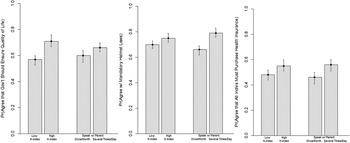
Figure 2 shows the probabilities that students will support various public welfare policies (e.g., mandatory helmet laws). The first panel examines how helicopter parenting influences the probability that a student believes that government should ensure that individuals can find a job and have a good quality of life. Both indicators of helicopter parenting are significant predictors of a student’s policy attitudes. Students that are low on the H-Index believe that government should ensure Americans’ quality of life with a probability of .57. In contrast, those that score high on the H-Index believe that government should ensure a quality of life at significantly higher rates than those that score low on the index. Those at the 90th percentile value on the H-Index have a .71 probability of agreeing that one’s quality of life should be ensured by government (p < .001). Speak has a similar influence. When Speak is at its 10th percentile value, the probability of agreeing that government should ensure a good quality of life is about .60; when Speak increases to its 90th percentile value, that probability increases to .66 (p = .053).
Support for Public Welfare Policies

The second panel in figure 2 shows students’ support for mandatory helmet laws for motorcycles and bikes. Students that score low on the H-Index or speak with their parents several times each month support helmet laws with probabilities of .70 and .66. Individuals that rank high on the H-Index or speak with their parents several times each day will support the policy with probabilities .75 (p = .046) and .79 (p < .001), respectively.
The final panel in figure 2 examines the probability of supporting the underlying tenet of the Affordable Care Act—that is, should the government require all individuals to have health insurance? Here, both the H-Index and Speak significantly predict individuals’ attitudes toward the individual mandate, even after controlling for partisanship, ideology, personality, race, gender, and income. Students that rank low on the H-Index or speak relatively infrequently with their parents (several times a month) support the individual mandate with probabilities .48 and .46, respectively. In contrast, those that score high on the H-Index and Speak believe that individuals should be required to purchase health insurance with probabilities .55 (p = .035) and .56 (p = .006). Broadly, there is substantial evidence across the three panels of figure 2 that helicopter parenting is associated with increased support for public welfare policies among college students.
Notably, these results also help to address a key concern—that the two helicopter parenting indicators are simply acting as proxies for parental ideology. As noted above, conservative ideology and identifying as Republican are positively associated with helicopter parenting. We know from past works that parental ideology and partisanship are highly transferable to one’s children (Healy and Malhotra Reference Healy and Malhotra2013; Jennings and Niemi Reference Jennings and Niemi1968; Milburn et al. Reference Milburn, Conrad, Sala and Carberry1995). Thus, there is the concern that the relationships we see between helicopter parenting and policy attitudes are simply the result of the transference of parental ideology. However, the results in figures 1 and 2 show that helicopter parenting is associated with increased student support for both liberal (i.e., public welfare) and conservative (i.e., national security) policies. College students with helicopter parents respond favorably to policies oriented toward government intervention and protection, regardless of whether the programs are considered to be traditionally liberal (e.g., government ensuring a good quality of life) or conservative (e.g., e-mail interception). Parental ideology, therefore, cannot be the sole factor driving these observed relationships.
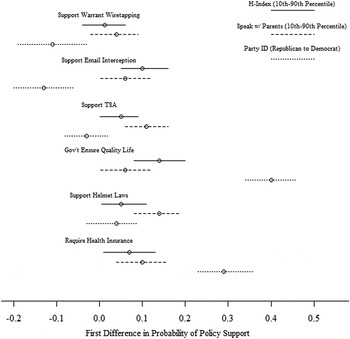
Helicopter parenting appears to exert a sizable influence over college students’ policy attitudes. However, it is important to understand the relative magnitude of these effects. Thus, we compare the effect size of helicopter parenting relative to party ID, a factor known to strongly shape political attitudes. Figure 3 presents the first differences in the probability of supporting each of the six policies as the two helicopter indicators moves from their 10th to 90th percentile values, and party ID moves from Republican to Democrat with 95% confidence intervals shown.
Comparing Effect Sizes for Helicopter Parenting and Partisanship

Importantly, figure 3 shows that helicopter parenting never exerts a significantly larger effect on policy attitudes than party ID. For all of the issues where the two parties have ideologically sorted (e.g., attitudes toward welfare, Affordable Care Act), party ID has a very large substantive effect on policy attitudes. For instance, a student that identifies as a Democrat is about .40 (p < .05) more likely to say that government should ensure a good quality of life for individuals than a student that identifies as a Republican would be. Unsurprisingly, while helicopter parenting strongly shapes students’ attitudes, the magnitude of this influence is often dwarfed by the influence of partisanship.
CONCLUSION
The effects of helicopter parenting on college-aged children continue to make themselves known. From accounts of professors to university administrators alike, helicoptered college students are changing the educational landscape. However, the long-term effects of helicopter parenting are not yet known—particularly the effects that over-parented students may have on the classroom environment. Only now are colleges beginning to see the influx of helicoptered students entering the university ranks en masse.
This study is a first attempt to understand whether there are political correlates of helicopter parenting for college-aged students. Because helicopter parenting leads to the development of an external locus of control, a student is likely to accept the interventions of others to resolve conflicts that may arise. Thus, we posit that an external locus of control should lead a student to be more accepting of government intervention in the resolution of social or political problems. We find strong evidence that helicoptered students are significantly more likely than those without helicopter parents to express support for both national security and public welfare policies.
While this study takes an important first step in identifying the connections between helicopter parenting and policy preferences in young adults, its limitations must be reiterated. Given the nature of our survey of over 1,800 college students, we cannot definitively determine causality. Despite controlling for key political, demographic, and personality factors, we can only show the relative direction and strength of the association between reported acts of helicopter parenting and students’ policy attitudes. However, we believe that future work may be able to overcome this limitation. Two potential research designs may accomplish this. First, a panel study that follows the socialization of the child to young adulthood would be invaluable. Such a design would help to address issues such as the longevity of helicopter parenting’s effects. Second, researchers should consider a survey that includes parent–child pair responses. This would allow us to inquire as to the motivation behind parental intervention in their child’s college life.
Future research should also consider the potential impact that helicopter parenting may have on democratic participation in the US and beyond. For instance, if helicopter parenting leads children to develop an external locus of control, whereby they become comfortable with frequent government interventions to resolve social problems, does this also make them more likely to blame government for troubles that might befall them? If so, there may be additional “downstream” effects of helicopter parenting such as decreased confidence in government. Scholars have documented the fall in nascent political ambition for some time and have shown that political disengagement is a democratic reality (Lawless and Fox Reference Lawless and Fox2015). If helicopter parenting leads children to develop a low sense of efficacy—to believe that they need some outside force, be it a parent or government—to resolve problems, it is also conceivable that these individuals are highly unlikely to run for public office in hopes of making a difference. It is possible that this parent–child socialization is at least partly to blame for the documented decline of political ambition among young adults. In short, helicopter parenting may have far-reaching and long-lasting effects that extend well beyond the college classroom.
SUPPLEMENTARY MATERIAL
To view supplementary material for this article, please visit https://doi.org/10.1017/S1049096516002808