Diving behaviour in air-breathing vertebrates is highly variable among groups and is dependent on many physiological constraints such as oxygen stores, the rate at which oxygen is consumed and the capacity for anaerobic metabolism (Schreer & Kovacs, Reference Schreer and Kovacs1997). The aerobic dive limit (ADL), defined as the dive duration beyond which lactate levels begin to rise above resting levels is a useful parameter for estimating oxygen-limited physiological boundaries to activity patterns of air-breathing, diving animals (Kooyman et al., Reference Kooyman, Wahrenbrock, Castellini, Davis and Sinnett1980). Because direct measurements of post-dive blood lactate levels are generally not possible, calculated ADLs (cADLs) are typically estimated from measures of total body oxygen stores and metabolic rates for the animal under study (Costa et al., Reference Costa, Gales and Goebel2001).
Leatherback turtles (Dermochelys coriacea) are known to exhibit the deepest and longest active, non-hibernating dives of any sea turtle species (Lutcavage & Lutz, Reference Lutcavage, Lutz, Lutz and Musick1997). Leatherbacks possess respiratory and cardiovascular physiological adaptations for deep, prolonged diving, including increased blood and tissue oxygen storage capacity (Lutcavage et al., Reference Lutcavage, Bushnell and Jones1992). The longest reported dive durations for leatherbacks were 67.3 min (Southwood et al., Reference Southwood, Andrews, Lutcavage, Paladino, West, George and Jones1999) and more recently 83.8 min (Fossette et al., Reference Fossette, Corbel, Gaspar, Le Maho and Georges2008). The deepest recorded dive for this species, to 1280 m, was recently reported by Doyle et al. (Reference Doyle, Houghton, Suilleabhain, Hobson, Marnell, Davenport and Hays2008). However, extremely deep and long dives are relatively rare and in general leatherback dives are shallower than 250 m and have a duration of 10–20 min (Hays et al., Reference Hays, Houghton and Myers2004; Sale et al., Reference Sale, Luschi, Mencacci, Lambardi, Hughes, Hays, Benvenuti and Papi2006).
Several authors have calculated aerobic dive limits for leatherbacks. Lutcavage et al. (Reference Lutcavage, Bushnell and Jones1992) first estimated a cADL range of 5 to 70 min based on measurements of total body oxygen stores. Later, Southwood et al. (Reference Southwood, Andrews, Lutcavage, Paladino, West, George and Jones1999) refined this estimate to 33 to 67 min using measurements of heart rates during different activities. Most recently, Wallace et al. (Reference Wallace, Williams, Paladino, Morreale, Lindstrom and Spotila2005) and Bradshaw et al. (Reference Bradshaw, McMahon and Hays2007) reported leatherback cADLs of 11.7 to 44.3 min and of 19 to 48 min based on measurements of at-sea metabolic rates and inferred metabolic rates from dive profiles, respectively.
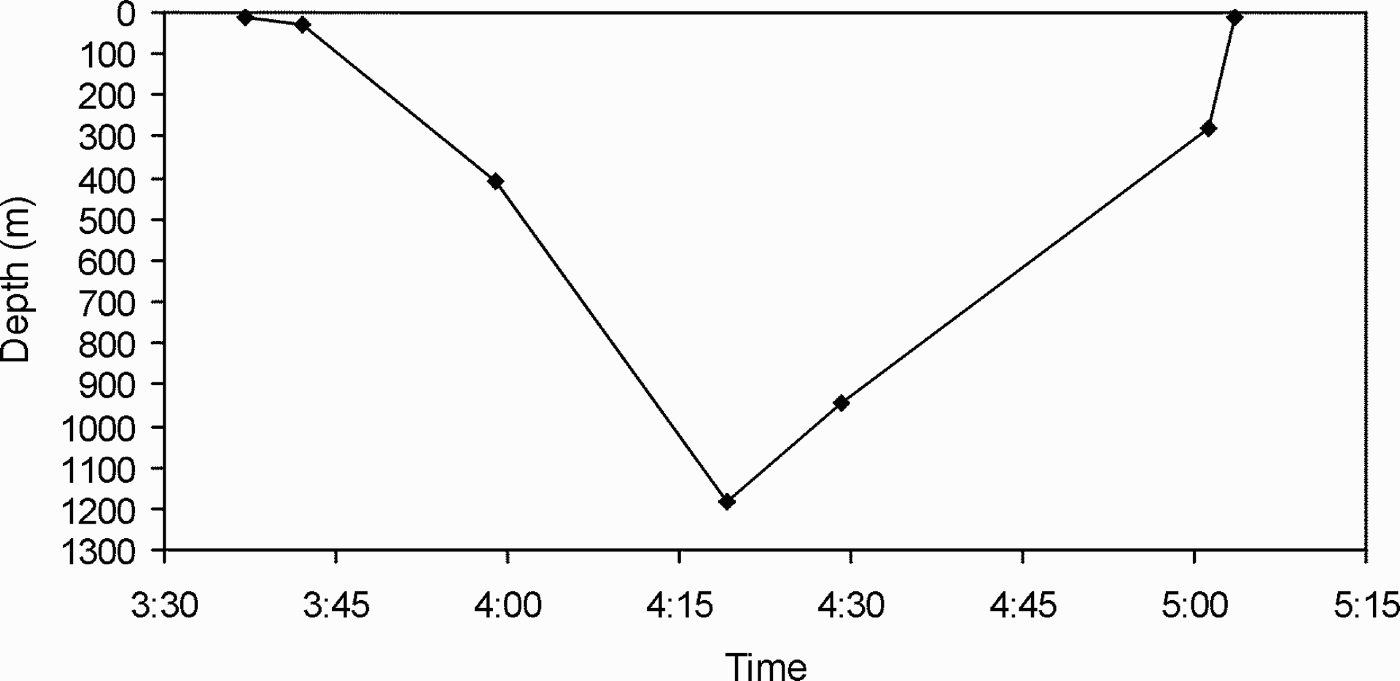
Here we report the longest dive duration ever recorded for D. coriacea, as well as one of the deepest dives for this species. The individual was a female (curved carapace length, CCL = 148.0 cm) that was incidentally captured (15 June 2005) during pelagic longline fishing operations in the south-west Atlantic Ocean off Uruguay (29.5°S 41.7°W). The turtle was equipped with a satellite relay data logger (SRDL) (Sea Mammal Research Unit, St Andrews, UK), by an on-board scientific observer (PNOFA-DINARA, Uruguay). The tag was attached to the turtle's carapace using a customized harness (Eckert et al., Reference Eckert, Chan, Liew and Eckert1996). The SRDL included a pressure sensor to measure dive depth to an accuracy of 0.33 m every 4 seconds. Individual dives were recorded when the depth exceeded 10 m, and dive profiles were examined to determine the time and depth of the five most significant inflection points during each recorded dive (Figure 1).
Shows the complete dive profile recorded for the individual, including the time and depth attained during the dive.

The turtle moved continuously toward low latitudes (~6°S) and after five months returned back to high latitudes. The dive took place along the southern coast of South America on 6 March 2006 (264 days after tagged), in international waters (29.2°S 40.7°W) where bottom depths were roughly 3700 m. The turtle started the dive at 0337 h, and attained the maximum depth (1186 m) 42 min later. During ascent, the turtle crossed the 10 m dive threshold at 0503, indicating that the dive lasted at least 86 min and 5 s (Figure 1). The shape of the dive does not indicate that the turtle occupied any certain depth for an extended period. Rather, the dive profile showed continuous descent followed by continuous ascent; thus, the turtle appeared to be active throughout the dive.
This dive duration exceeded previously published cADLs for leatherbacks by almost two-fold. Diving animals are thought to commonly exceed their cADLs to maximize energy gain while in a high quality foraging area (Thompson & Fedak, Reference Thompson and Fedak2001). James et al. (Reference James, Ottensmeyer, Eckert and Myers2006) suggested that during migration leatherbacks perform very deep dives to ascertain the depth of vertically migrating prey and to assess whether to attempt foraging at that time, and that diurnal dives were deeper and longer than nocturnal dives. However, in part because this dive occurred prior to dawn, it is unclear whether it represented a foraging bout. In addition, cADLs are often calculated using metabolic rates that do not take into account effects of hypometabolism on dive durations (Butler, Reference Butler2004). Indeed, Southwood et al. (Reference Southwood, Andrews, Lutcavage, Paladino, West, George and Jones1999) reported typical dive response patterns in leatherback heart rates during prolonged dives, where heart rates slowed during descent and at maximum depths, and increased during ascent and during surfacing events. This pattern suggests that leatherback turtles tend to adjust heart rate (and presumably also other physiological functions) to optimize oxygen consumption and maintain aerobic metabolism during dives (Wallace & Jones, Reference Wallace and Jones2008). In addition, other cardiovascular adjustments, such as changes in blood flow (i.e. oxygen transport and delivery), which can be reflected by changes in heart rate (Butler & Jones, Reference Butler and Jones1997), might provide an explanation for this exceptionally long dive.
Despite the lack of certainty about its exact purpose, this record-setting dive duration extends our knowledge of the diving capacity of free-swimming leatherback turtles, and raises interesting questions about the functions of these extreme diving events in this species.
ACKNOWLEDGEMENTS
We would like to thank the on-board scientific observers from PNOFA-DINARA, Uruguay. Funding was provided by the Convention of Migratory Species and the WWF as part of the Trans-Atlantic Leatherback Conservation Initiative. The Coordenação de Aperfeiçoamento de Pessoal de Nivel Superior (CAPES) provided a grant to M.L.M. and the Conselho Nacional de Desenvolvimento Científico e Tecnológico (CNPq) provided research grants to C.F.D.R. (Nos. 307653/2003-0 and 477715/2006-0).