Introduction
Multiple longitudinal studies have established that a minority of those exposed to trauma have initially low or moderate levels of post-traumatic symptoms that subsequently become worse over time (Bonanno et al. Reference Bonanno, Rennicke and Dekel2005, Reference Bonanno, Ho, Chan, Kwong, Cheung, Wong and Wong2008). This pattern is recognized in the Diagnostic and Statistical Manual of Mental Disorders, fourth edition (DSM-IV) by the delayed-onset form of post-traumatic stress disorder (PTSD), which is defined as occurring more than 6 months after a traumatic event. Delayed-onset PTSD is a significant problem in military populations (Solomon & Mikulincer, Reference Solomon and Mikulincer2006), accounting for nearly 40% of cases of PTSD (Andrews et al. Reference Andrews, Brewin, Philpott and Stewart2007). Although delayed-onset PTSD will sometimes occur during military service, the majority of cases are likely to occur post-discharge. Despite this, few studies have investigated whether servicemen who only develop delayed-onset PTSD after discharge show early signs of the disorder in terms of their reactions to traumatic events or by exhibiting other signs of disturbance while still in service.
In our previous study (Andrews et al. Reference Andrews, Brewin, Stewart, Philpott and Hejdenberg2009) we conducted retrospective clinical interviews with UK veterans receiving a war pension and compared cases of delayed- and immediate-onset PTSD with other trauma-exposed individuals receiving their pension for physical disabilities rather than PTSD. In this article we compare the same no-PTSD control group with cases who developed PTSD post-discharge. This is a distinction which overlaps partly, but not wholly, with the immediate- versus delayed-onset distinction. We report an investigation, using the medical and personnel records of this sample as well as our retrospective data, of early signs of disturbance identifiable while individuals who developed delayed-onset PTSD post-discharge were still in service.
Delayed-onset PTSD is a condition which rarely comes ‘out of the blue’, some symptoms usually being acquired immediately post-trauma even though the individual takes 6 months or more to reach full diagnostic criteria (Andrews et al. Reference Andrews, Brewin, Philpott and Stewart2007). Previous research on veterans has found that it is an insidious condition in which symptoms are steadily acquired over a military career, with onset of the full syndrome frequently following an event that is stressful but unrelated to the original military trauma (Andrews et al. Reference Andrews, Brewin, Stewart, Philpott and Hejdenberg2009). These findings suggest that it may be possible to identify early signs of the subsequent disorder. When delayed onsets occur post-discharge, arranging for treatment provision may be difficult, particularly in countries where there is no dedicated medical provision for veterans. A knowledge of early signs present while still in service would be valuable in alerting medical officers to those servicemen with an increased risk of developing PTSD after their discharge.
There is a variety of risk factors for PTSD (Brewin et al. Reference Brewin, Andrews and Valentine2000). Among the early signs that could be identified by medical and commanding officers are psychological and behavioural problems that occurred either prior to or after trauma exposure in service. Epidemiological and twin studies have suggested that pre-trauma vulnerability factors for PTSD involve both internalizing psychopathology such as anxiety and depression and externalizing psychopathology such as substance abuse, aggression and conduct disorder (Koenen et al. Reference Koenen, Fu, Lyons, Toomey, Goldberg, Eisen, True and Tsuang2005; Resick & Miller, Reference Resick and Miller2009). For example, unique among the anxiety disorders, adults with PTSD at age 32 years are significantly more likely to have had a juvenile history of conduct disorder or oppositional defiant disorder (Gregory et al. Reference Gregory, Caspi, Moffitt, Koenen, Eley and Poulton2007). Consistent with this, research with civilian and veteran samples has found that PTSD is associated both with internalizing and externalizing subtypes of co-morbidity (King et al. Reference King, King, Foy and Gudanowski1996; Miller et al. Reference Miller, Kaloupek, Dillon and Keane2004, Reference Miller, Fogler, Wolf, Kaloupek and Keane2008; Miller & Resick, Reference Miller and Resick2007; Forbes et al. Reference Forbes, Elhai, Miller and Creamer2010).
A limitation of almost all these studies, whether or not they find an association between PTSD and externalizing co-morbidity, is their reliance on self-report data or clinician interviews without independent corroboration. This leaves open the possibility that participants' response biases or recall biases (Koenen et al. Reference Koenen, Fu, Lyons, Toomey, Goldberg, Eisen, True and Tsuang2005) may be contributing to the pattern of findings, something that cannot be unequivocally ruled out without evidence for the existence of externalizing problems from an independent source. One way of allaying these concerns is to investigate whether servicemen who only suffer from PTSD after discharge from the armed forces show early signs in the form of an excess history of disciplinary offences recorded while they are still serving in the military.
The current study drew on data from our retrospective study of veterans (Andrews et al. Reference Andrews, Brewin, Stewart, Philpott and Hejdenberg2009). Although retrospective studies have limitations, they also have the advantage that, providing they allow a considerable time to elapse post-discharge, they can maximize the representativeness of delayed-onset cases. The fact that these cases accrue relatively slowly over an extended period of time means that longitudinal studies would have to be exceptionally large, long-lasting and expensive to achieve the same result. Longitudinal studies of short duration would run the risk of misclassifying a proportion of servicemen who would only later develop the disorder. Perhaps for this reason there has been very little systematic research on delayed-onset PTSD and our sample of delayed-onset cases is the largest so far studied (Andrews et al. Reference Andrews, Brewin, Philpott and Stewart2007).
We set out to investigate objective predictors of post-discharge PTSD recorded within contemporaneous medical records while the veteran was still serving (being medically downgraded because of mental health problems, coming into contact with medical services for mental health problems, receiving treatment for mental health problems, heavy drinking noted) and personnel records (history of disciplinary offences). We investigated the association between disciplinary offences and trauma exposure, and considered separately the subset of disciplinary offences that occurred prior to any self-reported traumatic event in service, which could more plausibly be argued to be pre-trauma vulnerability factors. Our primary hypothesis was that individuals with post-discharge delayed-onset PTSD, compared with service personnel with no PTSD, would show early signs of the condition while still in service in terms of increased internalizing and externalizing problems. Data from service personnel who developed PTSD in service are included for comparison purposes.
Method
Participants
As described in more detail in our previous article (Andrews et al. Reference Andrews, Brewin, Stewart, Philpott and Hejdenberg2009), veterans were predominantly recruited from the UK Service Personnel and Veterans Agency (SPVA) whose medical staff identified and sent invitation letters for research participation to groups of veterans receiving pensions for PTSD or for physical disabilities only. The explicit focus of the study was on veterans' general wellbeing. Of the veterans at confirmed addresses, 51% agreed to interview, a response rate typical of military surveys (Fear et al. Reference Fear, Jones, Murphy, Hull, Iversen, Coker, Machell, Sundin, Woodhead, Jones, Greenberg, Landau, Dandeker, Rona, Hotopf and Wessely2010). Eligibility for the study and group assignments were based on the results of the research interviews. Inclusion criteria were being in receipt of a war pension, age less than 60 years, having experienced a traumatic event during military service, and having suffered either from PTSD or a physical disability as a result of military service. Exclusion criteria were the presence of ongoing PTSD from before military service, other very severe psychiatric disorder such as psychotic conditions, inability to remember key symptom, trauma and date information, and unwillingness to disclose such information.
Of the original sample of 142 studied by Andrews et al. (Reference Andrews, Brewin, Stewart, Philpott and Hejdenberg2009), 13 did not give written consent for their official service records to be checked and no records could be traced for a further three servicemen, leaving an available sample of 126 out of the original 142. The current report is based on the subset of 43 veterans diagnosed on the basis of our research interview with PTSD that developed post-discharge (all of whom met DSM-IV criteria for delayed onset) and 35 controls receiving war pensions for physical disorders who did not report PTSD at any time. Data from 48 personnel who developed PTSD while still in service (34 meeting DSM-IV criteria for immediate onset and 14 for delayed onset) are included for comparison. The research was approved by Research Ethics Committees at Royal Holloway and University College London. After complete description of the study to the subjects, written informed consent was obtained.
Diagnoses
Lifetime diagnoses of PTSD were obtained using the Structured Clinical Interview for DSM-IV (SCID-IV; Spitzer et al. Reference Spitzer, Gibbon and Williams1996). As in previous studies of military samples, PTSD criterion A2 (reporting fear, helplessness, or horror at the time of the event) was not required (for more detailed justification, see Andrews et al. Reference Andrews, Brewin, Stewart, Philpott and Hejdenberg2009). Immediate-onset PTSD was rated when respondents reported meeting full PTSD criteria at any time up to 6 months after a traumatic event occurring during their military service, and delayed-onset PTSD was rated when full criteria were only met 6 months or more after a traumatic event. Given that military service often involved exposure to multiple traumas, reliable rating of immediate versus delayed onsets required establishing dates of specific traumatic events identified by each veteran and linking them with re-experiencing symptoms. Onset and offset dates for each PTSD symptom individually were also recorded, including symptoms that began either before military service or during military service but before a traumatic event. These procedures allowed us to specify reasonably accurately when full criteria were met and in relation to which traumatic event.
Interviewers were trained to use the SCID and then given additional practice with veterans. Their assessments were checked for adherence to the protocol, and diagnostic issues discussed at regular meetings throughout the project. All interviews were audiotaped and transcribed verbatim, and expert diagnostic assessors (B.A. and C.R.B.) independently extracted all relevant information to generate consensus ratings. Inter-rater reliability was calculated on a subset of 27 interviews from the full 2009 sample and found to be acceptable: classification as immediate versus delayed onset versus no PTSD (96% agreement, κ=0.94). Complete details of diagnostic procedures are contained in our earlier report (Andrews et al. Reference Andrews, Brewin, Stewart, Philpott and Hejdenberg2009).
Trauma exposure
War-zone stress was assessed with the combat experience and non-combat experience sections of the Deployment Risk and Resilience Inventory (King et al. Reference King, King and Vogt2003). Responses (0=‘no’, 1=‘yes’) were summed in the 15-item sections to give overall exposure scores.
Medical and personnel records
Targeted files were ordered on behalf of the research team by SPVA staff and inspected in the presence of SPVA staff by a member of the research team. An anonymized form with predetermined headings for particular occurrences and dates of occurrence was used to collate the information systematically for all veterans in the sample. Files were coded blind to the information recorded in previous interviews conducted by the research team.
In-service medical care
Information was recorded about any contact with medical services for psychological problems while the veteran was serving. This was obtained from letters and medical board documents in the medical files. Details obtained included: any diagnoses by medical staff of PTSD or depression, alcohol abuse/heavy drinking noted, whether the veteran had been downgraded because of mental health problems, whether the veteran had had any contact for mental health problems, and whether or not they had received any treatment for mental health problems.
Disciplinary records
Regimental and company conduct sheets and other service records from veterans' personnel files were examined for disciplinary offences. Offences included going absent without leave, drunkenness, violence, disobedience (including failure to attend duty), and negligence. One personnel file could not be traced and five were incomplete, reducing the number available for analysis by six.
Analytic strategy
The three groups were compared using χ2 tests for nominal variables and analysis of variance (ANOVA) for continuous variables. Follow-up contrasts to significant F tests corrected for unequal variances were carried out where appropriate, and analyses were repeated with non-parametric tests when data were skewed. Additional analyses on the personnel record data investigated the effects of removing the subset of delayed-onset cases from the onset in service group.
Results
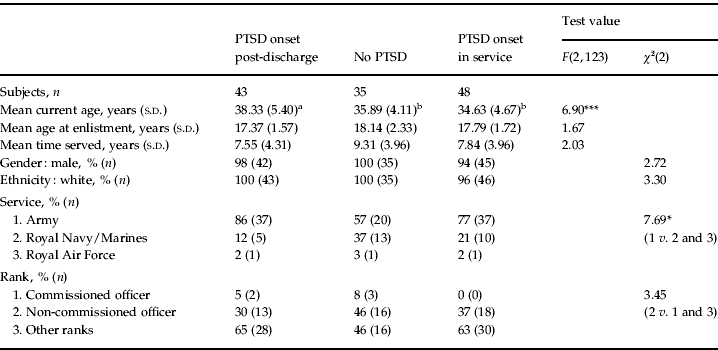
As shown in Table 1, the sample was predominantly male and of white ethnicity. Groups did not differ on age at enlistment or number of years served, but age at interview was about 2.5–3.5 years older for the post-discharge-onset group than for the other groups (p<0.05). The groups did not differ in rank at discharge. The post-discharge-onset group were more likely than the other groups to have served in the Army rather than the Royal Navy or Royal Air Force (p<0.05). Onsets in this group occurred on average 35.63 months post-discharge (median 12 months, s.d.=56.12 months, range 0–294 months). We additionally compared the number of PTSD symptoms reported at interview by the onset in service and onset post-discharge groups, but these did not differ significantly [t(88)=1.38, p>0.05].
Demographic and service details for PTSD and no-PTSD groups

PTSD, Post-traumatic stress disorder; s.d., standard deviation.
a,b Mean values within a row with unlike superscript letters were significantly different (p<0.05).
* p<0.05, *** p<0.001.
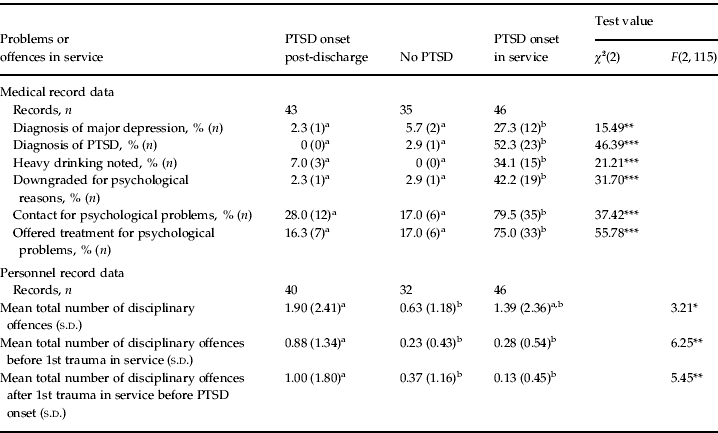
Data extracted from the medical records and shown in Table 2 indicate that while in service the post-discharge-onset group was no more likely than the controls to have been diagnosed with PTSD or depression, to have had drinking problems noted, to have been medically downgraded for mental health reasons, to have been in contact with psychiatric services, or to have been offered psychological or psychiatric treatment. In contrast, the group with PTSD in service was significantly elevated on all these variables. Data were not numerous enough to compare statistically those with immediate and delayed onsets in service, but proportions were generally similar numerically: diagnosis of major depression (23% v. 42%); diagnosis of PTSD (47% v. 67%); heavy drinking noted (34% v. 33%); medically downgraded (44% v. 38%); contact for emotional problems (81% v. 75%); treatment for emotional problems (72% v. 75%).
Recorded psychological problems and disciplinary offences in service among veterans with and without PTSD in service

The numbers of medical and personnel records vary slightly owing to missing records.
PTSD, Post-traumatic stress disorder; s.d., standard deviation.
a,b Values within a row with unlike superscript letters were significantly different (p<0.05).
* p<0.05, ** p<0.01, *** p<0.001.
Disciplinary problems in service were next considered as a possible early behavioural sign of later post-discharge PTSD. In Table 2, the overall ANOVA comparing all three groups shows that those with post-discharge-onset PTSD had significantly more disciplinary entries overall than those with no PTSD (Cohen's d=0.68). The group with onsets in service had an intermediate number of entries and were not significantly different from either of these groups. Those with immediate onsets in service had similar numbers of offences (mean=1.38) to those with delayed onsets in service (mean=1.42). Removing the subsample with delayed onsets from the onset in service group did not affect the results.
A series of follow-up contrasts then compared those with post-discharge onsets and those with no PTSD on a number of individual disciplinary offences, correcting for unequal variances where appropriate. Those with post-discharge onsets had significantly more offences of absence without leave [t(54.62)=2.62, p<0.02], disobedience [t(67.59)=2.04, p<0.05] and dishonesty [t(39.00)=2.62, p<0.02]. In contrast, the two groups did not differ on offences involving negligence, violence or drunkenness. As the data were skewed, group comparisons were re-run using non-parametric Mann–Whitney tests. The pattern of significant differences remained, with the exception that the post-discharge-onset group no longer reported an excess of offences involving disobedience relative to the no PTSD group.
We next investigated whether total number of disciplinary offences was related to trauma exposure. Although disciplinary offences were not associated with combat or non-combat trauma in the control group [largest r(35)=0.21, n.s.], in the combined PTSD groups more disciplinary offences were related to greater reports of combat trauma [r(86)=0.31, p<0.01], as well as non-combat trauma [r(86)=0.30, p<0.01]. In order to distinguish vulnerability factors from reactions to trauma exposure, we therefore considered separately the subset of offences that was recorded as occurring before the first service trauma identified by each veteran. As shown in Table 2, those with post-discharge-onset PTSD had significantly more disciplinary entries during this period than either of the other groups (Cohen's d=0.67). Those with immediate onsets in service had similar numbers of offences (mean=0.29) to those with delayed onsets in service (mean=0.25). Removing the subsample with delayed onsets from the onset in service group did not affect the results.
We also examined group differences in number of offences reported after the first trauma in service. In order to exclude the possibility that offences were secondary to PTSD in the group who developed it while in service, we restricted the analysis to the period before PTSD onset. Once again there was a significant excess of offences in the post-discharge-onset group relative to both other groups (Cohen's d=0.41). Those with immediate onsets in service had similar numbers of offences (mean=0.09) to those with delayed onsets in service (mean=0.25). Removing the subsample with delayed onsets from the onset in service group did not affect the results. The pattern of significant differences also remained when the groups were compared using Mann–Whitney tests.
Discussion
The main findings were that the occurrence of delayed-onset PTSD post-discharge could be objectively predicted by a record of disciplinary offences in service but not by the content of the medical records. A potential threat to the validity of the study arises from the fact that veterans' retrospective reports of the date each symptom had begun were used to determine that PTSD did indeed onset post-discharge and not before. As symptom onsets may qualify as personally significant and consequential events, it is reasonable to expect that recall would be relatively good (Holland & Kensinger, Reference Holland and Kensinger2010). Poor recall would introduce noise and reduce the likelihood of obtaining the kind of significant associations reported in this study. In addition, a potential source of systematic bias that needs to be considered is the level of symptoms at interview (Koenen et al. Reference Koenen, Fu, Ertel, Lyons, Eisen, True, Goldberg and Tsuang2008). The fact that the onset post-discharge group differed in a number of ways from the onset in service group, despite having similar levels of symptoms at interview, indicates that this cannot explain our findings.
Further validating these symptom reports, as well as the retrospective diagnoses made by the research team, the medical records of the onset post-discharge group indicated modest levels of contact with psychological or psychiatric services, either for internalizing or externalizing problems. These levels of contact did not differ from veterans who did not go on to develop PTSD, and were very substantially less than those of veterans who reported PTSD developing while still in service. There were no other indications in the post-discharge-onset group of excessive internalizing symptoms such as depression or externalizing symptoms such as alcohol abuse at this time. Previous research on veterans has found that delayed-onset PTSD differs from immediate-onset PTSD in the presence of a small excess of self-reported early hyperarousal symptoms (Andrews et al. Reference Andrews, Brewin, Stewart, Philpott and Hejdenberg2009). The results of this study suggest that any such excess of symptoms experienced in service by the post-discharge-onset group is not severe enough to provoke a referral or otherwise bring them to the attention of medical services.
Our finding that post-discharge-onset PTSD is associated with externalizing problems in the form of independently recorded disciplinary offences is a particularly striking one. Although there also appears to be evidence for an association between externalizing problems and greater trauma exposure, this would not explain the selective association with post-discharge rather than in-service onset of PTSD. We were further able to confirm a similar pattern when we considered only the subset of offences that occurred prior to traumatic events identified by veterans, suggesting that the results are more likely to reflect a pre-existing vulnerability factor rather than a response to trauma. To our knowledge this is the first evidence for an association of PTSD with externalizing factors that does not rely at least partially on self-report data, and hence provides strong support for this hypothesis.
Although we were not able in this study to report separately on the association between disciplinary offences and other post-discharge psychopathology, owing to the high levels of co-morbidity typically found in combat veterans, it is notable that so far PTSD appears to be unique among anxiety disorders and depression in loading on both internalizing and externalizing factors (Fu et al. Reference Fu, Koenen, Miller, Heath, Bucholz, Lyons, Eisen, True, Goldberg and Tsuang2007). It remains to be determined whether the best way of conceptualizing our findings is in terms of problem behaviours such as disciplinary offences or in terms of related constructs such as temperament. Previous research (Miller et al. Reference Miller, Kaloupek, Dillon and Keane2004; Miller & Resick, Reference Miller and Resick2007) has described the externalizing type of post-trauma psychopathology in terms of personality profiles defined by low constraint (i.e. impulsivity) coupled with high negative emotionality and aggression. In contrast, the internalizing type was defined by personality profiles characterized by high negative emotionality with low positive emotionality. The externalizing type was found to be more common in combat veterans than in female sexual assault survivors.
More detailed analyses showed that although the excess of disciplinary offences did not involve violence or drunkenness, a range of offences was involved including going absent without leave, and dishonesty. The fact that there was an excess of dishonesty raises the possibility previously warned about by others (Atkinson et al. Reference Atkinson, Henderson, Sparr and Deale1982) that, given the secondary gains involved in war pensions and associated benefits, some claims of delayed onset post-discharge may involve malingering. Although this cannot be conclusively ruled out, it is worth noting that our sample had all been independently assessed and their claims verified by the SPVA, and all had allowed us to inspect their records. It is also worth noting that various types of conduct disorder and behaviour problems have also been found to be risk factors for PTSD in civilian samples where the issue of financial benefit is absent or reduced (Widom, Reference Widom1999; Gregory et al. Reference Gregory, Caspi, Moffitt, Koenen, Eley and Poulton2007; Miller & Resick, Reference Miller and Resick2007). Relatedly, anxiety and antisocial behaviours tend to be intercorrelated in children and adults (Koenen et al. Reference Koenen, Fu, Lyons, Toomey, Goldberg, Eisen, True and Tsuang2005). Results of modelling retrospective data from Vietnam veterans (King et al. Reference King, King, Foy and Gudanowski1996) suggest that family instability, including exposure to violence in the home, is a precursor of antisocial behaviour which in turn increases the risk of subsequent PTSD. Nevertheless, given the finding of increased pre-morbid dishonesty and related conduct problems, it will be important to clarify whether there is an increased rate of malingering in delayed-onset PTSD that occurs post-discharge.
Our findings concerning externalizing factors pertain specifically to the delayed-onset form of the disorder occurring post-discharge. Although other personnel with PTSD in service had on average over twice the number of total offences than the control group, this was not a significant difference. Total numbers of offences could in any case be affected by the development of PTSD itself, so more informative are the analyses on offences before the first trauma, or before PTSD onset. These showed more clearly that the effect was specific to the post-discharge, delayed-onset group. One possibility is that the way this group copes with stressors is managed adequately within the armed services, but creates particular difficulties in civilian life. This incompatibility then generates further stress, which leads to PTSD onset. Thus, given that much of the existing research is on veteran samples in whom delayed onsets are common, future research may need to study personal and family history of externalizing and internalizing disorders separately, not only in delayed- versus immediate-onset PTSD, but also in PTSD that develops in service versus post-discharge. Largely distinct genetic risk factors for the latent internalizing and externalizing co-morbidity dimensions have been reported (Wolf et al. Reference Wolf, Miller, Krueger, Lyons, Tsuang and Koenen2010), raising the possibility that the various forms of early- and late-developing PTSD are different conditions with different genetic risk factors and different natural histories and should not be included together as is commonly done at present.
Among the limitations of the study was the use of war pensioners. Although sampling this group was the only practical way of acquiring a large number of delayed-onset cases within a short time-frame, it is unclear to what extent our results will generalize to more representative samples of veterans. The sample size, although large compared with previous investigations of delayed-onset PTSD, was also modest in absolute terms. This reflects the difficulty in acquiring these samples and the consequent extreme shortage of empirical evidence on delayed onsets. In this investigation the strategy of acquiring very detailed data on the timing of traumas and symptoms was preferred to that of obtaining more limited data from a larger sample (Andrews et al. Reference Andrews, Brewin, Stewart, Philpott and Hejdenberg2009). The response rate of 51% was typical of military surveys, but the use of objective records and the fact that delayed-onset PTSD was not mentioned as a focus of the study makes it highly unlikely that the sample was affected by systematic biases. The sample size also restricted our power to investigate some of the less common disciplinary offences and to establish conclusively whether or not there was an excess of these. The lack of measures of exposure to trauma in childhood and adolescence is also to be regretted, as this may have thrown light on the different patterns of responses observed. Finally, the accuracy of medical and personnel records generally is open to question, although it should be noted that substantial levels of inaccuracy would introduce noise into the data and make it less likely that regularities of the kind described in this investigation would be found. It is also possible that disciplinary records were more complete than medical records, which may have had a negative impact on our ability to detect predictors in the medical records.
With a few exceptions (Pitman et al. Reference Pitman, Orr, Lowenhagen, Macklin and Altman1991), service records remain an under-utilized resource in studies that predict the development of disorders in military samples. Although a proportion of delayed onsets in military samples occur while the individual is still in the armed forces, the majority occur post-discharge. The current findings suggest that there appear to be early signs visible while in service, in the form of disciplinary problems, that an individual is at risk of developing PTSD post-discharge. These early signs may already be visible prior to any trauma exposure, suggesting that they are at least in part pre-existing vulnerability factors. The findings need to be validated in future longitudinal studies, but imply that discharge interviews conducted by medical officers should consider routinely reviewing the conduct records of servicemen as well as their medical records in order to assess the risk of later psychological problems. Moreover, resources devoted to the subsequent monitoring and follow-up of discharged veterans could be focused more specifically on those with a history of conduct problems while in service.
Acknowledgements
The research was funded by the UK Ministry of Defence (contracts CBC/MED/0981 and CTLBC/954). We are indebted to Dr Anne Braidwood and Mrs Julie Almond at the UK Service Personnel and Veterans' Agency for the exceptional levels of advice, assistance and support provided throughout the project.
Declaration of Interest
None.