According to the firm-level dynamic capabilities (DCs) framework, DCs can integrate, build, and reconfigure competences to address changes in the business environment (Teece, Pisano, & Shuen, Reference Teece, Pisano and Shuen1997). However, how DCs enable organizations to adapt and succeed remains pending (Barreto, Reference Barreto2010; Eriksson, Reference Eriksson2014; Hodgkinson & Healey, Reference Hodgkinson and Healey2011; Kurtmollaiev, Reference Kurtmollaiev2020; Teece, Reference Teece2014, Reference Teece2018; Wang & Ahmed, Reference Wang and Ahmed2007). The answer to this question is key to understanding the basis of competition (Levinthal & Rerup, Reference Levinthal and Rerup2006). As Teece (Reference Teece2007, p. 1344) argues, if an enterprise has resources/competences but lacks DCs, ‘it cannot sustain supra-competitive returns for the long term except due to chance.’ If we do not understand how DCs can shape an organization to become more resilient, we cannot identify the mechanisms that allow survival and growth in volatile, uncertain, complex, and ambiguous environments (Arndt, Reference Arndt2019; Barreto, Reference Barreto2010). Here we argue that what is needed is a theory of dynamic capabilities to explain how DCs allow entrepreneurially led organizations to solve problems, and ultimately prosper.
The need for a theory of DCs emerges from the recognition that earlier works ‘merely sketched an outline for a dynamic capabilities approach’ (Teece, Pisano, & Shuen, Reference Teece, Pisano and Shuen1997, p. 530; see also Teece, Reference Teece2007, Reference Teece2014, Reference Teece2018). In practice, conceptualizations and results around DC took the form of a framework and not of a theory. From that, there is a lack in understanding how the elements of the DC framework enable organizations to adapt to changes and succeed by relating to one anotherFootnote 1. For example, despite the entrepreneurs' or managers' perception about a firm's history matters as a microfoundation of their ability to sense opportunities (Suddaby, Coraiola, Harvey, & Foster, Reference Suddaby, Coraiola, Harvey and Foster2020), it is not investigated how perception is linked with routines – another microfoundation of DCs (Zollo & Winter, Reference Zollo and Winter1999).
To fill the above gap, in line with the recent evolutionary and ecological conceptualization of DCs (Arndt & Bach, Reference Arndt and Bach2015; Arndt & Pierce, Reference Arndt and Pierce2018; Björklund, Maula, Soule, & Maula, Reference Björklund, Maula, Soule and Maula2020; Galvin, Rice, & Liao, Reference Galvin, Rice and Liao2014; Reference Galvin, Rice and Liao2015), we adopt an evolutionary lens, including elements from the co-evolutionary stream (that sees the firm‒environment relationship as dialectical rather than deterministic), for building a theory of DCs able to investigate the formation of the DCs at the micro-level analysis, thus microfoundations. In doing that, this article answers the call of this special issue on DCs for the Journal of Management & Organization to ‘unpack the processes by which DCs are created, expressed and transformed within organizations.’
To unpack these processes, adaptation is here seen as the ‘evolutionary change in which the organism creates a constantly better solution to the problem it faces, whose result is finally that of being adapted’ (Lewontin, Reference Lewontin1989, p. 157). In practice, the adaptation process is the way organizational agents seek to make a change (Levinthal, Reference Levinthal1991). That is, it is akin to the way organisms in the natural world strive to redefine or design the external conditions in which they exist, based on their capabilities. In essence, this idea of co-evolution – from which some elements are considered for the proposed conceptualization – assigns a proactive role to organizations in designing their path, determining ‘the speed at, and the degree to which, the firm's particular resources can be aligned and realigned to match the requirements and opportunities of the business environment to generate sustained abnormal (positive) returns’ (Teece, Reference Teece2012, p. 1395; see also Augier & Teece, Reference Augier and Teece2006; Teece, Reference Teece2014; Teece, Pisano, & Shuen, Reference Teece, Pisano and Shuen1997; Zahra, Sapienza, & Davidsson, Reference Zahra, Sapienza and Davidsson2006). This is in contrast to the theoretical perspective of generalized Darwinism.
Stemming from the above, this paper advances the theorization of DCs, considering strategic behavior formation both at the individual and collective levels. It explicates how ordinary and low-order capabilities and their substantiating elements (meaning, knowledge, and habits/routines) co-evolve, and explores the shift from these initial capabilities to intentional actions by organizational agents (Zollo & Winter, Reference Zollo and Winter2002; Zollo, Bettinazzi, Neumann, & Snoeren, Reference Zollo, Bettinazzi, Neumann and Snoeren2016). Thus, our theory exploits the microfoundations of DCs. By considering, within the proposed theory, evolutionary mechanisms (e.g., replicators and interactors) that were not included in prior evolutionary studies of DCs (Zollo et al., Reference Zollo, Bettinazzi, Neumann and Snoeren2016; Zollo & Winter, Reference Zollo and Winter2002), this article responds to the critique of some scholars (Abatecola, Breslin, & Kask, Reference Abatecola, Breslin and Kask2020) underlining a lack of clarity in what is varied, selected, and retained in the evolution of DCs (Teece, Pisano, & Shuen, Reference Teece, Pisano, Shuen, Dosi, Nelson and Winter2000). Thanks to that, this work explicitly positions DCs as an evolutionary theory – as asked by Galvin, Rice, and Liao (Reference Galvin, Rice and Liao2014). However, the proposed theory does account for the complexity of multi-level co-evolutionary relations within and beyond organizations; this is the main limitation of our theory. Despite that, provided conceptualization helps interpret DCs as tools used to entrepreneurially achieve the evolutionary fitness of organizations. That is, a means to adapt to changes and ultimately succeed.
Theoretical issues
DCs: definition and theoretical developments
How do firms achieve and sustain competitive advantage? This is the question addressed by Teece, Pisano, and Shuen (Reference Teece, Pisano and Shuen1997) in the late 1990s. Using the Schumpeterian innovation-based conception of competition, Teece, Pisano, and Shuen (Reference Teece, Pisano and Shuen1997) highlighted DCs as drivers of wealth creation and capture.
Teece, Pisano, and Shuen (Reference Teece, Pisano and Shuen1997, p. 516) identified the critical elements of DCs as resources, routines, ordinary capabilities, and low-order capabilities. Resources are ‘firm-specific assets that are difficult if not impossible to imitate’ (e.g., trade secrets). Routines are the clusters of firm-specific assets that trigger activities by people and groups that arise from complex interactions among learning, organizational resources, and organizational histories (e.g., exposing a business unit's results in the weekly meeting). Ordinary capabilities (e.g., production process) are the ‘competences that define a firm's fundamental business’ (usually connected with administration, operation, and governance processes). Low-order capabilities allow the organization to grow somewhat routinely (e.g., development of new products) and can be assisted by simple rules to provide guidance but with enough flexibility to respond to emergencies. In some parts of this theorization, we'll use the term operating capabilities to underline both ordinary and low-order ones.
Resources, routines, and capabilities can be continuously created, extended, upgraded, protected, and kept relevant only through the action of difficult-to-imitate DCs, such as market sensing and sensemaking, and associated new product development. Organizational resources and competences are, therefore, ‘hierarchical’ (Wang and Ahmed, Reference Wang and Ahmed2007) and DCs are a meta-competence, transcending operational competence and enabling organizations to develop and produce differentiated products and services that address new and existing markets while meeting (long run) profitability tests (Teece, Reference Teece2007, Reference Teece2014); or, at least, to resiliently survive change. An example is the Italian airline, Alitalia, which has used the DC ‘building alliances’ with other industry players to overcome several financial crises. Thanks to this DC, Alitalia was able to catch the financial resources missing in critical periods of its life cycle or benefit from the resources of other players or develop new capabilities to exploit new business opportunities. This is the case of: (a) the SkyTeam alliance of flight operators joined in 2001, which helped Alitalia in replacing their Boeing 747 with new Boeing 777-200ER, and (b) the transatlantic joint venture participated by Alitalia in 2010 and including Air France, KLM, and Delta Air Lines. This latter allowed the division of costs and revenues coming from routes operated across Europe and North America, Amsterdam and India, North America and Tahiti, as well as building operational competences in new markets.
For analytical purposes, Teece (Reference Teece2007) clusters DCs according to their capacity to: (1) sense and shape opportunities and threats (sensing); (2) seize opportunities (seizing; i.e., allocating resources to catch them); and (3) maintain competitiveness through enhancing, combining, protecting, and, when necessary, transforming the organization's intangible and tangible assets (transforming). In this regard, the three depicted DCs are rooted in a series of microfoundations – for example, distinct skills, processes, procedures, organizational structures, decision rules, and disciplines – which are difficult to develop and deploy. Yet, DCs themselves are foundations of the sustainable competitive advantage of firms, mainly because explaining the strategic adaptation of the firm in rapidly changing environments.
For DCs to be strong, management must be entrepreneurial; according to Teece (Reference Teece2007, p. 1321): ‘Dynamic capabilities assist in achieving evolutionary fitness, in part by helping to shape the environment. The element of dynamic capabilities that involves shaping (and not just adapting to) the environment is entrepreneurial in nature.’ Yet, Teece recognized that DCs cannot operate alone; they must be accompanied by VRIN (valuable, rare, imperfectly imitable, and non-substitutable) resources and effective strategizing, which makes relevant the cognition‒action nexus underlining DCs (Barreto, Reference Barreto2010; Kurtmollaiev, Reference Kurtmollaiev2020; Zollo & Winter, Reference Zollo and Winter2002).
Recently, the concept of DCs has been expanded in two ways: (1) incorporating the individual managerial level, and (2) seeing DCs as (workable) management systems theory. First, it has been introduced the concept of dynamic managerial capabilities (DMCs), which are ‘the capabilities with which managers build, integrate, and reconfigure organizational resources and competences’ (Adner & Helfat, Reference Adner and Helfat2003, p. 1012; Teece, Reference Teece2018). Regarding the second development, Teece (Reference Teece2018) recently advanced considering DCs as akin to (workable) management systems theory, in that DCs are nested (systems are formed by sub-units and DCs are essential at the corporate and operational levels), emphasizing the importance of feedback mechanisms (information for systems theory and learning for DCs) (see also Kay, Leih, and Teece, Reference Kay, Leih and Teece2018). However, critics argue that systems theory is too abstract and cannot detail the most critical relationships at a particular juncture (Teece, Reference Teece2018). In particular, Teece (Reference Teece2018, p. 363) describes ‘general systems theory, with its biological orientation and emphasis on reactivity, [as] consistent with an evolutionary view of the firm. Strategic management, however, calls for a framework that recognizes both evolution (path dependence) and design (entrepreneurship).’ We address this by considering the principles of the co-evolutionary view.
Generalized Darwinism
Over the last 40 years, organizational evolution studies have adopted different approaches to understanding how organizations adapt and evolve. One such approach is generalized Darwinism, mainly adopted in evolutionary economics (Witt, Reference Witt2004). Another is co-evolution, primarily used in management and organization studies (Abatecola, Reference Abatecola2014; Abatecola, Belussi, Breslin, & Filatotchev, Reference Abatecola, Belussi, Breslin and Filatotchev2016). In this sub-section, we discuss generalized Darwinism before turning to co-evolution in the following sub-section.
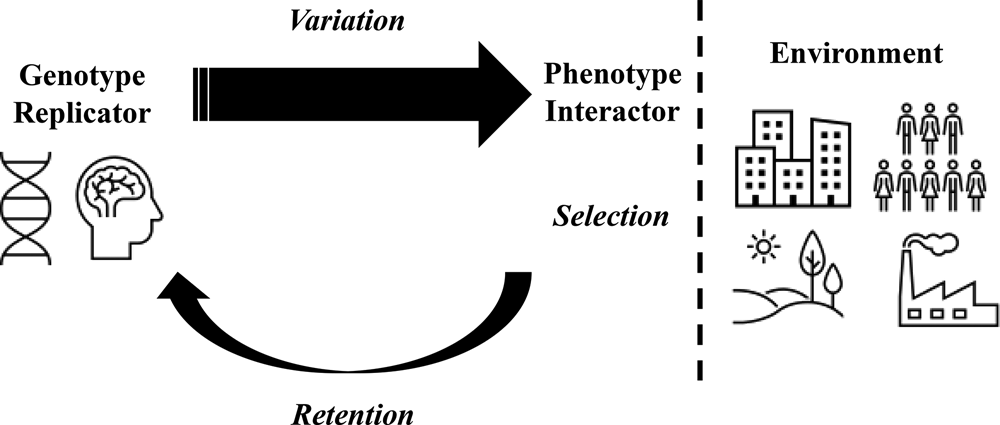
Two biological elements underpin generalized Darwinism: (1) variation–selection–retention (VSR) principles; and (2) replicator–interactor mechanisms. Both are considered here to explain how DCs form meanings, knowledge, habits, routines, and capabilities.
As shown in Figure 1, VSR principles can be conceived in the organizational domain (Hodgson & Knudsen, Reference Hodgson and Knudsen2010; Hull, Reference Hull1988) as follows:
(1) Current routines, competencies, and/or business practices that randomly mutate or are subject to recombination, that is, blind variation. For example, ordering items according to their perishability mutates into ordering them based on seasonal demand. These are, in biological terms, the instructions in an entity's underlying coding attributes (i.e., genes) (Abatecola, Breslin, & Kask, Reference Abatecola, Breslin and Kask2020).
(2) Configurations produced by variation (i.e., genotypes), which may, for example, include documented procedures for ordering items. These variations are selected, reducing disorder or entropy. Selection occurs according to the fitness rule that determines the probability a variation will survive or reproduce.
(3) Variations that have been selected are retained, thus preserved, duplicated, or otherwise reproduced. Replicators (abstracted from genotypes; Hull, Reference Hull1988) are units that are transferred to other subjects (e.g., individuals, groups, organizations) through a series of subsequent replications, while interactors (abstracted from phenotypes; Hull, Reference Hull1988) interact with their environment. Thus: ‘Y is a replicate of X if and only if: (i) X and Y are similar (in some relevant respects), and (ii) X was causally involved in the production of Y in a way responsible for the similarity of Y to X. Replication is any process by which a replicate is produced’ (Godfrey-Smith, Reference Godfrey-Smith2000, pp. 414–415)Footnote 2.
Variation, selection, and retention.
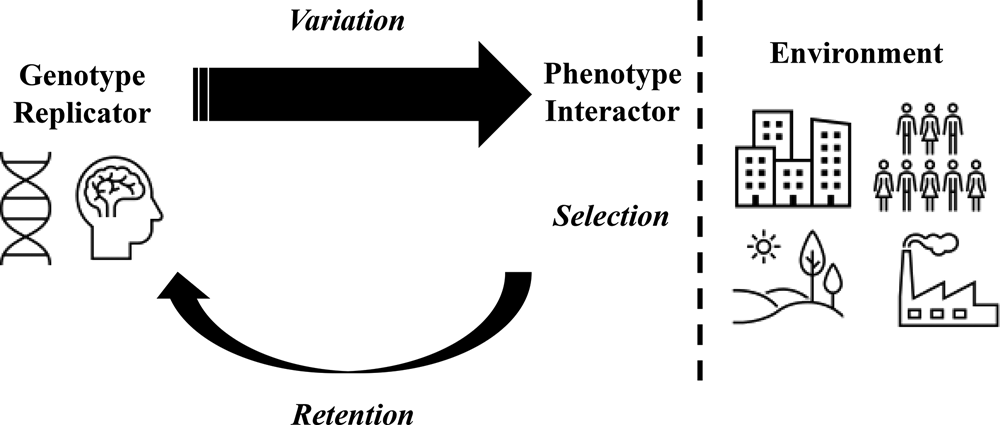
Breslin (Reference Breslin2016) highlights that evolutionary scholars adopt two main approaches to interpreting replicators and interactors, the entity view and the practice view. According to the entity view, replicators are ideas, routines, ordinary and low-order capabilities, and knowledge repositories, while interactors include technological artifacts and organizational performance. In the case of the entity view, variation, selection, and retention are driven by external selection forces. In contrast, the practice view sees replicators as abstracted cognitive structures and cognitive understandings (i.e., forms of schemata, Breslin, Reference Breslin2008), while interactors are behaviors, socially situated practices, language, and narratives. Unlike the entity view, the practice view sees variation, selection, and retention as driven by individuals, groups, and organizations, which continually modify replicators through their actions, such as visualizing a product prototype on paper or drawing a business model. The practice view aligns with the concept of DCs and therefore is adopted in this work.
Co-evolution
The overlap among replicators and interactors proposed by some scholars is closer to the co-evolutionary approach. Due to its ability to consider the entrepreneurialism of organizational agents and the influencing constraints of the environment, co-evolution provides a useful interpretative lens for understanding how DCs enable organizations to adapt to changes and ultimately succeed.
In particular, according to Weick (Reference Weick1969), co-evolution – in biological terms, ‘the evolution of two or more species through the action of reciprocal selective pressures and adaptation between them, as each has a causal influence on the other's evolution’ (Abatecola, Breslin, & Kask, Reference Abatecola, Breslin and Kask2020, p. 2) – assumes that the reality faced by organizations does not objectively exist, but is enacted by organizational members. That is, organizational decision makers intend or design co-adaptation. For instance, they decide to sell the company or change its business model in response to an industry downturn (Aldrich, Reference Aldrich1999). The firm‒environment relationship is then interpreted as dialectical (Cafferata, Reference Cafferata2016), substantiating the first assumption of co-evolution: thinking in circles (Weick, Reference Weick1969), meaning that the relationship between people and their physical and/or social environment is circular. The second assumption of co-evolution is the so-called interdependence and reciprocal feedback among different entities. However, interacting entities may not be positioned at the same level, because there is a macro-level (i.e., general environment-organizations), meso-level (i.e., industry-organizations), and micro-level co-evolution (i.e., units within organizations). This gives rise to the third assumption of co-evolution, multi-level logic (Abatecola, Reference Abatecola2014; Paniccia & Leoni, Reference Paniccia and Leoni2019). This latter is not fully developed in the provided theorization.
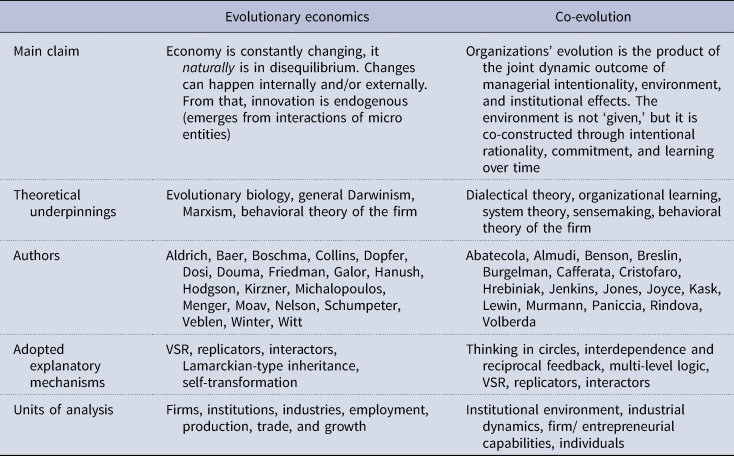
From the above, the co-evolutionary approach partly differs, but not in an unreconcilable manner, from evolutionary economics. These differences are highlighted in Table 1.
Evolutionary economics versus co-evolution
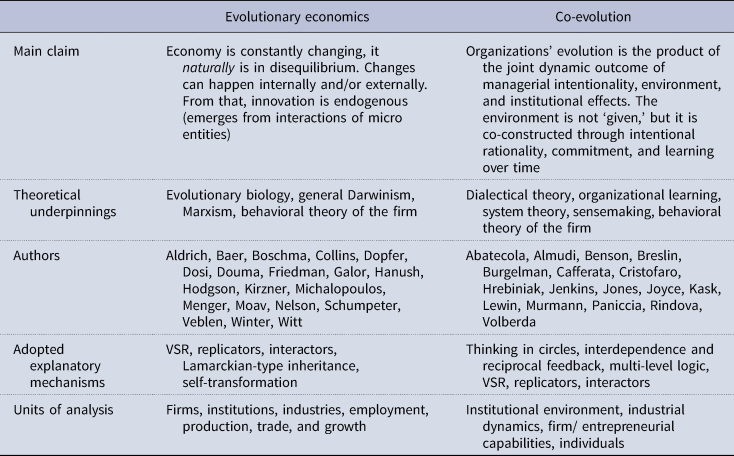
In general terms, evolutionary economics is focused on studying mechanisms (based on biology) that explain the evolution and disequilibrium of economic systems. At the same time, co-evolution describes the co-influencing effects of managerial intentionality and environmental determinism on a multi-level basis (Benson, Reference Benson1977; Breslin, Kask, Schlaile, & Abatecola, Reference Breslin, Kask, Schlaile and Abatecola2021). These differences stem from distinct theoretical underpinnings. Evolutionary economics embraces the principles of generalized Darwinism, such as ‘blind variation’ and ‘selective retention.’ The role of leadership is discounted, and relative emphasis is placed on change (only incremental innovations are counted). Co-evolution, however, while recognizing the value of VSR principles and replicator–interactor mechanisms – and this is the main point of consistency between Generalized Darwinism (GD) and co-evolution – incorporates intention into new entrepreneurial ways of solving problems. This happens because the co-evolutionary approach fully acknowledges the role played by human creativity and actions in entrepreneurially shaping the environment (Murmann, Reference Murmann2013; Teece, Reference Teece2007). Co-evolution acknowledges how human actors drive their own evolution and that of their organizations/institutions. In brief, co-evolution does not consider evolution as the sole product of uncontrollable environmental forces. In fact, co-evolution – building on its roots in the behavioral theory of the firm and systems theory – can be conceptualized as the making of new combinations while also considering the environment (Abatecola, Reference Abatecola2014; Abatecola, Breslin, & Kask, Reference Abatecola, Breslin and Kask2020; Cafferata, Reference Cafferata2016). In this regard, although evolutionary economics does not entirely ignore intentionality, the role of executives in organizations is implicit. Yet, in evolutionary economics, the object of analysis is usually the organization, industry, or supra-entity level, taking a collective, rather than an individual approach. In contrast, organizational agents' perceptions and learning mechanisms are at the center of the study of co-evolutionary dynamics, in which the role of agents is explicit (Levinthal & March, Reference Levinthal and March1993).
Evolutionary view of DCs
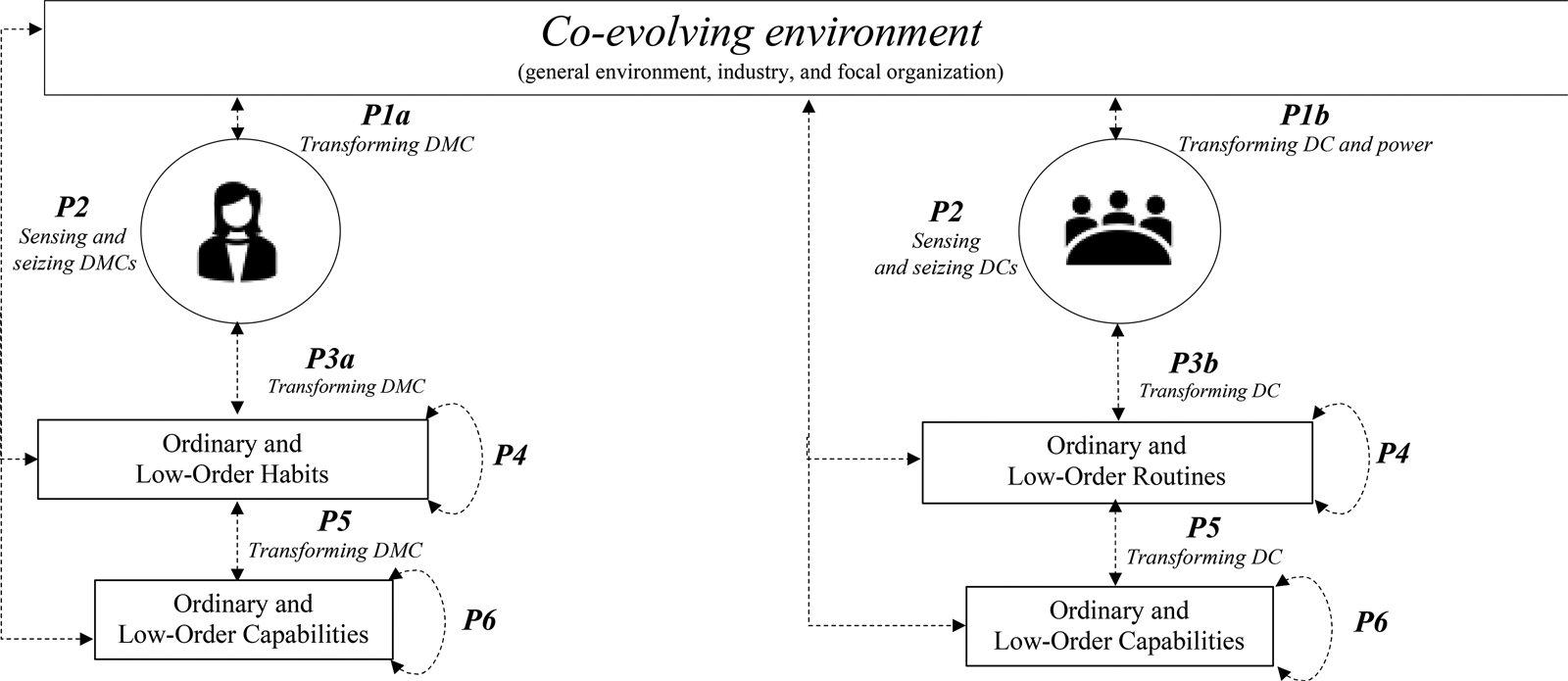
In this section, we propose our evolutionary theory of DCs. See Figure 2 for an illustration.
Evolutionary theory of DCs.
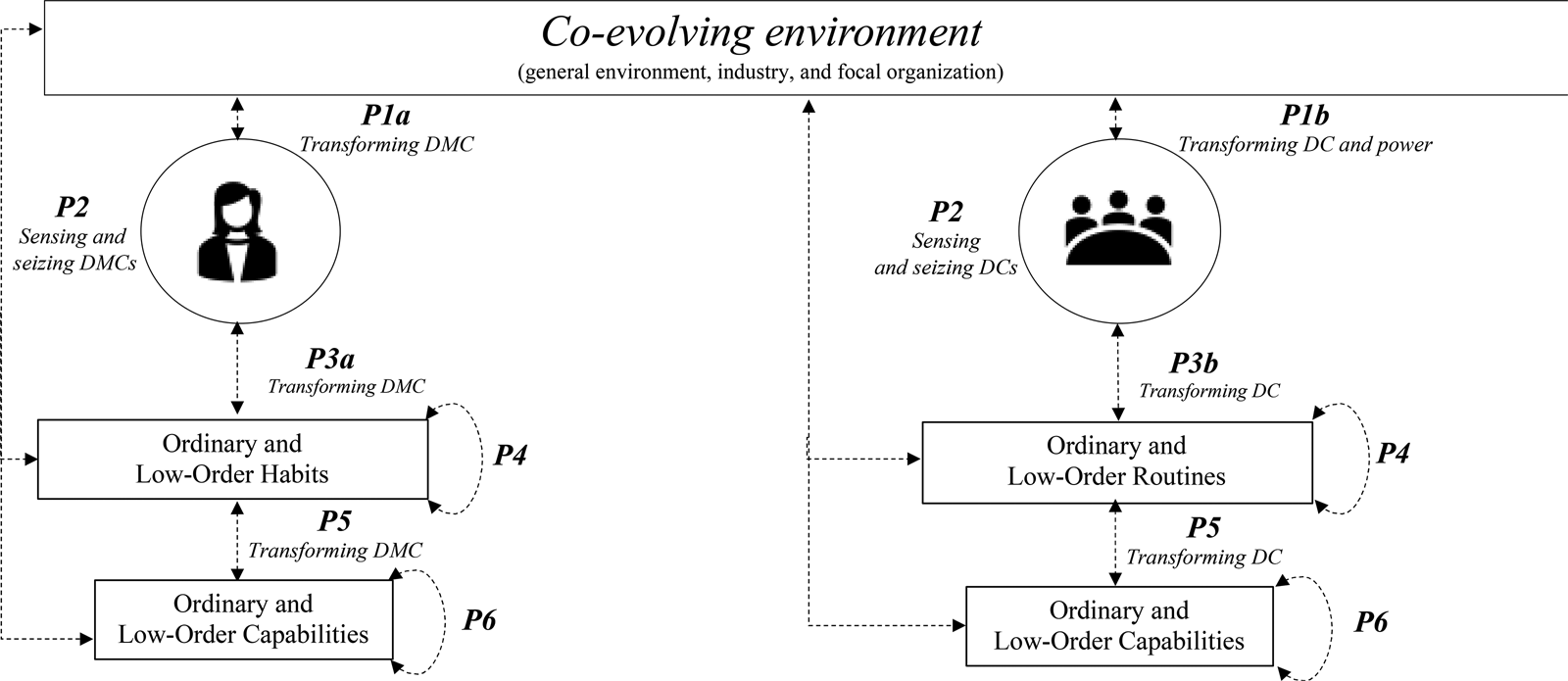
The theory is composed of six propositions that deal with DCs at the individual and collective levels. The explanation of the theory is divided into three parts: (a) from the dynamic context to sensemaking, (b) from the retained meaning to ordinary and low-order habits/routines, and (c) from habits/routines to ordinary and low-order capabilities toward competitive advantage. As to provide a flowing and causal view of DCs and their microfoundations, the explanation starts always from the individual level, and then it is referred to the collective one. It is worth to note that, apart from the hierarchy followed based on the different individual/collective levels of analysis, the provided theorization is rooted in the hierarchy of microfoundations: meaning, knowledge, ordinary and low-order habits/routines, ordinary and low-order capabilities. The three DCs identified by Teece (Reference Teece2007), sensing, seizing, and transforming, explain the transitions among the identified microfoundations and how they are shaped as to allow organizations to adapt to changes and succeed. In particular, apart from the co-evolutionary relationships emerging within the context in which the organization is embedded (among the general, industry, and the organizational environment itself), the three DCs by Teece (Reference Teece2007) are at the center of evolutionary processes, especially the transforming DC. In this regard, evolutionary processes are here considered to happen among microfoundations themselves and in relation to the context. In our opinion, it is the study of microfoundations and their co-evolutionary relationships that allow organizations to adapt to changes and succeed.
From the dynamic context to sensemaking
The business environment faced by organizations is increasingly ‘dynamic,’ thus featured by rapid change in external environmental forces (e.g., technology shifts and market conditions), with consequences for the enterprise. Dynamicity can be seen also within organizations, referring to changes in organizations' internal conditions (e.g., a shift in business model). These latter heighten or are heightened by competition, following the multilevel property of co-evolution (Dijksterhuis, Van den Bosch, & Volberda, Reference Dijksterhuis, Van den Bosch and Volberda1999; Murmann, Reference Murmann2013) for which the general environment, industry, and organizations influence each other – that is, co-evolve – and create discrepancies in the state of the world (Weick, Reference Weick1969; Weick, Sutcliffe, & Obstfeld, Reference Weick, Sutcliffe and Obstfeld2005). These discrepancies trigger managerial actions (Teece, Pisano, & Shuen, Reference Teece, Pisano and Shuen1997), thus stimulating exploration processes to support the capacity to renew capabilities to achieve congruence with a changing environment (Teece, Pisano, & Shuen, Reference Teece, Pisano and Shuen1997). Organizational agents that expect or see the current state of the world to be different from the predicted state (i.e., adaptive sensemaking; e.g., company does not meet expected profits) or become aware of something absent or concealed (i.e., generative sensemaking, Dong, Garbuio, and Lovallo, Reference Dong, Garbuio and Lovallo2016; such as identification of new business opportunity), try making sense of the causes and find a suitable organizational response (Weick, Sutcliffe, & Obstfeld, Reference Weick, Sutcliffe and Obstfeld2005). Making sense of these causes is a microfoundation in the proposed reasoning. As a first step, the individual enacts the situation: thus, the agent interprets the ongoing and chaotic environment and starts collecting cues that can help this activity (Weick, Reference Weick1969). As for the case of a hospital, changes in health conditions of the populations, such as a pandemic, are some of the propellants for the enactment activity, whose goal is to quickly respond to these forces by moving medical treatments in and out according to value maximization criteria.
According to Zollo and Winter (Reference Zollo and Winter2002), this enactment stage of sensemaking provides the raw materials, the cues to be interpreted, for the variation of learning activities, the object of which is ‘ideas’ ‘initially [present] in embryonic and partly tacit form’ (p. 343; see also Winter, Reference Winter2000). Zollo et al. (Reference Zollo, Bettinazzi, Neumann and Snoeren2016) refer to these ‘ideas’ as ‘cognitive schemata’ or the mental templates that organizations use to react to changes quickly and consider these the principal drivers ‘of the evolution of the enterprise model in a given firm’ (p. 234). However, more recently, Cristofaro (Reference Cristofaro2020) builds on the assumption that emotions drive sensemaking by recalling congruent (emotional) events. He proposes emotional schemata, an emotionally directed mental template individuals use to give an environment form and meaning; so, emotional schemata are the ‘engine’ of sensemaking.
From a practice perspective (Breslin, Reference Breslin2016), here adopted for the understanding of DCs' formation (Wenzel, Danner-Schröder, & Spee, Reference Wenzel, Danner-Schröder and Spee2020), emotional schemata are the replicators that vary according to the collected and updated cues as well as to interactors, that is, the narratives, language, or other kinds of carriers that support these mental representations (Cristofaro, Reference Cristofaro2021). The initial emotional schema is intentionally selected by testing it for plausibility, an internal and intentional selection to judge whether it is, compared to others, able to build a plausible story for solving the existing discrepancy (Price, Reference Price1995; Weick, Sutcliffe, & Obstfeld, Reference Weick, Sutcliffe and Obstfeld2005). If it fails the test, another emotional schema will be selected and tested until one is intentionally retained (Schlaile & Ehrenberger, Reference Schlaile, Ehrenberger, Berger and Kuckertz2016). This mental template is then the first one selected when understanding future similar situations.
In this regard, Cristofaro (Reference Cristofaro2021), starting from prior sensemaking studies (Maitlis, Vogus, & Lawrence, Reference Maitlis, Vogus and Lawrence2013), postulated that it is usually selected and retained: a novel and favorable plausible account of the situation when positive affective states are predominant; an accurate and unfavorable plausible account of the situation when negative affective states are predominant; too many or no plausible account of the situation when mixed affective states are predominant. In practice, the emotional schema that fits this selection criterion substantiates the meaning that is retained.
The process of VSR is completed by the organizational agent, in brief, with a new or reinforced meaning. The VSR process is an entrepreneurially driven transformation of the DMC, producing learning and helping organizational agents implement their intentions (Pandza & Thorpe, Reference Pandza and Thorpe2009), with the goal of achieving sustainable competitive advantage. The mastering role of the transforming DMC–DC in the retention of meaning can be intuited in a series of studies, such as in Warner and Wäger (Reference Warner and Wäger2019), where the digital transforming capabilities consist of navigating innovation ecosystems and other substantiating activities all oriented to identify meaning to the changing digital environment. Also in the study by Chang (Reference Chang2019), conducted on senior executives of 169 firms operating in an industrial district, it emerges how DMCs–DCs are developed by firms to master sensemaking and enable rapid response to environmental change in a network's context. Thus, we propose the following.
Proposition 1a: At the individual level, the greater the transforming dynamic managerial capability's exertion, the more plausible the retained emotional schema to make sense of the context.
Like at the individual level, groups of organizational agents respond to needs and challenges in the external and internal environments. However, according to Cristofaro (Reference Cristofaro2021), when scaling up to the collective level, the selective-retention of emotional schemata occurs through entrepreneurially power-directed sensegiving–sensemaking cyclesFootnote 3 – which are mastered through the transforming DC (Lovallo, Reference Lovallo1996a, Reference Lovallo, Dosi and Malerba1996b). These cycles – which may occur simultaneously to facilitate adaptation (further supporting the co-evolutionary logic) (Scarduzio & Tracy, Reference Scarduzio and Tracy2015) – are based on the emotional and cognitive contagion among organizational agents. Emotional and cognitive contagion are the processes by which an individual catches the affective states/mental models of others, sometimes without being aware of it, and in turn, converges on their affective states/mental models. ‘A sensemaker’ (e.g., a leader) initially makes sense of a situation, then emotionally or cognitively passes this to others (e.g., employees) through sensegiving. However, organizational members engaged in sensemaking processes from sensegivers are not simply passive recipients of others' emotional schemata; they ‘activate their own sensemaking, with the consequence of adopting, or not, the sense they have been given and influencing the hierarchy’ (Cristofaro, Reference Cristofaro2021, p. 9). From this last passage emerges how the sensegiving–sensemaking relationship is moderated by the power intentionally exerted (or not) by sensegivers (Heaphy, Reference Heaphy2017; Hoyte, Noke, Mosey, & Marlow, Reference Hoyte, Noke, Mosey and Marlow2019). Indeed, the hierarchy may, or may not, adapt to the emotional schemata of the others – consistent with the entrepreneurial view of the DCs framework (Teece, Reference Teece2007). Therefore, not just at an individual, but also at a collective level, emotional schemata act as replicators, while behaviors, narratives, and other ways of carrying the replicator are the interactors.
The final meaning assigned to a situation is the product of power-directed sensegiving–sensemaking interactions (Cristofaro, Reference Cristofaro2021), a microfoundation at the collective level in our reasoning, that advances the dual role of sensemaking as the object and subject of evolutionary processes (Abatecola, Reference Abatecola2014; Breslin, Reference Breslin2016). The role of power clearly emerges in that the intentionality of powerful organizational agents has a driving role in the formation of meaning (Schildt, Mantere, & Cornelissen, Reference Schildt, Mantere and Cornelissen2020). From that, the more powerful actors can ‘alter the situation so that meanings in the situation are consistent with their own definition of the situation’ (Cast, Reference Cast2003, p. 188; see also Dionysiou & Tsoukas, Reference Dionysiou and Tsoukas2013). Sensegiving–sensemaking cycles are, accordingly, negotiations undertaken in structures that privilege some actors over others, whose accounts are imposed and accepted (Helms Mills, Thurlow, & Mills, Reference Helms Mills, Thurlow and Mills2010). For example, Mikkelsen and Wåhlin (Reference Mikkelsen and Wåhlin2020), through an investigation of the political processes of sensemaking about diversity management practices in a Danish retailer, found that who controls cultural values within organizations also impacts the circulation of specific emotions. Managers who circulate a set of values linked to diversity and persuade subordinates to them through sensegiving processes will control emotions connected to these values and their spread (through metaphors, axioms, and stories), facilitating the ongoing reproduction of social order within organizations. From that, we advance the following.
Proposition 1b: At the collective level, the greater the transforming dynamic capability's exertion pushed by powerful agents, the more plausible and adopted the retained emotional schema to make sense of the context.
The sensemaking phase, not only for the assonance with the sensemaking word, sees also the implementation of sensing DC – devoted to the ‘identification, development, co-development, and assessment of [technological] opportunities’ – and seizing DC – intended as the ‘mobilization of resources to address needs and opportunities, and to capture value from doing so’ (Teece, Reference Teece2014, p. 332). Here we see a synthesis of ideas from the sensemaking and DCs literature. When organizational agents notice and bracket the environment to interpret it (Weick, Sutcliffe, & Obstfeld, Reference Weick, Sutcliffe and Obstfeld2005), they are entrepreneurially making ‘a diagnosis, which is important to strategy,’ in other words, sensing (Teece, Reference Teece2014, p. 341). In other words, ‘sensing (and shaping) new opportunities is very much a scanning, creation, learning, and interpretative activity’ (Teece, Reference Teece2007, p. 1322). In parallel, seizing, as an act of combining policy with action to efficiently and effectively mobilize resources (Teece, Reference Teece2014), aligns with Weick's (Reference Weick1969) emphasis on the link between enactment and action within the sensemaking process. That is, from the initial sensing of an opportunity and identifying that it requires action, in parallel, one seizes the resources to be allocated to catch that opportunity, thus building the foundation for superior performance (Lovallo, Brown, Teece, & Bardolet, Reference Lovallo, Brown, Teece and Bardolet2020). In other words, organizational agents try identifying, through the retained emotional schema, potential solutions or opportunities (sensing) and forecasting the resources needed for capturing value (seizing). This has been intuited in a series of studies (Henneberg, Naudé, & Mouzas, Reference Henneberg, Naudé and Mouzas2010; Sheng, Reference Sheng2017), which explained that: when organizations make sense of turbulent environments, they define their competitive positions and strengthen critical processes to prepare alternatives for turbulences. Accordingly, we propose the following.
Proposition 2: The greater the development of sensing and seizing dynamic capabilities, the greater the number (and potentially quality) of discovered opportunities and solutions during the sensemaking process.
From the retained meaning to ordinary and low-order habits/routines
Considering the cognitive definition of learning – ‘the reorganization of experiences in order to make sense of stimuli from the environment’ (Merriam & Caffarella, Reference Merriam and Caffarella1999, p. 254) – we see sensemaking and learning as complementary. In particular, the use and challenge of emotional schemata are at the basis of the entrepreneurial reorganization of experiences (Marchionini, Reference Marchionini2019). Thus, sensemaking assists learning. At the individual level, this learning activity brings tacit knowledge (Lei, Hitt, & Bettis, Reference Lei, Hitt and Bettis1996), a kind of knowledge that is highly personal, not easily visible, difficult to formalize and communicate, and deeply rooted in an individual's actions and experience as well as in their ideals, values, or emotions (Nonaka, Reference Nonaka1994).
Knowledge is here considered as the final output of the sensemaking process which, at the individual level, provides the scaffolding for ‘a propensity to behave in a particular way in a particular class of situations,’ also called habit (Hodgson, Reference Hodgson and Becker2009, p. 29; see also Breslin & Jones, Reference Breslin and Jones2012), at the basis of routines in organizations. However, not all habits are equal. Some habits are ordinary (e.g., send an activity report at the end of the working day), and some are low-order (e.g., start breaking a problem down into chunks) (Winter, Reference Winter2003), and this distinction is driven by intrinsic, contextual, and actionable knowledge quality.
Habits become the new replicator and their ostensive aspects, the narrative/script behind the habit, substantiate the interactors (Cristofaro, Reference Cristofaro2021). Habits, therefore, vary according to the relationship with interactors, the new knowledge produced in sensemaking processes, the interaction with other habits and ostensive aspects, and other individuals/groups/organizations (Hodgson & Knudsen, Reference Hodgson and Knudsen2004). This variation, and then also the selection process, occurs through interaction with the environment. Then, stemming from the assumption that ‘humans developed the capacity to acquire habits concomitantly with the evolution of a cultural apparatus by which adaptive solutions to problems of survival could be preserved and passed on’ (Hodgson, Reference Hodgson and Becker2009, p. 28; see also Hodgson, Reference Hodgson2004; Richerson & Boyd, Reference Richerson and Boyd2001), habits that show the best performative aspects are selectively retained (Wood, Mazar, & Neal, Reference Wood, Mazar and Neal2022). Other habits that are less performative or that are not being used are selected out (Hodgson & Knudsen, Reference Hodgson and Knudsen2004).
The transforming DMC masters the VSR process of habits, and this can be seen, for example, in the central role of managerial autonomy and self-determination expressed in Salvato and Vassolo (Reference Salvato and Vassolo2012) for the selection and retention of habits. The transforming DMC gives the capacity to match the requirements of a changing environment (Teece, Reference Teece2014) and, from that, it selects the habits that maximize the specific configuration of organizational resources (Krzakiewicz & Cyfert, Reference Krzakiewicz and Cyfert2017). It is the individual that makes the decision about which habits should be used and, therefore, reinvigorated through the application (Hodgson & Knudsen, Reference Hodgson and Knudsen2004). And this decision is driven by the transforming DMC, such that how much it is developed influences the selection of performative habits. This can be also observed in Salvato and Vassolo (Reference Salvato and Vassolo2018), who proposes the individual actions on which DCs are formed as an integration of habits. Accordingly:
Proposition 3a: At the individual level, the greater the exertion of the transforming DMC, the more performative are retained ordinary and low-order habits.
Habits are the basis for routines at the collective level (Hodgson, Reference Hodgson and Becker2009), together with the knowledge produced in group contexts through sensegiving–sensemaking cycles. These cycles are akin to a thinking in circle dynamic (Weick, Reference Weick1969), in which, following the practice view (Breslin, Reference Breslin2016), knowledge is the element passed from one level to another (i.e., the replicator) and modified according to the behavior, language, narratives, and socially situated practices (i.e., interactors), mastered by the transforming DC (e.g., Sheng, Reference Sheng2017). This latter substantiates the intentionality and the entrepreneurialism of the organizational agents. The identification of a routine as being ordinary or low-order depends on the level of patterning of routines and can be measured on a continuum ranging from high rigidity (ordinary routines) to high flexibility (low-order routines) (Friesl & Larty, Reference Friesl and Larty2013; Salvato & Rerup, Reference Salvato and Rerup2011; Winter, Reference Winter2003). Thus, the more (less) flexible is the processes' substantiating routines, the more low order (ordinary routines) are produced.
The nature of the routine varies, therefore, according to their implicit or explicit nature, manifested into interactions of behaviors and narratives, as well as using explicit tools, such as templates, case studies, flow charts, and process descriptions (i.e., the interactors; Breslin and Jones, Reference Breslin and Jones2012). Like habits, routines vary according to the interactions with the environment that occur with routines' interactors, the knowledge produced during the sensemaking processes, the interaction with other routines and their ostensive aspects, and other individuals/groups/organizations (Hodgson & Knudsen, Reference Hodgson and Knudsen2004).
Within this intervention of interactors, power plays a crucial entrepreneurial role. Indeed, as found by Safavi and Omidvar (Reference Safavi and Omidvar2016) in their analysis of a merger initiative in the educational sector, the ostensive aspects of routines provide opportunities for organizational actors to exercise power by shaping those understandings. This is aligned with Feldman and Pentland (Reference Feldman and Pentland2003, p. 110) who stated how changes in routines rely on the power of individuals who can ‘turn exceptions into rules.’ In sum, organizational agents that can more persuade or inhibit routines influence their replications and the basis for organizations' strategizing. And this ability to intentionally modify the routine or substitute it according to conditions is mastered by the transforming DC, which takes the form of a political (i.e., power-oriented) process (Breslin, Reference Breslin2008; Friesl & Larty, Reference Friesl and Larty2013). In fact, as reported by Winter and Szulanski (Reference Winter, Szulanski, Bontis and Choo2002), the replication of routines is a capability to be mastered as to benefit from the learning of the routines' replication process and build superior routines. If the transforming DC is well developed, the group of organizational agents can selectively retain good routines that have few errors and that are able to face diverse situations (Winter & Szulanski, Reference Winter and Szulanski2001). From the above, we propose that:
Proposition 3b: At the collective level, the greater the transforming dynamic capability's exertion pushed by powerful agents, the more performative and adopted the retained ordinary and low-order routines.
Habits and routines are adaptive, as suggested within the ‘patterned approach’ to DCs (e.g., Zollo and Winter, Reference Zollo and Winter2002). A habit may vary through the modification of individual knowledge (Aarts & Dijksterhuis, Reference Aarts and Dijksterhuis2000) as well as from interaction with other habits (such as time spent with technology in the workplace and time spent interacting with colleagues; Schraeder, Reference Schraeder2014), and other external elements. Therefore, habits (of all orders) interact, through ostensive aspects, according to a co-evolutionary logic according to which habits modify each other (Breslin, Reference Breslin, Belussi and Staber2011a; Breslin & Jones, Reference Breslin and Jones2012).
At the collective level, routines are the product of collective learning that embraces an escalation of habits at the individual level to routines at the group one (Breslin & Jones, Reference Breslin and Jones2012), which happens due to interactions among agents within and outside the organization and by the coevolving interaction of routines themselves (Breslin, Reference Breslin, Belussi and Staber2011a; Taj, Kautz, & Bruno, Reference Taj, Kautz and Bruno2021). This escalation takes the resemblance of knowledge creation since this process is made by orchestrated passages from an individual to a collective (and vice-versa) and by inclusion, exclusion, addition, substitution, and combination of knowledge (Breslin, Reference Breslin2016; Nelson & Winter, Reference Nelson and Winter1982). In this regard, Friesl and Larty (Reference Friesl and Larty2013) discuss routines as entrepreneurially replicated, arguing that this occurs by ‘forward knowledge flows’ (e.g., from a Top Management Team [TMT] to a group of senior executives) and ‘reverse knowledge flows’ (e.g., from a group of senior executives to the TMT). This second process suggests that ‘routines are adapted and further developed as an organization learns [emphasis added; Zollo & Winter, Reference Zollo and Winter2002] more about them during the process of replication’ (Friesl and Larty, Reference Friesl and Larty2013, p. 111).
Being habits and routines reservoirs of knowledge (Lazaric & Raybaut, Reference Lazaric and Raybaut2005) explicating how things are done, when passing through the VSR process and interacting with the environment, a learning activity takes place (Rerup & Feldman, Reference Rerup and Feldman2011). Due to this learning, routines accordingly modify their knowledge structure, whose final form is the one that most adapts to the faced context (Becker & Lazaric, Reference Becker and Lazaric2003; Breslin, Reference Breslin, Belussi and Staber2011a; Winter & Szulanski, Reference Winter and Szulanski2001). Accordingly:
Proposition 4: Ordinary and low-order habits/routines co-evolve such that the more interaction, the greater the learning and reinforcement/change of substantiating microfoundations.
From habits/routines to ordinary and low-order capabilities toward competitive advantage
Because of the repetitive, intentional relationships with the environment (consistent with the co-evolutionary properties of thinking in circles and substantiated by individuals' actions and decisions; Hodgson, Reference Hodgson and Becker2009; Weick, Reference Weick1969), ordinary and low-order habits/routines are retained or substituted with more effective ones and – due to this learning process being driven by the transforming DMC–DC – knowledge, skills, and abilities are enhanced (Adner & Helfat, Reference Adner and Helfat2003). These three latter elements are the foundation of capabilities formation (Aguinis, Reference Aguinis2009) and create the distinction among ordinary (e.g., absorptive capacity; Cohen and Levinthal, Reference Cohen and Levinthal1990) and low-order (Teece, Pisano, & Shuen, Reference Teece, Pisano and Shuen1997; e.g., conflict resolution) capabilities. Therefore, capabilities (ordinary and low order) become the new unit of analysis that is subject to replication.
Therefore, like habits/routines, operating capabilities pass through the VSR process. The variation occurs due to the elements that carry out the capabilities themselves (e.g., the Customer Relationship Management system that supports the customers' analytics capability), the interaction with agents that are endogenous and exogenous to the organization, and the relation with other capabilities – in a coevolving fashion (Biesenthal, Gudergan, & Ambrosini, Reference Biesenthal, Gudergan and Ambrosini2019; Breslin, Reference Breslin2016; Galvin, Rice, & Liao, Reference Galvin, Rice and Liao2014). In line with Newey and Zahra (Reference Newey and Zahra2009, p. S82), we propose that the interactions between DMCs–DCs and operating capabilities do not only occur because of exogenous triggers, but also thanks to ‘the firm's endogenously driven entrepreneurship […], and it is through this mechanism that firms also build their adaptive capacity’ (see also Eriksson, Reference Eriksson2014; Lavie, Reference Lavie2006).
The selectively retained capabilities by the organizational agents are the ones that demonstrate having a fit with the internal and external environments (Breslin, Reference Breslin2021), such that the exertion of the transforming DMCs–DCs of organizational agents orient to selectively retain the capabilities that allow the organizational agent to operate/successfully adapt to the changing environment (Teece, Reference Teece2007, Reference Teece2014; Teece, Pisano, & Shuen, Reference Teece, Pisano and Shuen1997). Indeed, through DMCs–DCs ‘the organization systematically generates and modifies its operating routines in pursuit of improved effectiveness […they are] exemplified by an organization that adapts its operating processes through a relatively stable activity dedicated to process improvements’ (Zollo & Winter, Reference Zollo and Winter2002, p. 340). This is also in line with Zott (Reference Zott2003, p. 98) who argued that ‘dynamic capabilities are indirectly linked with firm performance by aiming at changing a firm's bundle of resources, operational routines, and competencies, which in turn affect economic performance.’ In this regard, the capabilities' degree of fitness is substantiated by their performance, also called ‘technical fitness,’ which captures ‘how effectively a capability performs its intended function’ (Helfat et al., Reference Helfat, Finkelstein, Mitchell, Peteraf, Singh, Teece and Winter2007, p. 7).
The transforming DMC–DC produces, by managing the VSR process of ordinary and low-order capabilities (Cepeda & Vera, Reference Cepeda and Vera2007), a learning outcome that shapes individual/organizational development (Newey & Zahra, Reference Newey and Zahra2009) and forms organizations' coadaptation (Cacciolatti & Lee, Reference Cacciolatti and Lee2016). In fact, it is the specific role of DMCs–DCs to change the key internal components of the firm, such as operating capabilities (e.g., Eisenhardt & Martin, Reference Eisenhardt and Martin2000; Helfat et al., Reference Helfat, Finkelstein, Mitchell, Peteraf, Singh, Teece and Winter2007; Teece, Pisano, & Shuen, Reference Teece, Pisano and Shuen1997; Winter, Reference Winter2003), and routines (Zollo & Winter, Reference Zollo and Winter2002). From that, DMCs/DCs play a primary role in individual and organizational development such that the activation of entrepreneurial leadership/management practices allows the organization to discover, co-create, and change (Augier & Teece, Reference Augier and Teece2006), driving operating capabilities and their substantiating habits/routines (Barreto, Reference Barreto2010; Zollo & Winter, Reference Zollo and Winter1999). Accordingly, we propose:
Proposition 5: The greater the exertion of the transforming dynamic managerial capability/dynamic capability, the more performative ordinary and low-order capabilities are retained.
Operating capabilities do not operate in silos, but they influence each other as it is in the nature of firms where multiple parts and participants interact (Cafferata, Reference Cafferata2016). Indeed, as to transform raw materials into finished products, a series of ordinary and low-order capabilities are needed to interact, such as monitoring contracts with suppliers and leading new product development. For example, Willcocks, Reynolds, and Feeny (Reference Willcocks, Reynolds and Feeny2007) described the nine human resource capabilities (leadership, informed buying, business systems thinking, relationship building, contract facilitation, architecture planning and design, vendor development, contract monitoring, and making technology work) that are needed, also taking into account their interactions, to have an advantage in the IT services market. Yet, Golgeci and Gligor (Reference Golgeci and Gligor2017), based on the findings from dyadic interviews with 26 marketing and supply chain management executives from business-to-business firms, found co-evolving influences among relational, market learning, innovativeness, and supply chain agility capabilities. Yet, they highlighted that cross-functional awareness among different departments of an organization and their distinct capabilities – obtainable through the feedback of their intertwined operations – fosters cross-functional capability synergies, able to diminish discrepancies in the firm system.
Thanks to the dialectic with the environment, ordinary and low-order capabilities enable organizational agents to learn and accumulate experience, exploit and explore social ties, and refine their habits/routines and emotional schemata that substantiate them (Biesenthal, Gudergan, & Ambrosini, Reference Biesenthal, Gudergan and Ambrosini2019; Dunning & Lundan, Reference Dunning and Lundan2010; Lei, Hitt, & Bettis, Reference Lei, Hitt and Bettis1996; Salvato & Rerup, Reference Salvato and Rerup2011; Winter, Reference Winter2003). Thus, organizational agents learn and produce new knowledge (Quansah, Hartz, & Salipante, Reference Quansah, Hartz and Salipante2022) that can reinforce or change DCs' antecedents, thus confirming, or not, the way in which things are thought/done is the correct one. This can be seen in Cepeda and Vera (Reference Cepeda and Vera2007) who found, with a sample of 107 firms in the information technology and communication industry in Spain, that operating capabilities are the product of VSR of knowledge, such that modifications in operating capabilities substantiate the modification of their knowledge structure. Yet, Nielsen (Reference Nielsen2006) advanced that the DCs and the associated knowledge management activities create flows to and from the firm's stock of knowledge and they support the creation and use of organizational capabilities. In particular, the operating capabilities are seen as a ‘use of knowledge,’ whose output contributes to the development of the knowledge basis, then recombined to reinforce/change the habits/routines behind operating capabilities. Accordingly:
Proposition 6: Ordinary and low-order capabilities co-evolve, such that the more interaction, the greater the learning and reinforcement/change of substantiating microfoundations.
The proposed theorizing clarifies that ordinary and low-order capabilities evolve ‘through explicit managerial intervention’ (Salvato & Rerup, Reference Salvato and Rerup2011, p. 471) – that is substantiated by the exertion of the transforming DC – but this happens with due consideration of the dialectic with the environment. Indeed, the implementation of operating capabilities creates a contextualization within the environment and feedback received establishes a learning mechanism (always mastered through the transforming DC) that modifies/reinforces, as an inverted cascade effect, the ordinary and low-order habits/routines. From that, the emotional-cognitive aspect of mental representations that are at the basis of sensemaking, retained habits/routines, and subsequent capabilities/DMCs are reinforced and will be first used for further sensemaking processes (Cristofaro, Reference Cristofaro2020, Reference Cristofaro2021). From that, the modified/reinforced emotional‒cognitive aspects used for other sensemaking processes will co-evolve to affect habits/routines and operating capabilities (Kars-Unluoglu & Kevill, Reference Kars-Unluoglu and Kevill2021). The process in action is the product of organization–environment dialectical relationships that contribute to reaching (or maintaining) the ‘systemness’ of the organization (Cafferata, Reference Cafferata2016).
Here, DCs substantially drive adaptation at the firm level, and firms co-evolve with industry and macro forces. Indeed, DCs allow strategic growth alternatives, such as global diversification, new applications of current technologies, and the development of new lines of business that can produce competitive advantage and, thereby, reduce uncertainty (Dixon, Meyer, & Day, Reference Dixon, Meyer and Day2014; Lei, Hitt, & Bettis, Reference Lei, Hitt and Bettis1996).
Example of the theory in action
Consider the case of a global car manufacturer that observes a shock in the energy market, such as the one provoked by the current Russia–Ukraine war. The goal of the car manufacturer is to quickly respond to that crisis by mobilizing organizational responses, such as building alliances with car manufacturers established in countries rich in energy sources.
To find organizational responses, the Chief Operations Officer (COO) of the global car manufacturer must better understand the new energy supply scenario. In this regard, the perceived features of the context (e.g., inflation of prices) will elicit some affective states (e.g., fear, surprise) that will influence the process of cues collection (e.g., being in a negative mood, which leads to being more accurate in cues collection). Within this COO's sensemaking activity, the initial emotional-cognitive frame of the phenomenon, ‘physiological and temporary shock in the energy market’, challenges other emotional-cognitive frames, such as the ‘pathological and permanent shock in the energy market’. If the COO is strongly able to combine different information coming from distinct IT data systems owned by the company (a type of DMC), the COO will be more solid in the process of cues collection and in testing the plausibility of the emotional schema. From that test, the framing ‘pathological and permanent shock in the energy market’ comes out being able to interpret the occurring scenario better than others, and it is selectively retained and adopted (proposition 1a).
In cases where is not the COO, but the whole TMT who must make sense of the changing context, the adopted meaning is the product of power-oriented cognitive and emotional exchanges among TMT members. This happens when the COO advances an interpretation (‘pathological and permanent shock in the energy market’) corroborated by combining different information and found reinforcement from most other TMT members that share the same negative feelings toward the shock in the energy market. The few members that differently interpret the situation will finish adopting the meaning of the COO which gained more appreciation for its plausibility and power endorsement (proposition 1b). While making sense of the new scenario by collecting cues and combining information, the COO, or the whole TMT, implicitly try to identify and seize the potential solutions to the problem, such as building alliances with car manufacturers established in countries rich in energy sources. The produced solution will be as valuable as it is the COO and TMT's experience in sensing and seizing opportunities in cases of sudden shocks (proposition 2).
The COO/TMT's learning activity, emerging from the selective retention and implementation of the emotional schema, gives light to chunks of knowledge. Assuming that the shock in the energy market is pathological and permanent, the COO/TMT relates with counterparts of competitors and knows that European governments are already signing agreements with other countries for energy supply. This news leads the COO/TMT to collect and check energy prices in countries where other car manufacturers are established and that are rich in energy. On an individual basis, the more the COO can combine different information coming from distinct IT data systems owned by the company, the more effective the collection and check of energy prices (proposition 3a). On a collective basis, the more the powerful TMT members can combine different information coming from distinct IT data systems owned by the company, the more effective the collection and check of energy prices (proposition 3b). In either case, ‘collecting and checking energy prices in countries where other car manufacturers are established and that are rich in energy' is a repeated pattern that interacts with others, such as ‘exploring new sources of information’. If there is a positive interaction between the two, such as an addition of a new source of information that allows a larger data collection of energy prices, it is possible to produce new knowledge and reinforce/change the initial framing of the context (proposition 4).
The ability to combine different information coming from distinct IT data systems owned by the company is directly influenced by the newly produced knowledge, and the stronger this ability, at the COO or TMT level, the more developed are linked operating capabilities, such as the diagnostic capability and forecasting capability (proposition 5). These two operating capabilities, diagnostic and forecasting, due to their nature and aims in the firm, are connected and live in a constant interplay. The greater the frequency of their exchanges, the more reinforced/modified will be the ‘exploring new sources of information’ pattern (proposition 6).
Conclusions and implications
By adopting the evolutionary lens, with some elements from the co-evolutionary stream, this paper exploits the microfoundations of DCs and advances a theory to explain how DCs enable organizations to adapt to changes and ultimately succeed. As well as implications for theory, we identify implications for practice and a future research agenda.
Our theory of DCs elucidates strategic behavior and its microfoundations (Felin, Foss, & Ployhart, Reference Felin, Foss and Ployhart2015). Responding to calls for DCs as a theory per se (Barreto, Reference Barreto2010; Easterby-Smith, Lyles, & Peteraf, Reference Easterby-Smith, Lyles and Peteraf2009), we form propositions to consider the individual and collective levels and the scale-up from the former to the latter. We explicate how ordinary and low-order capabilities and their substantiating elements (emotional schemata, knowledge, and habits/routines) are intentionally varied, selected, and retained through DCs, and then depart from their origins, that is, the initial sensemaking of organizational agents. Our theorizing overcomes some limits in the DCs research, answering, for example, the question of Schilke, Hu, and Helfat (Reference Schilke, Hu and Helfat2018, p. 417): ‘what are the similarities and differences in routinization at the individual and organizational levels of analysis?.’ Indeed, we explain that both habits and routines are patterns of behavior based on chunks of knowledge coming from the sensemaking activity. Habits and routines similarly pass through VSR processes that select the most performative. However, for routines, powerful organizational agents are determinant for retained selection.
Our theorizing clarifies the positive developmental influences of DMCs/DCs on individuals and organizations (Teece, Reference Teece2007, Reference Teece2014; Teece, Pisano, & Shuen, Reference Teece, Pisano and Shuen1997). In particular, a primary role is covered by the sensing, seizing, and transforming of DMCs/DCs. The first two find application in the sensemaking process and are assumed to orient the attention of organizational agents to the discovery of opportunities and the mental allocation of resources to catch them. Transforming, instead, is the capability that masters knowledge creation cycles, and the VSR process of emotional schemata, habits/routines, and capabilities. These processes help organizational agents to engage in sensemaking that enables them to find suitable meanings and create knowledge, habits/routines, and other capabilities that allow the organization to survive environmental changes and prosper. We extend this conceptualization of sensing, seizing, and transforming as building organizations' strategic orientation and competitive advantage to incorporate co-evolutionary dynamics, which includes agents' behavior. Because sensing and seizing are part of the sensemaking process, sensemaking is here considered the locus where organizational agents' strategic behavior is formed and implemented, where strategy and competitive advantage start to take shape. Our theory extends prior studies by conceptualizing DCs (in particular sensing and seizing) as shaping sensemaking and, positioning organizational agents as responsible for the survival and prosperity of their organizations, or, in other words, of its evolution with design (Augier & Teece, Reference Augier and Teece2006). Hence our study advances the understanding of strategic behavior as discussed in the behavioral strategy stream of research (Powell, Lovallo, & Fox, Reference Powell, Lovallo and Fox2011). In particular, it is expanded the conceptualization that firm evolution is only underpinned by interactions between dynamic and operating capabilities (Helfat et al., Reference Helfat, Finkelstein, Mitchell, Peteraf, Singh, Teece and Winter2007; Newey & Zahra, Reference Newey and Zahra2009; Winter, Reference Winter2003; Zollo & Winter, Reference Zollo and Winter2002) by enlarging the view which includes the interactions of DCs with emotional schemata, habits, and routines – thus, all other microfoundations.
Our view of the firm as evolving around DCs clarifies the relationship between routines and innovation and explains how strategic decisions of dynamically capable managers are vital to the fates of firms and the dynamics of industries. While our proposed theory recognizes habits and routines as the very essence of operational (ordinary) capabilities, it also suggests that routine-based explanations are not sufficient to account for the most essential features of the firm. In fact, while the honing of routines is vital for ‘doing things right’ (i.e., efficiently), this is just one contributor. Our theory of DCs shows that executives are central to the firm's evolution because they can impact whether existing routines and capabilities will remain in the firm and whether new ones should be added. And this decision is driven by DCs, in line with the DC-related understanding of the evolutionary fitness as ‘how well a dynamic capability enables an organization to make a living by creating, extending, or modifying its resource base’ (Helfat et al., Reference Helfat, Finkelstein, Mitchell, Peteraf, Singh, Teece and Winter2007, p. 7).
Our proposed theory can contribute to answering two critical questions posed in the behavioral strategy literature (Lovallo, Reference Lovallo1996a, Reference Lovallo, Dosi and Malerba1996b; Powell, Lovallo, & Fox, Reference Powell, Lovallo and Fox2011). How does individual cognition scale to collective behavior? What are the psychological underpinnings of strategic management theory? To do so, our propositions should be empirically tested. Mixed-methods research, based on qualitative and quantitative data, could investigate if our propositions are consistent when applied to a range of cases.
Our proposed theory also has the potential to advance questions about learning as an outcome and catalyst for DMCs/DCs, consistent with the conceptualization by Augier and Teece (Reference Augier and Teece2006, p. S4) of ‘organizational [and individual] knowledge, learning and capabilities … [as] a triangle: the ongoing development of organizational knowledge is, or can be, a dynamic capability that leads to continuous organizational learning and further development of knowledge assets’ (see also Easterby-Smith and Prieto, Reference Easterby-Smith and Prieto2008). Here we see how DMCs/DCs play a co-evolutionary role in environmental feedback, both producing learning when implemented in the sensemaking phase or when mastering VSR processes and learning underpinning their formation (Teece, Pisano, & Shuen, Reference Teece, Pisano and Shuen1997). Learning can be considered the vehicle for stability and ongoing adaptation (Levinthal, Reference Levinthal1991) – in contrast to other views that see this role played by ‘simple’ routines – however, it is not a continuous and linear process but co-evolutionary, where contradictory forms of knowledge emerge. Relatedly, learning, as achieved through the transforming capability of DMCs/DCs – by activating processes of evolution and adaptation – can help organizations gain competitive advantage (Argyris, Reference Argyris1993; Levinthal & Rerup, Reference Levinthal and Rerup2006; Zollo & Winter, Reference Zollo and Winter1999, Reference Zollo and Winter2002). While it is clear that ordinary and low-order capabilities, therefore, do not simply reside in routines (Nelson & Winter, Reference Nelson and Winter1982), but in the learning of organizational agents, questions remain about whether virtual or hybrid learning supports the development of DCs. Under what conditions does power bias learning processes and lead to dysfunctional organizations? Can particular aspects of an emotional schema improve or limit learning?
Our study also contributes to the discussion of affect‒cognitive interplays and power as the basis for developing meaning, habits, routines, and capabilities. While the centrality of the social aspect in habits and routines has been recognized in the literature, only recently have affective states been included as drivers of DCs (Kars-Unluoglu & Kevill, Reference Kars-Unluoglu and Kevill2021) and evolution (Breslin, Reference Breslin2021). We extend this by considering affective states in the initial formation of routines. We argue that an affective evaluation initially evokes judgment before any higher-level reasoning occurs, considering this as consistent with our concept of emotional schemata. Therefore, sensemaking, DCs implementation, and reasoning are intertwined processes to be entrepreneurially managed and shape all subsequent outputs (e.g., habits, routines, ordinary and low-order capabilities). This theoretical explanation is consistent with the work of prior scholars for whom capabilities are based on non-cognitive processes (Hodgkinson & Healey, Reference Hodgkinson and Healey2011; Kars-Unluoglu & Kevill, Reference Kars-Unluoglu and Kevill2021; Nayak, Chia, & Canales, Reference Nayak, Chia and Canales2020). Our theory further recognizes that the affect‒cognitive interplay is not the only mechanism that drives the later formation of meaning, habits, routines, and capabilities. Power (or politics) within organizations can also cause this cognitive and emotional interplay and the selection of retained meaning (Cristofaro, Reference Cristofaro2021), routines, and capabilities which impact resource allocation and the success of companies (Bardolet, Brown, & Lovallo, Reference Bardolet, Brown and Lovallo2017; Lovallo et al., Reference Lovallo, Brown, Teece and Bardolet2020). Future studies could identify if different forms of power are needed at the sensemaking, routine, and capabilities levels to favorably select the desired meaning, routine, and capability. For example, is hierarchical power more effective than social power for selecting routines?
In terms of ontological advancements, our work responds to Teece's (Reference Teece2018) call to adopt systems theory to understand DCs. By adopting elements from a system-based evolutionary lens (i.e., co-evolution), we can see the role of the ‘intentionality’ of top decision makers and governance bodies in organizations' life cycles (Abatecola, Breslin, & Kask, Reference Abatecola, Breslin and Kask2020; Breslin, Reference Breslin2011b; Cafferata, Reference Cafferata2016; Cristofaro, Reference Cristofaro2019, Reference Cristofaro2021; Murmann, Reference Murmann2013). In doing so, we contribute to the ontological debate about DCs as a source of sustainable competitive advantage. Future studies could investigate where specific characteristics of organizations' external environment moderate the DC‒competitive advantage connection.
Our evolutionary interpretation helps to see DCs as instruments able to entrepreneurially solve organizations' evolutionary fitness problems. It explains how DCs emerge from the characteristics of the TMT, and from the organizational culture and structure – in close interaction with the environment (see Ambrosini, Bowman, and Collier, Reference Ambrosini, Bowman and Collier2009) – supporting organizational routines established under the stewardship of top management. Here we answer the call by Schilke, Hu, and Helfat (Reference Schilke, Hu and Helfat2018, p. 407), who argued that ‘studying the evolution of dynamic capabilities’ is consistent with a focus on DCs in strategic change research. Again, more mixed-methods research, which can allow for simultaneous theory extension and testing, can advance the proposed theory and support the ontological point of view presented in this work.
Our study also has implications for managers. Practitioners positioned at the managerial and governmental levels – both in public and private organizations – can reconsider the meaning of competitive advantage to understand it not only comes from the resources and capabilities of the firm, which can be expanded through collaborations/acquisitions, but as based on learning mechanisms that can be activated through the transforming DC. This dialectic move is, in fact, the platform for the generation, selection, and retention of patterns of thoughts, knowledge, habits, and routines that build capabilities. Given the idea of learning organizations, in which continuous transformation takes place (Senge, Reference Senge2014), it can be argued that organizational agents should adopt and support systems thinking to improve capability building, sustainable competitive advantage, and related coadaptation. Indeed, systems thinking helps: (a) seeing events, mental models, and patterns of behavior as operating simultaneously to find links and loops, (b) developing personal (and intrapersonal) mastery, and (c) developing emotional schemata, in which they reflect on how their own and others' mental models are created. This can build a shared vision and create a common identity that provides focus and energy for learning and supports team learning through dialog and debate.
Finally, this theorizing is not exempted from limitations. The main one is in not deeply accounting for the complexity of multiple multi-level coevolutionary relations within and beyond organizations, that would clearly impact the focal DCs, habits, and routines. The narrative can be developed further as to include this more complex interpretation of coevolution, for example including the range of interactions within the organization itself. This limit was taken into account from the very beginning due to the fact that a microfoundational view, that calls for seeing the specific basic elements of a phenomenon does not align with a fully multi-level theory (Felin & Foss, Reference Felin and Foss2005).
Conflict of interest
The authors declare none.