An estimated 93,000 persons were potentially exposed to drinking water contaminated with petroleum jet propellant (JP)-5 fuel after a leak at the Red Hill Bulk Fuel Storage Facility on Oahu, Hawaii. Municipal water supplied by the Joint Base Pearl Harbor-Hickam (JBPHH) water distribution system was potentially contaminated starting on November 20, 2021. The Hawaii State Department of Health (HDOH) issued a drinking water advisory on November 29, 2021. HDOH amended the advisory and declared the water as safe for all uses on March 18, 2022. The Red Hill event is one of the first known jet fuel exposures of this magnitude impacting public drinking water.
The long-term effects of jet fuel exposure in humans have not been well studied. 1 JP-5 includes a mixture of additives and hydrocarbons used in military aircraft. 1 Studies examining self-reported symptoms following petroleum contamination of drinking water found that most participants experienced one or more new or worsening symptoms after the incident, with many reporting symptoms lasting >30 days (most common symptoms related to the nervous system, gastrointestinal system, and skin).Reference Troeschel, Gerhardstein and Poniatowski 2 While studies exist describing mental health effects associated with occupational exposure to jet fuel, limited information is available regarding mental health effects associated with long-term nonoccupational jet fuel exposure.Reference Kendall, Smith, Smith and Gibson 3 , Reference Makwana 4 Other literature has noted that chemicals in petroleum fuels, such as volatile organic compounds (VOCs) and polycyclic aromatic hydrocarbons (PAHs), may impact mental health beyond the psychosocial effects of a contamination event, possibly due to the neuroinflammatory effects of these chemicals.Reference Kim, Huh and Kang 5
Because of the scarcity of existing research and the scale of this event, HDOH requested assistance from the Centers for Disease Control and Prevention (CDC)/Agency for Toxic Substances and Disease Registry (ATSDR) to assess the incident’s effect on health. The Assessment of Chemical Exposures (ACE) program provides rapid epidemiologic resources (e.g., modifiable surveys and databases) to assess exposed individuals following large-scale toxic substance spills or chemical emergencies.Reference Konkle, Kevin Horton and Orr 6 In January 2022, an initial ACE investigation occurred, which found 72% (n = 1,653) of the 2289 participants reported new or worsening mental health symptoms.Reference Miko, Poniatowski and Troeschel 7 In September 2022, a follow-up ACE investigation found 80% (n = 789) of 986 people surveyed experienced one or more acute health effects during the previous month and 50% (n = 493) reported worsening mental health after the jet fuel incident. 8
These previous investigations identified the need to evaluate long-term health effects, including mental health, associated with exposure to JP-5. 8 In February 2023, the U.S. Department of Defense’s Defense Health Agency (DHA) Public Health requested assistance from CDC/ATSDR. We conducted comprehensive medical chart abstractions within the military’s healthcare system on a sample of potentially exposed persons to assess ongoing mental health concerns 15 months after the JP-5 leak into the JBPHH water distribution system.
Methods
Upon completion of training and patient confidentiality agreements, DHA provided access to electronic health records (EHRs) within the Military Health System (MHS) GENESIS and Joint Legacy Viewer systems at Tripler Army Medical Center. A roster of 28,601 persons served by the contaminated water source during the exposure window of November 20, 2021–March 18, 2022, was obtained from the DHA’s Defense Occupational and Environmental Health Readiness System (DOEHRS). 9 We then selected from 4 nonmutually exclusive subgroups of persons on the roster who sought care through the military health network, including persons with International Classification of Diseases, tenth revision (ICD-10) diagnosis codes for toxic effects,Footnote a persons with ICD-10 codes of clinical interest,Footnote b persons with pregnancy-related ICD-10 codes from visits during November 20, 2021 to June 18, 2022, and persons with multiple (>2) clinic visits during the study period (November 20, 2021–February 24, 2023). In total, we completed full medical chart abstraction on 653 persons.Reference Nguyen, McArdle and Saunders 10
Descriptive analyses were conducted to examine reported mental health conditions among individuals potentially exposed to jet fuel-contaminated water. To provide appropriate descriptive statistics for this public health investigation, we abstracted deidentified data from medical records including demographic information, medical history, laboratory tests, imaging, medications, referrals, and visit summaries. We reviewed charts and categorized all symptoms and conditions, including those related to mental health (Table 2), for adults aged >18 years using the following case definitions: (1) “preexisting and unchanged” if documented before November 20, 2021, and considered stable; (2) “worsening preexisting” if documented as present before November 20, 2021, with evidence of worsening in >2 medical visits after November 20, 2021; (3) “persistent new” if documented on or after November 20, 2021, and lasting ≥3 months; or, (4) “acute” if first documented on or after November 20, 2021, and resolved <3 months. These definitions are not mutually exclusive; patients could be represented in more than one category based on symptoms or conditions reflected in the medical records. We recorded frequency of referrals to psychiatry, behavioral health, and other mental health-related specialties. We also assessed mental health medication use through active medication lists in the EHR during the year before November 20, 2021, and the period after November 20, 2021, through February 24, 2023, among the entire sample of adult persons. Medications were grouped together by pharmacological class. Medications were included only if they had an indication for mental health use, such as antihistamines used for anxiety. We designed a survey in REDCap to collect medical chart abstraction data. SAS® v9.4 (SAS Institute, Inc., Cary, North Carolina) was used for data cleaning and analysis.
This activity was reviewed by CDC, deemed not research, and was conducted consistent with applicable federal law and CDC policy (45 C.F.R. part 46.102(l)(2), 21 C.F.R. part 56; 42 U.S.C. §241(d); 5 U.S.C. §552a; 44 U.S.C. §3501 et seq.); consenting was not required under Department of Defense Manual 6025.18.
Results
We completed full medical chart abstraction for 653 of the 28,601 persons identified on the DOEHRS roster.Reference Nguyen, McArdle and Saunders 10 The mental health analysis was limited to adults aged ≥18 years (n = 411) within this cohort (Table 1). Pediatric patients (n = 242) were excluded from the mental health analysis. The majority were female (n = 245; 59.6%), White race (n = 217; 52.8%), and non-Hispanic (n = 273; 66.4%). Based on available beneficiary data, 40.1% (n = 165) were active-duty military service members, 44.3% (n = 182) were dependents, and the remaining 15.6% (n = 64) included military reservists or guardsmen, civilian employees, retirees, or were of unknown beneficiary status. In total, 123 adults (29.9%) had at least ≥1 worsening preexisting mental health condition or symptom; 86 adults (20.9%) had ≥1 persistent new mental health condition or symptom during the study period. These classifications are not mutually exclusive. Demographic data can be found in the supplemental table.
Mental health-related conditions and symptoms among adults (N = 411) potentially exposed to petroleum-contaminated water on Oahu, Hawaii, as documented in medical chart abstraction and meeting case definition for worsening preexisting or persistent new, November 20, 2021–February 24, 2023.

* Persons may be included in more than 1 row and/or more than 1 column if more than 1 condition or symptom met the case definitions.
ǂ Attention deficit hyperactivity disorder or attention deficit disorder (ADHD or ADD).
The most documented worsening preexisting mental health conditions were anxiety disorders (n = 37; 9%), depressive disorders (n = 14; 3.4%), and sleep disorders (including insomnia) (n = 12; 2.9%) (Table 1). The most common worsening preexisting mental health symptoms were related to anxiety (n = 38; 9.2%), depression, low mood, or anhedonia (n = 21; 5.1%), and sleep difficulty (n = 15; 3.6%). Significant mental health conditions documented as persistent new conditions included adjustment disorders (n = 17; 4.1%) and anxiety disorders (n = 8; 1.9%). The most documented persistent new mental health symptoms were related to anxiety (n = 19; 4.6%), depression, low mood, or anhedonia (n = 13; 3.2%), and stress (n = 11; 2.7%).
We also assessed mental health-related referrals documented in the medical records during the study period. Among the 411 adults, 68 (16.5%) received psychiatry referrals and 25 (6.1%) received consults for behavioral health or counseling. The behavioral health referrals also included consults to neuropsychology, mental health, and neuropsychiatry.
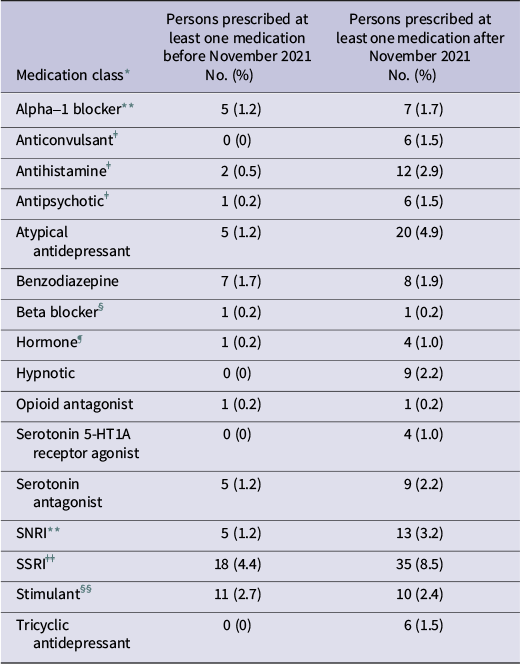
We reviewed 1,581 individual medications documented in the medical and pharmacy records of the 411 adults. Of those, 119 (29%) adults had ≥1 mental health-related medication documented at any time during the period reviewed, November 2020–February 2023, for a total of 237 prescriptions. A mean of 2 mental health medications per adult were prescribed, with a range of 1–7 medications per person. After the exposure event in November 2021, 109 (26.5%) adults had ≥1 mental health medication prescribed. In 13 of 16 reviewed mental health-related medication classes, more medications were prescribed after November 2021 than before (Table 2). Antipsychotic prescriptions increased from 0.2% to 1.5% of adults from November 2021 to February 2023. Antihistamine prescriptions for mental health increased from 0.5% to 2.9% of adults after the exposure event. Similarly, hormones used for sleep-related complaints (i.e., melatonin) and hypnotics increased in use from 0.2% to 1.0% and 0% to 2.2%, respectively, from November 2021 to February 2023. Atypical antidepressant prescriptions increased from 1.2% to 4.9% of adults. Serotonin-norepinephrine reuptake inhibitors (SNRIs) (1.2% vs 3.2%), selective serotonin reuptake inhibitors (SSRIs) (4.4% vs 8.5%), and serotonin antagonists (1.2% vs 2.2%) also increased in documented use during the 15 months after November 20, 2021. Thirteen medication records could not be classified because of missing start date information.
Mental health-related medication use among adults (N = 411) before and after a jet fuel leak into the drinking water system on Joint Base Pearl Harbor-Hickam on November 20, 2021.

* Medications that were considered active at the time of chart abstraction were considered in this analysis. Persons may be included in more than 1 row and column if data supported multiple medication classes. Person is only counted once for prescriptions in each medication class (row). The medication classes of centrally acting alpha agonist and mood stabilizer were deleted for zero counts.
ǂ Medication was included if documented with an indication for posttraumatic stress disorder, insomnia, or nightmares. We did not include tamsulosin prescriptions.
§ Medication included if documented with a mental health-related indication. Includes atypical antipsychotics.
¶ The hormone category consists of melatonin with documented indication for sleep-related symptoms or conditions such as insomnia.
** Serotonin-norepinephrine reuptake inhibitor (SNRI) does not include medications with documented indications for chronic pain syndromes or migraine.
ǂǂ Selective serotonin reuptake inhibitor (SSRI).
§§ Stimulants do not include medications with documented indication for clinical weight loss.
Discussion
The November 2021 jet fuel leak and resulting drinking water contamination event disrupted the population using the JBPHH distribution system. 11 Our assessment found 29.9% of sampled adults had ≥1 preexisting mental health condition or symptom that worsened during the 15 months after the exposure event. Among preexisting and worsening conditions, we found that adjustment disorders, anxiety, depression, stress, and sleep disorders (insomnia or sleep difficulty) were most commonly documented.
Our analysis examined reported symptoms and diagnoses beyond the acute period of JP-5 exposure and found new mental health concerns persisting for ≥3 months in approximately 20% of adults sampled. Persistent new conditions commonly included adjustment disorders, fatigue or malaise, anxiety, depression, and stress. Our findings support previous community assessment results that reported persistent mental health symptoms in this potentially exposed population. 8 The frequency of mental health referrals demonstrates the need for ongoing access to care and mental health services. The University of Hawaii and community partners have developed a third-party health registry to fully understand the long-term health effects on the population exposed to JP-5. 12
We found certain classes of mental health medications were used more frequently after the jet fuel contamination incident, particularly antipsychotics, antidepressants, and sleep-related medications. This finding suggests that mental health symptoms may have become more prevalent following the contamination event.
Limitations
We obtained data from chart reviews of adults sampled through DOEHRS who visited the clinic during the study period. Therefore, the sample might be susceptible to selection bias. These data did not capture personal experiences of those who chose to seek care outside the military medical system or who did not disclose their symptoms to military health care providers. Our findings are limited by a low selection rate, as we abstracted medical charts from 653 of the 28,601 (2.3%) persons identified on the DOEHRS roster and included 411 persons in the mental health study. We are unable to determine level of potential JP-5 exposure to individuals, and this study did not seek to determine causality of mental health effects. Psychosocial effects of the contamination event itself may have contributed to mental health concerns, such as fear and anxiety related to the water supply, misinformation, stress from relocation, and job stress, among others. 13 The COVID-19 pandemic was ongoing during this incident and also resulted in societal disruptions.Reference Miko, Poniatowski and Troeschel 7 The medication analysis was based on EHR medications listed as active, though we could not determine if patients were taking these medications.
Conclusion
Our analysis highlights the need for mental health awareness, education, and access to care during and after environmental disasters, including large-scale water contamination events. Robust and organized disaster response efforts can provide community support during contamination events; prevent or address misinformation; and allow for clear communication that mitigates panic, anger, and distrust. Longitudinal studies would be helpful to fully understand the long-term mental health effects among this population. Continued access to mental and behavioral health care services should be considered for this population. The University of Hawaii’s Red Hill registry will allow for continued monitoring of long-term mental health outcomes related to contaminated water exposure. 12
Supplementary material
The supplementary material for this article can be found at http://doi.org/10.1017/dmp.2025.10207.
Acknowledgments
The team acknowledges Jennifer Espiritu, Amy Lavery, John Oh, and the personnel of the Defense Health Agency Region Indo-Pacific, EpiData Center, and Tripler Army Medical Center.
Author contribution
D.N., C.M., K.S., D.C., L.B., I.M., A.F., J.P., N.T., T.H., M.O., and S.K. conceived and planned the medical record abstraction. D.N. and S.K. provided administrative and logistical support. D.N., C.M., K.S., D.C., L.B., I.M., A.F., J.P., N.T., T.H., A.C., and S.K. carried out the record review and/or quality control and assurance. C.M., I.M., and A.F. designed the database, worked out technical details, and carried out the analysis. D.N., C.M., K.S., D.C., L.B., N.T., T.H., and A.C. contributed to the interpretation of the results. K.S. and L.B. took the lead in writing the manuscript. All authors provided critical feedback and helped shape the research, analysis, and manuscript.
Funding statement
There are no funding sources to disclose.
Competing interests
The authors declare none.
Disclaimer
The findings and conclusions in this report are those of the authors and do not necessarily represent the official positions of the US Centers for Disease Control and Prevention/Agency for Toxic Substances and Disease Registry.