After the Constitutional Revolution, particularly in the period between the two world wars, Tehran underwent massive socio-spatial transformations. By the advent of World War II, the city was unrecognizable from what it had been in the early twentieth century. Tehran between the two world wars is a relatively understudied topic.Footnote 1 Most of the available literature examines the spatial transformation of the city through a morphological framework. They mostly focus on the role of the Pahlavi state in performing massive urban projects and transforming the physicality of Tehran by constructing new streets and squares, both in the old and new cities. The municipality of Tehran widened the streets of the northern city from the 1870s expansion and built new squares at their cross-sections. In the southern city, it constructed new straight and wide streets by cutting through the old neighborhoods. Through these projects, the state superimposed a new spatial pattern on the old fabric. Moreover, by constructing buildings with uniform façades and extroverted architecture alongside the new streets and squares and incorporating pre-Islamic motifs in the façades of the government buildings, the Pahlavi state provided a new physical appearance for the city.Footnote 2 The state also wiped out a vast section of the Sangelaj neighborhood for the stock exchange building. This project was never finished and, years later, the municipality transformed the empty land into a public park, Pārk-e Shahr. Similarly, the destruction of many of the Qajar palaces inside and outside of the royal compound provided open space for new government buildings. In 1933, the municipality tore down the city ramparts without replacing them; the last barrier against Tehran’s limitless expansion was wiped out. Finally, long avenues connected Tehran to the northern mountainous region. These streets provided the spatial structure for the expansion of Tehran towards the north.Footnote 3
In contrast to these morphological descriptions, this article presents an alternative story. By the analysis of the social transformation of Iranian urban society in the first half of the twentieth century, it studies the relationship between spatial and social changes in Tehran. It demonstrates that the consolidation of the discourse of modernity, manifested in the social demand for the pursuit of alternative forms of social life and state-sponsored socio-spatial reforms, played a crucial role in the transformation of the city. Although the urban projects of the Pahlavi state resulted in dramatic spatial changes in Tehran, this article rewrites the story of modern Tehran through the investigation of the reciprocal relationship between the sociality and spatiality of the city.Footnote 4
As this article suggests, the transformation of Tehran, particularly in the 1920s and 1930s, was a twofold process. The first aspect of this process resulted in the dramatic decline of the traditional forms of social life and spaces in the city. The second aspect led to the development of alternative forms that were relatively new and did not have much precedent in Iranian cities. These two aspects were deeply interconnected and each had certain impacts on specific sections of Iranian urban society. Moreover, the Pahlavi state played a significant role in this socio-spatial transformation.
The investigation of Tehran in the interwar period demonstrates that, on the one hand, the pursuit of modernity by the state and society, particularly the modern middle class, resulted in the systematic transformation of traditional social spaces, such as coffeehouses, traditional kitchens, zurkhānehs, and takiyyehs. By imposing strict guidelines, nezāmnāmehs,Footnote 5 the state regulated and altered the long-established socio-spatial configuration of these spaces. In their periodicals,Footnote 6 the modern middle class portrayed these traditional forms of social life and spaces as filthy, unhealthy, and obsolete. On the other hand, the advocates of modernity pursued novel forms of social life modeled after European countries. The members of the modern middle class produced new social spaces mostly in the northern neighborhoods of Tehran, Hasanābād and Dowlat. These European-style spaces—cafés, restaurants, cinemas, theaters, hotels, and sport clubs—acted as social markers for the distinction of the advocates of modernity and their way of life from the rest of society and the traditional and religious lifestyles.Footnote 7
As this investigation suggests, a powerful social discourse generated a strong desire for new forms of social life with vast spatial manifestations. This discourse resulted in certain spatial and social dichotomies in Tehran. Modern and traditional, progressive and obsolete, European and Iranian, and secular and religious dichotomies produced their socio-spatial manifestations in the city.
This article continues with a brief introduction to the transformation of Iranian urban society and the formation of the modern middle class after the Constitutional Revolution, particularly during the two decades of Reza Shah’s reign. This examination demonstrates that the formation and development of the modern middle class and its close ties with the Pahlavi state were decisive factors in the transformation of social life and spaces of Tehran. Afterwards, the paper examines the formation of alternative forms of social life and spaces in the city and the demise of the traditional ones. It studies the role of the state and the modern middle class in these socio-spatial transformations and demonstrates that the prevalence of cafés, restaurants, hotels, theaters, cinemas, and sport clubs took place alongside the decline of coffeehouses, traditional kitchens, takiyyehs, and zurkhānehs.
The Transformation of Iranian Urban Society
Iranian urban society underwent a dramatic transformation in the post-Constitutional Revolution era. This transformation accelerated in the two decades of Reza Shah’s power. The nineteenth-century Iranian urban society was largely communal and segmented.Footnote 8 The urban population consisted of many smaller communities. The members of each community had a shared social identity, such as ethnicity, city of origin, language, religion, sectarian affiliation, profession, and the like.Footnote 9 As a result, instead of broad horizontal classes, “vertical bonds” structured urban society; in the “vertical divisions in society,” the homogenous groups consisted of rich and poor people at the same time. The vertical communal bonds were stronger than horizontal social ties that might have transcended the differences between the communities and created classes based on common economic interests.Footnote 10
The spatial manifestations of this segmented urban society were semi-independent wards. The inhabitants of each ward had the same social identity.Footnote 11 Moreover, this communal identity was reflected in the traditional social spaces of Iranian cities. Each community had its own coffeehouses, takiyyehs, zurkhānehs, bathhouses, and mosques. These mostly masculine spaces were the centers of social gatherings for each community where people could follow their communal practices. People’s communal identity constituted communal spaces, and in return, these spaces reproduced the communal identity of various communities of the city.
However, this old-established social structure underwent dramatic transformations in the first half of the twentieth century. Rapid urbanization and internal migration from rural areas to the cities increased the urban population.Footnote 12 Tehran’s population in 1922, a year after Reza Shah’s military coup, was around 210,000 people.Footnote 13 This number reached 310,000 in ten years without any change in the city boundaries.Footnote 14 By 1941, just before Reza Shah’s abdication, the population of Tehran had passed 540,000 people, and the city had grown considerably.Footnote 15 Fifteen years later, the first national census of November 1956 counted more than 1.5 million people in the city.Footnote 16
This rapid urban growth, accompanied by the political and social demands for reforms in pursuit of modernity,Footnote 17 disturbed the old social structures, led to the decline of the communal segmentation, and contributed to the development of new urban classes. After the Constitutional Revolution, two major classes developed in Iranian cities: the urban working class and the modern middle class. By the establishment of the Pahlavi state, the modern middle class, the focus of this paper, grew rapidly to become a decisive social force in the years to come. This class had a significant impact on the transformation of Tehran, its social life, and spaces.
In Iranian studies literature, there are different terms for this class, such as professional-bureaucratic intelligentsia, new middle class, intelligentsia, modern middle class, and rowshanfekrān or intellectuals.Footnote 18 The examination of various definitions of the modern middle class suggests two possible approaches to delineate this class: through its socio-economic status and based on its social values. It is important to note that each of these markers has points of overlap and divergence with the traditional strata of society, and the clear demarcation between the modern middle class and the rest of urban society can be misleading.
The central bureaucracy of the Pahlavi state, its centralization policies, and the modern professional market contributed to the formation and development of the modern middle class as a socio-economic marker. During the interwar period, the state grew from a weak and small circle of courtiers to a capable central government with thousands of full-time personnel. Moreover, the military forces had thousands of personnel in their service. As a result, the state became the biggest employer in the country. The 1922 municipality census counted 6,369 government employees in Tehran, and in 1932 there were 12,105 employees in both military and nonmilitary sections. In 1932, the number of the employees plus their family members was 40,838, which suggests that government employment had a direct impact on more than 13 percent of the total population of the city.Footnote 19
Besides the state, as Schayegh argues, the growing market for the modern professions, such as medicine, law, teaching, engineering, and architecture, played a great role in the development of the modern middle class.Footnote 20 Al-e Ahmad uses this professional background to estimate the size of the modern middle class in 1956. Based on his detailed calculations using the 1956 national census, the modern middle class nationally consisted of 450,000 people in that year.Footnote 21
Moreover, the development of the national education system had a significant impact on the consolidation of this class. The new education system trained the manpower for the state’s bureaucracy, industries, and commercial enterprises. Moreover, it was a crucial element in the nation-building project of the state.Footnote 22 Although the basis of these reforms had been initiated by the establishment of a few modern primary schools in the late nineteenth century and, more importantly, the 1910 passage of the Fundamental Law of Education by the parliament, the main national reforms occurred after the 1921 coup and the establishment of the Pahlavi monarchy.Footnote 23
The 1935 yearbook of the Ministry of Education provides a reliable source for illustrating this progress.Footnote 24 Between 1925 and 1935, the budget of the Ministry of Education increased 7.5 times, from 7.7 to 58 million riyāls,Footnote 25 and reached 84 million in 1940.Footnote 26 The number of the schools, both the old-fashioned schools (maktabs) and new schools, increased from 612 in 1922–23 to 5,339 in 1934–35.Footnote 27 During the same period, the number of students rose from 55,131 to 255,673;Footnote 28 by the time of Reza Shah’s abdication from the power, their number had reached 366,095. Only 51,922 of the students were in maktabs.Footnote 29
Women’s education witnessed an impressive expansion during this era as well. The number of female graduates from the modern primary schools increased from three in 1912, compared to forty-four male graduates for the same year, to 2,253, compared to 6,631 males, in 1935.Footnote 30 The first group of forty girls graduated from the modern high schools in 1928, fourteen years after the first male graduates. This number reached 211 girls in 1935, compared to 537 boys.Footnote 31
The state’s bureaucracy, the new education system, and the modern professions were not continuations of their Qajar counterparts. They were detached from the politics of segmented society; they were centers for the amalgamation of people under the rubric of nationalism; they were employers beyond any communal identity. Although by the end of the Reza Shah era the size of the modern middle class was relatively small in comparison to the entire population, these changes signaled the beginning of the decline of the old social structures.Footnote 32
Regarding the social values of the modern middle class, it differed from the traditional strata of society in two significant ways. First, the modern middle class distinguished itself from the rest of society by including women in the social scene. The state’s social reforms had great effect on this process. The Pahlavi state commenced a top-down project to integrate women into public life. By increasing women’s education and employment opportunities as well as introducing compulsory unveiling, the state attempted to redefine the image of modern Iranian women.Footnote 33 Although these steps were elementary, in the long term they had a crucial impact on Iranian urban society. The most significant shift was the transformation of the gendered quality of public spaces.Footnote 34 New definitions of women in society, beyond daughters, mothers, and sisters, became possible during the first Pahlavi era. Although Amin demonstrates that alongside this social transformation “the very meaning of male guardianship had been expanded” as well, by this time women could become students, teachers, co-workers, and classmates, and the modern middle class was at the center of this social change.Footnote 35
Second, the modern middle class assimilated willingly into the culture of modernity through an active pursuit of modern reforms in the West. It is possible to trace this desire to long before the Constitutional Revolution, as early as the Fath ʿAli Shah (1797–1834) era. However, the Constitutional Revolution and the establishment of the Pahlavi state provided a new momentum for the pursuit of this desire and mobilized certain sections of Iranian society and the state. The modern middle class actively followed and promoted a new lifestyle, different from the traditional one. In the words of Bianca Devos, “[t]hese middle-class Iranians were not just passively modernized through state-enforced reforms, they themselves acted as pioneers promoting a progressive way of life, primarily by adopting a modern Western lifestyle.”Footnote 36 Ahmad Ashraf suggests that this class turned away from Iranian and religious culture to enjoy “the fruits of modernization and Westernization.”Footnote 37 Multiple motives behind the modern middle class’ adoption of Western culture can be identified, such as their sense of the backwardness of the country, interest in improving Iranian society, and adoption of a western lifestyle as a marker of their social status.Footnote 38
There was an alignment between the Pahlavi state’s reform projects and the demand of particular sections of Iranian society, particularly the modern middle class, for modernization and progress. As a result, more than any other social group, the modern middle class constituted the state’s growing bureaucracy; it played an active role in the modernization project of the state. Through an analysis of the newspaper articles of the era, Bianca Devos claims that: “[m]ost of the middle-class modernists widely supported the state’s ambitious reform agenda. They believed a strong centralized state to be of utmost importance for it to succeed.”Footnote 39 The members of the modern middle class tied their own interests to the state’s social reforms; they played a significant role in the substitution of secular nationalism for religious fanaticism. Without their support, the Pahlavi state could not implement many of its reforms.Footnote 40
These social transformations led to the formation of, in the words of Ahmad Ashraf, a “dual class structure” in Iranian cities.Footnote 41 On the one hand, there were the traditional sections of Iranian society with all their communal interactions and religious gatherings and, on the other hand, there was the alliance between the state and certain sections of urban society, particularly the modern middle class, based on the shared desire for the pursuit of modernity and reforms. In this era, a social gap developed between the two sections. Ashraf describes this gap in these words:
The rift between these two principal strata intensified in the process of modernization in the interwar period [ … ] These developments have led to the formation of an increasing cultural alienation of the ruling elite and the new middle classes from the religious stratum and the masses of bazaaris, rural migrants, workers, peasants, and tribesmen.Footnote 42
Under these conditions, the close bond between the state and the modern middle class resulted in the consolidation of this class and further transformation of the social life and spaces of Iranian cities, particularly Tehran.
Although these accounts portray a dichotomous social structure and the further examination of social spaces in Tehran demonstrates the spatial manifestation of this dichotomy, it is important to note that this dichotomization did not necessarily result in the complete separation of social groups. There were definitely many people in the so-called traditional sections of urban society who actively pursued alternative ways of life. Similarly, the alliance between the modern middle class and the state does not mean that there was no point of convergence. The dictatorial attitude of the Pahlavi state generated discontent among various social groups, as well as within the modern middle class.Footnote 43
The next section examines the social life and spaces of the modern middle class and the traditional strata of society in Tehran. The spatial rise of the modern middle class coincided with the decline of communal life and traditional social spaces. As this research demonstrates, the state’s policies played a decisive role in the consolidation of the former and the demise of the latter.
From Coffeehouses to Cafés
Coffeehouses and traditional kitchensFootnote 44 were the centers of communal life in nineteenth- and early twentieth-century Tehran. With their particular social norms and practices, they were the spatial manifestations of the communal identity of their users. Men of each community, guild, or neighborhood gathered in these spaces for socializing, listening to the tales of storytellers, and, as manifested during the Constitutional Revolution, for political activities. In the interwar period, by imposing strict guidelines, nezāmnāmehs, the state systematically regulated and transformed these spaces and their social interactions.
On 25 September 1928, the municipality of Tehran issued its first nezāmnāmeh for cafés and coffeehouses. It consisted of twenty-five rules organized into four sections: construction, opening, products, and the range of services.Footnote 45 The primary goal of this nezāmnāmeh and many other similar ones was the regulation of the safety and health aspects of various enterprises. For example, the cafés and coffeehouses nezāmnāmeh obliged the owners to control the wastewater from their premises and install chimneys for fumes, forbade clay cups, regulated the use of hookahs, and many other similar measures.Footnote 46 However, a close reading of the nezāmnāmehs shows that they were the state’s means for implementing subtle socio-spatial transformations to redefine the traditional social functions of these spaces.
The very first line of this nezāmnāmeh states that “cafés and coffeehouses are the same.” By placing cafés and coffeehouses in the same category, the state was able to regulate them in the same way. Coffeehouses were lively centers of communal life with their well-established social interactions. In contrast, cafés mostly belonged to the modern middle class and were patterned after European cafés. The state’s regulation thus resulted in the social transformation of the former and the growing prevalence of the latter. Article three of the first section of this nezāmnāmeh forbade coffeehouses from drawing pictures on their walls and ceilings; article five forbade them from building sitting platforms around their interior space; article six obliged them to separate the food, tea, and coffee preparation area from the serving space; article one of the second section obliged them to use tables and chairs instead of platforms; and article seven of the fourth section prohibited naqqāli, storytelling, and similar communal activities usual in traditional coffeehouses.
These regulations went far beyond a public health discourse. The spatial bureaucratization through this nezāmnāmeh did not merely address issues of hygiene. By targeting one of the most vibrant traditional social spaces, the state was able to upset the reciprocal relationship between social interactions and social spaces. Forbidding the drawings meant the storytellers were unable to use them to perform their acts, since drawings were an inseparable part of naqqāli. The rearrangement of the interior seating affected the communal atmosphere of coffeehouses. Instead of sitting on platforms around the interior space, watching the performance, and participating in the collective act taking place in the middle, now people had to sit at separate tables. Moreover, these laws directly forbade all the communal activities that took place in coffeehouses, particularly naqqāli.Footnote 47 Finally, by separating the food preparation and serving areas, the laws disregarded the central role of the owner of the coffeehouse, the qahvehkhānehchi. As prominent figures in their neighborhoods and communities, the owners played a significant role in all the communal activities inside their enterprise and, at the same time, they could control the food preparation and serving processes. But these regulations forced them to move behind the walls of the kitchen, effectively detaching them from their communities.
The same socio-spatial regulations affected traditional kitchens. Similar to coffeehouses, the nezāmnāmeh for traditional kitchens primarily focused on various health and safety aspects.Footnote 48 However, amid these health and safety regulations, the state altered some socio-spatial aspects of traditional kitchens as well. The municipality’s regulations obliged them to separate their food preparation area from their serving area, otherwise they would be shut down.Footnote 49 Similar to coffeehouses, platforms were forbidden, they were obliged to use tables and chairs; they had to separate the interior space from the street by installing windows, and they had to remove all the drawings on the ceilings and walls. The laws even forbade customers from eating with their hands, obliging them to use utensils.Footnote 50
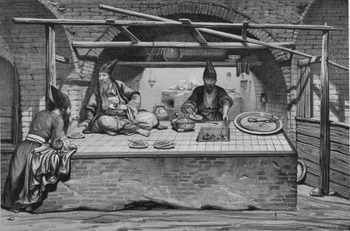
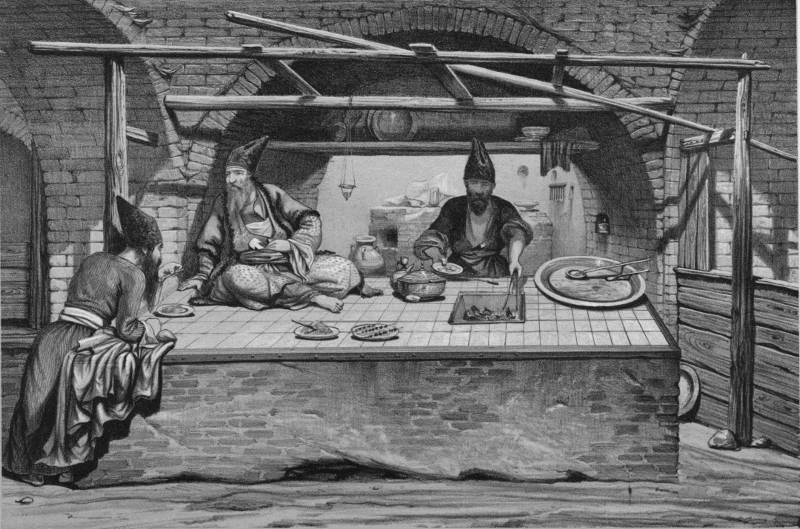
A painting from the early 1840s provides an image of traditional kitchens in the Tehran bazaar, as shown in Figure 1. This painting shows how the location of the platform in the front of the shop was like a meeting place for the owner of the kitchen and his customers. It helps to imagine how separating the kitchen and serving place, installing windows and doors for the shop, and using chairs and tables instead of platforms transformed the customary socio-spatial relations. While the health and safety aspects of these regulations are indisputable, it is important to note how subtle architectural transformations had profound social impacts. The resulting stores did not belong to traditional Iranian society; they were alien spaces in the old city. Through these spatial transformations, the Pahlavi state managed to upset the spatial arrangements that could enhance communal interactions between the members of the traditional strata of society. The state attempted to construct a socio-spatial image that matched its desired norms for a modern and progressive society.
A Traditional Kitchen in Tehran Bazaar.
Source: Eugène Flandin, “Tourneur de Caliouns; Cuisine de Bazar,” General Research Division, the New York Public Library, New York Public Library Digital Collections, under http://digitalcollections.nypl.org/items/510d47e2-9066-a3d9-e040-e00a18064a99 (accessed January 4, 2016).
The systematic transformation of coffeehouses and traditional kitchens is half of the story. In contrast to the fate of these spaces, the Reza Shah era witnessed the proliferation of European-style cafés, restaurants, and hotels in Tehran. Alongside the development of the modern middle class, these spaces increased and spread mostly in the northern neighborhoods of the city. Cafés, restaurants, and hotels became the gathering places of the people who wished to practice an alternative lifestyle, which was modern, mixed-sex, nontraditional, and European. Articles in the Ettelāʿāt newspaper, as the main vehicle for reflecting the social views of the modern middle class, clearly demonstrate how this class equated progress and the modernization of society with the proliferation of European-style social spaces. In this view, a modern city and society had to have cafés, restaurants, and hotels: “hotels are one of the principles of civilization and one of the requirements and necessities of every city.”Footnote 51 Another article from 25 October 1931 asks whether people have changed as the result of the state’s modernization. The article encourages people to go to theaters, cinemas, cafés, and concerts to become modern:
People who are trying to change, not only have changed their appearances but also have changed their identity and adopted the modern principles of social life from a few years ago; they are eager to learn [about the modern world]. Now that they have to go to theaters, cinemas, cafés, and concerts, they want to know which moral principles they should adopt and which [flaws] they should abandon.Footnote 52
The modern middle class advocated new forms of social life and social spaces as venues for the modernization and westernization of society. Participation in the social life of these spaces was understood as the mechanism by which the culture of modernity could be assimilated.
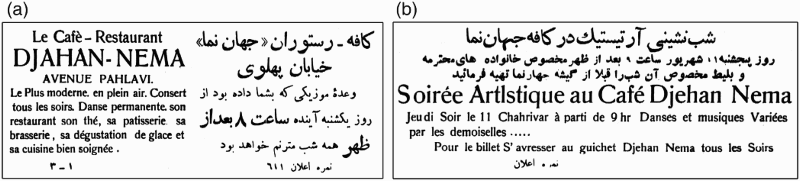
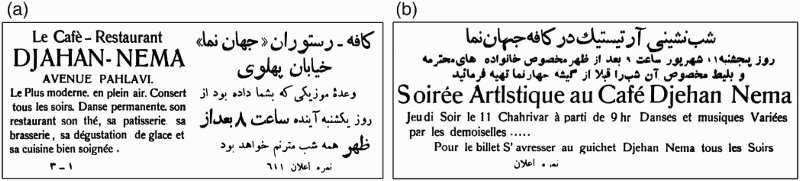
It is no surprise that most of the names of these enterprises were non-Iranian, mostly European, such as the Grand,Footnote 53 Paris,Footnote 54 Victoria,Footnote 55 Renaissance,Footnote 56 Luxe,Footnote 57 Imperial,Footnote 58 and ContinentalFootnote 59 hotels. Similarly there were Continental,Footnote 60 Voka,Footnote 61 Imperial,Footnote 62 Mikado,Footnote 63 Modern,Footnote 64 Lausanne,Footnote 65 Luna Park,Footnote 66 Lotto,Footnote 67 and BristolFootnote 68 cafés or café-restaurants. Some of the cafés went as far as advertising in Persian and French at the same time, as seen in Figures 2 and 3, and in their advertisements they highlighted their western features:
Important Announcement. Imperial Hotel and Restaurant in Lālehzār Street next to Didehbān Māyāk Cinema inaugurated on Monday night, 3 Azar 1309 [25 November 1930], based on the best European style. For the reception of respectable gentlemen, there are various options such as soirée, evening tea, American bar, lunch, and dinner. The orchestra for the evening tea plays from four to six pm and for the soirée from eight pm to two hours after midnight.Footnote 69
Advertisements of Cafés in the Ettelāʿāt Newspaper.
Sources: Ettelāʿāt Newspaper, 24 Khordād 1310 [15 June 1931]; 7 Shahrivar 1310 [30 August 1931].
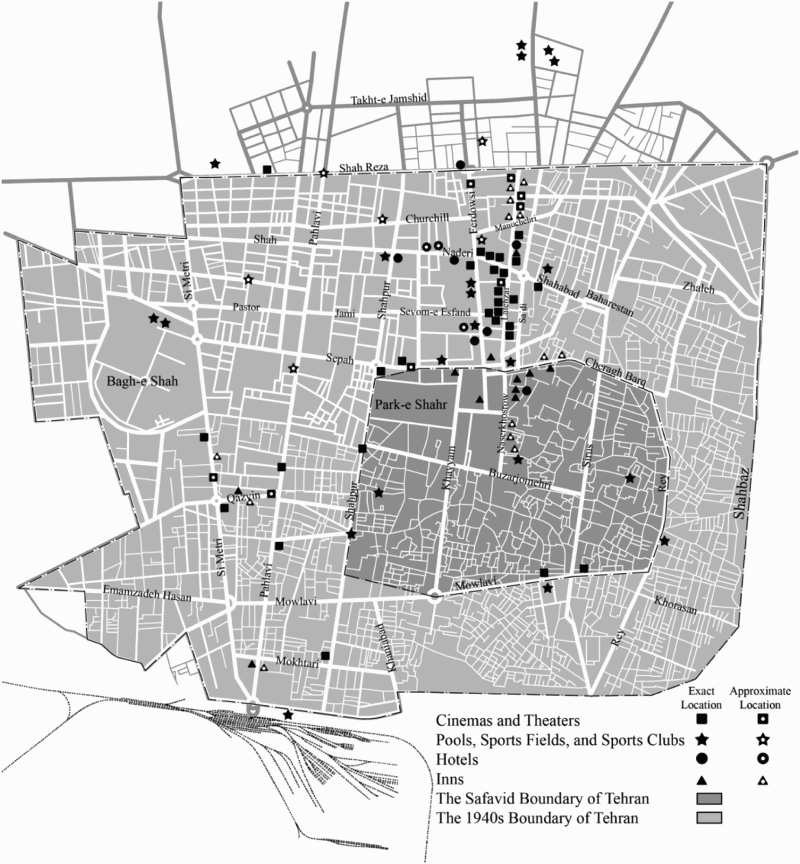
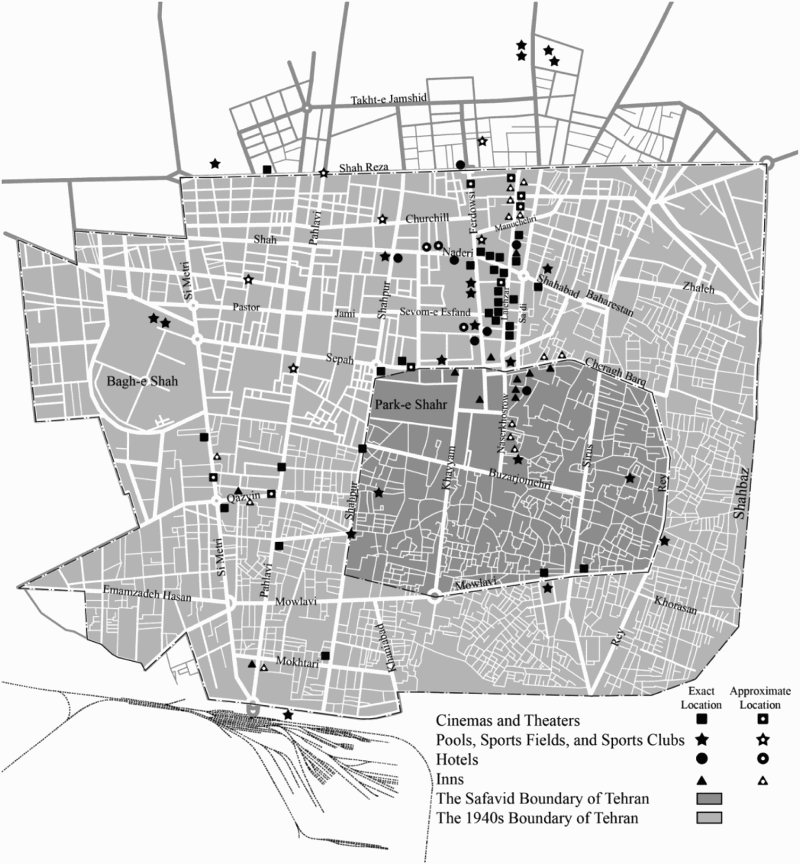
The distribution of modern social spaces in Tehran in 1949.
Source: Shahrbani-ye Kol-e Keshvar. Rāhnamā-ye shahr-e Tehran [Tehran city guide]. Tehran: Dāʾereh-ye Joghrāfiyā-ye Setād-e Artesh, 1328 [1949].
Notes: After the reviewers’ suggestion for a more accurate mapping of the enterprises in this figure, I went through a time-consuming process of identifying the exact location of all ninety-seven marks on the map. My initial list of these places—Rāhnamā-ye shahr-e Tehran—does not record their exact address and, on many occasions, it just mentions the main streets where they were located. I utilized various sources for this mapping. I used Google Map to identify if these enterprises still exist. Another interesting and more accurate source is the Iranian version of Google Map for Tehran, Naqsheh-ye Tehran accessible at http://map.tehran.ir/. In comparison to Google Map, this map registers more local enterprises and, more importantly, it has the street view of Tehran’s streets and alleyways. This street view was a great help in identifying the current location of many enterprises, particularly the old cinemas. Parviz Davāʾi’s Bazgasht-e Yekkeh Savār provided me with a great description of the cinemas in Tehran and helped me to map them more accurately. In addition, I studied many different weblogs and websites to cross-check my findings in various sources to determine their validity or accuracy. Finally, I visited many places in person to identify whether these enterprises still exist. After all, I could not identify the exact location of thirty enterprises. I marked these ones with a white dot on the map. Davāʾi, Bazgasht-e Yekkeh Savār, 63–88.
The advertisements in the Ettelāʿāt newspaper show that new forms of social life developed around these spaces, such as garden parties, masquerades, public parties for the New Year, dances, concerts, theater, film screenings, and the like.Footnote 70 These forms of social life were relatively new in Iranian cities. The desire for alternative forms of social life, mostly pursued by the modern middle class, produced spaces that were in stark contrast to the traditional strata’s social spaces. The contrast between these spaces is traceable in the literature of both sections of society. On the one hand, the traditional strata used particular terms to humiliate those who practiced the modern way of life and people with a European appearance, such as fokoli, mostafrang, qerti, and farangimaāb.Footnote 71 On the other hand, the modern middle class ridiculed the traditional forms of social life and spaces in their periodicals. For example, the Ettelāʿāt newspaper wrote about the unhealthy conditions in traditional coffeehouses and claimed that the customers of these places were either low-income workers or opium addicts.Footnote 72 In a series of comic articles in the Tehran-e Mosavvar magazine, the author depicted a countryman, dehāti,Footnote 73 who came to Tehran and was impressed by its progress. No longer able to recognize the city, he talked about its various marvels. On one occasion, the poor countryman entered a modern café and described it in these words:
Wow! What is this place?! It is not a coffeehouse! Definitely, it is not a coffeehouse! If it is a coffeehouse, why there is no painting of Rostam, Sohrāb, and Giv on the walls!?Footnote 74 If it is a coffeehouse, why does it not have a storyteller? [ … ] If it is a coffeehouse, what are these chairs and table?! If it is a coffeehouse, why does it have a gramophone?! […] Maybe it is the house of farangis! O my God! I seek refuge in You. I am about to go crazy.Footnote 75
The modern social spaces of Tehran were mostly located in the new northern neighborhoods of the city. The 1932 census of Tehran counted fifty-five cafés in the city, forty-three of which were in the two northern neighborhoods, Hasanābād and Dowlat. A 1914 travel guide to Tehran mentions only three hotels in the city, Hotel de Paris, Hotel de France, and Hotel de l’Europe, all on the northern street of ʿAlāʾ al-Dowleh, later Ferdowsi Street.Footnote 76 In 1932, there were fifty-four hotels and inns, thirty-three of which were in Hasanābād and Dowlat, and sixteen in the Udlājān neighborhood. Finally, the census counted thirty-three restaurants, nineteen of them in the northern neighborhoods. There were no cafés and hotels in the two main southern neighborhoods of Mohammadiyyeh and Bazaar, and there were only two restaurants in the latter.Footnote 77 Figure 3 shows the distribution of hotels and inns in the city based on the 1949 guidebook for Tehran. Once again, the two neighborhoods of Dowlat and Hasanābād accommodate the majority of these enterprises. The south and north, old and new, traditional and modern, and Iranian and European dichotomies had formed distinct spatial dimensions in the city.
From Takiyyehs and Religious Performances to Cinemas and Theaters
The second half of Reza Shah’s reign witnessed the restriction of many religious public performances. The prohibition of Muharram mourning rituals, particularly taʿziyyeh performances and mourning processions, was one of the manifestations of the state’s clampdown on religion. There was a transitional period from the formation of the Pahlavi state to the banning of the religious rituals. The announcements in the Ettelāʿāt newspaper prove that the municipality of Tehran sponsored Muharram rituals up to 1933.Footnote 78 After 1933, there is no sign of the state-sponsored Muharram ceremonies. As a result, Shahidi’s and Floor’s estimates that 1932 or 1933 were the possible years of the official ban on Muharram rituals is likely to be correct.Footnote 79
There are several possible reasons for this prohibition. Peter J. Chelkowski believes that the incompatibility of these rituals with the state’s modernization programs and the fear of the transformation of the rituals into political demonstrations were the main reasons for the ban.Footnote 80 Aghaie sees the ban as the state’s method of eliminating possible political opponents.Footnote 81 Beizaʾi and again Aghaie argue that the state’s ban on the ceremonies was in order to create a more civilized image of Iranian society in the international arena, since some of these ceremonies could be judged as violent and backward by foreigners.Footnote 82
The articles in Ettelāʿāt provide clues regarding the hostility of the advocates of modern reforms towards the religious rituals. The authors of these articles, mostly the members of the modern middle class, depict mourning ceremonies as dark rituals against public virtue,Footnote 83 contrary to public health, and an element of the humiliation of Iranians in the eyes of Europeans.Footnote 84 Muharram rituals were not the only religious ceremonies that were prohibited under Reza Shah’s rule. The qorbān camel sacrifice suffered a similar fate; in 1935, the state abolished the ceremony. Two articles in Ettelāʿāt announcing the ban provide valuable insight into its public framing. On the one hand, the articles mention that the camel sacrifice ceremony was against the real essence of Islam, and that it was a shame for all Muslims. On the other hand, the articles connect the ceremony to the dark ages of Iran, claiming that it was not compatible with a modern and progressive nation.Footnote 85 Moreover, the articles in Ettelāʿāt introduce the month of Ramadan as the month of “silence, boredom, lethargy, and inaction.”Footnote 86
Whatever the reasons behind the restrictions on religious ceremonies, these bans had profound spatial impacts. By abolishing or altering social life, traditional social spaces began to disintegrate and disappear in the cities. Tehran’s takiyyehs, as the lively centers of the old neighborhoods, disappeared one by one in the years following. In 1946, the state demolished the gigantic circular takiyyeh Dowlat in the royal compound to provide an open space for the bazaar branch of the National Bank.Footnote 87 In losing their communal spaces, the traditional forms of social life lost their reproductive capacity.Footnote 88
However, the disintegration of the old forms of communal life and spaces was not the only process. Similar to the case of coffeehouses and cafés, a parallel social process generated new forms based on the sociality and spatiality of western countries. As such, cinemas and theaters offered an alternative to the abolished religious performances. Beginning in the constitutional era, the intelligentsia had already begun to popularize cinema and theater when the Pahlavi state consolidated. The constitutional era helped to transfer theatrical performances from the small circle of Qajar courtiers to the broader public.Footnote 89
However, this process accelerated during the Reza Shah period. The growth of the modern middle class and the social demands for alternative forms of collective life were decisive factors in the proliferation of cinemas and theaters. Gradually the number of these spaces increased in Tehran. In 1925, there was only one cinema in the entire city. The number reached seven in 1929,Footnote 90 fifteen in 1933,Footnote 91 and thirty-six—twenty-eight cinemas and eight theaters—in 1949.Footnote 92
Moreover, the cinemas became more affordable for all the sections of society. An article in the Ettelāʿāt newspaper on 19 August 1929 criticized the prices of the tickets and complained that the poor and ordinary people could not afford the tickets. In 1932, the municipality began to set the ticket prices for each cinema separately.Footnote 93 With the increase in the number of cinemas, the municipality graded them into three levels and issued a separate cinema nezāmnāmeh. The cinema nezāmnāmeh set the maximum price of the tickets for each grade.Footnote 94
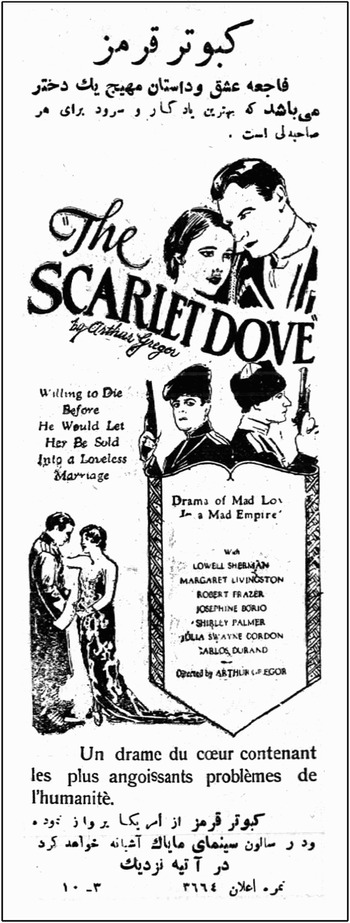
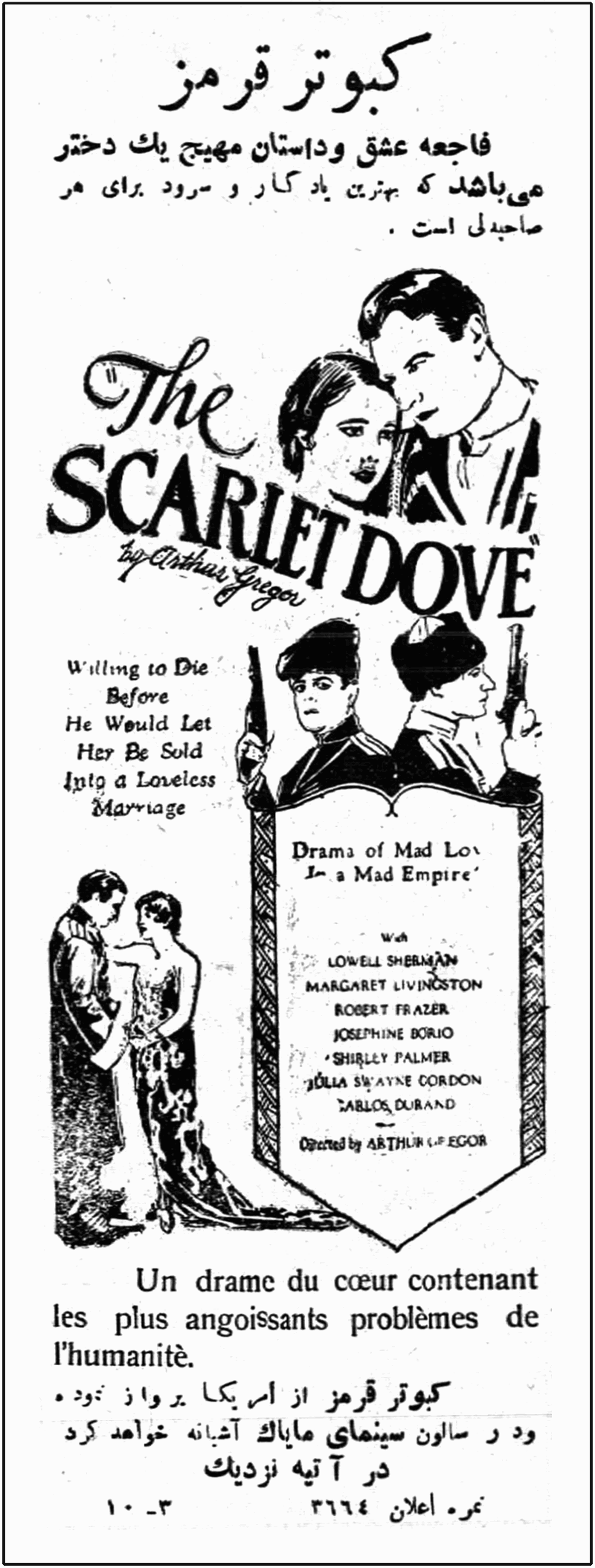
Through these measures, cinemas and theaters became an inseparable part of people’s social life, particularly for the modern middle class. Hamid Naficy demonstrates how the rise of the modern middle class contributed to the popularization of the cinema. In this process, advertisement was a key factor; “newspaper ads, flyers, posters, billboards, and sometimes spectacles involving ballyhoo, barkers, musicians, and planes” helped to create a culture of social life around cinemas and theaters in Iranian cities, as can be seen in Figure 4.Footnote 95 By the second half of Reza Shah’s reign, articles in Ettelāʿāt depict crowded cinemas, long lines in the streets, and the popularity of cinemas and theaters.Footnote 96 The document that most accurately confirms this popularity is the municipality’s census of the annual ticket sales in 1931–32Footnote 97 and 1932–33.Footnote 98 Based on this census, in 1931–32, 136,074 theater tickets and 1,032,973 cinema tickets were sold in Tehran. The next year, the sale of theater tickets reached 217,732 and cinema tickets decreased to 927,986. These figures show that on average, in 1931–32, each person in the city went to the cinema or theater five times, and in 1932–33, the number was still high, at four times.Footnote 99 These figures indicate that, by the early 1930s, a lively social life had formed around cinemas and theaters in Tehran. Five cinema and theater attendances per capita in a year show that the desire for alternative forms of social life was not limited to the modern middle class, and various sections of urban society enjoyed the social life of cinemas and theaters.
A Movie Advertisement in Ettelāʿāt newspaper. The bottom text of the advertisement reads: “The Scarlet Dove has flown from America and will nest in Māyāk cinema in the near future.”
Source: Ettelāʿāt Newspaper, 15 Dey 1308 [5 January 1930].
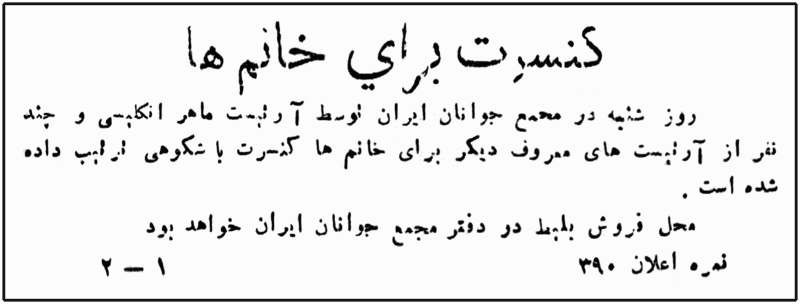
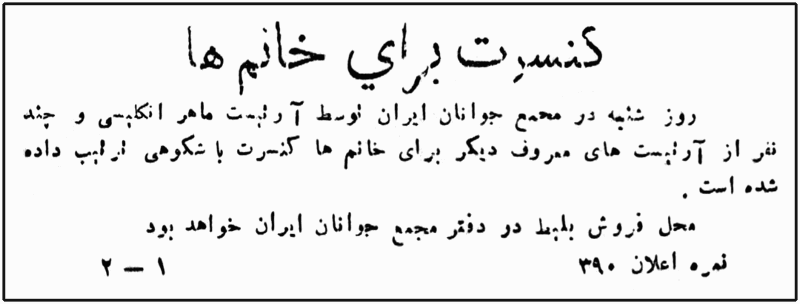
Another significant transformation was the presence of women in the cinemas and theaters. At first, the cinema and theater halls were men-only spaces with occasional women-only showing times. Figure 5 shows an advertisement in Ettelāʿāt newspaper for a women-only concert, announcing: “Concert for women! On Saturday, there will be a glorious concert for women by a skillful British artist and some other famous artists in the Iranian Youth Club.”Footnote 100 Naficy mentions that Alinaqi Vaziri, a reformist musician, opened the first women’s cinema in April 1928.Footnote 101 After the destruction of this cinema in a fire, the modern middle class reformists pursued the establishment of mixed-gender cinemas. One of the early articles that asked for women’s presence in cinemas and theaters appeared on 2 January 1929 in Ettelāʿāt.Footnote 102 Soon women were allowed into the saloons. Similar to the takiyyehs, men and women were separated on two different sides. However, beginning in March 1936, men and women could sit together.Footnote 103
An Advertisement for a Women-only Concert.
Source: Ettelāʿāt Newspaper, 20 Ordibehesht 1306 [11 May 1927].
The decline of takiyyehs and other instances of religious life and the proliferation of cinemas and theaters were the outcomes of the same social discourse that resulted in the transformation of coffeehouses and the prevalence of cafés. There was a commonality between cinemas, theaters, cafés, restaurants, and hotels. They were the products of the social demands of urban society, particularly the modern middle class, for alternative forms of social life and state-sponsored reform aimed at the modernization and westernization of society. At the same time, these spaces were the (re)producers of the same forms of sociality. The articles in Ettelāʿāt show how the modern middle class regarded cinemas and theaters as instruments for social reform. They regarded the cinema as a “necessity of life,” an source for “enhancement of morality,” and a means of “enlightenment.”Footnote 104 Cinemas and theaters were the bridges connecting the modern middle class to the modern European world.
The distribution of cinemas and theaters in the city follows the same pattern as the cafés, restaurants, and hotels. They were mostly concentrated in the northern city, away from the old neighborhoods. Notably, Lālehzār Street became the cultural center accommodating most of the city’s cinemas and theaters. In 1949, five out of eight theaters and nine out of twenty-eight cinemas in Tehran were located on Lālehzār Street. The rest of the theaters and cinemas in the city were mostly grouped in the same neighborhood, such as on Shāh Street.Footnote 105 Figure 3 above provides a map of the distribution of these enterprises based on a 1949 guidebook of Tehran. As the map demonstrates, there is a concentration of cinemas and theaters on Lālehzār and Shāh Streets.
From Zurkhānehs to Sport Clubs
The traditional gymnasiums of Iranian cities faced a similar fate to coffeehouses, kitchens, takiyyehs, and the other venues of traditional social life. The decline of zurkhānehs had already started after the Constitutional Revolution when royal patronage ceased to support them. However, a major blow to the wellbeing of these institutions occurred during Reza Shah’s reign. By the establishment and consolidation of the Pahlavi state, the ban on religious ceremonies, the founding of the municipalities and police forces in the cities, and the eradication of semi-independent neighborhoods and their administration, the zurkhāneh communities lost their primary connections to the broader urban society. They lost their role as the protectors of their neighborhoods after the establishment of police forces. By the ban on Muharram ceremonies, the social strata most closely associated with the institution of the zurkhāneh lost one of their main communal activities. Finally, coffeehouses as their main gathering places outside gymnasiums underwent fundamental socio-spatial transformations.Footnote 106
In the interwar period, the negative framing of zurkhānehs by the advocates of social reforms accelerated their decline. An example from Ettelāʿāt newspaper on 18 October 1928 perfectly summarizes this framing. The article mentions three main drawbacks of zurkhānehs that made them inefficient for the modern way of life. First, although zurkhāneh sports strengthen some muscles, they do not contribute to enhancing the general condition of the body. Second, zurkhāneh exercises are not based on modern scientific design and can cause deformation of certain body parts. Finally, zurkhānehs do not have proper ventilation, and exercising in their unhealthy air can cause harm.Footnote 107 Chehabi mentions four main themes that the modern middle class used to stigmatize zurkhānehs, mostly in their periodicals: the moral corruption of their members, zurkhānehs as centers for criminals, their exercises being incompatible with the modern way of life, and unhealthy air.Footnote 108 Moreover, Cyrus Schayegh recognizes a class discourse in this stigmatization:
The modern middle class thought that the corruption of ‘old’ sport in the unhygienic zūrkhānahs had been caused by human factors. After all, these institutions were frequented mostly by the urban lower classes and by some members of the traditional urban middle class, ignorant of modern science and hostile to disciplined sport and human interaction.Footnote 109
As a result, the same social discourse that resulted in the decline of coffeehouses, traditional kitchens, and religious performances in Iranian cities was at work against the zurkhānehs. Establishing spatial stigmas was one of the reformists’ methods to distinguish their lifestyle from traditional forms of social life.
In contrast to the general decline of zurkhānehs and their stigmatization, a second process was at work to popularize modern European sports in society, particularly amongst the modern middle class. Schayegh’s study shows how the modern middle class adopted modern sports as a socio-cultural marker to distinguish itself from the traditional strata of society. This incentive “propelled sport into the field of state policy and made it a part of the government’s attempt to create a healthy and productive nation.”Footnote 110 Through this process, the modern middle class tied modern sport to a discourse that exemplified it as a means of producing healthy and fit individuals, of enhancing the mental and moral condition of people and society, and as an instrument for the nation-building project of the state.Footnote 111
The first step by the Pahlavi state to promote modern European sports was the passage of the Law for Compulsory Daily Physical Education in the New Public Schools, Qanun-e Varzesh-e Ejbāri dar Madāres-e Jadideh.Footnote 112 The resulting curriculum for physical education in schools completely ignored “zurkhaneh-type exercises”Footnote 113 and adopted a Swedish calisthenics system for boys’ and girls’ physical education.Footnote 114 In 1934, the Office of Physical Education was opened in the Ministry of Education to arrange soccer teams in the schools and hold interschool competitions.Footnote 115 Later that year “a number of Iranian statesmen and educators founded the National Association for Physical Education,” and an American, Thomas R. Gibson, was invited to establish and organize sport clubs and events in the country.Footnote 116 A year later, the Ettelāʿāt newspaper translated and published Gibson’s speech at Alborz College of Tehran, in which he enumerated his first year’s achievements: establishing forty-seven sport clubs in the country, increasing the annual sport budget from 10,000 to 25,000 tumāns, establishing mandatory hours of physical education for primary schools and high schools—one hour per day and two hours per week, respectively—arranging a specific curriculum for children, educating special teachers for physical education hours in schools, and expanding physical education among girls and women.Footnote 117
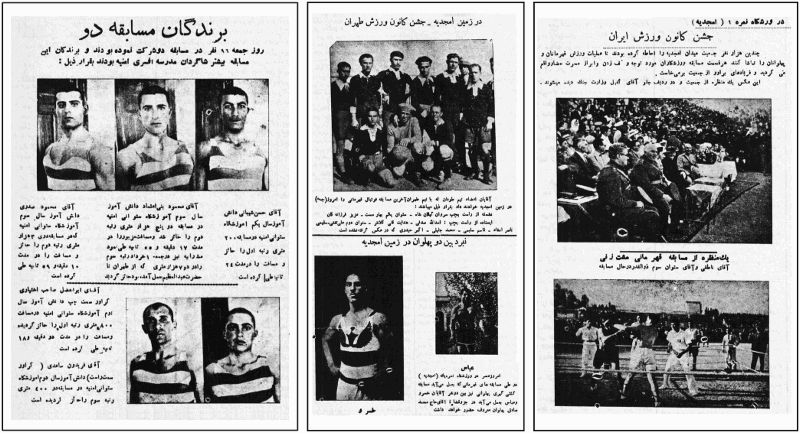
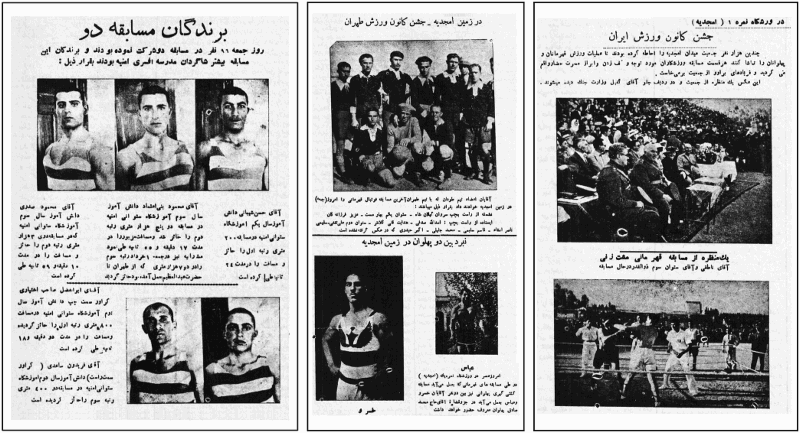
The popularity of modern sports, particularly soccer, grew gradually but constantly throughout the First and Second Pahlavi eras. Chehabi’s study of the popularization of soccer shows how state policies and social demand transformed it from an unknown phenomenon into the most popular sport in the country in just a few decades.Footnote 118 The newspapers of the modern middle class had a great role in the popularization of modern sports. After the establishment of the National Association for Physical Education, the Ettelāʿāt newspaper frequently devoted several columns to reporting various sporting events in the country. Sports news often made its way to the front page of the newspaper, as seen in Figure 6.Footnote 119
News of sports events on the first page of Ettelāʿāt newspaper.
Source: Ettelāʿāt Newspaper, 11 Khordād 1315 [1 June 1936]; Ettelāʿāt Newspaper, 29 Khordād 1315 [19 June 1936]; Ettelāʿāt Newspaper, 31 Khordād 1315 [21 June 1936].
The spatial distribution of modern sport fields and zurkhānehs in Tehran follows the same pattern as other modern and traditional spaces. In 1932, there were eighteen zurkhānehs in Tehran. Only three of them were located in the new northern neighborhoods of the city, and none of them were in the Dowlat neighborhood. Eleven zurkhānehs were located in the Bazaar and Udlājān neighborhoods, the main neighborhoods of the old city.Footnote 120 In contrast, in 1949 there were nineteen sports clubs, seven swimming pools, and seven sports fields in Tehran, mostly in the northern neighborhoods of the city or far north in Shemirānāt.Footnote 121 Figure 3 above shows the location of sport clubs, fields, and swimming pools in Tehran based on a 1949 guidebook of the city. As the map demonstrates, similar to other modern social spaces, they were mostly concentrated in the northern neighborhoods of Dowlat and Hasanābād, particularly on Ferdowsi Street.
Conclusion
A twofold process transformed Tehran—its sociality and spatiality—after the Constitutional Revolution. This process resulted in the decline of the traditional forms of social life and spaces; in contrast, it consolidated the discourse of modernity spatially and produced alternative forms of social life and spaces in the city. This process had passionate social and political supporters.
The advocates of modern reform, particularly the modern middle class, initially supported Reza Shah’s dictatorship since they saw him as the only way towards peace and the modernization of the country.Footnote 122 In return, this class found the opportunity to produce its desired social image; they filled the positions in the new administrative apparatus of the state and played a significant role in its modernization projects.Footnote 123
These reforms had significant spatial manifestations. As detailed above, the Pahlavi state regulated coffeehouses and traditional kitchens in favor of new European-style cafés, restaurants, and hotels. The state’s ban on religious ceremonies was accompanied by a proliferation of cinemas and theaters in Iranian cities. Modern sports clubs and fields overshadowed zurkhānehs and their social practices.
These changes represent the spatial manifestations of the social discourse that had been incubated in Iranian society for decades and reached its apex during Reza Shah’s reign. In this discourse, the West, particularly western Europe and the United States, became a model for the advocates of reform, particularly the modern middle class. This social discourse helped them to distinguish themselves from the rest of society and defined their position as the designated social and cultural heirs of Iran’s future. They constructed an image of the West and reproduced their city after that desired image. In their view, cinemas, theaters, modern sport clubs, hotels, cafés, restaurants, and other western social spaces and practices were the remedy for the obsolete, backward, and traditional sections of society. Social reforms equated to watching plays, going to cinemas, attending garden parties and masquerades, spending time in cafés, and playing soccer. These practices and their related spaces were means to reform traditional Iranian society. In their periodicals, the modern middle class observed its right to continuously educate the other sections of society on how to behave like a modern person and how to act in the new social spaces of the city.
This social discourse produced dichotomies between the advocates of modernity and the rest of society. The former defined its way of life by terms such as modern, progressive, European, secular, healthy, scientific, and happy; and it portrayed the traditional lifestyle as backward, obsolete, religious, unhealthy, unhappy, and ignorant. These dichotomies went far beyond social groups and ways of life. They were reproduced in Tehran and provided new definitions for its sociality and spatiality. The two types of social spaces and the two poles of Tehran, north and south, were redefined through the same discourse, as can be seen in Figure 3 above. The unhygienic, traditional, religious, ignorant south with its takiyyehs, coffeehouses, and zurkhānehs stood in contrast to the modern, western, clean, and enlightened north with its cafés, cinemas, theaters, sport fields, and the like.
The history of modern Tehran and its socio-spatial configuration is deeply entangled with the period between the Constitutional Revolution and the advent of World War II. As the cases detailed in this paper suggest, the state was not the sole agent in the spatial transformation of the city. The conventional morphological studies of Tehran overlook the impact of changing social relations on the spatial configuration of the city. The new social discourse and the resulting relationship between the old and new sociality and spatiality of the city had a dramatic impact on Tehran. These socio-spatial dichotomies transformed the city and defined its future trajectories.
Finally, the case of Tehran can be regarded as a model for the investigation of the same process in other big cities around the country and in the Middle East. During the past century, Tehran, as the biggest and the most populated city in Iran, has always produced models for social and spatial interventions in other Iranian cities. It was like a laboratory, with the results of its experimentations being promoted throughout the country. For example, the construction of long and wide streets in Tehran provided a blueprint for the same spatial interventions in other major Iranian cities, such as Esfahan, Yazd, Hamadan, and Tabriz. These cities witnessed the destruction of their old neighborhoods through the imposition of new spatial structures. Similarly, further research is needed to shed light on the impact of social transformations on the spatiality of other major urban centers in Iran during the Pahlavi era.