In a 1925 article for Music & Letters entitled ‘On the Composition of English Songs’, the British musicologist Edward J. Dent urged the ‘modern English composer’ to turn serious attention to the development of ‘a real technique of song-writing’.Footnote 1 As Dent underlined, ‘song-writing affects the whole style of English musical composition’, for
we English are by natural temperament singers rather than instrumentalists [. . .] If there is an English style in music it is founded firmly on vocal principles, and, indeed, I have heard Continental observers remark that our whole system of training composers is conspicuously vocal as compared with that of other countries. The man who was born with a fiddle under his chin, so conspicuous in the music of Central and Eastern Europe, hardly exists for us. Our instinct, like that of the Italians, is to sing.Footnote 2
Yet, as he quickly qualified, ‘not to sing like the Italians, for climatic conditions have given us a different type of language and apparently a different type of larynx’.Footnote 3 With this in mind, Dent outlined a ‘style of true English singing’ to which the English song composer might turn for his ‘primary inspiration’: a voice determined essentially by ‘the rhythms and the pace of ideal English speech – that is, of poetry’, but also, a voice that told of the instinctive ‘English temperament’. The English singer did not ‘let [himself] go in the way that Italians do’, for example, as Dent explained.Footnote 4 That said, the English singer did, or should, indulge himself in a certain kind of abandon: ‘the natural man sings in his bath; he is in a state of nature’. This ‘natural state’, as Dent lamented, had been lost in ‘modern’ times: the ‘inhibition of natural vocal instinct is a product of modern civilisation, like the equally unnatural habit of reading poetry in silence’.Footnote 5 Thus, Dent encouraged the song composer to rediscover his ‘pre-modern’ vocal instincts: to ‘go out into the garden and bawl at the top of [his] voice’, recovering the voice of ‘natural man’ in the creative act of his song.Footnote 6
Central among Dent's concerns in ‘On the Composition of English Songs’ was to promote improvement in standards of native art song composition by encouraging the English composer to take inspiration from an ‘ideal’ and historic mode of English declamation. As such, he contributed to a series of debates surrounding both song composition and singing in English that had emerged in the earliest issues of Music & Letters,Footnote 7 and that gained momentum within British musical culture during the 1920s in particular.Footnote 8 Lurking within such discussions, as within Dent's article, was a notion that simultaneously emerged from but reached beyond questions of the pronunciation and declamation of English text; namely, the possibility of recovering a ‘pre-modern’, ‘natural’, and even somehow distinctively ‘English’ singing voice. This idea captured the imagination of British musical culture during the so-called ‘English musical renaissance’,Footnote 9 a nationalistic movement in which musicians staged particular narratives and performances of cultural renewal, negotiating questions of national identity and modernity by appealing to distant (and often fictitious) national pasts,Footnote 10 in search of ‘authentic’ sounds and experiences of musical Englishness that had supposedly been lost in an increasingly industrialized and urbanized society.Footnote 11 As is suggested by Dent's directive that the composer become a singer, song composition and performance were frequently imagined as powerful and connected practices through which to rediscover ‘pre-modern’ modes of English musical expression. In the words of another eminent musicologist, Jack Westrup, song – or rather, its community performance – represented the one traditional musical heritage to which England could lay claim. As he reflected in 1947:
The English vein is no sentimental fiction; but it is easier to admit than to define. It is certainly something more than the supposed heartiness of ‘merrie England’ [. . .] The background of our music is the world of amateurs [. . .] The tradition we absorb is shaped by circumstances. Song still lives, because we are a singing nation. From Dowland to the present day the line, though sometimes thin, is scarcely broken.Footnote 12
Like Dent, Westrup associated the stylistic voice of twentieth-century English music with the literal voices of a historic singing public. In such constructions of national musical identity, the performance of song became a ‘crucible in which time and its memories are collected, reconstituted, and preserved’.Footnote 13
In her study of music's role in British cultural renewal after the Second World War, Heather Wiebe contends that the past imagined as sound figured powerfully in mid-century reconstructions of cultural continuity and community.Footnote 14 A conception of sound as a portal to the past – one of a series of ‘invisible ties that bind people into communities, link[ing] the present with the past’Footnote 15 – might be considered to have played a significant part in an earlier phase of British cultural renewal: that which characterized the early decades of the twentieth century, during which the revival of English music flourished. At the heart of this movement lay initiatives devoted as much to the recovery of the glories of England's musical past as to the regeneration of music-making and music education in the nation, and in turn, to the development of a distinctive compositional idiom in the music of native composers.Footnote 16 While scholars have long assumed a link between these various ‘stages’ of the so-called renaissance, what remains less clear is how the regeneration of musical performance and education inspired the development of a particular compositional style.Footnote 17 As I shall suggest, the notion of sounding a ‘pre-modern’ English voice became both an idea and a practice around which the various projects of early twentieth-century English musical revival converged.
I propose in this article that the burden of defining a ‘native voice’ for English music fell not only to composers but also to a community of English singers. The opening decades of the twentieth century saw an unprecedented outpouring of texts devoted to the subject of ‘singing and voice production’, as vocal pedagogues, physicians, and elocutionists gathered together to advise a broad British public on the production of the voice in singing, as much as in speaking.Footnote 18 Emerging in part as a response to a perceived decline in standards of singing in England,Footnote 19 these unexplored discourses promoted the recovery of a vernacular for classical vocal performance.Footnote 20 Through investigating how this culture of performance and pedagogy promoted conceptions of an ‘English voice’, a series of new perspectives upon constructions of national musical identity in early twentieth-century British musical culture can be drawn into focus. As George Revill has briefly noted, this was a period in which the English composer was imagined as a ‘minstrel’: an ancient, wandering singer, who bore, simultaneously, a social responsibility to speak both to and on behalf of the nation.Footnote 21 Inherent in such unexamined constructions of national musical identity is a complex and intriguing notion of plural musical voices that is probed throughout the current article. By investigating such voices, I suggest that ‘song’ became a place in which a community of singers were drawn together in order to re-sing lost voices of the past in the present, fortifying an idealized future in which the voices both of composers and performers shared in the making of a national music.
In order that this complex cultural idea may be explored and elaborated, the current article is divided into three sections: the first two trace the origins and development of ideas surrounding the ‘English’ singing voice in early twentieth-century musical culture, and the last reflects upon how a dialogue between an aesthetics of vocal performance and an aesthetics of art song composition might begin to be recovered.Footnote 22 Here, I take as a case study Ralph Vaughan Williams's ‘Silent Noon’, a song that became a ‘recital staple’ in early twentieth-century British musical culture,Footnote 23 and that today remains one of the best known and most frequently performed of this ‘quintessentially English’ composer's art songs.Footnote 24 In situating constructions of national musical identity in ‘Silent Noon’ against the backdrop of a contemporaneous vocal culture, my article mitigates the paucity of scholarly attention devoted to twentieth-century English art song and its singers.Footnote 25 It does so by drawing upon perspectives developed in recent studies of song, voice production, and national and aesthetic identity.Footnote 26 Such studies provide a series of concepts with which to begin an exploration of the complex ways in which ideas of real singing voices intersected with ideas of a figurative compositional voice in early twentieth-century British musical culture. As such, my article deepens understandings of how key ideals of English musical revival could be performed and embodied, thus rethinking the relation between music and culture during the English musical renaissance. This notion has been subject to considerable scholarly criticism in recent years,Footnote 27 and an influential body of contextual work has been undertaken with a view to challenging perceptions of twentieth-century British music as an insular, regressive retreat from twentieth-century social modernity, as much as from contemporaneous expressions of artistic modernisms.Footnote 28 In line with such work, it will be demonstrated that vocal culture became an arena in which conflicts inherent in broader narratives of national identity were played out, as the making of an ‘English voice’ revealed tensions between the claims of tradition and modernity. With this in mind, current understandings of twentieth-century English song as ‘Romantic song’ remain open to revision, a project preliminarily advanced in my concluding discussion of the national voice self-consciously sounded in Vaughan Williams's ‘Silent Noon’.Footnote 29
Discovering the English voice: songs of ancestral voices
An emphasis upon song as a repository of history – and of the ‘authentic’ English voice – was inspired in part by the discoveries of the first folk song revival, whose pioneers had unearthed a wealth of ‘ancestral’ English music purportedly preserved in the ‘unlettered’, oral cultures of the countryside.Footnote 30 Through the collection of such music and its subsequent publication for performance by the nation at large, folk songs were believed to represent a powerful raw material from which native art music would grow.Footnote 31 The folk movement has been maligned by some historians, who have levelled charges that upper middle-class collectors including Lucy Broadwood, Cecil Sharp, and Ralph Vaughan Williams expropriated the music of ‘peasant’ communities for their own purposes, modifying and distorting songs collected from unacknowledged performers and inventing a tradition of ‘the folk’ as the embodiment of an idealized rural past, in part as a response to the crises of modernity.Footnote 32 In more recent scholarship, however, it has been countered that both the motivations and the collecting methods of early twentieth-century folklorists have been misrepresented,Footnote 33 and that questions of class and cultural politics have obscured the artistic and musical priorities of composers, scholars, and educationists such as Sharp, Vaughan Williams, and Lucy Broadwood in particular. As Dorothy de Val has considered, the villages from which – and the singers from whom – such musicians drew creative inspiration were not entirely ‘imagined’.Footnote 34
With such revisionism in mind, a question worthy of further attention is the extent to which some early twentieth-century folk collectors appear to have been motivated as much by the prospect of collecting a body of ‘national songs’, as by the possibility of mediating the performance of a ‘traditional’ English voice.Footnote 35 As historian Simon Featherstone has recently interpreted, Cecil Sharp's ‘discovery’ of the folk song ‘The Seeds of Love’ (a ‘prize’ famously ‘captured’ from the lips of the gardener John England in the village of Hambridge, Somerset, in 1903) was less of a discovery than Sharp's powerful mythology suggested, for this song had already been published by the Folk-Song Society two years earlier.Footnote 36 With this in mind, the particular value of Sharp's encounter with John England lay at least in part in the promise of appropriating and recreating an ‘authentic’, ‘pre-modern’ mode of English musical performance and expression, as Sharp underlined when he staged a performance of ‘The Seeds of Love’ by a trained contralto on the very evening of its collection.Footnote 37 Such mediation was amplified through Sharp's subsequent promotion of folk singing in schools, exerting pressure upon the Board of Education until it published a book of suggestions for teachers, in which the role of folk song was given particular prominence in the teaching of singing.Footnote 38 His expression of anxiety towards the dominance of ‘foreign vocalists, singing in a foreign tongue’ was essential to his cultural and educational project.Footnote 39 Tellingly, an emphasis upon the singing of folk songs in order to develop particular techniques of ‘voice production’ was outlined in original drafts of his pamphlet Folk-Singing in Schools, as correspondence between Sharp and Vaughan Williams reveals.Footnote 40
The recovery of an ‘ancestral’ English voice may be considered to have exerted a powerful impact upon various spheres of early twentieth-century British culture. Historian Robert Colls, for example, has pointed to a preoccupation with the sounds of the words and songs of ‘the Celts’ during the early decade of the century, and has drawn attention to the frequent publication by non-native speakers of Hebridean-Gaelic fishing songs, often without translations. As Colls underlines, the songs, crafts, customs, and languages of the Celtic peoples of Scotland, Ireland, and Wales were considered by late nineteenth- and early twentieth-century English artists as a source of inspiration and regeneration, representing communities ‘unspoilt’ by the corruptions of modernity. Such people were imagined to have preserved the authentic voices of pre-industrial Britain, as Colls concludes, interpreting that ‘it was not necessary to speak Gaelic, Erse, or Welsh in order to appreciate the beauty of those voices, for beauty was in the beholding’.Footnote 41
In his rare chapter on the voice as a site upon which negotiations of national identity were staged during the early twentieth century, Simon Featherstone suggests that elocutionists, linguists, and phoneticians active in England from the first decade of the century onwards derived powerful imaginative impetus from the ‘discoveries’ of the first folk revival. As he asserts:
[a] founding myth of twentieth-century Englishness locates the re-discovery of its authentic voice in the encounter between Cecil Sharp and [the folk singer] John England [. . .]Footnote 42
Cecil Sharp's project to revive English folk-song, as with his work with the morris dance, was part of a nationalist strategy which, like that of elocutionists, intended to purify the traditional English voice from the corruptions of modernity.Footnote 43
Though Featherstone makes an important connection between developments in musical culture, on the one hand, and broader social concerns with the speaking voice, on the other, his study does not turn attention to the way in which elocutionists often worked closely with pedagogues active in the revivalist promotion of classical vocal performance, especially during the interwar years.Footnote 44 Such relationships developed with some momentum early in the century, and were formalized with the establishment of the Society of English Singers in 1913, founded under the guidance of an honorary secretary, Dr William Arthur Aikin.Footnote 45 Aikin's cornerstone text The Voice: An Introduction to Practical Phonology (Reference Aikin1910) was influential in shaping perspectives on singing and voice production throughout the first part of the century.Footnote 46 Members of the Society ranked among them not only prominent British vocalists – including Harry Plunket Greene, Steuart Wilson, Gervase Elwes, Francis Harford, and James Campbell McInnes – but also professors of singing employed at the London conservatoires of music (including the tenor Dawson Freer, for example, with whom Peter Pears studied and to whose pedagogical texts attention is turned below).Footnote 47 It is of some significance that scholars such as Edward Dent and song composers such as Charles Stanford and Arthur Somervell were also members of this body (Stanford was in fact the Society's first president), which saw a parallel expression in the establishment of the Society for Pure English, also inaugurated during 1913 at the suggestion of Robert Bridges, the poet laureate.Footnote 48
The Society of English Singers was established essentially to promote improved standards of public vocal performance and, as was outlined in its introductory manifesto, it sought to do so by establishing ‘an English school of singing’. Here, an avowedly ‘patriotic desire’ to see England's conservatoires taking ‘a strong line that may place them in the front rank of the singing schools of the world’ was baldly declared.Footnote 49 Publishing a series of recommendations for the teaching of singing, the society urged Britain's music schools to implement changes in their curricula accordingly. It also developed close ties with researchers in the field of elocutionary theory and linguistics, inviting the influential phonologist Professor Daniel Jones to deliver a talk on ‘English Pronunciation in Olden Times’, for example.Footnote 50 Jones, like both folk collectors and classical vocal pedagogues, sought to banish ‘artificiality’ in the production of the voice.Footnote 51 Among other papers read at society meetings were those tellingly entitled ‘Translations’ and ‘Singing in the Vernacular’.Footnote 52
As was suggested above, the project of recovering a ‘traditional’ English voice reached beyond matters of diction and the pronunciation of English text, however, as was demonstrated by vocalists such as the English Singers. Theirs was a project of mediating the historical performance styles of the ‘early’ English madrigals they brought to public attention.Footnote 53 Informed by the pioneering research of E. H. Fellowes, the English Singers re-performed the ‘forgotten’ music of ancestral musicians while seated around a table onstage, attempting to re-enact the ‘informal’ and ‘natural’ performance practices of that lost ‘Golden Age’ of England's musical past.Footnote 54 While it has been concluded that, unlike the folk movement, ‘Tudor music remained an academic interest, gaining little practical relevance in mass education or popular perception’,Footnote 55 the English Singers appear to have enjoyed considerable popularity and international critical acclaim, securing a recording contract with the Gramophone Company soon after their formation.Footnote 56 The group's performance practices inspired imitation among many English madrigal groups established during the interwar years, a number of whom adopted the Singers’ habit of performing while seated around a table.Footnote 57 With such imitation in mind, it is ironic that Steuart Wilson later publicly confessed that this particular performance practice derived less from the discoveries of Fellowes's research, as from the necessity of finding a solution to a ‘practical difficulty’ arising from the demands of urban modern living; namely, the problem of transporting music stands across London on the bus.Footnote 58
In purportedly reviving ‘ancestral’ English voices, the English Singers formed a vocal counterpart to Arnold Dolmetsch, who made ‘ancient’ instruments for the ‘authentic’ performance of such music.Footnote 59 Like the English Singers, Dolmetsch was closely aligned with the folk movement,Footnote 60 using his instruments to accompany the performances of Lucy Broadwood, who sang her folk song arrangements in London salons.Footnote 61 In turn, Broadwood worked as mentor and vocal coach to prominent classical vocalists such as James Campbell McInnes (to whom a number of early twentieth-century song composers dedicated new compositions).Footnote 62 She also developed a close association with the celebrated bass-baritone Harry Plunket Greene, who had been a founding member of the Folk Song Society in 1898, and who popularized her folk song arrangements widely in London concert halls in the years around the turn of the century.Footnote 63
Plunket Greene is a figure of particular interest to the present study, for he became a pioneering presence not only in the performance and popularization of art songs by native composers,Footnote 64 but also in the promotion of a set of influential ideals for early twentieth-century English vocal performance.Footnote 65 It is to some of the key themes of his pedagogical treatises that I now turn. By teasing out the imagined sound of the ancestral English voice, through investigating its means of production, it becomes possible to explore how the voices of pre-modern singers were purportedly mediated through practices of classical vocal performance. This nourishes, in turn, a rich and novel understanding of how English musicians sought to recover and define distinctive modes of English musical expression, communication, and creation during these years.
Producing the English voice: a journey through song
In October 1926, Harry Plunket Greene gave a series of three radio talks on singing for the BBC.Footnote 66 Here, he imagined rediscovery of an English voice in terms that staged an ironic dialogue with the mass medium through which he transmitted his discussion: the radio, a very symbol of a modernity he strove to mitigate in the recovery of a vocal vernacular. Plunket Greene sought, like Dent, to return the voice to an essential, ‘pre-modern’, and ‘natural’ state, for as he repeated as a guiding mantra to the English singer: ‘the highest art is to conceal art’.Footnote 67 This cultivated ‘artless’ state was to be clear in the facial expressions and bodily postures of the singer, as much as in the delivery of the voice. As Plunket Greene had earlier underlined in his influential text Interpretation in Song, singing must be an
unconscious response to the play of [the singer's] feeling [. . .] All such physical response, and all facial expression, should be unconscious and automatic; for the very idea of artificiality is abhorrent.Footnote 68
This ‘unconscious’, embodied naturalness was a condition of a particular innocence. As Plunket Greene explained:
we sing by nature when we are children and have to learn to speak, but as we grow up and self-consciousness takes possession of us these positions are reversed; speech becomes so much of a habit as to be practically spontaneous, while singing has to be learnt.Footnote 69
The recovery of an ‘earlier’, innocent, spontaneous, and unconscious voice – a voice of pre-literate childhood – was directed in turn towards enacting ‘the sympathetic force with which audience and singer hold one another’, for, as Plunket Greene maintained, the function of the voice, ‘from time immemorial’, was ‘to give a message from man to man without proxy’.Footnote 70 To this end, he reminded the performer that at all times, ‘singer and audience sing, in reality, together in sympathy’,Footnote 71 and in the second of his radio talks (during a discussion of rhythmic pulse), he illustrated such ‘sympathetic’ singing in hearing by staging a provocative invitation to singer and listener alike, in a performance of Arthur Somervell's arrangement of the folk song ‘All Through the Night’, as follows:
When Mr. Liddle starts the opening symphony [the piano's introduction], I want you to get in step with him and walk forward in slow march time. I will join you immediately and we will all go forward together. I have really been walking with you the whole time but do not become obstreperous till the fifth bar. Take a line at random, say: ‘Hill and dale in slumber steeping’ and notice how the ‘ll’ of ‘hill’ jumps on to the ‘a’ of ‘and’ and pushes it forward [. . .] and so on.
I have to call your attention to it, for if I didn't you would never notice it. All you would feel would be that we were all three moving on in rhythmic pulses in a straight line to the end, and that we never once paused or looked back.Footnote 72
Plunket Greene's ostensibly idiosyncratic directives to the singer are worth recounting extensively in this way, for they highlight a series of themes that feature persistently in vocal pedagogies of the early twentieth century. His idealized vision of a community bound together through the sound of an ‘unconscious’, ‘natural’ singing voice reflected not only the characterization of folk music and folk performance by figures such as Cecil Sharp,Footnote 73 but also mediated the ethos of such folklorists more broadly. As Richard Sykes has assessed, ‘[t]he aim of the [folk] movement was to help effect, through a common musical idiom, a shared collective consciousness’.Footnote 74 This promotion of ties between members of the ‘home community’ was the expression of a particular kind of nationalism, drawing strength from ‘perceptions of shared experiences both past and present.’Footnote 75
By associating the singing voice with both innocence and the landscape – with an act of journey through a space, the ‘hill and dale’ of Somervell's folk song arrangement – Plunket Greene also drew upon the contemporary travelogue genre, in which narratives of rural journey and exploration promised the rediscovery of a lost and idealized English past.Footnote 76 Such narratives and journeys lay at the heart of the rural movement from which the folk revival drew its impetus. The imagining of song as a rural landscape in which to search for musical meaning and inspiration, and through which a pre-modern English voice could be recovered, was a persistent focus within a number of early twentieth-century vocal pedagogies, as will be demonstrated below.Footnote 77 As such, the English voice became a site upon which community was imagined and enacted, as vocalists – like composers – were ‘returned to the land’ in order to secure the future of national music.
Like the tales of rural adventure that emerged during the early decades of the twentieth century, texts concerning the production of the voice emerged most intensively during the interwar years. While some vocal pedagogies appear to have been aimed primarily at students for whom singing was a relatively serious pursuit, others emerging during this period include those such as Walter Twinning's The Amateur Vocalist: A Guide to Singing with Useful Hints on Voice Production, Song Interpretation, etc,Footnote 78 or Madge Wells's Singers! A Word! Allow Me!,Footnote 79 both of which were aimed at the very beginner, displaying a transparent and accessible language. Such texts formed part of the music education movement, as music-making and appreciation – like rural exploration and discovery – became accessible and popular leisure pursuits.Footnote 80
Regardless of the intended consumer, vocal pedagogies promoted broadly consistent ideas about the production of an English voice. The kind of voice encouraged was, as H. Travers Adams put it, ‘a vocal sound possessing perfect firmness, solidity, depth, volume, penetration, power and beauty – a real honest, robust, enduring, seasoned voice’.Footnote 81 Voice production was here defined as ‘a special branch of the great art of singing’, which involved ‘the planning, the building up of, and then the playing upon a perfect musical instrument’.Footnote 82
As related to the ‘unconscious naturalness’ coveted in English singing, some controversy emerged as to whether it was ‘unwise to attempt to instruct the student in the anatomy and physiology of the respiratory and vocal organs’.Footnote 83 Plunket Greene often castigated ‘vocal charlatans’, objecting that the ‘breathing faddist’, or ‘scientific’ pedagogue, interfered with ‘natural’ voice production. As he insisted:
Singing is the finest natural exercise in the word. It may be hard to separate cause and effect, but the fact remains that public singers, in spite of late hours, bad air, nervous strain, and a life spent in trains and hotels are, as a rule, unwarrantably and disgustingly healthy [. . .] The English singer is as sound a good fellow in mind as he is in body.
It is not the faddist who has made singing the finest exercise in the world; it is Nature. She has told all living things to breathe in the way that gives them least trouble.Footnote 84
This construction of the English singer as ‘a sound good fellow’, healthy in body and mind, stakes an important claim for a ‘natural’ mode of native singing. Such a voice, like the rural spaces of the countryside, was promoted as the source of physical and psychological health: a remedy to the ‘bad air’ and ‘nervous strain’ experienced by singers in increasingly modernized conditions. Ironically, this ‘natural’ voice was promoted by the very ‘breathing faddists’ for whom Plunket Greene has such disdain, as a broad range of discourses found common ground in their emphasis upon the communicative capacity of an ‘honest’, ‘healthy’, and ‘spontaneous’ utterance.Footnote 85
As such, singing was imagined as a natural extension of speech: a form of heightened, direct, communicative speech, accessible and intelligible to all. In the first part of his article ‘The Future of the English Song’, Plunket Greene stressed that
[s]ong is to man, if he did but know it, as natural as speech. Scientific research has revealed to us the fact that every normal child has music in him and a voice wherewith to give it life [. . .] singing can be learned in youth as easily as speech [. . .] [t]he one to be pitied is he who has allowed one of Nature's most beautiful endowments to perish from atrophy.Footnote 86
Harry Gregory Hast, a professor of singing at the Guildhall School of Music and long-standing member of the Society of English Singers, expressed a comparable belief in the communicative voice, emphasizing that singing was ‘glorified speech’. He too insisted upon a particular notion of ‘naturalness’ in English singing:
Many people approach the act of singing as a tremendous business. It is quite a usual thing to see a singer walk to the piano in a perfectly easy, natural and graceful manner, and then, just before the song begins, the body stiffens, the arms become rigid, the hands, perhaps, clenched tightly, the face and jaw and throat and the whole box of tricks become set fast, a frown makes its appearance, and a look of dull solemnity takes the place of the bright and natural smile. The singer is making the awful, though silent, announcement, ‘Ladies and Gentlemen, I am about to sing’. Why all the fuss? How much better it would be if he would retain his natural ease and attitude, and simply open his mouth and sing. The ease and naturalness of the performance is half the battle, and the message of the song will go straight to the hearts of the listeners if it is unhampered by the whole cargo of unnecessary contortions.Footnote 87
An emphasis upon the natural delivery of the voice as an extension of unaffected physical deportment was prominent in such manuals.Footnote 88 Significantly, this was a characteristic of folk performance lauded by Cecil Sharp. In Folk-Singing in Schools, for example, he had reminded teachers that ‘folk-songs are sung not only without gesture, but with the greatest restraint in the matter of expression; indeed, the folk-singer will usually close his eyes and preserve an impassive demeanour throughout his performance’.Footnote 89
The Reverend William Charles Gib, a vocal trainer and authority on the art of voice production, looked explicitly to ‘nature’ in order to inspire a voice free from ‘artificiality’ and ‘self-consciousness’, and designed for ‘the purpose of the enactment of a spiritual and embodied communion between men’. As he maintained:
The great art of manifesting our thoughts and feelings through the voice, brings soul face to face with soul, and causes us to lose sight of the means by which thoughts cross from one to another [. . .] You have nature close at hand to study: you have divine instincts throbbing in your breasts which need spontaneous expression.Footnote 90
Gib's emphasis upon an ‘unconscious’ mode of self-expression is suggestive of a persistent preoccupation with ideas of the folkloristic voice, as much as its perceived role in binding communities together. Dawson Freer imagined the building of community through English singing in similar terms, advising that a performer must learn to ‘sense’ an audience, and that the experienced vocalist
almost unconsciously adapts himself to [the audience's] understanding [. . .] The sensation of being in sympathy with an audience is a feeling of being at one with it. For an emotion experienced simultaneously by two or more people is a fire which melts their individualities and fuses them into one entity.Footnote 91
The notion that singing should form a bond ‘from heart to heart’ with a listener had its origins in vocal pedagogies produced in England during the late eighteenth and early nineteenth centuries.Footnote 92 Pedagogies of the early twentieth century marked a departure from earlier models in their negotiations of vocal community, however, to the extent that they engaged a revivalist rhetoric derived from contemporaneous reformations and performances of English identity, especially ideas of the rural landscape as a place in which both to discover and to contain individual creative inspiration and emotional expression, as well as the forging of community through embodied musical communication.
For example, Plunket Greene imagined the countryside as a place in which to break free of the strictures of ‘the Victorian era’. As he maintained:
Self-consciousness [is] unfortunately a commonplace of the English singer. Englishmen are noted for their reserve [. . .]
O for a fire to cremate the starched collar, and a rude north wind to scatter the cheap conventions!Footnote 93
The ‘rude north wind’ becomes a powerful antidote to the ‘cheap conventions’ of the ‘Victorian’ singer, whose excessive emotional reserve is here denigrated (though this figure is elsewhere ridiculed by Plunket Greene as a flamboyant, Italianate effeminate, the antidote to whom becomes the English singer armed with ‘rod and gun’).Footnote 94 The expression and simultaneous control of musical ‘fire’, or emotion, was of grave importance, as Dawson Freer elaborated in a chapter entitled ‘The Liberation of the Emotions’. Here, he maintained that the student vocalist
must be persuaded to let themselves feel and then taught how to control those feelings, for without control there is no proportion kept, and the keeping of proportion is the creation of form.Footnote 95
Later in this text, Freer elaborated upon the dangers of emotional abandon, equating excessive and uncontrolled musical emotion – both in song composition and in performance – with bad taste, and warning that ‘sound without sense’ engendered ‘physical excitement through sound vibrations’. As he continued:
[t]o feed the emotions and to starve the intellect has the usual dangerous result of poisoning sound judgement and letting loose undisciplined emotions. True art is not violent in its appeal, but persuasive; for art is a union of intellectual form and emotional expression, and it is the former that prevents the latter from becoming hysteria.Footnote 96
Freer's warning against ‘hysteria’ betrays a contemporaneous cultural anxiety towards the association of the human voice both with excessive emotion and with sexual pleasure.Footnote 97 The tension inherent in an ‘intellectual’ and rational voice that was at the same time to be ‘unconscious’ and embodied was clear between and within numerous pedagogies.
Indeed, the English voice simultaneously required the exploration and the containment of the singer's body. As Charles Kennedy Scott emphasized in Word and Tone: An English Method of Vocal Technique for Solo Singers and Choralists, vocal tone was to be drawn from the very physicality of the body, for ‘a note does not really live till it has registered spiritual feeling and intensity’. A ‘good note’, as he maintained, is ‘an emotion, a strenuous breath, not so many vibrations to the second [. . .] Feeling is the only thing that really cements notes together.’Footnote 98 As he continued:
[t]he problem of singing is to join up the voice as an instrument with the personality of the singer [. . .] Footnote 99
Notes should have a bony structure; they should not be just flesh and fat, though these softer substances can, as it were, clothe the hard framework of the sound.Footnote 100
Ideas of the nation itself as a ‘living body’ were prevalent throughout the years under discussion. Arthur Mee, for example, advocated ‘The Great Truth that a Nation is like a Living Body’ in his Children's Encyclopaedia, reminding the reader that ‘we are members of one another [. . .] Each one of us is part of a great whole.’Footnote 101 Such conceptions illuminate a powerful context in which to situate discourses surrounding the English singing voice. Yet, and as was suggested above, the proposition that fortifying a nation through building community necessitated becoming ‘members of one another’ elicited caution from vocal pedagogues. It was upon the dual sites of childhood and of the countryside that this voice was to be both rediscovered and contained.Footnote 102
For example, Plunket Greene's evocation of a ‘rude north wind’ can be related to his frequent discussion of the ‘fairy-land’ to be ‘discovered’ by the singer in the study and subsequent performance of a song. The singer's journey through a song's landscape was imagined at the very opening of his 1912 text, in which he characterized the vocalist as a ‘pioneer’, as follows:
There is a fascination about the pioneer; he carries romance in his very name [. . .] To explore the unexplored, to ‘walk out toward the unknown region’, to win the secrets of the earth by force of arms have been the dream of boy and man from time immemorial. As with Nature, so with Art. Song has her dark continents and virgin peaks waiting to be conquered, and when they call the pioneer must be up and doing.Footnote 103
This charting and conquering of the song's landscape led not only to the containment of the body in the land, but also to the discovery of musical meaning and creative inspiration, as the following discussion of musical ‘atmosphere’ suggests:
Every song has an Atmosphere of its own; that is, a something all-pervading to which all detail is subordinate [. . .] It follows that every song must be treated as a whole. The composer wrote it as a whole; the singer must sing it as a whole. A musical phrase is made up of a number of notes. The singer does not think of these notes separately; he thinks of the phrase as a whole, and the song is to the phrase what the phrase is to the note [. . .] If the singer has imagination, atmosphere will come to meet him half-way. Its fascination will lure him on and lead him into fairy-land. A thousand feet may have worn the path bare before him, but to him all is virgin soil.Footnote 104
The implication of the singer's body in the landscape of a song completes a process of performing man's return to the land, as songs became a place where ‘for every treasure [the singer] discovers he knows the earth to hold a thousand more’.Footnote 105 The spatial quality of the song – its soundscape and expressive realm – was to be ‘imprinted’ in the body, as much as mapped as a place to search for musical meaning and, thus, interpretative inspiration. The forward movement of the phrase, for example, and the communication of a particular relation between notes, was crucial to such discovery, as was the treatment of the song as a series of parts which make up a ‘whole’.
Like Plunket Greene, Harry Gregory Hast imagined song as a land of rural discovery, and specifically as a ‘fairyland’ of lost beauty. In his chapter on interpretation in song, he began with the following invitation to the road:
[t]he path to be trodden by the artist gifted with the power of interpretation runs through fairyland and will reveal to him at every turn new beauties and opportunities for expressing them. It is a land unknown to the mere vocalist. It is the thing that makes singing worth while to one with limited vocal powers.Footnote 106
‘Fairyland’ connoted both escapist fantasy and lost innocence, and was a well-established Victorian and Edwardian topic.Footnote 107 Such metaphors also engage later twentieth-century constructions of rural exploration and retreat. In Hubert Brown's study, for example, the discovery and communication of the song's basic shape – its climaxes and structural terrain – was imagined as an act of ‘walking up a steep hill, the top of which appears to be the highest point to be reached; but on reaching this top, we find a sudden short dip, followed by another hill, rising above the first’. The ‘summits’ of these hills, as Brown underlined, offered moments of interpretative enlightenment: the creative discoveries and vocal triumphs of a singer's journey.Footnote 108
While such themes represent but a preliminary introduction to a vast range of discourses concerning vocal performance and pedagogy that emerged in England during the early twentieth century, they nevertheless provide a powerful new lens onto ideas of musical expression, community, and identity during this period of musical revival. In particular, such discourses facilitate a novel perspective from which to consider how the voice became a contested site upon which musical culture mediated broader notions of social and cultural change and regeneration, especially in relation to the rural movement. The project of returning man to the land in order to secure the survival of the nationFootnote 109 represented a point of focus for the divergent compositional styles developed by British composers at this time: a complex musical category that has problematically been described as the ‘historical-pastoral’.Footnote 110 Stringent attempts to unpack this category have sustained a particularly influential body of research in the field of recent British music studies.Footnote 111 With this in mind, the current article presents not only a series of unexplored constructions through which ‘song’ and ‘voice’ were situated at the heart of English musical revival but, by unearthing such constructions, also provides a fresh point of departure from which to assess the pervasive and complex presence of the rural in early twentieth-century performances of musical Englishness.
Songs of English Voices: Vaughan Williams's ‘Silent Noon’
As has been posited above, early twentieth-century British musicians frequently imagined the making of an English voice – both literally, in performance, and figuratively, in composition – in terms of an idealized collaborative project, one shared between composer, singer, and even listener. Such ideas were fundamental to Ralph Vaughan Williams's musical aesthetics and to his project for national music, as I shall briefly note below, before offering by way of conclusion a series of reflections upon his song ‘Silent Noon’. Here, categories of voice, performance, memory, landscape, and community are subtly negotiated. By considering this classic of the English song repertoire in light of a contemporaneous culture of vocal performance and pedagogy, I seek to consider how invoking this fresh context might provoke new questions about early twentieth-century English art songs. As such, what follows necessarily represents a series of notes to further research.
‘Silent Noon’ was premiered in 1903, though was likely composed in 1902.Footnote 112 Vaughan Williams's biographer Ursula Vaughan Williams relates that by way of preparation for the first series of lectures he delivered on the subject of folk song in 1902, he had undertaken a course of lessons in ‘voice production’, having already sought out training in singing.Footnote 113 Plunket Greene popularized ‘Silent Noon’ both in his pedagogical texts and on the concert platform,Footnote 114 and a series of remarks made when discussing vocal performance suggest that Vaughan Williams was intimately familiar with his teachings.Footnote 115 He was also convinced of the extent to which the performance practices of particular singers could inspire compositional choices,Footnote 116 and like numerous proponents of national musical revival, Vaughan Williams imagined the composer as a singer (often as a folk singer).Footnote 117 Perhaps the central tenet of his project for national music, moreover, was a belief in the fundamental importance of music-making to the emergence of a distinctive compositional style.Footnote 118 Indeed, he asserted many times that the future of a national music lay in a collaborative exchange between composer and performer, as he outlined in his important article ‘The Letter and the Spirit’:
a musical composition when invented is only half finished, and until actual sound is produced that composition does not exist. How then is the musical composer to make his invention live in actual sound? [. . .] he must seek out others who are capable of making the sounds he desires.Footnote 119
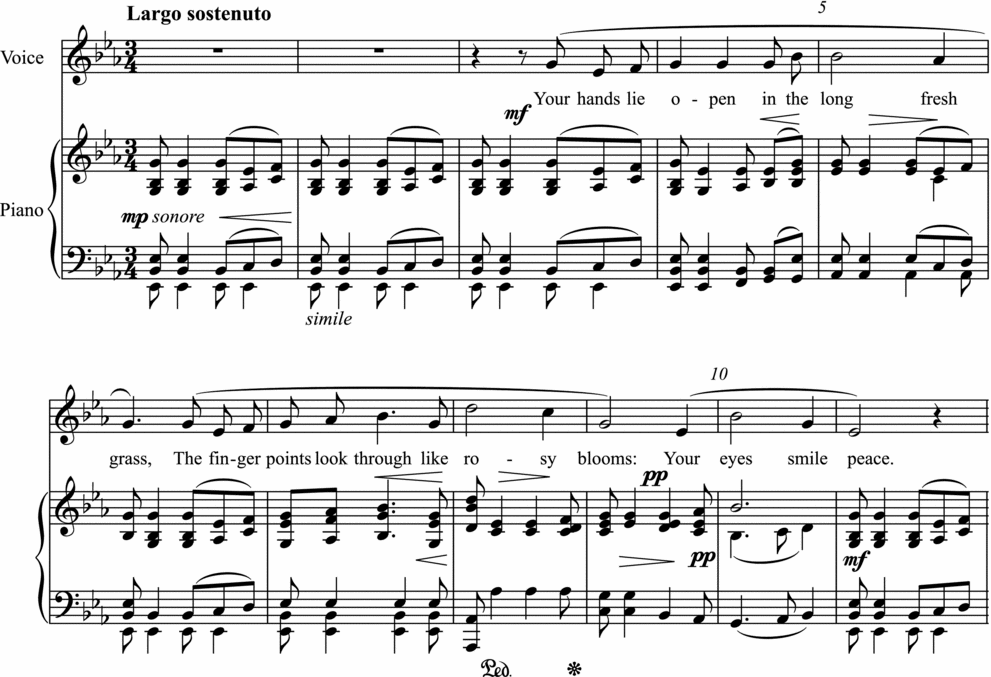
‘Silent Noon’ has often been somewhat vaguely associated with ideas of voice, memory, phenomenology, and performance.Footnote 120 As Stephen Banfield has put it, the ‘deliberately episodic’ nature of the song's construction works such that it conveys, finally, ‘the realization of a moment held forever in the present tense of memory’.Footnote 121 Banfield refers to the way in which the opening material of ‘Silent Noon’ returns at its conclusion. The song begins with a brief prelude in the piano, outlining the melodic contour of the subsequent vocal entry (Example 1, bb. 1–3, beat 1). The effect is such that the piano gently coaxes the entry of the voice, as the complex generic signal – part barcarolle, part berceuse – creates a sense of tension, heightened by the metrical syncopation (which pushes gently against the crotchet beat and pushes towards the end of each bar). Plunket Greene described this opening as one of ‘heat-haze and human throb’,Footnote 122 and as is implied in this characterization, the opening of ‘Silent Noon’ seems to beat with the heart, evoking a sense of ritualistic dwelling in the landscape, and enacting (rather than describing) the present-tense experience of union both with a beloved – and with nature – that is described by the song's poetic voice.
‘Silent Noon’, bb. 1–11. © Copyright Chester Music Limited trading as Edwin Ashdown. All Rights Reserved. International Copyright Secured. Reprinted by permission of Chester Music Limited trading as Edwin Ashdown.

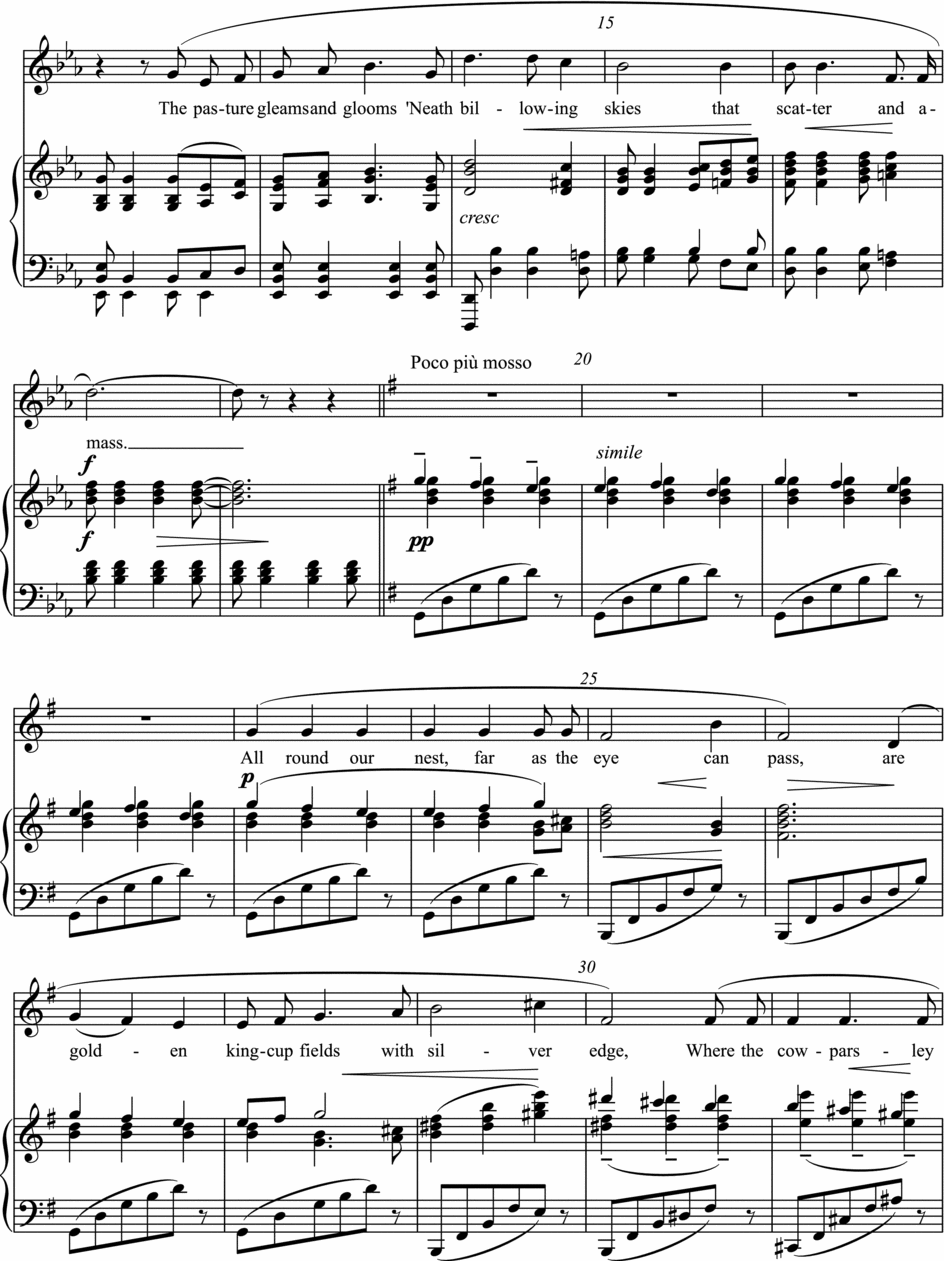
Thereafter, a harmonically exploratory middle section ensues (Examples 2 and 3, bb. 19–60), in which a series of common-tone modulations convey musical shifts of consciousness, corresponding again to the poetic persona's experience of an unfolding landscape experience (see Example 2, bb. 38–9, for example). The musical progress of this second section communicates a powerful evocation of restless exploration, or musical journey: a series of ‘climbing’ gestures that are evocative of Hubert Brown's direction to the performer's exploration of a song's space by traversing its various ‘hills’, the top of which promise moments of creative enlightenment.
‘Silent Noon’, bb. 12–52. © Copyright Chester Music Limited trading as Edwin Ashdown. All Rights Reserved. International Copyright Secured. Reprinted by permission of Chester Music Limited trading as Edwin Ashdown.
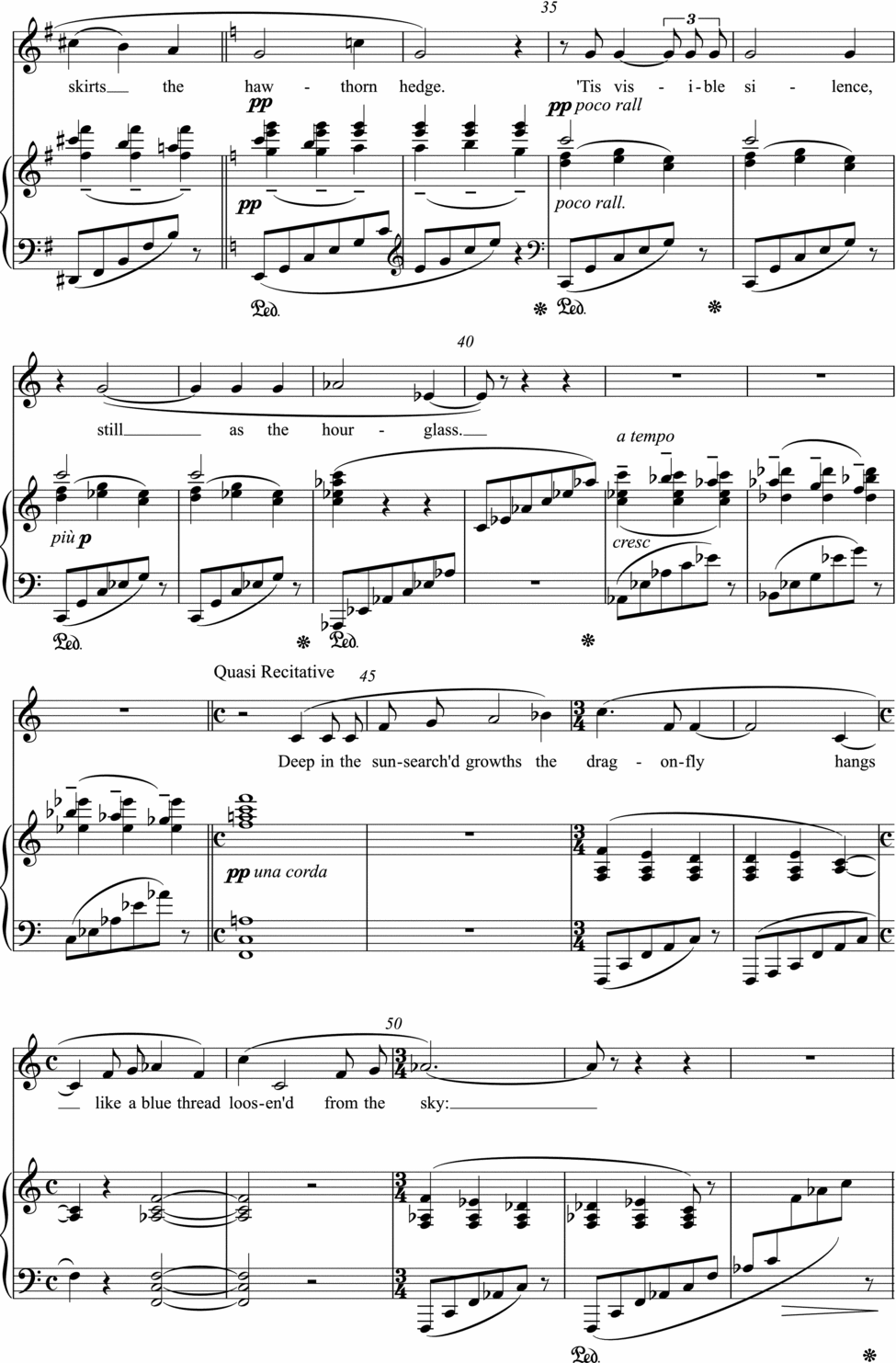
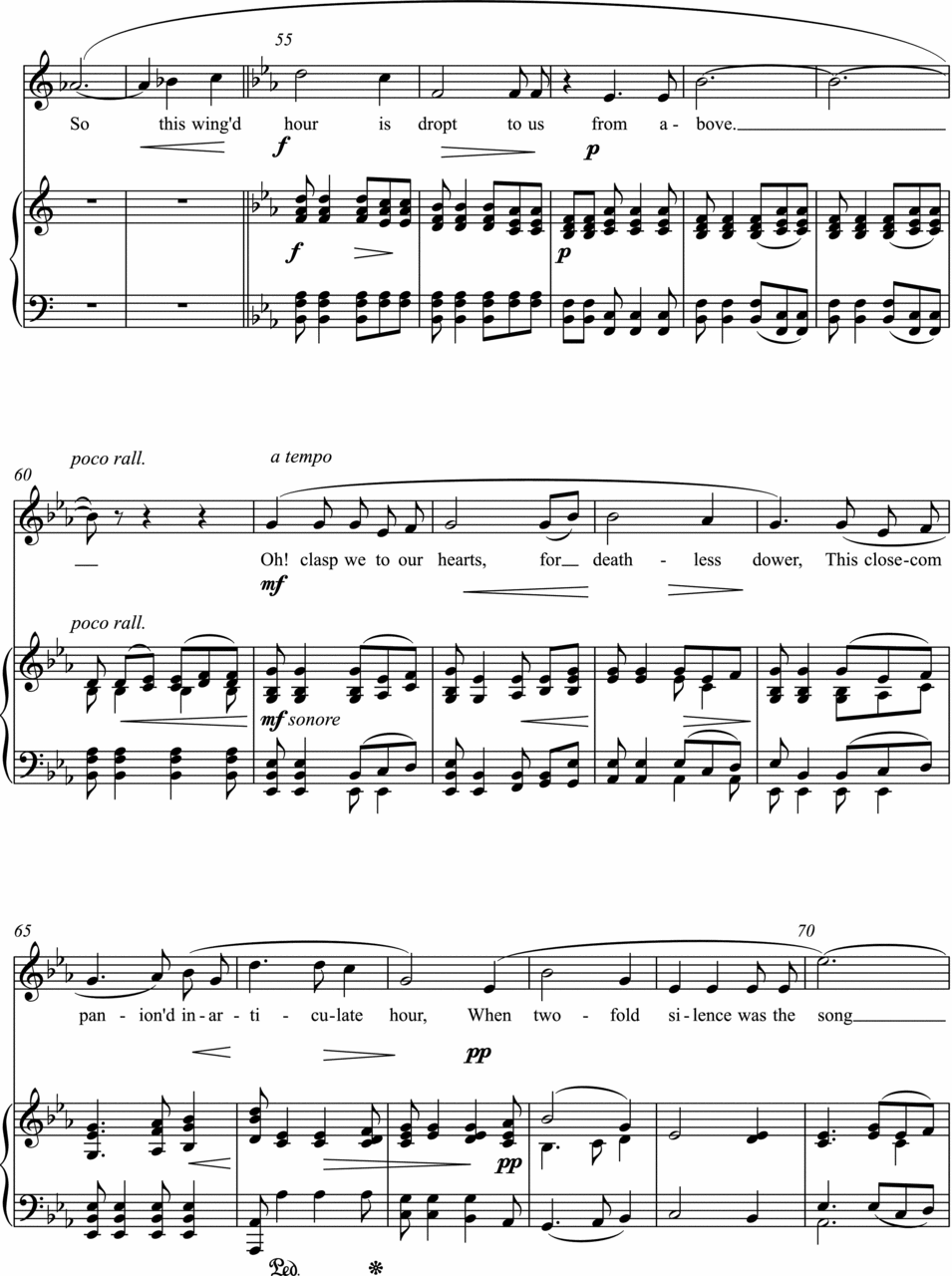
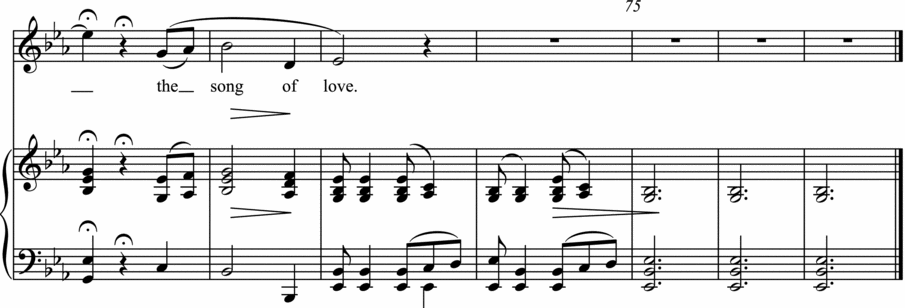
Ralph Vaughan Williams, ‘Silent Noon’, bb. 53–77. © Copyright Chester Music Limited trading as Edwin Ashdown. All Rights Reserved. International Copyright Secured. Reprinted by permission of Chester Music Limited trading as Edwin Ashdown.
Finally, a joyous return of the opening musical material at bar 61 brings ultimately a sudden shift, in the poetry, from the ecstatic present tense to a past-tense narration, in a reflection upon all that has been heard thus far (see Example 3). Dante Gabriel Rossetti's text at this moment reads as follows:
The textual change to the past tense in the final words of ‘Silent Noon’ suggests that a different voice, a narrating voice, has entered here, reflecting upon an earlier moment where ‘twofold silence was the song of love’ (emphasis mine). In its sudden shift to a reflection upon the past, the poetic voice confirms that what has been heard thus far in the song is just that: a ‘song’. The corresponding octave shift in the musical setting to a literally different register with the word ‘song’, as the accompaniment grinds to a halt, calls attention to the very quality of voice itself (see Example 3, bb. 69–71). As such, this moment highlights an act of sounding, the presence of a performer.Footnote 123
This is enforced by the way in which the exclamation of the poetic voice's ‘Oh’ is given actual voice by the singer in Vaughan Williams's musical setting, at precisely the moment at which the opening music returns (see Example 3, b. 61). This is an exclamation of recognition. The delayed cadential closure on ‘song of love’ (Example 3, bb. 72–3), as the text moves to the past tense, refers back to the long-held scale degree 5 on ‘-bove’ (bb. 58–60), and thus recalls exactly this moment of return. As such, the return of the opening music of ‘Silent Noon’ works to re-perform an ‘earlier’ music that has already been made, but that has temporarily receded into the background: a ‘song’ whose performance is exposed by a narration of the poetic voice. Crucially, the moment of re-performing a song of the past in the present is unconscious and embodied, as the blank, sonic vocal utterance ‘Oh!’ suggests. The exclamation of recognition is an embodied response to the musical return, as the consciousness of a cerebral articulation is only engaged when the poetic voice shifts to the past tense in its very final words. In this way, the re-singing of the song's opening music becomes the recovery of a lost music, performed by an unconscious, communal, and thus English voice of the present.
By staging a performance of musical recovery as the focus of Rossetti's erotic evocation of landscape, Vaughan Williams engages a complex set of constructions that collected around both the idea and the sound of the English voice during the early decades of the century. ‘Silent Noon’ transmutes the union of two lovers, contained and embedded upon the site of the land, into a broader statement of community, as this ‘twofold’ song becomes a glorification of song itself, a site upon which communal performances of national identity were powerfully focused during the early decades of the twentieth century. The extensive, sharp-side harmonic exploration conveyed through the middle section of ‘Silent Noon’ enables, with the final return to the home key of E♭ major, a sense of re-entering a place once known, but temporarily forgotten. This song performs a return of man to the land, from which the English voice is drawn, and in which it is re-sounded.
Situating early twentieth-century English art songs in relation to an associated vocal culture promises a rich means of examining the aesthetics of a genre powerfully influenced by contemporaneous cultural ideas of memory, tradition, voice, and performance. The scope of the current article necessitates that the reflections offered above represent but a preliminary outline of the ways in which the subtle intersections between this genre and its associated musical culture might begin to be recovered. Yet they are suggestive, nevertheless, of the potential efficacy of such contextual elaboration, particularly in regard to probing deeper into the aesthetics of what Stephen Banfield has called the ‘Romantic’, ‘vernacular’, and ‘conservationist’ ethos of early twentieth-century English art songs.Footnote 124 The self-consciousness with which ‘Silent Noon’ stages a performance of musical regeneration and renewal prompts a reconsideration not only of the complex ways in which Vaughan Williams mediated the idea of ‘ancestral’ music in his works, but also of the myriad contemporaneous cultural forces impacting upon the genre of twentieth-century English art song more broadly. Far from representing the regressive retreat suggested by a ‘Romantic’ designation, such songs might rather be considered in relation to the various expressions of modernity inherent in performances of national identity during this period. The notion of the composer as singer reaches to the heart of a series of unexamined constructions of English musical identity. By the same token, the notion of the singer as a collaborative creator foregrounds new perspectives from which to view the dynamics of creating community in the making of national music during the English musical renaissance.