

Introduction
In January 2017, when the leader of the Five Star Movement (hereafter: M5S) Beppe Grillo attempted to switch political group in the European Parliament (EP), moving his contingent of 17 deputies from the Eurosceptic Europe of Freedom and Direct Democracy (EFDD) group to the very pro-European Alliance of Liberals and Democrats in Europe (ALDE), several members and observers of the M5S raised their eyebrows. Why would one of the most Eurosceptic parties in the Italian party system seek to enter one of the most pro-EU political groups? What was the rationale behind such a surprising decision?
The academic attention for the origins, electoral success and ideology of the M5S has steadily grown (i.e. Conti and Memoli, Reference Conti and Memoli2015; Passarelli and Tuorto, Reference Passarelli and Tuorto2018; Manucci and Amsler, Reference Marks2018). The bulk of research has focussed on domestic politics, with only scattered attention paid to its EU activities. The notable exception has been its Euroscepticism, with empirical work on its discourse and voting behaviour in the EP (Corbetta and Vignati, Reference Corbetta and Vignati2014; Franzosi et al., Reference Franzosi, Marone and Salvati2015). This article shifts the focus on the M5S in Europe, analysing the contentious issues of its transnational affiliation. It seeks to understand why Grillo’s Movement entered an alliance with Nigel Farage’s United Kingdom Independence Party (UKIP) in 2014 and attempted (without success) to break it in early 2017.
This work is a case study of political group affiliation in the EP. Theoretical arguments on the motives for political parties to choose their ‘home’ in the EU are applied to the case of the M5S. Building on the literature on political group formation in the EP (Bressanelli, Reference Bressanelli2012; McDonnell and Werner, Reference McDonnell and Werner2018; McElroy and Benoit, Reference McElroy and Benoit2010), national parties are expected to join a political group for ideological/policy compatibility; for the office gains that membership in a (large) group brings in the EP; or to pursue their vote or office-seeking objectives at the national level. In this sense, this article not only aims to provide a better understanding of the behaviour of the M5S in the EU but also contributes to research on the politics of group affiliation in the EP – placing its analytical focus on the motivations of national parties in their choice of transnational allies.
The theoretical arguments are assessed triangulating different data: from the EUANDI data on the position of political parties in Europe to official data of the EP; from original interviews with members of the European Parliament (MEPs) to declarations to the press or in Beppe Grillo’s blog. In a nutshell, what this article argues is that neither policy nor office considerations at the EU level can fully explain the transnational affiliations (observed and attempted) of the M5S in the EP. The real drivers of its choices were strategic considerations at the domestic level. In other words, for the M5S group membership was functional to the pursuit of more prominent domestic goals. Be it the expansion of its electoral support with more Eurosceptic voters in 2014, be it its governing ambitions after the failed constitutional referendum of December 2016, the ‘second-order’ EU-related choices of the Movement have been instrumental to its changing, ‘first-order’ domestic goals.
This paper proceeds as follows. After presenting some background information on the affiliations of the M5S in the EP (second section), three theoretical arguments on group membership are advanced (third section). Their empirical assessment is presented in the fourth section. Finally, the fifth section discusses the broader implications of the findings, and what they mean both for the nature of the M5S and for transnational affiliation in the EP.
Choosing partners in the EP
In June 2014, the grillini – so are called the supporters of Grillo’s M5S – were asked to cast their online vote via Grillo’s blog to decide which political group should be joined by the 17, newly elected M5S MEPs. Three options were given: the Europe of Freedom and Democracy (EFD) group, comprising right-wing, Eurosceptic parties including, most prominently, the UKIP; the European Conservatives and Reformists group, whose largest national delegation is the British Tories; and the non-attached. For the M5S statute, its MEPs shall refrain from joining any political group, unless there is ‘the possibility of setting up, in the European Parliament, a political group with members from other European countries who share M5S’s fundamental values’ (Movimento 5 Stelle, 2014). Should this occur, Beppe Grillo, in his capacity as a political leader, shall submit a proposal to M5S registered members for online ratification.
Grillo’s preferred option was the EFD group. In a blog post published on the same day of the poll, the M5S leader stressed that, within the EFD, M5S MEPs would enjoy the freedom of votes. Furthermore, he maintained that:
[The EFD] has represented in the previous legislature the most strenuous opposition to a federalism based on austerity and to the concentration of power in the hands of unelected bureaucrats in Brussels. The EFD is against the euro which has caused poverty and unemployment (Grillo, Reference Grillo2014b).
In the same piece, Grillo highlighted how UKIP, the biggest party in the EFD group, supported direct democracy and stood against ethnic discrimination, big banks, multinational corporations, and excessive bureaucracy. Nonetheless, these arguments failed to persuade numerous M5S supporters, who blamed the decision to join a political group comprising national parties renowned for their nationalistic and anti-migration stance. Moreover, the M5S leadership was reproached for excluding from the options given in the online poll the Greens/European Free Alliance group (G/EFA), whose political platform was perceived as close to the M5S’s stance on environmental issues. Grillo addressed this criticism by pointing that it was the G/EFA group to cross-out, in the first place, the possibility that the M5S delegation might join its ranks. However, an analysis of news accounts suggests that the G/EFA group was officially approached by the M5S leadership only after talks started with UKIP. On 28 May, 3 days after EP elections, Grillo flew to Brussels to meet with Farage. After 2 days, the co-chair of the European Green Party – the extra-parliamentary equivalent of the G/EFA group – declared to the Italian press that doors were still open for talks with the M5S.Footnote 1 Nevertheless, the official request to the Greens was sent on 3 June only. The following day, the G/EFA Secretary general replied:
According to our information, the agreement between the Five Star Movement and Nigel Farage is now in its final phase. It is precisely for this reason that we have doubts on whether its request for dialogue is genuine or simply a front for a decision which has already been taken. […] Our group will not be able to meet you until your relationship with Farage’s group is clarified (quoted in Grillo, Reference Grillo2014d).
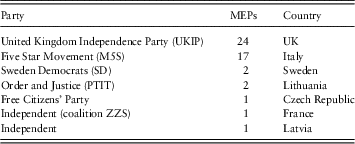
The above provides evidence to claim that, independently from the G/EFA’s refusal, the political marriage with UKIP was Grillo’s preferred choice. This option obtained eventually most of the votes in the online poll. The M5S joined the UKIP and other small parties (see Table 1), and the EFD has lately renamed itself EFDD.
National delegations in the Europe of Freedom and Direct Democracy group (constitutive session: 1 July 2014)

MEPs=members of the European Parliament.
Source: European Parliament, www.europarl.europa.eu
In January 2017, the grillini were called back to the online polls. This time, half-way through the legislature, their leader was asking them to ratify the decision to leave the EFDD for joining the ALDE group. The other two voting options were either remaining in the EFDD group or joining the non-attached members. The U-turn was announced on the very same day of the vote via the usual blog post and came as a surprise not only to M5S supporters but some of the MEPs themselves: ‘As a M5S MEP, I was not aware [of this decision], just like you activists. I have found out about this news this morning, with astonishment and concern’ (Zanni, Reference Zanni2017).Footnote 2 Interestingly, it was not long before that Guy Verhofstadt, the ALDE group leader, was defined as ‘unpresentable’ and depicted as ‘the politician who, within the EP, best embodies the idea of a centralised European super-state’ (Movimento 5 Stelle Europa, 2015). The snap online vote raised criticism both among the M5S membership and within the party in public office. Grillo answered them back maintaining that ‘refusing to join a political group means […] occupying a seat of power with tied hands: in other words, it means impossibility to work’ (Grillo, Reference Grillo2017).
In the end, Grillo’s proposal to join the ALDE group won the approval of 78.5% of the voters. Yet, the union between the M5S and the ALDE group eventually failed to materialize due to the latter’s veto. Nonetheless, the question arises of what the rationale behind these antithetical choices is. In other words, why joining a Eurosceptic group in the first place, and opting to leave it in favour of the most Europhile EP group 2.5 years later? As Grillo put it, joining the EFDD was ‘nothing but a marriage of convenience for our mutual advantage’ (Grillo, Reference Grillo2014a). The dowry of this marriage should consist of EP offices and resources. The divorce was then officially asked on the basis that ‘recent European events, notably Brexit, ask us […] to rethink the nature of the EFDD group’ (Grillo, Reference Grillo2014a). But are these justifications corroborated by evidence? We will address this question after reviewing the main scholarly hypotheses put forward to explain transnational affiliation in the EP.
Explaining group choice in the EP
The provisions contained in the EP rules of procedures (RoP) on the formation of the political groups are quite loose. Art. 32 only states that ‘members may form themselves according to their political affinities’. However, the criterion of political affinities is not scrutinized by the EP, which assumes that members forming a group share by definition a common platform. Only when political affinities are explicitly denied, the EP may call for the dissolution of a group (cf. Settembri, Reference Settembri2004).
The RoP are, instead, much more specific on the numbers needed to form a group. At the beginning of the 2014 term, a political group had to include at least 25 members elected in a quarter of the member states (i.e. seven countries). Therefore, while the RoP provide specific numerical indications, they leave a significant margin of manoeuvre regarding the political affinities between members. Moving beyond the (vague) legal provisions, scholars have therefore suggested three main explanations for group choice in the EP.
A first explanation is that ideological or policy affinities matter and national parties choose the political group that best matches their ideological or policy position. Traditionally, this argument has been based on the commonality of the cleavages in the (West) European party systems, which ‘produced’ distinct and rather cohesive party families (Mair and Mudde, Reference Mair and Mudde1998). From this perspective, parties get together because they share common socio-political bases and programmatic identities. To put it metaphorically, ‘birds of a feather flock together’, and enter durable marriages.
More recently, several studies have supported the enduring validity of this explanation. For instance, analysing national election manifestos, Klingemann et al. conclude that political groups ‘have a strong basis in the old party families’ (Reference Klingemann, Volkens, Bara, Budge and Macdonald2006: 28). Hix et al., looking at voting behaviour in the EP, argue: ‘politics in the European Parliament […] is driven by the traditional party families’ (Reference Hix, Noury and Roland2007: 181). In a study modelling transnational group affiliation, McElroy and Benoit (Reference McElroy and Benoit2010) test whether policy congruence is the main predictor of party group ‘choice’. They find substantial evidence that this is indeed the case, with the national parties seeking membership in the group closer to their own policy position on the most salient policy dimensions. Finally, studying the formation of the groups at the start of the 2009–14 legislature, Bressanelli (Reference Bressanelli2012) finds that policy or ideological affinity is the most important factor predicting transnational affiliation.
For other observers, instead, the choice of a political group is mostly guided by the pursuit of office goals in the EP. For instance, the British Conservative Party established an alliance with the European People’s Party (EPP) Group (which was then renamed EPP-ED) even if they deeply disagreed over the EU (Maurer et al., Reference Maurer, Parkes and Wagner2008). The regulatory framework in the EP provides strong incentives to form loosely bound political groups. Both the transnational groups and the national parties face strong self-interested incentives to, respectively, include more members and seek membership in the existing groups. Several dispositions in the RoP reward the larger groups more. Votes in the Conference of Presidents – the key executive organ of the EP – are weighted by the number of MEPs in each group. Therefore, the larger a group is the bigger its ‘voting power’. While the non-attached members are invited, they do not have voting rights. Furthermore, the D’Hondt method – which, albeit proportional, brings better rewards to larger parties – is normally used when allocating office positions like committee chairmanships. The point-system method used to allocate reports at the committee stage also favours the larger groups more. Finally, the RoP (arts. 162.3 and 162.4) make clear that the order and the time allocated to speakers in the plenary debates also depends on the size of the groups. Alliances between national parties where opportunistic motives dominate are metaphorically labelled ‘marriages of convenience’ (Maurer et al., Reference Maurer, Parkes and Wagner2008).
A third explanation for political group membership looks, instead, at the importance of vote- and office-seeking motivations at the national level. While the two arguments presented above place their analytical focus on policy- and office-seeking motivations at the EU level, other research explores the impact that the EU-level choices of political parties have on the national arena. Studying four radical-right parties, McDonnell and Werner (Reference McDonnell and Werner2018) argue that these parties have compelling reasons to focus on their national electorates when making their EU-level alliances. When mainstream parties create a cordon sanitaire and refuse a priori co-operation with radical parties, transnational alliances can help the latter to gain ‘respectability’. For instance, both in the case of the Finns Party and the Danish People’s Party, their choice to ally with the European Conservatives and Reformists Group was motivated by their desire to gain legitimacy to widen their electoral appeal and/or strengthen their coalition potential with future partners in the national government. This two-level game is most likely to be played by parties in the ‘shadow’ of a general election.
While radical-right parties provide a particularly good illustration of this argument, there is no reason to restrict a ‘domestic politics’ explanation to this sub-set of parties. For instance, the Italian party Forza Italia had long flirted with the EPP Group, before becoming eventually a member, in order to be seen as a respectable governing party (cf. Jansen, Reference Jansen2006). Such alliances, where one of the partners seeks an ‘upgrade’ of its status, have been labelled ‘marriages of respectability’ (McDonnell and Werner, Reference McDonnell and Werner2018).
Moreover, ‘respectability’ to pursue office and vote-seeking objectives at home is only one specific instance of a ‘domestic politics’ explanation. In other cases, the domestic goals of the party can be advanced by the ‘publicity’ it gains through transnational affiliation. The UKIP, for instance, has been very effective to use the EP and its group as a springboard to broaden its electoral appeal in the United Kingdom (Whitaker and Lynch, Reference Whitaker and Lynch2014).
The political groups also have their own incentives to admit or reject an application for membership. Policy- and office-seeking explanations apply to them as well. On the one hand, they may be strict on the ideological compatibility of the new members, making sure that only those parties that are strictly belonging to the ‘party family’ join – not to undermine their cohesion and capacity to pass legislation. On the other, they have strong incentives not to be overly demanding on the ideological compatibility of the new members. Financial resources are distributed among the political groups considering both their size (the number of MEPs) and their territorial heterogeneity (the number of member countries). The bigger a group and the more countries are represented in it, the more resources it is endowed with (Corbett et al., Reference Corbett, Jacobs and Neville2016). Furthermore, the quota of financial resources the EU extra-parliamentary parties are allocated largely depends on the number of seats of their associated groups in the EP.Footnote 3 Excluding large national parties from membership entails a direct financial cost for EU-level political parties. Finally, some apical positions in the EP hierarchy are only allocated to the largest, or the pivotal, political groups. While the focus of this article is on the rationale behind the M5S choice to join, or consider joining, different political groups, it is important to underline that the ‘success’ of the former crucially depends on the willingness of the latter to accept its membership.
In conclusion, there are three main arguments to explain the choice by a national party of a particular transnational group in the EP. Policy congruence accounts for most of the cases, but not all marriages are marriages of ‘love’. Some others are functional to the pursuit of offices in the EP; still, others are instrumental to the pursuit of domestic goals. The next section assesses which argument(s) best explains the M5S’s transnational affiliation and attempts to change it.
Empirical analysis
Policy congruence
To assess whether policy affinity was the key driver of the choice of the M5S to ally with the UKIP, and later seek to abandon it for the ALDE group, we rely on the EUANDI data (Garzia et al., Reference Garzia, Alexander and De Sio2017). The EUANDI project created a Voting Advice Application through which voters could match their policy preferences with political parties competing for seats in the 2014 EP elections in the 28 EU member countries. Parties were asked to self-place themselves with respect to 30 salient policy issues grouped in nine policy domains. The party self-placement was double checked by country experts, who coded the position of the parties in case of no-answer or undocumented position, but also had the final word on the coding (i.e. when the party self-placement did not appear convincing to the experts when compared with sources like the EU election manifesto or the party election platform).
This iterative method of party positioning is what distinguishes the EUANDI data from other established data. As Garzia et al. note, none of the established techniques to place parties in a policy/ideological space has evolved into a ‘gold standard’ (Reference Garzia, Alexander and De Sio2017: 334–335). The coding of national and Euro-manifestos, the survey of experts on political parties, the scaling of roll-call votes all have their strengths and weaknesses. Indeed, as one prominent scholar suggested, the weaknesses of the existing methodologies may be overcome ‘triangulating’ different data (Marks, Reference Manucci and Amsler2007). Here lies, instead, the strength of the EUANDI data, which in its design combines the party self-placement and the coding of experts, with the latter also based on a plurality of sources.
Substantively, the EUANDI project was specifically created to study party competition in the 28 member states of the EU ahead of the 2014 elections, including all the parties which were expected to win seats in the EP. This means that even small parties from small member states are part of the data set, which includes 96% of the MEPs (720/751). For both methodological and substantive reasons, the EUANDI data is therefore particularly useful to study the congruence of the M5S in the EFDD group and alternative options.
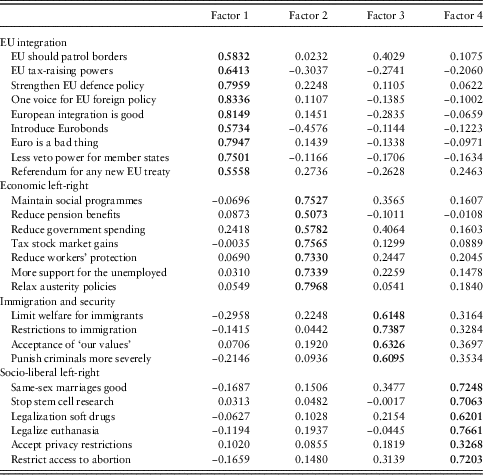
To compare the position of the parties in the policy space, we used principal component factor analysis with varimax rotation to extract the common underlying dimensions to the 28 policy issues, which were coded by the EUANDI team for all EU member states. Each answer to the survey question has values ranging from −2 to 2.Footnote 4 ‘No opinions’ have been merged with neutral answers, and both have been coded as zeros (cf. Borz and Rose, Reference Borz and Rose2010).
Following established conventions, we retained all factors with eigenvalue bigger than, or equal to 1 (Kim and Mueller, Reference Kim and Mueller1978). On substantive grounds, we used in the analysis the first four returned factors, which we interpret as EU integration, economic left-right, immigration and security, and socio-liberal left-right.Footnote 5 The validity of the former two scales – on EU integration and economic left-right – has been assessed by comparing them with the established measures in the Chapel Hill expert survey (Polk et al., Reference Polk, Rovny, Bakker, Edwards, Hooghe, Jolly, Koedam, Kostelka, Marks, Schumacher, Steenbergen, Vachudova and Zilovic2017). The correlation between the EU integration scales is strong (r=0.78; P<0.001), and that between the economic left-right scales is also robust (r=0.72; P<0.001). These results reassure on the validity of the scales generated from the EUANDI party data set for use in our analysis.
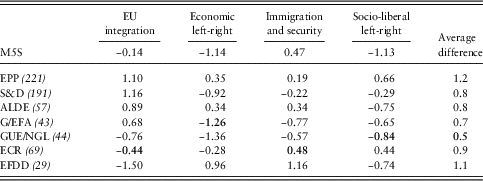
To assess the policy fit of the M5S with its current political group, and the other options considered by its leadership, we looked at the policy differences among them (Table 2). Based on the EUANDI data, the M5S has a moderately Eurosceptic position, a left-wing political agenda in economic policy and socio-liberal values, but a tougher approach on immigration and security matters. The EUANDI data present a conventional picture of the positions of the political groups, calculated as the (weighted) average of the position of the member parties. Mainstream and fringe political groups are split on the issue of EU integration, while the ALDE group is much closer to the more right-wing EPP on economic policies, and to the more left-wing groups (the Socialists & Democrats (S&D) and the G/EFA) on socio-liberal issues.
The Five Star Movement (M5S) position and policy difference from the political groups

EPP=European People’s Party; S&D=Socialists & Democrats; ALDE=Alliance of Liberals and Democrats in Europe; G/EFA=Greens/European Free Alliance group; GUE/NGL=European United Left/Nordic Green Left.
Policy positions have been weighted by the parliamentary seats of each political party in the European Parliament (in parentheses the total for each group). The count for the Europe of Freedom and Direct Democracy (EFDD) excludes the M5S.
Source: Elaboration from EUANDI.
Note: Bold values represent the closest political group to the M5S on a given policy dimension.
In this context, it is hard to say what the best fit for the M5S is. Its position is closer to that of the European Conservatives and Reformists (ECR) group on EU integration and immigration and security; to the G/EFA on economic left-right, and to the European United Left/Nordic Green Left (GUE/NGL) on socio-liberal issues. On average, the group closer to the M5S on the four dimensions is the GUE/NGL, but the G/EFA is also close. What is, instead, clear is that the M5S poorly fits with its current political group. The EFDD is, together with the EPP, the group with which the M5S has the least in common in terms of policy. Differences are particularly stark on the economic left-right dimension, but the hard-Eurosceptic position of the EFDD group is also quite different from the M5S critical, but more moderate position on the EU.
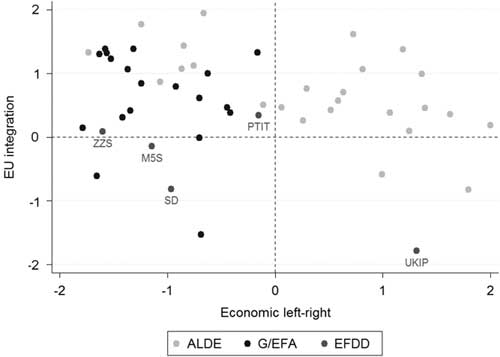
Figure 1 displays the policy positions of the member parties of the ALDE, the G/EFA, and the EFDD groupFootnote 6 on the bi-dimensional space defined by two most important policy dimensions in the EP: economic left-right and EU integration (Hix and Lord, Reference Hix and Lord1997). Clearly, the M5S and UKIP have two different policy platforms, not only on the left-right dimension but also on EU integration. This was confirmed during our face-to-face meetings with the UKIP and M5S MEPs.Footnote 7 Consulted on the matter, a UKIP MEP expressed surprise at the fact that the M5S was gaining popularity in Italy as a Eurosceptic party despite exhibiting very little Euroscepticism inside the EP. This stance was confirmed by an EFDD colleague from the M5S, who maintained that:
Over time, different views have emerged between UKIP and us. […] We have a different approach towards the EU as well. Yes, we do belong to the same Eurosceptic group, but, as you know, they are for withdrawing from the EU and ending the process of European integration tout court. Our Euroscepticism is instead to interpret as a claim to build a different Europe […] not to destroy it (Interview, M5S MEP, 26 May 2016).
Focussing on the two other political groups with which the M5S considered an alliance in EP8, members of the ALDE group have unsurprisingly very different positions on economic policies, but its parties share a pro-EU platform.Footnote 8 On the other hand, the G/EFA members have a more varied position on integration, with some critical positions, and are located on the left of the policy spectrum. On policy-grounds, membership in the G/EFA would appear to be a better fit for the M5S.
The Five Star Movement (M5S): current and potential partners in the European Parliament. PTIT=Order and Justice; ZZS=Independent; SD=Sweden Democrats; ALDE= Alliance of Liberals and Democrats in Europe; UKIP=United Kingdom Independence Party; G/EFA=Greens/EFA group; EFDD=Europe of Freedom and Direct Democracy.

The EUANDI data provide a clear picture: it is not a policy the glue that made the M5S and the UKIP stick together. To investigate this aspect further, we analyse the voting behaviour of the M5S in the first 2 years of EP8. We only focus on votes under the ordinary legislative procedure which, after the entry into force of the Treaty of Lisbon, became the standard law-making procedure. We further restrict our sample by studying final votes which, since 2009, must all be by roll-call. In this way, we deal with the bias in the study of roll-call votes in the EP – namely, that they may be called for strategic reasons, and are therefore unrepresentative of the full population of votes (see Yordanova and Mühlböck, Reference Yordanova and Mühlböck2015). Under these restrictions, we analyse 87 votes from July 2014 to July 2016.Footnote 9
We look at the voting agreement of the M5S with the political groups. We considered a case of agreement when a majority of members of the M5S and most members of a political group voted in the same way (i.e. they either voted in favour, against, or abstained). We classified our votes in four broad policy categories: ‘EU Integration’, which includes votes on institutional matters and new programmes or funds; ‘Single Market’, with votes on the regulation of the single market; ‘Custom Union’ for trade with non-EU countries, and ‘Home Affairs and Migration’, for legislation on rights and migration.
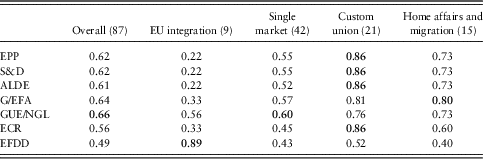
Once again, the poor fit with the EFDD is evident. Table 3 shows that the overall agreement between the M5S and the EFDD is the lowest of all political groups: in less than half of the legislative votes the M5S and the UKIP voted in the same way. The voting agreement of the M5S is never too high with any of the groups, but it is the highest, at almost 70%, with the GUE/NGL. Not surprisingly, when the voting agreement is disaggregated per policy area, the data show that the M5S and the UKIP have a better working relationship on EU Integration issues (voting together about 90% of the times), but tend to vote very differently on the regulation of the single market, the custom union and home affairs and migration. In the latter areas, voting agreement scores are higher with the ALDE, the GUE/NGL and, especially, the G/EFA.
The Five Star Movement (M5S) voting agreement with the political groups (July 2014 to July 2016)

EPP=European People’s Party; S&D=Socialists & Democrats; ALDE=Alliance of Liberals and Democrats in Europe; G/EFA=Greens/EFA group; GUE/NGL=European United Left/Nordic Green Left; EFDD=Europe of Freedom and Direct Democracy.
Votes are plenary votes on the whole text under the ordinary legislative procedure. In bold the highest voting agreement with the M5S.
Source: Elaboration from VoteWatch.eu.
Office gains
While the decision of the M5S to join the EFDD is not explained by policy congruence, it could pay off in terms of office gains. Has the formation of the EFDD – where the M5S is the second delegation in terms of size – allowed Grillo’s Movement to obtain positions of power and influence in EP8? To shed light on these issues, we have examined the ‘mega-seats’ and legislative reports that the M5S MEPs have partaken since their entry in the EP in July 2014. Below, we first discuss the Movement’s gains and losses in terms of leadership positions in committees. We then focus on the number of legislative reports obtained by its MEPs during the first half-term of EP8.
Mega-seats (Carroll et al., Reference Carroll, Gary and Pachón2006) are the key offices in a legislative assembly. In the context of the EP, the most coveted offices consist of the presidency and vice-presidency of the EP; chair and vice-chair of parliamentary committees; group leadership and group coordination on committees (see Benedetto, Reference Benedetto2015, who also includes quaestors). Seeking these key positions once elected is in line with the idea that political parties pursue office goals in addition to vote and policy ones (Strøm, Reference Strøm1990). As a matter of fact, ‘parties neither cease to exist or cease to compete for office when the general election is over’ (Carroll et al., Reference Carroll, Gary and Pachón2006: 154). Beppe Grillo seemed aware of this when he dismissed the idea of joining the non-attached members, despite this being presented as the ideal option in the M5S statute. As known, the legislative rules in the EP are such that non-attached members remain excluded from the contest for key EP positions, and are allotted very little speaking time. Allegedly, therefore, a marriage between the M5S and UKIP was nothing but ‘a tactical move’ through which ‘elect Parliament’s Vice-Presidents and committee chairs who can then influence choices’ (Di Maio MP, quoted in ANSA, 2014). However, if office goals supposedly drove its group membership, the question remains as to why the Movement joined the EFDD rather than other groups, notably the G/EFA group, larger than the EFDD and closer to the M5S in ideological terms. We show that the M5S has indeed lost in terms of mega-seats by joining the EFDD.
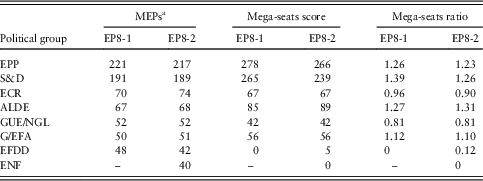
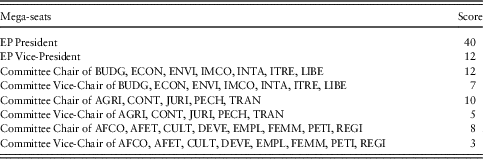
As Carroll et al. point out, the allocation of mega-seats is determined by both formal and informal rules (Reference Carroll, Gary and Pachón2006: 156). This is the case in the EP as well, where ‘the EP’s internal rules make national parties’ group affiliation the defining factor in the distribution of committee seats’ (Maurer et al., Reference Maurer, Parkes and Wagner2008: 248). More specifically, according to the D’Hondt method, parliamentary power is proportionally distributed in the EP. Yet, the D’Hondt formula is not mentioned in the EP RoP, but it is used following a ‘gentlemen’s agreement’ between the political groups. This agreement was broken at the start of EP8. The M5S bid for four vice-chairs (AGRI, BUDG, ITRE, PECH), for the chair of PETI and one of the vice-presidencies of the EP. Yet, these positions ended up being distributed among S&D, EPP, and ALDE members. Most notably, the failure in attaining the chair of PETI, which received considerable resonance on the M5S’s web platforms, was provoked by the anti-EFDD coalition between ALDE, EPP, and S&D – defined by Grillo as ‘the Triple’ (Grillo, Reference Grillo2014c) – during the ballot for the election of the bureau on the very first session of the PETI committee. The trend was partially reversed at the start of the second half-term, when the M5S secured the vice-chair of JURI, although it did not belong to the EFDD according to the D’Hondt distribution of posts. More systematic insight is provided by comparing the share of mega-seats obtained by the EFDD with that of the other EP groups. In doing this comparison, we consider only those mega-seats assigned via inter-group competition. Hence, group leadership and coordination on committees, whose allocation is determined by intra-group dynamics, are not pertinent here. Mega-seats have been weighted using Votewatch’s weights for assessing MEPs’ influence in the EP (VoteWatch Europe, 2016; see Appendix for details). We have then calculated each group’s mega-seats ratio, defined as the ratio of mega-seats score and the number of group members.
Table 4 displays each group’s mega-seats score and ratio during, respectively, the first and second half-term of EP8. Despite a slight improvement during the second term – the 5 points consist of the JURI vice-chair – EFDD’s performance in terms of mega-seats is poor, and Grillo’s office-based explanations behind the choice to join the EFDD are not corroborated by evidence.Footnote 10
Mega-seats in European Parliament (EP8)

MEPs=members of the European Parliament; EPP=European People’s Party; S&D=Socialists & Democrats; ALDE=Alliance of Liberals and Democrats in Europe; GUE/NGL=European United Left/Nordic Green Left; G/EFA=Greens/EFA group; EFDD=Europe of Freedom and Direct Democracy.
EP8-1 and EP8-2 indicate, respectively, the first and the second half-term of EP8.
a Group seats for EP8-1 as of 25 November 2014; group seats for EP8-2 as of 20 January 2017. The Europe of Nations and Freedom (ENF) is not considered as this group was formed on 15 June 2015.
Source: Elaboration of data retrieved from the EP’s website. See Appendix for details.
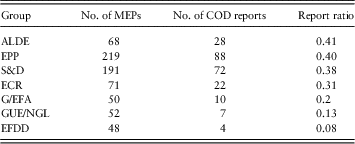
In addition to leadership positions, we also considered the legislative reports obtained by the EFDD. As noted by Yoshinaka et al. (Reference Yoshinaka, McElroy and Bowler2010), rapporteurs are indeed very influential legislators in the EP, particularly when they are responsible for legislation negotiated under the ordinary legislative procedure. In order to gauge the different power MEPs hold, in terms of reports, within different groups, we constructed a report ratio to compare the success of the EFDD with that of the other political groups. The ratio is calculated by dividing the number of codecision (COD) reportsFootnote 11 obtained by a group by the number of members of that group.
Table 5 reveals that the EFDD scores last in terms of reports ratio. Once more, the choice of the EFDD does not seem to pay off as much as other transnational affiliations. True, transnational party membership – and being a large delegation in a political group (Hausemer, Reference Hausemer2006) – is not the only factor to explain the allocation of reports. Personal characteristics of the rapporteur like, for instance, her seniority in the EP and expertise in the policy field, also matter (Yordanova, Reference Yordanova2011; Daniel, Reference Daniel2013). In our case, the latter may explain why the M5S – despite being only the second largest delegation in the EFDD (see Table 1) – obtained all the COD reports that were allocated to this group. Yet, particularly in budgetary and – significantly for our purposes – COD reports, ‘the party identification of an MEP is crucial for his chances to draft reports’ (Hurka and Kaeding, Reference Hurka and Kaeding2012: 525; Hurka et al., Reference Hurka, Kaeding and Obholzer2015: 1238). Thus, for instance, the French Mouvement Démocrate – a member of the ALDE with only four MEPs – has obtained the same number of COD reports as the M5S. Clearly, membership of the EFDD penalizes those members, and parties, which aim to obtain legislative reports.
Report allocation in the first half-term of European Parliament (EP8)

MEPs=members of the European Parliament; COD=codecision; ALDE=Alliance of Liberals and Democrats in Europe; EPP=European People’s Party; S&D=Socialists & Democrats; G/EFA=Greens/EFA group; GUE/NGL=European United Left/Nordic Green Left; EFDD=Europe of Freedom and Direct Democracy.
Source: Elaboration of data retrieved from the EP’s website.
The above suggests that neither policy congruence nor office gains fully explain the rationale behind the M5S’s group membership in the EP. Thus, the next section explores the argument that domestic considerations were the main driver for the M5S and its leader when choosing which EP group to join.
Domestic politics
Both hypotheses on policy congruence and office benefits focus on the activity at the EU level. However, parties may also use transnational membership to pursue domestic goals. In other words, membership in a political group could be functional to other, more important objectives that the party seeks to fulfil at home. If neither policy congruence nor office advantages fully account for the choices of the M5S in the EP, could the explanation for its swinging behaviour be found in Italian politics?
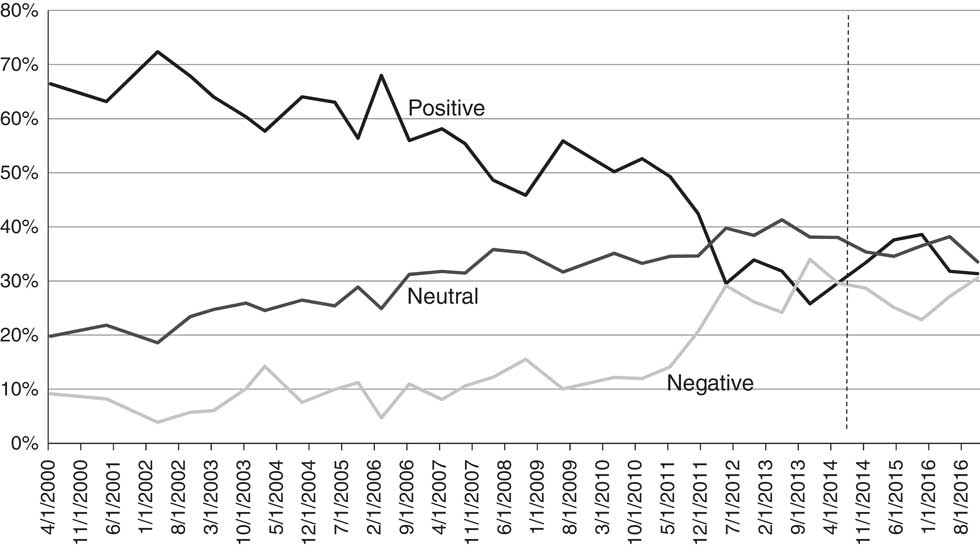
In a context of growing Euroscepticism and saliency of the EU for Italian public opinion (cf. Conti, Reference Conti2017), the EU issue could be used by the M5S to expand its electoral support. Ideological flexibility characterizes the M5S’s political discourse, which, as a result, can strategically adapt to the evolving socio-political context (Manucci and Amsler, Reference Marks2018). Figure 2 may therefore offer some preliminary insights on the decision of the M5S to join the EFDD group in July 2014. After 2011, the share of Italian citizens with a very negative or fairly negative image of the EU has matched that of those with a very positive or fairly positive view. Towards the end of 2013, for the first time ever, the share of negative answers was larger than the share of positive answers.
The image of the EU in Italy. ‘Don’t know’ answers are excluded. Source: Eurobarometer.
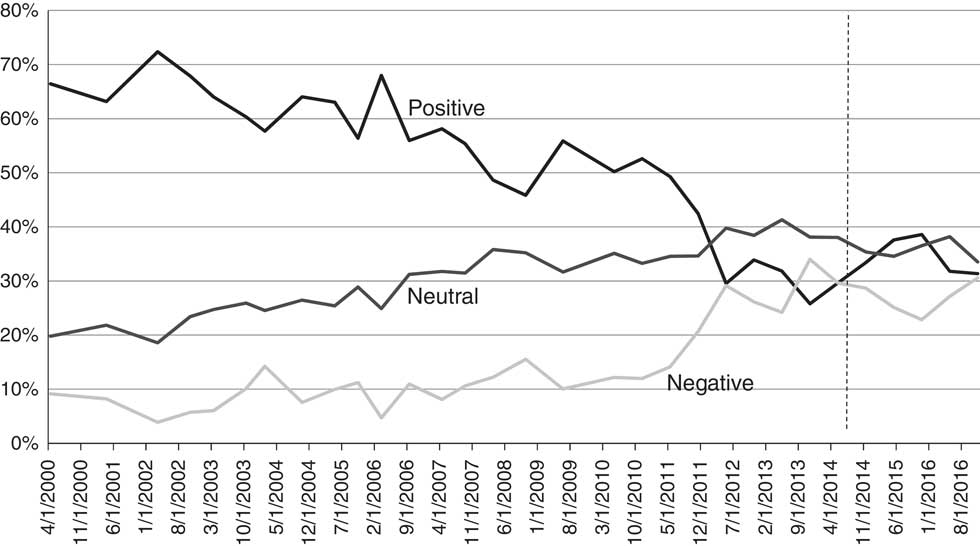
Thus, membership in the EFDD could be part and parcel of the Movement’s strategy to address the demand for anti-EU opposition expressed by a growing share of Italian voters. In other words, the M5S could use ‘Euroscepticism as a strategic resource to increase public support in a context of growing disillusionment of the Italian public opinion towards the European Union’ (Maggini, Reference Maggini2014). The hardening of its position vis-à-vis EU integration appeared even more resolute a few months later when the M5S started the collection of signatures for an advisory referendum on whether the country should leave the Euro. Clearly, joining the EFDD was in line with the M5S’s domestic strategy aimed at riding on Italians’ growing disaffection with the EU project.
If this explanation for membership in the EFDD is plausible, the attempted change of political group in January 2017 is puzzling. Figure 2 shows that the mood in Italian public opinion did not change, and Italian citizens were as sceptical towards the EU at the end of 2016 as they had been in 2014. What did change in the meanwhile, however, was the overall political context. In early December 2016, Prime Minister Matteo Renzi lost a referendum to reform the constitution and, consequently, resigned. Suddenly, political parties faced a new political scenario.
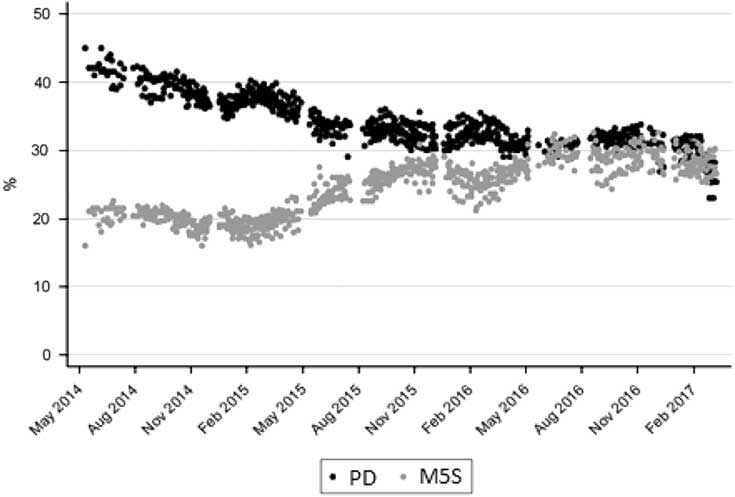
Crucially, public opinion appeared to have partly turned away from Renzi and the Democratic Party (PD). Figure 3 provides polling data on voting intentions from May 2014 to March 2017. In May 2014, the Democrats obtained over 40% of the votes at the EP elections (see Bressanelli, Reference Bressanelli2015). However, the graph shows that the margin between the M5S and the PD has become progressively narrower. Towards the end of 2016, according to several polls, the M5S had finally become the first Italian party, with the trend consolidating in the early months of 2017.
Voting intentions. Elaboration of polling data from www.termometropolitico.it. PD=Democratic Party; M5S=Five Star Movement.

Arguably, the referendum outcome ‘[has speeded up] the M5S’s preparations for the climb to the national government’ (Perrone, Reference Perrone2016). The Democrats’ defeat helped the M5S to considerably increase its blackmail potential, and its elites seemed aware of it. Indeed, hints at the M5S’s change of attitude multiplied between December 2016 and January 2017, in both declarations and actions by leading M5S figures. On the same day as the result of the constitutional referendum was announced, Grillo published a blog post revealing the M5S’s government plan for the energy sector (Grillo, Reference Grillo2016). A few days later, Alessandro Di Battista MP told the German newspaper Die Welt that the Movement was ready and determined to go to elections as early as possible (Reuscher, Reference Reuscher2016). The day after, his party colleague and vice-president of the Chamber of Deputies, Luigi Di Maio, stressed the urgency for a new electoral law, considered a necessary, preliminary step for new general elections (Il Sole 24 Ore, 2016). Concrete actions soon followed these declarations. Most crucially, on 15 December 2016, Davide Casaleggio, son of the M5S co-founder, published a Facebook post announcing that the M5S proposed government plan will soon be voted online by registered members (Casaleggio, Reference Casaleggio2016). Later, on 26 January 2017, Grillo sent a letter to the President of the Italian Republic, Sergio Mattarella, outlining the necessity to elect a new government as quickly as possible. Hence, between December 2016 and January 2017 the Movement evidently changed tactics and strategies within the domestic arena. As Paolo Becchi, who was once considered the ideologist of the Movement, maintained: ‘the M5S has now become a liquid party […] whose only objective is to govern’ (Picardi, Reference Picardi2017).
The changes inside the national arena were soon reflected on the M5S’s actions at the supranational level. Indeed, as an M5S MEP put it, for the M5S the national and the supranational arenas are not separate: ‘The goal is to coordinate more and more, as much as possible, in order to have consistency at different levels – European, national, regional and so on and so forth. […] The idea is to be as blended and coherent as possible at all levels’ (interview, M5S MEP, 26 May 2016). This observation brings support to the idea that the attempted move at the European level might have been driven by the new political scenario which opened up within domestic borders. While the affiliation with the EFDD group could suit well a ‘protest’ party, the ALDE group represented a better fit for a ‘governing’ party. Interestingly, a survey conducted in January 2017 among M5S supporters shows significant support for the idea linking the M5S’s attempt to switch transnational group to changes in domestic circumstances. Specifically, to the question as to why the M5S tried to leave the EFDD group, 33% of respondents affirmed: ‘Because the Movement is transforming more and more into a moderate and [potentially] governing political force’.Footnote 12 Further confirmation of this interpretation comes from the ALDE leader himself. Questioned about the rationale for seeking an alliance with Grillo’s Movement, Verhofstadt declared: ‘The delegation head came to us saying his party no longer wanted to cooperate with Nigel Farage. He said they wanted to be a “less classic” anti-European party’ (quoted in Banks, Reference Banks2017; emphasis added). Verhofstadt’s statement is indirectly supported by influential media outlets. For instance, it is reported that the M5S started looking for new EP allies already in the last few months of 2016. Among them, the ALDE group was the only one to accept – in Beppe Grillo’s words – to ‘open a dialogue’ with the Movement (Corriere della Sera, 2017; Pipitone, Reference Pipitone2017). This evidence supports the claim that the move towards ALDE was initiated by the M5S itself.
In light of the above, the official explanation provided by Grillo to leave the EFDD – namely the outcome of the UK referendum – does not appear compelling. We argue that the answer can be found in domestic politics. With the M5S overcoming the PD in terms of (potential) electoral support, a mainstream affiliation in the EP was a political signal about the ‘respectability’ of the M5S as a party of government. While the affiliation with the EFDD group could suit well a ‘protest’ party, the ALDE group represented a better fit for a ‘governing’ party. Such a chameleonic approach is in line with the idea that populist parties are equipped with a ‘thin-centred ideology’ (Mudde, Reference Mudde2004: 544). Thanks to its ideological thinness, the M5S could act as a political chameleon, and make use of the EP arena as an extension of the domestic one. Hence, membership in a transnational group is seen as a tool serving the domestic political needs of the Movement. Or, as the M5S’s slogan for 2014 European elections very aptly put it, ‘in Europe for Italy’.
Conclusions
This case study adds a piece to the puzzle of political group affiliations in the EP, and enhances our knowledge about the nature and EU activities of the M5S. By triangulating different types of data, we demonstrate that neither policy congruence nor office gains fully explain the M5S’s behaviour at the supranational level. We suggest that domestic politics matters instead. Domestic motives orient the behaviour of the M5S delegation in the EP, and provide an explanation for its antithetical choices. Hence, in June 2014, in line with the Italian public’s growing dissent over the EU and the process of European integration, the M5S joined a Eurosceptic political group. After 2 years, following the profound change within the Italian political scene and the increased popularity of Beppe Grillo’s Movement, the latter tries, without success, to move out of the Eurosceptic group to join a more ‘respectable’ alliance. Three main conclusions can be drawn here.
The first conclusion concerns the nature of the M5S and its attitude to European politics. Notably, this article indicates that domestic strategic considerations prevail over ideological coherence at the supranational level. In other words, the latter can be sacrificed for the benefit of domestic gains in terms of potential votes and offices. Such high flexibility of the political platform tells us a great deal about the populist nature of the Movement (Manucci and Amsler, Reference Marks2018), and confirms the rather strategic nature of its Euroscepticism (Franzosi et al., Reference Franzosi, Marone and Salvati2015). Just as in national politics, the M5S deftly tailors its European strategy to meet ‘citizens’ most pressing demands’ (Conti and Memoli, Reference Conti and Memoli2015: 528) and maximize its popularity.
A further and related remark concerns the role occupied by the EP in the M5S’s strategic toolkit. Such a ‘utilitarian’ use of the EP resonates with the usual approach of protest parties to EU affairs. As previous research suggests (i.e. Hix, Reference Hix2005: 193), protest parties tend to pay relatively more importance to the EP for this is the arena where they score better thanks to the second-order nature of European elections. For these parties, the supranational arena may work as a springboard to domestic politics. Yet, differently from most protest parties – which tend to be peripheral in their respective constituencies – the M5S does not occupy the margins of the Italian party system. As a result, for the M5S the EP represents a secondary, but strategically important arena to be used either as a mouthpiece or as a launching pad for domestic objectives. As Corbetta and Vignati put it, ‘The European Union […] figures in Grillo’s speeches within a chiefly national framework’ (Reference Corbetta and Vignati2014: 56). The third conclusion concerns transnational group membership in the EP and its broader relevance vis-à-vis the multi-level dimension of the EU. By showing that transnational group membership can serve purposes other than those internal to the EP, this research confirms the increasing interrelation between political parties’ EU and national-level choices (cf. McDonnell and Werner, Reference McDonnell and Werner2018). In the case of the M5S, policy and office objectives at the EU level – the two main triggers of group choice identified by the literature – played at best a secondary role to explain its transnational affiliation. As this research demonstrates, the hypothesis that domestic politics drives the M5S’s political group affiliation in the EP appears to have stronger explanatory value.
Considering the M5S’s core features – that is, its ‘chameleonic’ approach and ‘liquid’ political platform – the question arises as to whether our explanation applies to other cases. The increasing politicisation of the EU (cf. Grande and Kriesi, Reference Grande and Kriesi2014) has created ‘the conditions under which politics travels across the EU’s multilevel system’ (Koop et al., Reference Koop, Reh and Bressanelli2017: 3) and fostered the interplay between domestic and supranational arenas. This may suggest that far from being an exceptional case, the M5S’s approach to transnational alliances just reflects the increasingly intertwined character of the EU polity. Further research is welcome to unravel this puzzle by testing the validity of our argument for other parties across the EU.
Acknowledgements
The authors would like to thank Christoph Meyer, Markus Gastinger, all participants to the Joint Workshop on Europe held at the Technische Universität Dresden on 12–13 May 2017, and the two anonymous reviewers. The authors are also thankful to the Faculty of Arts and Humanities at King’s College London and to the Santander Universities scheme for supporting the authors’ fieldwork.
Funding
This research received no grants from the public, commercial, or non-profit funding agency.
Data
The replication data set is available at http://thedata.harvard.edu/dvn/dv/ipsr-risp
Appendix
Principal component factor analysis of the EUANDI data
Scores for the weighting of mega-seats