INTRODUCTION
Cerebral white matter (WM) is important for cognition, and microstructural changes contribute to age-related cognitive deficits (Bennett & Madden, Reference Bennett and Madden2014). Reductions in WM microstructure are related to poorer performance across several cognitive domains among clinically normal older adults (Vernooij et al., Reference Vernooij, Ikram, Vrooman, Wielopolski, Krestin, Hofman, Niessen, Van der Lugt and Breteler2009). Recent literature also demonstrates that WM abnormalities are an early feature of incipient neurodegenerative syndromes, including Alzheimer’s disease (AD; Fischer et al., Reference Fischer, Wolf, Scheurich and Fellgiebel2015). Microstructural alterations of WM are affected in AD relative to controls in several regions (Sexton et al., Reference Sexton, Ukwuori, Flippini, Mackay and Ebmeier2011), and are associated with the rate of cognitive decline (Brickman et al., Reference Brickman, Honig, Scarmeas, Tatarina, Sanders, Albert, Brandt, Blacker and Stern2008). It remains unclear, however, whether impairments arise from tract-based in addition to global changes in WM (Bennett & Madden, Reference Bennett and Madden2014). Clarifying the relationships between WM integrity and cognition may offer new insights into diagnosis and treatment planning. The objective of this study was to determine the importance of regional WM tracts and global WM for performance in cognitive domains that are commonly affected in neurocognitive disorders and assessed during dementia evaluations.
We used diffusion tensor imaging (DTI) to investigate the relationships between tract-based and global WM microstructure and performance on measures of memory, executive function and speed, and visuospatial skills. We used subtests from the University of California, San Francisco (UCSF) Brain Health Assessment (BHA), a tablet-based cognitive assessment for the detection and classification of mild neurocognitive disorders. In a prior study that examined regional gray matter correlates of these subtests (Possin et al., Reference Possin, Moskowitz, Erlhoff, Rogers, Johnson, Steele, Higgins, Stiver, Alioto, Farias, Miller and Rankin2018), memory performance correlated with medial temporal volumes; executive function and speed performance was associated with frontal, parietal, and basal ganglia volumes; and visuospatial performance correlated with right parietal volumes. We hypothesized that in a whole-brain DTI tract analysis, memory performance would show association with WM pathways in the temporal lobes; executive function and speed performance with subcortical and corpus callosum tracts; and visuospatial performance with WM microstructure within the right parietal lobe.
METHOD
Participants
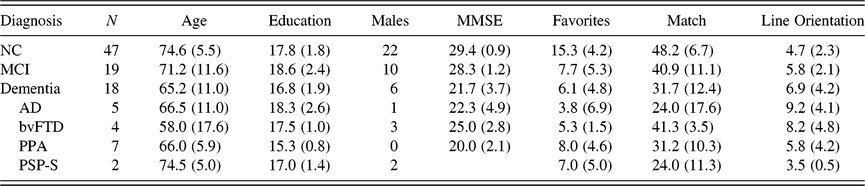
A total of 84 participants [47 neurologically healthy older adults; 19 mild cognitive impairment (MCI; Albert et al., Reference Albert, DeKosky, Dickson, Dubois, Feldman, Fox, Gamst, Holtzman, Jagust, Petersen, Snyder, Carrillo, Thies and Phelps2011); 18 dementia (major neurocognitive disorder; American Psychiatric Association, 2013)] were recruited from longitudinal studies at the UCSF Memory and Aging Center. We included participants who received magnetic resonance imaging (MRI) with DTI within 180 days of BHA administration. Participants were diagnosed in multidisciplinary clinical consensus conferences (Appendix 1 in Supplementary Material). Participants were diverse in terms of dementia diagnosis, cognitive performance, and patterns of WM microstructure. Demographic and clinical characteristics are reported in Table 1. The UCSF Committee on Human Research approved this study.
Demographic characteristics and BHA scores by diagnostic group

Note. Values represent mean (SD).
MMSE, Mini Mental State Examination (Folstein et al., Reference Folstein, Folstein and McHugh1975); NC, normal control; MCI, mild cognitive impairment; AD, Alzheimer’s disease; bvFTD, behavioral variant frontotemporal dementia; PPA, primary progressive aphasia including the nonfluent (N = 4), logopenic (N = 2), and semantic (N = 1) variants; PSP-S, progressive supranuclear palsy syndrome.
The Brain Health Assessment
The BHA was programmed in the TabCAT framework developed at UCSF (https://memory.ucsf.edu/tabcat) and was administered to participants by research assistants who were trained and supervised by a licensed neuropsychologist. During the BHA, participants were seated in a chair at a desk with a 9.7-inch iPad positioned horizontally in front of them with the back of the tablet propped 1 inch up from the desk surface. The assistant sat next to the participant for all tasks.
The Favorites memory test requires the participant to learn to associate faces with food and animal words across two learning trials. After each learning trial, the faces reappear one at a time, and the participant is asked to recall the food and animal associated with each face. The examiner records participant responses on a sheet of paper and later enters them into the tablet for scoring. Accuracy is summed across two immediate recall and one 10-min delay recall trial. The Match executive function and speed test requires the participant to quickly match numbers with simple abstract pictures using a legend that remains visible throughout the task. When a number appears in the middle of the screen, participants are asked to tap the corresponding picture as quickly as possible. Accurate responses in 2 min are totaled. The Line Orientation visuospatial test requires participants to identify which of two lines is parallel to a target line. The “angle difference” between the non-match line and the correct match line is staircased based on response accuracy. Higher scores on Favorites and Match, and lower scores on Line Orientation, represent better performance.
Neuroimaging Data Acquisition and Image Processing
Diffusion tensor imaging
Participants underwent MRI at the UCSF Memory and Aging Neuroscience Imaging Center using a Siemens 12-channel head coil on a 3 Tesla Siemens Prisma scanner (Appendix 1 Supplementary Material). Diffusion-weighted images (DTI) were acquired using single-short spin-echo sequence. WM tracts were masked using the ICBM-DTI-81 WM labels and tract atlas (Mori et al., Reference Mori, Wakana, van Zijl and Nagae-Poetscher2005). WM microstructure was determined using a DTI-derived metric, and mean FA was computed from 27 WM tracts throughout the brain. Global FA was calculated as mean FA across all voxels in the WM atlas. Details on DTI acquisition and processing are provided in Appendix 1 in Supplementary Material.
Statistical Analyses
All 84 participants who underwent DTI and completed Favorites, Match, and Line Orientation were included in the analyses. We used histograms to identify possible outliers. Across the data for all 3 tests and 27 major tracts, 25 data points were detached from the distribution and were greater than 3 standard deviations from the mean, and were winsorized to 3 standard deviations from the mean to reduce their influence. Scatter plots depicting primary findings by diagnostic group are shown in Supplementary Figures 1–3. To determine which of the 27 major tracts in frontal, temporal, parietal, and subcortical regions uniquely contributed to performance on each subtest, we performed stepwise regressions with backwards elimination. WM tract FA values were averaged and investigated bilaterally for Favorites and Match analyses, but were investigated separately by hemisphere for Line Orientation because we hypothesized stronger right hemisphere associations for this task. To avoid multicollinearity while allowing for broad consideration of potential regions, we first reduced the number of potential predictors for each regression model by correlating all 27 major WM tracts throughout the brain separately with test performance. We selected WM tracts for inclusion for which r p values were at least .30 (a medium effect size; Cohen, Reference Cohen1992). In each regression, we sequentially eliminated the weakest predictors until only predictors with a p-value <.05 remained. We conducted sensitivity analyses to determine if our results were similar after controlling for dementia severity (Clinical Dementia Rating; Morris, Reference Morris1993), and after sequentially removing each of the four dementia subtypes. We also report the significance of the individual correlations with all 27 tracts with type I error correction using the Hochberg method (Hochberg, Reference Hochberg1988; Supplementary Tables 1–2). The adjusted p-values used to determine statistical significance after correcting for multiple comparisons were: <.0023 for Favorites, <.0033 for Match, and <.0011 for Line Orientation performance. For all correlation and regression analyses, age and sex were included as covariates.
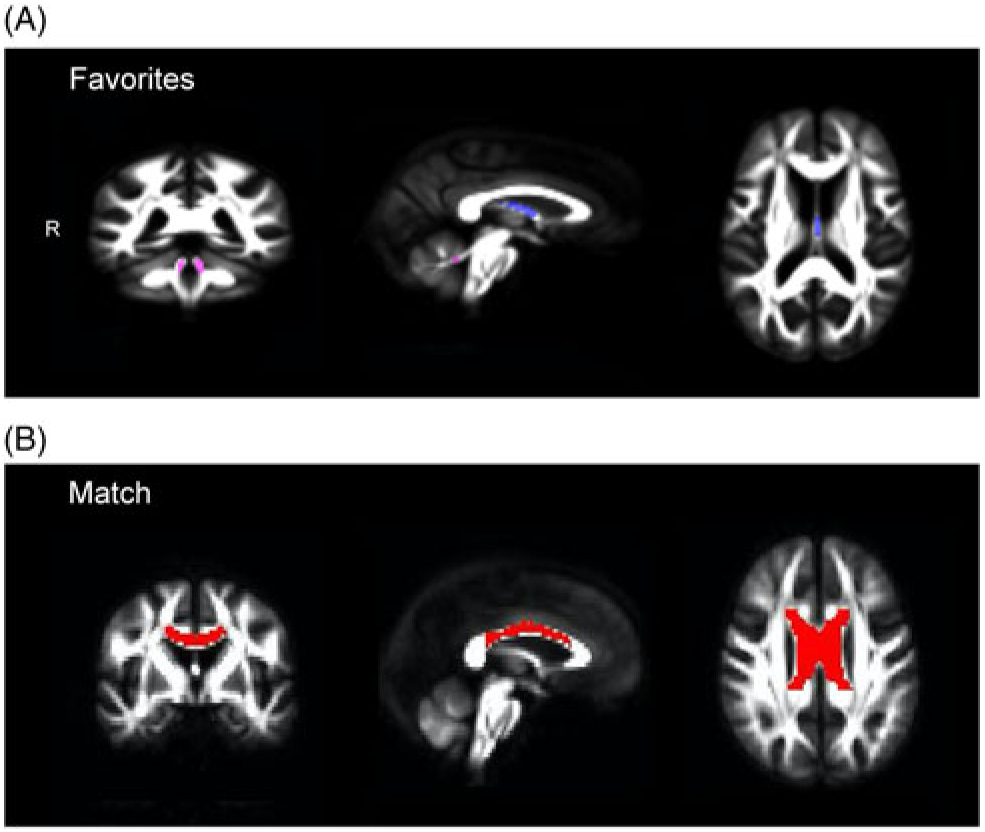
WM tracts that uniquely predict performance on the Favorites memory and the Match executive function and speed test performance in regression analyses. The fornix is shown in blue (A), the superior cerebellar peduncle in pink (A), and the body of the corpus callosum in red (B).

In secondary analyses, we explored the importance of regional WM microstructure in predicting domain-specific cognition after accounting for global WM. Separately for each cognitive test, we accounted for the effects of global FA, age, and sex and saved the residuals. Next, we used the regional FA values that were significant in primary regression analyses to predict these residuals.
RESULTS
Memory
Partial correlation coefficients of Favorites memory performance and WM microstructure are reported in Supplementary Table 1. Based on a moderate correlation with Favorites performance (r p’s ≥ .3), FA in 13 WM tracts in temporal, frontal, corpus callosal, and also subcortical regions were included in the regression. In the final stepwise regression model, FA of the column and body of the fornix (B = 30.78; p = .001) and the superior cerebellar peduncle (B = 41.76; p = .007) were retained (Supplementary Table 3; Figure 1). In sensitivity analyses, FA of the column and body of the fornix (B = 22.96; p =.03) and the superior cerebellar peduncle (B = 34.07; p =.04) remained significant after controlling for dementia severity. After sequentially removing each of the four dementia subtypes, the column and body of the fornix remained significant in all analyses (all p’s < .05), and the superior cerebellar peduncle was significant when each group was removed except AD (p = .08). The individual correlations with multiple comparison correction produced similar results: the same regions significantly correlated with Favorites performance, and the fornix stria terminalis and the superior longitudinal fasciculus additionally reached significance (Supplementary Table 1).
In secondary analyses, global FA was significantly associated with Favorites memory performance after controlling for age and sex (B = 87.02; p = .001). FA of the fornix (B = 18.90; p = .04) but not the superior cerebellar peduncle (B = 28.21; p = .06) significantly predicted the residuals.
Executive Function and Speed
FA in 13 WM pathways in frontal, callosal, temporal, and subcortical regions were included in the regression. In the final stepwise regression model, FA of the body of the corpus callosum (B = 147.18; p < .001) was retained (Supplementary Table 4; Figure 1). In sensitivity analyses, after sequentially removing each of the four dementia subtypes, the body of the corpus callosum remained significant in all analyses (all p’s < .05). After controlling for dementia severity, the body of the corpus callosum was not significant (B = 58.54; p = .08). In addition to this region, individual correlations with multiple comparison correction were significant for the genu and the splenium of the corpus callosum, the external capsule, the superior cerebellar peduncle, the superior longitudinal fasciculus, the sagittal stratum, the cingulate gyrus, the uncinate fasciculus, the fornix stria terminalis, and the fornix column and body (Supplementary Table 1).
In secondary analyses, global FA was significantly associated with Match executive and speed performance (B = 173.35; p < .001), and FA of the body of the corpus callosum significantly predicted the residuals (B = 52.93; p =.048).
Visuospatial Skills
Partial correlation coefficients of Line Orientation performance and FA of WM microstructure are reported in Supplementary Table 2. None of the 27 right-hemisphere or 27 left-hemisphere WM tracts met the threshold for inclusion in the regression model (all r ps < .30), or exhibited significant individual correlations with Line Orientation after correcting for multiple comparisons (Supplementary Table 2). In secondary analyses, global FA was not associated with visuospatial performance (B = −15.60; p = .23).
DISCUSSION
We investigated the relationships of memory, executive function and speed, and visuospatial performance on the UCSF Brain Health Assessment with regional and global WM microstructure. In regression analyses, memory performance was uniquely predicted by integrity in a WM temporal lobe tract important for memory, and by a tract in the cerebellum. Executive functions and speed were predicted by the microstructure of a corpus callosum tract important for efficient cognitive functions. Visuospatial skills did not exhibit significant associations with WM microstructural integrity in regional or whole-brain analyses. Findings support the differential recruitment of regional WM tracts for domain-specific cognitive skills.
The Favorites test of memory requires participants to learn and recall face–word associations. Performance was associated with WM integrity in the fornix and the superior cerebellar peduncle. Results were similar after controlling for dementia severity, indicating that associations were not specific to a particular functional level. Global FA significantly predicted memory performance, and integrity of the fornix but not the superior cerebellar peduncle significantly predicted residual variance, indicating an important role for the fornix in memory beyond global WM. The fornix is a critical component of the limbic system that constitutes the major WM pathways from the hippocampi. Fornicial microstructural integrity is shown to play an important role in episodic memory performance, and WM deterioration of the fornix is a sensitive predictor of conversion from normal cognition to MCI, as well as from MCI to AD (Nowrangi & Rosenberg, Reference Nowrangi and Rosenberg2015). Favorites memory performance also correlated with the stria terminalis, a band of fibers receiving projections from the hippocampus via the fornix. The correlation with the superior longitudinal fasciculus, an association fiber connecting lateral prefrontal to parietal regions, is consistent with the view that both frontal and parietal systems are important for memory (Fletcher & Henson, Reference Fletcher and Henson2001). Results suggest that episodic memory is a complex cognitive process relying on a widely distributed network of WM connections, especially limbic tracts, but also cerebellar and frontoparietal connections.
The Match test of executive functions and processing speed requires participants to quickly match numbers with a picture using a visible legend. Better performance was uniquely associated with WM integrity of the body of corpus callosum. Global FA significantly predicted executive functions and speed, and the corpus callosum significantly predicted residual variance. Prior research has established an important role for the corpus callosum in executive function and speed (e.g., Bettcher et al., Reference Bettcher, Mungas, Patel, Elofson, Dutt, Wynn, Watson, Stephens, Walsh and Kramer2016), consistent with its anatomical function connecting and enabling communication between hemispheres. FA in several additional regions correlated with Match, specifically the full extent of the corpus callosum, the superior longitudinal fasciculus, cingulate gyrus, external capsule, uncinate fasciculus, sagittal stratum, superior cerebellar peduncle, and the fornix stria terminalis. The broad array of correlations with Match is consistent with the view that WM integrity is particularly crucial for efficient executive functions and speeded cognition in aging (Jacobs et al., Reference Jacobs, Leritz, Williams, Van Boxtel, van der Elst, Jolles, Verhey, McGlinchey, Milberg and Salat2013).
The Line Orientation test requires subjects to identify which of two lines is parallel to a target line. We did not find significant associations between visuospatial performance and regional or whole-brain WM microstructure. No correlations with tract-based FA, including parietal tracts, were significant after multiple comparison correction or met our effect size threshold to be included in regression analyses. While many studies have demonstrated that right parietal gray matter is important for visuospatial functions, the gray matter correlates are circumscribed compared to those for memory and executive functions (Possin et al., Reference Possin, Moskowitz, Erlhoff, Rogers, Johnson, Steele, Higgins, Stiver, Alioto, Farias, Miller and Rankin2018; Tranel et al., Reference Tranel, Vianna, Manzel, Damasio and Grabowski2009), and efficient WM communication may therefore be less critical. Mild changes in WM microstructure may have less of an impact on visuospatial processing than on executive function or memory.
The study sample was English-speaking with high education, which limits generalizability to other clinical populations. Future work is planned with samples more diverse in terms of cultural background and education. In addition, our sample was not large enough to separately evaluate WM–cognition relationships in diagnostic subgroups, in which there may be unique relationships. This type of analysis is needed to make clinical interpretations about how WM changes in specific groups, such as AD, contribute to domain-specific cognitive deficits, and also the extent to which the reported findings generalize to the complete spectrum of dementias and MCI.
In summary, we found different patterns of correlations between the UCSF BHA subtests of memory, executive function and speed, and visuospatial skills with WM tract integrity. Memory performance was associated with WM microstructure of the fornix and superior cerebral peduncle; whereas executive function and speed performance, with corpus callosum integrity. The memory–fornix and the executive function–corpus callosum associations remained significant even after accounting for variance explained by global WM, suggesting that microstructural changes in these tracts impact cognition beyond global WM changes. In contrast, visuospatial performance was not associated with regional or whole-brain WM integrity. Given the growing prevalence of neurocognitive disorders among older individuals and advances in health care, future investigations of WM microstructural health and cognition will be importance to further elucidate the mechanisms of cognitive decline.
ACKNOWLEDGMENTS
We are grateful to our study participants and their families. This study was supported by the Global Brain Health Institute, Quest Diagnostics, the National Institute on Aging (K23 AG037566-01A1, ADRC P50 AG023501, P01 AG019724), the National Institute of Neurological Disorders and Stroke (UG3 NS105557-01), and the Larry L. Hillblom Network Aging Grant for the Prevention of Age-Associated Cognitive Decline (2014-A-004-NET).
CONFLICTS OF INTEREST
Katherine L. Possin has received grant support from Quest Diagnostics. Katherine P. Rankin has received grant support from Quest Diagnostics and the Rainwater Charitable Foundation. The remaining authors declare that they have no conflicts to disclose.
SUPPLEMENTARY MATERIAL
To view supplementary material for this article, please visit https://doi.org/10.1017/S1355617719000225.