In the middle of the night on July 28, 2017, political observers tuned in to CSPAN for the highly anticipated vote on the GOP’s “skinny repeal” of the Affordable Care Act. As he did on the campaign trail in 2016, President Donald Trump urged his Republican co-partisans to vote for the bill. In a tweet directed at a handful of recalcitrant lawmakers, Trump said his GOP colleagues needed to “step up to the plate and, after 7 years, vote to Repeal and Replace.” After hours of dramatic anticipation, Senator John McCain joined his colleagues Susan Collins and Lisa Murkowski in voting “no,” thus ensuring blockage of the seven-year Republican repeal effort. Democrats in the chamber, and those watching at home, cheered in unison at 1:30 a.m. From the chamber floor, Senate Majority Leader Mitch McConnell put it mildly, saying the legislative failure was “clearly a disappointing moment” (CSPAN 2017).
Media coverage of a few failed legislative efforts in 2017, such as the ACA repeal, coupled with attention to Republican opposition to Trump’s controversial statements, may have contributed to a perception that Trump lacked the support of his own party, including support for the president’s policy agenda. However, many Trump policy priorities did pass in this first year, the most prominent of which included the Republican tax bill and confirmation of Neil Gorsuch to the Supreme Court. We believe this prompts two questions: First, just how often did Republican lawmakers vote against Donald Trump in 2017, and was his party’s opposition uncommon in historical perspective? Second, why did some Republicans vote against Trump’s preferred policies while others were loyal supporters of the president?
We contribute to Perspectives on Politics’s special edition on the causes and consequences of Trump’s presidency in a number of ways. By examining past support from the president’s own party, we are able to address a fundamental question about whether the GOP’s response to Trump is abnormal or, in fact, fairly typical. We believe this is a necessary first step in addressing broader questions about Trump’s relationship to the Republican Party. Our analysis finds that Trump’s Republican support is in line with scholarly expectations, contrary to some claims. We also examine explanations for why Republicans supported or opposed Trump’s legislative positions. Our findings suggest that President Trump’s opposition from the GOP hinges on identity politics and district wealth.Footnote 1 We also find that establishment lawmakers, and especially conservative Republicans, were more likely to embrace the president’s positions.
Research on Presidential Support
A lengthy literature examines presidential power—the ability to influence and persuade (Neustadt Reference Neustadt1960). In this body of work, one way to view power is to assess the president’s ability to get his legislative priorities through Congress (Lebo and O’Geen Reference Lebo and O’Geen2011). We follow this line of work, with the exception that we focus on the president’s support from his own party. In contrast to the substantial volume of research on presidential power, research on co-party presidential support is thin at best and in need of greater development. We are aware of just one study that models support from the president’s party in isolation (Prins and Shull Reference Prins and Shull2006). We briefly review the relevant findings on the president’s legislative support, focusing on honeymoons and mandates, public opinion, and the distribution of legislator preferences. We then draw on this body of work to assess Trump’s legislative support in 2017.
Honeymoons and Mandates
Scholarship has found that lawmakers tend to vote with the president more in his first year in office than in subsequent years (Edwards Reference Edwards1989; Bond and Fleisher Reference Bond and Fleischer1990; Lockerbie, Borrelli, and Hedger Reference Lockerbie, Borrelli and Hedger1998; Peterson et al. Reference Peterson, Grossback, Stimson and Gangl2003; Grossback, Peterson, and Stimson Reference Grossback, Peterson and Stimson2005). Researchers attribute this phenomenon to either a “honeymoon period” or a “presidential mandate.” The existence of presidential honeymoons—favorable treatment by lawmakers, the public, the media, etc. in the president’s first 100 days or first year—has modest backing in the literature (Frendreis, Tatalovich, and Schaff Reference Frendreis, Tatalovich and Schaff2001; Dominguez Reference Dominguez2005; Beckman and Godfrey Reference Beckmann and Godfrey2007). In one of the more recent analyses, Beckman and Godfrey (Reference Beckmann and Godfrey2007) find that policy-making prospects do improve during the honeymoon period, but they are dependent on a host of other variables. Less scholarly consensus exists on the topic of presidential mandates—the notion that the president’s victory grants him or her the authority to push his agenda. Whether mandates exist (Wolfinger Reference Wolfinger and Ranney1985; Dahl Reference Dahl1990) and what drives them have been topics of controversy. Weinbaum and Judd (Reference Weinbaum and D. R.1970) found that mandate voting has more to do with the new makeup of Congress rather than a more comprehensive shift in lawmakers’ policy preferences. Grossback, Peterson, and Stimson’s (Reference Grossback, Peterson and Stimson2005) analysis shows that mandates are fueled by legislators’ perceptions of preference changes in the public rather than the presidents’ declaration of a mandate himself (Conley Reference Conely2001).
Public Opinion
The notion that the public has some influence in the president’s legislative success dates back to Neustadt’s (Reference Neustadt1960) work on the presidential power. In brief, Neustadt argues that the president’s public support operates “mostly in the background as a conditioner’’ (1960, 87), helping the president persuade Congress to act on his or her legislative priorities when the president enjoys popular support. Ultimately, this view guided the next few decades of research on presidential success, leading to empirical tests of Neustadt’s thesis with varying results. Some have questioned the relationship between approval and success entirely (Bond and Fleischer Reference Bond and Fleischer1990; Collier and Sullivan Reference Collier and Sullivan1995; Cohen et al. Reference Cohen, Bond, Fleisher and Hamman2000; Edwards Reference Edwards1980; Rudalevige Reference Rudalevige2002). Others have replicated the thesis while calling attention to qualifier variables such as issue salience at the bill level (Canes-Wrone and de Marchi Reference Canes-Wrone and de Marchi2002) and the chamber of Congress (Edwards Reference Edwards1980). Recent analyses have found that public opinion of the president’s co-partisans in the public is what matters most (Lebo and O’Geen Reference Lebo and O’Geen2011).
Congressional Preferences
A more recent line of scholarship finds that presidential support can be understood by examining the partisan and ideological makeup of Congress (Cooper and Brady Reference Cooper and Brady1981; Bond and Fleischer Reference Bond and Fleischer1990; Peterson Reference Peterson1990; Rudalevige Reference Rudalevige2002; Conley Reference Conely2001). For example, Peterson (Reference Peterson1990) suggests that support for the president’s agenda hinges on Congress’s partisan breakdown. Likewise, Prins and Shull (Reference Prins and Shull2006) find that a partisan margin variable exerts a larger effect on presidential success and support than any other predictor in their model. In their analysis, going from the lowest percentage of co-partisans in the House (33%) to the highest percentage (68%) increases the probability of presidential legislative success by 50% and the vote margin on the president’s preferred legislation by 15%. Additional studies have pointed to the role of legislator ideology and ideological cohesion (Lebo and O’Green Reference Lebo and O’Geen2011; Rudalevige Reference Rudalevige2002), ideological distance between the president and party leaders (Lebo and O’Geen Reference Lebo and O’Geen2011), and the exercise of stronger agenda control (Aldrich and Rohde Reference Aldrich, Rohde, Dodd and Oppenheimer2001; Curry Reference Curry2015; Lee Reference Lee2016; Rohde Reference Rohde1991).
Republican Opposition to Trump’s Legislative Positions In the Aggregate
Our first empirical question is whether Trump’s own party is opposing his legislative priorities at a notable level. We begin by acknowledging that there is nothing unusual about members of the president’s own party being at odds with his priorities. Conservative-leaning “blue dog” Democrats voted against the Affordable Care Act en masse. Likewise, Obama suffered a stinging defeat when Democrats joined with Republicans to override his veto of a bill allowing 9/11 victims’ families to sue Saudi Arabia. George W. Bush faced opposition from his own party on a number of significant policy items: a bill to reform social security, which never even came to the floor for a vote; an immigration reform bill, where on multiple votes a majority of Republicans opposed Bush’s position; and an override of a Medicare funding bill veto, which was thwarted with the support of about half of Republican members of Congress.
What did Trump’s support in his first year look like? Aggregate data on the president’s support in Congress is compiled every year by CQ Roll Call. Utilized in dozens of published studies as a dependent variable (for example in Bond and Fleisher 1980; Prins and Shull Reference Prins and Shull2006; Mack, DeRouen, and Lanoue Reference Mack, DeRouen and Lanoue2011), CQRC’s presidential “support score” measures how each lawmaker voted on dozens of recorded votes where the president (or an authorized spokesperson) took a clear position. In this section, CQRC’s data serve as our dependent variable. The data are restricted to the president’s own party, where higher values indicate greater support for the president’s positions and lower values indicate less support.
In 2017, CQRC coded 35 House votes and 115 Senate votes. According to these data, Trump received the support of 95.9% of his Republican co-partisans in the House and the support of 98.9% of his Republican co-partisans in the Senate. Both the greater number of votes and higher support in the Senate is due to CQRC’s inclusion of presidential appointments. If we remove nomination votes from the calculation in the upper chamber, Trump’s support in the Senate drops to 95.7%, almost exactly the same as in the House. Trump’s high level of support in both chambers contrasts with statements such as “His inability to get anything through a Congress run by his own party is becoming an unprecedented failure” (Slate 2017) and “GOP senators are willing to tell Trump to take a hike” (Politico 2017).
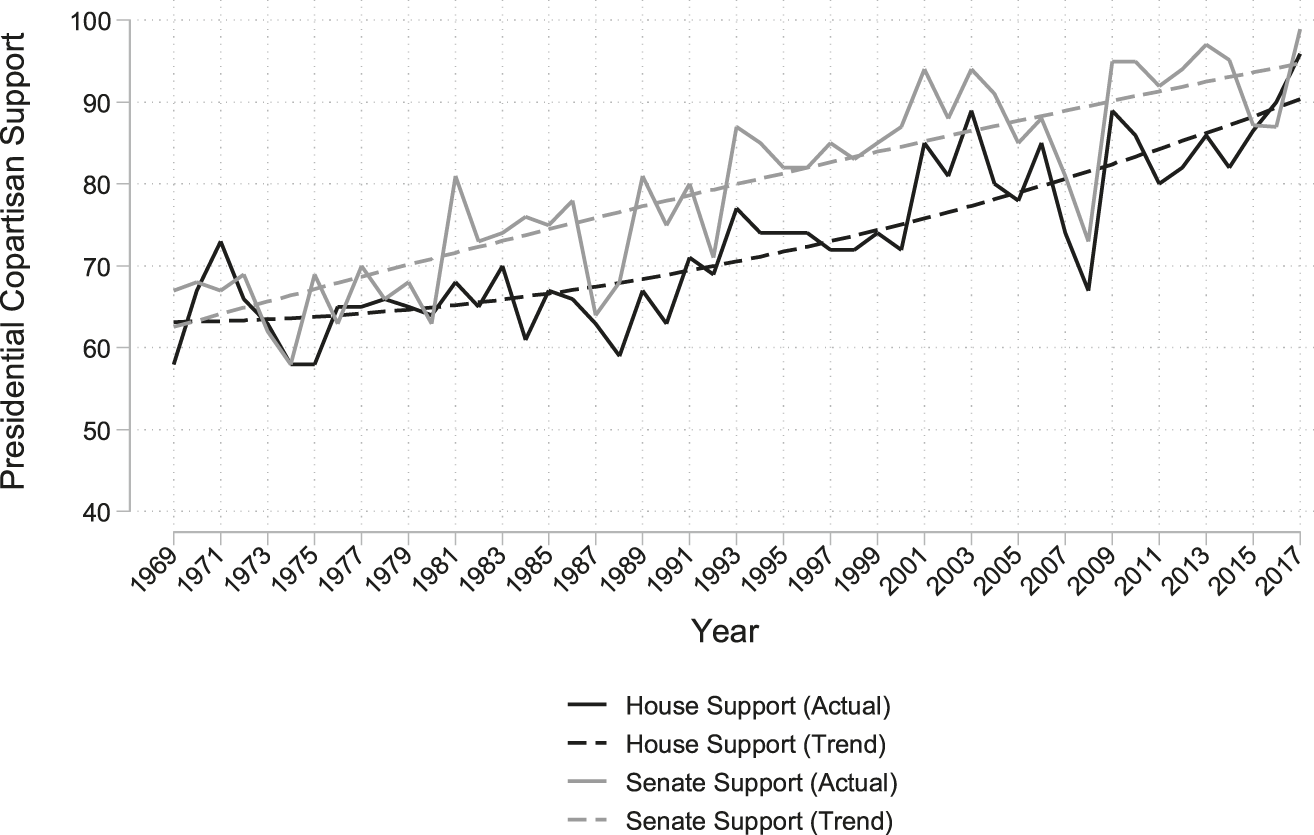
Having determined that Trump enjoyed a great deal of legislative support during his first year in office, we look at whether this level of agreement is historically anomalous. One way to answer this question is to compare Trump’s support to that of recent presidents. Figure 1 presents CQRC’s yearly presidential support scores for a president’s party since 1969 with a polynomial trend.Footnote 2 We can see that since Richard Nixon’s first year in office, the president has enjoyed increasing support from his co-partisans. In recent Congresses, the president’s support has hovered around 90%. For example, in 2016 Obama received the support of 90% of House Democrats and 87% of Senate Democrats. If we extend the trend forward one year, Trump’s legislative support appears roughly in line with expectations, albeit still high.
Aggregate presidential copartisan support (1969–2017)

Perhaps a better way to answer this question is to model presidential support from 1969 to 2016 and simply forecast Trump’s support in 2017. Our dependent variable is the measure in Figure 1: the president’s aggregate yearly support score among his co-partisans. In the model, we include nine predictors of presidential support, suggested by the literature reviewed earlier. Four of our predictors capture variation in the policy preferences of lawmakers as measured by Poole’s DW-NOMINATE scores. Chamber Polarization is the distance between the median Democrat and median Republican in the specific chamber.Footnote 3 Consistent with the literature, we hypothesize that inter-party polarization leads parties to support their president. We also include an interaction effect that captures the ideological divide between southern and non-southern Democrats in the first half of the time series. Ideological Cohesion (2nd dim.) is derived from Poole’s second-dimension scores and captures ideological variation on racial issues, where higher values indicate more variation and thus less cohesion, while the variable Democratic President is an indicator for Democratic presidents. We hypothesize a negative effect on the interaction term, indicating that high variation on the second-dimension decreases the support of Democratic presidents.
We also include five contextual variables. Chamber Majority records whether the president’s party is the majority in their respective chamber. We believe that majority status—and the greater chance of enacting legislation—will unite the president and his co-partisans around a common agenda. Presidential Approval is the president’s approval rating averaged over the year, according to Gallup. When the president is popular, we believe legislative support will increase. Seats Gained is a continuous variable for the number of seats the president’s party gained (or lost) in the most recent election. When the president’s party loses seats—especially in a midterm—we expect legislative support to decrease. Military Casualties is the number of soldiers killed in action. Given the president’s unique role as the Commander in Chief, a high number of fatalities will perhaps yield less support. Lastly, Year in Office records the president’s tenure.Footnote 4 Consistent with the notion of honeymoons and mandates, we predictve that presidents will enjoy greater support from their co-partisans early in their tenure.
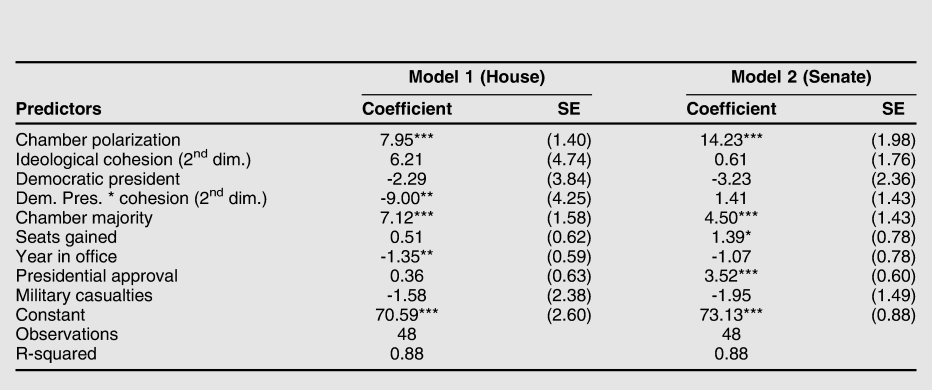
Table 1 presents our results. Because the dependent variable is continuous, we use OLS to estimate the model. We also estimated a fractional model given that the response is bound between zero and one. We found that the information criterion (AIC/BIC) vastly favors OLS. Further, a fractional model produces nearly identical results. In order to compare the effect of each covariate, the continuous covariates in table 1 were standardized to have a common scale.Footnote 5 With just 48 observations, our main goal is predictive accuracy, not significant covariates. By that standard, our models perform fairly well, explaining 88% of the variation in presidential support in both chambers.Footnote 6
Legislative support in the president’s party

*** p<0.01, **p<0.05, *p<0.10; robust standard errors in parentheses
A few factors are worth highlighting.Footnote 7 First, the polarization variable is significant in both chambers and has the largest effect size, indicating that party dynamics within Congress are key to the broader increase in presidential support since 1973. In this respect, we would expect Trump to receive a high level of support from his Republican counterparts given continued polarization in 2017 according to Keith Poole’s data. Second, Chamber Majority is significant in both chambers as well. Because the coefficients are positive they indicate that majority status is worth an extra 7.12% co-partisan support in the House and 4.50% co-partisan support in the Senate. And third, while one would think Trump’s low approval rating would cause his Republican counterparts to abandon him, the effect of Presidential Approval is either insignificant and small in magnitude, as in the House model, or significant but smaller in size compared to other factors, as in the Senate model. Notably, this relatively small effect is plainly evident in figure 1, where we can see that even the most popular presidents in the 1970s and 1980s had less support than the least popular presidents in the polarized 2000s and 2010s. For example, George W. Bush enjoyed greater Republican support in 2007 and 2008—as one of the least popular presidents—than Ronald Reagan in 1985 and 1986—as one of the most popular presidents. We believe these effects would be significant or larger in magnitude if we had used approval scores over the entire series from the president’s co-partisans only (Lebo and O’Geen Reference Lebo and O’Geen2011).
In the analysis, a few factors are significant in one chamber but insignificant in the other. We find that the ideological divide among Democrats on racial issues decreases the president’s support score, but only on the House side. Likewise, presidents receive less support from their copartisans later in their tenure in the House but not the Senate. In the Senate model, though not on the House side, we find that as presidential approval increases, so does presidential support, and that presidents who preside over seat gains by their party enjoy greater support. Although there are notable differences in the behavior of senators and representatives (Baker Reference Baker2008), we believe the most likely explanation for these disparate results is that our sample size is limited in its scope. As noted earlier, with just 48 observations our goal is predictive accuracy, not statistically significant covariates. In support of our claim about the sample size, it is worth noting that each insignificant effect is always in the same direction as its significant counterpart in the other chamber.
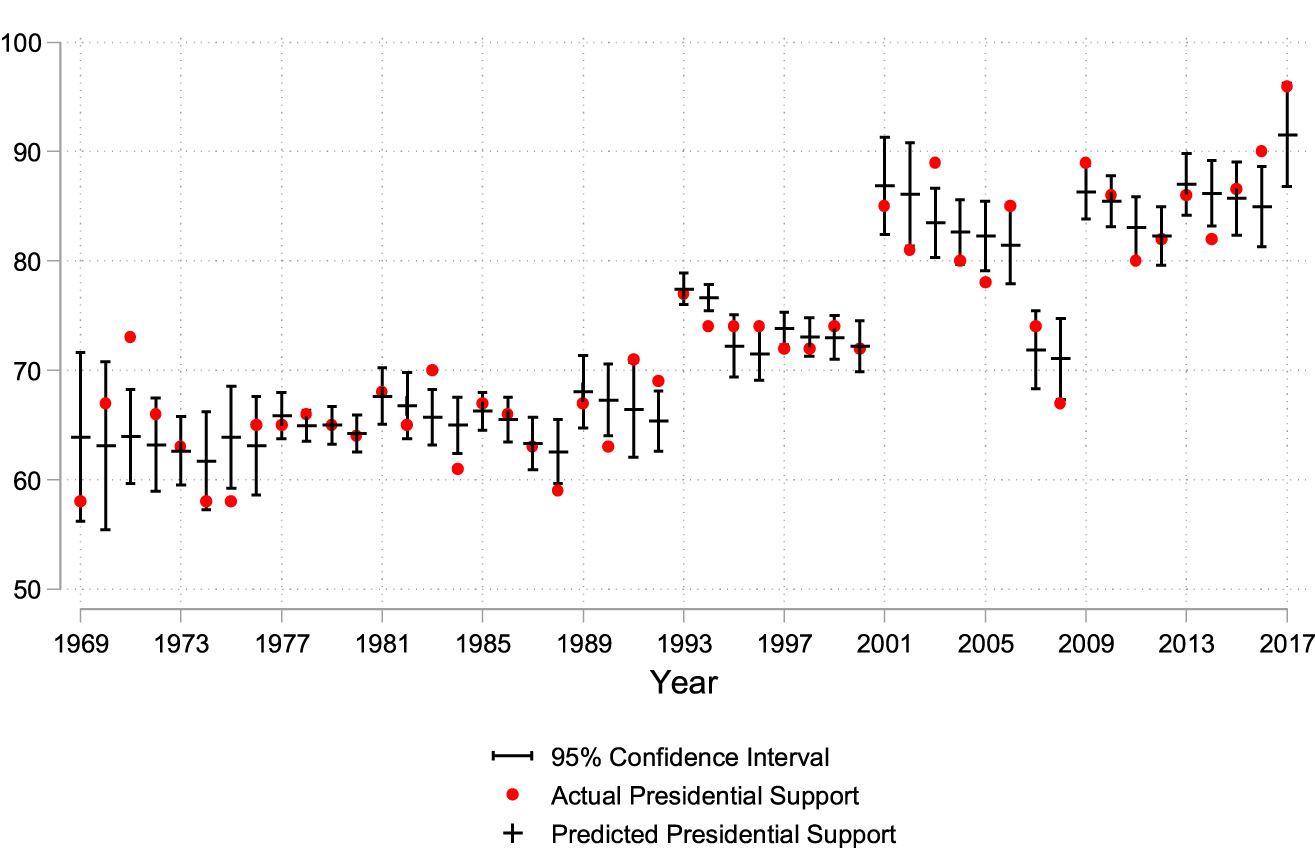
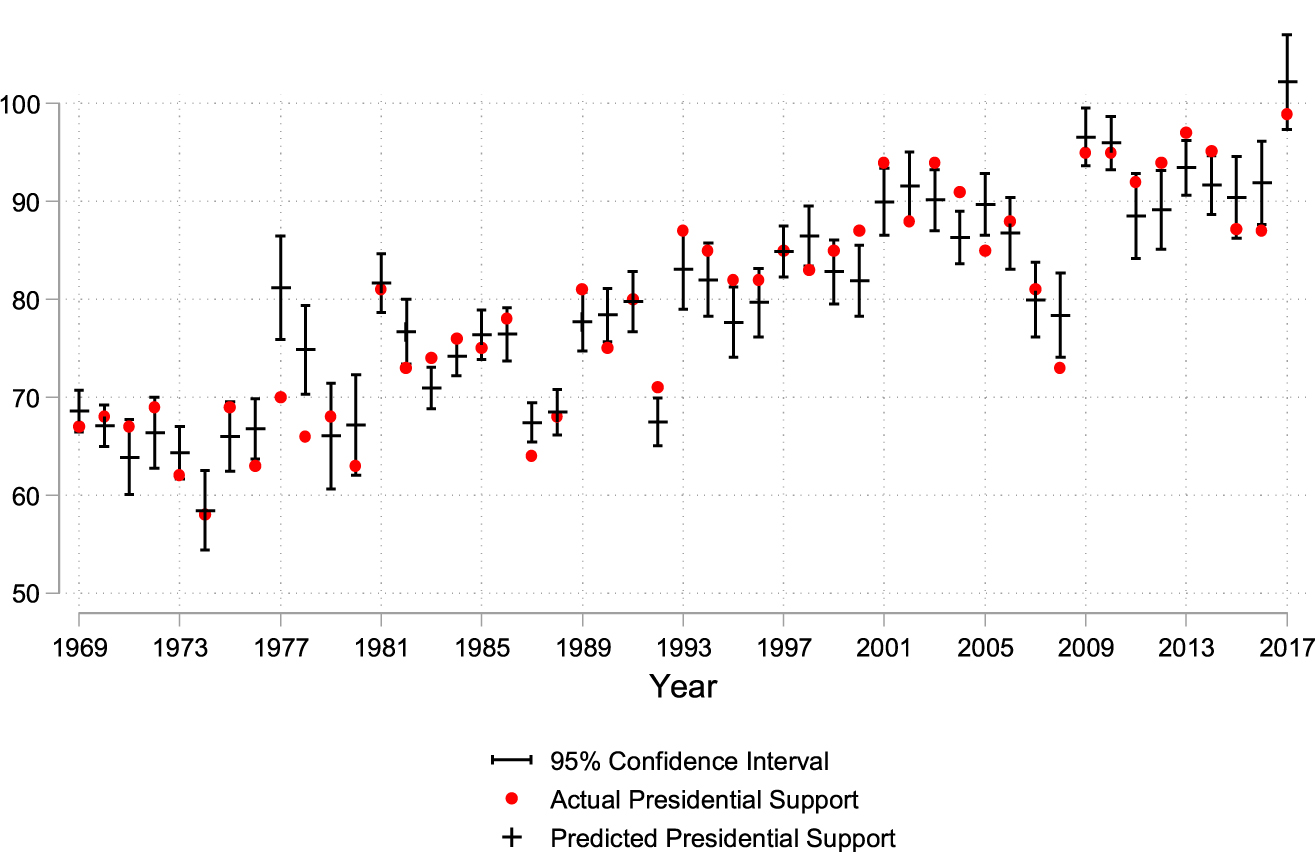
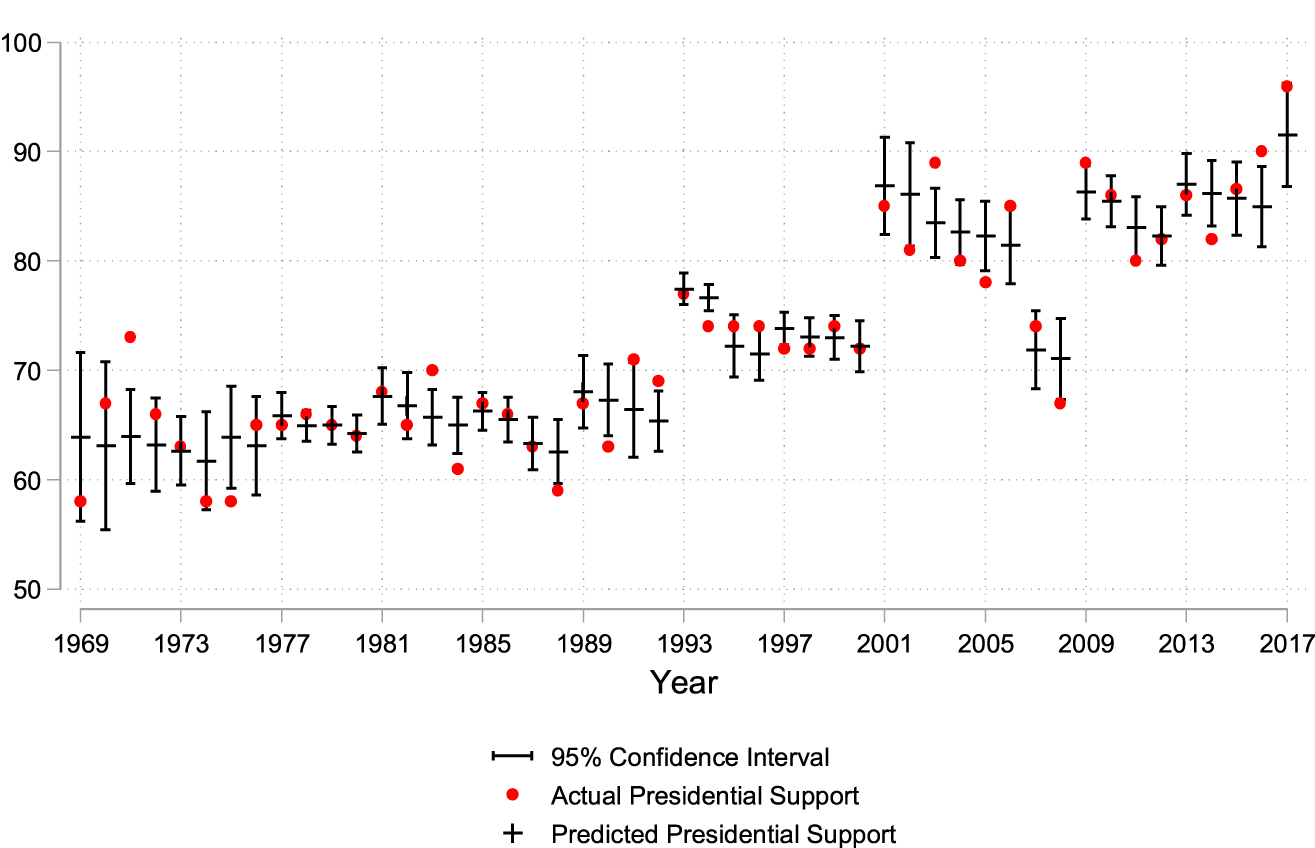
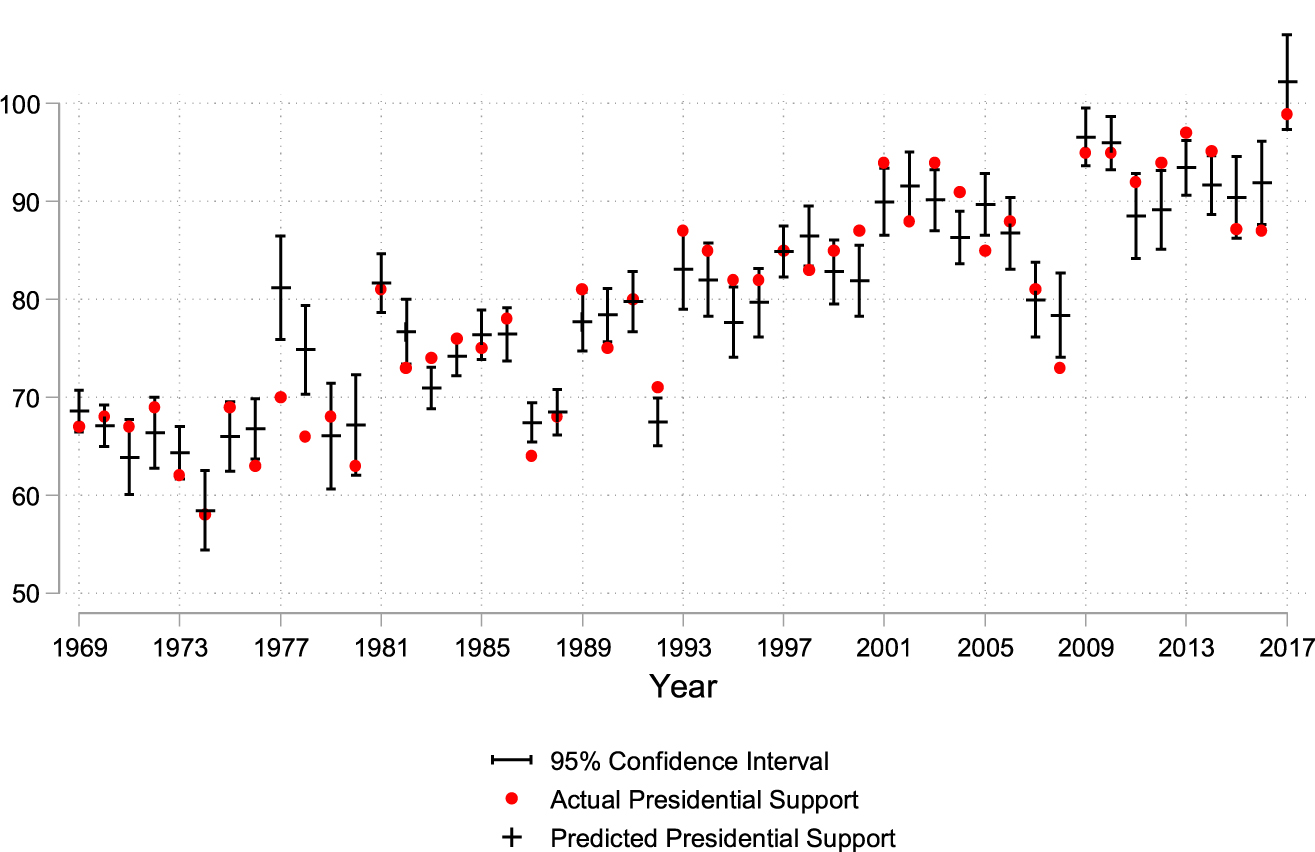
Table 1 forecasts Trump’s support in 2017, which allows us to see whether his GOP support is in line with expectations. We do so by simply computing the linear prediction for Trump’s first year—with the requisite data for 2017—along with a 95% confidence interval. Figures 2 and 3 present the results for the House and Senate, respectively. In both figures, Trump’s actual support in 2017 is denoted by a circle. Simply put, figures 2 and 3 reveal that Trump’s Republican support is in line with expectations given that the president’s support score in 2017 is within the confidence intervals. Although it is true that Trump’s legislative support set a record in 2017—despite the impression given by some headlines—our main conclusion in this section is that his support is not unusual given the features of the 115th Congress.
Aggregate presidential copartisan support forecast (House)
Aggregate presidential copartisan support forecast (Senate)
Republican Opposition to Trump’s Legislative Positions by Member
Although Trump enjoys a great deal of support from his party in the aggregate, it is also clear that he does receive occasional pushback. For example, in June of 2017, 50 of 52 Senate Republicans voted to limit Trump’s ability of lift sanctions on Russia for meddling in U.S. elections. Perhaps most notable was the repeated failure of the GOP’s Obamacare repeal efforts. Given that there has been at least some legislative resistance from Republicans, we now ask: “What member level variables predict opposition and support for Trump’s agenda?” As we note in our conclusion, answering this question provides insights into emerging dynamics within the Republican Party.
Scholarly Explanations
In order to generate a model of Trump’s support among lawmakers, we draw on four general categories of variables that are important to individual-level congressional behavior: electoral motivations, policy preferences, identity, and establishment dynamics. We begin by acknowledging that some factors we test could fit into multiple categories. In particular, many variables could relate back to electoral motivations. We use the four categories because the literature tends to speak about them separately (but see further commentary in the conclusion). We also recognize that this framework may not be generalizable to all presidents.
Electoral Motivations
In David Mayhew’s (Reference Mayhew1974) seminal work, he suggested that legislative behavior can be explained in large part by thinking of lawmakers as rational actors who seek re-election above all else and are therefore reactive to their constituent wants. While there are surely other motivations and pressures at play (Fenno Reference Fenno1978), Mayhew’s thesis has inspired countless studies that use district/state characteristics and opinions as independent variables to explain the actions of congressmen and women. Evidence of this “electoral connection” has been found to affect a range of legislator behaviors (Herrick, Moore, and Hibbing Reference Herrick, Moore and Hibbing1994), including support for the president (Lebo and O’Geen Reference Lebo and O’Geen2011).Footnote 8 Electoral motivations are also reflected in media explanations of Trump’s Republican support or opposition. For example, Alexander Burns (2017) of the New York Times implies that constituents may electorally punish their legislators for voting a certain direction on tax reform by stating that “key blue-state Republicans face an agonizing balancing act, weighing their ambition to deliver broad tax cuts with the narrower interests of their districts”.
Policy Preferences
A lawmaker’s ideology, usually conceived as a left/right orientation to economic issues (Poole and Rosenthal Reference Poole and Rosenthal1997), has become an important factor in the modern, polarized era and has been shown to have considerable predictive power in legislator behavior (Poole Reference Poole2007). Davis and Porter (Reference Davis and Porter1989) put it bluntly: “A politician’s preferences do matter. He is not strictly a captured agent speaking only for his constituents’ interests.” Most important for our purposes is the research showing that a member’s ideological leanings shape their general roll-call behavior (Poole Reference Poole2007). We therefore expect to see legislators’ personal preferences affecting their roll call votes during Trump’s first year, though the precise direction of this effect is uncertain. In particular, questions about the dynamic between Trump and conservative Republicans made its way into popular discourse. For example, Senator Jeff Flake’s (Reference Flake2017) book Conscience of a Conservative asks whether fellow conservatives are likely to go along with the Trump agenda.
Identity
While it is tempting to assume that electoral motivations, ideology and partisanship drive much of Congressional roll call behavior, a substantial body of evidence has accumulated in support of descriptive representation, which states that legislators do a better job representing citizens who share their demographic features and lifestyle (Burden Reference Burden2007). Evidence indicates that lawmakers engage in a range of behaviors that stem from demographic factors such as their race (Canon Reference Canon1999; Butler and Broockman Reference Butler and Broockman2011), gender (Swers Reference Swers2002), socioeconomic class (Carnes Reference Carnes2013), and religion (Burden Reference Burden2007). Research in the Congress literature also theorizes that legislative behavior reflects a kind of group identity (Loomis Reference Loomis1984; Garand and Clayton Reference Garand and Clayton1986; Ragusa Reference Ragusa2016). Given these findings, coupled with popular discussion about the growing role of identity in American politics, it is reasonable to expect members of Congress to express their personal characteristics through their roll-call votes and, perhaps, support or oppose Trump for reasons that can be explained as a function of their identity. Although these effects likely depend on the issue content or vote in question, we believe they may show up in aggregate support scores.
Establishment Dynamics
Although the term “the establishment” only gained traction recently, and has therefore been subject to less empirical testing, recent evidence does indicate that an establishment/anti-establishment rift exists in the GOP (Ragusa and Gaspar Reference Ragusa and Gaspar2016). One might expect establishment Republicans to oppose an “unorthodox” president like Trump. However, the evidence guides us towards the opposite expectation. First, the nature of polarization in the contemporary era (McCarty, Poole, and Rosenthal Reference McCarty, Poole and Rosenthal2001) leads one to expect ideologically cohesive parties to vote in unison on policy matters. At the same time, we might expect establishment Republicans to vote together even when they disagree on ideological grounds (Lee Reference Lee2009) in an effort to magnify differences with Democrats and thus help win election (Lee Reference Lee2016). Second, because the establishment’s fate is most closely tied to the success (or failure) of their party’s standard-bearer (Cohen et al. Reference Cohen, Karol, Noel and Zaller2008), it stands to reason that those at the “core” of the party would support the president the most given that their fate is tied to his fate (Stonecash Reference Stonecash2013). And third, a recent paper by Johnson, McCray, and Ragusa (Reference Johnson, McCray and Ragusa2018) found that establishment Republicans were more likely to endorse Trump in the 2016 election. Due to this emerging evidence, we believe the establishment is more—not less—likely to back Trump’s legislative positions. We consider this category to be particularly intriguing given its prominence in everyday discourse, where journalists and pundits see Trump’s presidency as representing an existential conflict between establishment and anti-establishment factions in the party.
Member Level Data and Method
Dependent Variable
Our dependent variable is constructed using the same data as earlier: CQ Roll Call’s presidential support scores in 2017. However, unlike our earlier analysis, which used an aggregate percentage, here we conduct a member-vote level analysis. A value of “1” in the dependent variable indicates that a Republican lawmaker cast a vote in line with Trump’s position on a given bill and a value of “0” indicates that the member cast a vote against Trump’s position on that bill. Because CQRC’s senate data include presidential nominations, where such votes do not exist in the House, we estimate models with and without these votes as a robustness check.Footnote 9
We follow Edwards (Reference Edwards, Edwards and Howell2009a), Bond and Fleisher (Reference Bond and Fleischer1990), Prins and Shull (Reference Prins and Shull2006), and others in how we analyze and interpret CQRC’s data. We note that these scores do not reflect the president’s effect on how members vote, but instead represent shared preferences between the two actors (Prins and Shull Reference Prins and Shull2006, 24). Therefore, we refer to our results as reflecting presidential “support” or “agreement” rather than presidential “success” or “influence.” In the analysis, we exclude lopsided votes, defined as any vote that received greater than 80% support, following Edwards’ (2009a) recommendations (see also Bond and Fleisher Reference Bond and Fleischer1990). Given our interest in non-routine votes, we believe this threshold is justified, even though alternative cutoffs are used in other roll-call analyses (for example NOMINATE scores use a 95% threshold).
Although widely used, presidential support scores suffer from three limitations. First, because party leaders only bring a bill to the floor if it has the support of a majority of their caucus, these scores reflect a mix of support for the president’s agenda and the agenda of party leaders. Researchers must therefore disentangle these two forces and capture support for the president’s positions beyond the usual forces of party loyalty. Second, the scores exhibit two kinds of selection bias. On the one hand, because the president doesn’t take a position on every legislative matter, the kinds of bills that garner presidential attention no doubt differ from those the president chooses to ignore. As just one example, the president may take a position only when a bill has a high chance of passing, as indicated by the number of bill co-sponsors or its ideological orthodoxy. On the other hand, because the president can’t force Congress to hold a vote, an unavoidable issue is that we lack information on a lawmaker’s support for presidential priorities that never receive a vote.
In the analysis that follows, we take steps to address the first two items. First, in the model, we control for a lawmaker’s baseline party unity with a variable that records the percentage of non-unanimous votes a member cast with his or her co-partisans in the first-session of the 115th Congress. Needless to say, this variable explains the greatest share of variation in the models and creates a high hurdle for other effects to overcome.Footnote 10 At issue in our analysis is whether a member votes with the president in a way that differs from how they typically vote on what party leaders bring to the floor. Second, we account for selection bias in the issues the president takes a position on by estimating a selection model. A model such as ours “corrects” for selection bias in the outcome equation, which in our case is the main model of Republican support for Trump’s agenda. We cannot address the third limitation—presidential agenda items that do not come up for a vote.
Independent Variables
In the analysis, we test multiple electoral variables. GOP Vote Percent is the percentage of the two-party vote for the Republican president averaged over the last two elections while Margin of Victory is the difference between the member’s vote percentage and the second-place finisher. Both are measured at the district level for representatives and state level for senators. We hypothesize that lawmakers from strong Republican districts/states and those who won by narrow margins have electoral incentives to support their party’s president. Electoral Threat accounts for members who announced they wouldn’t seek reelection in 2018 and were therefore “free” to oppose the president.Footnote 11 For members seeking reelection, the variable assumes the value “360,” which is the number of days between the first day in session (January 3, 2017) and the last day in session (December 29, 2017). For members who announced they would not seek reelection, the variable is the number of days from the member’s announcement to the last day in session.Footnote 12 Lastly, we test various demographic features of a lawmaker’s district/state: Hispanic Population, Black Population, Muslim Population, College Educated Population, Per Capita Income, and Manufacturing Population.Footnote 13 We suspect that Republicans in districts and states that are disproportionately white, with fewer college graduates, have lower incomes, and have a large manufacturing population will be more likely to support Trump’s legislative agenda. While all six tap into electoral motivations, they also capture two facets of identity politics: race and socioeconomic class.
We also include five electoral variables that measure constituents’ attitudes on a host of issues. All five came from the Cooperative Congressional Election Study (CCES) and are available at the state and district levels. Racial Problems asks the respondent their views on the frequency of racial problems in the United States. Higher values indicate that the respondents believes there are more racial issues facing the nation. Economic Anxiety asks respondents whether the nation’s economy has gotten better or worse over the past year. Higher values indicate the respondent believes the economy has gotten worse, and thus has greater economic anxiety. We also include policy questions that ask whether the respondent favors banning Muslims from the United States, whether they want the government to hire more border agents along the Mexican border, and if they want to increase the number of police on the streets. For each variable—Muslim Ban, More Border Agents, More Police—higher values indicate a greater percentage of respondents supporting the respective policy proposal. Consistent with the discussion about identity, we suspect that concerns about racial problems will be associated with less agreement with Trump’s legislative agenda while economic anxiety and constituent support for the three policy proposals will be associated with greater agreement.
A lawmaker’s ideology, measured with a single variable, Conservatism, is our lone measure of a Republican member’s preferences. Following conventions in the literature, this variable is a lawmaker’s first-dimension DW-NOMINATE score.Footnote 14 Generally speaking, this variable captures a lawmaker’s preferences concerning government involvement in the economy, where higher values indicate greater conservatism and lower values indicate an ideological moderate. For example, Senator Marco Rubio has a score of 0.59, making him one of the more conservative members of the Senate, while Lisa Murkowski has a score of 0.21, making her one of the most moderate Republicans in the upper chamber. It is unclear whether conservatives have been more supportive or less supportive of Trump’s agenda compared to relative moderates.
In the analysis, we have three demographic variables that record relevant features of a lawmaker’s identity. We include 1/0 variables for whether the lawmaker is Hispanic, Female, or Mormon. We obtained these data from a combination of sources including the Congressional Biographical Directory and the member’s website. We hypothesize that, as a result of Trump’s statements about women and racial and religious minorities, lawmakers with these characteristics may be more likely to oppose Trump’s legislative agenda.
Lastly, we examine establishment dynamics with three measures. Because the “establishment” is a multifaceted concept, we do not believe there is one single best measure. First, we include a lawmaker’s second dimension DW-NOMINATE score. We label this covariate Establishment Record since it stems from a lawmaker’s roll-call record. Keith Poole has notedFootnote 15 that in the recent Congresses the second dimension no longer represents regional patterns, but instead taps into “intra-party divisions,” namely what he calls an “insider vs. outsider cleavage.” Lower values indicate members of the anti-establishment. For example, with scores of -0.57 and -0.49, respectively, both Susan Collins and Rand Paul have anti-establishment voting records (even though Collins is a moderate in the first dimension while Paul extremely conservative). Congressional Leader records if the legislator is a party leader or chairs a standing committee in the 115th Congress. Conceivably, party leaders and committee chairs are part of the establishment owing to their greater institutional resources and power. Finally, the variable Tea Party/Freedom Caucus records if a lawmaker ever belonged to either intra-party group.Footnote 16 We posit that members of these two groups represent an anti-establishment faction of the GOP.
Member-Level Findings
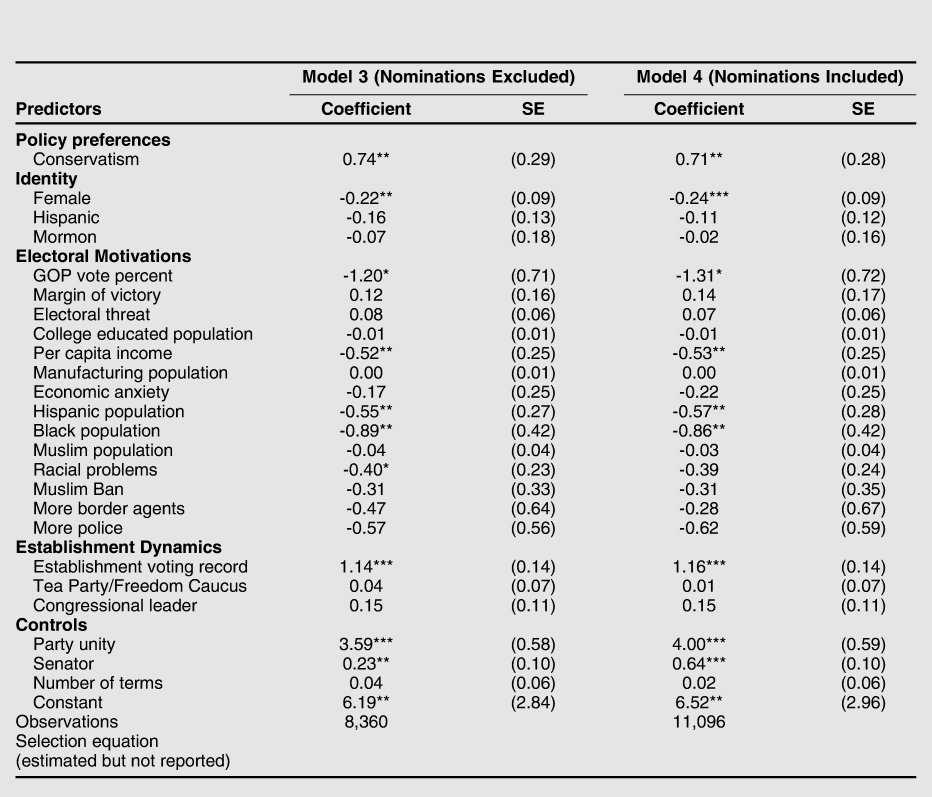
Our results are presented in table 2.Footnote 17 Model 3 excludes presidential nomination votes (which are only possible in the senate) while Model 4 includes them. Both are bivariate probit selection models where the unit of analysis in both equations is how a member voted on a bill. In the selection equation, the dependent variableFootnote 18 is an indicator that records whether Trump took a position on the vote in question (coded “1”) or not (coded “0”). Our sample in the selection equation consists of votes at final passage and any procedural or amendment votes classified by CQ Roll Call.Footnote 19 In the selection equation, we include variables for the ideological location of the bill, its chamber of origin, the number of cosponsors, and the committee of referral (which serves as a proxy for the bill’s policy content). We do not report the selection equation results due to space constrains but are happy to provide them upon request. Finally, in the outcome equation, our sample consists of votes on items where Trump took a position.
Determinants of GOP agreement with Trump’s legislative positions
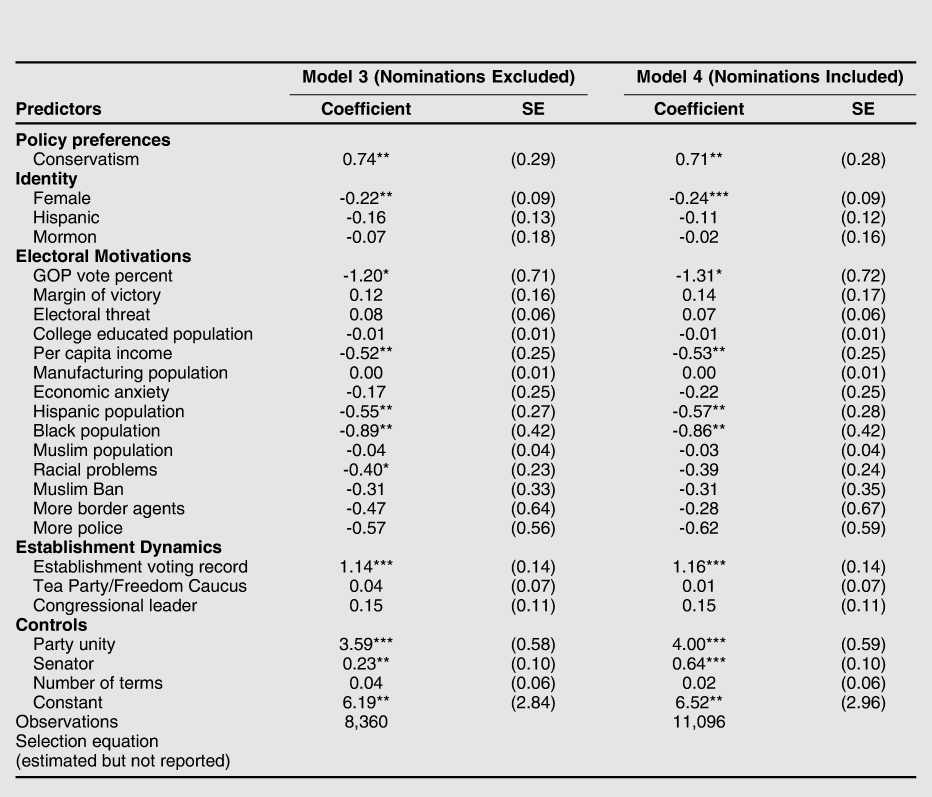
*** p<0.01, **p<0.05, *p<0.10; robust standard errors in parentheses
Looking at the covariates in the outcome equation, the model uncovers some evidence for all four theoretical categories. In both models, our lone measure of a lawmaker’s policy preferences, Conservatism, is positive and significant, indicating that conservative Republicans were more likely to vote with Trump in 2017. In contrast, ideologically moderate Republicans were more likely to vote against the president. As a substantive matter, this validates Jeff Flake’s concerns that his conservative colleagues are supporting, rather than opposing, the president. Second, the positive and significant effect of Establishment Voting Record in both models reveals that Republicans with establishment roll-call records were more likely to vote with Trump in 2017. Conversely, anti-establishment Republicans were more likely to oppose the president. Notably, this contradicts the suggestion from some in the media that Trump’s presidency represents a war on the party’s establishment (CNN 2017; Washington Post 2017). Both results are consistent with the finding that conservative and establishment Republicans were more likely to endorse Trump in the 2016 campaign (Johnson, McCray, and Ragusa Reference Johnson, McCray and Ragusa2018).
All of the identity variables are negative in table 2, as expected, yet only the Female variable is significant, revealing that female Republicans were less likely to vote with Trump’s legislative positions. In contrast, Male Republicans represent some of Trump’s strongest supporters. Because the model controls for a range of factors, gender seems to be a salient dimension vis-à-vis Trump’s presidency. We note that this effect is consistent with the finding that female Republicans were more likely to join the #NeverTrump movement in the 2016 campaign (Johnson, McCray, and Ragusa Reference Johnson, McCray and Ragusa2018). We do not find a significant effect on the Mormon variable, however. We think this is due to the fact that religious bans were not linked—either directly or indirectly—to any of Trump’s legislative positions in 2017. Finally, while the null effect on the variable for Hispanic Republicans is perhaps surprising, we do find an effect in the electoral motivations category.
We find a consistent effect on three electoral variables in the analysis. First, the coefficients on Hispanic Population and Black Population are negative, meaning the greater the percentage of Hispanic and black constituents, the less likely a Republican member is to vote with the president. Conversely, the greater the white population, the more likely a member was to vote with the president. We also find a negative and significant effect on Per Capita Income, revealing that lawmakers from more affluent districts and states were less likely to vote with Trump while Republicans from poorer districts and states were more likely to. All three effects indicate an important role of electoral motivations in the decision to support Donald Trump, particularly in the form of identity politics.
In table 2, we find two control variables that are significant in each model. First, Party Unity indicates that lawmakers who typically vote with their party were more likely to support the president’s positions. As noted earlier, this variable creates a high hurdle for other factors to overcome and helps ensure that the effects reported above reflect how a lawmaker voted on Trump’s positions in a way that differs from how they voted on what party leaders typically brought to the floor. Second, Senator indicates that senators are more likely to support the president’s position. Although we are not surprised by this result in Model 4, as it includes nomination votes that drive up presidential support, we can only speculate about the cause of this effect in Model 3. One possibility is because there are more total roll-call votes in the House, including more votes on which the president took a position, there may be a greater number of times a lawmaker could vote against the president in the lower chamber.
As a final matter, we find a marginally significant effect (p<.10) of GOP Vote Percent in both models. Because the effect is negative, the coefficient indicates that lawmakers from deep red districts and states were less likely to vote with the president in 2017, which is the opposite of expectations. Upon closer inspection, we discovered that this marginally significant effect is due to the variable’s correlation with other electoral variables in the analysis. Diagnostics do not indicate problematic collinearity, however, so we kept this variable in the model as a control.
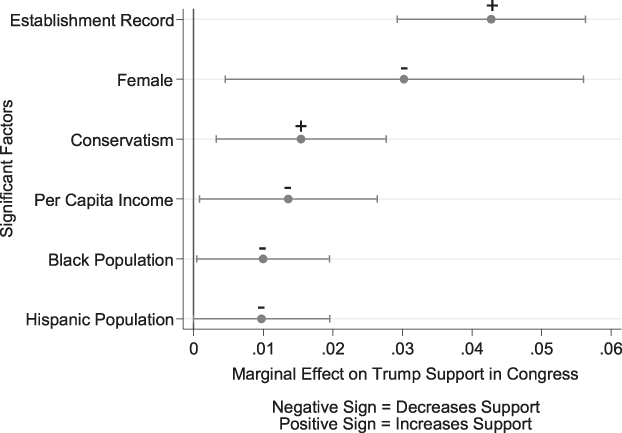
We also examined the effect sizes of the significant non-control variables in models: conservatism, establishment record, sex, district/state racial composition, and per-capita income.Footnote 20 We did this by standardizing the continuous covariates—so that they have the same scale—and by computing the absolute marginal effect of each factor. In figure 4, a positive sign indicates a variable with a positive effect (it increases Trump’s legislative support) while a negative sign represents a variable with a negative effect (it decreases Trump’s legislative support). Because the continuous covariates were standardized, a one-unit change indicates a standard deviation increase above the variable’s mean.
Significant covariate effect size

According to figure 4, Republicans with voting records one standard deviation in the establishment direction were 4.3% more likely to vote with the president on the floor. In the Senate, there were just over 100 presidential support votes in 2017, so every 1% increase in the likelihood of voting with the president translates into roughly one extra vote with Trump’s position per senator per year. Given the narrow margin on a number of key votes in the Senate—such as the ACA repeal vote—one additional vote in either direction could mean the difference between success and failure on the floor. Next, female Republicans were 3.0% less likely to support the president’s position in 2017 whereas one standard deviation increase in a Republican’s conservatism was associated with a 1.5% increase in their likelihood of voting with the president on the floor. Finally, lawmakers from affluent districts and states—those one standard deviation above the mean—were 1.4% less likely to vote with the president, as indicated by the effect of district/state per-capita income, while members representing a large percentage of African American or Hispanic constituents are 1.0% less likely vote with the president.
We find it interesting that the three factors with larger effect sizes are all non-electoral, insofar as they aren’t direct measurements of constituents themselves. While electoral motivations certainly matter when it comes to explaining a Republican lawmaker’s roll-call behavior on Trump’s legislative priorities, the results indicate they are not the entirety of the story. Simply put, lawmakers do not seem to be “single minded” in their pursuit of re-election when it comes to Trump. Rather, they seem to be making primarily personal decisions based on their policy preferences and identity.
Conclusions and Implications
Our findings shed light on the dynamics of Donald Trump’s Republican support in his first year in office. Our first analysis reaches an unexpected conclusion: although the extent of Republican agreement with Trump’s positions is the highest on record, it is not unexpected given the features of the 115th Congress. Our second analysis provides a host of both intuitive and counterintuitive conclusions about the dynamics of Trump’s legislative support. First, it is not surprising that the demographic features of legislators and their districts are driving factors among Trump’s copartisans, with female lawmakers and those representing non-white districts and states among those most opposed to the president’s positions. Male Republicans representing overwhelmingly white districts and states are Trump’s strongest supporters, by comparison. However, it is perhaps counter-intuitive that both conservative and establishment Republicans represent Trump’s strongest supporters. As noted earlier, the direction of these effects runs counter to the conventional wisdom that portrays Trump as a heterodox, anti-establishment figure seeking to remake the GOP from within.
Given these findings, we conclude by addressing the question: what broader implications do our findings have for the Republican Party? In the paragraphs below, we provide tentative answers to this question. We urge readers to keep in mind that our findings are preliminary and raise just as many questions as definitive answers. As is often the case with emerging literature, further research is needed.
For starters, it is worth noting that our significant predictors do not fit into only one of the four categories outlined in the fourth section, as some categories have natural overlaps. Despite this, some patterns do emerge. First, it appears that Trump’s Republican allies and adversaries are motivated, in large part, by identity politics. As noted, our results indicate that being a woman is a key driver of Trump’s opposition, with male lawmakers representing Trump’s strongest supporters, and that this effect exists independent of a lawmaker’s policy preferences and electoral motivations. In addition, the non-white composition of a member’s district compels Republican lawmakers to oppose Trump while the white population drives support for the president’s positions. Although the demographics of one’s constituents are categorized as electoral motivations in our theoretical framework, the fact that two of the significant district/state variables are racial in nature—rather than tapping into the raw partisan composition of a lawmaker’s constituents—indicates that something important is occurring with identity features. The combination of all three findings suggest that scholars should continue to analyze the Trump presidency using identity-related theories and variables.
In contemporary political discourse, the phrase “identity politics” has become a something of a buzzword and is often used as an expression leveraged against the Democratic Party for appealing to race and gender (Lilla Reference Lilla2017). Our findings suggest that identity politics—to some degree—also lives at the elite level of the Republican Party. Trump’s identity-centric remarks, behaviors, and policy priorities may be causing female legislators to look inward, thus activating a kind of descriptive representation (Burden Reference Burden2007). Although we are not the first to note that gender is a predictor of legislative roll-call behavior, prior studies typically examine this pattern with a focus on gendered policies (Thomas Reference Thomas1991; MacDonald and O’Brien Reference MacDonald and O’Brien2011). We believe the current climate requires us to pay attention to this variable writ large, especially given that Republican female legislators were also less likely to endorse Trump during the 2016 election (Johnson, McCray, and Ragusa Reference Johnson, McCray and Ragusa2018). However, we once again urge caution when considering these results and reiterate that further research is needed.
An important question in the wake of Trump’s election is whether the GOP is in the midst of realignment away from its conservative roots (free markets, free trade, limited government, moral absolutism, etc.) and thus resembling the president’s heterodox policies and personality. With just one year’s worth of data, it is hard for us to answer this question definitively but our findings provide hints at this possibility. In addition to the identity-related effects we described, which mirror a range of studies on realigning dynamics among voters (Mutz Reference Mutz2018; Valentino, Wayne, and Oceno Reference Valentino, Wayne and Oceno2018), the fact that conservative and establishment Republicans represent the president’s strongest supporters lends indirect evidence of a realignment from within the party. Although there are causality questions, which we address next, we think these results suggest at least some movement of the GOP from its conservative roots in the Trump direction. Future work should continue to study the behavior of the Republican establishment and especially the behavior of conservative elites. Our interpretation of events is certainly not the only way to view the behavior of Republican lawmakers in the age of Trump. For example, a logical alternative to the realignment hypothesis is that these results reflect strategic electoral behavior in a period of ideologically sorted parties. Research has shown that competitive elections in the modern era incentivize the parties to unify in opposition to one another (Lee Reference Lee2016). In this respect, it is no surprise that ideology has the largest effect in our analysis and that conservatives represent Trump’s strongest supporters.
On the question of which direction these effects run, it is important consider whether Trump is changing the Republican Party, or whether the Republican Party is changing Trump. The answer is likely somewhere in the middle. First, it is undeniable that party leaders and committee chairpersons set the legislative agenda, not the president, and thus congressional Republicans are surely causing Trump to take stances on some bills he may not champion voluntarily. However, the relationship is surely more complicated than that, and the direction of causality might depend on the issue area. Given our findings, we think Trump’s greatest effect on the GOP agenda may be occurring on issues tied to identity. For example, there were a number of votes in Congress that hinged on identity politics such as penalizing sanctuary cities, stricter immigration laws, and deporting immigrants suspected of being in gangs. While these are certainly right-wing policies, they are a clear abandonment of the Rove/Bush view that the GOP needs to appeal to Hispanics and Latinos. The Republican Party is a long way from the organization that tried to pass the Comprehensive Immigration Reform Act of 2006, which included an increase in the number of guest workers and a path to legalization for illegal immigrants. On domestic economic issues, however, we think Trump has embraced orthodox Republican positions. The tax reform bill would undoubtedly have passed no matter which Republican won the party’s nomination. While the GOP establishment may be changing Trump on some issues, it is possible that the effect runs the other way on others issues. Future researchers—armed with more votes across a range of issue domains—can help resolve this issue.
Our findings can and should be retested as roll-call votes continue to compile throughout the Trump presidency. There are a host of ways to explore how Trump is shaping the attitudes and behavior of GOP elites. In this respect, our results are the first to address what is likely to a long line of scholarship into Trump’s relationship with Congress and his own party. Party realignments can take some time to develop, and given the long-term implications of Trump’s presidency for separation of powers and legislative-executive interaction, we urge scholars to replicate these findings and continue using identity, ideology, and establishment measures as important indicators of Congressional behavior—particularly voting behavior.