INTRODUCTION
The adverse effects of oil and gas extraction activities on poor rural communities in developing countries including the Caribbean have been well documented (Ballard & Banks Reference Ballard and Banks2003; Rodriguez Reference Rodriguez1981; Bacon Reference Bacon and Diop1993; Burns et al. Reference Burns, Garrity and Levings1993; Lacerda et al. Reference Lacerda, Conde, Alarcon, Alvarez-Leon, Bacon, D'Croz, Kjerfve, Polaina, Vannucci and Diop1993; Ellison & Farnsworth Reference Ellison and Farnsworth1996). While the literature is substantial in reporting the environmental, social and economic effects of oil and gas drilling on mangroves and the surrounding ecosystem, relatively few researchers have examined factors influencing individual environmental attitudes and behaviours among residents of these dependent communities (Sah & Heinen Reference Sah and Heinen2001). This study sought to determine factors that influence the environmental attitudes and behaviours of rural communities impacted by oil and gas development within the Nariva Swamp, Trinidad.
Numerous demographic variables that influence environmental attitudes and behaviours have been identified. This study examines two attitudinal components, namely beliefs (understandings of the biophysical environment, its function and the human–environment dynamic; Stern Reference Stern2000; Stern et al. Reference Stern, Dietz and Guagnano1995) and concerns (attitudes regarding the potential for harmful environmental consequences for self, other people, or living things; Schultz Reference Schultz2000). Schultz (Reference Schultz2000) classified these concerns as egoistic (concern for self), altruistic (concern for others) or biospheric (concern for animals, plants and ecosystems). These reflect the underlying values of an individual toward the risk of oil and gas drilling. Environmental behaviour refers to intentions or actions individuals engage in concerning the environment in everyday life (Schmitt Reference Schmitt2003).
Within the field of robust attitudinal research, we have found mixed results for gender (Freudenburg & Davidson Reference Freudenburg and Davidson2007), proximity (Tremblay & Dunlap Reference Tremblay and Dunlap1978; Freudenburg Reference Freudenburg1991) and livelihoods (Freudenburg Reference Freudenburg1991) as predictor variables for community response to environmental threats. Zelezny et al. (Reference Zelezny, Chua and Aldrich2000) indicated that there were gender differences, not only in how environmental resources are used but also in how environmental problems are perceived within a community. Several studies have revealed a weak relationship between gender and environmental concern, indicating that females tend to be more environmentally concerned than males (Blocker & Eckberg Reference Blocker and Eckberg1989; Stern et al. Reference Stern, Dietz and Kalof1993; Davidson & Freudenburg Reference Davidson and Freudenburg1996; Bord & O'Conner Reference Bord and O'Conner1997; Freudenburg & Davidson Reference Freudenburg and Davidson2007). In concurrence, a review by Zelezny et al. (Reference Zelezny, Chua and Aldrich2000) found that the majority of studies published in the last decade reported that females expressed significantly greater environmental concern than males, although the effect of gender on environmental concern was small.
With the exception of Buttel and Flinn (Reference Buttel and Flinn1974), most studies indicate that rural residents tend to have lower concerns than urban dwellers (Hendee Reference Hendee1969; Tremblay & Dunlap Reference Tremblay and Dunlap1978; Freudenburg Reference Freudenburg1991; Dietz et al. Reference Dietz, Stern and Guagnano1998). Residential distance to water bodies is known to be a significant factor in explaining level of environmental knowledge and concern. For example, living in closer proximity to an estuary was associated with increased awareness of and support for policies to protect the estuary (Cornell Local Government Program 1998).
Traditionally, education has been used as an indicator of class, while income and occupation are less frequently employed as predictive environmental variables (Buttel & Flinn Reference Buttel and Flinn1978), with occupation and livelihood being used more scarcely to explain variance in environmental attitudes and concerns. Buttel and Flinn (Reference Buttel and Flinn1974) found that there are variations in environmental concerns based on type of occupation. Additionally, Freudenburg (Reference Freudenburg1991) demonstrated that individuals with livelihoods based on resource extractive activities had lower levels of concern regarding environmental conservation.
There has been a misperception that a monolithic/homogeneous hierarchy of attitudes exists among marginalized communities with respect to environmental and natural resource management. One of the main reasons for this is that these communities play a minor part in decision making about how natural resources are used and managed (Silvius et al. Reference Silvius, Oneka and Verhagen2000). However, local communities closely linked to natural resources have an essential and key role as guardians of the ecosystems sustaining their livelihoods. To improve the decision-making process, it is important to gain a better understanding of the empirical dimensions of attitudes and behaviours that contribute to and result from environmental threats to these natural resources.
Public environmental attitudes and concerns have been investigated extensively in developed countries such as the USA, but to a lesser extent in developing countries (Rauwald & Moore Reference Rauwald and Moore2002). Most environmental attitudinal studies have focused on sampling based on a limited population, that is, within a literate context, such as environmentalist groups, students or community leaders (Tuna Reference Tuna2004). In developing countries, extensive studies have been conducted examining rural attitudes, primarily from a conservation perspective, focusing on the concerns of villagers towards conservation of protected areas (Mehta & Kellert Reference Mehta and Kellert1998; Gillingham & Lee Reference Gillingham and Lee1999; Mehta & Heinen Reference Mehta and Heinen2001; Sekhar Reference Sekhar2003). Additionally, some research has focused on psychological perspectives towards general environmental issues (Dunlap & Gallup Reference Dunlap, Gallup and Gallup1993; Furman Reference Furman1998; Corral-Verdugo & Armendariz Reference Corral-Verdugo and Armendariz2000). In Trinidad, there has not been specific research to date on rural residents' attitudes toward oil and gas development. There is therefore a need to evaluate and understand rural environmental awareness and concerns within this context, as it provides useful information to aid in the policy-making process.
Rural wetland communities are generally marginalized in decision making about use and protection of rural resources for a number of reasons. One such reason is the lack of public participation in conservation and development decisions (Gumonye-Mafabi Reference Gumonye-Mafabi, Marchand and Udo De Haes1990). A second reason is that environmental education is insufficient (Gumonye-Mafabi Reference Gumonye-Mafabi, Marchand and Udo De Haes1990). This is of particular concern within a rural illiterate context where formal education is either unavailable or has not been a part of the culture of the communities. Within the policy arena, many conservation and development organizations have now moved away from focusing solely on the need to protect fragile environmental resources from a preservationist perspective, to an approach which acknowledges the need to build on the interrelationship between communities and their surrounding natural environment. Communities are generally aware of the need to protect these resources, however, if they are not included in the decision-making process or have a stake in the management of the resource, they are more likely to develop negative perceptions or attitudes towards conservation and are moreover less likely to engage in conservation-oriented behaviour (Gibson & Marks Reference Gibson and Marks1995; Agrawal & Gibson Reference Agrawal and Gibson1999). The traditional view of ‘community as obstacles to conservation’ has gradually been replaced by the notion that local populations, once provided with benefits and adequate incentives, can be good stewards of the environment (Agrawal & Gibson Reference Agrawal and Gibson1999; Gregory & Wellman Reference Gregory and Wellman2001; Mehta & Heinen Reference Mehta and Heinen2001; Sekhar Reference Sekhar2003).
This approach is now recognized for wetlands by the Ramsar Convention (Ramsar Convention Bureau 2002). This recognition has intensified the importance of identifying underlying factors responsible for forming and guiding the perceptions and behaviours of those stakeholders most impacted by resource management decisions. Furthermore, community-based conservation programmes have been established based on three different principles: multiple stakeholders with multiple interests, social process of interactions among the stakeholders and the institutional structures that support these interactions (Agrawal & Gibson Reference Agrawal and Gibson1999).
The specific objectives of this paper are to examine the roles of gender, village proximity and livelihoods in rural wetland residents' attitudes and behaviours toward oil development in Trinidad. Coastal communities in Trinidad and Tobago are heavily reliant on wetland resources to provide food, materials and recreational services (Carbonell & Nathai-Gyan Reference Carbonell and Nathai-Gyan2005). However, the importance of mangroves and wetland resources to rural communities has been overshadowed by the dedication of these vulnerable coastal areas to the energy sector. The Nariva Swamp, a Ramsar protected wetland (Carbonell et al. Reference Carbonell, Alleng, Browne and Massey2007), is located within a major energy block, on the south-east coast of Trinidad. The continued expansion of proposed oil and gas development in this vulnerable coastal area threatens livelihoods (Kacal Reference Kacal1999), aesthetics and life in general within the surrounding villages.
METHODS
The study area
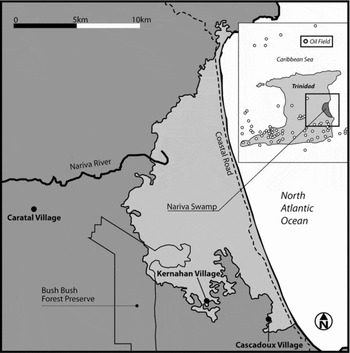
Nariva Swamp is the first national Ramsar Wetland and the largest freshwater swamp (approximately 6000 ha) in Trinidad and Tobago, located on the south-east coast of Trinidad, within an area known for oil and gas reserves (Fig. 1). The land-use in this area is approximately 85% swamp, 10% forest and 5% agriculture (Nathai-Gyan Reference Nathai-Gyan1996). The Swamp has rich flora and fauna, many threatened and endangered species, and is important in the Caribbean region (Ramsar Convention Secretariat 1995). Surrounding human communities depend on the wetland for social and economic needs, which include hunting, subsistence fishing, rice cultivation, conch and crab catching, the gathering of firewood and plant products for use in the crafts industry (Ramsar Convention Secretariat 1995). We surveyed the rural villages of Kernahan (contiguous with the Swamp), Cascadoux (adjacent to the Swamp) and Caratal (located c. 3 km west of the Swamp) that were most dependent on the swamp for livelihoods provision.
Diagram of the Nariva Swamp and location of villages studied.

Data collection
We conducted field work between June and August 2006. Literature reviews, site visits, identification of key informants and informal discussions with villagers were used to gather background data and determine the villages most affected by the new oil development proposal. We gathered data on socio-demographics, environmental beliefs, concerns, behaviours and policy support through a structured survey instrument, modified from an initial pretest. We interviewed 177 respondents from the three villages (76 from Kernahan, 38 from Cascadoux and 63 from Caratal). Usually the head of the household was interviewed. Informant interviews and pre-testing indicated that, due to cultural norms, heads of household would be predominantly male. Therefore, in order to ensure a representative sample of both male and female residents, a systematic purposive sampling method was used to increase the participation of women in the survey. Specifically, a consistent, explicit rationale was developed and applied where for each alternate house where the head was a male, a female was also interviewed (if both spouses were present, cultural expectations required that the man always be interviewed unless otherwise stated). Male and female respondents were interviewed separately, if from the same household. Additionally, statistical analysis indicated that for the key dependent psychological variables under investigation, male and female respondents from the same household were not more similar in their responses in comparison to other survey respondents.
The questionnaire consisted of closed-ended questions and it was divided into two main parts. The first section addressed the socio-demographic variables of the respondent. This included village proximity to the swamp, gender, age, length of time in village and region, ethnicity, land ownership, livelihood, number of and ages of children. The second section included questions designed to evaluate the environmental beliefs, concerns and behaviours of the respondent (see Supplementary material at http://www.ncl.ac.uk/icef/EC.Supplement.htm). Due to a high illiteracy rate, villagers were asked to indicate their responses using a pictorial representation of a Likert Scale. This representation was similar to a bar chart using seven (7) different bar sizes and colour intensities.
Determinants of environmental beliefs included questions designed to measure a combination of values, beliefs and knowledge regarding the oil and gas drilling activities within the swamp. Villagers were asked to indicate their levels of agreement or disagreement with each statement using the pictorial representation of a Likert scale (where 1 = strongly disagree, 4 = unsure and 7 = strongly agree). Scores were also combined in order to determine the overall environmental belief of the respondents. The environmental concern index was an adaptation of that used by Schultz (Reference Schultz2001). Villagers were asked to indicate how dangerous they considered oil and gas drilling to be for 12 different items using the pictorial Likert scale (where 1 = not dangerous and 7 = very dangerous). The three subscales of the environmental concern index as proposed by Schultz (Reference Schultz2001) were also evaluated: egoistic (concern about personal danger), altruistic (concern about dangers for others) and biospheric (concern about dangers for the environment). Villagers' support for governmental policies on oil and gas drilling, both in general and within the Nariva Swamp, were assessed by presenting statements of environmental policies pertaining to oil and gas development and asking respondents to indicate their level of agreement or disagreement with each statement using the pictorial Likert scale (where 1 = strongly disagree and 7 = strongly agree). Finally, environmental behaviours of the respondents were assessed by presenting respondents with statements regarding their use of the Nariva Swamp. Participants were asked to indicate how often they engaged in activities pertaining to the use of the swamp using the pictorial Likert scale ranging from 1 = never to 7 = always.
Data analysis
We used the Statistical Package for Social Scientists (SPSS) Version 12.0 for analysis. Mean comparisons and one-way ANOVAs were used for statistical comparisons, while factor analyses and reliability analyses were conducted to determine the components and the internal consistency of the indices used to evaluate environmental concerns, beliefs and behaviours. For the proximity measure, Kernahan and Cascadoux were combined into one group (‘near’) as these two villages are located adjacent or within the Nariva swamp and compared to Caratal (‘far’), located approximately 3 km from the swamp.
RESULTS
Environmental attitudes
Environmental beliefs
In comparison to respondents living in Caratal (far), villagers living in Kernahan and Cascadoux (near) were more likely to believe that oil and gas drilling had a harmful effect on the communities surrounding the swamp (Table 1). However, only responses to Statement 2 (development versus protection) showed a statistically significant difference between near and far villages. Villagers living in Caratal were significantly more likely to believe that the development was more important than protecting the swamp (p = 0.003) in comparison to those respondents living in the two villages closer to the Nariva Swamp (Table 1).
Mean level of environmental beliefs related to oil and gas drilling by proximity, gender and livelihood group (where 1 = strongly disagree and 7 = strongly agree). *p < 0.05.

Females tended to believe more than males that development was more important than protection of the Nariva Swamp. Males believed to a greater degree than females that it is more important to protect swamps from oil and gas drilling, that these development activities can result in health problems, and that oil and gas drilling can result in damage to swamps (p = 0.028; Table 1).
Farmers exhibited the highest level of pro-environmental beliefs (not statistically significant) with respect to protecting the Narvia Swamp from oil and gas drilling (Table 1). In addition, farmers believed that oil and gas drilling can result in health problems and contribute to pollution (not statistically significant). Those villagers engaged in activities such as fishing and self employment (Other) revealed the lowest level of pro-environmental beliefs toward protecting the swamp for future generations, while they rated development as being more of a priority than swamp protection. They were also the least likely to believe that oil and gas drilling negatively impacted health. Government employees indicated the highest level of belief in regards to statements that development was more important than swamp protection and oil and gas drilling causes pollution, but will not harm swamps. Homemakers revealed the highest level of belief in the statement that oil and gas drilling can cause harm to the Nariva swamp.
Environmental concern
Respondents from the two villages near the Nariva Swamp had higher biospheric (concern for the environment, p = 0.005), altruistic (concern for others, p = 0.000) and egoistic (personal concern, p = 0.000) concerns regarding the dangers of oil and gas drilling than those respondents from the villages further away (Table 2).
Mean level of environmental concerns: environmental concern sub-scales assess how dangerous respondents perceived oil and gas drilling to be for the environment (biospheric), for others (altruistic) and for themselves (egoistic) by proximity, gender and livelihood (where 1 = not dangerous and 7 = very dangerous). *p < 0.05.

Males had higher levels of biospheric concerns (p = 0.027) regarding oil and gas drilling and its dangers than females, however, females had higher though non-significant altruistic and egoistic concerns for oil and gas drilling than males.
Farmers were most likely to have the highest levels of biospheric, altruistic and egoistic concerns for dangers associated with oil and gas drilling (Table 2) when compared to the other three livelihood groups. Homemakers had the second highest level of altruistic and egoistic concerns, while government employees revealed the lowest levels of biospheric, altruistic and egoistic concerns for dangers associated with oil and gas drilling. However, these differences were not statistically significant (Table 2).
Environmental behaviours
Support for policies
Villagers from Caratal (far) indicated a significantly higher level of support for general monitoring of oil and gas drilling in all swamps (p = 0.046). Although not significant, respondents from Caratal were also more likely to support general policies that regulated oil and gas development activities (Table 3). Villagers from Kernahan and Cascadoux (near) indicated a stronger albeit non-significant (p = 0.074) level of support for policies that would protect swamps from oil and gas development. Respondents from both near and far villages were strongly opposed to the location of oil and gas development within the Nariva Swamp (Table 3).
Mean level of support for environmental policies related to oil and gas drilling in the Nariva Swamp by proximity, gender, and livelihood (where 1 = strongly disagree and 7 = strongly agree). *p < 0.05.

Male and female respondents did not differ significantly in their support for environmental policies to protect the swamp. However, males were somewhat stronger in their support of policies for government monitoring and regulation, while females were slightly stronger in their support for policies that would protect swamps from oil and gas development. Both groups indicated high levels of opposition to oil and gas development within the Nariva Swamp (Table 3).
While the results for the four livelihood groups did not differ significantly, relationships between environmental policy support and livelihoods were varied. Farmers were least likely to support policies for government monitoring, yet they were also most opposed to oil and gas development directly within the Nariva Swamp. Those respondents classified within the ‘Other’ livelihood category had the highest level of support for policies that monitor and regulate oil and gas development, as well as those that protect swamps from drilling. A majority of respondents grouped within this category, such as fisherfolk, were extremely dependent on the natural resources provided by the Nariva Swamp (Table 3).
Personal behaviour
For each of the five pro-environmental behaviours, respondents that lived closer to the swamp engaged in a higher level of activity (all p = 0.000) than those living in villages located further away from the Nariva Swamp (Table 4)
Mean level of environmental behaviour towards the Narvia Swamp by village proximity, gender and livelihoods (where 1 = never and 7 = always). *p < 0.05.

Males engaged in more pro-environmental behaviours (enjoyment of beauty, p = 0.000; tours, p = 0.000; enjoyment of area, p = 0.002; and civic engagement, p = 0.003) than females (Table 4), with the exception of the use of plant material from the swamp.
Farmers were most likely to enjoy the natural beauty of the swamp (p = 0.000), take boat rides and nature walks (p = 0.002) and engage in bird-watching (p = 0.000) activities. Homemakers were least likely to use small or moderate amounts of plant material from the swamp, while farmers indicated the greatest use of plant material from the swamp (p = 0.005). Government employees were most likely to engage in environmental actions such as civic engagement in the form of petition signing and attending meetings (p = 0.002) (Table 4).
Relationships among dependent variables
Respondents with strong environmental beliefs indicated higher levels of environmental concerns and were more likely to support policies that protected the swamp from oil and gas drilling, however these beliefs were not significantly correlated with environmental behaviours. Respondents who indicated high biospheric concerns also had high altruistic and egoistic concerns, were more likely to support protection policies and exhibit pro-environmental behaviours. This was not seen with the other two components (altruistic and egoistic concerns) of environmental concern. Those with high altruism were more likely to have high biospheric and egoistic concerns and more likely to have pro-environmental beliefs and behaviours, but not necessarily pro-environmental support for swamp protection. These results were similar for those with high egoistic concerns. For level of support for government policies, there were no significant correlations between egoistic and altruistic concerns, while for environmental behaviours there were no significant correlations with level of support for government policies.
DISCUSSION
This study focused on rural attitudes in Trinidad, demonstrating the importance of proximity, gender and livelihood as drivers of environmental attitudes and behaviour toward threatened environmental resources. In general, those villagers who resided in areas closer to the Nariva Swamp had higher levels of environmental beliefs, concerns, greater support for policies that protected the swamp and engaged in more pro-environmental behaviours than those villagers residing further away from the Swamp. These results are similar to those of previous research which have indicated that individuals who have more environmental opportunities available to them will engage in more environmental behaviours (Hendee Reference Hendee1969).
The concept in economics of spatial discounting offers a valuable explanation for the variation in proximity differences. Research examining spatially differentiated non-market goods and services indicates that decision makers give less weight to geographically distant effects in comparison to neighbouring effects (Perrings & Hannon Reference Perrings and Hannon2001). Furthermore, individuals tend to be more concerned about the short-term environmental impacts of economic activities in their neighbourhoods rather than those further away (Perrings & Hannon Reference Perrings and Hannon2001). Similarly, the villagers of Kernahan and Cascadoux, who lived closer to the threat of oil and gas drilling, were more concerned about the potential dangers of these activities on their neighbourhood than those villagers of Caratal who were further away from the threat.
The results obtained for gender were mixed, illustrating the controversy that has been generated in the robust literature regarding gender and environmental attitudes and concerns. Davidson and Freudenburg (Reference Davidson and Freudenburg1996) and Zelezny et al. (Reference Zelezny, Chua and Aldrich2000) have both conducted extensive reviews on this controversy regarding the relationship between gender and environmental attitudes. Davidson and Freudenburg (Reference Davidson and Freudenburg1996) concluded that the empirical research has strongly demonstrated that females have higher pro-environmental attitudes and concerns than males. Zelezny et al (Reference Zelezny, Chua and Aldrich2000) reviewed nine studies indicating that females are more environmentally concerned than men, two revealing that males are more environmentally concerned than females and two showing that there are no gender differences with respect to environmental concerns. Dietz et al. (Reference Dietz, Stern and Guagnano1998) stated that gender has only a weak effect on environmental attitudes and concern. The results of the present study were also equivocal. Females showed stronger environmental beliefs than males for some issues, while for others (such as biospheric concerns) the opposite was true.
The findings examining the relationship between livelihood strategy and environmental concern indicated that farmers tended to have the highest levels of environmental concerns, but their environmental beliefs regarding oil and gas drilling in the swamp and their environmental behaviours and support for policies were mixed. Tremblay and Dunlap (Reference Tremblay and Dunlap1978) reported that rural farmers tended to have lower levels of specific environmental concerns (pollution) than rural non-farmers, which was the opposite of that found in the present study with respect to oil and gas drilling. Buttel and Flinn (Reference Buttel and Flinn1974) suggested that farmers, and semi-skilled and unskilled workers lack personal resources for the development of the environment which contributes to their low levels of concern. Lowe et al. (Reference Lowe, Pinhey and Grimes1980) indicated that those livelihoods that depend on extractive industries have a weak positive relationship with environmental concerns. The results of the present study suggest that among rural groups there are high levels of environmental concerns despite the extractive nature of the activity.
Management and research implications
Wetlands generally serve different functions for the different stakeholders that are involved (Gopal Reference Gopal, Marchand and Udo De Haes1990). For example, the stake in decision making of villagers living in closer proximity to the Swamp would be different from that of villagers that are not as dependent on this resource for their main source of livelihoods. Thus decisions pertaining to the use of the Nariva Swamp's resources must ensure that compatible uses are considered in order to ensure that the resource is protected and also that the dependent communities are not further marginalized. A wetland that serves primarily as a livelihood strategy cannot also function as a source for an extractive industry such as oil and gas drilling, as the two functions are not compatible.
Effective management of a dependent resource such as the Nariva Swamp requires decision makers to take into consideration the attitudes and concerns of the communities that depend on the resource. This should also include the attitudes of different stakeholders, such as livelihood groups or gender groups, as concerns and attitudes may be highly varied as indicated here. While participatory management is relatively new to the Caribbean and Trinidad (Carbonell & Nathai-Gyan Reference Carbonell and Nathai-Gyan2005; Carbonell et al. Reference Carbonell, Alleng, Browne and Massey2007), it provides a valuable tool to promote protection of natural resources.
The present research provides new avenues for future study, particularly in the area of environmental psychology and conservation, to better understand how individual environmental attitudes and concerns of rural villagers vary, as opposed to the more traditional approach of comparing rural communities with urban communities. This study is limited in its sample sizes and variability of data, and the findings should not be generalized beyond the current setting. Nevertheless, the findings may provide a useful source of initial comparison for other rural settings in developing countries for empirical studies identifying and highlighting factors influencing community attitudes, concerns and behaviours. Expansion of the sample size and refinement of the questionnaire used in this study will provide additional insight on the factors influencing how residents of rural villages perceive and respond to environmental threats to their community and natural resources. Previous research (Dietz et al. Reference Dietz, Dan and Shwom2007) has examined how trust in government, business and environmental groups influence policy support. This is a predictor variable with tremendous potential for future research in this area that may provide more information on how environmental attitudes, worldviews and beliefs are shaped. Additionally, future avenues of research should focus on how communities' concerns and perceptions influence the local decision-making process regarding natural resource management and, more specifically, in relation to wetland management in Trinidad and in the wider Caribbean.
ACKNOWLEDGEMENTS
We thank the Program on Latin America and the Caribbean (Maxwell School, Syracuse University, USA) for funding this research and all the reviewers for helpful comments on earlier drafts of this paper.