INTRODUCTION
Pinnipeds are widely diverse in nature and occupy a variety of habitats, from the tropics to the Polar Regions of both hemispheres (King, Reference King1983). They are distributed worldwide along the coast and oceanic islands in the marine environment, but also inhabit freshwater environments (e.g. Phoca sibirica) (Bowen et al., Reference Bowen, Beck, Austin, Perrin, Würsig and Thewissen2009). The distribution of pinnipeds is affected by physical and biological characteristics of the habitat, demographic factors, morphological and physiological constraints and human actions (Riedman, Reference Riedman1990; Bowen et al., Reference Bowen, Beck, Austin, Perrin, Würsig and Thewissen2009).
The knowledge about pinnipeds’ distribution is principally based on the location of breeding colonies. On the other hand, little is known about where most species forage at sea and how far from the breeding station the species could disperse (Bowen et al., Reference Bowen, Beck, Austin, Perrin, Würsig and Thewissen2009).
Several species of pinnipeds have shown the ability to undertake long travels to different and unusual locations, where they are frequently interpreted as vagrants (Pinedo, Reference Pinedo1990; Moura & Siciliano, Reference Moura and Siciliano2007; Ferreira et al., Reference Ferreira, Oliveira, Wynen, Bester, Guinet, Moraes-Barros, Martins, Muelbert, Moreno, Siciliano, Ott and Morgante2008; Silva et al., Reference Silva, Brito, Santos and Barreiros2009; Velozo et al., Reference Velozo, Schiavetti and Dórea-Reis2009; Moura et al., Reference Moura, Di Dario, Lima and Siciliano2010). The dispersal pattern of some pinnipeds is frequently attributed to the search for food resources, influence of ocean current, wind force or the three factors acting together.
Among seven species of pinniped with occurrences on the Brazilian coast four belong to the family Otariidae and three to the family Phocidae, including: southern elephant seal (Mirounga leonina); leopard seal (Hydrurga leptonyx); crabeater seal (Lobodon carcinophaga); South American fur seal (Arctocephalus australis); sub-Antarctic fur seal (Arctocephalus tropicalis); Antarctic fur seal (Arctocephalus gazella); and South American sea lion (Otaria flavescens) (Vaz Ferreira, Reference Vaz Ferreira1965; Pinedo et al., Reference Pinedo, Rosas and Marmontel1992; Simões-Lopes et al., Reference Simões-Lopes, Drehmer and Ott1995).
Despite that there are no established reproductive sites on the Brazilian coast, pinnipeds have been reported in coastal regions of this country for thousands of years. The oldest palaeontological records of sea lions and fur seals on the coast of Brazil are pleistocenic fossils of the genus Arctocephalus and the species O. flavescens found in southern Brazil (Oliveira & Drehmer, Reference Oliveira and Drehmer1997; Drehmer & Ribeiro, Reference Drehmer and Ribeiro1998; Rodrigues et al., Reference Rodrigues, Prevosti, Ferigolo and Ribeiro2004). In archaeological sites of southern Brazil there are skeletal remains of A. australis and A. tropicalis from 4000 and 1500 years BP (Castilho et al., Reference Castilho, Simões-Lopes and De Masi1998).
Most records of pinnipeds are obviously concentrated in the southern region of Brazil, as this region is located closer to some breeding grounds (e.g. A. australis, O. flavescens and M. leonina) than the other lower latitudinal regions of the Brazilian coast. However, sub-Antarctic pinnipeds such as sub-Antarctic fur seals have been reported in Alagoas State (north-eastern Brazil, 09°42′S) and southern elephant seals have been recorded as far north as the Fernando de Noronha Archipelago (Pernambuco State, north-eastern Brazil, 03°50′S) (Ximenez, Reference Ximenez1980; Lodi & Siciliano, Reference Lodi and Siciliano1989).
The information about pinnipeds in tropical areas of the Brazillian coast is scarce and based on few individuals. The aim of this paper is to review the occurrence of pinnipeds on the coast of Rio de Janeiro Sate and to add new and unpublished information. The review of the occurrences of the seals could contribute to an evaluation of the dispersal patterns and seasonality of them.
MATERIALS AND METHODS
In this study we reviewed the occurrences of pinnipeds on the coast of Rio de Janeiro State, south-eastern Brazil. The records were obtained from abstracts of scientific meetings, newspapers, theses, TV news, scientific papers and personal observations in the field. Material acquired from the seals, such as photographs and reliable information were examined to obtain important data for this study, related to local occurrence, sex and body length. The date of the records was used to verify possible seasonal influences on the occurrences of the seals in Rio de Janeiro State. To determine whether there were seasonal trends in the occurrences of the seals, the data were categorized into four seasons: summer (January–March); autumn (April–June); winter (July–September); and spring (October–December).
The locality of each occurrence was used to create a geographical view in order to infer the distribution of the seals along the coast using ESRI-ArcView 3.2 software.
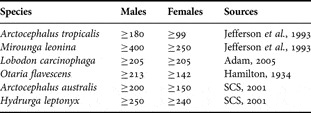
The total body length was used to estimate sexual maturity of the specimens of pinnipeds following Hamilton (Reference Hamilton1934), Jefferson et al. (Reference Jefferson, Leatherwood and Webber1993), SCS (2001) and Adam (Reference Adam2005) (Table 1).
Total body length (in cm) related to the sexual maturity of seal species with occurrence for Rio de Janeiro State, Brazil.

RESULTS
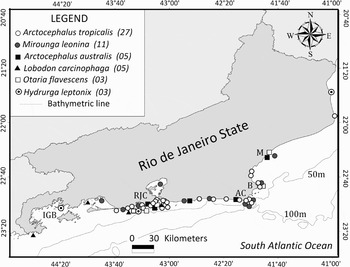
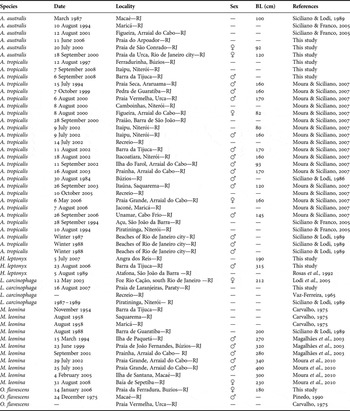
From 1954 to 2008 a total of 54 records of pinnipeds were reviewed for the coast of Rio de Janeiro State (Figure 1; Table 2). Most records were located in the region near Rio de Janeiro city and in less proportion near Arraial do Cabo and Búzios. In the northern region of the related state and around Ilha Grande Bay very few records were reported (Figure 1).
Location of occurrence of the pinnipeds recorded along the coast of Rio de Janeiro State. Rio de Janeiro city (RJC); Ilha Grande Bay (IGB); Búzios (B); Arraial do Cabo (AC); Macaé (M).

Records of pinnipeds found along the coast of Rio de Janeiro State (RJ), Brazil.

For full species names see text; BL, body length.
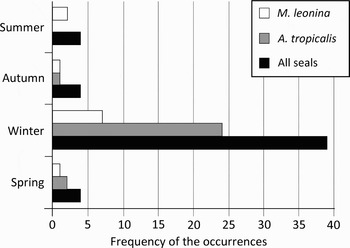
We present in this paper ten new and non-published records of pinnipeds, representing 18.2% of the records (Figure 2). The most common species registered in the study area was A. tropicalis (49.1%; N = 27) followed by the M. leonina (20%; N = 11). These two species alone accounted for 69.1% of all species of pinnipeds recorded. From the other four species registered, L. carcinophaga and O. flavescens have both four records, A. australis six records and H. leptonyx three. From 51 pinniped specimens with information about date, 76.5% (N = 39) occurred during winter, and the other 12 specimens were equally distributed along the three other seasons (Figure 3). The sub-Antarctic fur seals and southern elephant seals followed the same pattern of the total records, with the highest frequency occurring in the winter. All the specimens of H. leptonyx (N = 3) occurred during winter. Four of the six records of A. australis occurred during winter, one during summer and one during autumn. Two specimens of L. carcinophaga were distributed during autumn and winter and two records of O. flavescens were distributed in the summer and spring.
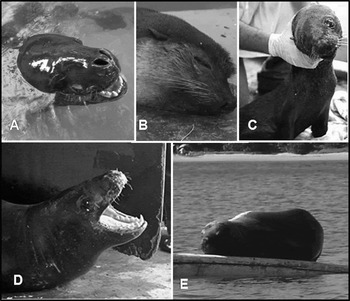
Some photographs from the new records of pinnipeds on the coast of Rio de Janeiro State, Brazil, presented in this paper. (A) Leopard seal (Hydrurga leptonyx) found on the coast of Angra dos Reis, on 5 July 2007; (B) male sub-Antarctic fur seal (Arctocephalus tropicalis) found in Barra da Tijuca, on 6 September 2008; (C) South American fur seal (Arctocephalus australis) found in Praia do Arpoador on 11 June 2006; (D) crabeater seal (Lobodon carcinophaga) found in Paraty, RJ, on 16 August 2007; (E): female South American sea lion (Otaria flavescens) found in Praia da Ferradura, Búzios, on 14 January 2006.

Frequency of occurrence of all pinnipeds, Arctocephalus tropicalis and Mirounga leonina reported for the Rio de Janeiro coast during the seasons.

From the 17 specimens of sub-Antarctic fur seals with information about sex 15 (88%) were males and only two were females. Five out of the six sexed southern elephant seals recorded in this study were males. Both lone records with information about the sex of the crabeater seal and southern fur seal were female. The only sexed leopard seal was male and two specimens of O. flavescens with information about their sex were one male and one female.
From 13 specimens of A. tropicalis with body length information 92.3% were sexually immature (10 males, 1 female and 1 non-sexed) except for one female which was classified as sexually mature. Seven out of eight specimens of M. leonina with body length information were classified as sexually immature and one specimen measuring 300 cm of body length could not be classified due to the unavailable sex information. There were only one record each with body length information for O. flavescens, L. carcinophaga and A. australis. Otaria flavescens was a sexually mature female, L. carcinophaga was classified as a sexually immature female and A. australis as sexually immature with unknown sex. One measured H. leptonix was classified as a sexually mature male and another one was sexually immature with unknown sex.
DISCUSSION
Six out of seven species with occurrence in Brazilian waters have been recorded in the tropical regions. The most common species registered along the coast of Rio de Janeiro State and also on the north-east coast of Brazil is the sub-Antarctic fur seal as previously described by Moura & Siciliano (Reference Moura and Siciliano2007). The occurrences of most seals were higher during winter. According to Castello & Pinedo (Reference Castello and Pinedo1977) and Pinedo (Reference Pinedo1990) this seasonal pattern is related to the stronger northward flow of the Malvinas/Falkland Current (MFC) during winter, which could drive the seals to tropical waters on the Brazilian coast. There is a recurrent justification for the cold temperate/sub-Antarctic species presence based on the effects of the MFC. However, the collision (confluence) of the southbound subtropical Brazil Current and the northbound sub-Antarctic MFC pivots seasonally around a fixed point at 38.9°S–54.2°W for nearly 300 km (Gordon, Reference Gordon1981; Chelton et al., Reference Chelton, Schlax, Witter and Richman1990; Saraceno et al., Reference Saraceno, Provost and Piola2005), and after collision the main flow of the MFC describes a sharp cyclonic loop, forming the Malvinas Return Flow (MRF) (Palma et al., Reference Palma, Matano and Piola2004; see figure 1 in Saraceno et al., Reference Saraceno, Provost and Piola2005). Despite the influence of the MFC on the occurrence of seals in tropical waters of Brazil the behaviour of that current also hardly justifies the northern presence of seals by itself.
The upwelling zone extending from Cabo Frío (23°S) to Cabo Santa Marta Grande (29°S) on the Brazilian coast, although representing locally upwelling events with stronger occurrence during summer (Emilsson, Reference Emilsson1961; Matsuura, Reference Matsuura1986; Castello, Reference Castello1990; Castro & Miranda, Reference Castro, Miranda, Robinson and Brink1998; Campos et al., Reference Campos, Velhote and da Silveira2000), brings productive South Atlantic Central Water to the coast and may constitute a hotspot for prey concentration, which could justify the presence of seal vagrants. Local enhanced prey concentration or spawning events were recorded for squid (Haimovici & Perez, Reference Haimovici and Perez1991) and pelagic fish (Bakun & Parrish, Reference Bakun and Parrish1990, Reference Bakun and Parrish1991; Matsuura, Reference Matsuura1996), with a clear influence on marine and shore bird distribution near these frontal areas (Antas, Reference Antas and Croxall1991; Valentin, Reference Valentin, Seeliger and Kjerfve2001).
In addition, the potential to swim long distances together with the lack of physical barriers in the marine environment could help the dispersion of seals for distant regions far from their traditional breeding or feeding regions (Silva, Reference Silva2004; Moura et al., Reference Moura, Di Dario, Lima and Siciliano2010).
After cessation of the hunting activities on seals in the southern hemisphere, some colonies have shown important signs of population growth. The population growth could result in erratic movements of seals possibly associated with the search for new suitable places to forage or colonization of new locations (Moura & Siciliano, Reference Moura and Siciliano2007; Moura et al., Reference Moura, Di Dario, Lima and Siciliano2010).
As pinnipeds are not a familiar sight to beach-goers in Rio de Janeiro State, their occurrence often attracts people (Moura & Siciliano, Reference Moura and Siciliano2007). Infectious diseases discovered in marine mammals have the potential to be transmitted to other mammals (Geraci & Ridgway, Reference Geraci and Ridgway1991; Cowan et al., Reference Cowan, House, House, Dierauf and Gulland2001). The contact of humans with pinnipeds could increase the risk of disease transmission from the seals to humans or the opposite situation (Geraci & Lounsbury, Reference Geraci and Lounsbury2005). Bastida et al. (Reference Bastida, Loureiro, Quse, Bernardelli, Rodríguez and Costa1999) described a case of tuberculosis in a wild sub-Antarctic fur seal found on the Argentine coast. Recently, Blanc et al. (Reference Blanc, Ruchansky, Clara, Achaval, Le Bas and Arbiza2009) identified antibodies to influenza viruses in South American fur seals from Uruguayan colonies. The authors confirmed that influenza A viruses circulate in marine mammals and also showed, for the first time, indirect evidence of influenza B infections in Arctocephalus australis. The public health must be taken into account in any future management plan for pinnipeds, particularly as it relates to the translocation and reintroduction of vagrant individuals along the Brazilian coast.
The distribution of seals along Rio de Janeiro State certainly reflects the non-systematic collection of records along the coastline. The concentration of records around Rio de Janeiro city is probably associated with the excessive presence of the media, environmental organizations and universities. The concentration of records near Búzios and Arraial do Cabo is justified by the presence of a long term monitoring programme carried out by the GEMM–Lagos (marine mammals research group) initiated in 1999.
Leopard seal
Leopard seals (Hydrurga leptonyx) are widely distributed in Antarctic and sub-Antarctic regions, occurring from the coast of the Antarctic Continent north throughout the pack ice and at most sub-Antarctic islands, such as Herd (Gwynn, Reference Gwynn1953), Auckland, Campbell (Reeves et al., Reference Reeves, Stewart and Leatherwood1992) and Kerguelen (Bester, Reference Bester1981). Small seasonal groups are also recorded in the Malvinas/Falklands (Hamilton, Reference Hamilton1934), South Georgia (Walker et al., Reference Walker, Boyd, McCafferty, Hun, Taylor and Reid1998) and Macquarie (Rounsevell & Eberhard, Reference Rounsevell and Eberhard1980) Islands. The northward movement of H. leptonyx is seasonal and influenced by ice conditions (King, Reference King1983).
Few leopard seals have been recorded in the western South Atlantic (Rodríguez et al., Reference Rodríguez, Bastida, Morón, Heredia and Loureiro2003). The occurrences of this seal is based on solitary specimens found in Argentina (Rodríguez et al., Reference Rodríguez, Bastida, Morón, Heredia and Loureiro2003), Uruguay (Vaz Ferreira, Reference Vaz Ferreira1984) and Brazil (Ximenez et al., Reference Ximenez, Simões-Lopez and Praderi1987; Pinedo, Reference Pinedo1990; Rosas et al., Reference Rosas, Capistrano, Di Beneditto and Ramos1992; Simões-Lopes et al., Reference Simões-Lopes, Drehmer and Ott1995). Most of the few leopard seals recorded in Brazil have been found in the south region (Rodríguez et al., Reference Rodríguez, Bastida, Morón, Heredia and Loureiro2003) and its northernmost occurrence was registered in Rio de Janeiro State (Rosas et al., Reference Rosas, Capistrano, Di Beneditto and Ramos1992).
The three records presented in this paper occurred during winter (July–August). Rodríguez et al. (Reference Rodríguez, Bastida, Morón, Heredia and Loureiro2003) found that 90% of the leopard seals were recorded from June to September in the western South Atlantic. Similar seasonal patterns of occurrence have also been observed on the coast of Australia and in South Georgia, Macquarie, Malvinas/Falklands and Kerguelen Islands. On the Australian coast most of the leopard seals are found stranded from August to October (King, Reference King1983). Some sub-Antarctic islands such as South Georgia, Kerguelen, Heard and St Paul, are the recipients of many of the winter and early spring visitors. Most of these are young seals from three to five years old.
Animals of different ages are believed to segregate by areas (Laws, Reference Laws1957; Hofman et al., Reference Hofman, Reichle, Siniff, Muller-Schwarze and Liano1977; King, Reference King1983). Segregation by sex is also suggested to influence the dispersal capability of H. leptonyx to the south-west Atlantic, where most seals found are male (Rodrígues et al., 2003), as with the only sexed leopard seal presented in this paper (Table 2).
The cyclic occurrences of leopard seals in sub-Antarctic islands are suggested to be periodic dispersal, rather than a migratory pattern (Rounsevell & Eberhard, Reference Rounsevell and Eberhard1980). The northward dispersal pattern of this seal species is more related to the food available, principally the abundance of krill. Despite that adult leopard seals can predate on different prey species (e.g. fish, crustaceans, squid, penguin and seals) young leopard seals are heavily dependent on krill, because of their lack of ability to catch large prey. Young leopard seals may be forced to disperse northward to search for prey due to their incapability to compete for food with adults in Antarctic regions.
The occurrence of vagrants in temperate and tropical regions of the south-west Atlantic during winter and spring is associated with the northward movements of young seals from the Antarctic and sub-Antarctic regions. The MFC together with the northern movement of leopard seals searching for food could help the occurrences of vagrants on the coast of Brazil, even in tropical regions such as on the coast of Rio de Janeiro State (Rodríguez et al., Reference Rodríguez, Bastida, Morón, Heredia and Loureiro2003).
Crabeater seal
The crabeater seal (Lobodon carcinophaga) is a gregarious circumpolar and pelagic phocid species distributed in the Antarctic region on drifting pack ice (King, Reference King1983; Adam, Reference Adam2005). This is the most abundant species of pinniped in the world (Jefferson et al., Reference Jefferson, Leatherwood and Webber1993). Despite an extreme variation in the estimated global density of L. carcinophaga, ranging from two to 75 millions according to Bengson (Reference Bengson, Perrin, Würsig and Thewissen2002), an estimation of 10 to 15 million is more currently accepted (Oliveira et al., Reference Oliveira, Machado, Alievi and Würdig2006).
The latitudinal movement of the crabeater seal is associated with the seasonal configuration of the pack ice. Its northward movement coincides with the winter extension of the pack ice, and it can move further south during summer as the ice breaks up. These phocids are abundant in Antarctic coastal waters, principally on the west coast of Graham Land and in the southern Ross Sea, where its sudden influx is characteristically semi-migratory (King, Reference King1983).
Vagrants have occurred on the coast of South Africa, Heard Island, Australia, New Zealand and South America (King, Reference King1983). Here we added one new record on the coast of Rio de Janeiro State (Table 2), which represents the northernmost location of the occurrences of L. carcinophaga in the western South Atlantic (Oliveira et al., Reference Oliveira, Machado, Alievi and Würdig2006).
Few crabeater seals have been reported for the Brazilian coast and most records have occurred during austral summer and autumn, as well as in winter months (Oliveira et al., Reference Oliveira, Machado, Alievi and Würdig2006). The only two records with available period of occurrence were reported during May and August (Table 2). On the coast of Chile this species occurs during winter (Olrog, Reference Olrog1950), and in Argentina the occurrence of crabeater seals has been reported during austral summer (Scolaro, Reference Scolaro1976; Goodall & Schiavini, Reference Goodall and Schiavini1987).
Between 1968 and 1975 Ross et al. (Reference Ross, Ryan, Saayman and Skinner1976) reported nine strandings of L. carcinophaga on the South Africa coast. The total body length of these vagrants (1.6–1.9 m) showed that they were probably pups of the previous year, with about four to six months of age. Despite the auxiliary propulsion northward promoted by the West Wind Drift (WWD), those crabeater seals would have to swim intensively to reach the coast of South Africa. The majority of the young seals stranded in the austral summer (December–March). This period coincides with the time when the bulk of the crabeater population would be moving southward with the break up of the winter ice cover (Ross et al., Reference Ross, Ryan, Saayman and Skinner1976). King (Reference King1983) described seven strandings of L. carcinophaga in the Australian coast between January and September, although half of the records occurred during winter.
Although rarely reported in Rio de Janeiro, as well as on the Brazilian coast, L. carcinophaga records in the area are probably linked to the post-reproductive dispersal pattern of adult seals influenced by the WWD and MFC (Pinedo, Reference Pinedo1990; Oliveira et al., Reference Oliveira, Machado, Alievi and Würdig2006), as is believed to occur with the vagrants reported on the Africa and South America coasts (Castello & Pinedo, Reference Castello and Pinedo1977).
Southern elephant seal
The southern elephant seal (Mirounga leonina) has a widely circumpolar distribution and breeding sites near the sub-Antarctic convergence. There are several small breeding groups of this large seal in sub-Antarctic islands, however the most abundant group is located in South Georgia (South Atlantic Ocean—54°17′S 36°42′W), Kerguelen–Heard (South Indian Ocean—49°21′S 70°12′E) and Macquarie Islands (South Pacific Ocean—54°30′S 158°57′E) (Reeves et al., Reference Reeves, Stewart, Clapham and Powell2002). In addition, in South America exists a genetically distinct small population at Peninsula Valdés, Argentina (Slade et al., Reference Slade, Moritz, Hoelzel and Burton1998; Hoelzel et al., Reference Hoelzel, Campagna and Arnbom2001). Southern elephant seals breed in the austral spring, from early September to mid-November, and they spend most time of the year at sea (Le Boeuf & Laws, Reference Le Boeuf, Laws, Le Boeuf and Laws1994). The global population of M. leonina is estimated between 664,000 and 740,000 animals distributed in 14 breeding stocks (McMahon et al., Reference McMahon, Bester, Burton, Hindell and Bradshaw2005). Vagrant southern elephant seals have been recorded in several locations far from their traditional breeding sites (Pinedo et al., Reference Pinedo, Rosas and Marmontel1992; Reeves et al., Reference Reeves, Stewart, Clapham and Powell2002). Their unexpected presence has been reported on the coast of central Chile, South Africa, New Zealand, Tasmania, Australia and Angola (Reeves et al., Reference Reeves, Stewart, Clapham and Powell2002). In Brazilian waters, this species has been occasionally recorded in Rio Grande do Sul, Santa Catarina, Paraná, São Paulo, Rio de Janeiro, Bahia, Sergipe and Fernando de Noronha Island (Lodi & Siciliano, Reference Lodi and Siciliano1989; Pinedo, Reference Pinedo1990; Pinedo et al., Reference Pinedo, Rosas and Marmontel1992; Simões-Lopes et al., Reference Simões-Lopes, Drehmer and Ott1995; Magalhães et al., Reference Magalhães, Hassel, Venturotti and Siciliano2003; Bastos et al., Reference Bastos, Norberto, Maia-Nogueira and Guimarães2006; Moura et al., Reference Moura, Di Dario, Lima and Siciliano2010).
Recently Moura et al. (Reference Moura, Di Dario, Lima and Siciliano2010) reviewed the occurrence of M. leonina on the Brazilian coast. These authors compiled 46 records from 1954 to 2008. Twenty-one per cent of the southern elephant seals occurred along the coast of Rio de Janeiro State.
Most occurrences of southern elephant seals on the South America coast are composed of sexually immature females (Lewis et al., Reference Lewis, Campagna, Marin and Fernandez2006; Moura et al., Reference Moura, Di Dario, Lima and Siciliano2010). Our data based on a review of records of this species in Rio de Janeiro State support this trend.
In our study, M. leonina was the second most common pinniped recorded in Rio de Janeiro State, and most of them occurred during winter. A similar seasonal trend was noted by Moura et al. (Reference Moura, Di Dario, Lima and Siciliano2010) who found most of the southern elephant seals during autumn and winter on the Brazilian coast. This seasonal pattern of occurrence suggests that the intrusion of the MFC, stronger in winter, could have an important role in the dispersal of the specimens found along the coast of South America, such as Rio de Janeiro State (Castello & Pinedo, Reference Castello and Pinedo1977; Oliveira et al., Reference Oliveira, Danilewicz, Martins, Ott, Moreno and Caon2001; Magalhães et al., Reference Magalhães, Hassel, Venturotti and Siciliano2003; Moura et al., Reference Moura, Di Dario, Lima and Siciliano2010). As postulated by Magalhães et al. (Reference Magalhães, Hassel, Venturotti and Siciliano2003) and Moura et al. (Reference Moura, Di Dario, Lima and Siciliano2010), one of the main reasons for the erratic movements of southern elephant seals could be attributed to the population growth of some colonies. Indeed, the continental colony of the species located in Peninsula Valdés has shown clear evidence of growth and could be the locality for the majority of seals presented in this paper (Bastida & Rodríguez, Reference Bastida and Rodríguez2003).
The potential ability to swim long distances together with the lack of physical barriers and MFC currents moving northwards may help the dispersion of these seals to different locations along the Brazilian coast.
South American fur seal
The South American fur seal (Arctocephalus australis) is distributed on both the Atlantic and Pacific coasts and offshore islands of South America, from Uruguay to Peru (King, Reference King1983; Pinedo et al., Reference Pinedo, Rosas and Marmontel1992). Most of the entire population is concentrated in the Atlantic side of the distribution, especially in Uruguay where 300,000 specimens have been estimated (Páez, Reference Páez, Rey, Amestoy and Arena1999). Despite that there are no established breeding colonies of A. australis on the Brazilian coast, every year several dozens of young fur seals have been recorded during austral autumn and spring months, principally in the southern region of Brazil (Simões-Lopes et al., Reference Simões-Lopes, Drehmer and Ott1995; Oliveira et al., Reference Oliveira, Danilewicz, Martins, Ott, Moreno and Caon2001). In addition, there are two areas where otariid seals haul-out in Rio Grande do Sul State: Molhe Leste, 32°10′S 52°06′W and Ilha dos Lobos, 29°20′S 49°43′W (Rosas et al., Reference Rosas, Pinedo, Marmontel and Haimovici1994). Some occurrences of South American fur seals have been recorded in other localities along the Brazilian coast, such as São Paulo and Rio de Janeiro State (Pinedo et al., Reference Pinedo, Rosas and Marmontel1992). Oliveira (Reference Oliveira1999), based on data recovered during beach surveys recorded several hundred live and dead South American fur seals along the coast of Rio Grande do Sul. According to this author, most specimens recorded are yearlings of both sexes and adult males.
As this species breed in temperate zones of western South America, and even haul-out in southern Brazil, it was expected that this seal could be one of the most common in lower latitudes of this country. In contrast, only six records of A. australis were found up to date on the Rio de Janeiro coast, representing 1.1% of all pinnipeds and 16.2% of the otariids. On the coast of Rio Grande do Sul State (southern Brazil) this species represented 64.2% (N = 79) of the otariids recorded from 1984–1993 and most of them were sexually immature males (Simões-Lopes et al., Reference Simões-Lopes, Drehmer and Ott1995). Even pregnant females have been recorded in southern Brazil (Muelbert & Oliveira, Reference Muelbert and Oliveira2006).
Five out of six records of A. australis on the Rio de Janeiro State coast occurred during winter. In southern Brazil most South American fur seals occur during winter and spring months (Pinedo, Reference Pinedo1990; Simões-Lopes et al., Reference Simões-Lopes, Drehmer and Ott1995; Muelbert & Oliveira, Reference Muelbert and Oliveira2006) and their occurrence has been attributed to the northward foraging movement after they depart from breeding colonies in Uruguay (Muelbert & Oliveira, Reference Muelbert and Oliveira2006).
South American sea lion
The Southern American sea lion (Otaria flavescens) is distributed from southern Brazil to southern Argentina along the Atlantic Ocean, and around the Chilean and Peruvian coasts along the Pacific Ocean (King, Reference King1983; Bastida & Rodríguez, Reference Bastida and Rodríguez2003). Despite that there are no established reproductive sites on the Brazilian coast O. flavescens is the second most common species of pinniped in the southern region; however, it is rarely observed on the coast of Rio de Janeiro, where only four specimens, representing 7.2% of records, were reported (Table 2). It is believed that the origin of the southern sea lions that inhabit the Brazilian coast is the breeding colonies from Uruguay, where there are about 12,000 seals (Páez, Reference Páez, Menafra, Gallgo, Scarabina and Conde2006). Most occurrences of sea lions in southern Brazil have been reported from September to November during their non-breeding distribution. Two records with available information on stranding times in the Rio de Janeiro State occurred in later spring and early summer (Table 2). According to Castello & Pinedo (Reference Castello and Pinedo1977) and Rosas et al. (Reference Rosas, Pinedo, Marmontel and Haimovici1994) the northern dispersion pattern of O. flavescens is related to suitable prey in southern Brazilian waters. This dispersion occurs principally with adult and sub-adult males which could travel long distances far from the breeding colonies. The foraging activities near the breeding ground could result in a collapse through the competition for food, principally for females and juveniles that need to forage and store energy to maintain their parental care (Rosas et al., Reference Rosas, Pinedo, Marmontel and Haimovici1994). However, females may also disperse long distances to forage as observed with a sexually mature female on Ferradura beach (Búzios, Rio de Janeiro). It was a healthy specimen that remained for seven days foraging and resting consecutively.
Only a small percentage of the southern sea lions recorded in the Rio Grande do Sul State are females. In contrast one adult female was observed in Búzios, Rio de Janeiro (Table 2).
According to Pinedo & Barros (Reference Pinedo and Barros1983) and Oliveira et al. (Reference Oliveira, Ott, Malabarba, Reis, Peracchi and Santos2008), southern sea lions in southern Brazil feed mainly on demersal fish of the family Scianidae (e.g. Paralonchurus brasiliensis, Macrodon ancylodon, Cynoscion striatus and Micropogonias furnieri) and Trichiuridae (Trichiurus lepturus). The majority of these fish are commercially exploited generating competition between fishermen and seals and promoting an important risk for the seals (Rosas, Reference Rosas1989).
Sub-Antarctic fur seal
The sub-Antarctic fur seals (Arctocephalus tropicalis) are widely distributed in the southern hemisphere. They breed on many sub-Antarctic Islands, north of the Antarctic convergence (Jefferson et al., Reference Jefferson, Leatherwood and Webber1993) including Gough/Tristan da Cunha (40°20′S 09°54′E), Prince Edward/Marion (46°38′S 37°57′E), Amsterdam/St Paul (37°50′S 77°31′E), Crozet (45°57′S 50°33′E) and Macquarie Islands (54°30′S 158°57′E) (Bester, Reference Bester, Croxall and Gentry1987; Pinedo et al., Reference Pinedo, Rosas and Marmontel1992). The northern limit of the species range is not well known, but vagrants have appeared in South Africa (Shaughnessy & Ross, Reference Shaughnessy and Ross1980), Argentina (Bastida et al., Reference Bastida, Loureiro, Quse, Bernardelli, Rodríguez and Costa1999; Bastida & Rodriguez, 2003), Brazil (Pinedo, Reference Pinedo1990), Australia and New Zealand (Taylor, Reference Taylor1990) and Juan Fernandez Islands, Chile (Torres & Aguayo, Reference Torres and Aguayo1984). In Brazil, A. tropicalis has been recorded in the States of Rio Grande do Sul, Santa Catarina, Paraná, São Paulo, Rio de Janeiro, Bahia Sergipe and Alagoas (Castello & Pinedo, Reference Castello and Pinedo1977; Ximenez, Reference Ximenez1980; Neves et al., Reference Neves, Reis and Brasileiro1990; Simões-Lopes et al., Reference Simões-Lopes, Drehmer and Ott1995; Velozo, Reference Velozo2007; Souto et al., Reference Souto, Abrão-Oliveira, Maia-Nogueira and Dórea-Reis2009; Velozo et al., Reference Velozo, Schiavetti and Dórea-Reis2009).
Sub-Antarctic fur seals pup and breed from late October to early January, with a peak in mid-December. Seals also come ashore for the annual moult between February and April, with a peak in March and April (Jefferson et al., Reference Jefferson, Leatherwood and Webber1993).
As A. tropicalis inhabits sub-Antarctic islands it was unexpected that this seal represents 49.1% of all seals and 75% of the otarids found in the Rio de Janeiro State. In southern Brazil it represents 26.8% of the otarids reported, and 64.2% of the family is composed of A. australis (Simões-Lopes et al., Reference Simões-Lopes, Drehmer and Ott1995). Most individuals reported were sexually immature males. The same pattern of occurrence was recently observed by Moura & Siciliano (Reference Moura and Siciliano2007) that presented 18 records of sub-Antarctic fur seals on the coast of Rio de Janeiro.
Ninety per cent of the specimens occurred during winter on the coast of Rio de Janeiro State. The same seasonal pattern is observed in southern Brazil, where most seals occur from June to October (Simões-Lopes et al., Reference Simões-Lopes, Drehmer and Ott1995). In South Africa the occurrence of A. tropicalis is also seasonal and most records occur between May and September (Shaughnessy & Ross, Reference Shaughnessy and Ross1980).
Most of the records made along the Brazilian coast have been suggested to be attributed to the favourable influence of the cold MFC which flows northward and is more intensive during winter, similar to other pinnipeds (Castello & Pinedo, Reference Castello and Pinedo1977; Pinedo, 1992, Simões-Lopes et al., Reference Simões-Lopes, Drehmer and Ott1995; Moura & Siciliano, Reference Moura and Siciliano2007). Nevertheless, Oliveira (Reference Oliveira1999) suggested that the fur seals found on the southern Brazilian coast could be vagrant individuals from Gough or Tristan da Cunha, aided by the South Atlantic Anticyclonic System, which in turn comprises the Antarctic Circumpolar, Benguela and Brazil Currents. The records of A. tropicalis along the north-eastern and south-eastern Brazil coasts have also been attributed to the passive transport of the Benguela Current, as suggested by Ximenez (Reference Ximenez1980) for the coast of Alagoas State, Velozo et al. (Reference Velozo, Schiavetti and Dórea-Reis2009) for the coasts of Sergipe and Bahia States, and also Moura & Siciliano (Reference Moura and Siciliano2007) who also postulated this hypothesis for the occurrences of sub-Antarctic fur seals in the Rio de Janeiro State.
A recent genetic study comparing the A. tropicalis found on the Brazilian coast with animals from the main breeding colonies of this species indicated that despite the majority of the vagrants being from Gough Islands (40°20′S 09°54′E), they could also come from other reproductive colonies (Ferreira et al., Reference Ferreira, Oliveira, Wynen, Bester, Guinet, Moraes-Barros, Martins, Muelbert, Moreno, Siciliano, Ott and Morgante2008). In addition, one vagrant seal which presented a DNA sequence matching an exclusive haplotype from the Crozet Islands (45°95′S 50°33′E), probably moved west with assistance of the West Wind Drift, around the Antarctic and MFC, reaching the Brazilian coast after covering a distance of about 16,500 km.
Following the cessation of intensive exploitation, populations have increased, often dramatically, and many islands have been recolonized by the species (SCAR, 1992). The records presented here suggest that the population increase in many breeding sites together and the auxiliary propulsion promoted by the Malvinas/Falklands or Benguela Currents could result in new extra limital records of A. tropicalis along the South America coast, including low latitudinal places, such as the south-eastern and north-eastern Brazilian coast.
AcKNOWLEDGEMENTS
The authors would like to thank the researchers who contributed with records presented in this paper. Thanks go to the research team of GEMM–Lagos. We also thank the fishermen and lifeguards from Cabo Frio, Saquarema and Búzios for their contribution with important information on pinniped records. J.F. Moura is supported by Fundação Oswaldo Cruz (FIOCRUZ) and is a PhD student of the Escola Nacional de Saúde Pública Sérgio Arouca (ENSP–FIOCRUZ). S. Siciliano is supported by Conselho Nacional de Desenvolvimento Científico e Tecnológico (CNPq) (Processo no. 301544/2008-5). We also thank the two anonymous referees who provided constructive comments to this article.