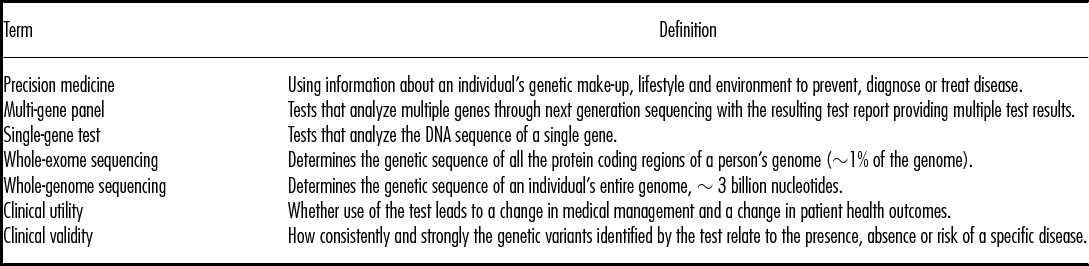
Advancements in whole-genome sequencing (determining the complete DNA-sequence of the human genome), whole-exome sequencing (determining the DNA-sequence of the protein coding regions of the genome), and multi-gene panel sequencing (determining the DNA sequence of multiple genes simultaneously) increasingly allow for an individual's health care to be tailored to their unique genetic makeup (see Table 1 for definitions of pertinent terminology). This personalized diagnostic model approach has been heralded as a new dawn in medicine and health care (Reference Berg, Khoury and Evans1;Reference Dotson, Bowen, Kolor and Khoury2). In his 2015 State of the Union address, President Obama announced the creation of the Precision Medicine Initiative, which has the goal of improving health and treating disease in part through leveraging advances in genomics (Reference Obama3). In 2016, the National Institutes of Health received $200 million for the Precision Medicine Initiative, and in the same year, Congress enacted the 21st Century Cures Act, which authorized $4.8 billion over 10 years to advance, among other initiatives, the Precision Medicine Initiative (4;5).
Definitions

Precision medicine: https://ghr.nlm.nih.gov/primer/precisionmedicine/definition
Single-gene test: https://ghr.nlm.nih.gov/primer/testing/genetictesting
Whole exome-sequencing: http://www.nature.com/jhg/journal/v59/n1/full/jhg2013114a.html
Clinical utility: http://www.cdc.gov/genomics/hugenet/file/print/pub_clincalUtility.pdf
Clinical validity: https://ghr.nlm.nih.gov/primer/testing/validtest
Genomic sequencing tests can provide high-speed analysis of a person's genome and generate information to aid clinical diagnosis and prognosis by detecting gene variants in asymptomatic patients and identifying the genetic origins of pre-existing symptoms (Reference Phillips, Trosman and Kelley6–Reference Dewey, Grove and Pan8). In oncology, genomic sequencing increasingly allows a patient's treatment to be tailored to the genetic characteristics of cancer cells (Reference Gagan and Van Allen9).
Payer coverage policies play a key role in the adoption of medical technologies and their diffusion into health care. Studies have found that payer coverage of precision medicine technologies can be inconsistent, with some technologies covered by some payers, but not by others (Reference Hresko and Haga10;Reference Graf, Needham, Teed and Brown11). To date, payers have most often provided coverage for “single gene/actionable result” testing, for example, cystic fibrosis testing. In contrast, coverage of multi-gene panels, for example, some tests for hereditary breast and ovarian cancers (termed “panels” for brevity), has been largely inconsistent because these panels contain low and moderate risk genes that do not have consensus management guidelines for clinical follow-up (Reference Chakradhar12).
Various reasons for inconsistent coverage have been suggested, including insufficient evidence of clinical validity and utility that prevents payers from judging whether a panel meets payers’ standards of medical necessity (Reference Phillips, Trosman and Kelley6;Reference Graf, Needham, Teed and Brown11;Reference Khoury, Coates and Evans13;Reference Khoury, Berg and Coates14). Furthermore, because genetic panels may include a combination of unvalidated gene sequences, that is, gene sequences that require clinical studies to determine their utility in a clinical setting, and validated genes, that is, gene sequences that can be used to make therapeutic decisions, the payer may determine the entire panel to be “investigational” (Reference Trosman, Weldon, Kelley and Phillips15). It has been asserted that the inconsistent way in which these tests are covered has prevented the benefits of panels from being fully realized (Reference Berg, Khoury and Evans1;Reference Deverka and Dreyfus16). A better understanding of the types of evidence payers review when formulating coverage policies for panels would make patients’ access to these tests more predictable.
Our objective in this study was to examine the evidence that payers have cited in their coverage policies for panels. First, we determined whether payers cited specific types of evidence in their coverage policies for panels. Second, we compared the types of evidence payers cited in coverage policies for panels with the types of evidence cited in coverage policies for other intervention types: pharmaceuticals, medical devices, surgeries, and diagnostic tests and imaging.
METHODS
Development of the TRANSPERS Payer Coverage Policy Registry
The starting point for this research was the TRANSPERS Payer Coverage Policy Registry©. The TRANSPERS Payer Coverage Policy Registry© systematically synthesizes payer coverage policies on panels to assess which panels are covered by payers, what factors relevant to coverage decisions are discussed in policies, and how coverage policies vary. The TRANSPERS Payer Coverage Policy Registry© was developed with a team of collaborators from multiple institutions (University of California at San Francisco, Tufts Medical Center, American Institutes for Research, and Center for Business Models in Healthcare), with funding from the National Human Genome Research Institute (R01HG007063) (17). The TRANSPERS Payer Coverage Policy Registry© is a copyrighted product based on proprietary methods; the developers of the Registry do not own copyright on the policies.
The Registry currently includes coverage policies relevant to whole genome sequencing, whole exome sequencing and gene panels. Gene panels in this context are defined as tests that analyze multiple genes by next generation sequencing or chromosomal microarray analysis, with the resulting test report providing multiple results, not an algorithmic score. The Registry includes data on what panels and testing indications are reviewed, whether panels are covered or not covered, and the evidence and rationale for coverage decisions cited in the policy (Reference Phillips, Deverka and Trosman20).
The Registry structure was developed based on an extensive review of existing registries. In addition, the Registry was informed by ten semi-structured interviews with a stakeholder advisory group that included private and public payers, genetic laboratory representatives, medical genetics experts, genetic counselors, regulators, consultants, and pathologists (Reference Phillips, Deverka and Trosman20).
The Registry currently includes policies from the five largest US private (commercial) payers, that is, health insurance companies that offer insurance to groups such as large employers or individuals, based on enrollment (18). These payers represent 112 million enrolled lives. Policies were coded as of June 2015. Each payer's website was searched using the terms “Genetic Test,” “Sequencing,” or “Panel” to identify applicable policies. All coverage policies were then obtained from the payers’ web sites. Within each policy, information about the policy and each panel found within the policy was coded. The coverage policy was the unit of analysis. Data were coded in Microsoft Excel by two trained coders who independently coded data and convened to resolve any discrepancies. Full details on the development of the TRANSPERS Payer Coverage Policy Registry© can be found elsewhere (17). The database has been used previously to evaluate trends in coverage of multi-gene panels (Reference Trosman, Weldon and Douglas19–Reference Dervan, Deverka and Trosman22).
Study Objective 1: To Examine the Evidence Cited in Coverage Policies for Panels
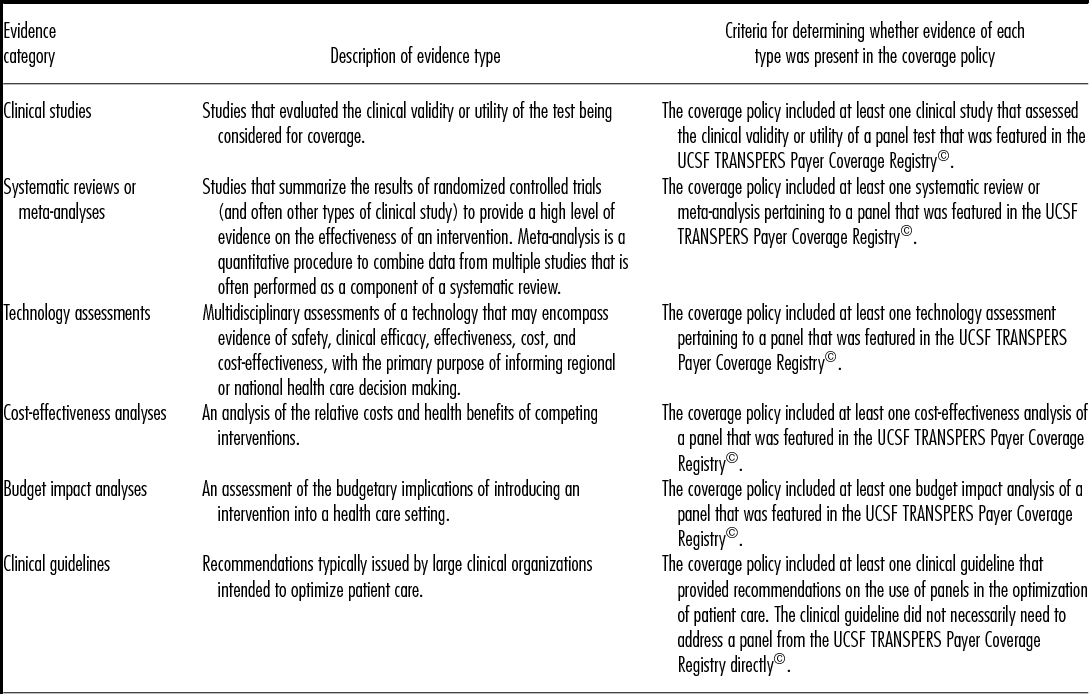
All coverage policies for panels included in the TRANSPERS Payer Coverage Policy Registry© were included in this research. We reviewed all coverage policy documentation present in the registry to determine the types of evidence the payers cited. We categorized the evidence using the following categories: clinical evidence, systematic literature reviews or meta-analyses, technology assessments, cost-effectiveness analyses, budget impact studies, and clinical guidelines (Table 2).
Evidence Categories

UCSF, University of California at San Francisco.
A trained researcher read each coverage policy in full to determine if studies of each evidence type were cited or discussed. When a pertinent citation was identified, the researcher obtained and reviewed it to determine if it met the inclusion criteria presented in Table 2. Each evidence source was considered to determine if it pertained to a panel. When the study title was insufficient to make this judgment, the study abstract (and if necessary the full article) was reviewed. We reported whether at least one of each evidence type pertaining to a panel in the Registry appeared in each coverage policy. Then, we reported the proportion of each payer's coverage policies in which at least one of each evidence type was cited.
Study Objective 2: To Compare the Evidence Cited for Different Types of Interventions
We compared the evidence that the payers cited in their coverage policies for panels with the evidence the payers cited in their coverage policies for other types of intervention using an existing dataset developed for a separate research study conducted at the Center for the Evaluation of Value and Risk in Health at Tufts Medical Center (Reference Chambers, Chenoweth and Neumann23). In this separate research study, we reviewed the coverage policies for medical interventions issued by the eighteen largest private payers (18). Also in this research, we reviewed all coverage policies issued by the included payers and identified the six pharmaceuticals, medical devices, diagnostic tests and imaging, and surgical interventions, for which the payers most often issued coverage policies. We included six interventions of each intervention type to ensure that each intervention type was adequately represented across payers.
We reviewed the coverage policies for these interventions and reported whether the payers cited evidence for each intervention using the same method outlined in study objective 1. In other words, we determined whether the payer cited at least one of the evidence types discussed above, that is, clinical evidence (e.g., randomized controlled trials), systematic literature reviews or meta-analyses, technology assessments, cost-effectiveness analyses, budget impact studies, and clinical guidelines, in their coverage policies. The interventions included in study objective 2 are listed in Supplementary File 1. Coverage policies were current as of August 2014.
For the current study, we considered the coverage policies issued by the same payers we considered in study objective 1, that is, the five largest U.S. private (commercial) payers, for the six interventions of each type of intervention. We determined whether the payer cited each type of evidence in each of the considered pharmaceuticals, medical devices, diagnostic tests and imaging, and surgical interventions’ coverage policies. We then determined the frequency that each payer cited each type of evidence. Lastly, we compared these frequencies with the frequency that payers cited each type of evidence in their coverage determinations for panels as determined in study objective 1.
RESULTS
Study Objective 1
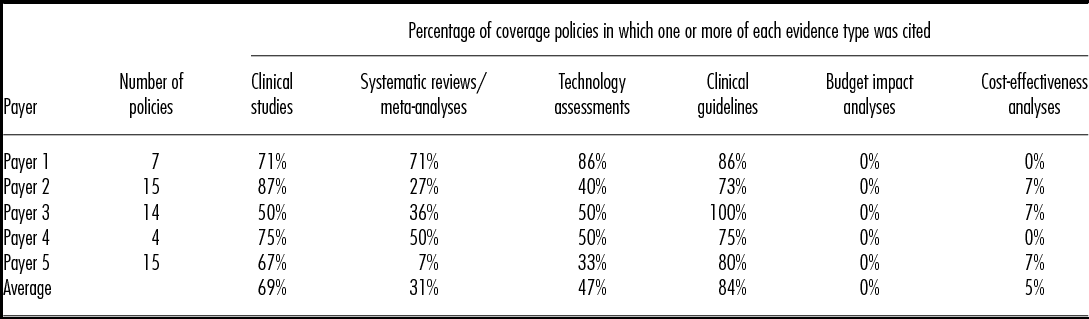
At the time that this research was performed, the TRANSPERS Payer Coverage Policy Registry© included fifty-five coverage policies. A single coverage policy typically assessed multiple different panel tests. Across the fifty-five included coverage policies the payers judged coverage of 313 panels. We found that different types of evidence were cited in the coverage polices with different frequencies. Clinical guidelines were cited in the largest percentage (84 percent) of coverage polices; the payer that most frequently cited clinical guidelines did so in 100 percent of their policies, the payer that least frequently cited clinical guidelines did so in 73 percent of their policies (Table 3).
Types of Evidence That Payers Cite in Coverage Policies for Multi-gene Panels and WGS/WESa Tests

aWhole genome sequencing or whole exome sequencing.
Cost-effectiveness analyses and budget impact studies were the study types that were least often cited in the coverage policies; no payer cited budget impact studies in their coverage policies, but three of the five payers cited a cost-effectiveness analysis in a single coverage policy (an average of 5 percent of coverage policies across all five payers; range, 0–7 percent).
On average payers cited clinical studies in 69 percent of their coverage policies (range, 50–87 percent). We found notable variation among the payers in the frequency that technology assessments and systematic reviews and meta-analyses were cited in coverage policies. On average payers cited technology assessments in 47 percent of their coverage policies (range, 33–86 percent), and systematic reviews or meta-analyses in 31 percent of their coverage policies (range, 7–71 percent).
Study Objective 2
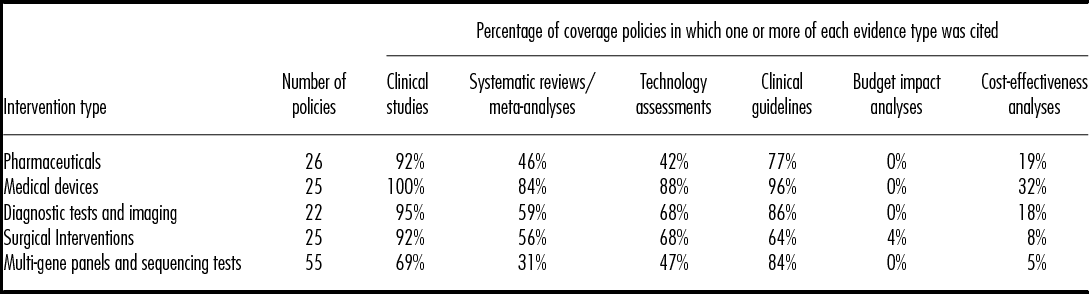
Compared with their coverage policies for the other types of interventions (pharmaceuticals, medical devices, diagnostic tests and imaging, and surgical interventions) payers less often cited clinical studies, systematic reviews, technology assessments, and cost-effectiveness analyses in their coverage policies for panels (Table 4). Payers cited clinical guidelines in a similar proportion of their coverage policies (84 percent) for panels as they did in their coverage policies for other technology types. Budget impact studies were only cited in coverage policies for surgical interventions.
Comparison of the Types of Evidence Payers Cited in Coverage Policies for Multi-gene Panels and WGS/WESFootnote a Tests with Other Technology Types

a Whole genome sequencing or whole exome sequencing.
DISCUSSION
Rapid advances in panels are transforming our ability to identify and manage various diseases and disorders that result from clinically significant gene variants. It has been argued, however, that advances in sequencing technology have outpaced our ability to integrate the information gleaned from such assays into health care (Reference Berg, Khoury and Evans1;Reference Clain, Trosman, Douglas, Weldon and Phillips21;Reference Desmond, Kurian and Gabree24;Reference Swisher25). The speed with which sequencing technologies have allowed genetic testing to shift from single gene analysis to multi-gene panels is indicative of this trend.
Payer coverage is fundamental in guiding how medical technologies are used in clinical practice and ultimately what technologies patients have access to (Reference Wang, Beattie, Ponce and Phillips26). To date, coverage of genetic tests has been inconsistent, with some payers covering a particular test but other payers not (Reference Hresko and Haga10;Reference Graf, Needham, Teed and Brown11). This inconsistency creates confusion for patients and clinicians as to who has access to these tests and how they are used in clinical practice. Researchers have called for greater transparency in payer coverage policies for panels as a means to reduce this confusion (Reference Trosman, Weldon, Kelley and Phillips15;Reference Wang, Beattie, Ponce and Phillips26).
We examined the evidence that payers cite in their coverage policies for panels and found that payers did not cite clinical studies in more than one quarter of policies. We also found that the included payers less often cited systematic reviews, technology assessments, and cost-effectiveness studies in coverage policies for panels than they did in their coverage policies for other intervention types. This finding is consistent with the literature describing the lack of available evidence analyzing the clinical validity and utility of panels (Reference Khoury, Coates and Evans13;Reference Trosman, Weldon, Kelley and Phillips15;Reference Clain, Trosman, Douglas, Weldon and Phillips21;Reference Messner, Al Naber and Koay27). Furthermore, regulatory approval for panels does not have the same evidentiary requirements as the approval pathways for drugs and, to varying degrees, medical devices (Reference Evans, Burke and Jarvik28). We also found that in comparison to other types of interventions payers less often cited systematic reviews, technology assessments, and cost-effectiveness studies. This finding is also expected given that these evidence types are contingent on availability of sufficient contributing clinical evidence.
Notably, we found the category of evidence most often cited in the coverage policies for panels were clinical guidelines. Clinical guidelines are typically formulated through a combination of the available clinical evidence and expert clinical opinion. The frequent citation of clinical guidelines in coverage policies for panels may indicate that in the absence of sufficient supporting clinical evidence, prevailing clinical opinion plays a larger role in payer decision making for these technologies than it does for other intervention types (Reference Khoury, Coates and Evans13). Alternatively, it may be that because guidelines cite the clinical evidence on which they are based, payers that cite the guidelines do not additionally cite the same clinical evidence. Research that evaluates the composition of clinical guidelines cited in coverage policies for panels, and the role of guidelines in decision making, would be valuable.
Study Limitations
This study has several limitations. As we include only five of the largest private payers, it is unclear whether study findings have any generalizability to small- or medium-sized private payers. Furthermore, it is uncertain whether our analysis of U.S. private payers has any generalizability to public payers in the United States, for example, Medicare and Medicaid. Furthermore, the included sample was insufficient for us to perform more rigorous statistical testing of the data and drawing more firm conclusions. In the future, we plan to repeat the analysis with a larger and broader set of interventions.
We assume that the payers comprehensively cite the evidence that they review in their coverage policies. However, it may be that some payers do not disclose all the information that they review. Furthermore, in regard to cost-effectiveness analyses and budget impact studies, it may be that payers perform their own analyses that they do not report in their coverage policies.
Because we did not assess the prevalence of relevant, high quality clinical evidence for multi-sequence panels, we were unable to determine how comprehensively payers report reviewing the available evidence in their coverage policies. Future research should evaluate how comprehensively payers cite the available relevant evidence for multi-sequence panels and to examine reasons for identified discrepancies, for example, whether payers choose to review only clinical evidence of sufficient quality.
While we determined whether coverage policies included any evidence of each type, we did not account for the frequency that each evidence type was reviewed. We do not account for the fact that payers may weigh different types of evidence differently in decision making, or may base their decisions on a different evidence base.
We report the frequency that the payers report at least one study of each type, rather than the total number of studies of each type that the payers report. This approach prevented us from comparing the volume of evidence that the payers reported reviewing in their coverage policies.
To compare the evidence cited in coverage policies for panels with the evidence cited in coverage policies for other types of interventions we relied on a dataset developed for a separate research study. While the included payers and the used methodologies were consistent between the two datasets, the coverage policies in the second dataset were not as recent as those in the first (August 2014 vs. June 2015).
Looking Forward
Genetic testing poses the healthcare system a particular challenge. While offering great promise to improve patient care, health outcomes, and disease prevention, it has been asserted that the lack of evidence demonstrating clinical validity and utility of panels has prevented society from reaping the benefits from the advancing technology (Reference Deverka, Messner and McCormack29). Generating evidence of clinical validity and utility for panels has documented difficulties (Reference Khoury, Berg and Coates14). For instance, the long-term clinical data required to confirm that the tests accurately predict disease are typically unavailable to payers making coverage decisions. Also, because many of the genetic variants that sequencing tests are designed to detect are rare, it is challenging to design clinical trials of a sufficient size. Furthermore, improving our understanding of the full range of gene variants identified by panels will be a long-term process and will require widespread use of genomic testing over a period of many years (Reference Evans, Burke and Jarvik28;Reference Shirts, Jacobson, Jarvik and Browning30). While our study addresses only U.S. payer coverage of panels, these highlighted challenges are relevant to payers and other health care decision makers in Europe and elsewhere.
Innovative approaches are required to generate evidence of clinical utility and validity while providing patients reasonable and appropriate access to these technologies. One approach would be to use coverage with evidence development (CED) policies similar to that used by the Centers for Medicare and Medicaid Services, the agency that administers the Medicare program (the federal health insurance program for people who are disabled, have end-stage renal disease and are aged 65 or older), in its national coverage determination for pharmacogenomic testing for warfarin response (31). In CED policies, patients gain access to a technology contingent on their enrollment in an approved registry or clinical study. The intention is that the evidence generated from the registry or clinical study can be used to inform future coverage determinations.
A recent study found that Noninvasive Prenatal Testing associated with good evidence of clinical validity and modeled evidence of clinical utility were rapidly covered by payers (Reference Shirts, Jacobson, Jarvik and Browning30). However, more research is needed to understand the quality of the current evidence base supporting panels and how rapidly evidence of clinical validity and utility become available once a panel is marketed.
Clarity with respect to the payers’ evidence requirements is required. An understanding of what kind of clinical and economic studies payers require would increase the efficiency of evidence generation and the predictability of coverage and patient access. There are several initiatives that are currently facilitating this discussion and are seeking to set evidence standards for panels. For instance, the Molecular Evidence Development Consortium (MED-C) is a U.S.-based nonprofit group that among its goals aims to bring together stakeholders and encourage the collection of high quality evidence and the provision of advanced molecular diagnostics to patients (32). The Green Park Collaborative is a multi-stakeholder collaborative with the goal of creating a consensus on the evidence needed to inform both clinical and payment decisions. One of the Collaborative's aims is to develop methodological guidance and evidence standards for next generation sequencing tests for cancer diagnosis and treatment (33). A goal of the MolDX Program administered by Palmetto GBA, a Medicare administrative contractor, is to establish clinical utility standards for next generation sequencing technologies (34). Among the MolDX Program's functions is to perform technology assessments to determine clinical utility and to establish reimbursement of NGS technologies for the regions under its purview.
CONCLUSIONS
Our findings suggest that the types of evidence payers cite in their coverage policies for panels differ from those they cite in their coverage policies for other types of intervention. We found that payers in our sample less often cited clinical studies and other evidence types in their coverage policies for panels than they did in their coverage policies for other types of medical interventions.
SUPPLEMENTARY MATERIAL
Supplementary File 1: https://doi.org/10.1017/S0266462317000903
CONFLICTS OF INTEREST
Chambers reports Other from Boehringer Ingelheim, Other from Astellas Pharma, Other from Sanofi-Aventis, and Other from Baxter, outside the submitted work. Saret reports grants from the NIH during the conduct of this study. Authors Anderson, Deverka, Douglas, and Phillips have nothing to disclose.