When is a political institution legitimate? Political philosophers and social scientists tend to approach that question differently. Philosophers typically appeal to the normative properties of the institution in question. They may claim that an institution is legitimate when it is instrumental to the realization of some substantive endFootnote 1 ; or they may claim that legitimacy is a procedural matter, being solely dependent upon, for instance, democratic procedures of some varietyFootnote 2 ; or procedural and substantive concerns may be combined, as when it is supposed that legitimacy requires democracy and – or indeed, because – the latter produces the best or correct resultsFootnote 3 ; or legitimacy might be said to depend on an institution meeting a wider range of prerequisites, such as, for instance, the provision of basic human rights internally, and a ‘minimal external justice requirement’ with respect to interaction with other institutions.Footnote 4
By contrast, social scientists typically understand legitimacy descriptively. Here, an institution’s (il)legitimacy is determined by the attitudes and beliefs that persons actually have with respect to it.Footnote 5 Legitimacy so understood is of interest due to its practical import for the stable functioning of an institution: if people believe that, for example, their state is legitimate, then that state will be able to function more easily than if no such belief exists. Descriptive legitimacy can therefore be conceived dispassionately as an alternative to (for example) bare coercion, or alignment with persons’ self-interest, as an enabler of the coordination of political action; various ‘legitimation narratives’ might produce such legitimacy beliefs in the relevant population.Footnote 6
This paper, while a work of normative political philosophy, takes seriously legitimacy’s sociological dimension and practical import.Footnote 7 It endeavours to bridge the gap between a purely descriptive view of agents’ beliefs concerning legitimacy and the simple application of the philosopher’s own normative criteria, offering an account of how the legitimacy criteria that are to apply to a given institution can both normatively regulate it and, at the same time, practically support the institution’s functioning. This paper does so by way of critical engagement with Allen Buchanan’s recent work, proceeding from which we set out a new view of how the derivation of legitimacy criteria ought to be sensitive to existing political circumstances; we call this ‘context-dependence’. The context in question is the political decision context, that is, the political context from within which a social process of convergence upon legitimacy criteria is to occur.
In what follows, we first explicate and broadly endorse Buchanan’s ‘Metacoordination View’ of institutional legitimacy. In this view, the political philosopher’s role is not unilaterally to settle the question of when an institution ought to be considered legitimate, but is instead to provide guidance for how a social process of seeking agreement on legitimacy criteria should proceed. Social convergence upon legitimacy criteria is what Buchanan calls metacoordination, and we will correspondingly refer to the practice of seeking convergence as the metacoordination process, and the convergence itself as the metacoordination outcome. Our primary concern in this paper is with the metacoordination process. We understand that process to be underspecified in two ways, as we set out in the second section: (i) which agents are to be involved in the pursuit of legitimacy criteria for a given institution (constituency) and (ii) within which normative bounds (normativity).
Both dimensions of the metacoordination process admit of differing potential specifications along an ordinal scale of demandingness. For metacoordination constituency, this is a scale of demandingness of inclusion: how many agents, of what type, ought to be party to the metacoordination process? For normativity, it is a scale of normative demandingness: how rigorous ought the normative constraints on the metacoordination process to be? Our main claim and intellectual contribution, in the third section of this paper, is that these dimensions of the metacoordination process ought in any one instance to be sensitive to the political decision context from within which the process is to occur. We highlight three relevant contextual elements (without supposing that these will be the only three of relevance): criticality, institutional time point and the motivational landscape. For each element, we offer an illustrative real-world example, focused on a specific international or global governance institution, and show how that element might rightly condition one or both dimensions of the metacoordination process.
The fact that we use international and global governance institutions as the main examples to elucidate context-dependence is no accident. Doing so throws into relief the fact that the state is just one peculiar kind of political institution among others, not a master institution in the image of which all conceptions of legitimacy ought to be built. The political decision contexts from within which legitimacy criteria for international institutions have to be socially derived will often be different from that of states. To illustrate, the level of public interest in international institutions is often far lower than citizens’ interest in their own states. International institutions are also often sui generis in character, with a clear recent genesis, allowing us to reflect upon the time before (and after) they existed. Both of these things, as we will argue, are relevant to how legitimacy criteria ought to be derived. This is not, however, to say that context-dependence is relevant only to the legitimacy of international institutions; on the contrary, context-dependence is part of a general theory of institutional legitimacy.
To be entirely clear at the outset, this paper is not addressing the first-order question ‘What are the appropriate legitimacy criteria for a specific institution?’ Rather, it argues that there are different ways in which the political decision context can affect how the metacoordination process (which does answer the first-order question) should be conducted. Developing the idea of metacoordination by way of context-dependence has the implication that differing approaches to deriving legitimacy criteria (i.e. differently shaped processes of metacoordination) might be appropriate for two institutions that are very similar – even identical – in terms of their institutional capacities and function, depending on the political decision context that pertains when legitimacy criteria are being sought.
The ‘Metacoordination View’ of legitimacy
According to Allen Buchanan, theories of legitimacy to date have ‘been chiefly preoccupied with the legitimacy of only one kind of institution – and quite a peculiar one at that – the state’.Footnote 8 Indeed, philosophers have been so preoccupied that they have often been minded to define legitimacy as ‘the right to rule’, even though defining legitimacy in this way overlooks the fact that other political institutions either do not rule in the same coercive, exclusionary way as states, or indeed do not rule at all, but rather, for instance, only make recommendations. Buchanan therefore claims that ‘theorists have not squarely addressed the task of developing a general account of institutional legitimacy’.Footnote 9
Buchanan’s ‘Metacoordination View’ of legitimacy is his contribution to this task. He contends that ‘there is a general concept of institutional legitimacy that applies across a wide range of cases and provides significant guidance for developing more specific conceptions of legitimacy’.Footnote 10 That general concept
includes two key ideas. First, the distinct practical role of legitimacy judgements is that they serve to solve a metacoordination problem: How to converge on public standards that institutions are to meet if we are to accord them the peculiar standing that they must have if they are to supply the coordination needed to achieve important benefits or avoid serious costs, and accomplish this without excessive costs. Second, this problem is to be solved in circumstances in which we should expect more of institutions than that they provide some benefits relative to the noninstitutional alternative but in which it would be unreasonable to expect them to be either fully just or optimally efficacious in producing the benefits they are designed to deliver.Footnote 11
By ‘peculiar standing’, Buchanan means ‘being recognised, in a social practice, as commanding certain forms of respect’.Footnote 12 Being afforded this social respect offers a crucial practical benefit: it allows the institution in question to carry out its particular function without excessive costs, moral or practical.
The Metacoordination View understands the process of arriving at criteria of legitimacy to be a necessarily social practice; metacoordination refers to public convergence on standards of legitimacy that can ground social respect for an institution.Footnote 13 The determination of legitimacy criteria (the metacoordination outcome) arises from this social practice (the metacoordination process). Thus, we can say that in the Metacoordination View not only is there no uniform conception of legitimacy discoverable in abstraction that applies across institutional contexts, there is in fact no determinate conception of legitimacy that applies to any given institution prior to this social practice occurring and terminating in convergence on such a conception.Footnote 14
Legitimacy thus understood is, however, not simply equivalent to a ‘sociological’, descriptive understanding – it is not the case that just any social convergence will do. Here the philosopher enters:
On this understanding of what legitimacy is about, the goal for the philosopher, after an initial clarification of the social role of legitimacy assessments, is to contribute to the development or maintenance of morally defensible social practices of assessing legitimacy for various types of important institutions.Footnote 15
The role of the philosopher, then, is not to offer a unilateral account of when a given institution is or isn’t legitimate but is rather to provide a framework for metacoordination processes of assessing legitimacy.Footnote 16
This framework for morally defensible practices of metacoordination is however underspecified in Buchanan’s account in two main ways, which we explicate in the next section. Before moving on to that task, we should underline what we understand to be motivating the Metacoordination View – a motivation that we share ourselves – namely, a commitment to the practical import of concepts and conceptions in political morality. From this perspective, normative political concepts are understood to have practical political functions; where a definition of a political concept does not fulfil this practical function, it is not an appropriate definition of that concept. Similarly, particular conceptions ought to be consistent with the concept fulfilling that function if they are to be appropriate conceptions of that concept. As an example of what this means, we can refer first to ‘practice-dependent’ theories of justice which, we suggest, take this kind of practical view.Footnote 17 Practice-dependent theorists emphasize that their approach is enjoined in order to develop principles of justice that are ‘normative for us, in our current world historical situation’.Footnote 18 In other words, the concept of justice includes the practical function of offering plausible ‘action-guidance’ for existing political agents; given this, conceptions of justice ought then to be practice-dependent, concentrating on the political practices that actually exist, the functions they perform, and the way they are actually understood by their participants. Aaron James’s practice-dependent approach, for example, is explicitly motivated by a concern with such ‘credibility of address’: where the concept of justice is understood as having a practical function, one will be open, in the development of specific conceptions, to limiting the ‘critical depth’ of those conceptions (by, for example, taking as axiomatic the existence of certain practices) in order to optimize that credibility.Footnote 19
This practical attitude, we suggest, also characterizes the Metacoordination View of legitimacy and will inform the idea of context-dependence (importantly different from practice-dependence) to be explicated in this paper. Legitimacy judgements have a ‘distinct practical role’Footnote 20 – that is, the provision to institutions of the social respect necessary for them to function effectively – and express ‘a compromise between the need to have a functioning institution and the desire to impose normative requirements on it’.Footnote 21 The emphasis upon the social process of metacoordination is born of this practical concern: an offering of respect to an institution will after all only play its practical role where that offering is widely enough endorsed. It is for this reason that ‘[t]he primary question when legitimacy judgements are at stake is not whether I (or you) should take a certain stance toward an institution; it is whether we ought to regard the institution as having a certain standing’.Footnote 22
We can describe this practical function of legitimacy as that of an ‘enabling constraint’. Legitimacy constrains institutions by setting out normative criteria that must be met before institutions are offered social respect; and legitimacy also plays an enabling role, because when institutions are offered that social respect, they can likely function more efficiently than with recourse only to bare coercion or appeal to self-interest. Taking sufficiently seriously the enabling dimension of legitimacy entails that legitimacy criteria for varying institutions ought to be realized by social metacoordination processes, and moreover, so we will argue, entails paying attention to the varying ‘political decision contexts’ within which such social practices are to occur.
Disagreements about the defensibility of the practical perspective on political normativity we endorse here will continue; we cannot hope to defend it in this paper.Footnote 23 The rest of the paper discusses the tools required by this practical approach to legitimacy, not its deeper justification.
Two underspecified dimensions of metacoordination
We can understand the Metacoordination View of legitimacy in terms of three ‘levels’:
1. The coordinating function a political institution performs – for example, one might understand one of the state’s functions to be to coordinate the behaviour of citizens in order to deliver social order.
2. The social practice of converging upon agreed legitimacy criteria to which the institution is to be held, which offers the social respect the institution requires to carry out its first-order coordinating function effectively. This social practice is the metacoordination process. (The ‘coordination’ is ‘meta’ because it is social coordination that adjudges institutions (il)legitimate in carrying out their own first-order coordinating functions).
3. Normative judgements about how the metacoordination process should be undertaken. This (and not the direct postulation of legitimacy criteria) is the philosopher’s primary task; the rest of this paper is devoted to contributing to this issue.
Although the role of the philosopher in the Metacoordination View is to offer guidance on practices of metacoordination, it is not guidance that has in fact yet been offered by the theory. In the first place, we understand two dimensions of the metacoordination process to require additional specification. These are the relevant constituents to a process of metacoordination (constituency) and how that process is to be normatively structured (normativity). Both of these dimensions admit of a range of possible specifications on an ordinal scale of demandingness: demandingness of inclusion with respect to constituency and deliberative demandingness with respect to normativity. These two dimensions are independent of each other, in the sense that the level of demandingness on one dimension need not necessarily imply anything about demandingness on the other.Footnote 24 We explicate these dimensions in the rest of this section of the paper before, in the next section, offering a novel, flexible way to specify the dimensions in specific circumstances, which we call ‘context-dependence’.
Constituency
Who are the appropriate participants in a social process of metacoordination on standards of legitimacy for a given institution? In the case with which we are most familiar when we talk about legitimacy – the state – many of us will presumably answer that the relevant participants are, in principle, all adult persons. Note though that there are those who would say, were they minded to talk in the language of metacoordination, that the relevant constituency is not formed of individuals but rather of groups (family units, for instance), or that the relevant constituency is individuals, but not all individuals (a ruling class, for example), or that the relevant constituency is made up of only one entity (namely, God). To suppose that the constituents relevant to a process of metacoordination are all individuals, even at state level, is already to take a particular theoretical perspective.
Even if individuals are the relevant constituents at state level, however, it does not automatically follow that they are the relevant agents when we come to talk about metacoordination regarding legitimacy standards for international institutions. Of course, one might wish to maintain that individuals remain the sole relevant constituents globally: someone of that persuasion would be taking a strongly cosmopolitan view. But one alternative is that the constituents relevant to a process of metacoordination become state representatives. On this view, once states have reached convergence about the standards of legitimacy for a given international institution, metacoordination has been realized. This may often be the more pragmatic view, but it is not an uncontroversial one: while it has been argued that state consent (at least when states are internally democratic) is sufficient for the legitimacy of international institutions,Footnote 25 the link between decisions made by state governments and the citizens who will be affected, directly or indirectly, by the operation of the institution in question has been thought by some to be insufficiently democratically robust.Footnote 26
States and individuals are not mutually exclusive as potential metacoordination constituents. In theorizing about justice, Rainer Forst supposes that at transnational levels, the ‘essential players’ in a discursive process of justification ‘are, in the first instance, states’. But states are not the only players: ‘affected parties below the state simultaneously have the right to demand participation in such discourses’ if states would otherwise fail properly to represent the views of those parties.Footnote 27 Metacoordination might similarly involve this kind of multi-agent, multi-layered constituency. Moreover, individuals and states are not the only potentially relevant agents: NGOs, activist movements and various other non-state groups might also be involved.Footnote 28
We can conceive of a kind of scale of demandingness of inclusion, therefore, when thinking about metacoordination constituency and with respect to international institutions in particular. In fact, the scale will comprise a number of separate sub-scales, relating to the level of inclusion of different kinds of agents. Are all state governments constituents or none? Are all individual persons globally constituents or none? These are the possible upper and lower ends of two inclusion sub-scales. With respect to non-state groups, the upper end of the sub-scale will be less clear, given the indeterminate number of such groups that exist (or may come to exist specifically in response to the question of a given institution’s legitimacy).Footnote 29
Normativity
To achieve metacoordination is to reach social convergence over standards of legitimacy for a given institution. But how should that process of reaching convergence be normatively structured? For instance, must the pursuit of convergence proceed exclusively via the exchange of moral reasons? Or alternatively, can agents also act for other types of reasons, such as their own self-interest? Must convergence be achieved only on account of ‘the unforced force of the better argument’,Footnote 30 or might part of the reason why convergence is achieved be, for instance, the strategic employment of coercion? Similarly, what exactly does successful metacoordination look like? Does it require consensus? Or is the issue rather one of a stable majority of constituents willing to understand an institution as legitimate if it meets certain criteria? Does convergence require explicit and positive affirmation of those standards? Or is metacoordination achieved just assuming an institution is able to operate with the acquiescence of constituents, without significant explicit challenge?
These questions about normative structure admit of more or less demanding answers, which we can characterize respectively as more ‘liberal’ and more ‘realist’.Footnote 31 A more liberal approach can be exemplified by discourse theory. Forst’s work on justice, for instance, rests upon the fundamental moral principle of a universal ‘right to justification’. For Forst, ‘what is at stake in political and social justice is norms of an institutional basic structure which lays claim to reciprocal and general validity’.Footnote 32 A norm’s having reciprocal and general validity means that ‘each person should adhere to this norm as an agent and can demand its observance from others’.Footnote 33 By extension, a reciprocally and generally valid institutional basic structure is one that no one person has good reasons not to adhere to in its totality, and to which one can demand adherence from others.Footnote 34 The key to vindicating such validity is a ‘discursive justification procedure’ in which the reciprocal and general validity claim of given norms can themselves be assessed reciprocally (i.e. without any parties to the discussion ‘claiming certain privileges over others and without one’s own needs or interests being projected onto others’) and generally (i.e. ‘without excluding the objections of anyone affected’).Footnote 35 Convergence on standards of justice must be the result of a fully inclusive and explicitly undertaken exchange of exclusively moral reasons between equals that aims at consensus. A metacoordination process that took a similar approach would suppose that legitimacy criteria ought to be arrived at in the same kind of way.
A more realist view of the normative structure of metacoordination would look significantly different. According to Bernard Williams’s ‘Basic Legitimation Demand’, political power must offer a justification of its power to each subject.Footnote 36 But although Williams endorsed a ‘critical theory principle’ (‘the acceptance of a justification does not count if the acceptance itself is produced by the coercive power which is supposedly being justified’Footnote 37 ), the justificatory relationship is different from that envisaged by Forst: a hierarchical, largely one-directional relationship between power and subject rather than a horizontal, reciprocal one between equals.Footnote 38 Moreover, justification need not proceed exclusively via the giving of moral reasons and can instead entail appeal to, for example, historical context, tradition, and so forth. It also explicitly does not matter whether all of those addressed accept the justification given.Footnote 39 Consensus, even hypothetical consensus, is not necessary to legitimacy. In addition, we take the realist perspective to be theoretically content with the thought that an institution may be considered legitimate just in case sufficient number of people acquiesce to it: if the question of an institution’s legitimacy is not being raised in a widespread way, that is indication enough that it implicitly ‘makes sense’ to those over whom that institution exercises power. In contrast to the liberal vision, then, a realist view of the normative structure of metacoordination does not consist exclusively of moral reason-giving, does not necessarily require the equal justificatory status of constituents, rejects the possibility of and need for consensus, and does not necessarily even need to be explicitly undertaken.
Liberal approaches on the one hand and realist approaches on the other can be understood as two points on a scale of normative demandingness along which any number of intermediate theoretical approaches to normativity in metacoordination might be placed. Both, it should be underscored, place normative demands on legitimacy; neither is a simple sociological understanding. Realism, as we are understanding it here, is committed to the ‘critical theory principle’ and to the provision of a plausible answer to the ‘Basic Legitimation Demand’. Institutions that indoctrinate their subjects in their own interests do not respect the former. And we take institutions that systemically violate basic human rights to be unable to offer a plausible answer to the latter.Footnote 40 While indoctrinating, basic-human-rights-violating institutions may successfully obtain some form of stable compliance with their directives, such stable compliance would not be legitimate, because the concept of legitimacy involves moving beyond bare coercion and self-interest towards something inherently normative. We return to the idea of ‘normative floors’ for any account of legitimacy in section 3.
The deliberative normativity of metacoordination has procedural implications. If, for instance, metacoordination is to occur by way of ‘reciprocal’ and ‘general’ moral justification, this would also imply, for Forst, a specific ‘basic structure of justification’. That is, a basic structure of justification in which a certain minimal standard of social, economic and political rights are respected that allow for the free participation of constituents in discursive practices. It would also imply formal democratic voting procedures necessary to bring a definitive conclusion to deliberation. Here, metacoordination appears almost indistinguishable from first-order democratic functioning: the distinction, however, would be that a process of metacoordination, itself essentially democratic, might potentially converge on non-democratic legitimacy criteria for the institution in question to adhere to thereafter.
By contrast, where metacoordination involves more ‘realist’ normative constraints, the formal procedural demands will be significantly less onerous. Indeed, there may be little in the way of formalized procedure required at all. If we are in a situation where a political institution can function successfully without serious and sustained challenge to its authority – where things implicitly seem to ‘make sense’ to those subject to the institution – then that might be considered procedurally sufficient. In such a case, metacoordination could in effect be an implicit, internal process carried out reiteratively by each constituent – the lack of sustained, widespread and explicit challenge to the operation of the institution would be taken to imply the achievement of convergence on criteria of legitimacy (namely, the criteria the institution is currently meeting) for that institution.
As with metacoordination constituency, what remains to be seen is how a point on the scale of normativity ought to be selected. Our suggestion, in the next section, is that in answering this question the political context from within which a decision on legitimacy standards is to be made matters.
Context-dependence
The previous section illustrated how the idea of a metacoordination process remains underspecified and admits of differing understandings on two key dimensions. In this section, we develop the idea of ‘context-dependence’: we claim that how those two dimensions of the metacoordination process ought to be specified depends upon aspects of the ‘political decision context’ from within which that metacoordination process it is to occur.
In what follows, we consider three aspects of the ‘political decision context’. Those three aspects we label criticality, institutional time point, and motivational landscape. We do not say that these are the only aspects of the political decision context that may be relevant to metacoordination, nor do we offer any account of how an exhaustive list of relevant aspects of the decision context might be derived. Our aims here are more modest and exploratory: we want to demonstrate that the political decision context matters to metacoordination.
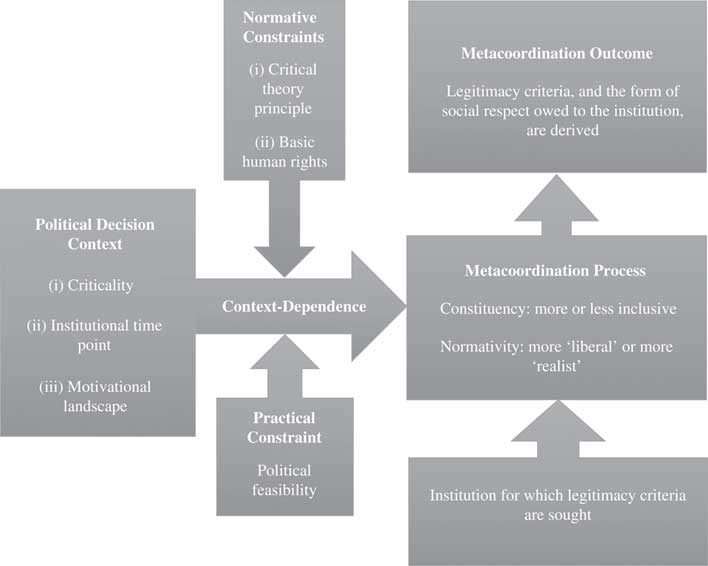
The very broad outlines of our theory – all to be illustrated as we proceed – are as follows. For any political institution for which legitimacy criteria are to be sought at any one time there will exist a related political decision context. Each of the three aforementioned aspects of the political decision context can affect the way we ought to specify one or both of the two dimensions of the metacoordination process. The same form of metacoordination process will therefore not be appropriate in all circumstances; it will instead depend on the context. The metacoordination process appropriate to any one political decision context then seeks convergence on a metacoordination outcome (i.e. criteria of legitimacy for the institution in question, along with the particular form of ‘social respect’ that will be offered where those criteria are met).
There are, however, both practical and normative constraints on the extent to which the decision context can and should affect metacoordination. The practical constraint is that the political context must condition metacoordination in a way that is politically feasible in practice (representing one aspect of the ‘enabling’ side of legitimacy as an ‘enabling constraint’). Context-dependence as an idea is supposed to fit within an account of legitimacy as a practical concept: it therefore cannot be the case that context-dependence conditions the metacoordination process in a way likely to be politically infeasible in practice.Footnote 41 There are two normative constraints – respect for basic human rightsFootnote 42 and a ‘critical theory principle’ – which are context-independent ‘normative floors’ for any legitimate institution (and represent one important aspect of the ‘constraining’ side of legitimacy as an ‘enabling constraint’).
Figure 1offers a visual representation of all of this.
Figure 1

The distinction between context-dependence and practice-dependence bears emphasizing. Context-dependence is the view that the form of the metacoordination process ought to be sensitive to the political context from within which it is to occur. Practice-dependence about legitimacy is the view that legitimacy criteria for a given institution ought to be dependent upon the nature and function of that institution. In our account, practice-dependence as an idea is something for metacoordination constituents themselves to consider – for any institution, legitimacy criteria may end up being recognizably ‘practice-dependent’, but it is presumptively also possible that metacoordination constituents alight reiteratively on similar legitimacy criteria for institutions that are themselves dissimilar, or indeed different legitimacy criteria for institutions that are very similar, even identical, in nature. Similarly, quite what kind of social respect is due to institutions is also, we suggest, a matter for metacoordination constituents themselves to determine, not something that ought to be read from the nature and function of the institution in a practice-dependent manner.
In this we appear to diverge from Buchanan himself who, alongside the Metacoordination View of legitimacy, also seems to want to propose a first-order practice-dependent view about legitimacy criteria when he says that such criteria ought to vary in accordance with the ‘natures and functions’ of differing institutions.Footnote 43 Buchanan makes similar practice-dependent claims also about the kind of social respect owed to different legitimate institutions.Footnote 44 In our view, making definitive and general first-order claims of this type is inconsistent with the logic of the Metacoordination View, which must leave these matters to metacoordination constituents themselves to determine in specific instances.
In what follows in this section, we introduce the three aspects of the political decision context, offer illustrative real-world examples of how metacoordination may be dependent on these aspects, and defend that idea against possible worries and criticisms. Two such worries are that the idea of context-dependence presents a form of moral hazard, and that it represents a status quo bias or collapses into a purely sociological account of legitimacy.
Criticality
The first element of the political decision context we want to highlight – criticality – refers to recognized, impending, severe circumstances. Our thought is that such circumstances can condition the shape of the metacoordination process appropriate for deriving legitimacy criteria for a given institution, specifically in a more normatively realist direction. However, where circumstances are (i) not severe, (ii) not near-term impending, or (iii) not recognized as severe and impending, they cannot condition normative standards for metacoordination in this way.Footnote 45 Our particular interest here is in an existing institution unilaterally extending its competences into a new area in order to respond to criticality.Footnote 46 We take it to be plausible that in such circumstances it may be unnecessary and indeed counterproductive to undergo a normatively – and in particular procedurally – more liberal metacoordination process in order to establish the legitimacy of such an extension.
It is likely to be counterproductive because of the time-sensitive nature of critical situations.Footnote 47 Bluntly, in the time it might take to undergo a normatively liberal deliberative procedure on the legitimacy criteria demanded of an institution carrying out some new function, the critical situation at hand may become only more critical, making it more difficult, perhaps impossible, to deal with effectively. That is assuming, in addition, that the appropriate institutional forum already exists that would allow such metacoordination to occur in a timely manner, which of course is not obviously the case, particularly for critical situations extending across state borders. But in any case, we consider that any such liberal metacoordination process may be unnecessary, because the criticality of the situation may encourage spontaneous social respect for the institution’s actions, either ex ante, when it is quickly widely accepted that the institution in question can deal with the critical situation, or ex post, where this realization occurs partly after the institution has indeed begun to deal with it. Either way, a liberal metacoordination procedure will not necessarily play any useful function, because metacoordination constituents can plausibly independently and spontaneously reach the conclusion that the institution deserves the respect it requires to function.
As an example, consider the World Health Organization’s (WHO) response to the 2003 SARS outbreak.Footnote 48 It has been claimed that the WHO’s actions in relation to this outbreak were ‘exceptional’ (in the Schmittian sense of a ‘state of exception’), extending beyond the institution’s previously established remit.Footnote 49 Specifically, the WHO
publicly shamed states that did not comply with the recommendations and guidelines prepared by the organization … This authoritative behaviour broke with WHO’s established practice of not publicly criticizing member-states … Second, WHO issued explicit travel warnings, beginning in April 2003, for the most affected territories in China, Hong Kong and Canada, even though it had never received a mandate to take such measures.Footnote 50
As Tine Hanrieder and Christian Kreuder-Sonnen clarify, since ‘SARS was successfully contained by May 2003 and the number of casualties remained below 1000, the crisis was seen as a success story for WHO’.Footnote 51
Our suggestion is that the mutually recognized critical nature of the SARS outbreak enjoined and enabled a normatively more ‘realist’ and, specifically, procedurally less substantive metacoordination process. Despite the unilateral nature of the extension of WHO competences, it seems to have ultimately been implicitly accepted by states – without the need for prior explicit deliberation – that, given the circumstances, WHO pronouncements and epidemiological criteria should be understood as authoritative.Footnote 52 This interpretation is given succour by the fact that states subsequently agreed to legally formalize the WHO’s emergency powers, in line with what had occurred, in the revised International Health Regulations of 2005.
One might, however, want to claim that it was only at this later stage, where explicit state consent to the extension of WHO emergency powers was gathered, that the legitimacy of the extension of those powers was in fact properly established. On this view, circumstances of criticality do not condition the metacoordination process from which legitimacy judgements are to be derived, but only defer that judgement until after the critical situation has passed. It might be thought that this way of looking at things is more sensible, because it allows for a scenario in which, for example, it retrospectively comes to light that an institution, while effectively responding to a critical situation, did so in a manner unreasonably discriminatory against a certain group. Indeed, it allows for a scenario in which that discriminatory activity was common knowledge at the time, and yet the majority of the population nevertheless offered the institution the social respect necessary for it to function, which we in hindsight would want to consider unjustifiable.
This is an important response, which enjoins a qualification of our view. We do not say that in critical circumstances the metacoordination process will necessarily, or even frequently, finally look normatively less liberal and more realist. Where claims of the type mentioned above are levied, then there is reason to engage, retrospectively, in a procedurally more liberal metacoordination process that may well have the effect of revising and overturning any earlier sense that the institution acted legitimately. This does not mean, however, that this type of retrospective process must occur. Suppose, by contrast, that there are no claims raised about discriminatory activity, and no evidence that any occurred. In these circumstances, it is unnecessary to instigate any retrospective liberal and procedurally substantive metacoordination process: the fact that the emergency agent performed a critical function which delivered spontaneous social respect is process enough to establish the legitimacy of the action. To return to our example, although the extension of WHO emergency powers was only formalized in the subsequently revised 2005 International Health Regulations, this was not a necessary element of establishing the legitimacy of the WHO’s earlier extension of competence: if no such ex post formalization had occurred, it is still possible to understand that extension as legitimate on the basis of a minimalist, implicit metacoordination process enjoined by the critical circumstances that pertained. The subsequent formalization of the extension merely plays the role, we suggest, of making that earlier minimalist metacoordination plain.Footnote 53
Another type of response to our view might be forthcoming from an opposing direction. A political realist might ask whether criticality is in fact doing much work here. After all, if an institution can operate successfully without widespread and explicit challenge, and with general acquiescence, then why is that not sufficient to understand the institution as receiving the relevant kind of social respect, and thus as legitimate, regardless of whether the institution is dealing with a critical situation? Our answer is the link between criticality and the plausibility of presuming widespread recognition or consensus, among constituents, of institutional purpose and desirability. In the WHO case, there was, we presume, a widely shared recognition of the critical nature of the SARS outbreak, a widely shared interest in its efficient control, and widely shared recognition that the actions of the WHO were intended to serve this shared aim. As a result, we consider it reasonable to interpret adherence to the pronouncements of that institution as spontaneous or implicit metacoordination about the desirability of having that institution perform that function. The fact that we emphasize presumed (near-)consensus indicates that, in this political context, we envisage a metacoordination process more normatively realist in some respects (in particular in its procedure) and more liberal in others (the place of consensus).
But now consider, by contrast, a scenario lacking criticality. Where an institution begins to perform some function not recognized as critical – imagine, for example, that the WHO issued travel warnings and ‘public shamings’ in response not to a SARS outbreak, but to low food hygiene standards – but which was nevertheless met with broad adherence, we do not suppose that that acquiescence can as reasonably be interpreted as akin to spontaneous or implicit metacoordination. Instead, that adherence may more plausibly house attitudes and beliefs ranging from suppressed hostility to disinterest to positive support. In these circumstances, a normatively liberal – and in particular, procedurally substantive – metacoordination process is enjoined to attempt to establish conclusively whether there in fact exists a desire for there to be an institution performing this kind of function. Since the situation is not critical, the time pressures that advise a more minimalist metacoordination process do not apply.
By this point readers may be getting frustrated. They will point out that in practice, whether or not we are in circumstances that are severe and impending is frequently politically contested; and even if there is an objective fact of the matter, that fact may nevertheless be rejected by many. In addition, there is a worry that appeal to such circumstances can serve as a pretext for the extension of political power sought for its own reasons, and that such extension may be given the veneer of legitimacy just in case the relevant populace is sufficiently alarmed to acquiesce with it. There can, in other words, be both ‘false negatives’ and ‘false positives’ with respect to criticality.
These worries further condition the import of criticality in two respects. The first, with respect to false negatives, is a matter of political feasibility: even if it is the case that a given circumstance is severe and impending objectively speaking, where this is nevertheless a matter of explicit political dispute, then it simply cannot be the case that a metacoordination process and outcome can occur implicitly and spontaneously, because it is a condition of the latter’s possibility that this reality is indeed widely recognized. Contrast the example of SARS with that of climate change. Although there is a scientific fact of the matter about climate change, it is also the case that the facts are politically disputed (not just in terms of whether we should concentrate on the reduction of carbon emissions or the production of adaptive technology, but whether we should do much about it at all, or even whether man-made climate change is happening). Given this, criticality cannot currently condition the metacoordination process for climate change institutions in the way we have suggested occurred with respect to the WHO: acquiescence with the extension of power in the latter case was premised upon widespread recognition of severe impending circumstances; but the severity of the circumstances remains (politically, if not scientifically) disputed in the case of climate change, meaning that there cannot (yet) possibly be an equivalent process of implicit, spontaneous metacoordination regarding climate change institutions. If a metacoordination outcome is to be realized, it will instead need to be via an explicit process which first addresses the very question of the consequences of climate change. This is a first indication of the way in which context-dependence is itself conditioned by political feasibility, per Figure 1.Footnote 54
The second worry above, however – the false positive worry – was that the prospect of ‘severe and impending circumstances’ might be cynically used as a pretext for the extension of political power, with apparently spontaneous recognition of those circumstances and acceptance of the extension of power in fact deliberately engendered by the same power that stands to benefit from that extension. In the language of securitization theory, there is a worry that political institutions, as powerful ‘securitizing actors’, may seek to socially construct certain issues as critical security threats precisely in order to extend their own powers.Footnote 55 Our response here is to appeal to what can be thought of as a variation on Williams’s ‘critical theory principle’: acquiescence to an extension of powers in the face of apparent severe and impending circumstances does not help legitimize the extension if that sense of criticality has been deliberately socially constructed by the institution whose powers are being extended, merely in order to enable that very extension. In such cases, we should remain unwilling to accept that an appropriate metacoordination process has occurred.
This of course leaves unaddressed the vexed question of how actually to determine when such a critical theory principle has been flouted.Footnote 56 Settling such a question is inevitably beyond the scope of this paper. In any case, we only need it to be possible that there can exist certain political circumstances in which the principle is not flouted, and in which criticality can therefore be relevant to metacoordination. The WHO example we give here is, we suggest, a good candidate for such a possibility. There are at least four reasons, we believe, for thinking so. First, while the spread of infectious disease is of course ‘frameable’ in different ways, there is at least some level of scientific objectivity underpinning such a phenomenon that might lead us to suppose that the threat is not merely a construction of political power. Second and relatedly, the WHO as an organization, while it will of course have its own institutional imperatives, is in essence primarily a technical institution. Although contests over political power (which may motivate the construction of threat in order to shore up such power) are inherent in institutions like the state, this is less obviously the case in organizations like the WHO. Third, the power relationship between the WHO and states is significantly different to that between a state and its citizens. The state pervades the day-to-day experience of its citizens and holds power over those citizens, in ways which render the self-serving engendering of belief possible. The same is not obviously true of the WHO with respect to states. Fourth, states, unlike individual citizens, in most cases possess considerable epistemic resources (scientific experts, for instance) which, in the case at hand here, provide some assurance that the circumstances were indeed genuinely critical.
Institutional time point
By ‘institutional time point’ we mean to refer to whether a given institution already exists or is merely proposed to come into existence. Our view is that this can matter to the demands of metacoordination and thus to legitimacy. Specifically, we suggest that, in at least some cases, the transition from pre- to post-institutional existence ought to bring a corresponding transition from a form of metacoordination process that prioritizes robust procedure to one that pays greater attention to consequences of the metacoordination process.Footnote 57 Metacoordination ‘normativity’ and ‘constituency’ flex according to these changing prioritizations. Before institutional existence there is in certain cases the potential for the metacoordination process to fail (i.e. to fail to converge upon a metacoordination outcome) without adverse consequences. In such cases, liberal procedural norms should play a prominent role in determining the metacoordination process. However, post institutional existence, the opportunity for metacoordination to fail without consequence will often disappear; from within a practical approach to legitimacy, it then becomes important to pay attention to those consequences.
When thinking about legitimacy, many philosophers, particularly those working in a ‘social contract’ tradition, are wont to begin by imagining a point zero – a hypothetical foundational moment that can inform us about the proper requirements of legitimacy with respect to institutions, usually states, that in fact already exist. Typical here is the notion that at this hypothetical point zero, the institution could and should be endorsed, following some appropriately normatively structured procedure, by all of those over whom it will thereafter hold authority. In the language of metacoordination dimensions, the relevant constituency is understood to be all state citizens; and there are typically robustly ‘liberal’ (if variable) normative demands placed upon the contracting parties with respect to the procedure that delivers the contract – for instance, an emphasis of consensus.
The closest real-world surrogates here are, we suggest, constitutional conventions: these formal procedures aim at extensive inclusion, and at wide-ranging deliberation with as much eventual consensus as possible. We understand such aspiration to be appropriate to the constitutional political context; if constituents are to be brought under a new political authority, they ought when possible to be given the opportunity to deliberate about what such an authority is to be for, and in which circumstances, if any, they consent to the creation of an institution performing that function.Footnote 58 Notably, a constitutional convention can fail: if it turns out not to be possible to generate sufficient consensus about (i) what an institution should be for and (ii) what legitimacy criteria it should be held to in the conducting of that function, then the institution may not be created at all.
Of course, if such a convention fails for an institution that already exists, there is no option not to create it. There obviously remains the option to dismantle the institution if, after the fact, a procedure of the ‘constitutional’ form cannot derive settled legitimacy criteria. However, neglecting to create an institution on the one hand, and dismantling it after it already exists on the other, are not equivalents. This is because dismantling an institution that already exists may have significantly worse consequences than not setting up the institution in the first place.
In circumstances in which there is reason to expect that dismantling the institution would bring severe consequences which it is important to avoid, and yet there is seemingly no prospect of a ‘constitutional’ variety of metacoordination yielding sufficient consensus about the function of an institution and the standards of legitimacy to which it should be held, a dilemma is faced: either one concludes that the institution must be illegitimate or else one tempers one’s understanding of what metacoordination can look like in such circumstances. We suggest that where legitimacy is understood as a practical concept, there is reason to favour the second approach. In the political circumstances at hand, maintaining that an institution must successfully undergo a constitutional-style metacoordination procedure or else be considered illegitimate runs the risk of undermining the institution’s ability to continue playing the coordinative function that at this point is presumably important to avoid bad consequences. If the philosopher’s role is to contribute to setting out morally defensible social practices of metacoordination, we argue that it can occasionally be defensible for a metacoordination procedure less concerned with consensus, with full inclusion, or with ‘moralist’ normativity than the constitutional picture to be enjoined, on account of the desire to avoid the negative consequences that now loom.
We can take as an example the Economic and Monetary Union of the European Union (EMU). It is plausible to suggest that EMU came about without any shared understanding among the founding member states of what its purpose was.Footnote 59 Rather, they had various differing motivations, often self-interested. Further to this, the relevant European treaty (Maastricht) was ratified in various states (Greece, Ireland and Italy, for example) by way of simple parliamentary majority – there was, in those instances, no requirement of supermajorities that would have gone some way to mimicking the pursuit of consensus. Moreover, we can say that the constituency of the process was less inclusive than one might hope: there were only a few referendums (one of which failed).
This is all to say that there did not occur, prior to the institution of EMU, metacoordination of the ideal ‘constitutional’ type, with high demandingness of inclusion and normativity. Had such a model of metacoordination occurred, it might have been the case that EMU was designed differently – for instance, providing for mechanisms mandating fiscal transfers necessary to deal with possible external shocks to the Eurozone area that would affect countries unequally.Footnote 60 But more to the point, it might have been concluded that since there was no consensus about the appropriate shape or bare desirability of these mechanisms, or indeed the point of EMU at all, there had not been achieved a form of metacoordination outcome appropriate to the political context at hand – the constitutional moment – and that therefore EMU should not go ahead. To be clear, this is not to say that there was nothing that could be called a metacoordination outcome that occurred in advance of EMU – the very fact that EMU could occur indicates that there existed some sufficiently powerful constituency willing to provide the idea of EMU with the social respect that enabled it to come into being. Our claim, rather, is that it was the wrong kind of metacoordination process (and hence metacoordination outcome) for the political context – with too limited a constituency and too lax a normative structure. Were the appropriate form of metacoordination process to have been employed at that time, it is possible that a metacoordination outcome would not have been achieved, and EMU would not have gone ahead.
In the event, of course, EMU did go ahead. The Great Recession of 2008 has put EMU under considerable strain, leading as it did to increased economic divergence between Eurozone countries. In lieu of any mechanism for direct fiscal transfers, increasing deficits have been addressed (most notably in Greece) via ‘financial assistance’ in the form of loans by the IMF and other members of the euro area. Receipt of this assistance was made conditional on increased ‘competitiveness’ to be achieved through structural reforms, including labour market reforms, cuts to the welfare state (e.g. pension entitlements) and public sector wages. The reforms imposed extremely high human costs on recipients and severely restricted their political autonomy.Footnote 61 European citizens, and in particular citizens of the so-called peripheral countries, have every reason to be angry about how things stand; they have a good claim to having been treated unjustly.
Nevertheless, and this is our central point here, it does not follow that the form of metacoordination process that should have occurred before EMU was institutionalized is the same kind of metacoordination process that should be undertaken now, and that (assuming that the related metacoordination outcome could not in fact now be successfully realized) we should therefore consider EMU illegitimate. What must be taken account of now, but not before, is that a failed metacoordination of the constitutional type, and resultant judgement of illegitimacy, may lead to the instability and even disintegration of EMU, bringing potentially disastrous consequences in train.
Denying the legitimacy of EMU impairs its ability to function effectively. Absent the social respect afforded to institutions understood as legitimate, subjects’ compliance with those institutions is contingent upon reasons such as congruence with personal interest, widespread coercion or normative judgements about the content of specific directives issued by the institution. Relying only on such reasons and mechanisms imposes a clear risk of instability: normative judgements about specific institutional directives may not be widely shared, widespread coercion is costly and not a long-term solution, and congruence between what the institution does and what is in particular subjects’ interests will vary over time and among subjects. This is a particularly poignant concern for a currency union: unless the currency area is economically homogeneous, divergence of economic interests and disagreement about the normative underpinnings of redistributive policies will feature. Without the social respect afforded by legitimacy judgements, EMU is exposed to a substantial risk of collapse.Footnote 62
The implications of any such collapse could potentially be tragic.Footnote 63 Assuming the reintroduction of individual currencies in any peripheral country would require an interim period of roughly one year, there could follow huge capital flight, aggressive forms of speculation in the sovereign bond market, the ballooning of the value of public debt still denominated in euros,Footnote 64 and the likely default on such debts. States’ banking systems would also be under threat: knowing that the value of one’s savings would devalue, savers could decide to withdraw their money from their bank accounts over the course of the interim period.Footnote 65
So, an inclusive, liberal metacoordination process will in all likelihood not succeed in legitimizing EMU today; and yet a widespread sense that this is the form the metacoordination process must take, with resultant judgement of illegitimacy, risks great damage. But these are not the only options. From the perspective of a practical understanding of legitimacy, there is reason to endorse a different way of thinking about metacoordination in the current political decision context. While a restricted metacoordination constituency can be understood as inappropriate prior to the institution of EMU, it is more plausibly appropriate now: we can think that the Maastricht Treaty should originally have been ratified everywhere via referendum, while thinking referendums on continuing membership of the Eurozone are now inappropriate on account of the risk they pose now to states’ economic well-being, a risk not posed originally. Similarly, while we can say that, prior to its institution, EMU ought to have been contingent upon a shared understanding of its purpose, and metacoordination ought to have proceeded via the exchange of reasons why, inter alia, differing institutionalizations of EMU do or don’t best secure that purpose, to suppose that such a shared understanding of purpose and way of proceeding are now a necessary requirement of a defensible metacoordination process is to ignore the fact that there are now consequences that follow from a judgement of illegitimacy that did not follow before.
Moreover, while it would presumably not be the case that, prior to the existence of EMU, a defensible metacoordination on legitimacy criteria would involve foreseeable unjust treatment, it might nevertheless, post-creation, be the case that the changed political context means that EMU is judged unjust in some of its effects and yet still legitimate. This conclusion is consistent with the practical understanding of legitimacy that understands it as a less demanding concept than justice. In sum, while a metacoordination process on the model of a constitutional convention would have been appropriate prior to the institution of EMU, a more realist vision of the metacoordination process, in which a metacoordination outcome is understood to have been realized just in case there is sufficient tacit consent or acquiescence with the institution for it to continue, can be thought acceptable, given the changed context.
There are caveats to be entered. The first is again to highlight the importance of political feasibility to context-dependence. Given the practical understanding of legitimacy, it cannot be the case that the institutional time point conditions metacoordination in a way that would in practice be politically infeasible. So, with respect to EMU, it would be no good suggesting that a post hoc metacoordination process ought to be modelled in the way we have suggested, based on some combination of tacit consent and acquiescence, if, as a matter of fact, reserves of tacit consent and acquiescence were not sufficient to uphold the institution.Footnote 66 If dissatisfaction with the institutions of the European Union continues to grow, there will come a point at which EMU will cease to benefit from even this minimalist understanding of social respect. At that stage, EMU would not be benefiting from any kind of metacoordination outcome and would be liable to collapse.
A second worry is that we here introduce a form of moral hazard: powerful political actors have incentive to avoid tricky constitutional procedures when first setting up new institutions, since they can seemingly then help themselves to weaker legitimacy criteria by making the prospect of the subsequent dismantling of the institution too costly.Footnote 67 Part of our answer here must be simply to recognize the hazard which is, to some extent, inherent in the practical approach to legitimacy as an ‘enabling constraint’ that we take in this paper. In our view, however, the hazard is not such that it outweighs the benefits of taking such an approach to thinking about legitimacy, just as the moral hazard involved in (some) insurance schemes does not, per se, outweigh the benefits of having such schemes. Among those benefits is that context-dependence has something to say in (frequent) scenarios in which what should have been done in the past was not done, changing the circumstances that now pertain. We consider this an advantage over inflexible approaches to institutional legitimacy.
A third closely related worry is status quo bias. Is it even possible to criticize existing institutions, given the form of argument we have laid out here? There are two things to say. The first is to refer to the two normative floors that are a feature of the context-dependence model: if the reason a given population is acquiescing with the demands of an institution is because that acquiescence has been deliberately inculcated in a population precisely so they will acquiesce – flouting the ‘critical theory principle’ – then there remains a basis for critique, and for declining to accept that a metacoordination outcome has in fact been achieved at all; the same is the case where an institution is systematically infringing basic human rights. A second response is to underscore the difference between legitimacy and justice. An institution is legitimate when it receives some level of social respect that enables it to function; this is not the same as it is being considered just. In most democracies citizens embark on forms of political protest against perceived injustice on a regular basis; most of them do not intend to question the basic legitimacy of the state against which they are agitating.
Of course, if an institution consistently and doggedly fails to reform in the direction of what is perceived to be just, the effect may be to undermine the social respect offered to that institution, and hence its legitimacy. Here we see another kind of way in which time matters: institutions that prove incapable of reforming themselves over time may eventually imperil even a more realist metacoordination outcome by encouraging more explicit resistance. The European institutions may turn out to be a case in point.
Motivational landscape
By ‘motivational landscape’ we mean to refer to the levels of interest that a population displays in a given institution, and in particular the motivation to be involved in political deliberation about the legitimacy of that institution. Our claim here is that (i) the metacoordination constituency must necessarily be coextensive with the motivational landscape that pertains in a given political context and (ii) this inevitably involves inserting a degree of inequality into the metacoordination process, which has implications for its normativity dimension.
People are, in general, often uninterested in politics. The extent of public interest – the ‘motivational landscape’ – changes, however, according to the institution at hand. If much of the public is politically unengaged in any one state context, this is only truer of transnational institutions like the EU. And when it comes to more obscure international institutions, the relevant public may not only be largely uninterested and correspondingly not very motivated at all to have a say about the criteria according to which that institution should be considered legitimate, but indeed may not even know that the institution exists. For an example of the last type, take the Bank for International Settlements (BIS), the function of which is ‘to serve central banks in their pursuit of monetary and financial stability, to foster international cooperation in those areas and to act as a bank for central banks’. The BIS does this partly via the ‘Basel Process’, which refers to the role of the BIS ‘in hosting and supporting the work of the international secretariats engaged in standard setting and the pursuit of financial stability’. There are nine such secretariats as well as three groups with ‘separate legal personality’ that BIS also hosts as part of the Basel Process.Footnote 68 It will not be controversial to suggest that the workings of the BIS do not exercise the minds of most people, if they have heard of it at all.Footnote 69 Because of this reality, it becomes a practical necessity – a matter of political feasibilityFootnote 70 – for the relevant metacoordination constituency to be far less inclusive than, for instance, all individuals worldwide. Instead, the metacoordination constituency will comprise, for example, some combination of state governments, industry experts, NGOs and engaged international activists. The motivational landscape has clear and direct implications for metacoordination constituency, therefore: the latter will by necessity be limited by the former.
The implications of the motivational landscape for metacoordination normativity are more nuanced. To show this, we can distinguish between the practical metacoordination constituency and the institutional constituency. The practical constituency is the actual metacoordination constituency which by necessity flexes in line with the motivational landscape. The institutional constituency is the fully inclusive population picked out by an ‘all affected interests’ principle’,Footnote 71 or an ‘all subjected’ principle,Footnote 72 or similar, with respect to the institution in question.Footnote 73 It is the practical constituency’s offering or withholding of social respect which matters to the viability of institutional functioning, since by definition the remainder of the institutional constituency is motivated to do neither. The practical constituency, then, inevitably enjoys a kind of normative priority: it is the members of the practical constituency who count in determining legitimacy criteria. This is not because other views are actively discounted but is rather by default, because the remainder of the institutional constituency does not offer any views at all.
This, inevitably, entails that the practical constituency will possess significant discretion to settle for itself inherently debatable matters that will arise during the metacoordination process – such as, for example, the relative importance of Buchanan’s ‘counting reasons’, whether and how legitimacy criteria ought to be practice-dependent, and the kind of social respect that ought to be offered to the institution – on which the wider institutional constituency might have taken a different view were it to have been motivated to engage. In that sense, the practical constituency is granted a kind of epistemic guardianship: it is given the role of determining what the legitimacy criteria are for a given institution on behalf of the wider institutional constituency.
In this regard, an interesting feature of the BIS case in particular is that the population motivated to deliberate about its legitimacy appears likely also to be the population that has significant epistemic competence with respect to the BIS’s affairs. Because the BIS does not have an obvious direct impact upon people’s lives, and its existence does not typically pervade public spheres, interest in its functioning and legitimacy cannot be stimulated merely by continued recognized exposure to it. Thus, those who come to be interested in the question of the BIS’s legitimacy are instead likely to be those who first come to learn about how it operates, either for professional reasons or due to atypical levels of political engagement generally. Given this confluence of motivation and epistemic competence, the prevalent motivational landscape with respect to the BIS allows the metacoordination constituency potentially to mimic the benefits that those who defend the democratic nature of ‘non-majoritarian institutions’ emphasize, such as, in particular, a high knowledge base and higher standard of deliberation.Footnote 74
The motivational landscape in this instance, then, inevitably offers the practical constituency a privileged status in the metacoordination process; it receives the ‘normative power’ to settle upon legitimacy criteria for an institution, a power that the wider institutional constituency does not receive (or rather, does not take up). In that respect, paying attention to the motivational landscape entails accepting a kind of inequality in the process of metacoordination, an inequality which to that extent moves us further towards the ‘realist’ end of the scale of normative demandingness.
However, this is definitively not to say that the practical constituency is thereby licensed to ignore the interests of the wider institutional constituency in its pursuit of convergence on standards of legitimacy. While the practical constituency must indeed possess the scope to settle certain contestable questions concerning legitimacy criteria, it cannot do so in ways that violate the basic human rights – typically understood to be politically incontestable rights – of the wider institutional constituency. In other words, the practical constituency cannot select legitimacy criteria that would impose excessive moral costs on the wider institutional constituency. Here again we see the constraining influence of one of the context-independent ‘normative floors’ that are a feature of the context-dependence model.
The second normative floor – respect for a kind of critical theory principle – further conditions the practical constituency’s room for manoeuvre. The lack of interest of a wider institutional constituency, it might be suggested, is not some natural fact, but might be deliberately encouraged and maintained, potentially by those who seek to benefit from the resultant lack of political participation. Issues of economic governance, in particular – the soundness of, say, ‘inflation targeting as a policy framework’, or ‘the best tools to be used to operate counter-cyclical monetary expansions when interest rates are near the zero lower bound’ – may be deliberately framed as technocratic questions (and expressed in technocratic language!) in order to ‘depoliticize’ them. If, however, state governments (for example) are deliberately and consistently maintaining their citizens’ ignorance about a given international institution in order to exclude them as practical metacoordination constituents, then that in itself would be a reason to reject the idea that the deliberations of any such practical constituency could lead to legitimate metacoordination outcomes. As it happens, we do not consider that the primary reason for widespread ignorance of the BIS is that such ignorance is deliberately maintained. More likely explanations seem to be the aforementioned lack of pervasiveness within persons’ lives and, where persons are aware of the institution’s existence but nevertheless remain unmotivated to learn and deliberate about it, a kind of ‘rational ignorance’.Footnote 75
This still leaves the possibility that a lack of interest is not deliberately engendered in the wider institutional constituency, the basic human rights of the latter are not infringed, and yet the practical constituency nevertheless skews the metacoordination outcome to its own particular benefit in some way. Here the response is twofold. First, it has to be admitted that this is indeed a possibility – even a probability – from within the practical approach to legitimacy that context-dependence exemplifies. To insist that any metacoordination process that is in any way skewed towards the benefit of the practical constituency cannot derive valid legitimacy criteria is to overlook the point that the concept of legitimacy is supposed in part to be an enabling one; requiring the process by which legitimacy criteria are derived to be shorn of all vestiges of self-interest is to take too stringent a line, which ignores this enabling function. Second, we can point out that the practical constituency is not a closed club: its current members cannot determine its future ones. And, bar cases in which the critical theory principle is violated, making choices that persistently favour the practical constituency at the expense of the wider institutional constituency is a good recipe, at least in the long run, for altering the motivational landscape and stimulating the attention of those who are systematically penalized, thereby bringing them into the practical constituency, and reopening the question of the institution’s legitimacy.
Conclusion
This paper endorses a practical way of thinking about legitimacy that we understand to be underlying Allen Buchanan’s ‘Metacoordination View’ of that concept. In our assessment, however, the metacoordination process itself is underspecified across two dimensions: constituency and normativity. Each of these dimensions admits of differing possibilities in the way that they are to be substantively understood. We have here argued that consideration of elements of the ‘political decision context’ from within which the metacoordination process is to occur should condition the way in which these dimensions are operationalized. We have highlighted three such elements of the decision context – criticality; institutional time point; and motivational landscape – and by reference to them have tried to show why the metacoordination process ought to be ‘context-dependent’. In order for the idea of context-dependence to fit within a practical approach to legitimacy, it must itself be conditioned by a concern for political feasibility. In order always to be a normative theory of legitimacy, context-dependence must also respect two normative floors.
We do not suppose that all relevant elements of any political decision context have been covered here. Nor have we addressed how the different elements that we have covered here may interact with each other and how this might affect the metacoordination process. For example, while we have suggested that a metacoordination process undertaken in advance of the creation of a given institution points towards the desirability of an inclusive metacoordination constituency, we have also suggested that the motivational landscape may necessarily point in the direction of a more restricted constituency. There is, then, a question about what the implications are for metacoordination when these two factors interact, for instance, in the case where a new international institution, likely to be somewhat obscure to most people, is yet to be created.
Because we have neither claimed to offer a comprehensive account of the individual elements of political decision contexts that may be relevant to the metacoordination process nor addressed the issue of those elements’ interaction, we resultantly make here no claim to have offered a model that can tell us how best overall to think about the metacoordination process in any one instance. The aim of the paper has been far more modest, being merely to introduce and make a preliminary exploration of the idea of context-dependence. Nevertheless, the promise of context-dependence is that it presents the possibility of transcending theoretical binaries in thinking about legitimacy, emphasizing instead the importance of plotting out an answer to what legitimacy demands by way of reference to the variable political circumstances in which we may find ourselves.
Acknowledgements
We would like to thank the three anonymous reviewers of this paper for their generous and helpful comments. For comments on earlier versions of the paper we would especially like to thank Nate Adams, Chris Armstrong, Allen Buchanan, Adam Etinson, Rob Jubb, Carmen Pavel, and Steve Welch, as well as audiences in Durham, Manchester, Oslo, Rome and Sheffield.