Introduction
Challenges that accompany the emergence of aging populations are becoming more prevalent worldwide, and Taiwan is no exception. As of 2011, the percentage of people aged 65 years and older in Taiwan was 7.9%, and this percentage of the population is projected to double by 2025. Thus, Taiwan will likely become one of the countries characterized by dramatic aging (National Statistics, 2013). While a continued increase in life expectancy is a major achievement, newer challenges such as keeping older adult active and maintaining their well-being have emerged. In recent decades, more interest has developed in linking social cohesion to trust in communities where the elderly reside. Social cohesion is defined as a state of affairs concerning both the vertical and the horizontal interactions among members of society, and is characterized by a set of attitudes and norms that includes trust, a sense of belonging, the willingness to participate and help, and related behavioral manifestations (Chan et al., Reference Chan, To and Chan2006).
Congruently, health research from a variety of disciplines such as sociology (Kawachi, Reference Kawachi1999), health geography, community psychology, geriatric medicine (Phongsavan et al., Reference Phongsavan, Chey, Bauman, Brooks and Silove2006), and social epidemiology (Ziersch et al., Reference Ziersch, Baum, MacDougall and Putland2005) have focused on how community cohesion and trust affect health indicators from different perspectives. Their results indicated that SCT are associated with psychological well-being as well as physical health. Social cohesion may be especially valuable among the elderly with regard to active aging, given that neighborhood cohesion and well-being were reportedly more strongly correlated in older people than in younger people (Elliott et al., Reference Elliott, Gale, Parsons and Kuh2014).
Communities with higher levels of social cohesion show better health outcomes including lower mortality rates and higher self-rated health (Ichida et al., Reference Ichida, Kondo, Hirai, Hanibuchi, Yoshikawa and Murata2009; Inoue et al., Reference Inoue, Yorifuji, Takao, Doi and Kawachi2013). One study (Inoue et al., Reference Inoue, Yorifuji, Takao, Doi and Kawachi2013) reported that individual perceptions of community cohesion were associated with a reduced risk of all-cause mortality (HR, 0.78; 95% CI, (0.73, 0.84)). However, whether or not boosting individual perceptions of community social cohesion can improve population health is still unknown. Another study reported that high social cohesion was significantly associated with good self-rated health (Ichida et al., Reference Ichida, Kondo, Hirai, Hanibuchi, Yoshikawa and Murata2009). Social cohesion and a sense of belonging in one's neighborhood are vital elements of a support system for older adults contending with poor health, limited mobility, financial constraints, lack of transportation, and accompanying social isolation (Russell et al., Reference Russell, Hill and Basser1998; Young et al., Reference Young, Russell and Powers2004). Although these studies show that SCT is highly associated with psychological and physical health, only one study (Kandula et al., Reference Kandula, Wen, Jacobs and Lauderdale2009) has examined the association between social cohesion and health in Asian countries, where cohesive social networks embody more cultural value than individualism, which is more common in Western countries. The relationship between SCT and health behaviors, which may influence SCT, has not yet been examined.
Active aging requires physical health, mental health, functional independence, economical stability, social participation, and spiritual identification (Matsubayashi and Okumiya, Reference Matsubayashi and Okumiya2012). A close relationship has been found between SCT and social participation/spiritual identification in Taiwan. In Taiwan, people have been educated in the principles of Confucianism, a widespread value system composed of the five virtues of benevolence, justice, courtesy, wisdom, and trust. Confucianism aims to realize and emphasize these five virtues in human relationships, not only between individuals, but also within the family, society, and the nation. In addition, it teaches that human beings can maintain spiritual contentment and ideal happiness. Confucianism pursues human happiness with the philosophy of social connection and trust, and Confucian values underlie the dominant moral doctrine and guiding principles in many forms of social interaction (Huang et al., Reference Huang, Chao, Tu and Yang2003). The primary socialization characteristics of a Confucian society are filial piety, strong family relations, benevolent paternalism, and social harmony. However, industrialization and globalization have rapidly transformed the social structure of Taiwan into a multicultural one. Consequently, societal and community structures have changed dramatically and the practice of filial piety has been challenged (Ku et al., Reference Ku, Liu and Wen2012).
The aim of this study is to investigate the associations between SCT and health status among community-dwelling elderly in a rural town in southern Taiwan, with a particular focus on comprehensive geriatric functions such as quantitative subjective QOL, depression, ADL, living situation, and health behaviors.
Materials and methods
Participants
The study population consisted of 149 community-dwelling elderly aged 65 years and older (68 men, 81 women; mean age, 75.4 ± 6.1 years) residing in the town of Dashe, Tainan City, Taiwan, who had agreed to undergo the comprehensive geriatric assessment (CGA) and had completed applicable portions in 2012. The total population of community-dwelling elderly aged 65 years and older in Dashe was 548 (10.9% of the total population of 5,003 people in 2012). The village leader of Dashe announced that health checks would be offered to all those aged 65 years or older. The author visited nearly 200 households with elderly individuals to inform them of the survey and recommend that elderly individuals volunteer to participate. Ultimately, 149 elderly people (27.2% of the eligible population of 548 elderly) agreed to participate. Dashe is an aging town with a population of 5,003, with 10.9% of the population aged 65 years or older in 2012. The demographic structure of elderly population in Dashe is similar to the percentage of the nationwide Taiwan in the same year.
Social cohesion and trust (SCT)
We used the SCT scale by Sampson et al. (Reference Sampson, Raudenbush and Earls1997). The SCT scale proposes that the differential ability of neighborhoods to recognize residents’ common values and maintain public order is a determinant of neighborhood variation in violence. Consequently, it measures “collective efficacy,” which is defined as social cohesion among neighbors combined with their willingness to intervene on behalf of the common good. The SCT comprises five items that respondents rated on a 5-point Likert scale ranging from 5 (strongly agree) to 1 (strongly disagree). Items included: “people in this neighborhood can be trusted,” “this is a close-knit neighborhood,” “people around here are willing to help their neighbors,” “people in this neighborhood generally don't get along with each other,” and “people in this neighborhood do not share the same values” (the last two statements were reverse coded) (Sampson et al., Reference Sampson, Raudenbush and Earls1997). Scores were added, resulting in SCT scores ranging from 5 to 25, with high scores indicating high SCT. Cronbach's α for the present study instrument was 0.83.
Items on the comprehensive geriatric assessment (CGA)
The CGA consisted of assessment of ADL, depression, current medical situation, medical history, daily lifestyle, neurobehavioral function, quantitative subjective QOL, and social background including factors such as health behavior.
Activities of daily living (ADL)
In the ADL assessment, participants rated their status for seven items (walking, ascending and descending stairs, eating, dressing, using the toilet, bathing, grooming) with regard to required assistance level, which ranged from 3 to 0 (3: completely independent, 2: some help required, 1: much help required, 0: completely dependent). The scores were added, resulting in ADL scores ranging from 0 to 21, with low scores indicating disability (Matsubayashi et al., Reference Matsubayashi, Okumiya, Osaki, Fujisawa and Doi1999; Ho et al., Reference Ho2002)
Depression
Depression was screened using the Chinese version of the 15-item geriatric depression scale (GDS-15) (Sheikh and Yesavage, Reference Sheikh, Yesavage and Brink1986; Yesavage, Reference Yesavage1988; Mui, Reference Mui1996). Each item contributes 1 point, with final scores ranging from 0 to 15. The validated Chinese version of GDS-15 using the cut-off point of 5 showed that prevalence of depression in community-dwelling elderly was 26% (Mui, Reference Mui1996). As such, we used this cut-off to identify depression in our study population.
Neurobehavioral function
Objective neurobehavioral function was assessed using three tests, including the TUG test (Podsiadlo and Richardson, Reference Podsiadlo and Richardson1991), functional reach test (Weiner et al., Reference Weiner, Duncan, Chandler and Studenski1992), and handgrip test (Aoyama et al., Reference Aoyama, Suzuki, Onishi and Kuzuya2011). The TUG test was performed by recording the time required for the participant to rise from an arm chair, walk a 3 m distance across the room, turn around, walk back to the chair, and sit back down. The functional reach test was used to assess balance and body flexibility in elderly persons. Each participant stood with their fist extended alongside a wall. Leaning forward as far as possible, the participant was instructed to move their fist along the wall without taking a step or losing stability. The length of fist movement was measured. Grip strength was measured by a handheld dynamometer, and we analyzed the maximum strength in both hands.
Quality of life (QOL)
Quantitative subjective QOL was assessed using a 100 mm visual analogue scale (with the lowest QOL on the left end of the scale, and the highest on the right) (Morrison, Reference Morrison1983). Subjective sense of health was assessed by the question, “How would you rate your current health status?” Participants were classified into two groups according to the median subjective sense of health score (68). Subjective happiness was assessed with the question, “How would you rate your level of subjective happiness?” Participants were classified into two groups according to the median value of subjective happiness (73). Three other indicators of QOL were measured, including relationship with family, relationship with friends, and financial satisfaction. Visual analogue scales for evaluation of self-rated happiness were also reported to be useful as CGA tools for community-dwelling individuals (Matsubayashi et al., Reference Matsubayashi, Okumiya, Osaki, Fujisawa and Doi1997; Hirosaki et al., Reference Hirosaki2011; Sakamoto et al., Reference Sakamoto2011; Chen et al., Reference Chen2013).
Health behaviors, current medical status, and past medical history
Data were also collected on other baseline characteristics such as living conditions (living alone or not), current medical status, health behaviors (current exercise, smoking and alcohol consumption), and past medical histories. Hypertension was defined as 140 mmHg or higher in systolic blood pressure, 90 mmHg or higher in diastolic blood pressure or taking antihypertensive medication. Diabetes mellitus was defined according to the criteria of the World Health Organization: diabetes (fasting blood sugar (FBS) ≧126 mg/dL) or taking antidiabetic medication.
Ethical considerations
This study was approved by the ethics committee of the Faculty of Medicine, Kyoto University, Kyoto, Japan (E-1190). Written informed consent was obtained from each participant.
Data analysis
Statistical analyses were performed using SPSS 19.0. The Student's t-test was used for continuous variables, while logistic regression and the χ 2 test were used for categorical variables. The relationship between SCT, health-related factors, and subjective sense of health, and happiness were evaluated by univariate and multivariate logistic regression. Associations between SCT and subjective health or happiness were analyzed in Model 1 by multiple logistic regression, adjusting for ADL, age, and sex. Associations between GDS and subjective health or happiness were analyzed by multiple logistic regression in Model 2, adjusting for ADL, age, and sex. Associations between SCT and subjective sense of health or happiness were analyzed in Model 3 by multiple logistic regression, adjusting for GDS, ADL, age and sex.
Results
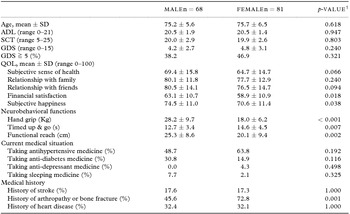
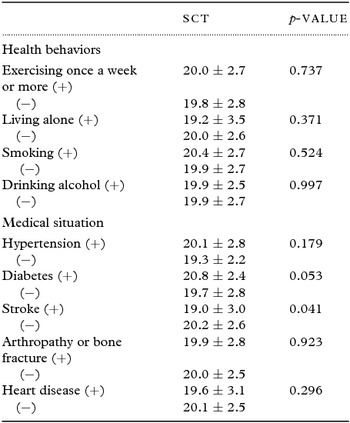
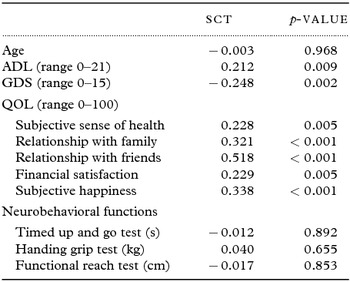
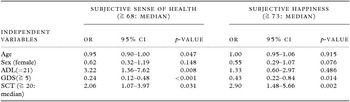
The present study population comprised 149 community-dwelling elderly aged 65 years and older (68 men, 81 women; mean age, 75.4 ± 6.1 years) among 548 elderly individuals who were notified of the health check (27.2% of the eligible population participated). Table 1 compares the baseline characteristics of the health status of elderly participants by gender. Mean ages for male and female participants were 75.2 ± 5.6 years and 75.7 ± 6.5 years, respectively. Mean SCT score was 19.9 ± 2.7 for the entire study population, with mean SCT scores in males and female of 20.0 ± 2.9 and 19.9 ± 2.6, respectively. No significant gender-dependent differences were identified for ADL, GDS-15, and SCT scores. Scores for the subjective sense of financial satisfaction and happiness were significantly higher in males than females. Males had significantly higher scores for neurobehavioral function than females according to the handgrip test (P < 0.001) and functional reach test (P = 0.002). Relative to females, males had significantly lower times for the TUG test (P = 0.007), and the percentage of those with a history of osteoarthropathy or bone fracture was significantly higher in females compared to males (P = 0.001). In contrast, we found no significant gender-dependent difference in the percentage of those with medical issues. Table 2 compares SCT scores by health behavior and medical situation. We observed no significant difference in SCT scores between those with and without health behaviors or other medical issues, except for a significant difference between those with and without past history of stroke. No significant correlation was observed between SCT scores and age (Table 3) or between SCT scores and neurobehavioral function. Scores for ADL and GDS as well as all subjective QOL items showed significant correlations with SCT scores, and a strong correlation was observed between SCT scores and relationship with friends. Table 4 shows odds ratios (OR) for age, sex, ADL, GDS, and SCT for subjective sense of health as well as subjective happiness, as determined by univariate logistic regression analysis. Significant associations were identified between subjective sense of health (median ≥ 68) and age (OR: 0.95; P = 0.047), ADL of 21 (OR: 3.22 vs. ADL < 21, P = 0.008), GDS ≥ 5 (OR: 0.24 vs. GDS < 5, P < 0.001), and SCT ≥ 20 (OR: 2.06 vs. SCT < 20, P = 0.031). Similarly, subjective happiness (median ≥ 73) was significantly associated with GDS ≥ 5 (OR: 0.43 vs. GDS < 5, P = 0.014) and SCT ≥ 20 (OR: 2.90 vs. SCT < 20, P = 0.002).
Gender comparisons of baseline characteristics of comprehensive geriatric functions

† P-values were calculated using the Student's t-test for continuous variables and the χ2 -test for categorical variables; SD, standard deviation; ADL, activities of daily living; SCT, social cohesion and trust scale; GDS, geriatric depression scale; QOL, quality of life.
Association among SCT, health behaviors and medical situation

P-values were calculated using the Student's t-test for continuous variables; SCT, social cohesion and trust scale.
Correlation coefficients between SCT and geriatric functions

*P < 0.05; **P < 0.001(two-tailed); P-values were calculated using Pearson correlation coefficient; ADL, activities of daily living; GDS, geriatric depression scale; SCT, social cohesion and trust scale; QOL, quality of life.
Odds ratios of age, sex, ADL, GDS, and SCT for subjective sense of health and subjective happiness determined by univariate logistic regression analysis

OR, odds ratio; CI, confidence interval; ADL, activities of daily living; GDS, geriatric depression scale; SCT, social cohesion and trust scale.
Table 5 also shows associations between SCT and subjective sense of health and subjective happiness as analyzed by multivariate logistic regression, after adjusting for possible confounding factors. In Model 1, SCT (≥ 20) was significantly associated with subjective sense of health (median ≥ 68) as well as subjective happiness (median ≥ 73), after adjusting for age, sex, and ADL. In Model 2, depression (GDS ≥ 5) was significantly and negatively associated with subjective sense of health (median ≥ 68) as well as subjective happiness (median ≥ 73), after adjusting for ADL, age, and sex. In Model 3, SCT ≥ 20 was not significantly associated with subjective sense of health (median ≥ 68) with the confounding factor of GDS ≥ 5 (OR: 0.29 vs. GDS < 5, P = 0.001) but associated with subjective happiness (OR: 2.54 vs. SCT < 20, P = 0.009) independently of GDS, ADL, age and sex.
Associations between SCT and subjective sense of health and subjective happiness as analyzed by multivariate logistic regression, after adjusting for possible confounding factors

OR, odds ratio; CI, confidence interval; –, not used in the model; ADL, activities of daily living; GDS, geriatric depression scale; SCT, social cohesion and trust scale.
Discussion
The present study revealed that SCT is associated with self-rated happiness and health, even after adjusting for ADL, age, and sex in a community-dwelling elderly population in a rural town in southern Taiwan. The present study is the first to investigate the association between SCT and subjective QOL in community-dwelling elderly in eastern countries, and did so in the rural and depopulated town of Dashe in southern Taiwan, where the spirit of Confucianism prevails and the concept of SCT is highly respected.
In a previous study from 1995, the authors surveyed 8,782 residents of 343 neighborhoods in Chicago and found similar results to those of the present study with regard to SCT assessment (Sampson et al., Reference Sampson, Raudenbush and Earls1997). While these studies cannot be easily compared, both studies reported that community social cohesion was associated with community friendship in this Western community and affected self-rated health and happiness. In our study population, we found significant associations between SCT, self-rated happiness, and health, even after adjusting for ADL, age, and sex. The present study supports the idea that SCT influences self-rated health and happiness independently of ADL, age, and sex.
SCT reflects the relationship between individuals and their communities, and social cohesion among neighbors may lead to higher levels of well-being among older adults (Cramm et al., Reference Cramm, van Dijk and Nieboer2013). Cohesive communities may be healthier and happier either because residents are psychologically healthier and express trust toward their neighbors or because the community social environment promotes health via group-level processes such as the ability to undertake collective actions (e.g. mobilizing local volunteers to participate in health promotion activities) (Inoue et al., Reference Inoue, Yorifuji, Takao, Doi and Kawachi2013). The present study also found an association between SCT and mental health. Specifically, GDS and SCT scores were significantly and negatively correlated. The present study findings are consistent with those of a previous study that indicated that having a strong sense of kinship and non-kin ties, as well as belonging and living in a socially cohesive neighborhood are inversely related to depression among older people (Young et al., Reference Young, Russell and Powers2004). Older adults who did not feel safe or trust in their community may be more likely to stay in their homes, leading to a higher risk of social isolation, depression, and reduced physical activity (Young et al., Reference Young, Russell and Powers2004). Particularly later on in life, elderly individuals experience changes in factors such as social function (e.g. retirement), social relations (e.g. death of a spouse and friends), and physical condition (e.g. chronic disease and disability) (Rowe and Kahn, Reference Rowe and Kahn1997). In such a transitional period, elderly persons with stronger social networks might be able to access a wider variety of resources, enhance mental condition, and prevent the onset of depression.
One study found an association between social cohesion and smoking prevalence among Asian Americans (Kandula et al., Reference Kandula, Wen, Jacobs and Lauderdale2009). However, no significant difference was found among SCT, health behaviors, and medical issues in our study. This discrepancy may be due to a difference in smoking rates, because none of the females in our study population smoked. We surmise that the cohesive social network in this rural town in southern Taiwan might have helped promote these health behaviors as a byproduct of some important and significant cultural pressures.
Our study also found a positive correlation between ADL and SCT, which is consistent with previous studies (Russell et al., Reference Russell, Hill and Basser1998; Young et al., Reference Young, Russell and Powers2004). Maintaining healthy relationships within a community may stimulate physical function and protect against decline in neurobehavioral function. For elderly individuals with low SCT, participation in group work activities (e.g. exercise therapy, music therapy, or other social networking activities) is recommended to prevent disability and depression and improve QOL (Okumiya et al., Reference Okumiya, Matsubayashi, Wada, Kimura, Doi and Ozawa1996). The reminiscent therapy composed by different generations and healthcare program by young and old people based on Confucianism which was carried out in Dashe might be supposed to be useful.
The present study has several limitations. First, the response rate was fairly low, and the non-response bias may have influenced our study findings. Second, the study setting was a single town in southern Taiwan, and thus our results may not be directly applicable to other, more urban communities. However, the relationship we identified between SCT and self-rated health was consistent with that reported in previous studies. As such, we would consider the present study results to be reliable and generalizable to some extent. Third, our study was the first to apply the Chinese version of the SCT assessment, but the Chinese SCT scale has not yet been validated. Thus, direct comparisons between our study and previous studies may be difficult. That said, our SCT scale showed a significant association with self-rated family relationships and friend relationships. Therefore, our results were likely valid, even if comparisons with other studies would yield imprecise results.
In conclusion, the present study showed that SCT is an important factor that influences self-rated health and happiness independently of ADL, age, and sex in a community in Taiwan, where SCT i.e. individual perception of trust, sense of belonging, willingness to participate, and help neighborhood are held in high regard. When assessing geriatric psychological function, SCT should be more heavily considered, given its association with self-rated health and happiness, depression, and physical function.
Conflict of interest
None.
Description of authors’ roles
WC performed statistical analyses and wrote the paper. KM, KO, TW, RS, and HI assisted with the statistical analyses and contributed to manuscript revisions. YI, YK, EF, and MF assisted with the statistical analyses and data collection. H-I Shih and C-M Chang helped with the literature review and data collection.
Acknowledgments
This study was supported by a Grant-in-Aid for JSPS Fellows. We express our appreciation to the elderly participants in Dashe for their cooperation.