A widespread belief has emerged, supported by a range of empirical studies, that political power sharing institutions have many virtues and benefits. Broadly speaking, power sharing arrangements limit the ability of stronger groups to use the power of the state for their own factional purposes. They appear to promote political equality in societies characterized by deep and enduring divisions. They lower the stakes of political contestation and thus arguably promote kinder and gentler policies.Footnote 1 And they promise to minimize the risk of civil conflict.Footnote 2
Yet, the properties of power sharing are not yet well understood. Nearly fifty years of scholarship have produced a rich literature but not yet a parsimonious and broadly accepted definition of political power sharing. This is at least in part because the relevant scholarship has evolved in two contexts and within two rather distinct scholarly communities. Existing scholarship thus typically analyzes power sharing practices in relation to one of two phenomena of broad political import: democracy and civil conflict. Arend Lijphart’s analysis of consociational democracy was thus originally informed by the experience of the Netherlands and other smaller European democracies, whose histories have been largely peaceful in spite of sometimes profound social divisions, but which are first and foremost democratic.Footnote 3 Steiner, and more recently Norris, accepted Lijphart’s conception of power sharing as a distinctive institutionalization of democracy.Footnote 4
In contrast, a large part of recent research has examined political power sharing in more precarious circumstances, often in efforts to end civil war or insurgency or as a remedy for societies threatened by such conflict.Footnote 5 The demands on power sharing institutions under these circumstances are clearly different from, and commonly greater than, those posed in established democracies; we might, therefore, also expect post-conflict power sharing to take different institutional forms. Moreover, the different challenges faced by power sharing agreements in say, Switzerland v. Burundi, also have consequences for the very conceptions of power sharing prevalent in these research communities and for the institutions considered critical (for example, federalism v. ethnic inclusiveness in the armed forces).
Power sharing research has also varied in its methods and samples. Early studies often focused on high-profile cases, such as the Netherlands in the early twentieth century, Switzerland, Cyprus in 1963, and Lebanon in 1975.Footnote 6 More recent scholarship often analyzes large cross-national samples of power sharing regimes.Footnote 7 Even so, these samples vary considerably: some include only post-conflict societies, others are bounded in time or space, and some by the types of institutions featured. These discrepancies make it difficult to generalize about the conditions under which power sharing is adopted, as well as about its effects. Results from studies that include only polities that have undergone civil conflict, for example, are particularly likely to be biased if they are generalized to (the many) polities that have not shared the same traumatic experiences.
As rich as the literature on power sharing is, there thus remain many unanswered questions, some of which we will address in this article. The first need is conceptual: a global analysis of power sharing needs to be guided by an explicit recognition of its various manifestations. Power sharing, we contend, comes in three separate forms, which we label inclusive, dispersive, and constraining, and which correspond to different ways in which ordinary citizens, and presumably constitution makers, may think about sharing political power.
Our intent in introducing this new conception of political power sharing is (1) to identify systematically different forms of accommodation in the real world and (2) to apply this conception to all states of significant size globally since the beginning of the third wave of democracy. Our contribution is thus also empirical: we intend to capture the incidence of various forms of political power sharing and their correlates across the contemporary world of states. We present a novel global dataset on power sharing institutions that includes more than 250,000 data points on 180 states over the period 1975–2010. This dataset is far richer than anything previously collected, both in the breadth of its institutional coverage, in the fine-grained way in which those institutions are disaggregated, and in its temporal and geographical range. We use these data to show that our three power sharing components indeed manifest themselves in systematic ways across a range of regimes.
The next section introduces a theoretical framework in which we can understand three different forms of political power sharing institutions and their purposes and effects. Next, we present the main patterns in our empirical sample and show that power sharing arrangements in the contemporary world indeed cluster in ways consistent with our theory. We then briefly examine the associations between the different dimensions of power sharing and two political conditions with which they are often associated: civil conflict and electoral democracy, respectively. We show that while some forms of power sharing exhibit a close relationship with democracy, others do not. And those forms of power sharing that are least correlated with electoral democracy are precisely those that are most common in societies that have experienced civil conflict.
Our results thus suggest that the two traditions in the study of power sharing to some extent have been talking past each other, as the forms of power sharing common in post-conflict societies are systematically different from those commonly found in successful, long-standing democracies. More troublingly, the same results also raise the concern that the forms of power sharing most likely to be adopted in the aftermath of civil conflict may not have the democratic virtues often associated with power sharing generically.
WHAT IS POWER SHARING?
The systematic study of political power sharing harks back to the seminal work of Arend Lijphart, who identified four defining features of what he termed consociational democracy: (1) a grand coalition, (2) a system of mutual veto power, (3) proportionality, and (4) segmental autonomy provisions, such as federalism.Footnote 8 Lijphart argued that these regime features tend to be positively correlated, and that they mutually help stabilize divided societies.
Although Lijphart emphasizes the ensemble of institutions that constitutes consociational democracy, it is clearly feasible to disaggregate his notion of a power sharing arrangement. Norris analyzes the incidence and effects of four different forms of power sharing separately, but her analysis and results are broadly consonant with Lijphart’s.Footnote 9 Lijphart’s enumerated features also do not necessarily exhaust the set of political institutions fostering inclusion or cooperation. Lijphart’s focus on core political regimes leaves out some social institutions that may particularly foster inclusiveness in post-conflict environments. Walter differentiates between political, territorial, and military power sharing arrangements.Footnote 10 In their study of negotiated settlements after civil wars, Hartzell and Hoddie adopt similar distinctions.Footnote 11 Once we recognize that power sharing can be disaggregated in such ways, however, it is entirely possible that its different components do not always work in concert or reinforce one another. Roeder and Rothchild draw a line between power sharing and power dividing arrangements and argue that the latter offer more favorable prospects for political stability.Footnote 12 Thus, the power sharing label captures a multitude of institutional provisions, and it is by no means obvious that they all tend to coexist or reinforce one another.Footnote 13
In this study, we focus on political power sharing, defined as a fundamental agreement (often embodied in a constitution, peace treaty, or the like) that enables a broad set of actors to exercise power through participation in political decision making. Power sharing agreements can be attached to a variety of institutions, such as cabinets and chief executive offices, legislatures, civil service organizations, courts, armed forces, electoral commissions, educational institutions, and various administrative agencies. They may be coupled with agreements concerning the sharing of economic wealth, military disarmament, or both.
Power sharing practices can be, and typically are, part and parcel of any democratic constitution. Thus, when the founding fathers of the United States of America designed the institutions of their new republic, they deliberately adopted a range of power sharing features. So, to varying degrees, did the framers of other democratic constitutions, including those of India and Germany (1949) as well as South Africa and Nigeria (1999), just to mention a few.
Power sharing arrangements vary in their entrenchment or rigidity. Lebanon from 1943 to 1975 featured a rigid power sharing agreement, by which particular offices were allocated to particular ethnic or religious groups, parties, or militias according to a very specific and static formula. Other such examples include Colombia (1958) and Northern Ireland (1974). Such rigid forms of power sharing typically recognize particular social groups and guarantee them ‘ownership’ of, or at least privileged access to, specific political offices. Less rigid power sharing may allow the rewards to different ethnic groups to vary over time, or even permit group identities to evolve. Nigeria’s ‘zoning’ practices were thus developed to ensure that key political offices would alternate between the country’s regions over time. South Africa’s ‘difference-blind’ power sharing went further in its flexibility and is also noteworthy for its transitional duration of five years (1994–99). Such stipulations address one of the key weaknesses of power sharing – its tendency to cement and perpetuate existing social cleavages.Footnote 14
Given the normative and practical interest in political power sharing, it is also important to point out what power sharing is not. Power sharing does not include all constraints on politicians, nor all governance provisions designed to promote peace. One of the great achievements of British politics between 1688 and the twentieth century was to convince all major political players to commit themselves to a competitive and majoritarian constitutional order that contained few formal mechanisms of inclusive governance. Like most of the literature, we differentiate such ‘winner-take-all’ institutions from power sharing.Footnote 15
The key to understanding power sharing, we believe, lies in the incentives it generates. Like any other institution, power sharing generates incentives for political behaviors, and the key challenge is to give its participants sufficient reason to act in accordance with the rules it specifies. Power sharing institutions extend the set of rulers, limit the influence of each, and make it costly for each to ignore the others.
One of the main purposes of power sharing is to prevent, end, or contain political violence. To succeed in this respect, power sharing institutions must convince each of the relevant players (each of the potential spoilers) to decide ex ante to abide by the results of civilian political contestation, especially elections and interparty bargaining, whatever those outcomes may be, and to abide by that commitment ex post. To succeed as a mechanism of conflict resolution, power sharing must thus be sufficiently rewarding for the critical political actors to commit themselves to these rules and sufficiently enforceable to make those decisions ‘stick.’ In other words, a successful power sharing regime must be both attractive and retentive.
Creating an attractive and retentive power sharing order is challenging for several reasons. One is that broadening access to power tends to come at the expense of existing power holders. The provision of political power in a given society at a given time is generically finite, though not necessarily zero-sum. That is to say that the empowerment of political players or institutions tends to come at the expense of others, though one player’s gain need not translate neatly into another player’s loss. Thus, when a political party is added to a coalition government, the influence of the existing members will tend to declineFootnote 16 . Similarly, when authority is devolved to subnational governments, the power of the central government will tend to shrink. And when courts are given the power to set aside executive or legislative decisions, the latter institutions will see their influence circumscribed. Thus, the players that most often stand to lose from power sharing are those that control, or have the strongest claim to, the national executive.
Power sharing is challenging also because it typically requires the voluntary and sustained cooperation of political players with fundamentally different goals. Powerful political actors (players) typically have an outside option of withdrawing from joint decision making. If they do, they may attempt to secede or resort to armed violence, or at a minimum contest the legitimacy of the regime, any of which could inflict a heavy cost on others.Footnote 17 A main premise of power sharing is, therefore, to guarantee each player capable of acting as a spoiler a sufficient payoff from cooperation and peaceful behavior.Footnote 18 The hope is that each player will enter into the agreement expecting a higher payoff from peaceful cooperation than from withdrawal or violence, and that the rewards from cooperative behavior will in fact sustain this expectation.Footnote 19
INCLUSIVE, DISPERSIVE, AND CONSTRAINING POWER SHARING
The existing literature identifies many distinct manifestations of power sharing. In this study, we suggest that power sharing comes in three forms, which we label as inclusion, dispersion, and constraint. To understand the differences between these three forms of power sharing, consider an ambiguity in the way we think about sharing in ordinary life. In some contexts, sharing something treasured means enjoying or consuming it jointly, as when family members share a home, or share a special moment or occasion. Jointness is inherent and critical to the way that we think about sharing in these circumstances: you do not share unless you are actually there and engage in the togetherness.
However, when family members share an inheritance, the meaning of sharing is quite different. The expectation is rarely that the wealth in question is held or expended jointly by all. More commonly, sharing is understood as a dispersion of goods to be consumed separately by their respective recipients. Finally, when political activists demand that elites ‘share the wealth’ or that motorists ‘share the road,’ their typical concern is to prevent the monopolization of some good, to the exclusion and detriment of more marginal users or beneficiaries. Sharing can thus refer to joint and inclusive consumption, or it can mean dispersion and individual consumption, or it can simply mean restrictions on some group’s control or possibly abuse of the good in question.
The same ambiguity is present in the institutions associated with political power sharing. Power sharing constraints can thus broadly be divided into (1) inclusive agreements that mandate the participation of several parties or groups in particular offices or decision-making processes, (2) dispersive agreements that divide authority among many actors in a well-defined pattern (such as territorial decentralization), and (3) constraining arrangements that limit the power of any party or social group and thus protect ordinary citizens and vulnerable groups against encroachment and abuse.
The purposes of these various forms of power sharing tend to differ. In inclusive power sharing, the purpose is to give each participant (often an ethnic group) a share in the exercise of political power. Dispersive power sharing, in contrast, partitions the policy process by giving control of particular territories and processes to distinct groups and generally by decentralizing decisions. Finally, the main emphasis in constraining power sharing is to protect and empower groups or individuals subject to predation or abuses by other parties or simply by those who hold political power.Footnote 20
Different forms of power sharing serve different broader concerns. The purpose of inclusive power sharing is thus often to solve collective action problems among political leaders, whereas dispersive arrangements may serve to maximize the efficiency with which the preferences of small and localized communities find representation.Footnote 21 Finally, constraining arrangements serve principally to protect ordinary citizens against abuses of power by their supposed agents, i.e. political leaders and entrepreneurs, and thus to lower the stakes of political competition.
We expect to see these purposes reflected in power sharing arrangements in the world’s states. These states’ constitutions, basic laws, or peace treaties have typically been forged through deliberation, negotiation, or imposition influenced by particular normative or organizational principles akin to our conceptions of sharing. We expect that they often bear the shape of these constitutional ideas and that, as in Lijphart’s conception, the institutions embodying each form of power sharing frequently share a common design or purpose.
These expectations lead us to the main proposition of our study, which is that political power sharing institutions cluster into three broad dimensions, capturing the inclusion, dispersion, and constraint of power, respectively. We expect that in national constitutions and other foundational agreements, institutional features within each of these dimensions will tend to coexist, while there may be no strong correlation between the strength of one such dimension and those of the others.
A NEW DATASET
To test this proposition, this article introduces a dataset with nineteen indicators of power sharing and twenty-four related variables across 180 countries covering the period 1975–2010. We include all independent countries with populations over 250,000 and we code as far back in time (to 1975 whenever possible) as permitted by the availability of secondary source material.Footnote 22
By disaggregating power sharing into its component parts and coding a global universe of cases, we overcome three significant research design problems in many previous analyses of power sharing. First, existing efforts often fail to capture comprehensively the full range of institutions through which power is shared, or they aggregate across distinct institutional features. For example, reserved legislative seats, reserved executive positions, and mutual veto provisions might all be analyzed as ‘positive action strategies.’Footnote 23 This can result in lumping together fundamentally different institutional arrangements with distinct effects. Second, several prominent studies limit their samples to those countries that have actually employed power sharing practices and exclude countries that have not. Third, and related to the second problem, some studies limit their scope to societies that have emerged from civil conflict and, therefore, exclude all states that have never experienced conflict in the first place.
Our approach allows us to use factor analysis to test whether these component institutions actually cluster in the way we predict. By disaggregating power sharing into its constituent institutions, we can also examine the ways in which component institutions affect civil peace or economic growth independently or interactively. With a global sample of cases, we avoid selection problems and can assess the determinants and effects of power sharing across an unrestricted range of pre-conditions. Finally, we can test theories regarding the conditional effectiveness of power sharing by interacting power sharing with the relevant conditioning variables.
MEASURING POWER SHARING
In this section, we identify our measures of inclusive, dispersive, and constraining power sharing and focus on the nineteen power sharing indicators that are at the theoretical core of our project. However, the twenty-four additional variables coded in the project capture important features of the institutional environment that may condition the effect of power sharing or constitute subjects of study in their own right. For an exhaustive account of all variables in the Inclusion, Dispersion, and Constraint (IDC) dataset we direct readers to the official codebook, which is available online.Footnote 24
DE JURE V. DE FACTO INSTITUTIONS
Especially in conflict-torn societies where the need for power sharing may be most pressing, formal institutions do not always describe politics ‘on the ground’ accurately. Some societies, such as Switzerland, feature a long-standing de facto practice of power sharing but few formal institutions. By contrast, some states – Lebanon in the mid-late 1980s for example – have detailed formal rules that in practice are not respected because central authority has broken down. Contrasting Switzerland with Lebanon illustrates what we expect is a general pattern: de facto power sharing can exist in the absence of formal rules primarily in ‘easy’ cases where the risk of violent conflict is low, while the cases in which de jure power sharing fails to be enforced are often those characterized by instability and violence.Footnote 25
Yet formal institutions, even when they are not fully enforced, can be focal points of expectation and ambition. Even when a country, such as Lebanon, is in fact ruled by various militia groups the constitution and other written rules still matter because they establish, at the very least, a focal point in bargaining that informs each group’s decisions whether or not to put down its guns. One of the challenges of institutional analysis in such contexts is, therefore, how to capture both the formal and the informal rules, especially when these diverge.
In this project, most variables have been designed to capture de jure institutions, with a particular focus on constitutional and treaty-based provisions.Footnote 26 We have adopted this approach for two reasons. First, information about de jure institutions can be more consistently sourced and more objectively coded than de facto arrangements. Second, as argued above, we believe that formal rules continue to matter even when they are violated. Yet implementation matters, since assessments about how formal power sharing institutions actually work are critical to the strategic choices that the various political players will make. Therefore, we also include some de facto indicators, particularly those that tell us whether core power sharing institutions, such as may be included in the national constitution, are in fact implemented.Footnote 27
INCLUSIVE POWER SHARING
The inclusive power sharing variables in this study cover two of Lijphart’s components of consociationalism: grand coalitions and the mutual veto. They also include the reservation of seats or executive positions for specific minority groups to ensure their inclusion in central government decision making.
Our empirical measures capture two types of grand coalitions: those mandated by constitutions or peace treaties (Mandated grand coalition); and de facto grand coalitions in non-elected governments, i.e., governments of national unity, which are usually installed by peace treaties (Unity).Footnote 28
A mutual or minority veto provision (Mutual veto) is coded as present whenever there is a constitutional or treaty provision providing for a minority veto over legislation in a particular policy area, such as language or cultural policy. Reserved executive positions captures whether any executive positions are reserved for members of specific groups, such as the arrangement in Lebanon, where the president is required to be a Maronite, and the prime minister a Sunni.Footnote 29 The variable ‘Reserved seats’ describes the proportion of legislative seats (lower house) reserved for minority groups. We also code a binary variable, Inclusive military, which takes a value of 1 if it is mandated that all major (ethnic, religious, or linguistic) groups be represented in the military or its officer corps, or that the armed forces be representative of different regions.
For our de jure indicators of mandated grand coalitions, reserved legislative seats, and reserved executive positions we also make a de facto assessment of whether these institutions are implemented. We code implementation as binary variables (gcimp, resimp, resseatsimp), and then create an additional binary variable, Violation, which takes a value of 1 any time one or more of these formal institutions is not enforced.Footnote 30
DISPERSIVE POWER SHARING
Dispersive power sharing refers to institutions that distribute authority among a variety of decision makers in a territorial pattern, such as federalism or Lijphart’s notion of segmental autonomy. We capture dispersive power sharing along three dimensions: (1) the powers allocated to subnational governments; (2) the accountability of subnational governments to citizens; (3) the representation of subnational constituencies in the central government.Footnote 31
To assess the powers allocated to subnational governments, we measure whether state/provincial governments have the authority to levy their own taxes (Subnational tax authority), whether they have shared or sole control over education policy (Subnational educational authority, which serves as a proxy for non-fiscal domestic policy more broadly), and whether state/provincial or municipal governments control any police or paramilitary forces (Subnational police authority), which captures decentralization of the legitimate use of force. To measure the accountability of subnational governments to ordinary citizens, we record whether executives and/or legislatures are directly elected both at the state/provincial level and at the municipal level. To measure the representation of subnational constituencies in the central government, we code a dummy variable for whether states/provinces form the constituencies of more than half the members of the upper house of the national legislature.
Our coding of subnational elections (State elections) and state/provincial representation in the legislative upper house (Constituency alignment) are based directly on variables first coded by Beck et al. in the Database of Political Institutions (DPI).Footnote 32 We both extend the coverage of these variables forward in time, and fill in a large number of previously missing values. Our codings are included in the 2010 release of DPI.
CONSTRAINING POWER SHARING
Constraining power sharing includes a variety of institutions designed to protect the rights of individuals and social groups from encroachments and predation by, for example, politicians or armed forces. Such constraints can take many forms, but we believe that some institutions are especially critical. One is constitutional provisions barring the military from engagement in electoral politics, since in many societies the armed forces (or parts of them) are the players that could most easily renege on their commitments to a collaborative civilian order and resort to force. Moreover, for ordinary citizens and a functioning civil society we believe it is critical to include provisions that protect freedom of speech and religious freedom and that discourage or bar the formation of political parties on explicitly religious or ethnic grounds. Finally, for all such rights to be enforced, there must be strong and independent courts. Therefore, we include, among our measures of constraining power sharing, provisions that bar active military personnel from participation in electoral politics, measures of the constitutional protection of religious liberties, bans on explicitly ethnic or religious parties, and an effective rule of law that includes judicial checks on political executives.
We thus code whether the constitution (or peace treaty) in place assures freedom of religious practice and/or freedom from discrimination on the basis of religious affiliation. The variables Religion protected (discrimination) and Religion protected (practice) take a value of 1 if the constitution guarantees freedom from religious discrimination and freedom of religious practice (respectively). We also code whether members of the armed forces are banned from serving in the legislature (Military legislator ban), and whether there is a ban on ethnic, religious, and/or regional parties (Ethnic party ban).
The presence of an effective judicial check on the authority of elected officials is assessed according to whether the supreme court has the power to void actions of the legislature and executive that violate the constitution (Judicial review), according to the tenure of justices of the highest court (Judicial tenure),Footnote 33 and according to whether the powers of the judiciary are enumerated in the constitution (Judicial constitution).Footnote 34
PROPORTIONAL REPRESENTATION, PARLIAMENTARY SYSTEMS, AND ELECTORAL ACCOUNTABILITY
The institutions discussed above capture many, but not all, of the important mechanisms through which political power is shared. Additional key features include the electoral accountability of the executive, proportional electoral systems (as opposed to majoritarian or non-electoral systems), and parliamentary (as opposed to presidential) systems of governance.
We measure electoral accountability of the executive using the Alvarez et al. binary measure of regime type (Democracy), which takes a value of 1 if both the executive and the legislature are elected and an electoral transition of power has been observed, and 0 otherwise.Footnote 35 We use binary measures of proportional representation (Pr) and parliamentary regime type (Parliamentary), drawn from coding initially conducted by Beck, Levine, and Loayza in DPI and, in the case of Pr, supplemented by our own coders.Footnote 36 In the case of Parliamentary we draw directly on the DPI System variable without augmentation.Footnote 37
DATA STRUCTURE
Our variables have been coded so as to allow for several different data structures. Time series cross-sectional datasets on governance, such as Polity IV and DPI, regularly employ a country-year unit of analysis. This is also our choice in this analysis, as it allows for easy integration with other governance datasets and with economic and political indicators, such as the World Development Indicators. The Inclusion, Dispersion, and Constraint variables are thus coded as of 1 January of a given country-year.Footnote 38
FACTOR ANALYSIS
Beginning with Lijphart, studies of power sharing have assumed that a set of observable variables, i.e., specific practices and institutions, are associated with one or more unobservable or latent variables (i.e., factors) that we can identify as power sharing.Footnote 39 The implication is that power sharing arrangements with similar purposes tend to go together. Constitutions or treaties drafted with the aim of sharing power typically include a variety of specific features that supplement one another. If the aim is to ensure the inclusion of minority groups in elite decision making, multiple institutional mechanisms will be available. States with the highest levels of inclusive power sharing will include several of these institutional arrangements together. For example, Fiji has since 1998 featured legislative seats reserved for ethnic minorities, similarly reserved executive positions, and a mandated grand coalition executive.
Our expectation is that our nineteen indicators cluster empirically around three latent variables that match the type of power sharing with which they are theoretically associated – thus, we expect all the indicators of constraining power sharing to load on the same factor (latent variable), and so forth.
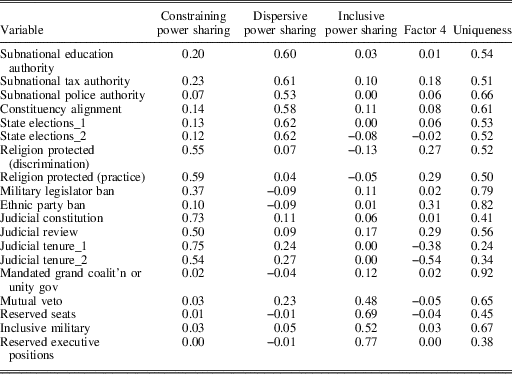
The factor analysis generates three significant and interpretable factors, each corresponding to one of our theoretical conceptions. Table 1 presents the factor loadings for the first four factors in our analysis. The first three factors extracted correspond neatly to our three forms of power sharing and are labeled accordingly. We include the fourth factor in the table for comparison, though it is much weaker and less interpretable. As predicted by our theory, the first three factors explain most of the association between the institutional measures in our analysis.
Factor Loadings

*Note: Factor loadings greater than 0.3 are in bold.
The grouping of the indicators around the theoretically appropriate latent variables is remarkably strong, stable and clean. Consistent with our expectation, every one of our indicators loads most heavily on the factor (i.e. latent variable) with which it is theoretically associated. Moreover, these results are robust to a range of alternative specifications.
The weakest associations between any indicators and the latent variable with which they are theoretically associated are between Grand coalition or Unity government and inclusive power sharing, and between Ethnic party bans and constraining power sharing. Note, however, that even these particular indicators do not load on one of the ‘wrong’ factors. Rather, these are the indicators with the highest uniqueness scores, which means that they often occur independently of any other form of power sharing. Thus, while reserved legislative seats, reserved executive positions, and military inclusiveness mandates are often used in conjunction with one another, grand coalition/unity governments more often stand alone as the sole inclusive power sharing arrangement.Footnote 40 Similarly, ethnic party bans are simply not highly correlated with any other form of power sharing.
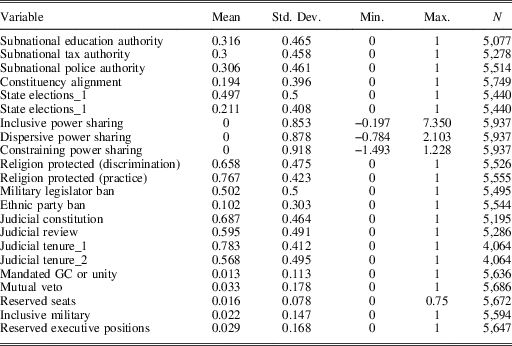
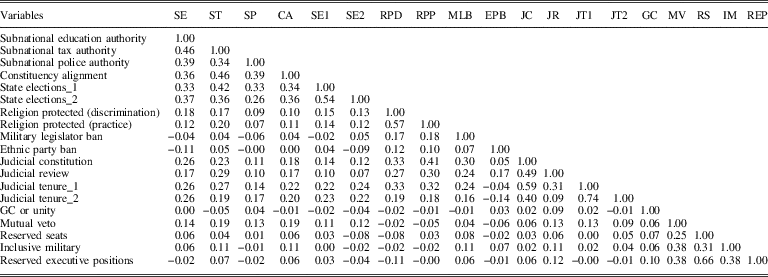
All in all, our empirical analysis provides strong empirical confirmation for our theoretical expectations. Political power sharing comes in three distinct forms, which are consistent with our theoretical distinction between inclusive, dispersive, and constraining mechanisms. Almost all of our nineteen empirical indicators do in fact load significantly on one of these three factors, and in a pattern that is consistent with our expectations. Other than these inclusive, dispersive, and constraining forms, no other significant dimension of power sharing emerges from our analysis. Specific forms of power sharing thus tend to cluster within our three power sharing dimensions, whereas, as Table A2 (in the appendix) shows, correlations across the various dimensions are rather weak. As a general rule, the indicators associated with inclusive power sharing, such as mandated grand coalitions and reserved executive positions, are less common than those associated with constraining or dispersive power sharing. Table A1 (in the appendix) provides descriptive statistics on all indicators.
To create an index of each of our three types of power sharing, we run a separate factor analysis for each latent variable, the weights from which create the index. Because of their low factor loadings, Ethnic party ban and Grand coalition/Unity government are assigned almost no weight in these indices. In the remainder of this article, we use these indices to explore the correlations between power sharing and the two phenomena with which it is commonly associated: civil conflict and democratization.
As noted in our introduction, the literature on political power sharing is bifurcated, with one branch focused on the role of power sharing in the aftermath or under the threat of civil conflict, and the other concerned with the place of power sharing arrangements in the design of democracy. In the remainder of this article, we shall, therefore, examine how the forms of power sharing that we have identified correlate with each of these contexts. Note, however, that a full causal examination of each of these relationships is challenging and clearly beyond the scope of the present analysis. We will show, however, that inclusive, dispersive, and constraining forms of power sharing correlate very differently with civil conflict, as well as with electoral democracy.
POWER SHARING AND CIVIL CONFLICT
A substantial part of the recent scholarship on power sharing arrangements has focused on the role that such agreements play in the aftermath of civil conflict. What makes such societies particularly precarious is that the recourse to armed violence is so readily available, that there are often players with a vested interest in the use of arms, and that for these reasons the security dilemma of many minority groups is particularly acute. The key question in this literature is whether power sharing arrangements can offer a way to end or curtail civil conflict and build peace in highly conflictive societies.Footnote 41
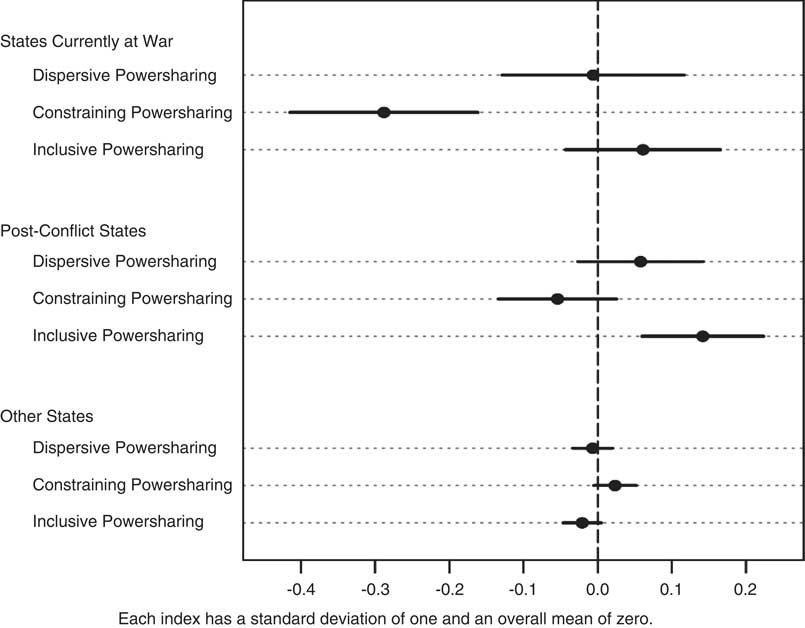
While a full analysis of the causal impact of power sharing on civil conflict is beyond the scope of this article, we can, with the help of the analysis above, take a first step toward clarifying the association between conflict and each of our three dimensions of power sharing. Figure 1 presents a plot of the average levels of inclusive, dispersive, and constraining power sharing in states currently at war, states that have experienced armed conflict within the past ten years, and states without any such experience of war. Conflict data drawn from Gleditsch et al. (2002).
Mean values of power sharing by war subgroups

We observe that inclusive power sharing is more prevalent in post-conflict states than in other contexts; this elevated incidence is also observable for dispersive power sharing, but to a lesser degree. This is consistent with the popularity of inclusive, and partly also dispersive, power sharing arrangements in efforts to establish stable post-conflict peace settlements.
Constraining institutions are actually somewhat less prevalent in post-conflict countries than elsewhere. Constraining institutions are most common in states with no experience of conflict, and least common in states at war. In related work, we present theory and evidence that this relationship is actually causal, i.e. that constraining institutions decrease the likelihood of the onset and recurrence of civil war.Footnote 42 We find also that inclusive power sharing has a pacifying effect only in post-conflict settings and that dispersive power sharing has no pacifying effect at all.
POWER SHARING AND DEMOCRACY
The classical literature on power sharing focused on such regime design as a distinctive form of democracy.Footnote 43 Lijphart thus termed the form of power sharing he identified as ‘consociational democracy,’ and this linkage between power sharing and democracy has remained at the core of a substantial body of scholarship. Norris thus summarizes the claim of this literature: ‘the primary idea is that in multiethnic societies divided into different linguistic, religious, or national communities, power-sharing institutions and procedures turn political opponents into cooperative partners, by providing communal leaders with a guaranteed stake in the democratic process.’Footnote 44
Yet, the democratic credentials of power sharing institutions are contestable. Przeworski influentially conceives of democracy as the institutionalization of uncertainty, typically expressed through the electoral channel.Footnote 45 Thus, Przeworski identifies democracy with the ex ante openness of democratic contestation. The greater the ex ante uncertainty about the outcome of political contests, the more democratic the regime. Yet, power sharing institutions are designed to reduce ex ante uncertainty about political outcomes. In the same way, power sharing essentially reduces the volatility of political outcomes. Thus, power sharing effectively blunts the impact of democratic competition. In this context, therefore, power sharing means giving priority to mutual security over the democratic values of ex ante uncertainty and procedural competitiveness that characterize electoral democracy in particular.
Even proponents of democratic power sharing see potential dangers in this form of governance. Thus, Norris concedes that:
In the longer term power-sharing institutions may also produce certain undesirable consequences for good governance, including the potential dangers of policy-stalemate, immobility, and deadlock between the executive and legislature; the lack of an effective opposition holding the government to account and providing voters with a clear-cut electoral choice; a loss of transparency in government decision-making; and the fragmentation of party competition in the legislature.Footnote 46
Though Norris’s critique does not explicitly focus on any particular form of power sharing, we believe that our analysis indicates the most plausible target. Stalemate, immobilism, and lack of political accountability are dangers that seem more prominent under inclusive power sharing than under constraints or dispersion. Inclusive power sharing relies heavily on the ability of factional leaders to collaborate effectively, often behind closed doors, and often in situations in which they face limited competition within their respective constituencies. These conditions could easily give rise to the deadlock, immobilism, lack of transparency, and erosion of political accountability that Norris identifies.
As with the relationship between power sharing and conflict, parsing the channels through which power sharing institutions support and/or undermine democracy is an important and complex scholarly challenge that is beyond the scope of this article. However, the data we introduce is well designed for this type of analysis, which is undertaken in forthcoming work.Footnote 47 Here we simply present the empirical correlations between electoral democracy and each of our three dimensions of power sharing.
The definition and measure of electoral democracy most compatible with Przeworski’s conception of democracy as ex ante uncertainty over the results of political contestation is the one offered by Alvarez et al.Footnote 48 This measure of democracy is binary and democracies are those countries in which:
-
1. The chief executive and legislature are both elected;
-
2. There is more than one party;
-
3. A lawful electoral transition has demonstrated (sometimes retroactively) that it is possible for the ruling party to lose and surrender office via election.Footnote 49
What is most important about this measure of democracy is that it is focused narrowly on the electoral accountability of the central government. In contrast, all of the nineteen distinct institutional variables that feed into our indices of inclusive, dispersive, and constraining power sharing fall outside of this definition of democracy. We thus preclude the possibility that any correlation between democracy and power sharing may be due to overlapping definitions or measurements.
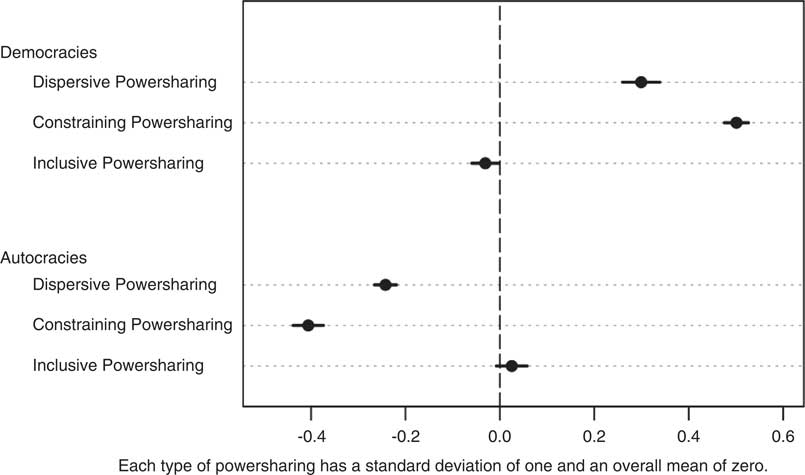
Figure 2 shows that constraining and dispersive power sharing are both substantially more prevalent among democracies than among non-democracies. Interestingly, inclusive power sharing, which has an inherent tension with the ex ante uncertainty central to Przeworski’s conception of democracy, is actually slightly less prevalent in democracies. This is consistent with the frequent introduction of inclusive power sharing institutions into post-conflict states, many of which are not democratic.
Mean values of power sharing by regime type

POWER SHARING TRENDS OVER TIME
Democracy has gained ground dramatically since the advent of the third wave of democracy in the 1970s. To the extent that power sharing is part of, or has contributed to, this democratization process, we expect temporal trends in power sharing to resemble those of democratization. As a final part of our examination of the association between power sharing and democracy, we plot the global trends in each of our three forms of power sharing against the development of electoral democracy over the same period.
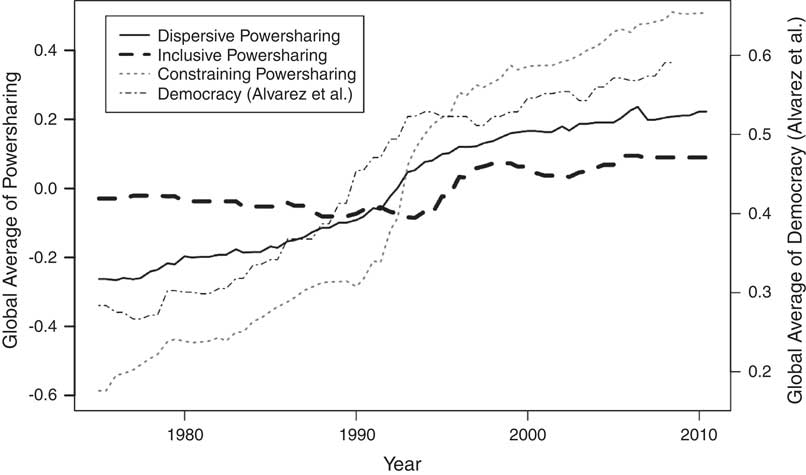
Figure 3 shows these trends in democratization and power sharing in the world’s states 1975–2010. Note that most of these lines show a clear upward trend. The incidence of constraining power sharing has increased steadily and dramatically throughout the period, while dispersive institutions began increasing in prevalence beginning in the mid-1980s. These upward trends largely match the steady march of electoral democratization during the same period.
Power sharing trends, 1975–2010

Inclusive institutions, by contrast, exhibit a much more static pattern; they actually declined slowly in prevalence into the early 1990s, when electoral democratization was particularly rapid, before registering a short burst of proliferation toward the end of that decade. Yet, the overall trend for inclusive power sharing is quite flat throughout. In sum, there are clear differences in how closely the various dimensions of power sharing track the adoption of democracy globally. Whereas the trend for constraining power sharing tracks the overall trend in electoral democratically quite closely, the trend in inclusive power sharing seems much less convergent, with the trends in dispersive power sharing falling somewhere in between.
CONCLUSION
Political power sharing is a multipurpose arrangement. Power sharing institutions are designed to facilitate political inclusion by giving all relevant groups access to the most important political decisions, by partitioning the policy process so as to give each group virtual autonomy in its own homelands and on issues of special concern, and by constraining the holders of political power from abusing their authority at the expense of any group or individual within their society. Power sharing is also, or can be, designed to reduce or contain conflict, and especially civil conflict, by lowering the stakes of domestic contestation. Our analysis shows that a multitude of political institutions serve these various purposes and that the global distribution of power sharing arrangements between 1975 and 2010 indeed reflect this multidimensionality and can be usefully divided into inclusive, dispersive, and constraining power sharing.
Much of the existing literature views political power sharing as a mechanism that is likely to be adopted in conflictive societies, and particularly after the cessation of armed civil hostilities. Our data show clearly that while this is true of inclusive power sharing, other forms of power sharing are equally or more prevalent in the much larger set of societies that have no recent history of conflict. Given these results, we can also begin to appreciate the limitations of previous studies that have confined themselves to states that have undergone civil conflict in the first place. Such states constitute a small subset of the real universe of power sharing arrangements, and generalizations from such a sample should, therefore, be made with great care.
Power sharing is also commonly viewed as a particular model of democratic governance. Our results at least partially corroborate this perception, as both constraining and dispersive power sharing are each strongly and positively correlated with electoral democracy. Democratic states tend to have much more extensive and credible institutions that constrain and disperse power away from the executive than do autocracies. Indeed, it is difficult to see how these types of power sharing can be credible under autocracy, and the more totalitarian the state, the less room there is for any sort of power sharing.
Even in this context, however, our analysis has uncovered significant differences between the various dimensions of power sharing. We have shown that inclusive power sharing is often introduced into conflictive polities and that it is virtually uncorrelated with electoral democracy. Inclusive power sharing is thus primarily a device to resolve uncertainty and conflict at the elite level and provides no guarantee of the empowerment of ordinary citizens. Dispersive or constraining power sharing, by contrast, clearly correlate with electoral democracy, reflecting the greater likelihood that these forms of power sharing will empower not only political elites, but also ordinary citizens. Recall that the institutional variables that load strongly on our factor of dispersive constraints are not only those measuring decentralization of government decision making, but also those capturing the accountability of those regional governments to ordinary citizens. The dispersion of power to subnational governments is more effective when subnational political authorities are not only given partial sovereignty but also made more accountable to ordinary citizens. Constraining power sharing, such as bills of rights and judicial institutions strong enough to enforce them, is even more obviously a device that not only helps political elites to coordinate, but also sets up barriers to the abuse of their authority over ordinary citizens. The more specific ways in which such institutions may promote democratization and democratic stability is, therefore, well worth further study.
APPENDIX
A1. COUNTRIES INCLUDED IN THE IDC DATASETFootnote 50
Afghanistan, Albania, Algeria, Angola, Argentina, Armenia, Australia, Austria, Azerbaijan, Bahamas, Bahrain, Bangladesh, Barbados, Belarus, Belgium, Belize, Benin, Bhutan, Bolivia, Bosnia-Herzegovina, Botswana, Brazil, Brunei, Bulgaria, Burkina Faso, Burundi, Cape Verde Islands, Cambodia, Cameroon, Canada, Central African Republic, Chad, Chile, Colombia, Comoro Islands, Congo, Costa Rica, Côte d’Ivoire, Croatia, Cuba, Cyprus, Czech Republic, Czechoslovakia, Democratic Republic Congo, Denmark, Djibouti, Dominican Republic, Ecuador, Egypt, El Salvador, Equatorial Guinea, Eritrea, Estonia, Ethiopia, FRG/Germany, Fiji, Finland, France, German Democratic Republic, Gabon, Gambia, Georgia, Ghana, Greece, Grenada, Guatemala, Guinea, Guinea-Bissau, Guyana, Haiti, Honduras, Hungary, Iceland, India, Indonesia, Iran, Iraq, Ireland, Israel, Italy, Jamaica, Japan, Jordan, Kazakhstan, Kenya, Kuwait, Kyrgyzstan, Laos, Latvia, Lebanon, Lesotho, Liberia, Libya, Lithuania, Luxembourg, Macedonia, Madagascar, Malawi, Malaysia, Maldives, Mali, Malta, Mauritania, Mauritius, Mexico, Moldova, Mongolia, Montenegro, Morocco, Mozambique, Myanmar, Namibia, Nepal, Netherlands, New Zealand, Nicaragua, Niger, Nigeria, North Korea, Norway, Oman, Papua New Guinea, People’s Republic of China, Pakistan, Panama, Paraguay, Peru, Philippines, Poland, Portugal, Qatar, Republic Of Korea, Romania, Russia, Rwanda, South Africa, Saudi Arabia, Senegal, Serbia, Serbia and Montenegro, Sierra Leone, Singapore, Slovakia, Slovenia, Solomon Is., Somalia, Soviet Union, Spain, Sri Lanka, St Lucia, Sudan, Suriname, Swaziland, Sweden, Switzerland, Syria, Taiwan, Tajikistan, Tanzania, Thailand, Timor-Leste, Togo, Trinidad-Tobago, Tunisia, Turkey, Turkmenistan, UAE, UK, USA, Uganda, Ukraine, Uruguay, Uzbekistan, Vanuatu, Venezuela, Vietnam, Western Samoa, Yemen, Yemen (Arab Republic), Yemen (People’s Democratic Republic), Yugoslavia, Zambia, and Zimbabwe.
A2. SOURCES AND DATA COLLECTION
Coders on this project employed a mix of primary and secondary source material. Primary sources included constitutions and peace treaties, as well as official government websites and the text of individual laws.Footnote 51 Secondary sources included the Political Handbook of the World (various years) and Europa World Yearbook (various years),Footnote 52 as well as the website of the International Parliamentary Union (Parline, http://www.ipu.org/parline/parlinesearch.asp), Library of Congress country studies (http://lcweb2.loc.gov/frd/cs/), the World Encyclopedia of Police Forces and Penal Systems (1989; 2006), and Freedom in the World (various years).
The greatest challenge facing coders involves assessing the precise dates on which different institutional forms were adopted or abandoned. Constitutional provisions are easy in this regard: there is a date when a constitution enters into force and a date when it is nullified, amended, or superseded. With some rules, however, it is difficult to identify the precise date at which a law was first enacted or the date at which it was superseded.
In all cases of uncertainty, coders were directed to employ a ‘preponderance of the evidence’ standard rather than a ‘beyond a reasonable doubt’ standard. Instances where the necessary information to make an informed coding is unavailable are coded as missing. Instances where information is available but the coder was uncertain were flagged for discussion in regular meetings of the coding team and a group decision was made on how to code the variable. Complicated institutional arrangements and codings perceived to be potentially controversial are discussed in the coder notes, which are available online, along with the full codebook, list of sources, and the dataset itself.Footnote 53