Introduction
Grain weight, which is determined by grain length (GL), grain width (GW) and grain thickness, is an important component of yield. Genes that affect grain size have been identified in rice (Thomson et al., Reference Thomson, Tai, McClung, Lai, Hinga and Lobos2003; Fan et al., Reference Fan, Xing, Mao, Lu, Han, Xu, Li and Zhang2006), and a few genes controlling seed size have been isolated in rice: GS3, GW2, qSW5 and GS5 (Fan et al., Reference Fan, Xing, Mao, Lu, Han, Xu, Li and Zhang2006; Song et al., Reference Song, Huang, Shi, Zhu and Lin2007; Shomura et al., Reference Shomura, Izawa, Ebana, Ebitani, Kanegae, Konishi and Yano2008; Li et al., Reference Li, Fan, Xing, Jiang, Luo, Sun, Shao, Xu, Li, Xiao, He and Zhang2011). GS3 has a significant effect on seed length, whereas GW2 has significant effects on both seed width or GW and grain weight in rice.
The number of spikelets per panicle (SPP) strongly influenced by primary and secondary branches is also important for determining yield potential in rice (Zhang et al., Reference Zhang, Luo, Xu, Zhang and Xing2006). Many studies have detected quantitative trait loci (QTLs) for SPP using various segregating populations (Thomson et al., Reference Thomson, Tai, McClung, Lai, Hinga and Lobos2003; Suh et al., Reference Suh, Ahn, Cho, Kang, Choi, Kim, Suh and Hwang2005; Liu et al., Reference Liu, Shao, Kovi and Xing2010). These QTLs are located across the chromosomes and provide valuable information on the genes that control SPP in different populations.
In a previous study, Hwaseong, a Korean japonica rice cultivar, was crossed as a recurrent with Oryza rufipogon and QTL analysis was conducted on BC2F2 (Cho et al., Reference Cho, Suh, Choi, Hong, Baek, Kang, Kim, Ahn, Choi, Hwang and Moon2003) and BC4F2 (Yun et al., Reference Yun, Kim, Park, Chung, Seong and Ahn2010) lines. The qTGW1 QTL was detected in both generations, whereas the qSPP1 QTL was detected only in the BC4F2 line. The present study was conducted to detect and characterize two QTLs, qSPP1 and qTGW1, using F2:3 populations from a cross between Hwaseong and near-isogenic lines (NILs).
Materials and methods
In previous studies, qSPP1 and qTGW1 have been detected on chromosome 1 (Cho et al., Reference Cho, Suh, Choi, Hong, Baek, Kang, Kim, Ahn, Choi, Hwang and Moon2003; Yun et al., Reference Yun, Kim, Park, Chung, Seong and Ahn2010). To detect these QTLs, CR572 was crossed with Hwaseong and then allowed to self to generate a F2 population (380 plants), which was used for QTL analysis. Substitution mapping was carried out to further fine-map the QTLs using F3 lines. Two populations (F2 and F3) and the parents were grown in the field during the summers of 2011–2013 at the Chungnam National University, Daejeon, Korea. F2 plants were planted 15 cm apart with 30 cm spacing between rows. F3 plants were planted in a completely randomized block design with three replications. SPP and 1000-grain weight (TGW) were evaluated in F2 lines. Evaluation of SPP, TGW and GW in F3 lines was carried out as described by Xie et al. (Reference Xie, Jin, Song, Suh, Hwang, Kim, McCouch and Ahn2008). Data were obtained from 15 plants per each line. DNA was extracted from the leaves of F2 plants using the CTAB method (Causse et al., Reference Causse, Fulton, Cho, Ahn, Chunwogse, Wu, Xiao, Yu, Ronald, Harrington, Second, McCouch and Tanksley1994). Simple sequence repeat (SSR) primers were synthesized according to an available rice genome sequence (http://www.gramene.org/markers/). Polymerase chain reaction and silver staining were conducted using the method of Xie et al. (Reference Xie, Jin, Song, Suh, Hwang, Kim, McCouch and Ahn2008). Phenotypic means of three genotypes, Hwaseong and O. rufipogon homozygotes and heterozygotes, were compared using Student's t test in the F2 population. QTLs were fine-mapped by comparing the phenotypic means of two genotypes of recombinants within the target region using the SAS statistical package. Paraffin-embedded spikelet tissue sections were prepared to investigate the origins of the observed size differences in spikelets between Hwaseong and CR7201 line following the methods described by Ji et al. (Reference Ji, Chu, Jiang, Chi, Hahn, Eun, McCouch and Koh2006).
Results and discussion
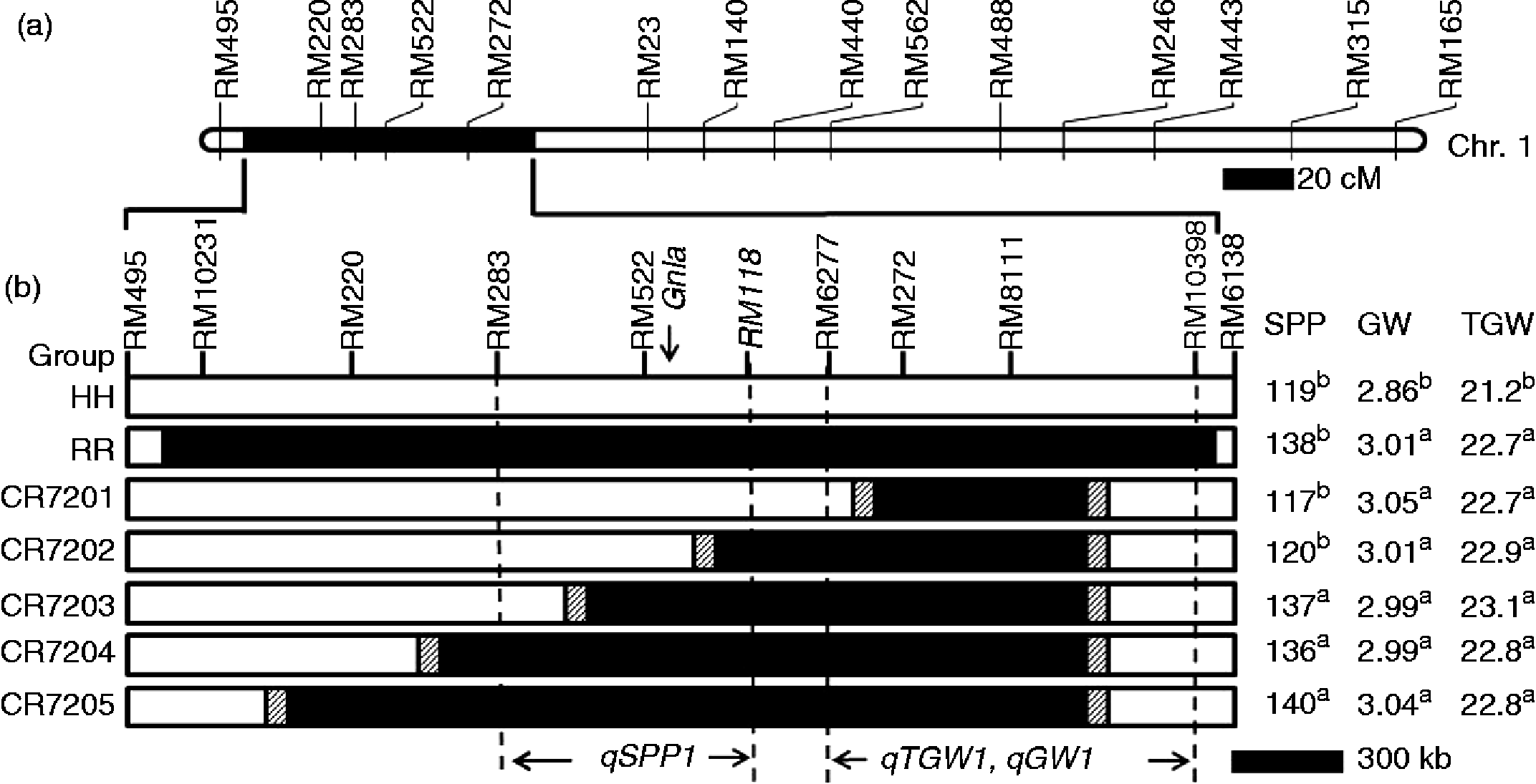
The SPP and TGW values were higher in CR572 than in Hwaseong, whereas no significant difference was observed for days to heading and spikelet fertility between the parents (data not shown). The possibility of the effect of non-target regions can be excluded because CR572 had no O. rufipogon introgression at the non-target regions (Fig. 1(a)). F2 plants were genotyped with ten SSR markers, and QTL analysis revealed that there was a significant peak near the marker RM522 for TGW and SPP (Fig. 1(b)). The logarithm of odds values for qSPP1 and qTGW1 were 19.2 and 8.0, respectively. The qSPP1 QTL explained 25.1% of the phenotypic variance. The additive effect of the O. rufipogon allele at qTGW1 was 0.52 TGW and 19.1% of the variance could be explained by the QTL.
(a) Single introgression from Oryza rufipogon flanked by RM495 and RM23 on chromosome 1 (Chr. 1) in a near-isogenic line (NIL), CR572. (b) Graphical genotypes of the F3 lines used for the substitution mapping of qSPP1 and qTGW1. The white portions of the graph indicate homozygous Hwaseong chromosomal segments, the black portions indicate homozygous O. rufipogon segments, the slashed areas are regions where crossing-over has occurred, and the broken vertical lines define the interval containing QTLs. On the right side of the graphical genotypes, the mean values of three traits for each F3 line are given. Values that are followed by different letters in each column are significantly different according to Tukey's honestly significant different test at 5%. HH and RR denote Hwaseong and CR572, respectively. The other five F3 lines (CR7201, CR7202, CR7203, CR7204 and CR7205) are NILs with a single introgression with a different size. The simple sequence repeat marker RM1118 (in italics) was additionally screened to further define the position of qSPP1. SPP, spikelets per panicle; GW, grain width; TGW, 1000-grain weight.

To further fine-map qTGW1 and qSPP1, five F2 plants with informative recombination breakpoints between RM495 and RM6138 were selfed to produce F3 lines for substitution mapping. Five F3 lines were evaluated for TGW, SPP, GL, GW and grain yield (YD). The mean phenotypic values of the five traits for each group were compared with those of the controls, Hwaseong and CR572. A comparison delimited the qTGW1 locus between RM6277 and RM10398 based on the finding that the TGW of the five F3 lines (CR7201, CR7202, CR7203, CR7204 and CR7205) did not differ significantly from that of CR572 but was higher than that of Hwaseong. Using the same procedure, qGW1 was found to be located within the same interval. A highly significant correlation was observed between GW and TGW (r= 0.87, P< 0.01), indicating that the variation in GW was associated with that in TGW at this locus. No major QTL associated with TGW was detected near qTGW1 in this study, suggesting that qTGW1 is a new QTL.
For qSPP1, CR7201 and CR7202 lines had significantly lower SPP than CR572. The SPP of CR7203, CR7204 and CR7205 lines, which share about 700 kb O. rufipogon segment between RM283 and RM1118, did not differ significantly from that of CR572 but was significantly higher than that of Hwaseong. These results imply that qSPP1 was located between RM283 and RM1118.
The qSPP1 QTL shares a similar location with the gene Gn1A (grain number 1a) for OsCKX2 (Oryza sativa L. cytokinin oxidase 2), which controls grain number (Ashikari et al., Reference Ashikari, Sakakibara, Lin, Yamamoto, Takashi, Nishimura, Angeles, Qian, Kitano and Matsuoka2005). The qSPP1 QTL has also been found to be co-localized with SPP1 controlling the number of SPP (Liu et al., Reference Liu, Shao, Kovi and Xing2010). Because of the low resolution, the relationship of qSPP1 with Gn1a and SPP1 is not clear.
To test the effect of qTGW1 and qSPP1 on yield, we compared the YD of CR572 and Hwaseong at two locations, Daejeon and Yesan, in 2011 and 2012 (data not shown). We found the YD of CR572 to be 18.2 (P< 0.05) and 15.8% (P< 0.05) higher than that of Hwaseong at the two locations, respectively, mainly due to the increase in TGW and SPP. The O. rufipogon segment is of particular interest because the O. rufipogon segment was not associated with any change in amylose and protein content. However, additional experiments are needed to determine the effect on other grain quality traits because increased SPP and TGW may have negative effects on japonica grain quality.
Before fertilization, the CR7201 spikelet hull was wider than the Hwaseong spikelet hull (Fig. 2), and we compared the cross sections of the central part of the spikelet hull in CR7201 and Hwaseong (Fig. 2(a)). The outer parenchyma cell layer in CR7201 was longer and contained more cells than that in Hwaseong (Fig. 2(b)). These results indicate that the increased width of the CR7201 spikelet hull results from an increase in cell number (Fig. 2(c)).
Histological analyses of spikelet hulls 3 d before heading in Hwaseong and CR7201 (plants in A group in Fig. 1(b)). (a) Top: Spikelets. Bottom: Cross section of spikelet hull. Dotted line indicates position of the cross section. (b) Magnified view of spikelet hull cross section boxed in (a). Scale bar: 50 μm. (c) Comparison of cell number and mean cell length in the outer cell layers of spikelet hulls of Hwaseong and CR7201 (n= 5 spikelets).

Several QTLs controlling TGW have been cloned using NILs (Song et al., Reference Song, Huang, Shi, Zhu and Lin2007; Shomura et al., Reference Shomura, Izawa, Ebana, Ebitani, Kanegae, Konishi and Yano2008). In the present study, qTGW1 was found to be responsible for 33.0% of the phenotypic variance. No QTL around the qTGW1 region has been cloned to date. It would be interesting to clone qTGW1 to examine the functional relationships of the genes that control TGW and to determine how they interact with other genes/alleles in various genetic backgrounds.
Acknowledgements
This study was supported by the Korean Government (MOEHRD, Basic Research Promotion Fund, KRF-2010-0024118) and the Next-Generation Biogreen 21 Program (Plant Molecular Breeding Center no. PJ008136), Rural Development Administration, Republic of Korea.