Introduction
Alongside human rights, elections are a defining feature of liberal democracy.Reference Schumpeter 1 Through voting, citizens can choose their representatives, voice their policy preferences and hold the government accountable.Reference Verba, Schlozman and Brady 2 High citizen participation is generally a sign of citizens’ involvement in politics and support for the democratic process. It guarantees that different views are heard and represented.Reference Buehlmann, Merkel, Mueller and Wessels 3 In contrast, low voter turnout decreases the legitimacy of the political process and likely leads to a skewed representation of preferences.Reference Wattenberg 4 However, voter turnout is no constant. Some individuals decide to vote in some elections but abstain in others.Reference Cutts, Fieldhouse and John 5 In Europe, this phenomenon is particularly visible if we compare turnout in national elections with electoral participation in European elections. In the former, around 70% of the population turns out to vote, whereas participation figures drop to 40% for the same countries for the latter type of elections.
What makes people vote in national (first-order) elections but not in European (second-order) elections? This is the question we aim to tackle in this article. Using panel data for Bavaria compiled by the Making Electoral Democracy Work project for the fall 2013 German general elections and the spring 2014 European Elections, we contextualize the second-order national election model. The model characterizes elections to the European Parliament (EP elections) as less important (i.e. turnout is much lower) and dominated by national factors when it comes to individuals’ vote choice. Does this dominance also mean that European-level factors – such as knowledge about EU politicians or interest in EU politics – do not play a role in individuals’ decision to turn out or stay at home on EP Election Day? We address this question through a multi-stage research process. We first distinguish three types of groups – (1) individuals who vote in both elections; (2) individuals who vote in national elections but not in European elections; and (3) citizens who do not vote in either of the two elections. 6 Second, we employ univariate and descriptive statistics as well as multinomial regression analysis to identify why somebody belongs to any of the three groups. Our results reveal the following patterns: for one, we confirm that self-reported turnout is, in fact, lower at EP elections and, taken together, EU citizens have lower levels of knowledge, interest and a sense of duty in European elections. However, we also highlight that some of the turnout gap between national and EP elections can be explained by varying degrees of knowledge, interest and a sense of duty between national and EP elections. In other words, our results indicate that citizens’ knowledge, interest and sense of duty for a national election is a necessary, but insufficient condition for individuals to vote in EP elections. Rather, to have a high likelihood to vote in the elections to the assemblies in Strasbourg and Brussels, EU citizens must possess the same attributes but towards Europe.
This article proceeds as follows. In the next section, we situate our study within the literature on the second-order national election model and the individual determinants of voting. In the third section, we explain the research design and variables we employ for this study. In the fourth part, we highlight the statistical procedures adopted for this research. We then display and interpret our findings. Finally, we summarize the main results of this study and offer some avenues for future research.
Literature Review, Research Question and Hypotheses
To date, probably the most famous theory on the differences in voting between national and European elections is the second-order national election model as developed by Reif and Schmitt in 1980.Reference Reif and Schmitt 7 The theory consists of two components. (1) Second-order elections, such as European elections, are perceived to be less important than the first-order national elections. For example, candidates to European elections are not as well-known as national candidates, the political parties involved in the elections devote fewer resources to second-order campaigns and media broadcasting is less intensive.Reference Van der Eijk and van Egmond 8 As a consequence, some individuals have less knowledge, interest, and engagement in these elections. (2) The second-order national election model postulates that, in essence, elections to the European Parliament are national elections with domestic factors dominating the electoral campaign.Reference Hobolt, Spoon and Tilley 9 In the words of Follesdal and Hix, when it comes to peoples’ vote choice ‘European Elections are not about the personalities and parties at the European level or the direction of the EU policy agenda’.Reference Follesdal and Hix 10 Giebler and Wagner add that there are no crucial differences in vote choice and evaluations of candidates.Reference Giebler and Wagner 11 For both elections, what counts are party identification, (national) level issues and candidates.
The second-order national election theory helps us in our analysis of the turnout gap between national and European Elections.Reference Adshead and Hill 12 The first part of the theory implies that Europe and European factors should matter in individuals’ decision to vote or stay at home on EP Election Day. Because these elections are less important in the eyes of voters, parties and the media, turnout is lower in EP elections. The second part of the theory suggests that citizens base their vote choice on domestic factors. However, it is not entirely clear, from this perspective, who are these individuals, who turn out nationally, but not in the European Elections. To be more precise, is it only national-level factors that influence somebody’s decision to cast a ballot in the elections to Brussels and Strasbourg or do European factors matter? But if they matter, how exactly? Does knowledge of the stakes, issues and EU politicians differ for some citizens, but not for others? If this is the case, then the decision to turn out nationally, but not on the European level, could be the result of a gap in knowledge, interest and a sense of duty between the two levels. In other words, national level voters might not turn out on European Election Day because they just do not have the same degree of engagement for the European level as they have for the national level.
In this article, we want to focus on attitudes about the national election/government and the European election/government to explain individuals’ propensity to turn out at either of the two elections.Reference Harder and Krosnick 13 While the literature has identified a wide array of attitudes and perceptions that affect voting,Reference Johann 14 we are particularly interested in three selective participation/abstention mechanisms. These three participation/abstention mechanisms are political knowledge and interest at either of the two levels, a sense of duty to vote for either national elections or European elections, as well as citizens’ perceptions of national- and European-level corruption. All these attitudinal factors may vary across levels of government or elections and this variation may account for somebody’s decision to vote in one type of election and abstain in another type.
First, we examine political knowledge. In general, there is consensus in the literature that the likelihood to vote increases with a person’s level of political knowledge.Reference Stewart, MacIver and Young 15 To cite Luskin, individuals’ understanding and making sense of politics depend on ‘the political information to which people are exposed, their ability to assimilate and organize such information, and their motivation to do so’.Reference Luskin 16 However, levels of knowledge can differ between levels of government. It is not necessarily the case that somebody who has good political knowledge about national politics also knows the politicians, stakes and issues at the European level. In particular, if EP elections are about Europe, then we assume that somebody who votes in EP elections must have some knowledge about EU politics. In other words, knowledge about national politics might not be sufficient to cast one’s ballot at the European level. This applies even more so, given that political sophistication might differ between the two levels.
Second and relatedly, voting is not only a question of being informed about political realities but also a question of being interested or psychologically engaged.Reference Echegaray 17 As such, citizens who actively follow politics should have a higher likelihood to vote. Yet individuals might follow national and European politics with varying intensities. We hypothesize that individuals’ interest in national politics might not be sufficient to vote in EP elections. Rather, citizens must also have some inherent interest in EU politics to vote on EP Election Day.
Third, elections, as the most conventional form of political participation, do not only have an instrumental or expressive value – they allow citizens to make their voices heard and select their party of choice – but also a symbolic value.Reference Bowler and Donovan 18 Citizens may turn out in elections thanks to a moral obligation, a sense of civic duty.Reference Galais and Blais 19 The strength of this sense of duty might differ from one election to another. In other words, in elections considered to be more important, some citizens might feel it more of their duty to vote than in elections which voters consider less important. Applied to EP elections, this would imply that some voters might feel a stronger sense of duty to vote in the elections to the national assembly than the EP elections. This difference, in turn, could well explain why some citizens turn out nationally but not for the supranational EU election.
Finally, participation in elections may hinge upon voters’ judgements of the performance of the government and the political class, in general. Yet, citizens’ assessment of corruption or perceived corruption might differ between various government levels.Reference Birch 20 For example, if corruption is perceived to be widespread at the European level, individuals may lose trust in the EU politicians and the institutions they represent, which, in turn, may render them more cynical and apathetic about EU politics.Reference Ecker, Glinitzer and Meyer 21 If the same citizens then see the national political system as less corrupt, more efficient and transparent, they might be pushed to turn out in large numbers for the national parliamentary election, but not for the EP elections.Reference Kostadinova 22
Looking at the salience of these four attitudinal factors, which we both apply to national and EU politics, we gauge how much Europe matters for individuals’ decision to vote in EP elections. We believe that European Elections are at least in part about Europe and European affairs.Reference Clark and Rohrschneider 23 That is why we hypothesize that interest and knowledge about national politics, a sense of duty to vote in national elections, as well as the perception that the national government is honest, are not sufficient to vote in EP elections. People must also have knowledge, interest, a sense of duty and a perception that EP elections and EU politics are transparent to also vote in EP elections. This applies even more so considering that demographics and personal factors remain constant from one election to another, and so do individuals’ knowledge, interest and civic duty about national politics. Hence, we deem it unlikely that these national level factors can explain why, in Germany, the UK or Denmark, to name a few countries, turnout is nearly twice as high in national as compared with European elections.
It is our goal to determine whether differences in attitudinal factors and perceptions of how well the government performs between the national and the European levels affect somebody’s likelihood to vote at one level of government (i.e. the national level), but not at another level (i.e. the European level).Reference Teixeira 24 Yet, perceptions and attitudes likely do not explain all the variance in national and EP turnout, as well as the gap between the two levels. That is why we also include five sociodemographic characteristics into our analysis: education, age, gender, place of residence and religiosity into the analysis. First, somebody’s likelihood to vote at both levels should increase with somebody’s education (i.e. higher educated individuals should have the intellectual capacity to understand national and European politics as well as the personal resources to be politically engaged).Reference Gallego 25 Second, regardless of the election type (i.e. national or EP elections), older cohorts of the population ought to be significantly more likely to vote than younger cohorts because they are more mature, settled in life and civic minded.Reference Wattenberg 26
Third, historically, politics has been a male domain. Yet, recent evidence suggests that the gender gap in turnout has disappeared in most countries.Reference Nevitte, Blais, Gidengil and Nadeau 27 Nevertheless, gender remains a standard variable in individual voting models.Reference Söderlund 28 That is why we also include this variable here as a possible predictor of national and EP turnout. Fourth, a place of residency in the countryside has been traditionally linked to an increased propensity to vote, among other things, because of closer links between voters and parties or candidates.Reference Corvalan and Cox 29
Fifth, religion should be positively related to the propensity to vote at both levels, albeit more so for national elections. For religious individuals, voting should not only be the main mechanism of political engagement, religious individuals ought to normally also have clear partisan attachments.Reference Gerber, Gruber and Hungerman 30 Taking these observations together, an individual should have the highest likelihood to vote if he or she is a middle-age to senior man with high education, who lives in the countryside and is religious. In contrast, young women with low education, who live in cities and are not religious should be the most likely to abstain. However, and this is important for our study, these factors remain constant in our analysis (the two elections in our dataset are roughly one year apart). Hence, it is unlikely that these factors explain differences in somebody’s decision to turn out in both national and EP elections. Rather, we deem it likely that differences in knowledge, interest, a sense of duty and perceived performance, which individuals might have for the two levels of government, ought to explain some citizens’ propensity to vote in one type of election but not in the other.
Research Design
To test our hypothesis that voting in European elections is not only about national politics but also about Europe, we use panel data from the Making Electoral Democracy Work Project on Bavaria. The panel covers the 2013 German federal election and the 2014 European election. While restricted in scope, this panel offers several advantages. First, it is the only panel we are aware of that asks individuals about their knowledge, interest and attachment for different types of elections. Second, the answers to the panel questions are comparable as they were asked at approximately the same time before each election. Third, while Bavarian citizens are probably the most EU-sceptic of all Germany, there is wide variation in this region. There are European and multicultural centres, such as Munich, and remote traditional and conservative mountain villages. In the multicultural centres, knowledge, interest and attachment toward EU politics should be higher than in the traditional and conservative countryside.Reference Spohn 31 This variation in EU-related attitudes should allow for some nice variation in the independent variables of interest; some variation that is likely to explain, at least in part, why some individuals vote at one level but not at the other.
In total, 2425 individuals filled out all parts of the survey. These individuals form the sample of our study. The dependent variable is self-reported turnout in the two elections. We code as abstainers all individuals who either indicated that they did not vote or that could not remember whether they voted. Based on this classification, the self-reported turnout rate was 88.2% for the federal election and 69.9% for the European election. As is the rule with self-reported turnout, these numbers are highly inflated.Reference Smets and van Ham 32 Nevertheless, and this is important for our research, there is as big a gap in self-reported turnout between the national and the European elections as there is in the official turnout, even if it is not as big as the real gap (i.e. national level turnout was 71.5% in 2013, and turnout for the 2014 European elections was 40.8%)
For our classification of voters we obtain the following breakdown. Out of the 2425 participants of the survey, 216 individuals abstained in both elections, 514 individuals voted nationally but not in the European parliamentary elections and 1624 individuals claimed to have voted in both elections. Only 38 individuals reported to have voted in the EP election but not in the national election. There are more than 12 times fewer individuals who indicated they voted nationally but not in the European elections than vice versa. In addition, many of these individuals indicated that they were unable to vote nationally (i.e. they were physically absent from their residence during the elections). We deem it likely that under normal circumstances these voters would vote in the national election. Hence, we have three main categories: (1) individuals who vote in both types of elections; (2) individuals who vote nationally but not at the European level; and (3) individuals who do not vote at all. From our theoretical discussion, we would expect the following patterns. (1) Individuals who vote in both types of elections have high interest, knowledge, a sense of duty and a positive performance perception for both types of contests. (2) Those who vote at the national level but not at the European level have high interest, knowledge, a high sense of duty and a positive performance perception for national elections but not for European elections. (3) Non-voters lack interest, knowledge, sense of duty and positive performance evaluation for both types of elections.
Since we hypothesize that the level of political interest, knowledge and a sense of duty might be different between the national and the European level and that these differences contribute to variations in voting, we include for each attitudinal variable a measure that gauges political knowledge, interest and a sense of duty for both the European and the national level. To measure political interest at the national level, we create a dummy variable coded 1 if the individual knows who the German financial minister was in 2013/2014 (i.e. Wolfgang Schäuble). Similarly, the proxy variable for knowledge of European politics is a dummy variable coded 1 if the respondent knows the name of the president of the European Commission at the time (i.e. José Manuel Barroso) and 0 otherwise.
Second, we measure political interest in national politics and elections by an additive index, gauging the level of political attention individuals paid to news about the national election on TV, newspapers, the radio and the internet. The index ranges from 0 (not interested at all) to 10 (strongly interested). To operationalize political interest in European politics and elections, we create the same additive index for attention to news about the European election. The third attitudinal concept, the civic duty to vote, is a dummy variable coded 1 if individuals indicated that they see it as their duty to vote in the national- or the European election, respectively. The final indicator is a measure of citizens’ perception of corruption in government, which we measure both at the national and European level with the help of a 1 to 4 scale (1 means that there is no corruption and 4 indicates that there is high corruption).
We operationalize the demographics, which make a baseline model, to which we add our attitudinal and performance indicators, as follows: first, education is a three-value ordinal variable (coded 1 to 3) that ranges from lower secondary education (Hauptschule in German), to higher secondary education (Gymnasium in German). The middle category is secondary education (Realschule in German). Second, age is the actual age of the respondent. Third, gender is a dummy variable coded 1 for men and 2 for women. Third, urbanization is a five-value ordinal variable coded 1 for somebody who lives in a large city to 5 for somebody who lives in the countryside. The final demographic/ personal variable is religiosity, which ranges from 1, not very religious, to 4, very religious.
Methods
We conduct three types of analyses. To gain an idea about the distribution of the variables, we first display some univariate statistics. Second, we present some descriptive statistics of the independent variables across the three categories of participants in elections. These descriptive statistics give us a first indication of how any of our explanatory variables might be related to participation in the two types of elections. Third, we present the results of three multinomial regression models. On the left-hand side of our regression models is the dependent variable, which distinguishes voters in both contests, national level voters and abstainers. On the right-hand side, we add the independent variables stepwise. The first model is the baseline model, it includes the demographic and personal factors, which form the core of any voting model; the second and third models add the attitudinal and performance indicators, respectively. In all models, the base category is abstainers, the first category national level voters and the second category national and European level voters. We transform the logit coefficients of significant variables into probabilities in order to interpret the substantive influence of our predictor variables. To do so we use ‘Clarify’, a program developed by Michael Tomz, Jason Wittenberg and Gary King.Reference Tomz, Wittenberg and King 33
We choose to use multinomial regression analysis because we cannot assume that the independent variables linearly influence the dependent variable. Rather, we assume that some of the predictors only influence some of the outcome categories. For example, those who are interested in national elections but not in European elections should be more prone to be national-level, but not European-level voters. In contrast, those with an inherent interest at both levels should vote in both types of elections.
Results
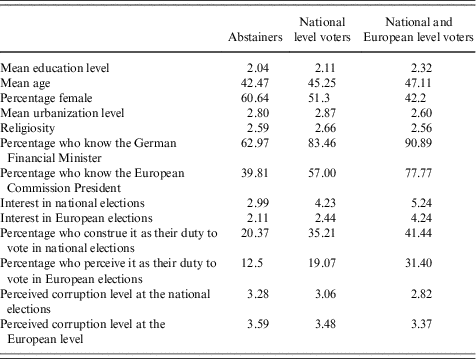
Table 1 presents univariate statistics. We can see, as expected, that respondents are more informed and interested about national than European politics and that their sense of duty is stronger for national than for European elections. These univariate statistics also highlight that, in the aggregate, transparency perceptions are higher at the national level as compared with the European level. This preliminary assessment offers some initial indication that political sophistication and positive performance evaluations are higher for the national regime as compared with the European regime. Table 2, which illustrates the bivariate relationship between the various independent variables and the three types of voters, 34 confirms this preliminary assessment from the univariate statistics. Political knowledge, interest and a sense of duty for different levels seem to matter for why individuals turn out at any of the two elections. Abstainers have the lowest knowledge, interest and sense of duty, both about European and national politics. National level voters have higher knowledge, interest and have a stronger sense of civic engagement about national level politics. Voters in national and European elections, in turn, display high knowledge, interest and sense of duty not only about national level contests, but also about EP elections. 35 In contrast, perceived corruption seems to matter much less for voting at both levels.
Univariate statistics.

Relationship between the type of voter and the various independent variables.

The results of the multinomial regression analysis mainly confirm the initial observations from the univariate and bivariate statistics (see Table 3). However, before turning to our indicators of interest, we first present a baseline model of voting. As such, model 1, which only includes demographics and personal factors, illustrates that gender, education and age significantly influence whether individuals are consistent voters, national voters or abstainers in both contests. Yet, after controlling for attitudinal and performance indicators, age remains the sole demographic variable that increases somebody’s likelihood to vote either nationally or both nationally and at the European level. In contrast, the association with gender and education disappears in models 2 and 3, indicating that men and higher educated individuals vote more frequently in either the national elections or both the national elections and the European elections because they know more about politics, have a greater interest in the elections and a higher sense of duty.

Second, and more importantly for our purposes, models 2 and 3 provide strong support for our hypothesis. The equations confirm that individuals voting in both elections must have high knowledge and interest in both national and European elections. To vote in the European elections in addition to the national elections, it is not enough to have high national level sophistication. Rather, this sophistication must also be present for European politics (i.e. the regression coefficients for interest, knowledge and a sense of duty for national, as well as European elections are in the expected direction and statistically significant) (see model 3). In contrast, for national level voters, it is only knowledge, interest, and sense of duty for national elections that increases somebody’s propensity to vote nationally. Conversely, a lack of knowledge, interest and duty at both levels is conducive to abstention in both elections. The fourth factor, perceived corruption level, does not seem to influence citizens’ propensity to vote. In fact, perceptions of high national corruption only seem to (slightly) reduce somebody’s chances to becoming a voter in both contests.
To get some indication of the substantive influence of the statistically significant variables, we conduct some probability transformations. For these probability transformations we use the complete model (i.e. model 3) and hold all variables constant at their median (see Table 4). These probability transformations confirm that attitudinal factors are strong predictors of voting in both elections, national level voting and abstaining. To take an example, an individual who knows the German financial minister but not the EU Commission president has a 7% chance to be an abstainer, a 27% chance to be a national level voter and a 66% chance to be a voter in both elections. If this same person also knows the Commission president her chance of being a voter in both elections increases to 75%. The substantive influence of political interest is even stronger. For example, an individual who is interested in national elections (her interest rating is 9) but has no interest in European elections (her interest rating is 1) has a 2% chance to be an abstainer, a 39% chance to be a national-level voter and a 58% chance to be a voter for both contests. If the same individual also develops high interest in European elections (her interest rating is 9), she has a 93% predicted probability to also vote in the EP elections.
Predicted probabilities of being an abstainer, national level voter, and consistent voter (based on model 3).

A similar gap is perceptible for the third attitudinal factor, a sense of duty to vote. Somebody who indicates a sense of duty to vote in national but not European elections has a 3% chance to be an abstainer, a 22% chance to be a national level voter and 75% chance to be a national/European voter. If the same person also perceives turning out on European Election Day a duty, her chances to be a voter in both contests increases to 85%. Our three attitudinal factors not only have some perceptible influence on our three categories of voters individually, but also have a reinforcing impact. For example, somebody who has low knowledge about politics (she does not know either the German financial minister or the EU Commission President), low political interest (she rates her political interest for both the national and the European election at 1), and does not feel it her duty to vote at either of the two elections, has a predicted 29% chance to be an abstainer, a 33% chance to be a national level voter and a 38% chance to be a voter in both contests. If this same person develops knowledge about national politics (she knows the German financial minister), becomes interested in the national elections (her interest level moves to 9), and sees voting nationally as a duty, her predicted chance of being a national level voter increases to 52%. In contrast, the same person’s predicted chances of being a voter in both elections only marginally increases by 7 percentage points to 45%. Finally, if this same person also has high knowledge, interest and sees voting in EP elections as a duty, her likelihood to be a full voter in both elections increases to 96%.
This study provides support for the second-order national election model. As a general rule, individuals vote less when they are less informed, know less about politics and feel less of a sense of duty to vote. Yet, these attitudes sometimes vary across levels. These differences matter and explain at least part of the turnout gap between national and European elections. Attachment and knowledge about national politics are not enough to become a voter in European elections. In addition to these national-level factors, it is knowledge, interest and a sense of duty about Europe and European elections that make individuals vote in EP elections. Hence, EP elections might well be national elections when it comes to the vote choice of some individuals. Yet, they are not national elections when it comes to citizens’ decision to vote or not to vote. To have a high likelihood to vote in EP elections individuals also need sophistication in European politics. Hence, knowledge, interest, and a sense of duty for national politics are necessary, but insufficient, conditions to also vote at the European level.
Conclusion
This article makes several contributions to the voting literature and the more specific literature on EP elections. Our results contextualize the notion of European elections as second-order elections. Three findings stick out. First, individuals who are neither interested nor informed nor feel a moral obligation to vote in both elections are likely to be abstainers. Second, citizens with high knowledge, interest and a high sense of duty to vote nationally but do not have the same attitudes toward Europe have a high likelihood to vote in national elections. Third, citizens, who are knowledgeable, interested and attached to national and European Politics have a high likelihood to vote in both elections. Hence, it is the gap in (positive) attitudes toward Europe that largely explains why some individuals vote nationally but not at the European level. This implies that their decision to turn out on European Election Day is shaped to a large degree by how they feel about European elections. In other words, knowledge, interest and a sense of duty in national elections are necessary, but not sufficient, conditions for individuals to vote in EP elections. In this sense, we do not dispute the assertion that somebody’s vote choice in the European election is driven mainly by national-level considerations. Our more modest claim is that the decision to participate or not in the European election hinges a lot on how engaged (or not) one is with European politics.
This study raises additional questions for future research. A small but growing literature suggests that individual attitudes about the EU might matter for citizens’ propensity to vote.Reference Blondel, Sinnott and Svensson 36 In essence, these studies find that individuals with a positive assessment toward the EU have a higher likelihood to vote in EP elections than citizens with a negative EU assessment. It is possible that these pro or anti-EU attitudes are related to individuals’ knowledge, interest and a sense of duty to vote in EP elections. If this is the case, then increasing knowledge and interest in EP elections could trigger more positive attitudes, which, in turn, could increase turnout. Unfortunately, the current data we have do not allow us to test these propositions. Election surveys such as the Making Electoral Democracy Work project or election studies normally do not ask about pro- and anti-EU attitudes. Vice versa, attitudinal studies do not ask about citizens’ knowledge, interest and attachment toward various degrees of elections.Reference Boomgaarden, Schuck, Elenbaas and De Vreese 37
More specific for election research, it is important to include more levels, such as local elections, to further elucidate why some individuals vote in some elections but not in others. Our study would conjecture that interest, knowledge and a sense of duty to vote in local elections should have a strong and important influence on local level voters. Equally important, it would be interesting to have longer panels covering many different elections to confirm the generality of our findings. Is there some consistency in the behaviour of citizens who cast their ballots in some elections, but not in others? Are knowledge, interest and a sense of duty for any specific contest a prerequisite to vote?
About the Author
Daniel Stockemer is Associate Professor in the School of Political Studies at the University of Ottawa. His research interests are elections, parties and political representation. In these and related subjects Daniel has published more than 90 articles, which have appeared in Political Behavior, the European Journal of Political Research and Governance, among others.
André Blais is Professor in the Department of Political Science at the University of Montreal where he is the University Research Chair in Electoral Studies, after holding two Tier I Canada Research Chairs in Electoral Studies. He has published 20 books, eight edited volumes, 194 journal articles, and 104 chapters in edited volumes, including the top journals in political science.