As a result of important advances in diagnostic, surgical and catheter interventional techniques, the life expectancy of children with congenital heart disease has increased dramatically, and currently it is expected that more than 85% of infants born with congenital heart disease reach adulthood.Reference Bhat and Sahn1
The birth of an infant is an emotional moment for parents. Before and after the moment such an infant is found to have congenital cardiac disease, parents experience a mixture of feelings. How they respond to this situation, and to the diagnosis, the hospitalisation, any subsequent surgical intervention, and caring for the infant at home, can affect both the short-term and long-term developmental outcomes of their children. Parents of infants newly diagnosed with congenital cardiac malformations have been reported to show heightened levels of stress compared with parents of healthy infants, or parents of children newly diagnosed with cystic fibrosis.Reference Goldberg, Morris, Simmons, Fowler and Levison2 Reactions of parents to an illness identified in infancy may be quite different from those occurring when children are older. Parental stress changes over time, and is affected by the nature and course of the illness.Reference Utens, Versluis-Den Bieman, Witsenburg, Bogers, Hess and Verhulst3, Reference Wray and Sensky4 Over time, the use of several styles of coping may differ from those shortly after the disease was discovered.Reference Utens, Versluis-Den Bieman, Witsenburg, Bogers, Hess and Verhulst3 Nowadays, the long-term survival of children with congenitally malformed hearts has improved, but parents still have to cope with the effects of the illness on the functioning, development, and quality of life of their child, irrespective of the severity of the disease.
Many of the studies previously conducted on parents of children with congenitally malformed hearts focus on parental adjustment to the diagnosis, and the short-term impact of the illness on the family, the early relationship between mother and infant, and problems in providing care.Reference Svavarsdottir and McCubbin5–Reference Lobo8 Thus, while there has been considerable attention to the short-term psychological effects of congenital cardiac malformations on parents, especially mothers, data on the long-term effect of the cardiac malformations on both parents is very limited.
The study reported here is part of a follow-up study concerning the long-term medical and psychological outcome in a cohort of children, adolescents, and young adults who underwent invasive treatment for congenital cardiac malformations between 1990 and 1995. Its aims were:
• To compare the levels of psychological distress and current styles of coping of both mothers and fathers of children and adolescents aged from 7 to 15 who underwent invasive treatment for congenital cardiac disease at young age, with that of reference groups.
• To identify the role of sex, age and cardiac diagnosis in psychological distress and styles of coping of parents of this sample.
• To compare the level of psychological distress and styles of coping of mothers versus fathers of the sample of patients.
Methods
General Health Questionnaire
We used the 28-item version of the General Health Questionnaire. This is a reliable and valid standardised self-report with which to assess the level of psychological distress.Reference Koeter and Ormel9 It contains four scales, which are concerned with: somatic symptoms, anxiety and sleeplessness, social dysfunctioning and serious depression. Cronbachs alpha for the total score is .94.Reference Koeter and Ormel9
Utrecht Coping List
We used the Utrecht Coping List, a reliable and standardised self-report to assess styles of coping.Reference Schreurs, Willege van de, Brosschot, Tellegen and Graus10 The respondent is asked to indicate how often he or she reacts to problems in a certain manner. Styles of coping are measured on 7 scales, namely: active solving of problems, which includes approaching problems in a purposeful and confident manner such as direct intervening when there are difficulties, looking at a problem from all angles; palliative reaction, which includes seeking diversion in an healthy or unhealthy manner such as trying to relax by smoking or drinking; avoiding and waiting, such as avoiding difficult situations or waiting to see what happens; seeking social support, by sharing feelings, or asking for assistance; passive patterns of reaction, such as being absorbed by problems and showing hopelessness such as withdrawing yourself completely from others, and not being able to do anything; expression of emotions, by showing aggression and annoyance, or working off the tensions; and reassuring thoughts, such as using positive cognitions to keep up courage, as in considering that after rain comes sunshine.
The satisfactory validity of the Utrecht Coping List has been described elsewhere.Reference Schreurs, Willege van de, Brosschot, Tellegen and Graus10 Construct validity and predictive validity has been examined by comparing the Utrecht Coping List with a range of other measures including those assessing coping, patterns of behaviour, reaction to stress, negative emotions, and personality characteristics.
Criterions of inclusion and exclusion
During the follow-up, which took place in 2003 and 2004, consecutive surviving patients of 4 diagnostic groups, who underwent their first invasive treatment for congenital heart disease at least 7 years and 6 months ago, between January 1, 1990, and January 1, 1996, in the Erasmus University Medical Centre Rotterdam, and who were younger than 15 years at the time of the treatment, were eligible. The sample in this study encompassed those having surgical closure of atrial septal defect, surgical closure of ventricular septal defect, arterial switch for transposition, and balloon dilation for pulmonary stenosis. Patients with proven syndromes of mental retardation, including Down’s syndrome, were excluded. Both the parents and patients had to be Dutch-speaking. For the present study, we recruited parents of children aged from 7 to 15 years.
Sample of patients and parents
The target population consisted of 159 eligible consecutive surviving patients aged from 7 to 15 years. From these 159 patients, 50 sets of parents refused to participate, citing practical grounds in 39 instances, or emotional grounds in the remaining 11. For the other 109 patients, 52 sets of both parents, 48 mothers alone and 9 fathers alone, respectively, completed the General Health Questionnaire, and 53 sets of both parents, and 50 mothers alone and 6 fathers alone, completed the Utrecht Coping List. The response rate was 69%.
Overall, there were no differences between the non-responders and those participating in the study as to the distribution of patients over diagnostic groups, number and type of cardiac interventions, age at time of interventions, and the age and gender distribution of patients.
Significant differences were found using Student’s t-test between the mean ages of mothers, at 40.5 years plus or minus 4.7 years, and fathers, at 44.5 years plus or minus 5.7 years, for those completing the General Health Questionnaire, and between the mean ages of mothers, at 40.5 years plus or minus 4.8 years, and fathers, at 44.6 year plus or minus 6.0 years, for those answering the Utrecht Coping List.
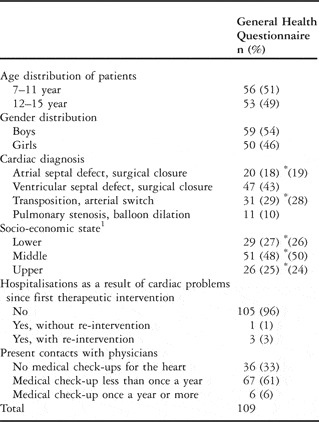
Socio-economic state was scored on a 9-point scale of parental occupation, with scores 1 to 3 corresponding with elementary and so called ‘lower’ occupations, 4 and 5 corresponding with so called ‘middle’ occupations, and 6 to 9 corresponding with so called ‘higher’ and scientific occupations (Table 1).11 For those answering the General Health Questionnaire, 20 had undergone surgical closure of atrial septal defect, with a mean age of 13.2 years plus or minus 1.6 years, 47 had undergone surgical closure of ventricular septal defect, with a mean age of 11.3 years plus or minus 2.0 years, 31 had undergone the arterial switch operation, having a mean age of 10.3 years plus or minus 1.6 years, and 11 had undergone balloon dilation for pulmonary stenosis, these having a mean age of 11.9 years plus or minus 2.4 years.
Characteristics of the sample with completed General Health Questionnaires.

*Numbers with an asterisk indicate the percentages of parents in the study sample, who completed the Utrecht Coping List. On all other variables the numbers/percentages of parents in the General Health Questionnaire and Utrecht Coping List study samples are the same.
1For 3 families socio-economic status data are lacking.
Reference groups
Normative data is derived from the manuals of the questionnaires used. The reference groups for the General Health Questionnaire consisted of random samples drawn from the general population.Reference Koeter and Ormel9
The male and female reference groups for the Utrecht Coping List consisted of employers of the Dutch railways and hospital nurses respectively, both combined with a random sample of the general population.Reference Schreurs, Willege van de, Brosschot, Tellegen and Graus10
Assessment
The research protocol was approved by the Dutch Central Committee on Medical Research involving Human Subjects before the start of the study. All parents and their children were traced, approached uniformly, and all signed an informed consent before participating in the study. The definite cardiac diagnosis was checked by a paediatric cardiologist (W.H.). During the psychological investigation of their child in the Erasmus University Medical Centre, parents completed the General Health Questionnaire and Utrecht Coping List, independently from each other, in the waiting room. Most children were accompanied by one parent. If possible, the accompanying parent was asked to deliver the questionnaires to their partner, who could complete them at home and return them with a prepaid envelope.
Statistical analyses
All analyses were performed with two-sided tests, taking a p value smaller than 0.05 as significant. One sample t-tests were used to test differences in group means between the parents of the patients and reference groups on the General Health Questionnaire and Utrecht Coping List. To identify the role of gender of the patients, age of the patients, considering those above and below 12 years, and cardiac diagnosis on the outcomes of the parents we carried out univariate analyses of (co)variance, on all scales of the General Health Questionnaire and Utrecht Coping List. The variable state of socio-economic standing showed a significant main effect in these analyses of variance on all scales of the General Health Questionnaire, indicating more psychological distress in the so-called “lower classes”. Because of this, it was applied as covariate in analysis on this questionnaire. No main effects for socio-economic state were found on the Utrecht Coping List. Differences in means on the General Health Questionnaire and Utrecht Coping List between mothers and fathers within families were assessed with paired t-test.
Results
Comparison of psychological distress of the parents versus the reference groups
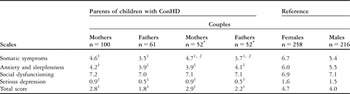
In Table 2, we show the mean scores, and significant differences, on the General Health Questionnaire for the parents of the patients and the reference group. Mothers, as well as fathers, of children with congenital cardiac disease reported significantly less complaints than did the corresponding same-sex reference groups on the total score of the General Health Questionnaire, and the scales concerning somatic symptoms, anxiety and sleeplessness, and serious depression.
Mean scores on the General Health Questionnaire of parents of patients and the reference group.

A high total score and high subscale scores is indicative of unfavourable functioning.
*For 52 parent couples, data were available from both parents.
1Significant (p < 0.05) difference between mothers or fathers of children with ConHD versus same-sex reference groups.
2Significant (p < 0.05) difference between mothers versus fathers within families.
Comparison of styles of coping of the parents versus the reference groups
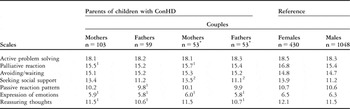
Mothers of children with congenital cardiac disease showed a weaker tendency to use palliative reaction, expression of negative emotions, and reassuring thoughts compared to the reference group (Table 3). Compared to reference peers of male gender, fathers of children with congenital cardiac disease showed a weaker tendency to use a passive reaction pattern, to express negative emotions, and to use reassuring thoughts.
Mean scale scores on the Utrecht Coping List of parents of patients sample and the reference group.

On each scale, a high score indicates a strong tendency to use this coping style. A total score can not be computed.
*For 53 parent couples data were available from both parents.
1Significant (p < 0.05) difference between mothers or fathers of children with ConHD versus same-sex reference groups.
2Significant (p < 0.05) difference between mothers versus fathers within families.
Effect of gender, age, and cardiac diagnosis within the sample of parents
Parents of girls with congenital cardiac disease reported significantly more complaints on the scale concerning serious depression of the General Health Questionnaire than parents of boys with congenital cardiac disease. As to age, and cardiac diagnosis, no significant differences were found on any of the scales of the General Health Questionnaire within the sample of parents. Neither was any significant main effect found for gender, age, or diagnosis within the sample of parents on any of the scales of the Utrecht Coping List.
Comparison within families with children with congenital cardiac disease: mothers versus fathers
On the General Health Questionnaire a significant difference within families with children with congenital cardiac disease was found on the subscale for somatic symptoms. Mothers reported significantly more somatic symptoms than fathers. On the Utrecht Coping List, mothers scored significantly higher than fathers when asked about the search for social support. No further differences were found on either list.
Discussion
Level of psychological distress
Overall, the results of our current study showed lower levels of psychological distress in both mothers and fathers of children with congenital cardiac disease compared to the reference groups. In a previous study, using the same assessment instruments, Utens et al.Reference Utens, Versluis-Den Bieman, Witsenburg, Bogers, Hess and Verhulst3 found that parents of children who underwent elective cardiac surgery or catheter intervention also reported significantly lower levels of psychological distress than normative reference groups. In that study, the time of assessment of psychological distress in parents after the treatment differed from ours. Parental reactions were assessed about 18 months after the cardiac procedure. In a more recent study, Wray and SenskyReference Wray and Sensky4 found that both mothers and fathers of children with cardiac lesions had significantly higher rates of psychological distress prior to the surgical procedures than mothers or fathers of healthy children. Twelve months following treatment, there was a significant reduction in the level of distress. Their sample was heterogeneous, with patients ranging in age from birth to 16 years, and covered a wide spectrum of cardiac diagnoses.
A possible explanation for our positive findings could be that the acute, life-threatening, nature of congenital cardiac disease has decreased for the children and adolescents in our sample, since they underwent their first invasive treatment for congenital heart disease at least 7 years and 6 months ago. The medical history of the patients in our study showed that most of them did not need re-hospitalisation as a result of cardiac problems since their first therapeutic intervention. Only 3 patients have had a re-intervention, these being surgical procedures for peripheral pulmonary stenosis, subaortic stenosis and recoarctation at 2.2, 4.2, and 0.5 years after the initial operation, respectively, all in patients with transposition. Furthermore, at time of follow-up, the frequency of medical check-ups for the heart was low, with one-third having no medical check-ups at all, and three-fifths having check-ups less than once a year. A long-term stable medical state may relieve stress for many families. The frightening and stressful period, in which parents were confronted with the diagnosis and the cardiac procedure, is left behind them. Because of their past experience, parents may have developed other reference norms and values than parents in the general population. The impact of this experience may have made parents stronger, and could possibly lead to an attitude of worrying less about futilities in life. Our patients were treated in one university hospital. Families were approached uniformly according to the protocol of our institute. It may be assumed that they received similar support. Whether the support received positively influenced the long-term outcomes in this study, in comparison to the reference group, is unknown. No data are available regarding social support, neither for the reference group nor for the patients.
To explain lower levels of psychological distress in parents after elective cardiac surgery or catheter intervention, Utens et al.Reference Utens, Versluis-Den Bieman, Witsenburg, Bogers, Hess and Verhulst3 referred to the possibility of the denial mechanism. In the study of Garson et al.,Reference Garson, Scott Benson, Ivler and Patton12 denial was especially seen in parents of asymptomatic children. Denial may also have influenced our present results.
Our response rate was satisfactory. The extent that availability of data from non-responders would have led to less positive findings is unknown. About one fifth of the group not responding refused to participate on emotional grounds. In most cases, the refusal was in a way connected with emotional problems of their children, such as anxiety to visit the hospital, but appeared not to be caused by psychological distress of parents themselves. Considering that the present parental outcomes were even better than normal, and considering the small number of refusals on emotional grounds, we assume that parental outcomes would still have been favourable, and comparable to those reported by reference groups, if the refusing parents of children with emotional problems would have participated.
Styles of coping
Overall, the styles of coping reported by our parents are comparable to those of their reference peers in the general population. The significant differences found can be considered in favour of the parents in our sample. Mothers and fathers of children with congenital cardiac disease expressed negative emotions less frequently, and used reassuring thought less often, compared to the reference group. Further, mothers of children with congenital cardiac disease showed less palliative reactions, and fathers less often showed a passive pattern of reaction.
In contrast with our study, Wray and SenskyReference Wray and Sensky4 reported that mothers and fathers of children with cyanotic and acyanotic cardiac lesions used the coping mechanisms of reassuring thoughts and active problem-solving most frequently, and a mechanism of passive reaction least frequently. Davis et al.Reference Davis, Brown, Bakeman and Campbell13 found that maternal adjustment was associated with high levels of daily stress and palliative techniques of coping. The methods of Davis et al.,Reference Davis, Brown, Bakeman and Campbell13 however, differed from ours, since they used a different questionnaire to assess styles of coping, and the children of the mothers in their sample were two years or younger.
Effect of gender, age, and cardiac diagnosis
Overall, we found no differences concerning long-term psychological distress and styles of coping between parents of male versus female patients, neither between parents of younger as opposed to older patients. Furthermore, no differences were found on distress, nor in styles of coping, between parents of the four diagnostic groups, and no differences were found between parents of children undergoing cardiac surgery versus catheter intervention. This is in line with previous findings, in which psychological and parental stress is unrelated to the severity of the cardiac malformation.Reference Davis, Brown, Bakeman and Campbell13, Reference Morelius, Lundh and Nelson14 Results of the study of Wray and SenskyReference Wray and Sensky4 showed that, both before and after treatment, parents of children undergoing cardiac surgery or transplantation of bone marrow, as well as the parents of healthy children, used the same mechanisms for coping, suggesting that neither the presence nor the nature of the chronic illness was influential in determining the type and frequency of strategies used.
In contrast with the current findings, Utens et al.Reference Utens, Versluis-Den Bieman, Witsenburg, Bogers, Hess and Verhulst3, Reference Utens, Versluis-Den Bieman, Verhulst, Witsenburg, Bogers and Hess15 reported previously that parents of children undergoing elective cardiac surgery showed more psychological distress, before and 18 months after the procedure, than did parents of those undergoing catheter intervention. Results, however, are difficult to compare, since different samples of patients were used then, and the time of assessment differed. Our results might indicate that differences in stress between parents of surgically treated children and children treated by catheter intervention fade away on the long-term. Since the number of patients who underwent catheter intervention was small, both in the present as well as in the previous studies, we should be careful in drawing firm conclusions. Moreover, our results may not be generalizable to parents of patients with complex diagnoses. Until similar studies have been performed in groups with complex diagnoses and more unstable long-term medical state, caution should be used when stating that long-term parental distress is not directly related to cardiac diagnosis for these groups.
Comparison within families with children with congenital cardiac disease
Overall, no difference was found in psychological distress within families between mothers versus fathers of children with congenital cardiac disease, apart from one finding concerning somatic symptoms, with mothers reporting more distress than fathers.
Previous studies showed a higher level of distress in mothers of children with congenital cardiac disease than fathers. Lawoko and SoaresReference Lawoko and Soares16 examined differences in distress, such as depression, anxiety, and somatisation, among parents of children with congenital cardiac disease, parents of children with other diseases, and parents of healthy children. Mothers within all groups had higher levels of distress than did fathers, with the highest level among mothers of children with congenital cardiac disease. Fathers of children with congenital cardiac disease were also doing worse than fathers belonging to the other groups. Utens et al.Reference Utens, Versluis-Den Bieman, Verhulst, Witsenburg, Bogers and Hess15 found that mothers of children scheduled for elective surgery reported significantly more psychological distress than their husbands prior to the procedure. In the general population, a same trend was found, with females showing more distress than men.Reference Koeter and Ormel9 In these previous studies, differences between mothers and fathers of children with congenital cardiac disease were assessed more shortly after treatment than in our study.
Mothers of children with congenital cardiac disease appeared to seek social support by sharing their feelings more often than fathers. This is in line with previous findings, in which mothers scored significantly higher with regard to seeking social support than fathers.Reference Utens, Versluis-Den Bieman, Verhulst, Witsenburg, Bogers and Hess15 Wray and SenskyReference Wray and Sensky4 found in their study a significant decrease in the use of social support for fathers of children with cyanotic cardiac lesions at follow-up compared with before surgery.
Limitations of the present study
The present sample of children with congenital cardiac disease contains a selection of four diagnostic groups, with specific age ranges, and is therefore not completely representative for all congenital cardiac malformations. Furthermore, our sample of parents of children treated by catheter intervention was small, which restricts us in drawing firm conclusions comparing the treatment of children operated surgically or by catheter intervention. We recruited a sample of predominantly white, college-educated, married mothers and fathers, which limits the generalizability of the findings to other groups of men and woman.
Implications
In an old, but classic, qualitative study with 260 families, Garson et al.Reference Garson, Scott Benson, Ivler and Patton12 reported that the psychological needs of parents are not dependent on the seriousness of the cardiac malformation suffered by their child. They stated that children with less severe congenital cardiac malformations were at a higher risk for psychological problems because their parents frequently received less support from the providers of care than they needed. It has also been reported that overall improvements in the state of patients with congenital cardiac disease may lead medical providers to underestimate the level of concern and stress experienced by their families.Reference Van Horn, DeMaso, Gonzalez-Heydrich and Dahlmeier Erickson17 Parents need assistance to determine what is ‘normal’ for their child, and how to monitor health and safety.Reference Sparacino, Tong, Messias, Foote, Chesla and Gilliss18
Overall, parents of our sample showed favourable long-term outcomes. Congenital cardiac disease represents many different diagnoses and prognoses. Patients in our study, however, had types of congenital defects with a good to excellent prognosis. Overall, they did not require further re-interventions or reoperations, and did not have frequent medical check-ups. This is in contrast to more complex congenital cardiac malformations. Our results, therefore, may not be considered representative for parents of patients with complex malformations.
Our sample was restricted to patients aged from 7 to 15 years, and older adolescents were not included. It is well established that the transition to adulthood is a difficult phase for those with congenital cardiac malformations, especially regarding the transition form paediatric to the adult cardiology department.Reference Sparacino, Tong, Messias, Foote, Chesla and Gilliss18–Reference Fernandes and Landzberg20 As adolescents mature, and display more independence, parents may struggle with letting go, and leaving the responsibility to their child. This process may lead to parental stress and adjustment of styles of coping may be required. Gudmundsdottir et al.Reference Gudmundsdottir, Gilliss and Sparacino21 found that adolescents and young adults and their parents often used similar styles of coping to gain control over the disease. Future research, therefore, should not only focus on short-term parental stress, but should also encompass long-term parental stress and styles of coping, especially regarding the process of transition. Insight in illness-related parental concerns creates the opportunity to improve clinical care. Awareness of the parental stress and styles of coping enables providers of healthcare to support and facilitate the developmental and transitions experienced by both parents and their children.
The impact of the level of follow-up was not evaluated in this study. Low level of follow-up can be experienced as an indicator for good health, which may positively influence parental levels of distress. Further analyses in our study revealed no relationship between frequency of medical check-ups and long-term parental distress. Future research needs to indicate whether this is also the case for parents of patients with complex defects. Until then, clinicians should be alerted in signalling levels of distress in parents of patients having more complex cardiac malformations.
In general, taking note of existing evidenceReference Goldberg, Morris, Simmons, Fowler and Levison2–Reference Wray and Sensky4, Reference Utens, Versluis-Den Bieman, Verhulst, Witsenburg, Bogers and Hess15 and the results of our present study, we conclude that in clinical practice provision of support is needed more immediately around the time of diagnosis, shortly before and shortly after treatment when parents are uncertain about long-term outcomes of their child. It is, however, recommended that clinicians establish the needs of individual parents and families, rather than using the diagnosis or severity of the illness as indicators of need.
Acknowledgements
We gratefully acknowledge the kind cooperation of all patients and their parents who participated in the study. Without them, this study would not have been possible. We also thank Mrs I. Van Vuuren-Bisdom for her support in the collection of the data. This study was financially supported by Doctors for Children.