Accumulating evidence suggests that exposure to early psychosocial stress and adversity is prospectively associated with worse adult health outcomes, including enhanced risks for chronic diseases and mortality (Brown et al., Reference Brown, Anda, Tiemeier, Felitti, Edwards, Croft and Giles2009; Danese, Pariante, Caspi, Taylor, & Poulton, Reference Danese, Pariante, Caspi, Taylor and Poulton2007; Danese et al., Reference Danese, Moffitt, Harrington, Milne, Polanczyk, Pariante and Caspi2009; Felitti et al., Reference Felitti, Anda, Nordenberg, Williamson, Spitz and Edwards1998). While cardiometabolic diseases appear in later adulthood, studies of children and adolescents have examined biological processes associated with the development and progression of cardiometabolic diseases, such as chronic low-grade inflammation. Studies suggest that youth exposed to various kinds of early adversities, including child maltreatment (Baumeister, Akhtar, Ciufolini, Pariante, & Mondelli, Reference Baumeister, Akhtar, Ciufolini, Pariante and Mondelli2016; Coelho, Viola, Walss-Bass, Brietzke, & Grassi-Oliveira, Reference Coelho, Viola, Walss-Bass, Brietzke and Grassi-Oliveira2014; Ehrlich, Ross, Chen, & Miller, Reference Ehrlich, Ross, Chen and Miller2016), social inequality (Broyles et al., Reference Broyles, Staiano, Drazba, Gupta, Sothern and Katzmarzyk2012; Schmeer & Yoon, Reference Schmeer and Yoon2016), parental psychiatric disorders (O'Connor et al., Reference O'Connor, Willoughby, Moynihan, Messing, Sefair, Carnahan and Caserta2019), and harsh family climate (Miller & Chen, Reference Miller and Chen2010), show elevated levels of Interleukin (IL)-6 (i.e., a cytokine), and C-reactive protein (CRP, i.e., an acute phase protein released in reaction to systemic inflammation), which are risk factors linked to cardiometabolic diseases (e.g., atherosclerosis, Type 2 diabetes) (Donath & Shoelson, Reference Donath and Shoelson2011; Kuo et al., Reference Kuo, Yen, Chang, Kuo, Chen and Sorond2005; Pradhan, Manson, Rifai, Buring, & Ridker, Reference Pradhan, Manson, Rifai, Buring and Ridker2001). These findings are consistent with the early biological embedding model (Hertzman, Reference Hertzman1999; Miller, Chen, & Parker, Reference Miller, Chen and Parker2011; Shonkoff, Boyce, & McEwen, Reference Shonkoff, Boyce and McEwen2009) which asserts that early exposure to stress calibrates the long-term functioning of physiological systems for regulating stress and immune functioning, resulting in a phenotype that is behaviorally reactive and prone to systemic inflammation. However, support for this model across studies of youth has been inconsistent, as null results and different patterns of association for different kinds of early adversities have been reported (Baumeister et al., Reference Baumeister, Akhtar, Ciufolini, Pariante and Mondelli2016; Kuhlman, Horn, Chiang, & Bower, Reference Kuhlman, Horn, Chiang and Bower2019; O'Connor et al., Reference O'Connor, Willoughby, Moynihan, Messing, Sefair, Carnahan and Caserta2019; Slopen et al., Reference Slopen, Tang, Nelson, Zeanah, McDade, McLaughlin and Fox2019). As such, it remains important to examine the extent to which different types of early adversity affect the immune system and vulnerability to later chronic diseases, and to test alternative models that account for stress not only in early childhood but also in later development. The present study is an extension of Wade et al. (Reference Wade, Fox, Zeanah and Nelson2019b), which found that psychosocial deprivation early in life sensitizes individuals to externalizing psychopathology following stressful life events, whereas early placement into foster care is protective. Here, we examine the stress-sensitizing effect on inflammation by testing whether early psychosocial deprivation sensitizes individuals to elevated levels of inflammation following stressful life events relative to a group of typically reared children, and whether placement into foster care is protective.
Unlike the early biological embedding model which accounts for early stress exposure only, the stress sensitization model (Daskalakis, Bagot, Parker, Vinkers, & de Kloet, Reference Daskalakis, Bagot, Parker, Vinkers and de Kloet2013; Hammen, Henry, & Daley, Reference Hammen, Henry and Daley2000) asserts that exposure to early adversity lowers the threshold for tolerating future stressful events, which may instigate or worsen psychopathology. According to this model, early life stress and later stressful events should interact to predict health risks. Support for the stress sensitization hypothesis is best described for the development of psychopathology (Dougherty, Klein, & Davila, Reference Dougherty, Klein and Davila2004; Espejo et al., Reference Espejo, Hammen, Connolly, Brennan, Najman and Bor2007; Harkness, Bruce, & Lumley, Reference Harkness, Bruce and Lumley2006; Kendler, Kuhn, & Prescott, Reference Kendler, Kuhn and Prescott2004; McLaughlin, Conron, Koenen, & Gilman, Reference McLaughlin, Conron, Koenen and Gilman2010), but has been extended to other biological processes that predict health risks, including a dysregulated hypothalamic−pituitary−adrenal (HPA) system (Young et al., Reference Young, Farrell, Carlson, Englund, Miller, Gunnar and Simpson2019), shortening of telomere length (Kiecolt-Glaser et al., Reference Kiecolt-Glaser, Gouin, Weng, Malarkey, Beversdorf and Glaser2011; Savolainen et al., Reference Savolainen, Eriksson, Kananen, Kajantie, Pesonen, Heinonen and Räikkönen2014), and heightened inflammation (Gouin, Glaser, Malarkey, Beversdorf, & Kiecolt-Glaser, Reference Gouin, Glaser, Malarkey, Beversdorf and Kiecolt-Glaser2012; John-Henderson, Marsland, Kamarck, Muldoon, & Manuck, Reference John-Henderson, Marsland, Kamarck, Muldoon and Manuck2016; Kiecolt-Glaser et al., Reference Kiecolt-Glaser, Gouin, Weng, Malarkey, Beversdorf and Glaser2011). Of note, the existing studies of stress sensitization and biological processes linked to physical health risks have measured outcomes in middle and older adulthood. For example, in a community sample of 459 adults (M age, 42.7 years), the association between childhood socioeconomic disadvantage and IL-6 was moderated by recent stressful events (John-Henderson et al., Reference John-Henderson, Marsland, Kamarck, Muldoon and Manuck2016). Similarly, in other studies, older adults who self-reported childhood adversities and high levels of current stress show heightened pro-inflammatory measures, including IL-6 (Gouin et al., Reference Gouin, Glaser, Malarkey, Beversdorf and Kiecolt-Glaser2012; Kiecolt-Glaser et al., Reference Kiecolt-Glaser, Gouin, Weng, Malarkey, Beversdorf and Glaser2011).
Despite accumulating evidence supporting a stress sensitization model, it remains important to examine the utility of this model in risk for chronic cardiometabolic diseases for several reasons. First, the majority of existing studies have focused on depression as an outcome (Espejo et al., Reference Espejo, Hammen, Connolly, Brennan, Najman and Bor2007; Harkness et al., Reference Harkness, Bruce and Lumley2006; Kendler et al., Reference Kendler, Kuhn and Prescott2004), although there is increasing recognition that early adversity is relevant to the development of cardiometabolic diseases and mortality among adults. Second, prior studies examining the stress sensitization hypothesis for inflammation have methodological constraints, including the reliance on retrospective and subjective reports of childhood adversity, and concurrent measures of stressful events and inflammation in adulthood (Gouin et al., Reference Gouin, Glaser, Malarkey, Beversdorf and Kiecolt-Glaser2012; John-Henderson et al., Reference John-Henderson, Marsland, Kamarck, Muldoon and Manuck2016; Kiecolt-Glaser et al., Reference Kiecolt-Glaser, Gouin, Weng, Malarkey, Beversdorf and Glaser2011). Concurrent measures cannot distinguish whether later stressful events function as moderators of early stress on heightened inflammation, or as proxies of early stress that are correlated with heightened inflammation. Examining different periods in which ongoing stress occurs across development has translational implications, as this can provide information about when interventions should be delivered. One important developmental period to examine stressful events is adolescence.
Adolescence is characterized by numerous psychosociobiological changes (Blakemore & Mills, Reference Blakemore and Mills2014; Crone & Dahl, Reference Crone and Dahl2012; National Academies of Sciences, E, & Medicine, 2019) and has been described as a period of heightened sensitivity to stress, including social stress, that could enhance psychopathology risk (Cicchetti & Rogosch, Reference Cicchetti and Rogosch2002; Guyer, Silk, & Nelson, Reference Guyer, Silk and Nelson2016). Adolescents go through a period of shifting their socially supportive figures from parents to friends (Brown, Reference Brown2004; Lenhart, Reference Lenhart2009), increased interest in romantic relationships (Furman & ShaVer, Reference Furman, ShaVer, Furman and Shaffer2003; Smetana, Campione-Barr, & Metzger, Reference Smetana, Campione-Barr and Metzger2006), and engagement in risk-taking behaviors (Johnston, O'Malley, Miech, Bachman, & Schulenberg, Reference Johnston, O'Malley, Miech, Bachman and Schulenberg2017; Steinberg, Reference Steinberg2015). Studies suggest that risk for psychopathology in adolescence is amplified among those with a history of early stress (Espejo et al., Reference Espejo, Hammen, Connolly, Brennan, Najman and Bor2007; Harkness et al., Reference Harkness, Bruce and Lumley2006) and the stress-sensitizing effect on psychopathology is stronger in adolescence than in adulthood (La Rocque, Harkness, & Bagby, Reference La Rocque, Harkness and Bagby2014), which may reflect the considerable sociobiological changes during adolescence. It is also possible that early, as opposed to later, adolescence might be a period of increased vulnerability to stressors, given that social and cognitive skills are less well developed during this time (Blakemore & Choudhury, Reference Blakemore and Choudhury2006; Blakemore & Mills, Reference Blakemore and Mills2014; Crone & Dahl, Reference Crone and Dahl2012). However, research identifying whether different stages of adolescence are associated with heightened vulnerability to stressors are lacking. To expand on previous work, the present study documented stressful life events at 12 and 16 years to examine whether the stress-sensitizing effect is more pronounced in early or later adolescence. Furthermore, we examine whether the stress-sensitizing effects could amplify inflammation among individuals with a history of early adversity, and neglect in particular.
Neglect is the most common form of child maltreatment, accounting for 75% of all confirmed child maltreatment in the United States in the year 2017 (US Department of Health & Human Services, DC). Such high prevalence of neglect should warrant high research priorities. However, neglect has been the least studied because most studies use observational designs that are rarely able to separate the contributions of different forms of maltreatment (Simons et al., Reference Simons, Woodring, Simons, Sutton, Lei, Beach and Gibbons2019). Importantly, not all children who experience neglect display increased risk for later disease outcomes and some evidence suggests early experiences of parental separation could explain individual variability. For example, the Helsinki Birth Cohort Study found that respondents (M age = 63.2 years) who were both separated from parents in childhood and experienced later trauma had shorter telomere length relative to those who did not have both experiences (Savolainen et al., Reference Savolainen, Eriksson, Kananen, Kajantie, Pesonen, Heinonen and Räikkönen2014). However, this study sample included older adults, thus we do not know the earlier or underlying processes that could lead to such pattern of results. Identifying social and biological processes, such as stressful events and inflammation, that may account for individual differences in cardiometabolic risks among those exposed to early neglect, would inform our understanding of the etiology of health dipartites and the development of interventions.
The present study examined the stress sensitization model using data from the Bucharest Early Intervention Project (BEIP), the only randomized controlled trial of foster care as an alternative to institutional care (Zeanah et al., Reference Zeanah, Nelson, Fox, Smyke, Marshall, Parker and Koga2003). In a previous study, we found no direct effect of early deprivation due to institutional rearing on cardiometabolic risk factors, including CRP and IL-6, at age 16 (Slopen et al., Reference Slopen, Tang, Nelson, Zeanah, McDade, McLaughlin and Fox2019), indicating no support for the biological embedding model. Here, we extend our prior work by examining whether stressful life events across adolescence are associated with levels of inflammation in a cohort of children with similar experiences of early deprivation who were then randomly assigned to either care as usual or foster care intervention, as well as a group of never-institutionalized children (NIG) matched for age and sex. We prospectively measured stressful life events across two waves of assessments in adolescence (ages 12 and 16 years), and pro-inflammatory makers, including IL-6 and CRP at age 16. We selected these outcomes as they are among the most commonly studied markers of inflammation in youth (Kuhlman et al., Reference Kuhlman, Horn, Chiang and Bower2019; Slopen, Kubzansky, & Koenen, Reference Slopen, Kubzansky and Koenen2011). We hypothesized that adolescents with a history of institutional rearing would show heightened inflammation as a function of more stressful life events in adolescence relative to those without a history of institutional care. Furthermore, we hypothesized that placement in high-quality foster care would help to reverse such effects, manifested as a lower inflammatory response relative to those with more prolonged institutional rearing.
Method
Participants
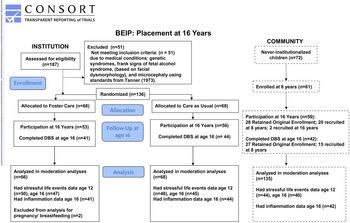
Trial design and participant selection of the BEIP (ClinicalTrials.gov, NCT00747396) have been previously reported (Zeanah et al., Reference Zeanah, Nelson, Fox, Smyke, Marshall, Parker and Koga2003) and are summarized in the consort diagram (Figure 1). In the year 2000, 187 infants ranging from ages 6 to 31 months who were living in one of six institutions in Bucharest, Romania, completed physical examinations; 51children were excluded for serious medical conditions (e.g., genetic and fetal alcohol syndromes). Accordingly, 136 children (ages 6–30 months) were recruited. After the baseline assessment, half of the children were randomly assigned to care as usual (CAUG: n = 68) and half to foster care (FCG: n = 68). The age of foster care placement ranged from 6.81 to 33.01 months (M age = 22.63 months, SD = 7.33). The BEIP principal investigators and staff members performed the randomization procedures by randomly drawing numbers from a hat. Children were alternately assigned to the two groups, with the first number drawn assigned to CAUG and the next number drawn assigned to FCG. At baseline, a group of sex- and age-matched NIG (n = 72) was recruited from pediatric clinics in Bucharest, and additional NIG were recruited at age 8 (n = 61) and age 16 (n = 2).
Consort diagram.

At age 16, a subsample of participants (n = 127: 44 CAUG, 41 FCG, 42 NIG) from our larger study provided blood spots, which were used to derive CRP. This subgroup who provided blood samples is representative of the larger sample of participants who participated in other assessments of the larger study at age 16 (range = 15.49–17.97 years) (see Figure 1). The reasons for not participating in the blood spot collection were largely because they were unavailable or they declined, n = 13. Among the FCG and CAUG who provided blood samples at age 16 compared to those who did not, there were no differences in sex (p = .97), birth weight (p = .49), baseline body mass index (BMI) (p = .32), baseline age (p = .56), stressful life events at age12 (p = .510) or at age 16 (p = .475). This indicated that the subset of participants who provided blood samples are representative of the original cohort.
Stressful life events (ages 12 and 16)
Participants self-reported the presence of up to 30 life events that happened to them or members of their family over the past 12 months using a modified version of Coddington's Child Life Events Scale (Coddington, Reference Coddington1972). Items tapping stressful life events included: “you and your boyfriend/girlfriend had a big fight or broke up”; “your family's house or car was broken into or robbed”; and “you had a serious accident or illness and were in the hospital.” The distributions of the number of stressful life events were positively-skewed, with only 8.5% (n = 12) and 9.8% (n = 13) of the sample reporting between 8 to 12 events (the maximum reported) at ages 12 and 16, respectively. To reduce skewness, the items were re-scaled into an 8-point ordinal scale (0 = 0 events; 7 = 7+ events) and used in further analyses, consistent with Wade et al. (Reference Wade, Zeanah, Fox, Tibu, Ciolan and Nelson2019b).
As a sensitivity analysis, total stressful life events were divided into dependent and independent life events to separate those events that could be elicited by the child's behavior versus those that are exogenous events (see Supplemental Table S1 for classification) (Wade et al., Reference Wade, Zeanah, Fox, Tibu, Ciolan and Nelson2019b). An example of an independent event is “a family member got into trouble with the law, was arrested, or went to prison”; an example of a dependent event is “you got into serious trouble at school (i.e., suspended).”
Inflammatory outcomes (age 16)
To measure inflammation, we used a minimally invasive technique, dried blood spots (DBS). Trained research assistants wiped the participants’ finger with isopropyl alcohol then pricked the finger with a sterile, disposable, micro-lancet. Four blood drops (each about 50 μL) were applied to filter paper. The blood drops saturated the paper and the paper air-dried for a minimum of 4 hours. After drying, DBS samples were placed into a re-sealable plastic bag and stored at −24°C until they were shipped to the Laboratory for Human Biology Research (Evanston, IL) for processing. CRP was measured using a high-sensitivity CRP assay method (McDade, Burhop, & Dohnal, Reference McDade, Burhop and Dohnal2004). IL-6 was measured using a modification of the R&D Systems Quantikine HS Human IL-6 (Kit #HS600B) (Miller & McDade, Reference Miller and McDade2012). The means of low, mid, and high samples were 0.40, 1.24, and 3.45 pg/ml for CRP, and 1.09, 3.78, 14.71 pg/ml for IL-6. Between-assay coefficients of variability of low, mid, and high samples were 12.35%, 4.23%, 6.98% for CRP, and 12.75%, 6.97%, 4.77% for IL-6. No CRP values exceeded 10 mg/L. CRP assay results below the limit of detection (< 0 mg/L) were winsorized with the nearest value within the limit of detection (n = 14); two outliers above 3 SD were winsorized with the nearest highest value (Horn et al., Reference Horn, Long, Nelson, Allen, Fisher and Byrne2018). A log transformation was applied to reduce the positively skewed distribution of CRP. For IL-6, two outliers above 3 SD were winsorized with the nearest highest value and a log-transform was applied to reduce the positive-skewness.
Covariates
At the DBS collection, research assistants measured participants’ height, weight, and body temperature. Height and weight were used to calculate BMI at age 16. Participants reported their current medications. Frequently reported medications included nonsteroidal anti-inflammatory drugs, antibiotics, psychotropics, drugs for heart conditions, and glucose control. Given that many of the participants who were on medication were taking more than one psychotropic and/or more than one drug category, we accounted for the use of any medication by using a binary variable (yes/no). Participants also provided some information on recent health behaviors using validated survey items from the National Longitudinal Study of Adolescent to Adult Health (Harris & Udry, Reference Harris and Udry2018). Binary responses (yes/no) were recorded for regular cigarette use, “Have you ever smoked cigarettes regularly – that is, at least one cigarette every day for 30 days?” and physical activity in the past day, “In the past 24 hours, have you participated in vigorous physical activity long enough to work up a sweat, get your heart thumping, or get out of breath?” These health behaviors were controlled by regressing inflammation on BMI, body temperature, use of any medication, regular cigarette-use, physical activity in the past day, and sex in our analyses. In addition, pregnant and breast-feeding females (n = 2) were excluded from all analyses involving inflammation.
Data analyses
Multiple-group regression models were performed to test the study's hypotheses in the R software package, Lavaan (Rosseel, Reference Rosseel2012). In all models, full information maximum likelihood estimation using all available data was used to handle missing data (Enders & Bandalos, Reference Enders and Bandalos2001). To examine whether stressful life events in adolescence were associated with immune functioning, separate models regressed IL-6 and CRP on stressful life events at ages 12 and 16, while controlling for covariates of health behaviors. Unadjusted results are presented in Supplemental Table 2. To examine whether the associations between stressful events and inflammation were moderated by early institutional, foster, or family care, study group was modeled as a grouping variable. Multiple-group analysis is a well-established method to examine moderation effects in path analyses or structural equation modeling. We used χ2 difference tests to evaluate whether study groups differed in paths of interest (i.e., stressful life events at both ages 12 and 16 to inflammation at age 16). This involved comparing χ2 values between a null model, in which the path coefficients of interest were constrained to be equal across study groups, and an alternative model, in which all path coefficients were freely estimated. A significant χ2diff value between the null and alternative models is evidence that the effect of stressful life events on inflammation is moderated by study group. In sensitivity analyses, these procedures were repeated for models that included dependent and independent life events separately, as well as models that did not include covariates that could be on the causal pathway (i.e., BMI, medication, and health behaviors).
Individuals with missing data did not differ from those without missing data on key variables, including stressful life events at ages 12 (p = .781) and 16 (p = .718), IL-6 (p = .926), CRP (p = .139), BMI (p = .661), smoking (p = .653), exercise in the past 24 h (p = .183), medication status (p = .163), body temperature (p = .600) or demographic variables, such as sex (p = .597). There were more missing data in the NIG compared to CAUG and FCG (p < .001) since the NIG did not always return to the study. However, we note that the recruited NIG always matched on sex and age to the institutionalized groups.
Results
Preliminary analyses
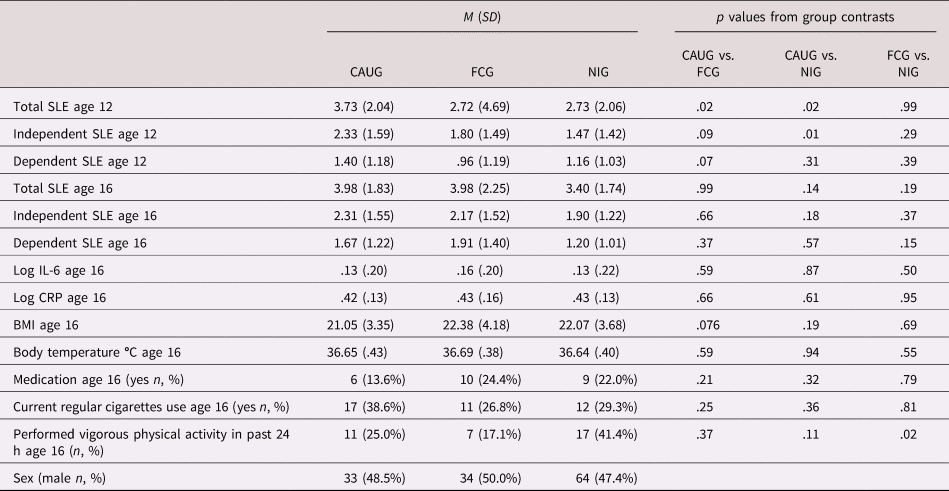
Descriptive statistics of measures across the CAUG, FCG, and NIG are displayed in Table 1. At age 12, the CAUG had more total stressful life events than the FCG and NIG consistent with a previous report (Wade et al., Reference Wade, Zeanah, Fox, Tibu, Ciolan and Nelson2019b). The CAUG also had more independent stressful events than the NIG and more dependent stressful events than the FCG (at trend level, p = .072) at age 12. The FCG did not differ from the NIG in stressful life events at age 12 and the three groups showed comparable number of stressful life events at age 16. Also consistent with previous reports, the health-related measures at age 16, including IL-6, CRP, BMI, use of medication, body temperature, and smoking did not differ among the three groups, with one exception (i.e., fewer FCG have exercised in the past day compared to the NIG) (Slopen et al., Reference Slopen, Tang, Nelson, Zeanah, McDade, McLaughlin and Fox2019; Tang, Fox, Nelson, Zeanah, & Slopen, Reference Tang, Fox, Nelson, Zeanah and Slopen2019).
Descriptive statistics

Note. BMI = body mass index; CAUG = children assigned to care as usual; CRP = C-reactive protein; FCG = children assigned to foster care; h = hours; IL-6 = interleukin-6; NIG = never institutionalized children; SLE = stressful life events; Body temperature, use of medication and blood samples were collected on the same day in a subsample (n = 127: 44 CAUG, 41 FCG, and 42 NIG). Percentages of sex and ethnicity are based on 68 CAUG, 68 FCG, 135 NIG.
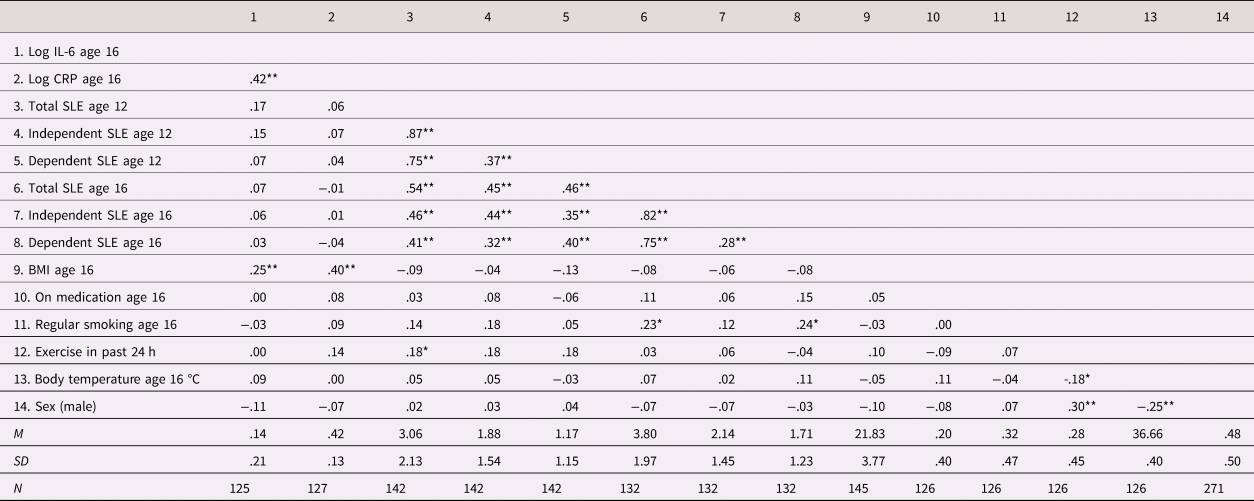
Bivariate correlations among measures across study groups are shown in Table 2. As expected, stressful life events were significantly correlated with each other and across ages 12 and 16. CRP and IL-6 were significantly correlated with each other and with BMI, but not with use of medication, sex, exercise, or smoking. Collapsed across study groups, CRP and IL-6 were not correlated with total, independent or dependent stressful life events.
Bivariate correlations among variables

Note. BMI = body mass index; CRP = C-reactive protein; h = hours; IL-6 = interleukin-6; SLE = stressful life events. **p <.001. *p <.05.
Total stressful life events and inflammation
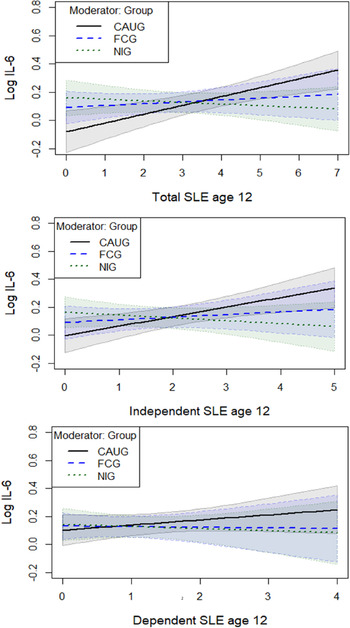
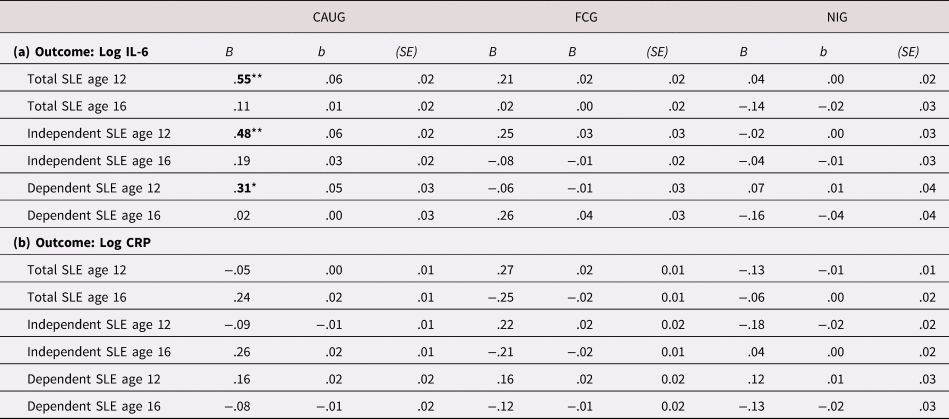
Regression coefficients adjusted for health behaviors at age 16 for the three groups are shown in Table 3. There were significant differences between the partially constrained and freely estimated models which examined associations between total stressful life events and IL-6, χ2diff (4) = 10.18, p = .038. This result indicated that regression coefficients of total stressful life events on IL-6 were significantly different across the three groups. Within the CAUG, more total stressful life events at age 12, but not at age 16, predicted higher levels of IL-6 (Table 3a). In contrast, neither age 12 nor age 16 total stressful life events were associated with IL-6 in the FCG or NIG. This interaction between stressful life events and study groups is shown in Figure 2. The adjusted results for CRP are shown in Table 3b. There were no between-group differences in the associations between total stressful life events and CRP (χ2diff (4) = 6.23, p = .183). Also, there were no significant within-group effects (Table 3b).
Interaction between total, independent, and dependent stressful life events and study group on IL6. Note. IL-6 = interleukin-6. SLE = stressful life events. Shaded region denotes 95% confidence intervals.

Within-group estimates for (a) IL-6 and (b) CRP at age 16

Note. Estimates adjust for body mass index (BMI), medication status, regular smoking, exercise in the past day, body temperature, and sex at age 16. CAUG= children assigned to care as usual; CRP = C-reactive protein; FCG = children assigned to foster care; IL-6 = interleukin-6; NIG = never institutionalized children; SLE = stressful life events. **p <.001. *p <.05*.
Sensitivity analyses
Independent and dependent events adjusting for health behaviors
Results from the sensitivity analyses examining independent and dependent events separately showed marginal significant differences across groups in the model examining associations between independent stressful life events and IL-6, χ2diff (4) = 8.04, p = .089. Within the CAUG, more independent stressful life events at age 12, but not at age 16, predicted higher levels of IL-6. Again, these relations were not observed in the FCG or NIG (Table 3a, Figure 2). The model examining the associations between dependent stressful life events and IL-6 showed no significant group differences, χ2diff (4) = 4.20, p = .379. Thus, even though the within-group estimates show that dependent stressful life events at age 12 are associated with higher levels of IL-6 within the CAUG, these estimates are not significantly different than those within the FCG or NIG (Table 3a). The interaction plot (Figure 2) also shows that the slopes overlap across groups.
For CRP, there were no significant between-group differences in the models examining the effects of independent (χ2diff (4) = 7.10, p = .131), or dependent (χ2diff (4) = .143, p = .998) stressful life events on CRP. There were also no significant within-group effects (Table 3b).
Estimates unadjusted for health behaviors
Considering models that excluded covariates linked to health behaviors that could be on the causal pathway (i.e., potential mediators) of inflammation, we found similar patterns of association for IL-6 (Supplemental Table 2a). Results for IL-6 showed significant between-group differences in the unadjusted model examining total stressful events (χ2diff (4) = 11.63, p = .020); marginal significant differences for independent events (χ2diff (4) = 8.64, p = .070); and no significant differences for dependent events (χ2diff (4) = 4.36, p = .359). For CRP, more stressful life events at age 16, but not age 12, were concurrently associated with higher levels of CRP in only the CAUG but not FCG, or NIG (Supplemental Table 2b). However, none of the models for CRP were significantly different across groups, suggesting the relation between stressful life events at age 16 and CRP at age 16 are not different among the the study groups.
Discussion
This longitudinal randomized controlled trial examined whether early institutional care is associated with heightened inflammation to stressors in adolescence, and whether early foster care intervention buffers against these responses. We found that early institutionalization interacted with stressful life events in early adolescence (i.e., age 12) to predict elevated IL-6 at age 16 among individuals with prolonged institutional care (i.e., CAUG). These results remained robust even after adjusting for covariates, suggesting the effects of stressful events are independent of health behaviors. In further separating stressful events into those that were controllable versus uncontrollable by the individuals, we found that the magnitude of the association was larger for uncontrollable relative to controllable events. In contrast, these associations were not observed among institutionalized children who received early foster care or those who were never institutionalized. These results are consistent with our prior work that showed independent stressful life events at age 12 exacerbates later externalizing problems at age 16 in the CAUG but not the FCG or NIG (Wade et al., Reference Wade, Zeanah, Fox, Tibu, Ciolan and Nelson2019b). In support of the stress sensitization model, the current findings suggest that early and prolonged institutional rearing sensitizes children to the effects of later stressful events on pro-inflammatory tendencies. These findings provide experimental evidence that early removal from institutions and placement into family care plays a protective role in buffering against vulnerability to the effects of later stressful life events on low-grade inflammation.
To date, studies have used retrospective reports of childhood adversities and concurrent measures of inflammation in samples of adults. These studies show that heightened IL-6 is related to more recent stressful events among adults who reported socioeconomic disadvantage in childhood, but not among those with few recent stressful events or those who grew up in privileged backgrounds (John-Henderson et al., Reference John-Henderson, Marsland, Kamarck, Muldoon and Manuck2016). Similarly, heightened levels of IL-6 linked to concurrent caregiving stress has been observed in older adults who also self-reported childhood abuse, compared to those without caregiving stress or child abuse (Gouin et al., Reference Gouin, Glaser, Malarkey, Beversdorf and Kiecolt-Glaser2012; Kiecolt-Glaser et al., Reference Kiecolt-Glaser, Gouin, Weng, Malarkey, Beversdorf and Glaser2011). Our findings extend this literature in two ways. First, we show a stress-sensitizing effect of early neglect due to institutional rearing on inflammation in a sample of adolescents. Second, whereas prior studies have examined concurrent measures of recent stressful events and inflammation in adulthood, we documented stressors at multiple time points in adolescence.
Stressful life events showed some continuity, as individuals who had more stressful life events at age 12 also had more stressful events at age 16. Even after accounting for stressful events at age 16, stressful events at age 12 continued to predict IL-6 at age 16 in the care as usual group. This suggests that stressors in the early transition to adolescence might be more disruptive to the immune system or other restorative processes among individuals exposed to early adversity. This could result in higher levels of circulating cytokines such as IL-6, which do not necessarily define an inflammatory state but generally indicates that the immune system is working harder to protect, preserve, and/or repair tissues (Del Giudice & Gangestad, Reference Del Giudice and Gangestad2018). This interpretation is consistent with a preliminary report of internationally adopted children who show immune incompetence indicated by their T cell profiles (Reid et al., Reference Reid, Coe, Doyle, Sheerar, Slukvina, Donzella and Gunnar2019). We speculate that early adolescents have less well-developed cognitive abilities for handling stressors (Hampel & Petermann, Reference Hampel and Petermann2006), which might have downstream consequences on inflammation as part of the stress response. Coping strategies vary with age throughout adolescence, and more adaptive coping strategies (e.g. problem solving, accepting responsibility, self-control, social support) help to reduce stress in older adolescents compared to younger adolescents (Al-Bahrani, Aldhafri, Alkharusi, Kazem, & Alzubiadi, Reference Al-Bahrani, Aldhafri, Alkharusi, Kazem and Alzubiadi2013; Alumran & Punamäki, Reference Alumran and Punamäki2008; Plancherel, Bolognini, & Halfon, Reference Plancherel, Bolognini and Halfon1998). In addition, the delayed development across multiple domains of functioning (Almas et al., Reference Almas, Degnan, Walker, Radulescu, Nelson, Zeanah and Fox2015; Debnath, Tang, Zeanah, Nelson, & Fox, Reference Debnath, Tang, Zeanah, Nelson and Fox2019; Wade, Fox, Zeanah, & Nelson, Reference Wade, Fox, Zeanah and Nelson2019a) and blunted stress physiology (McLaughlin et al., Reference McLaughlin, Sheridan, Tibu, Fox, Zeanah and Nelson2015) reported in the CAUG may underlie an increased vulnerability to stressors and inflammation.
Contrary to our hypothesis, we did not observe evidence for the stress sensitization hypothesis for CRP. Although results from the unadjusted models showed concurrent associations between stressful life events and CRP at age 16 among the care as usual group, these effects were nonsignificant after adjusting for health behaviors. Notably, one other study which examined stress-sensitizing effects of self-reported child abuse on CRP in older-adults also found no associations with CRP (Gouin et al., Reference Gouin, Glaser, Malarkey, Beversdorf and Kiecolt-Glaser2012). It is unclear why the associations involving IL-6 were significant but those involving CRP were not, as both indicators are functionally linked, empirically correlated, and associated with the progression and development of cardiometabolic diseases (Donath & Shoelson, Reference Donath and Shoelson2011; Harrington, Reference Harrington2017; Kuo et al., Reference Kuo, Yen, Chang, Kuo, Chen and Sorond2005; Pradhan et al., Reference Pradhan, Manson, Rifai, Buring and Ridker2001). However, the two indicators have different signaling pathways (Del Giudice & Gangestad, Reference Del Giudice and Gangestad2018; Gabay, Reference Gabay2006). Specifically, IL-6 and other pro-inflammatory cytokines stimulate the synthesis of acute phase proteins, including CRP, whereas CRP is a more downstream reactant to systemic inflammation (Gabay, Reference Gabay2006). Moreover, both IL-6 and CRP have functional roles in immunity (e.g., pathogen defense) and tissue repair, but IL-6 also actively promotes somatic maintenance through its metabolic effects in allocating energy and resources toward immunity and repair (Del Giudice & Gangestad, Reference Del Giudice and Gangestad2018; Fuster & Walsh, Reference Fuster and Walsh2014). Future work is needed to explain the differential mechanisms by which these indicators are impacted by early and later stress, and how they link to mental and physical health.
Our findings should be interpreted in light of several limitations. First, our inflammatory markers were collected in a subset of the full BEIP sample. Even though we ensured that this subsample was representative of the larger sample, this smaller sample size might limit the precision of our estimates for the relations between stressful evets and inflammation, as well as effects that we could not detect. As such, our results warrant future replication. Second, we collected inflammation at only one time point, so we cannot determine bidirectional effects between stressful life events and inflammatory markers. Third, the use of DBS instead of venous blood was intended to maximize participation. Although pro-inflammatory markers measured in DBS have been validated as proxies of plasma serum levels, we acknowledge that there may be variability in DBS (Bond & Richards-Kortum, Reference Bond and Richards-Kortum2015). Finally, we cannot rule out the relevance of earlier stressful events or potential third variables, such as coping strategies. Future work should use larger samples, multiple markers of immune functioning (e.g., stimulated cytokines or antigen response to immunization), and examine whether positive coping strategies, or positive events can offset the effects of stressful events among individuals exposed to early adversity (e.g., Chiang, Chen, & Miller, Reference Chiang, Chen and Miller2018; Sin, Graham-Engeland, Ong, & Almeida, Reference Sin, Graham-Engeland, Ong and Almeida2015).
Strengths of this study include (a) the application of a randomized controlled design which offers experimental evidence for the protective effect of early foster care intervention; and (b) the assessment of stressors at multiple time points which showed the persistent negative effects of stressors in early adolescence on peripheral inflammation among children with a history of early institutionalization. While this study cannot identify mechanisms linked to health problems at this early stage of development, the evidence suggests tangible effects of later stressors on higher levels of inflammation, which if sustained over time is one pathway that could affect the long-term health of individuals with a history of early institutional rearing and severe psychosocial neglect. Thus, from a theoretical perspective, these findings advance knowledge about the developmental psychobiology of stress. From an applied perspective, future research can inform the development of targeted policies and practices to promote healthy development amongst children who have experienced neglect in early life and who are subsequently confronted with multiple stressors during early adolescence, a period of increased neurobiological plasticity which may offer an opportunity to intervene and mitigate (or reverse) the effects of severe early adversity.
Funding Statement
This research was supported by the John D. and Catherine T. MacArthur Foundation, the Binder Family Foundation, the Jacobs Foundation, and the National Institute of Mental Health (R01MH091363) to CA Nelson and the Palix Foundation to CH Zeanah.
Conflicts of Interest
None