I. INTRODUCTION
Nimonic 80A is a Ni–Cr based superalloy extensively used for high-temperature and high-strength components of aerospace, marine engineering, power generation, etc., due to its excellent creep, fatigue, and corrosion resistance.Reference Xu, Yang, Ran, Hu, Xiao, Cao and Jia1–Reference Wilthan, Tanzer, Schützenhöfer and Pottlacher5 It is well known that the microstructure of metals determines the final service properties of products to a great extent. Some studies have been performed on the microstructure of Nimonic 80A by investigating the dynamic recrystallization (DRX) behaviors in the isothermal compression. Jeong et al.Reference Jeong, Cho and Park3 obtained a set of mathematical models to describe the DRX evolution of Nimonic 80A using isothermal compression tests and then predicted the microstructural evolution during hot closed die forging. Bombac et al.Reference Bombac, Brojan, Tercelj and Turk6 defined optimal hot forming characteristics of Nimonic 80A using laboratory compression tests and established a mathematical expression connecting mean grain size and true stress. Tian et al.Reference Tian, Lind, Schafler and Paris7 determined microstructural changes during hot deformation as a function of strain and strain rate by investigating the DRX and dynamic recovery (DRV) of Nimonic 80A.
Generally, in a metal hot forming process, three typical softening mechanisms, namely, DRX during deformation, metadynamic recrystallization (MDRX), and static recrystallization during interpass periods, may occur, when dynamic and static recoveries are ignored.Reference Kazeminezhad8–Reference Solhjoo and Ebrahimi13 If DRX is not complete during deformation, MDRX occurs by the continued growth of nuclei formed as a result of DRX.Reference Roucoules, Yue and Jonas14,Reference Cho and Yoo15 The MDRX, especially, is an important metallurgical phenomenon causing the changes in the microstructural distribution and evolution of metals, thus further affects the final mechanical properties of hot rolled or forged products. So, understanding of MDRX behaviors during the multistage or multipass forming processes is essential for the analysis and optimization of the metal forming processes.
Many researchers have studied MDRX behaviors for several steels and alloys. They approved that the strain rate was the primary parameter affecting MDRX kinetics, with a small effect of temperature but insensitivity to prestrain. HodgsonReference Hodgson16 formulated equations for MDRX kinetics and recrystallized grain size considering the effects of deformation temperature and strain rate to predict the final mechanical properties of a hot rolled steel. Djaic and JonasReference Djaic and Jonas17 studied the effects of interpass time on microstructural evolution in a high carbon steel at a single deformation temperature and a constant strain rate during interpass periods between deformation passes. Jung et al.Reference Jung, Lee and Im18 formulated equations for MDRX grain size by double compression tests of AISI 4135 at various temperatures and strain rates. Elwazri et al.Reference Elwazri, Wanjara and Yue19 investigated the MDRX behaviors in a hypereutectoid steel containing 1% carbon using hot compression testing. Peng et al.Reference Ma, Peng, Liu and Jia20 studied the MDRX behaviors of a low-alloy steel Q345B during hot compression deformation and set up the MDRX kinetic model. Lin et al.Reference Lin, Chen and Zhong21–Reference Lin, Li and Xia23 investigated the effects of deformation temperature, strain rate, initial grain size, and deformation degree on the recrystallization kinetics and microstructural evolution during MDRX in a low alloy steel and 2124 aluminum alloy. Liu et al.Reference Liu, Liu, Lin and Li24 investigated the MDRX behaviors of 300M steel by using the double compression tests and set up kinetic equations of MDRX. Cheng et al.Reference Cheng, Chang, Tang, Kou and Li25 applied stress relaxation tests and plane strain compression tests to measure the MDRX kinetics in a high Nb containing TiAl alloy. But for Ni–Cr based superalloys, little information has been available for the MDRX behaviors using hot compression tests, and the related data are still rare.
In the present work, the MDRX behaviors of Nimonic 80A superalloy were investigated by isothermal interrupted hot compression tests. The effects of deformation temperature, strain rate, and prestrain on the metadynamic softening and recrystallized grain size were discussed. The MDRX kinetic model and recrystallized grain size model were established to predict the softening behaviors and microstructural evolution in Nimonic 80A superalloy. The accuracy of the proposed model was further evaluated.
II. EXPERIMENTAL PROCEDURE
The alloy (Nimonic 80A) used in this investigation was provided in the form of the rolled bar. Its chemical composition is shown in Table I. To evaluate the hot deformation characteristics, cylindrical compression specimens with a diameter of 8 mm and a height of 12 mm were machined to perform isothermal compression tests.
Chemical composition of Nimonic 80A (wt%).

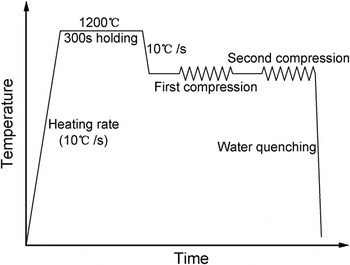
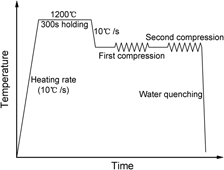
The isothermal interrupted hot compression tests were performed on a Gleeble-1500 thermo-mechanical simulator (Dynamic System Inc., Poestenkill, NY). The end faces of the specimens were lubricated with graphite to minimize the effect of friction between the anvils and the end faces of the specimens during the compression process. Figure 1 shows a schematic diagram of the compression process. Before compression, the specimens were heated to 1200 °C at a rate of 10 °C/s and held for 300 s to make sure that the initial grain sizes of all the specimens were in conformance with each other. Then, the specimens were cooled at a rate of 10 °C/s to deformation temperatures (1050, 1100, and 1150 °C) and held for 30 s to eliminate the temperature gradient. Subsequently, the first compressions were performed at the deformation temperatures with four different strain rates (0.01, 0.1, 1, and 4 s−1). To investigate the effects of prestrain on the MDRX behaviors in this study, three different deformation strains (0.30, 0.40, and 0.50) were used in the first compression. Of course, the first deformation is greatly above the critical strain for DRX, as determined by the single hit tests. The specimens were then unloaded and held at the deformation temperatures for different interpass times (0.5, 1, 1.5, 2, 5, and 10 s) to allow MDRX to occur. Then, the specimens were deformed to the strain of 0.1 to apply the second compression. The deformation temperatures and strain rates were the same as those in the first compression. The specimens were quenched immediately after each test to preserve the grain boundary of elevated temperature austenite microstructures. Finally, all the specimens were sectioned along the longitudinal axis. The longitudinal sections of the specimens were polished and then etched (the etchant is 100 ml HCl + 10 ml H2SO4 + 5 g CuSO4). The austenite grain size of the specimens was measured by optical microscopy. To obtain the initial microstructure without deformation, a specimen was heated to 1200 °C and held for 300 s, then immediately quenched and examined by optical microscopy.
Experimental procedure for the isothermal interrupted hot compression tests.

III. RESULTS AND DISCUSSION
A. Double hit flow curves and initial microstructure
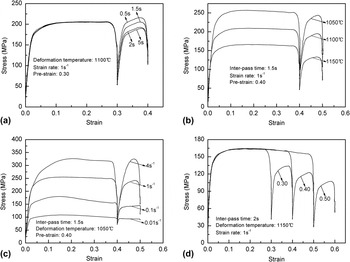
The selected flow stress–strain curves obtained in the isothermal interrupted hot compression tests of Nimonic 80A at different interpass times, deformation temperatures, strain rates, and prestrains are shown in Fig. 2. It can be found from Fig. 2(a) that the yield stress in the second compression generally decreases with the increase of interpass time, which suggests that significant MDRX occurred with the increase of interpass time. It is also observed that the flow stress is sensitive to deformation temperature and strain rate, as shown in Figs. 2(b) and 2(c). The flow stress level decreases markedly with increasing deformation temperature or decreasing strain rate under fixed other experimental conditions. The flow stress–strain curves at various prestrains with a deformation temperature of 1150 °C are shown in Fig. 2(d). It can be seen that the yield stress in the second compression generally decreases with the increase of prestrain under fixed other experimental conditions. The initial microstructure for the specimen heated at 1200 °C and held for 300 s is shown in Fig. 3. Some equiaxed grains are observed. The average initial grain size is about 240 μm.
Flow stress–strain curves in the isothermal interrupted hot compression tests at different interpass times (a), deformation temperatures (b), strain rates (c), and prestrains (d).

Initial microstructure before compression.

B. Effects of deformation parameters on the MDRX behaviors
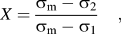
The 0.2% offset yield methodReference Yue, Zhang, Liao and Gao26–Reference Dehghan-Manshadi, Barnett and Hodgson28 is adopted in the present study to determine the metadynamic softening fraction. The softening fraction X is determined as follows:
 $$X = {{{\sigma _{\rm{m}}} - {\sigma _2}} \over {{\sigma _{\rm{m}}} - {\sigma _1}}}\quad ,$$
where σm is the flow stress at the end interruption and σ1 and σ2 are the 0.2% offset yield flow stress in the first compression and the second compression, respectively. The metadynamic softening fraction of Nimonic 80A can be determined using the obtained flow strain–stress data according to Eq. (1).
1. Effects of deformation temperature
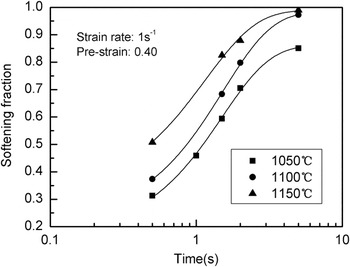
The metadynamic softening fraction is plotted against the interpass time for three different deformation temperatures, as shown in Fig. 4. It is obvious that the effects of deformation temperature on the metadynamic softening are significant. It can be seen that softening fraction increases rapidly with the increase in deformation temperature. Under the deformation temperature of 1150 °C, the values of softening fraction are higher than those under the other deformation temperature conditions. However, at the deformation temperature of 1150 °C and the interpass time of 5 s, complete softening fraction is achieved, which means that it is difficult to result in complete MDRX under these deformation conditions. As the softening mechanisms are thermally activated, the higher the deformation temperature the larger the metadynamic softening degree.Reference Lin, Chen and Zhong21–Reference Liu, Liu, Lin and Li24 In addition, the rate of softening increases firstly and then decreases with the increase of interpass time. It is evident that the softening curves follow the Avrami equation.Reference Lin, Chen and Zhong21–Reference Liu, Liu, Lin and Li24,Reference Choi and Lee29
Effects of deformation temperature on metadynamic softening.

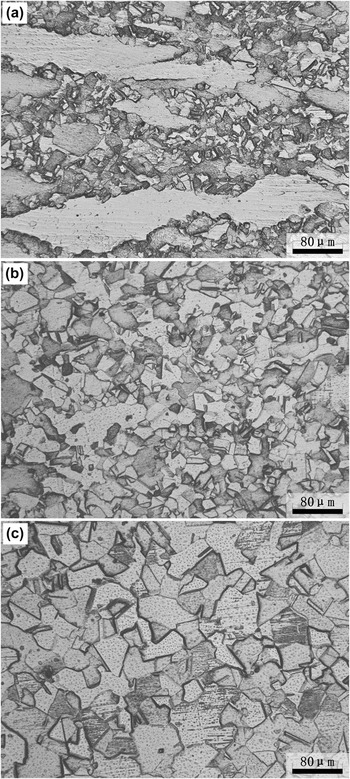
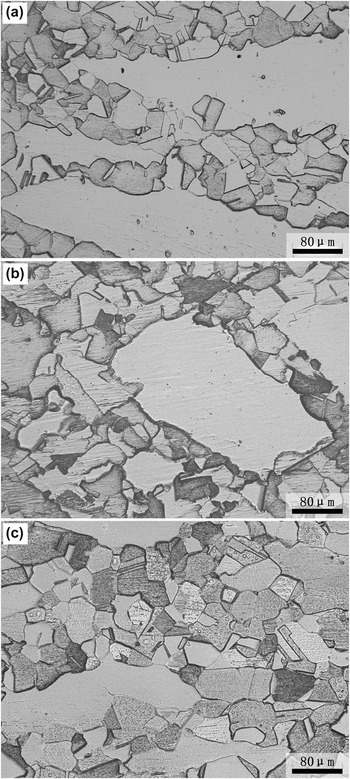
Figures 5(a)–5(c) illustrate the optical microstructures on the cross-section of specimens at the temperatures of 1050, 1100, and 1150 °C, respectively. The deformed microstructures depend closely on the deformation temperature. From Fig. 5(a), the original grains have been flattened and elongated. Some fine and strain-free grains are observed at the grain boundaries of the original grains and formed the necklace structure, which indicates that partial MDRX occurs in the specimen. With the increase in the deformation temperature, the fine and strain-free grains completely replace the original grains as shown in Figs. 5(b) and 5(c). The average grain sizes are measured as 28 and 41 μm for the deformation temperature of 1100 and 1150 °C, respectively. The higher the deformation temperature, the larger the recrystallized grain size. This is mainly because higher deformation temperature can accelerate the motion of dislocations, thus speeding up the growth of nuclei. Meanwhile, the grain growth will take place at the interpass time, and the rate of grain growth will increase with the increase of deformation temperature.Reference Lin and Chen22,Reference Chen, Cui, Sui and Fu30
Optical microstructures of Nimonic 80A superalloy on the cross-section of specimens at the interpass time of 5 s, strain rate of 1 s−1, and prestrain of 0.50 with deformation temperatures of (a) 1050, (b) 1100, and (c) 1150 °C.

2. Effects of strain rate
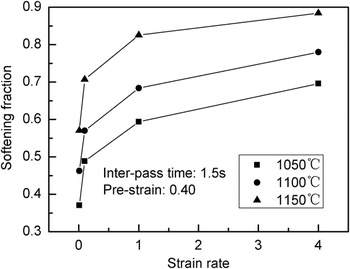
The effects of strain rate on metadynamic softening at various deformation temperatures are shown in Fig. 6. It is evident that the metadynamic softening fraction is accelerated significantly with the increase of strain rate and 87% metadynamic softening fraction is achieved at the strain rate of 4 s−1 and the deformation temperature of 1150 °C. The rate of softening tends to decrease with the increase of strain rate. This is due to higher strain energy stored and lesser time available for DRV under high strain rate conditions. Then, high strain energy produces a higher dislocation density and increases the driving force for recrystallization.Reference Lin, Chen and Zhong21–Reference Liu, Liu, Lin and Li24
Effects of strain rate on metadynamic softening.

Figures 7(a)–7(c) illustrate the optical microstructures on the cross-section of specimens for different strain rates. It is found from the figures that the original grain boundaries become serrated and bulging. Fine and strain-free grains are observed along the grain boundaries, which indicates that partial MDRX occurs in the specimens. Due to the high strain energy stored in the deformation block under high strain rate conditions, a greater number of nucleation sites were generated in the initial grains.Reference Lin and Chen22,Reference Chen, Cui, Sui and Fu30 More recrystallized grains are observed with the increase of strain rate and the strain-free grains appear finer with the increase of strain rate from 0.1 to 4 s−1.
Optical microstructures of Nimonic 80A superalloy on the cross-section of specimens at the interpass time of 5 s, deformation temperature of 1150 °C, and prestrain of 0.40 with strain rates of (a) 0.1, (b) 1, and (c) 4 s−1.

3. Effects of prestrain
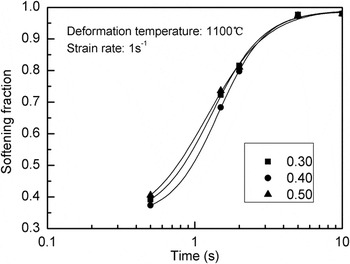
The metadynamic softening fraction is plotted against the interpass time for three different prestrains at the strain rate of 1 s−1, as shown in Fig. 8. It is clear that the changes in metadynamic softening fraction are not very marked for three different prestrains in the interpass time range of 0.5–10 s, which suggests that the metadynamic softening fraction is less dependent on prestrain. Lin et al.Reference Lin, Chen and Zhong21,Reference Lin, Li and Xia23 and Chen et al.Reference Chen, Cui, Sui and Fu30 also obtained the similar results for the effects of the metadynamic softening fraction.
Effects of prestrain on metadynamic softening.

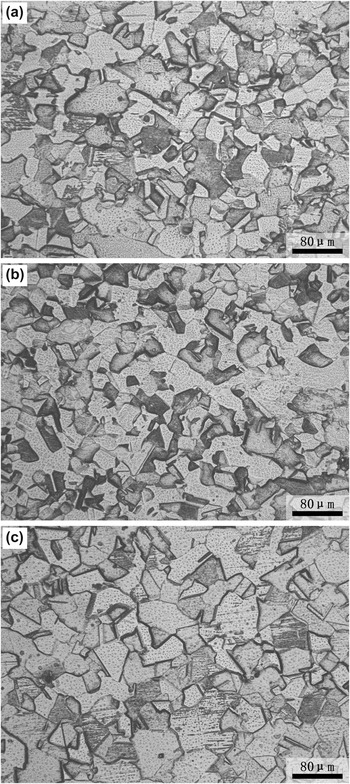
Figures 9(a)–9(c) illustrate the optical microstructure on the cross-section of specimens at the prestrains of 0.30, 0.40, and 0.50, at the deformation temperature of 1150 °C, interpass time of 5 s, and strain rate of 1 s−1. It is clear that recrystallization completed in the specimens. The average grain sizes are measured as 38, 36, and 41 μm for the prestrains of 0.30, 0.40, and 0.50, respectively. It is found that the effects of prestrain on the average recrystallized grain size of Nimonic 80A after MDRX are not significant.
Optical microstructures of Nimonic 80A superalloy on the cross-section of specimens at the deformation temperature of 1150 °C, interpass time of 5 s, and strain rate of 1 s−1 with prestrains of (a) 0.30; (b) 0.40; and (c) 0.50.

In conclusion, the effects of deformation temperature and strain rate on metadynamic softening fraction and recrystallized grain size in hot deformed Nimonic 80A are significant. However, the effects of prestrain on these are not very marked. To quantitatively describe the MDRX behaviors of the alloy, the MDRX kinetic model and recrystallized grain size model were established.
C. Modeling the kinetics of MDRX
Usually, the kinetics of metadynamic softening can be described by the Avrami equation in the following formReference Lin, Chen and Zhong21–Reference Chen, Cui, Sui and Fu30:
 $${X_{{\rm{MDRX}}}} = 1 - \exp \left[ { - 0.693{{\left( {{t \over {{t_{0.5}}}}} \right)}^n}} \right]\quad ,$$
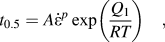
where X MDRX is the metadynamic softening fraction, n is the material dependent constant, and t 0.5 is the time for 50% MDRX. According to the analysis above, the effects of prestrain can be neglected. For a given initial grain size, t 0.5 is widely expressed as followsReference Lin, Chen and Zhong21–Reference Chen, Cui, Sui and Fu30:
 $${t_{0.5}} = A{\dot \varepsilon ^p}\exp \left( {{{{Q_1}} \over {RT}}} \right)\quad ,$$
where A and p are material dependent constants, Q 1 is the apparent activation energy for MDRX (J/mol),  $\dot \varepsilon$ is the strain rate, T is the absolute temperature (K), and R is the gas constant (8.314 J/(mol K)).
1. Determination of n
Taking the logarithm of both sides of Eq. (2) twice gives,
 $$\ln \left[ {\ln \left( {{1 \over {1 - {X_{{\rm{MDRX}}}}}}} \right)} \right] = \ln 0.693 + n\ln t - n\ln {t_{0.5}}\quad .$$
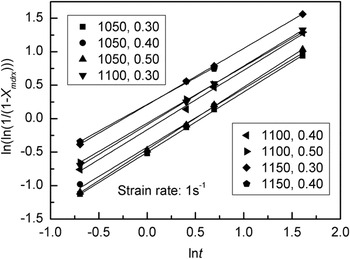
Then, by substituting the values of metadynamic softening fraction X MDRX and the corresponding interpass time under different deformation conditions into Eq. (4), the plots of ln(ln(−(1 − X MDRX))) versus lnt are shown in Fig. 10. The values of n are determined by the linear slope, and the average value of n is 0.874.
Relationships between ln(ln(−(1 − X MDRX))) and lnt under different deformation temperatures and prestrains.

2. Determination of the dependence of t 0.5 on the deformation parameters
Taking the logarithm of both sides of Eq. (3) gives:
 $$\ln {t_{0.5}} = \ln A + p\ln \dot \varepsilon + {{{Q_1}} \over {RT}}\quad .$$
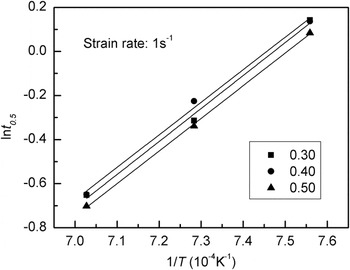
From the relationships between X MDRX and the corresponding interpass time, the values of t 0.5 under different deformation conditions can be derived. Then, by substituting the values of t 0.5 and the corresponding deformation temperatures, t 0.5, and corresponding strain rates into Eq. (5), respectively, the relationships between lnt 0.5 and 1/T, lnt 0.5 and  $\ln \dot \varepsilon$ can be obtained as shown in Figs. 11 and 12. It is easy to evaluate the values of material dependent constants A and p as 1.51 × 10⁻⁵ and −0.177, respectively. The apparent activation energy Q 1 is also obtained as 123.40 kJ/mol.
Relationships between lnt 0.5 and 1/T under different prestrains.

Relationships between lnt 0.5 and  $\ln \dot \varepsilon$ under different deformation temperatures.

Then, the MDRX kinetic model for Nimonic 80A can be represented as the following equations,
 $${X_{{\rm{MDRX}}}} = 1 - \exp \left[ { - 0.693{{\left( {{t \over {{t_{0.5}}}}} \right)}^{0.874}}} \right]\quad ,$$
 $${t_{0.5}} = 1.51 \times {10^{ - 5}}{\dot \varepsilon ^{ - 0.177}}\exp \left( {{{123,400} \over {RT}}} \right)\quad .$$
D. Modeling the recrystallized grain size after MDRX
For a given initial grain size, the recrystallized grain size model after MDRX can be expressed as a function of deformation temperature and strain rate in the following formReference Lin and Chen22,Reference Choi and Lee29,Reference Chen, Cui, Sui and Fu30 :
 $${D_{{\rm{MDRX}}}} = C{\dot \varepsilon ^q}\exp \left( {{{{Q_2}} \mathord{\left/ {\vphantom {{{Q_2}} {RT}}} \right. \kern-\nulldelimiterspace} {RT}}} \right)\quad ,$$
where D MDRX is the recrystallized grain size after MDRX. C, q, and Q 2 are material dependent constants.
Taking the logarithm of both sides of Eq. (8) gives:
 $$\ln {D_{{\rm{MDRX}}}} = \ln C + q\ln \dot \varepsilon + {{{Q_2}} \over {RT}}\quad .$$
When the values of lnD MDRX constitute the values of the dependent variable, the values of  $\ln \dot \varepsilon$ and 1/T constitute the values of the independent variables, lnC and Q 2/R are the regression coefficients, and lnA/n is the constant, Eq. (9) can be regarded as a multiple regression equation. C, q, and Q 2 can be obtained through multiple linear regressions. The recrystallized grain size model after MDRX for Nimonic 80A can be expressed as follows:
 $${D_{{\rm{MDRX}}}} = 2.15 \times {10^6}{\dot \varepsilon ^{ - 0.296}}\exp \left( {{{ - 128,600} \mathord{\left/ {\vphantom {{ - 128,600} {RT}}} \right. \kern-\nulldelimiterspace} {RT}}} \right)\quad .$$
E. Model verification
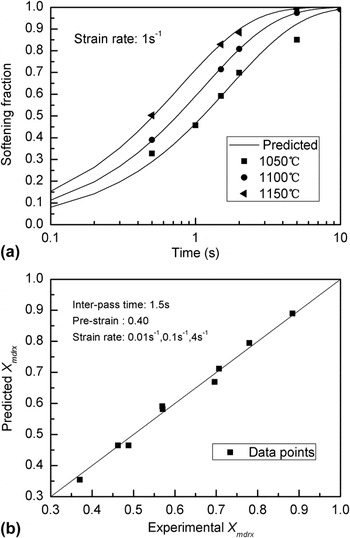
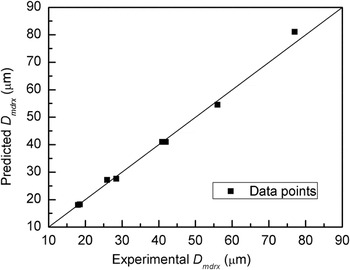
To compare and verify the proposed models above, Fig. 13 shows the comparisons between the experimental metadynamic softening fraction and the predicted ones. Figure 14 shows the comparisons between the experimental recrystallized grain size and the predicted ones. It can be seen that the metadynamic softening fraction values and the recrystallized grain size values predicted by the proposed models are in good agreement with the experimental ones, which suggests that the proposed models can give an accurate prediction of the softening behaviors and microstructural evolution for Nimonic 80A.
Comparisons between the experimental metadynamic softening fraction and the predicted ones with strain rates of (a) 1 and (b) 0.01, 0.1, and 4 s−1.

Comparisons between the experimental recrystallized grain size and the predicted ones.

IV. CONCLUSIONS
The MDRX behaviors of Nimonic 80A superalloy were investigated by isothermal interrupted hot compression tests. The effects of different deformation conditions, including interpass time, deformation temperature, strain rate, and prestrain, were studied in detail. The following conclusions have been drawn from the results of this investigation.
(1) Deformation temperature and strain rate have strong effects on metadynamic softening behaviors and recrystallized grain size after MDRX. The metadynamic softening fraction increases with the increase of deformation temperature and strain rate. The recrystallized grain size increases with the increase of deformation temperature and decrease of strain rate. However, the effects of prestrain on these are not very marked.
(2) By regression analysis of the experimental data, the MDRX kinetic model and recrystallized grain size model were proposed to predict the softening behaviors and microstructural evolution for Nimonic 80A. The model verification results indicate that the proposed models can give accurate predictions of the softening behaviors and microstructural evolution for Nimonic 80A.