I. INTRODUCTION
Recently, semiconductor nanomaterials, due to their potential applications to deal with the problems of energy shortage and environment pollution, have attracted much attention of researchers in the world. They not only can be used in the fabrication of solar cellsReference Chang, Rhee, Sang, Yong, Kim, Sang, Nazeeruddin and Grätzel1 and hydrogen production by photocatalytic water splitting,Reference Wang, Maeda, Thomas, Takanabe, Xin, Carlsson, Domen and Antonietti2–Reference Adesanya, Davey, Scott and Smith4 but also be used as a photocatalyst to degrade organic and inorganic pollutants in the environment.Reference Chen, Ma and Zhao5 As one of the most promising photocatalysts, TiO2 has catched much attention due to its high efficiency, chemical stability, easy availability, and non-toxicity, and was widely used in the photodegradation of environmental organic pollutants and the waste-water treatments.Reference Yang, Jiang, Shi, Xiao and Yan6–Reference Chen, Liu and Huang8 Searching for visible light activated titania has been an interesting topic because of its significance as a photocatalyst for environmental applications under solar irradiation.Reference Cao, Low, Yu and Jaroniec9 TiO2 used as a catalyst for the ambient light, however, has two major disadvantages. One is its wide band gap (3.2 eV), which can only be response to the proportion of less than 5% of the ultraviolet radiation in sunlight. So the direct use of solar energy is limited for TiO2 photocatalyst.Reference Kudo and Miseki10,Reference Li, Xia, Xu, Murowchick and Chen11 Another one is the easy recombination of photogenerated electron and hole, resulting in the decrease of photocatalytic activity, which is mainly decided by the separation process of photogenerated electron and hole pairs on TiO2.
Many efforts have been attempted towards the reduction of photogenerated electron–hole recombination rate on TiO2.Reference Liu and Chen12,Reference Wen, Li, Liu, Fang, Xie and Xu13 Several researchers reported that modification of noble metal, such as Au, Ag, Pt, and Ru, could promote the effective separation of electrons and holes.Reference He, Xie, Song, Wang, Tu and Hong14–Reference Liu, Li, Zhang and Lin18 Noble metal deposited on TiO2 surface was thought to produce traps, which can capture the photogenerated electrons, thus suppressing electron–hole recombination. However, noble metals are too expensive to be widely used practically. Known as an important functional organic polymer semiconductor with a band gap of approximately 1.8 eV, poly-3-hexylthiophene (P3HT) has been widely exploited as hole transport material used in dye-sensitized solar cells.Reference Chang, Rhee, Sang, Yong, Kim, Sang, Nazeeruddin and Grätzel1 In addition, both the conduction band and the valence band of P3HT are higher than those of the TiO2, the photogenerated electrons on the conduction band of P3HT therefore can be injected from P3HT to TiO2, at the same time, the photogenerated holes on the valence band of TiO2 can be injected from TiO2 to P3HT. Several researchers reported the application of P3HT to form the composite structure of TiO2/P3HT as a visible light photocatalyst due to visible light response of P3HT with a narrower band gap.Reference Schilinsky, Asawapirom, Scherf, Biele and Brabec19–Reference Liao, Chen, Quan, Chen and Zhang24 Meanwhile, the band structure fabricated on the TiO2 and P3HT composite materials can promote the separation of photogenerated electron and hole on the TiO2. The effective separation of photogenerated electron–hole pairs will extend the lifetime of the photogenerated charge carriers.Reference Al-Ibrahim, Rotha, Zhokhavetsb, Gobsch and Sensfuss25 Therefore, P3HT modification towards the TiO2 thin film, is a possible way to effectively improve the UV light catalytic activity of TiO2 catalyst.Reference Zhu and Dan26,Reference Muktha, Mahanta, Patil and Madras27
Herein, we introduce an in situ surface modification strategy of P3HT on TiO2 nanocrystalline thin film, to accelerate the charge separation on the TiO2 surface. 3-Hexylthiophene monomers were in situ polymerized on the TiO2 nanocrystalline thin film with FeCl3 as polymerization catalyst. The P3HT was modified on TiO2 thin film other than to form a P3HT/TiO2 composite thin film as reported in the literature. The advantage for our modification strategy of P3HT is that modification of P3HT is homogeneous and the loading amount is less than the composite thin film, which may improve the stability of P3HT on TiO2 nanoparticles surface. The purpose of modification of P3HT is to accelerate the separation of photogenerated electrons with holes. The photocatalytic degradation properties of the as-prepared thin film towards methyl orange was tested under UV light irradiation. The photocatalytic performance was significantly enhanced due to the homogeneous modification of P3HT. The role of P3HT was demonstrated in detail by the measurements of photoluminescence (PL) spectra and open-circuit voltage decay (OCVD) processes. P3HT was found to efficiently separate electron and hole, resulting in an obvious suppression on the electron recombination processes.
II. EXPERIMENTAL
A. Materials
TiO2 nanoparticles powder (P25) with the mean diameter of 25 nm was purchased from Beijing HWRK Chem. Co., Ltd. The dye of methyl orange (MO) was purchased from Kanto. 3-Hexylthiophene monomer (98%), iron(III) chloride (97%), Triton X-100 (99%), n-butanol (99.5%), anhydrous diethyl ether (99%) were purchased from Alfa Aesar Inc. China without further purification. Fluorine-doped tin oxide conducting glass (FTO, 10 Ω/sq, Nippon Sheet Glass Co., Ltd. Japan) was ultrasonically cleaned sequentially in deionized water, acetone and isopropanol and finally soaked in isopropanol. The well-cleaned FTO was used as a substrate for deposition of the nanocrystalline TiO2 thin film.
B. Modification of P3HT on TiO2 thin film
TiO2 powder paste was prepared by grinding the mixture of 1.0 g P25 TiO2 nanoparticles powder and 0.5 mL Triton X-100 in n-butanol for 3 h at room temperature. Then the doctor-blade method was used to form a porous TiO2 thin film on FTO substrate. The films were further sintered at 450 °C in air for 30 min.Reference Zhao, Tang, Zhang and Lin28
3-Hexylthiophene monomers were in situ polymerized on the as-prepared TiO2 nanocrystalline thin film. The typical preparation process was as follows. 5.19 g FeCl3 was dissolved in 10 mL ether, then 4 mL 1 M HCl solution was added, the mixing solution was stirred for 15 min. At the same time, 0.10 g 3-hexylthiophene monomer was dissolved in 6 mL ether. The TiO2 thin film was first dipped into the FeCl3 solution for 2 min, subsequently, in 3-hexylthiophene monomer ether solution for 10 min. The as-modified thin films were rinsed with deionized water and dried in air at room temperature. The modified amount of P3HT can be changed by treating the film in different concentrations of 3-hexylthiophene monomer ether solutions. The samples marked as S1, S2, and S3 were corresponding to the films treated in the ether solution containing 0.10 g (0.097 M), 0.15 g (0.146 M), and 0.20 g (0.194 M) 3-hexylthiophene monomer, respectively.
C. Characterization of P3HT modified TiO2 thin film
The crystalline structure of the P3HT modified TiO2 thin film was characterized by an x-ray power diffraction meter (XRD, Rigaku D/max-2500, Rigaku Corporation, Tokyo, Japan, Cu Kα). Surface morphologies of the nanocrystalline thin films with and without P3HT modification were observed with a scanning electron microscopy (SEM; FEI Nova Nano SEM 230, FEI Company, Hillsboro, Oregon). The ultraviolet-visible (UV-Vis) absorption spectrum of the solutions and thin films was measured with an UV-Vis spectrophotometer (UV-2600, Shimadzu Corp., Kyoto, Japan). Infrared spectra were recorded by employing a Nicolet (Avatar-370, Thermo Scientific, Madison, Wisconsin) FT-IR spectrometer and the KBr disk method. PL spectra of the thin films were recorded using a Cary Eclipse fluorescence spectrophotometer (Agilent, Santa Clara, California). The excitation wave length is 380 nm. Thin layer solar cell was fabricated with a TiO2 thin film working electrode and a Pt foil counter electrode. The aqueous solution containing 0.1 M KSCN was used as the electrolyte. OCVD of the assembled thin layer solar cell was measured with a computerized voltammetry system (Hokuto Denko HSV-100, Hokuto Denko Corporation, Osaka, Japan) under light intensity of 28 W high pressure Hg lamp. The active area was 0.20 cm2.
D. Photocatalytic activity of P3HT modified TiO2 thin film
The photodegradation experiments of MO were conducted in an open beaker with 100 mL capacity at room temperature, and the beaker was open to air to ensure enough oxygen in the solution. The TiO2 thin film or P3HT modified TiO2 thin film was laid at the bottom of the beaker, immersed by 20 mL aqueous solution containing MO with the initial concentration of 20 μM, which was exposed to illumination of a 28 W high pressure Hg lamp (λ = 365 nm). Prior to the irradiation, the solution with the TiO2 thin film was placed in darkness to establish adsorption–desorption equilibrium. The concentration of dye after adsorption–desorption equilibrium was treated as C 0. The change in the concentration of dye based on C 0 was detected by measuring absorbance value at maximum absorption wave length of 517 nm of the dye solution taken out regularly from the reactor beaker.
III. RESULTS AND DISCUSSION
A. Characterization of P3HT modified TiO2 thin film
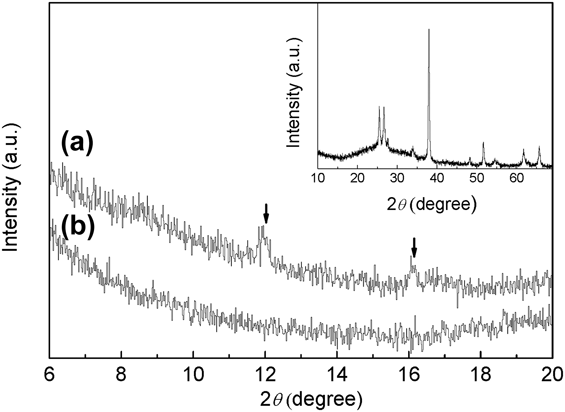
TiO2 nanocrystalline thin film with high porous structure allows modification of some compounds to improve its properties. P3HT is a commonly used electron donor (hole transport) materials, it has a narrow band gap and higher hole carrier mobility. Compared with TiO2, the P3HT modified thin film samples with the matched band structure will promote the separation of photogenerated electron–hole pairs so as to probably improve the photocatalytic activity of TiO2. Therefore, 3-hexylthiophene molecules were in situ polymerized on the nanoporous TiO2 thin film to form a homogeneous P3HT modified thin film. Figure 1 showed XRD patterns of the TiO2 nanocrystalline thin films with and without the P3HT modification. The sharp diffraction peaks for the TiO2 nanocrystalline thin film as shown in inset of Fig. 1 clearly indicate that TiO2 nanocrystalline thin film is well crystallized. The peaks located at 25.3, 37.8, and 48.1° are corresponding to (101), (004), and (200) peaks of TiO2 anatase phase, and two weak peaks located at 27.5° and 55.1° correspond to (110) and (211) peaks of TiO2 rutile phase. The results conform with P25 is a mixed phase of anatase and rutile. In the range from 6° to 20° as shown in Fig. 1, there is a sharp contrast between the pure TiO2 and the P3HT modified thin film. In comparison with the pure TiO2 thin film, The P3HT modified thin film exhibits two peaks at diffraction angles of 10.7° and 15.9° marked by two arrows for (200) and (300) peaks corresponding to P3HT phase,Reference Kim, Cook, Tuladhar, Choulls, Nelson, Durrant, Bradley, Giles, Mcculloch, Ha and Ree29 indicating the presence of P3HT.
XRD patterns of P3HT modified TiO2 (a) and TiO2 (b). Inset is wide XRD patterns of TiO2 nanocrystalline thin film on FTO.

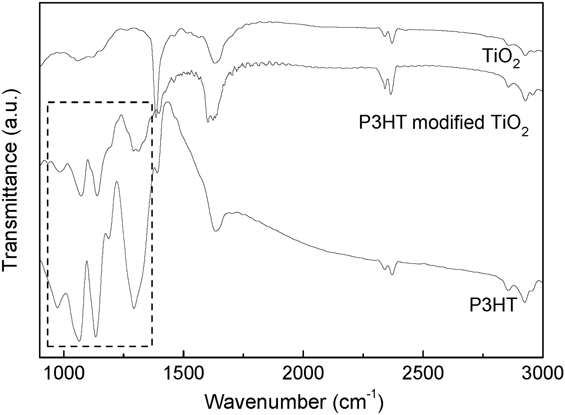
The FTIR of the nanocrystalline TiO2 thin film with and without modification of P3HT were measured to further confirm the modification of P3HT. The P3HT modified sample was removed out from conductive substrate with a doctor blade to obtain sample powder. The disk for IR measurement was made by pressing the mixture of the 5 mg sample and 195 mg dry KBr. According to the same method, the KBr disks containing pure P3HT and TiO2 were made as IR measurement samples, respectively. Figure 2 showed the FTIR spectra of TiO2, P3HT and P3HT modified TiO2 materials used in this experiment. The characteristic peaks for P3HT marked by a dash square resemble spectra of the nanocrystalline powder obtained from the modified film. The small peak shift towards long wave number for the P3HT present on the TiO2 particles may be due to its adsorption on the TiO2. The chemical adsorption can affect the stretching vibration of adsorption groups and the close groups, the corresponding IR wave number will be shifted.Reference Zhang and Zaban30 These observations confirm the chemical polymerization of P3HT on the nanocrystalline thin film.
FTIR spectra of TiO2 nanoparticles, pure P3HT and the powders scraped from the P3HT modified TiO2 thin film.
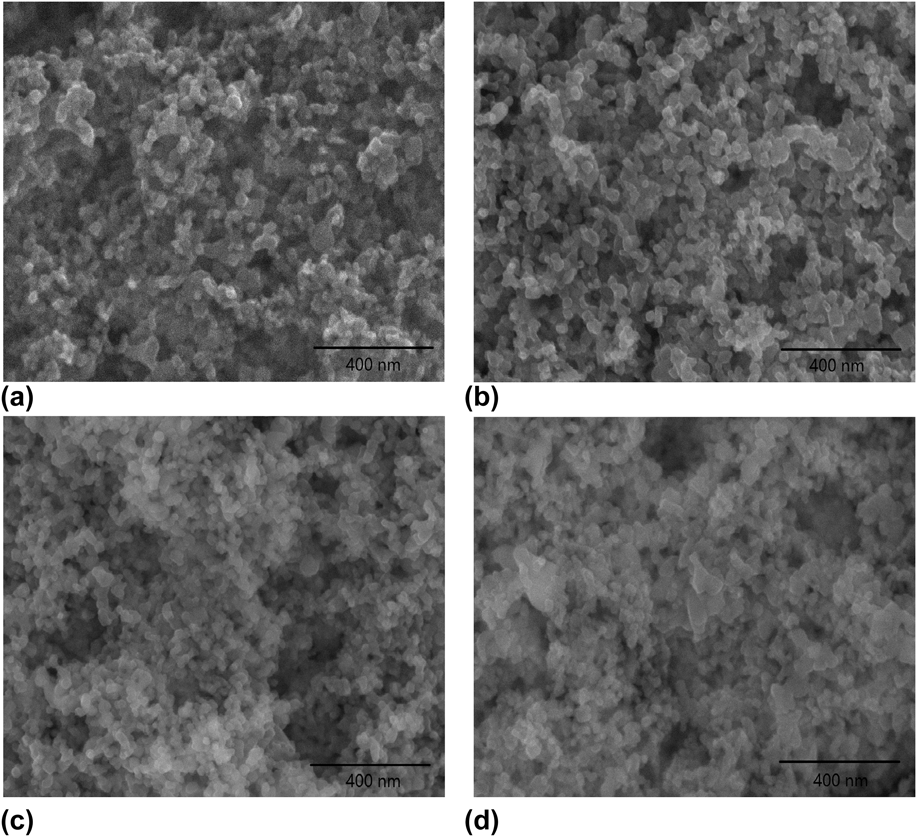
The SEM surface morphologies of the nanoporous TiO2 thin film and the films with different modification amounts of P3HT were observed and shown in Fig. 3. The TiO2 nanocrystalline thin film is composed of nanoparticles with an average diameter of 20–30 nm, forming a porous structure as shown in Fig. 3(a). The samples named as S1, S2, and S3 refer to the TiO2 thin film treated in the ether solutions containing 0.10, 0.15, and 0.20 g 3-hexylthiophene monomer, respectively. In the higher concentration ether solution, the more amount of P3HT can be polymerized on the porous structure of TiO2 nanocrystalline thin film. It can be seen from their SEM morphologies shown in Figs. 3(b)–3(d) that the TiO2 particles are coated with P3HT making the porous structure be obscure. The porous structure becomes more obscure with the increasing of the modification amount of P3HT. However, even for S3 sample [Fig. 3(d)] with the most amount of P3HT in this experiment, the porous structure is still open, which ensures enough surface of the nanocrystalline thin film to access and then photodegrade organic molecules. Therefore, the loading amount of P3HT on the TiO2 nanocrystalline thin film cannot be too high, otherwise, the loaded P3HT will block the porous structure.
SEM surface images of the nanoporous TiO2 thin film (a) and the films S1 (b), S2 (c) and S3 (d) with different modification amounts of P3HT.
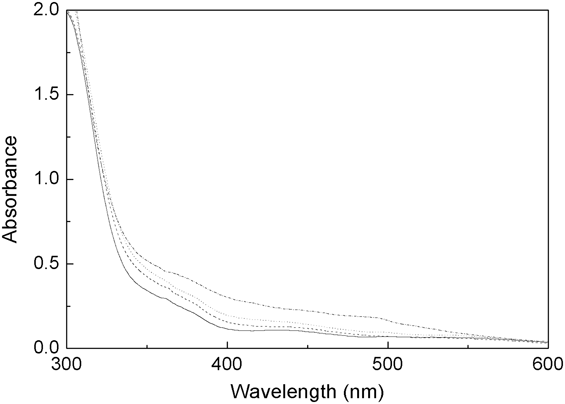
The absorption spectra for the nanoporous TiO2 thin film and the films with different modification amounts of P3HT were shown in Fig. 4. The absorbance increase from about 550 nm for the modified thin films indicating the loading of P3HT. The increasing in absorbance value from sample S1 to S3 demonstrates that the modification amount of P3HT is increased. At the same time, the lower absorbance value for the P3HT indicates that the modification amount is low, which is different to the reported P3HT/TiO2 composite thin films.
Absorption spectra of the TiO2 nanocrystalline thin film (solid line), S1 (dash line), S2 (dot line), and S3 (dash dot line) with different modification amounts of P3HT.
B. Photocatalytic activity of the P3HT modified TiO2 thin film
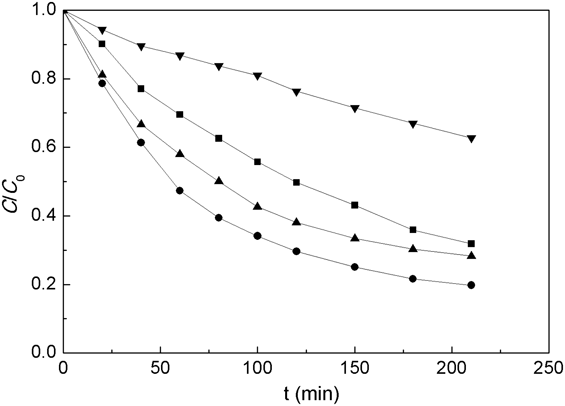
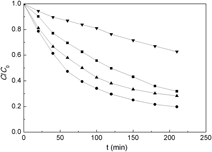
Methyl orange was selected as a substrate to estimate the photocatalytic activity of P3HT modified TiO2 thin films. Before degradation, the blank experiment without photocatalyst was carried out to check the stability of MO under irradiation of the high pressure Hg lamp. Figure 5 showed relationship between irradiation time and C/C 0 of photocatalytic degradation. The photocatalytic degradation performance of the modified thin films towards methyl orange in the solution can be roughly estimated from Fig. 5. Within 210 min, for the TiO2 nanocrystalline thin film, about 38% of methyl orange was degraded, and this value is reached to the highest value of 80% for the P3HT modified TiO2 thin film (S2). The degradation efficiency was slightly decreased to 68% and 75% for S1 and S3, respectively. Therefore, the modified amount of P3HT for sample S2 is the optimized amount in this experiment. Less than the optimized amount is not enough to form a perfect coating of P3HT, and more than the optimized amount will block the contact of MO with surface of TiO2. Both cases will decrease the photocatalytic activity of the P3HT modified TiO2 thin films.
Relationship between irradiation time and C/C 0 of photocatalytic degradation for the nanoporous TiO2 thin film (▼) and the films S1 (■), S2 (●) and S3 (▲) with different modification amounts of P3HT.
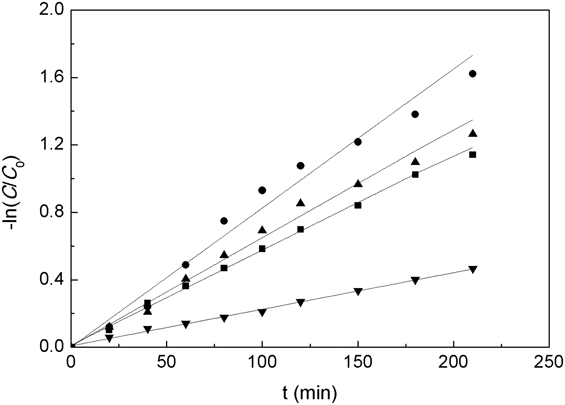
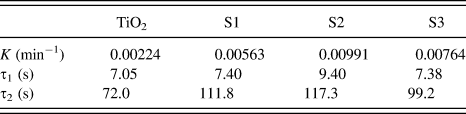
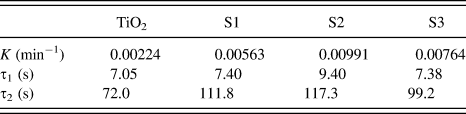
Figure 6 further showed the linear relationship of ln(C/C 0) and irradiation time for the photocatalytic results as shown in Fig. 5. The good linear relationship confirmed that all the photodegradation processes follow the first-order kinetics. The photodegradation apparent rate constant obtained from the slope for the porous thin films prepared with various concentrations of 3-hexylthiophene, as listed in Table I, is higher than that of the pure TiO2. The photodegradation apparent rate constant for S2 is almost 4.4 times higher than that of the TiO2 thin film. This enhancement may be attributed to the recombination suppression of photogenerated charges. The stability of P3HT modified TiO2 is checked by comparing the IR and absorption spectra of the P3HT modified TiO2 sample before and after photocatalytic experiment. No obvious changes were observed, indicating the stability of the P3HT modified on the surface of TiO2 is satisfied. A less modification of P3HT ensures the penetration of solution into the porous film and then holes and electrons can be transferred in time. These factors maybe contribute to the stability of the P3HT modified thin film.
The linear relationship of ln(C/C 0) and irradiation time for the photocatalytic results as shown in Fig.5. The nanoporous TiO2 thin film (▼) and the films S1 (■), S2 (●), and S3 (▲).
The photodegradation apparent rate constants and time constants of V oc decay fitted from the OCVD curves shown in Fig. 7 for TiO2 nanocrystalline thin films without and with different modification amounts of P3HT.
C. Photocatalytic enhancement mechanism due to modification of P3HT
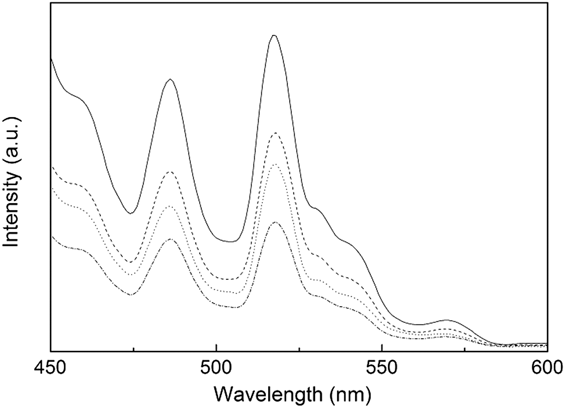
PL describes the decay process of photo-excited electrons. Based on the PL intensity change, the numbers of electron decay according to different ways can be analyzed. Figure 7 showed the PL spectra measured for the samples of the TiO2 nanocrystalline thin film, S1, S2, and S3, respectively. The double bands at 487 nm and 520 nm are typically attributed to the PL emission of TiO2.Reference Jing, Qu, Wang, Li, Jiang, Yang, Wei, Fu and Sun31,Reference Iijima, Goto, Enomoto, Kunugita, Ema, Tsukamoto, Sakama and Ichikawa32 In this process, TiO2 absorbs the incident photons along with the ground-state electrons being excited to the high energy state. The excited electron directly returns to the ground state leading to the PL emission. If the excited electron is transferred away from the polymer, the PL emission of TiO2 will be quenched.Reference Lin, Chu, Chen and Su33 It is observed in Fig. 7 that S1, S2, and S3 shows lower PL emission intensity than the pure TiO2 thin film, indicating the occurrence of the PL quenching on each modified thin film. Importantly, the sample of S2 exhibits lower PL emission intensity than S1 and S3.
PL spectra of the TiO2 nanocrystalline thin film (solid line), S1 (dash line), S2 (dot line), and S3 (dash dot line). The excitation wave length is 380 nm.
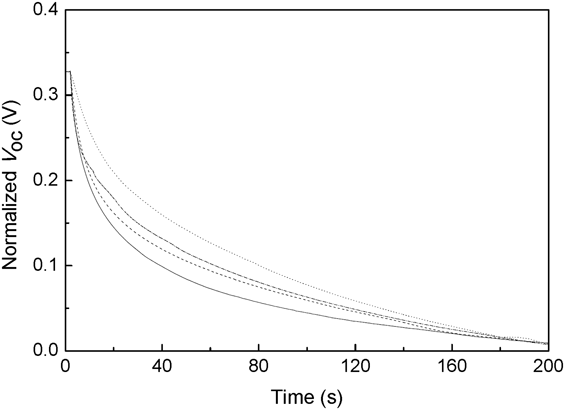
OCVD technique is regarded as a powerful tool to detect the recombination process and lifetime of electrons in dye-sensitized solar cell by monitoring the subsequent decay of open circuit photovoltage (V oc) after interrupting the illumination.Reference Yang, Li, Zhang and Lin34 The decay of V oc reflects the decrease of the electron density on the photoelectrode at open circuit situation, which is mainly determined by the charge recombination process. The slower decay process of V oc indicates the slower charge recombination process and then the longer lifetime of electrons. In the case of photodegradation, the rapid separation of electron and hole pair will effectively suppress their recombination processes. Namely, the recombination suppression is attributed to the rapid transfer of photogenerated charges. Therefore, the P3HT modified TiO2 thin film was assembled to a thin layer solar cell to check the recombination processes of the photogenerated electrons on TiO2, and OCVD curves of the fabricated thin layer solar cells based on TiO2 nanocrystalline thin films without and with different modification amounts of P3HT were measured. Figure 8 showed the normalized OCVD curves for comparing their different decay processes. The OCVD curve exhibits characteristic of double exponential decay. To quantificationally understand the recombination suppression after the introduction of the P3HT modification, the time constants for V oc decay processes (τ) were estimated by fitting OCVD curves in Fig. 8 and the values of τ were summarized in Table I. The fast decay component (τ1) is normally attributed to the recombination of photogenerated electrons with surface states, and the slow decay component (τ2) arises from the recombination of photogenerated electrons with the electrolyte, respectively.Reference Bisquert, Zaban, Greenshtein and Mora-Sero35 It clearly indicated that the values of τ1 for the S1 and S3 samples are only slight longer than that of TiO2. However, the value of τ1 for S2 sample with the best photocatalytic activity is obviously longer than that of other samples. The values of τ2 for three samples with modification of P3HT are longer than that of the TiO2 nanocrystalline thin film without P3HT. The larger value of τ indicates that the photogenerated electrons can survive longer so that they have enough time to degrade the organic molecules in the solution. The longer carrier lifetime is due to the recombination suppression of photogenerated electrons with the electrolyte and holes after modification of P3HT. All these results are in good agreement with the aforementioned conclusion.
Normalized OCVD curves for the thin layer solar cells based on the TiO2 nanocrystalline thin film (solid line), S1 (dash line), S2 (dot line), and S3 (dash dot line), respectively.
Figure 9 showed the band structure schematic diagram of P3HT modified TiO2 porous film. The better photocatalytic activity under the irradiation of ultraviolet light for TiO2 nanoparticles with surface modification of P3HT can be demonstrated. The main reason is the fast separation of the photogenerated electrons excited to the conduction band of TiO2 under UV irradiation with holes on the valence band of TiO2. Otherwise, they may be recombined lowering photodegradation efficiency. The modified P3HT with a narrow band gap and a valence band higher than that of TiO2, is more likely to transfer holes from TiO2. Thus the photogenerated electrons and holes are rich in the conduction band of TiO2 and the valence band of P3HT, respectively, so as to realize the separation of electron–hole pairs and effectively increase the lifetime of electrons and holes. Both electrons and holes then have enough time to react with pre-adsorbed O2 and H2O to produce highly active superoxide and hydroxyl radicals. These active radicals further degrade methyl orange to some small molecules such as water and carbon dioxide.Reference Wang, Sun, Lin, Cai, Xie and Lin36,Reference Kou, Jin, Zhang, Sun and Zhang37
Schematic diagram for the photocatalytic enhancement mechanism of P3HT modified TiO2 porous thin film.
IV. CONCLUSIONS
3-Hexylthiophene monomers were in situ polymerized on the TiO2 nanocrystalline thin film by the chemical polymerization strategy to form the homogenous P3HT modified TiO2 porous thin film. The band position of P3HT is higher than that of TiO2, the matching band structure was formed in the modified structure. Therefore, the appropriate modification amount of P3HT ensuring the porous structure for penetration of solution can transfer the photogenerated holes from the valence band TiO2 and then promote the separation of photogenerated electrons and holes on the TiO2. The TiO2 photocatalytic activity was obviously improved due to modification of P3HT by retarding recombination of electrons with holes. This is a very promising result of this study in view of the application of TiO2 nanocrystalline thin films for the effective degradation of organic pollutants.
ACKNOWLEDGMENTS
This work was financially supported by the National Nature Science Foundation of China (Grant Nos 21273160 and 20873162), the Nature Science Foundation of Tianjin (Grant No. 14JCYBJC18000), and the Program for Innovative Research Team in University of Tianjin (TD12-5038).