INTRODUCTION
Corporate philanthropy (CP) has received increasing attention from business academia during the past several decades (Griffin & Mahon, Reference Griffin and Mahon1997; Peloza, Reference Peloza2009; Wang & Qian, Reference Wang and Qian2011). CP, as a form of corporate social responsibility (CSR), involves money or gifts given by firms to social and charitable causes such as education, culture, health care, environmental protection, and disaster relief (Godfrey, Reference Godfrey2005; Seifert, Morris, & Bartkus, Reference Seifert, Morris and Bartkus2004; Wang, Choi, & Li, Reference Wang, Choi and Li2008). Many scholars tend to take a strategic perspective on CP arguing that ‘doing good leads to doing better’ (Gardberg & Fombrun, Reference Gardberg and Fombrun2006; Godfrey, Reference Godfrey2005; Porter & Kramer, Reference Porter and Kramer2002; Seifert et al., Reference Seifert, Morris and Bartkus2004). Prior empirical studies also support this argument by finding a positive relationship between CP and financial performance (see Peloza, Reference Peloza2009 for a review; Wang & Qian, Reference Wang and Qian2011).
Despite abundant empirical evidence for a positive relationship between CP and financial performance, little is known regarding why or how CP could enhance financial performance (Aguilera, Rupp, Williams, & Ganapathi, Reference Aguilera, Rupp, Williams and Ganapathi2007; Aguinis, Reference Aguinis and Zedeck2011; Wood, Reference Wood2010). Although some scholars suggest that stakeholders’ attitudes and subsequent behaviors toward CP may be key in uncovering the mechanisms linking CP with financial performance (e.g., Freeman, Reference Freeman1984; Orlitzky, Schmidt, & Rynes, Reference Orlitzky, Schmidt and Rynes2003; Rowley & Berman, Reference Rowley and Berman2000; Wood & Jones, Reference Wood and Jones1995), empirical investigations remain limited (Aguinis & Glavas, Reference Aguinis and Glavas2012). Many scholars note that further research efforts are still required in order to investigate properly the underlying mechanisms linking CP with financial performance (Aguilera et al., Reference Aguilera, Rupp, Williams and Ganapathi2007; Aguinis, Reference Aguinis and Zedeck2011; Wood, Reference Wood2010).
We argue that employees’ attitudes and responses toward CP may act as one of the underlying mechanisms linking CP to financial performance. It is well known that employees as a group are one of the influential stakeholder groups that shape corporate financial performance (Freeman, Reference Freeman1984). Employee satisfaction or morale and therefore productivity significantly affect a firm's performance and success (Stancu, Grigore, & Rosca, 2011). CP may increase employee morale and productivity by helping firms build a pro-social image and reputation (Brammer, Millington, & Pavelin, Reference Brammer, Millington and Pavelin2006; Gardberg & Fombrun, Reference Gardberg and Fombrun2006; Godfrey, Reference Godfrey2005). Such an image increases employee self-esteem (Dutton & Dukerich, Reference Dutton and Dukerich1991; Riordan, Gatewood, & Bill, Reference Riordan, Gatewood and Bill1997) by supporting self-esteem through belonging to the firm's group (Tajfel & Turner, Reference Tajfel, Turner, Austin and Worchel1979; Tyler & Blader, Reference Tyler and Blader2000). Employees with satisfied self-esteem may be willing to reward their firms by increasing productivity. We accordingly believe that CP will motivate labor productivity and further increase financial performance.
We examine the effect of CP on employee responses, which act as an important step in understanding employees’ roles in the relationship between CP and financial performance. Specifically, we examine whether or not CP could enhance labor productivity. Although some prior studies examine employees’ individual and subjective responses to CSR initiatives such as job satisfaction (Valentine & Fleischman, Reference Valentine and Fleischman2008), organizational commitment (e.g., Aguilera et al., Reference Aguilera, Rupp, Ganapathi and Williams2006; Brammer et al., Reference Brammer, Millington and Rayton2007), and identification with the company (e.g., Kim, Lee, Lee, & Kim, Reference Kim, Lee, Lee and Kim2010; Rodrigo & Arenas, Reference Rodrigo and Arenas2008), few examine employee responses either collectively or objectively through variables such as labor productivity. Prior studies also primarily focus on employee responses to CSR versus CP. Although CP could be seen as a form of CSR, significant differences may exist between CP and CSR because CSR usually includes activities that promote the welfare of employees or their families (Ali, Rehman, Ali, Yousaf, & Zia, Reference Ali, Rehman, Ali, Yousaf and Zia2010) while CP does not have any direct benefit for employees. It would then be interesting to examine employees’ objective responses to CP. Our study should contribute to the CSR literature by examining the effect of CP on labor productivity – a measure of employees’ collective and objective responses.
We argue that CP could increase labor productivity by helping firms build a pro-social image. A pro-social firm image increases employee self-esteem, further motivating them to reward the firms by working harder or/and more proactively. We therefore expect that CP has a positive effect on labor productivity. We also consider some boundary conditions for the effect of CP on labor productivity. We believe that monetary incentives will supplement the nonmonetary incentives of CP in motivating employees. Monetary salary could satisfy employees’ material needs while CP could satisfy their mental need for self-esteem. Only when material needs are satisfied will employees value the satisfaction of mental needs (Maslow, Reference Maslow1943). We therefore expect that employee salary level will strengthen the positive relationship between CP and labor productivity. We also find that a firm's CP becomes of greater public concern through its high market visibility, improving employee self-esteem and raising the benefit from CP. We therefore expect that firm visibility also increases employee support for CP.
We conduct this study in the context of the world's largest transition economy, China. The underdeveloped institutions in China make it urgent for the public to solicit support from companies in philanthropic activities, which cannot be covered fully by government forces. CP has accordingly been encouraged by governments at all levels as well as firm stakeholders at large. Significant variances also exist in China for CP activities due to differences in regional developments, industry characteristics, and firm attributes, making it an ideal context for examining the impact of CP on firm outcomes.
THEORETICAL BACKGROUND AND HYPOTHESES
Social identity theory provides us with an insightful view into the effect of CP on labor productivity. Social identity is a person's self-concept based on his/her group membership (Turner & Oakes, Reference Turner and Oakes1986), and the theory posits that people are motivated to achieve and maintain self-esteem (Hogg & Turner, Reference Hogg and Turner1987). Self-esteem is a disposition which reflects a person's overall evaluation of his or her own worthiness (Olsen, Breckler, & Wiggins, Reference Olsen, Breckler and Wiggins2008). Psychologists widely recognize that the groups or organizations a person belongs to are important sources of self-esteem (Tajfel & Turner, Reference Tajfel, Turner, Austin and Worchel1979). People will choose organizations with high social identity as employers in order to enhance self-esteem. They may also work harder to reward such organizations for offering high self-esteem.
According to the social identity theory, people tend to identify with organizations that have high prestige and attractive images because high organizational identity or status helps them build and maintain self-esteem (Ashforth & Mael, Reference Ashforth and Mael1989; Dutton & Dukerich, Reference Dutton and Dukerich1991; Tajfel & Turner, Reference Tajfel, Turner, Worchel and Austin1985). Corporate philanthropy (CP) is widely recognized as an effective instrument helping firms build favorable pro-social image and reputations (Gardberg & Fombrun, Reference Gardberg and Fombrun2006; Godfrey, Reference Godfrey2005; Fombrun & Shanley, Reference Fombrun and Shanley1990). People should therefore be more likely to join and remain with firms that have better social performance in order to increase personal self-esteem. Incumbent employees may be proud of serving their firms and willing to work harder in exchange for the high self-esteem provided by such firms.
Corporate Philanthropy and Labor Productivity
Prior literature widely identifies the strategic value of CP for firms (e.g., Brammer et al., Reference Brammer, Millington and Pavelin2006; Godfrey, Reference Godfrey2005; Porter & Kramer, Reference Porter and Kramer2002). CP is akin to advertising (e.g., Burt, Reference Burt1983) in helping firms improve their public image (Brammer et al., Reference Brammer, Millington and Pavelin2006; Saiia, Reference Saiia2002) as well as create reputational capital (Gardberg & Fombrun, Reference Gardberg and Fombrun2006; Godfrey, Reference Godfrey2005). A favorable reputation also raises employee morale and productivity (Turban & Cable, Reference Turban and Cable2003), as well as attracting potential job seekers (Sánchez, Reference Sánchez2000; Turban & Cable, Reference Turban and Cable2003).
Social identity theory provides a useful perspective in understanding the underlying reasons why CP may induce positive employee responses. Employees are self-esteem seekers for which the firms they serve act as an important source. Employees tend to use firm image and/or reputation in order to evaluate outsider perceptions of both the firm and themselves (Dutton & Dukerich, Reference Dutton and Dukerich1991). Favorable firm image and reputation accordingly contribute directly to employee self-esteem (Riordan et al., Reference Riordan, Gatewood and Bill1997; Tyler & Blader, Reference Tyler and Blader2000). Employees may feel proud of joining, working for, and rewarding firms because of their CP or other CSR activities (Brown & Dacin, Reference Brown and Dacin1997; Turban & Greening, Reference Turban and Greening1997).
This social image arising from a firm's CP will become more evident in a transition economy like China. Employee support for CP in China can be explained by two major factors. First, underdeveloped institutions in China make it unlikely for the government to take care of all social welfare so that firms are encouraged by governments as well as the public to help with philanthropic activities. For example, the State Council issued the ‘Directive Opinion on the Healthy Development of Charitable Causes’ in November 24, 2014. This document encourages firms and individuals to actively take part in charitable causes. Research shows that the public supports CP in transition economies such as China (Tian, Wang, & Yang, 2011; Wang & Qian, Reference Wang and Qian2011). Ramasamy and Yeung (2009) further find that consumers in China are even more supportive of corporate social responsibility compared to their counterparts in Europe and the United States.
Second, Chinese society attaches great importance to philanthropic activities, particularly during a time when society is asking for a revitalization of Confucian values. Society has come to realize the value of the virtues upheld in Confucian philosophy such as benevolence, righteousness, manners, wisdom, and credit that contain the egocentrism prevalent in a market economy following economic progress in China since the open door policy. Individuals or firms that actively help others are considered to have the qualities of a sage (Confucian Analects), and will be praised by the public (Mao, 2009). For instance, the stock price and brand value of Vanke (the largest real estate firm in China at that time) decreased significantly after its refusal to donate a large amount for Sichuan earthquake relief in 2008, while the sales of Wanglaoji (an herbal tea brand in China) increased dramatically following its donation commitment (Wang & Qian, Reference Wang and Qian2011). According to statistics from the Ministry of Civil Affairs (MCA) China received only approximately RMB 10 billion in donations (from both individuals and firms) in 2006. In 2009 the total amount of philanthropic donations had reached more than RMB 33.2 billion, and in 2013 this amount had further increased to approximately RMB 98.9 billion. Donations from firms are estimated as approximately RMB 68.9 billion. This increase in donations reflects people's valuation of CP.
Some prior studies find that CSR significantly and positively affects intra-organizational behavior such as organizational commitment (Peterson, Reference Peterson2004) and job satisfaction (Brammer et al., Reference Brammer, Millington and Rayton2007). Although CP is different from CSR since CP is externally-oriented while CSR often includes employee welfare (Ali et al., Reference Ali, Rehman, Ali, Yousaf and Zia2010), the logic we discuss above is clearly applicable for CP. We therefore expect a positive effect of CP on labor productivity and propose the following hypothesis.
Hypothesis 1: Corporate philanthropy (CP) will have a positive effect on labor productivity.
Moderation Effect of Salary Level
Although employees may be willing to support their firms because of CP, this support may depend on the extent to which the firm satisfies their material needs (Maslow, Reference Maslow1943). Since the satisfaction of material needs depends on the salary provided, we expect that employees’ salary levels will strengthen the positive relationship between CP and labor productivity.
Motivation theory has long and widely recognized the role of both monetary (e.g., Atkinson, Banker, Kaplan, & Young, Reference Atkinson, Banker, Kaplan and Young2001; Bonner & Sprinkle, Reference Bonner and Sprinkle2002; Horngren, Foster, & Datar, Reference Horngren, Foster and Datar2000) and nonmonetary incentives (e.g., Abdullah & Wan, Reference Abdullah and Wan2013; Condly, Clark, & Stolovitch, Reference Condly, Clark and Stolovitch2003; Khan, Shahid, Nawab, & Wali, Reference Khan, Shahid, Nawab and Wali2013) in promoting workplace or job performance. We expect CP and salary as nonmonetary and monetary incentives respectively to affect labor productivity positively. However, some scholars suggest that monetary incentives will crowd out nonmonetary incentives (see for a review, Deci, Koestner, & Ryan, Reference Deci, Koestner and Ryan1999), while others suggest that both crowd-out and crowd-in are possible (e.g., Frey, Reference Frey1994; Mason & Watts, Reference Mason and Watts2010).
However, to date, the studies reporting a crowd-out effect primarily focus on external incentives (for example, monetary incentives or intervention) crowding out intrinsic motivation (e.g., Frey & Jegen, Reference Frey and Jegen2000).Footnote [1] There is very limited evidence showing that one external incentive will crowd out another external incentive. Both CP and salary are external incentives (Rosenstiel, Reference Rosenstiel1975) used to satisfy different types of employee needs. CP could satisfy employees’ mental needs for self-esteem while salary satisfies their material needs for better living conditions. These two types of incentives could coexist. Moreover, satisfying low-rank material needs will lead the motivation of satisfying high-ranking self-esteem into taking effect (Maslow, Reference Maslow1943; Wahba & Bridwell, Reference Wahba and Bridwell1976). Although employees are willing to support CP because it increases self-esteem, they should be even more likely to do so if they feel that firms pay them fairly. We accordingly expect that monetary incentives (salary) will supplement CP in motivating employee productivity.
Psychologists suggest that employees are less likely to be motivated by absolute salary levels than by relative salary to a given reference point (e.g., Kahneman & Tversky, Reference Kahneman and Tversky1979; Thaler & Johnson, Reference Thaler and Johnson1990). Individuals make comparisons either between the current situation and their previous one (Schifferstein & Oudejans, Reference Schifferstein and Oudejans1996) or between their situation and that of peers with similar characteristics (Wu & Wardman, Reference Wu and Wardman2007), and such comparisons affect perceptions (Adams, Reference Adams1963, Reference Adams and Berkowitz1965; Stutzer, Reference Stutzer2004). We consider both comparisons between one's current salary and his/her salary history (self-comparison) as well as between one's salary and that of industry peers (social comparison).
We believe that higher relative salary will motivate employees and supplement the effect of CP on labor productivity. We accordingly propose the following hypotheses.
Hypothesis 2a: Self-compared salary will strengthen the positive relationship between CP and labor productivity.
Hypothesis 2b: Social-compared salary will strengthen the positive relationship between CP and labor productivity.
Moderation Effect of Firm Visibility
The social identity theory suggests that CP will induce employees’ positive responses (highlighted by labor productivity) because CP increases self-esteem through building a firm's favorable image and reputation. However, we expect that the effect of CP on labor productivity should be different for firms with different visibility levels. Higher visibility makes a firm's CP more easily identified by the public. Firm visibility may therefore enlarge the positive effect of CP on firm image and reputation, and eventually on employee self-esteem.
High visibility resulting from intensive advertising and other communication activities helps firms attract increased attention from external stakeholders, particularly from existing and prospective customers as well as potential employees (Brammer & Millington, 2005). Visibility functions as an amplifier, which enlarges the effect of corporate behaviors (Fombrun, Reference Fombrun1996; Rhee & Haunschild, Reference Rhee and Haunschild2006). Higher visibility helps firms benefit more from doing good through actions such as CP (Wang & Qian, Reference Wang and Qian2011), and also leads firms to lose more from doing badly such as illegal and unethical behaviors. Since visibility facilitates the diffusion of information concerning CP, firms with higher visibility should find it easier to construct a good image and reputation via CP in local markets than firms with lower visibility (Gardberg & Fombrun, Reference Gardberg and Fombrun2006).
Self-esteem seeking employees may feel proud of working for firms with good images and reputation. We expect that the positive effect of CP on employees (labor productivity) will be strengthened by firm visibility since high visibility enlarges the effect of CP on firm image and reputation. We propose the following hypothesis.
Hypothesis 3: Firm visibility will strengthen the positive relationship between CP and labor productivity.
METHOD
Data and Sample
We use a sample of Chinese publicly traded firms listed on either the Shanghai Stock Exchange or Shenzhen Stock Exchange for the period from 2001 to 2010. Since some firms conducted initial public offering (IPO) during this period our sample constitutes an imbalanced panel data.
Our data come from two sources. The main source is a leading database in China – the China Stock Market & Accounting Research (CSMAR). The CSMAR was developed by the GTA, a leading global provider of Chinese financial market data. All the data used in this study except market development either come directly from, or are computed based on the original data from, CSMAR database. However, the CSMAR database does not include the variable of political ties. The data concerning political ties are collected by searching for the introductions of a firm's Board Chairperson and its chief executive officer (CEO) in the CSMAR database.Footnote [2] We use China Statistic Yearbooks during the same period from 2001 to 2010 as a complementary source in order to collect the data regarding market development.
However, in our sample, more than forty percent of listed firms have not made charitable contributions. For this kind of sample a simple regression analysis may not be appropriate because the firms who made charitable contributions may be significantly different from those who did not. It is possible that there are factors affecting donation that may correlate with the dependent variable – labor productivity. We follow Brammer and Millington (Reference Brammer and Millington2008), Wang and Qian (Reference Wang and Qian2011), and Wang et al. (Reference Wang, Choi and Li2008) in using a two-stage Heckman model (Heckman, Reference Heckman1979) to correct for the sample selection bias. By excluding samples with missing key information we construct a final sample of 10703 firm-year observations.
Measurement of Variables
Dependent variable
We measure our dependent variable of Labor Productivity using a firm's total income divided by its number of employees (Stuebs & Sun, Reference Stuebs and Sun2010).Footnote [3] Total income is the total sales minus capital cost (Total Income = Total Sales – Capital Cost). We compute its natural logarithm in order to correct for its skewedness.
Explanatory variable
We measure our explanatory variable of Corporate philanthropy by following the approaches from Chen, Patten, and Roberts (Reference Chen, Patten and Roberts2008), Wang et al. (Reference Wang, Choi and Li2008), and Williams (Reference Williams2003). This is specifically measured as a firm's charitable contribution in the form of both cash and in-kind, scaled by the total sales during a given year. Since large firms tend to have more resources to support charities, we control for the effect of size when considering the effect of CP on employee responses. Suppose there are two firms and each has donated US $1 million to charities. However, one is a large firm with total sales of US $100 million dollars while the other is small and has only total sales of US $10 million dollars. Employees at the smaller firm should be more likely to feel proud of their firm because it has a higher ratio of donation to sales than the larger one.
Moderators
This study includes three moderators: self-compared salary, social-compared salary, and firm visibility. Self-compared salary is measured as the ratio of a firm's average salary during a given year to its own average salary during the previous year. Average salary is a firm's total salary expenditure scaled by the total number of employees.Footnote [4] Social-compared salary is measured as the ratio of a firm's average salary during a given year to the average industry salary (excluding the focal firm) during the same year.Footnote [5] We measure self-compared and social-compared salaries in this way in order to help control for the effect of base salary level.Footnote [6] We measure Firm visibility following Wang and Qian (Reference Wang and Qian2011) as the percentage of sales, general, and administrative (SG&A) expenses to total sales.
Control variables
We control for many variables that may affect labor productivity including firm size, firm age, financial performance, leverage, slack resources, political ties, ownership type, industry type, and market development. Firm size is measured as the logarithm (natural log) of total assets. Firm age is the number of years since a firm's foundation. Financial performance is measured as the return on assets (ROA), which is further measured by the percentage of net profits to total assets. Since there are extreme values (outliers) regarding ROA we winsorize it at the upper and lower 1% distribution tails. Leverage is measured as the percentage of total debts to total assets. Since this ratio is highly skewed we winsorize it at the upper and lower 1% distribution tails. We measure Slack resources following Seifert et al. (Reference Seifert, Morris and Bartkus2004), and Wang and Qian (Reference Wang and Qian2011) as the total net cash flow from a firm's operations, financing, and investing activities scaled by its total sales. Since this ratio is also highly skewed we winsorize it at the upper and lower 1% distribution tails. We measure Political ties following Gao (Reference Gao2011) in terms of the Board Chairman or CEO's political membership. Firms with their Board Chairman or CEO acting as a deputy of the People's Congress or a member of the Chinese People's Political Consultative Conference (CPPCC) are coded as 1, and otherwise 0. Firms with political ties may receive more favorable policies or treatment from the government that affects financial performance. Ownership type is a dummy variable with state-owned enterprises (SOEs) being coded as 1, and 0 otherwise. We also include 12 Industry dummies representing 13 different industry categories identified by the China Securities Regulatory Commission (CSRC). We measure Market development following Marquis and Qian (2014) as a province's gross domestic product (GDP) per capita, or a province's GDP divided by its population expressed in 10 thousands of Chinese Yuan (Renminbi). We take score of the province where a firm is headquartered as its market development level.
All of these control variables except market development are included in the first-stage probit model used to predict firm giving probability, but all are lagged by one additional year in order to reduce the possibility of reverse causality (Wang & Qian, Reference Wang and Qian2011). Many prior studies suggest that all of these control variables may affect corporate philanthropic decisions (Adams & Hardwick, Reference Adams and Hardwick1998; Brammer & Millington, Reference Brammer and Millington2008; Gao, Reference Gao2011; Seifert et al., Reference Seifert, Morris and Bartkus2004; Wang & Qian, Reference Wang and Qian2011). The first-stage probit model also includes firm visibility because firms with higher visibility are more likely to face higher pressure to donate (Gao, Reference Gao2011). We also include industry-level giving amount in the first-stage Heckman model equation. Industry-level giving amount is the average giving amount within a given industry, and we use its natural logarithm. A firm's philanthropic decisions can be affected by its peers within the same industry (Galaskiewicz & Burt, Reference Galaskiewicz and Burt1991). Industry-level giving (amount) is also a valid instrumental variable (Wang & Qian, Reference Wang and Qian2011) because it is thought to affect giving behavior but is less likely to have any direct impact on labor productivity.
Estimation Method
The first stage of the Heckman process is to estimate the effect of organizational and industry factors on giving probability. We conduct probit regression analysis by using the entire sample of firms, including firms with and without donations. We calculate the adjustment term of the inverse Mills ratio based on the probit regression and include it in the second-stage Heckman model as a control variable (Heckman, Reference Heckman1979).
The second-stage Heckman model is a linear regression model using only the firms with donations as a sample. However, in the second stage equation we include past labor productivity as an additional control variable in order to reduce the influence of autocorrelation (Wang et al., Reference Wang, Choi and Li2008). The equation for the second stage model could be specified as follows:
 $$\begin{eqnarray*}
{\hbox{\it Labor}}{\_}{\hbox{\it productivit}} {y_{t + 1}} &=& {\beta _0} + {\beta _1}{\hbox{\it Labor}}{\_}{\hbox{\it productivit}}{y_t} + {\beta _2}{\hbox{\it Corporate}}{\_}{\hbox{\it philanthrop}}{y_t}\\
&& + \,{\beta _3}{\hbox{\it Moderator}}{s_t} + {\beta _4}{\hbox{\it Corporate}}{\_}{\hbox{\it philanthrop}}{y_t} \times {\hbox{\it Moderator}}{s_t} \\
&&+\, {\beta _5}{\hbox{\it IM}}{R_t} + {\beta _6}{\hbox{\it Control}}{s_t} + {\varepsilon _t}
\end{eqnarray*}$$
where moderators are the contingent factors mentioned in the hypotheses, including self-compared salary, social-compared salary, and firm visibility. IMR is the inverse Mills ratio. The ɛ is an error term. We also introduce eight-year dummies in order to control for time-variant heterogeneity.Footnote [7]
RESULTS
Descriptive Statistics
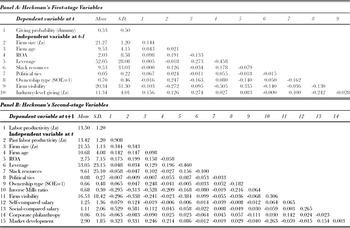
Table 1 reports the descriptive statistics and correlation matrix. Panel A includes the variables used to predict giving probability in the first probit model of the two-stage Heckman process. From Panel A we can see that the mean of giving probability is 0.53, suggesting that 53 percent of the total sampled firms conducted philanthropic giving. As expected, most of the variables are significantly correlated with giving probability.
Descriptive statistics and correlation matrix

Note: N=10,703, correlations ≥ |0.021| are significant at p < 0.05 level.
Note: N=5,525, correlations ≥ |0.027| are significant at p < 0.05 level.
Panel B includes variables used to predict employee responses during the second-stage Heckman analyses. From Panel B corporate philanthropy is significantly but negatively correlated with subsequent labor productivity. We find significant inter-correlations among the independent variables. In order to mitigate the potential multicollinearity problem we mean-center all independent variables included in the interaction terms and then create interaction terms by multiplying the relevant mean-centered variables (Aiken & West, Reference Aiken and West1991; Li, Poppo, & Zhou, Reference Li, Poppo and Zhou2008). We also compute variance inflation factors (VIFs) in order to check the potential multicollinearity problem in the second-stage Heckman estimates. The largest VIF in all models is 7.891, below the cut-off point of 10. This suggests that multicollinearity problem is not serious in this study.
First-Stage Giving Probability Estimates
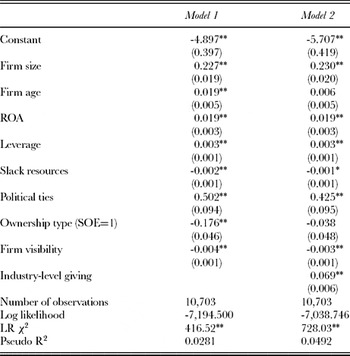
Table 2 reports the results for the first-stage Heckman selection model. In this model the dependent variable is giving probability, a dummy variable with 1 suggesting that a firm made donations and 0 suggesting that the firm did not. Model 1 only includes the control variables and firm visibility, a moderator in the second-stage Heckman analyses that is expected to affect giving probability. In Model 2 we further add industry dummies and industry-level giving that are also expected to affect giving probability.
Probit estimates from a Heckman first-stage sample selection model: Regression of giving probability at t on firm and industry predictors at t-1

Note: *<0.05, **<0.01 (two-tailed). Figures in parentheses are the values of standard errors. Industry dummies were included but not reported here.
From Table 2 we can see that firm size, ROA, leverage, political ties, and industry-level giving are all positively and significantly associated with giving probability, while slack resources and firm visibility are negatively associated with giving probability. The coefficients of firm age and ownership type are not significant.
Second-Stage Labor Productivity Estimates
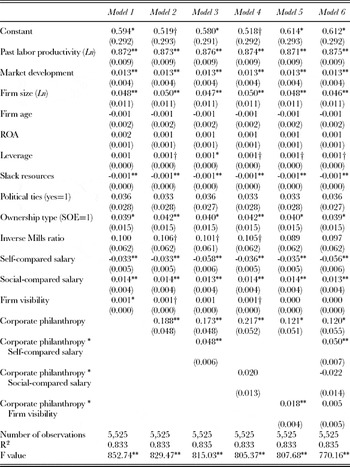
Table 3 reports the results for the second-stage Heckman analyses by using firms with donations as sample. We include the inverse Mills ratio in all models in order to correct for selection bias. Past labor productivity acts as an additional control variable in this analysis.
Estimates for Heckman second-stage employees reaction models: Regression of labor productivity at t+1 on firm and industry predictors at t

Note: † p <0.1, *p < 0.05, **p < 0.01 (two-tailed). Figures in parentheses are the values of standard errors. Industry dummies and year dummies are included in each model.
In Table 3, Model 1 only includes the basic control variables and three moderators including self-compared salary, social-compared salary, and firm visibility. Model 2 adds the explanatory variable CP in order to test its main effect. Models 3 to 5 further test the moderating effect of the above three moderators respectively. Model 6 is the full model including all independent variables as well as the interaction terms between explanatory variables and moderators.
Hypothesis 1 predicts that CP has positive effect on labor productivity. In Model 2 of Table 3 the coefficient of CP is significant and positive (β = 0.188, p < 0.01). This is consistent with our expectations, and Hypothesis 1 is supported.
Hypothesis 2a (or 2b) predicts that self-compared salary (or social-compared salary) strengthens the positive relationship between CP and labor productivity. In Model 3 of Table 3 the coefficient of the interaction term between self-compared salary and CP is positive and significant (β = 0.048, p < 0.01). However, in Model 4 of Table 3 the coefficient of the interaction term between social compared salary and CP is also positive but not significant. Hypothesis 2a is therefore supported while Hypothesis 2b is not supported.
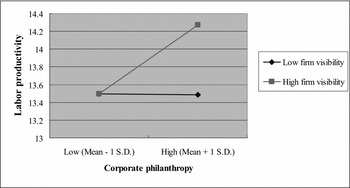
Hypothesis 3 predicts that firm visibility strengthens the positive relationship between CP and labor productivity. In Model 5 of Table 3 the coefficient of the interaction term between firm visibility and CP is positive and significant (β = 0.018, p < 0.01), supporting Hypothesis 3.
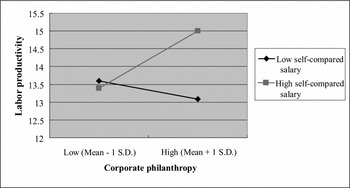
In order to better interpret our results we followed Aiken and West's (Reference Aiken and West1991) approach in plotting the significant interaction effects (see Figures 1 and 2). These figures show that the relationship between corporate philanthropy and labor productivity is more positive at high levels of self-compared salary and firm visibility. For firms with high self-compared salary levels, labor productivity increases by 12.01% as CP increases by one standard deviation. However, for firms with low-self compared salary levels, labor productivity decreases by 3.76% as CP increases by one standard deviation. For firms with high visibility, labor productivity increases by 5.73% as CP increases by one standard deviation. In contrast, for firms with low visibility, labor productivity decreases 0.06% as CP increases by one standard deviation.
Interaction effect between corporate philanthropy and self-compared salary on labor productivity

Interaction effect between corporate philanthropy and firm visibility on labor productivity

DISCUSSION
We investigate the effect of corporate philanthropy (CP) on employee responses in the form of labor productivity, as well as the moderation effect of salary level (both self- and social-compared) and firm visibility using Chinese listed firms during the period 2001 to 2010 as sample. Our results show that CP has a significant and positive effect on labor productivity. We also find that both self-compared salary and firm visibility strengthen the positive relationship between CP and labor productivity. However, the moderating effect of social-compared salary is not supported. This study has significant theoretical and practical implications.
Theoretical Implications
Our study contributes to the literature on both CSR and motivation in the following aspects. First, this study acts as an important step examining the underlying mechanisms linking CP with corporate financial performance from the employee perspective. Although prior studies examine the effect of CSR initiatives on employee subjective responses from the individual level (e.g., Aguilera et al., Reference Aguilera, Rupp, Ganapathi and Williams2006; Brammer et al., Reference Brammer, Millington and Rayton2007; Valentine & Fleischman, Reference Valentine and Fleischman2008), little attention has been paid to CP and its effect on employee objective responses from either an individual or collective level. This study makes up a significant gap existing in the CSR literature by focusing on CP's effect on employee objective responses (highlighted by labor productivity) from a collective level.
Second, this study provides evidence for the social identity perspective of CP. Social identity theory posits that employees seek self-esteem from the firms they serve (Tajfel & Turner, Reference Tajfel, Turner, Austin and Worchel1979; Tyler & Blader, Reference Tyler and Blader2000). CP helps firms build a pro-social image and reputation (Brammer et al., Reference Brammer, Millington and Pavelin2006; Gardberg & Fombrun, Reference Gardberg and Fombrun2006; Godfrey, Reference Godfrey2005) which further increases employee self-esteem. CP Highly visible firms tend to benefit more from CP because it increases employee self-esteem more significantly than it does for firms with lower visibility. These results also offer support for the strategic perspective of corporate philanthropy widely recognized in the existing CSR literature (e.g., McWilliams & Siegel, Reference McWilliams and Siegel2000; Porter & Kramer, Reference Porter and Kramer2002; Saiia, Carroll, & Buchholtz, Reference Saiia, Carroll and Buchholtz2003).
This study also sheds light on the research in motivation. We find first that self- and social-compared salaries have different effects on labor productivity. A relatively higher salary level than industry peers motivates employees to increase labor productivity, while a higher salary relative to historical salary has a negative effect on labor productivity. This is an interesting finding and suggests that studies on monetary incentives should consider this difference. The negative effect of self-compared salary on labor productivity may be attributed to the fact that an increase in salary makes employees more likely to relax and enjoy life without promoting productivity. However, they tend to become more supportive because they feel honored to contribute to society. We also find that monetary incentives (here salary) can coexist with nonmonetary incentives (here CP). This suggests that the crowd-in or crowd-out effect of monetary incentives on nonmonetary incentives is dependent on the type of nonmonetary incentives.
Practical Implications
Despite the above theoretical implications, this study also has significant practical insights. First, the positive effect of CP on labor productivity suggests that business executives could treat CP as a form of incentive. Firms cannot only use monetary incentives such as salary and welfare, (increasing a job's richness and interestingness) to motivate employees, but can also use social incentives such as CP. As more and more people become concerned with CSR and a firm's social position, the motivation effect of CP and other CSR activities on employees should not be overlooked.
Firms with high self-compared salaries are also in a better position to use CP for motivating their employees. However, it is worth noting that a high self-compared salary (or salary growth) tends to have a main negative effect on labor productivity. This negative effect may suggest that for some firms, employee salary has been increased too quickly and overridden its benefits. It also suggests that CP decisions should follow salary decisions. When a high salary growth rate is determined, firms could then consider using CP to motivate their employees. Similarly, firms with high visibility are in a better position to conduct CP in order to motivate their employees. High visibility not only attracts customers, but also enlarges the positive effect of CP on employee self-esteem. This finding suggests that a firm's communication activities could coordinate with CP so as to attract customers and motivate employees simultaneously.
Limitations and Implications for Future Research
Our findings are based the Chinese context. Although China provides us a good field for conducting this study and testing our arguments, some limitations cannot be overlooked. First, CSR is a cultural and social concept, and people in different countries may have different perceptions and attitudes toward it. Although we find that CP has a positive effect on labor productivity, there is no guarantee that we will still find a positive effect in other countries, particularly in less developed countries than China. In more underdeveloped countries employees tend to be miserably paid. They may not support their firms spending a significant amount of money on social goals. Generalizing this study's findings to other countries therefore requires caution. Specifically, we require additional evidence from countries with different cultural and economic environments.
Second, while examine the impact of CP on firm outcomes it is equally important to understand the drivers for CP, particularly in a transition economy such as China. Research in this area has been limited as evidenced by the modest level of explained variance in our first-stage model. On the one hand, firms in China have a high pressure for survival in the market economy and feel less motivated to conduct CP. On the other hand, we do see surging CP activities in China. While our research uses a social identity theory to unravel the underlying mechanisms between CP and labor productivity, it is likely that firm CP in China will be driven by many other factors such as resources and legitimacy within a transition economy. Future research that builds on context-specific arguments from an institution-based and resource-based view will hold promise for a better understanding of CP in China.
Third, although we posit that employees are willing to support firm CP because they benefit from increased self-esteem, we could not exclude alternative mechanisms which link CP to employee support. Prior studies suggest that when employees share values with their companies they are more likely to identify with them (e.g., Kim et al., Reference Kim, Lee, Lee and Kim2010; Rodrigo & Arenas, Reference Rodrigo and Arenas2008). It is therefore possible that CP may increase employee labor productivity through organizational identification or other mechanisms yet to be identified.
Finally, more endeavors are needed to consider other groups of stakeholders beyond employees and their responses to CP in order to discover the underlying mechanisms linking CP with corporate financial performance. Identifying different stakeholders’ responses to CP will help draw a more complete picture demonstrating why CP could boost financial performance. In our study employees’ responses to CP are measured solely by labor productivity. Although labor productivity acts as a good measure of employee reactions to CP, other possible measures such as employee attitudes or morale could be considered in future studies.
CONCLUSION
To unravel the underlying mechanism between CP and firm outcomes, this study develops a social identity theory to argue that the pro-social image and reputation arising from CP promotes employees’ self-esteem, leading to enhanced labor productivity. Our findings further suggest that this increased labor productivity is more evident when employees’ receive a high self-compared salary and when the firm enjoys a high market visibility. The take-away message of our study is that employees as an influential stakeholder group may act as an important factor in realizing the value of CP.