INTRODUCTION
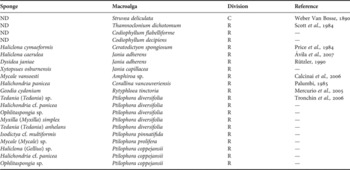
Sponges are a group of invertebrates that can establish symbiotic associations with a wide range of marine organisms (both autotrophs and heterotrophs). Among them, the associations with macroalgae have commonly been reported worldwide (Weber Van Bosse, Reference Weber Van Bosse1890; Scott et al., Reference Scott, Wetherbee and Kraft1982; Palumbi, Reference Palumbi1985; Barthel, Reference Barthel1986; Rützler, Reference Rützler and Rützler1990; Trautman et al., Reference Trautman, Hinde and Borowitzka2000; Carballo & Ávila, Reference Carballo and Ávila2004; Calcinai et al., Reference Calcinai, Cerrano, Totti, Romagnoli and Bavestrello2006; Tronchin et al., Reference Tronchin, Samaai, Anderson and Bolton2006; Wulff, Reference Wulff2006) (Table 1). In most of the sponge–macroalgae associations previously described, the algae belonged to the division Rhodophyta and to a lesser extent to the division Chlorophyta and Heterokontophyta.
List of associations between sponges and macroalgae previously described in the literature and the taxonomic group to which algae belong.

C, Chlorophyta; R, Rhodophyta; ND, not determined.
Associations between sponges and macroalgae are generally more frequent in tropical regions (Trautman & Hinde, Reference Trautman, Hinde and Seckbach2002) and in most of the cases it has been suggested that these organisms obtain mutual benefits from the association (Rützler, Reference Rützler and Rützler1990; Trautman et al., Reference Trautman, Hinde and Borowitzka2000, Reference Trautman, Hinde and Borowitzka2003; Carballo et al., Reference Carballo, Avila, Enríquez and Camacho2006). In some of the sponge–red macroalga associations previously described, it has been demonstrated that sponges, may acquire structural support (Rützler, Reference Rützler and Rützler1990; Trautman et al., Reference Trautman, Hinde and Borowitzka2000; Carballo et al., Reference Carballo, Avila, Enríquez and Camacho2006) and receive organic compounds derived from algal photosynthesis (Davy et al., Reference Davy, Trautman, Borowitzka and Hinde2002). In return, the alga may acquire structural reinforcement against abrasive hydrodynamics (Trautman et al., Reference Trautman, Hinde and Borowitzka2000; Calcinai et al., Reference Calcinai, Cerrano, Totti, Romagnoli and Bavestrello2006; Carballo et al., Reference Carballo, Avila, Enríquez and Camacho2006) and expand their photosynthetic surfaces in order to reduce self-shading and increase their distribution range with depth (Enríquez et al., Reference Enríquez, Carballo and Avila2009). In addition, it has also been documented that the alga may receive nitrogenated compounds from the sponge catabolism (Davy et al., Reference Davy, Trautman, Borowitzka and Hinde2002). These associations may have an important role in nutrient-poor waters such as coral reef ecosystems as they can reach high biomasses (Trautman et al., Reference Trautman, Hinde and Borowitzka2000), and contribute significantly to the net productivity of the system (Wilkinson, Reference Wilkinson1983; Trautman et al., Reference Trautman, Hinde and Borowitzka2000; Davy et al., Reference Davy, Trautman, Borowitzka and Hinde2002).
In the case of associations between sponges and brown seaweeds, most of the studies have focused mainly on taxonomic descriptions (e.g. Mukai, Reference Mukai1971; Withers et al., Reference Withers, Farnham, Lewey, Jephson, Haythorn and Gray1975; Norton & Benson, Reference Norton and Benson1983; Vasquez & Vega, Reference Vasquez, Vega and Figueroa2005), in which sponges were only reported as part of their associated fauna (e.g. in Sargassum and kelp forests).
In the south-western Gulf of California (East Pacific), particularly in La Paz bay, it is common to observe large expanses of Sargassum spp. (Phaeophyceae: Fucales), often attached to the bedrock and pebbles along the intertidal and shallow subtidal areas (McCourt, Reference McCourt1984; Rivera & Scrosati, Reference Rivera and Scrosati2006). In this region, these perennial seaweeds are the dominant component of the macroalgal assemblage, in terms of biomass and coverage (Rivera & Scrosati, Reference Rivera and Scrosati2006). These seaweeds were also identified as critical habitats for conservation because they provide habitat, refuge, and grazing areas for numerous fish and invertebrates (Aburto-Oropeza et al., Reference Aburto-Oropeza, Sala, Paredes, Mendoza and Ballesteros2007). Nevertheless, little attention has been paid to their associated fauna (Suárez-Castillo, Reference Suárez-Castillo2008), particularly to their interactions with sessile invertebrates like sponges, which appear to be one of the most common groups of epibionts on these macroalgae (personal observation).
The aim of this study was to investigate the diversity and abundance of the sponges associated with Sargassum spp. Likewise, it was evaluated whether the inter-annual variation in the abundance of these associations was influenced by environmental variables such as water temperature and salinity, as well as by the density and size of the Sargassum.
MATERIALS AND METHODS
Study area
The study area was located in San Juan de la Costa in the north-western part of La Paz bay (Baja California Sur, Mexico) (Figure 1). Within this area, two localities were selected: Agua de Yepiz: 24°17′29″N–110°38′05″W and Piedras Coloradas: 24°20′49″N–110°40′24″W (approximately 2 km apart). This area contains one of the largest and densest Sargassum beds from the southern Gulf of California, which is mainly composed of the endemic species Sargassum horridum Setchell & Gardner, 1924 and Sargassum lapazeanum Setchell & Gardner, 1924 (Paul-Chavez, Reference Paul-Chávez2005; Rivera & Scrosati, Reference Rivera and Scrosati2006). These seaweeds are distributed at a depth ranging from 0–2.5 m in relation to the approximate low water mark and the seabed is gently sloping with rocky patches and medium size boulders (~10–50 cm) between sandy patches that increase in area until the rocks disappear almost completely between 3 and 4 m depth.
Map of the study area showing the location of the two sampling sites (black filled triangles).

Abundance of the sponge–Sargassum associations
In this study, we considered an association to exist when a sponge was attached to any part of the Sargassum thallus (holdfast, stipe or frond). The abundance of these associations was studied from November 2006 to November 2007 in three depth zones: low intertidal (0–0.5 m depth), shallow subtidal (0.5–1.5 m depth) and low subtidal (1.5–2.5 m depth), which were all within the distribution area of the Sargassum bed. In each depth zone, three 30 m long transects were randomly placed, parallel to the shore, to provide three replicates (separated with a minimum distance of 2 m). Along each transect, five sampling points of 1 × 0.1 m2 (0.05 m2 on each side of transect) were randomly chosen. Later, in each point, all the Sargassum plants were completely cut off below their holdfasts by SCUBA divers. The algae were immediately placed in plastic bags and transported to the laboratory. At each depth, the total sampled area was therefore 1.5 m2. This sampling method was used to avoid removing all the plants along each transect and was repeated 9 times during the study period at Agua de Yepiz (November 2006–November 2007), while at Piedras Coloradas it was repeated 6 times (April 2007–November 2007).
In the laboratory, the sponge–Sargassum spp. associations were separated and counted and their abundance was expressed as the number of associations per square metre. In addition, an average value of abundance was derived for each depth. After these determinations, the specimens were preserved by immersion in 10% formalin for 24 hours and subsequent transfer to 70% ethanol for long term storage. Sponge identification was made by considering the external morphology (colour, texture and shape) and arrangement and dimensions of their skeletal elements. Later, all the specimens were deposited in the Colección de Esponjas of the Instituto de Ciencias del Mar y Limnología, Universidad Nacional Autónoma de México, in Mazatlan, Mexico.
Density and size of Sargassum plants
To determine whether the abundance of the sponge–Sargassum associations was related to the density and size of Sargassum plants, all the plants collected within the sampled area (4.5 m2 per locality) were counted and measured monthly. Density of Sargassum was expressed as number of individuals m−2. The average size was obtained by measuring the distance (in centimetres) from the bottom of the holdfast to the tip of the longest frond.
Sponge species richness inside versus outside the seaweed bed
On a subsequent visit to the study area (June 2008) the sponge species richness (number of species m−2, both epiphytic on Sargassum and non-epiphytic) inside versus outside the Sargassum bed was compared. For this, three replicates of five 1 m2 quadrats were placed parallel to the shoreline and separated by 5 m from each other. The adjacent area (lacking Sargassum) was at the same depth (between 1 and 2 m depth) and the substrate of this site was mostly sandy with small rocky patches.
Environmental parameters
The environmental parameters, water temperature (°C) and salinity (‰) were recorded in the study area. Both were measured monthly at 0.5 m depth from the surface using a mercury thermometer and a refractometer, respectively.
Data analysis
To test whether the abundance of the sponge–Sargassum associations varied through the year and along a depth gradient, a two-way ANOVA was performed (time and depth were random factors), followed by the post-hoc analysis Student–Newman–Keuls test (Underwood, Reference Underwood1997). After verifying normality (Kolmogorov–Smirnov test) and homogeneity of variances (Bartlett test), there were no significant departures from homogeneity. Spearman's rank correlations were used to test whether there were relations between frequency of associations and abiotic variables (water temperature and salinity) and population descriptors of Sargassum (density and size).
RESULTS
Sponge species associated with Sargassum
A total of 12 sponge species were found associated with Sargassum spp. in the study area (nine in the period from November 2006 to November 2007 and another three in June 2008), belonging to 4 orders (4 Haplosclerida, 3 Poecilosclerida, 4 Dictyoceratida and 1 Clathrinida). Of these 12 species, seven were identified to species level (Callyspongia californica Dickinson, 1945; Haliclona caerulea Hechtel, 1965; Haliclona turquoisia de Laubenfels 1954, Hyatella intestinalis Lamark, 1814; Lissodendoryx isodictyalis Carter, 1882; Mycale cecilia de Laubenfels, 1936 and Mycale magniraphidifera van Soest, 1984) while the other five species were only identified to the order level (3 Dictyoceratida, 1 Clathrinida and 1 Haplosclerida).
All 12 species were found at Agua de Yepiz and only two (C. californica and H. turquoisia) at Piedras Coloradas. The number of species showed variation throughout the study period. The highest number of species recorded was in August (8 species) and the lowest from March to May (1 species at both sites) (Figure 2). In all cases, the sponges were found on the Sargassum holdfasts and sometimes extended onto lower portions (<15 cm) of the Sargassum thalli (Figure 3). Occasionally, two or three sponge specimens (of different species or the same species) were observed on the same plant.
Variation in the number of epiphytic sponge species on Sargassum spp. over time in two localities of La Paz bay (Agua de Yepiz and Piedras Coloradas).

Image of the three most frequent sponge–Sargassum associations. (A) Callyspongia californica–Sargassum; (B) Halicona turquoisia–Sargassum; and (C) Halicona caerulea–Sargassum. Scale bar = 1 cm.

Abundance of the sponge–Sargassum associations and sponge species richness
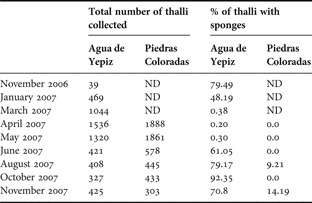
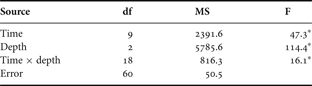
In general, the abundance of the sponge–Sargassum associations was higher in the locality of Agua de Yepiz than in Piedras Coloradas (Figure 4). From a total of 5989 thalli collected at Agua de Yepiz, 24% had sponges attached to them (1451 associations) (Table 2). The dominant sponge species were C. californica (38.4%), H. turquoisia (27.2%) and H. caerulea (13.2%). The frequency for the rest of the species was lower than 10%. In this site, the abundance of the associations varied significantly through time (ANOVA, P < 0.05) and depth (ANOVA, P < 0.05) (Table 3). The highest mean abundance (±SE) of the associations was recorded in the period June to November 2007, with maximum values in August (23.9±2.0 associations m−2) and minimum values in April (0.2±0.0 associations m−2) (Figure 4).
Temporal variation in the abundance of sponge–Sargassum associations at Agua de Yepiz and Piedras Coloradas, from November 2006 to November 2007.

Total number of Sargassum thalli collected monthly during the study period at Agua de Yepiz and Piedras Coloradas and the percentage of them supporting sponges.

ND, no data.
Summary analysis of variance test results for abundance of the sponge–Sargassum associations with time and depth as factors.
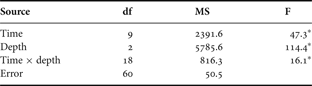
Significance level: *P < 0.05.
At Piedras Coloradas, 5508 thalli were collected, from which only 1.5% had sponges (85% C. californica and 15% H. turquoisia) (Table 2). The abundance of the associations in this site was relatively low and were recorded only in August and November 2007 (3.0±1.7 associations m−2 and 3.2±2.0 associations m−2, respectively) (Figure 4).
Although Sargassum plants were present in the intertidal zone down to approximately 2.5 m below low tide mark, the associations were significantly more frequent below the intertidal zone from 0.5–2.5 m depth. From a total of 1535 associations recorded (at both sites), only 0.79% of them were in the intertidal zone, 50.1% in the low intertidal zone and 49.0% in the shallow subtidal zone.
During the survey in June 2008 in Agua de Yepiz, an average (±SE) of 4.8±1.2 sponge species m−2 were recorded inside the Sargassum bed, whereas in the adjacent area (outside the Sargassum bed) none were found.
Density and size of Sargassum
The average density and size of Sargassum spp. showed a seasonal fluctuation (Figure 5). The values given below are averages for both sites. The highest average density (±SE) was recorded from March to June 2007, peaking in April (380.4±55.3 ind m−2) and the lowest was in November 2006 (4.3±6.1 ind m−2). The largest sizes were recorded in May (90.1±14.1 cm) and the smallest (5.0±7.1 cm) in November (2006) (Figure 5). The smaller sizes (<20 cm) corresponded to the basal holdfast portion, which were generally found from late summer to late winter.
Monthly average density (shaded bars) and size (clear bars) of Sargassum spp. during the study period. The average values of density and size are from the 2 sites. The error bars show the standard error.

The monthly average abundance of the sponge–seaweed associations covaried negatively with density (Spearman's R = –0.71, P < 0.05) and size (Spearman's R = –0.87, P < 0.05) of Sargassum, showing that the abundance was lower when the seaweed was longer than 20 cm and had densities higher than 150 thalli m−2 (Figure 6A). Although this relationship was significant only in the locality of Agua de Yepiz, a similar tendency was observed in Piedras Coloradas (Figure 6B).
(A) Relationships between the abundance of associations and the average density (continuous line, white circles, R =−0.71, P < 0.05) and size (discontinuous line, black circles, R =−0.87, P < 0.05) of Sargassum spp. in Agua de Yepiz; (B) relationships between the abundance of associations and the average density (continuous line, white circles, R =−0.68, P > 0.05) and size (discontinuous line, black circles, R =−0.99, P > 0.05) of Sargassum spp. in Piedras Coloradas.

A significant negative relationship was also found between the number of sponge species recorded monthly and the average size of Sargassum (Spearman R = –0.75, P < 0.05) (Figure 7A). A similar inverse tendency (but no significant) was observed between the number of sponge species and the density (Spearman R = –0.53, P > 0.05) of Sargassum (Figure 7B). These relationships were only obtained for the site of Agua de Yepiz.
Negative linear relationships between the number of sponge species and the: (A) average density (R =−0.53, P > 0.05); and (B) size (R =−0.75, P < 0.05) of Sargassum spp. in Agua de Yepiz.

Environmental variables
Monthly average water temperature values showed a seasonal fluctuation with maximum values from August to October 2007 (30°C) and a minimum in December 2006 (20°C) (Figure 8). Salinity values showed a slight variation over time, which fluctuated between 32‰ in August (minimum value; coinciding with the rainy season) and 36‰ in November 2007 (maximum value) (Figure 8).
Temporal variation of surface seawater temperature (°C) and salinity (‰) during the study period.

DISCUSSION
Most of the sponge species recorded in this study (Callyspongia californica, Haliclona caerulea, Haliclona turquoisia, Hyatella intestinalis, Lissodendoryx isodictyalis, Mycale cecilia and Mycale magniraphidifera) had already been reported previously in rocky subtidal habitats from the south-eastern Gulf of California (Mazatlan bay, Mexico) (Carballo et al., Reference Carballo, Vega, Cruz-Barraza, Yañez, Nava, Ávila and Wilson2008a). Nevertheless, this is the first time that these species have been studied and reported in association with Sargassum spp. The three most abundant sponge species (C. californica, H. turquoisia and H. caerulea) that were found in association with the Sargassum spp. belong to the order Haplosclerida. In fact, it has been suggested that most sponges that establish associations with other taxa belong to this order (Avila et al., Reference Ávila, Carballo, Cruz-Barraza, Custódio, Hajdu, Lôbo-Hajdu and Muricy2007). However, we could not identify some of the species due to the lack of modern taxonomic keys, as compared to those available for boring sponges (Carballo et al., Reference Carballo, Cruz-Barraza, Nava and Bautista-Guerrero2008b).
In all the sponge–Sargassum spp. associations, the sponges were largely confined to the older proximal parts of the seaweed, mainly on their holdfasts, as has been reported for other encrusting filter feeding organisms in other parts of the world (Withers et al., Reference Withers, Farnham, Lewey, Jephson, Haythorn and Gray1975; Leite et al., Reference Leite, Tanaka and Gebara2007; Blight & Thompson, Reference Blight and Thompson2008). Their presence on the holdfasts could be because this part of brown seaweeds has a complex three-dimensional structure which provides a habitat and shelter from predation and wave impact for a great diversity of organisms (Andrews, Reference Andrews1945; Ghelardi, Reference Ghelardi and North1971; Wigham, Reference Wigham1975; Moore, Reference Moore1978; Cancino & Santelices, Reference Cancino, Santelices and Levring1981; Ojeda & Santelices, Reference Ojeda and Santelices1984). Furthermore, many of these perennial holdfasts remain attached to the substrate after natural thallus fragmentation (Rivera & Scrosati, Reference Rivera and Scrosati2006), thereby increasing the chance that larvae of sessile invertebrates will colonize these live substrates (Goodsell & Connell, Reference Goodsell and Connell2008). It is possible that the sponge–Sargassum associations resulted from selective larval settlement, since it is known that larvae of many marine invertebrates can locate and settle selectively in physical microrefuges (Maldonado & Uriz, Reference Maldonado and Uriz1998; Avila & Carballo, Reference Ávila and Carballo2006). The entangled Sargassum holdfasts would offer such a suitable physical environment for sponge larval settlement. Sometimes two or more small sponges were observed attached to a single Sargassum holdfast (generally in those larger than 3 cm diameter), which possibly originated through selective larval settlement.
It has been established that in most of the associations between sponges and red macroalgae, the sponges benefit by obtaining some kind of protection from their host against environmental factors (e.g. fish predation, sedimentation or hydrodynamism) (Wulff, Reference Wulff1997, Reference Wulff2006; Trautman et al., Reference Trautman, Hinde and Borowitzka2000; Carballo & Avila, 2004; Avila et al., Reference Ávila, Carballo, Cruz-Barraza, Custódio, Hajdu, Lôbo-Hajdu and Muricy2007); however, they may also be obtaining nutritional benefits (Davy et al., Reference Davy, Trautman, Borowitzka and Hinde2002). Therefore, it is possible that the epiphytic sponges in this study were also obtaining some other benefit of being associated with Sargassum, besides substratum and protection. Interestingly, H. caerulea was almost always found associated with a red calcareous macroalga as well as being attached to Sargassum. This sponge–red seaweed association has been reported in other localities of the Mexican coasts (Atlantic and Pacific) and on the Pacific coasts of Panama (Wulff, Reference Wulff1997; Avila et al., Reference Ávila, Carballo, Cruz-Barraza, Custódio, Hajdu, Lôbo-Hajdu and Muricy2007).
In general, the occurrence of the sponge–seaweed associations in the study area was high and showed significant variations throughout the year, between localities and along a depth gradient. Contrary to expectations, the presence of epiphytic sponges was lower during the period of higher density of Sargassum (from March to May). Several studies have revealed that the habitat complexity is an important factor in determining patterns of abundance and diversity of many marine organisms (e.g. Stoner & Lewis, Reference Stoner and Lewis1985; Hacker & Steneck, Reference Hacker and Steneck1990; Taniguchi et al., Reference Taniguchi, Nakano and Tokeshi2003). Also, the relationship between habitat complexity and species diversity has often been attributed to a surface area effect, as more complex habitats generally also have a greater surface area to support a larger number of species (Hauser et al., Reference Hauser, Attrill and Cotton2006). In this case, although the habitat complexity (more Sargassum thalli per unit area) increased from March to June, the diversity and abundance of epiphytic sponges decreased considerably. It is possible that other factors such as competition for space and predation increased in this period and could act in detriment of the sponge abundance (Martin-Smith, Reference Martin-Smith1993).
A similar negative relationship was documented between the biomass of Sargassum cymosum C. Agardh 1820 and the abundance of its associated fauna at Lamberto's Beach, Brazil (Leite & Turra, Reference Leite and Turra2003). These authors attributed this inverse pattern to an increase in the abundance of Hypnea epiphytism, which reduced the surface available to other epibionts (Leite & Turra, Reference Leite and Turra2003). Other studies have documented that some Sargassum species (S. natans and S. muticum) can reduce the epiphyte load by means of production of tannin-like substances during their growth stage (Conover & Sieburth, Reference Conover and Sieburth1964; Withers et al., Reference Withers, Farnham, Lewey, Jephson, Haythorn and Gray1975; Jephson & Gray, Reference Jephson, Gray, Keegan, Ceidigh and Boaden1977). These substances, produced on the distal growing tips of the algae, inhibit the development of surface microflora, which is considered a necessary prerequisite for the settlement of epiphytic fauna (Martinez-Nadal et al., Reference Martinez-Nadal, Rodriguez and Casillas1965; Sieburth & Conover, Reference Sieburth and Conover1965; Ryland, Reference Ryland1974), and may be significant in determining the epibiont abundance and species richness (Blight & Thompson, Reference Blight and Thompson2008).
Other studies have revealed that these substances are produced seasonally (during the growth period of the alga) and serve as chemical defences against herbivory (Gorham & Lewey, Reference Gorham and Lewey1984; Steinberg, Reference Steinberg1986). In addition, it is known that its concentration may vary between tropical and temperate Sargassum species (Steinberg, Reference Steinberg1986). Therefore, one possible explanation of the increases in sponge abundance from June to November could be attributed, among other factors (e.g. sponge recruitment), to a reduction in compounds production by Sargassum spp. A similar temporal pattern was also documented in S. sinicola, S. pteropleuron and Sargassum sp., in which a greater percentage of epiphytism occurred after the plants had reached their maximum length (Prince & O'Neal, Reference Prince and O'Neal1979; Ang, Reference Ang1985; Espinoza & Rodríguez, Reference Espinoza and Rodriguez1989). It has been reported that epiphytism in S. muticum and S. sinicola starts on the basal parts, possibly because some kind of antibiotic effect is lower in those parts, in comparison to apical parts (Jephson & Gray, Reference Jephson, Gray, Keegan, Ceidigh and Boaden1977). Other studies have suggested that low epibiont density within some areas of the Sargasso Sea may be nutrient limited, rather than limited by the antibiotic activity of Sargassum exudates (Carpenter & Cox, Reference Carpenter and Cox1974). Future studies are needed to assess whether the Sargassum species in the study presented here (S. lapazeanum and S. horridum) release polyphenolic compounds that affect sponge epiphytism.
Likewise, the possibility that the high density of Sargassum plants may negatively affect water movement is not discarded, light penetration, sediment accumulation, and anoxia at night as has been suggested in S. muticum (Osborn, Reference Osborn1999).
The variations in abundance of associations through the year might also be related to changes in environmental conditions such as water temperature and sedimentation rate (Gerrodette & Flechsig, Reference Gerrodette and Flechsig1979; Barthel, Reference Barthel, Klekowski, Styczynska-Jurewicz and Falkowski1989; Carballo & Avila, 2004). For example, the rise in water temperature by 4°C between late winter and early summer coincided with a decrease in the frequency of the associations. Previous studies have documented that seasonal fluctuations in water temperature may positively or negatively affect aspects such as growth rate, sexual reproduction and abundance of sponges (Frost et al., Reference Frost, De Nagy and Gilbert1982; Carballo & Avila, 2004). Nevertheless, in the case of Sargassum, increases in water temperature may favour its growth rate (Ray-Lien et al., Reference Ray-Lien, Chuan-Chuan and Tse-Min2004).
The sediment regime is another important factor that must be considered when studying organisms associated with seaweed holdfasts (Moore, Reference Moore1971; Smith, Reference Smith1996). The presence of sediment in these structures may increase faunal diversity through increasing habitat diversity (McQuaid & Dower, Reference McQuaid and Dower1990), but on the other hand, high deposition rates of sediment may result in the exclusion of some taxa or functional groups (Gray, Reference Gray1981). Although the sedimentation rate was not measured in this study, it is possible that differences in the abundance of the associations between localities were related to sedimentation. Our field observations support this theory because during almost the whole study in the locality of Piedras Coloradas, a thin layer of fine sand was observed covering the bedrock where Sargassum was distributed. This layer of sediment was more evident after the passing of Hurricane Paul in late October 2006 and could have buried the epibionts attached to the lower parts of the plants and/or prevented the settlement of new ones (Maldonado et al., Reference Maldonado, Giraud and Carmona2008).
In the study areas, the sponge community was restricted to the Sargassum habitat because outside it (>3 m depth) the hard substratum was almost completely absent and there were no sponges. Outside the Sargassum bed the substratum was sandy. Others have also suggested that the absence of hard substrata for attachment is one of the main limiting factors that explain the spatial distribution of other sponge–macroalga associations (Trautman et al., Reference Trautman, Hinde and Borowitzka2003; Carballo et al., Reference Carballo, Avila, Enríquez and Camacho2006). Nevertheless, in shallower water (from 0–0.5 m), the lower frequency of the associations could be related to the action of waves (Wilkinson & Evans, Reference Wilkinson and Evans1989). These results, therefore, support prior studies which established that these macroalgal habitats represent critical environments for several marine organisms (Kingsford & Choat, Reference Kingsford and Choat1985; Coston-Clements et al., Reference Coston-Clements, Settle, Hoss and Cross1991).
The sponge richness reported in June 2008 in this seaweed habitat (4.8 species m−2) was higher than those reported in a rocky subtidal habitat in Mazatlan bay (in the south-eastern Gulf of California), which ranged from 0.2–0.6 species m−2 depending on the time of year (Carballo et al., Reference Carballo, Vega, Cruz-Barraza, Yañez, Nava, Ávila and Wilson2008a). However, the values given by these authors correspond to a very specific habitat, the upper surface of the rocks, and it is known that in this same locality that lower boulder surfaces (4.3 species m−2; Bell & Carballo, Reference Bell and Carballo2008) and vertical walls usually have higher sponge species richness (Padilla-Verdín, Reference Padilla-Verdín2007). These differences in species richness can probably be attributed to the presence of Sargassum structures, which offer high habitat diversity as well as an increase in available surface area for epibiont settlement. In kelp habitats (e.g. Macrocystis pyrifera from southern Chile), it has been demonstrated that the biomass of the invertebrate fauna inhabiting holdfasts increases with the size of these structures (Ojeda & Santelices, Reference Ojeda and Santelices1984).
In this preliminary study, besides making a contribution to the knowledge of the overall biodiversity of the south-western Gulf of California, it was determined that Sargassum beds constitute an important habitat for the subtidal sponge community from this region. There, the associated sponges were largely confined to the lower portions of these seaweeds and their occurrence showed significant temporal and spatial variations. Future studies will likely be aimed at better understanding the dynamics of these sponge–brown seaweed interactions. It would be interesting to study the role that sponges play in the seaweed habitat, whether these endemic Sargassum species really release tannins that affect the epiphytic sponges, and to make an in-depth study to investigate the kind of relationship that the sponges and Sargassum establish.
ACKNOWLEDGEMENTS
This research was supported by the project ‘Sargassum forest associated Biodiversity from the Gulf of California’ developed by the Departamento de Biología Marina, Universidad Autónoma de Baja California Sur and the Centro Interdisciplinario de Ciencias Marinas (CICIMAR, IPN) funded by the Natural Geography In Shore Areas (NaGISA). E. Ávila is grateful to the Consejo Nacional de Ciencia y Tecnología (CONACyT) for a Postdoctoral Fellowship. We thank J.L. Carballo and J.A. Cruz-Barraza (UA Mazatlan, Instituto de Ciencias del Mar y Limnología) for advice on the taxonomy of the sponge species studied and D Seage for his English review and editing of the manuscript.